Feeds:
Posts
Comments

Archive for the ‘philosophy’ Category

tele bird

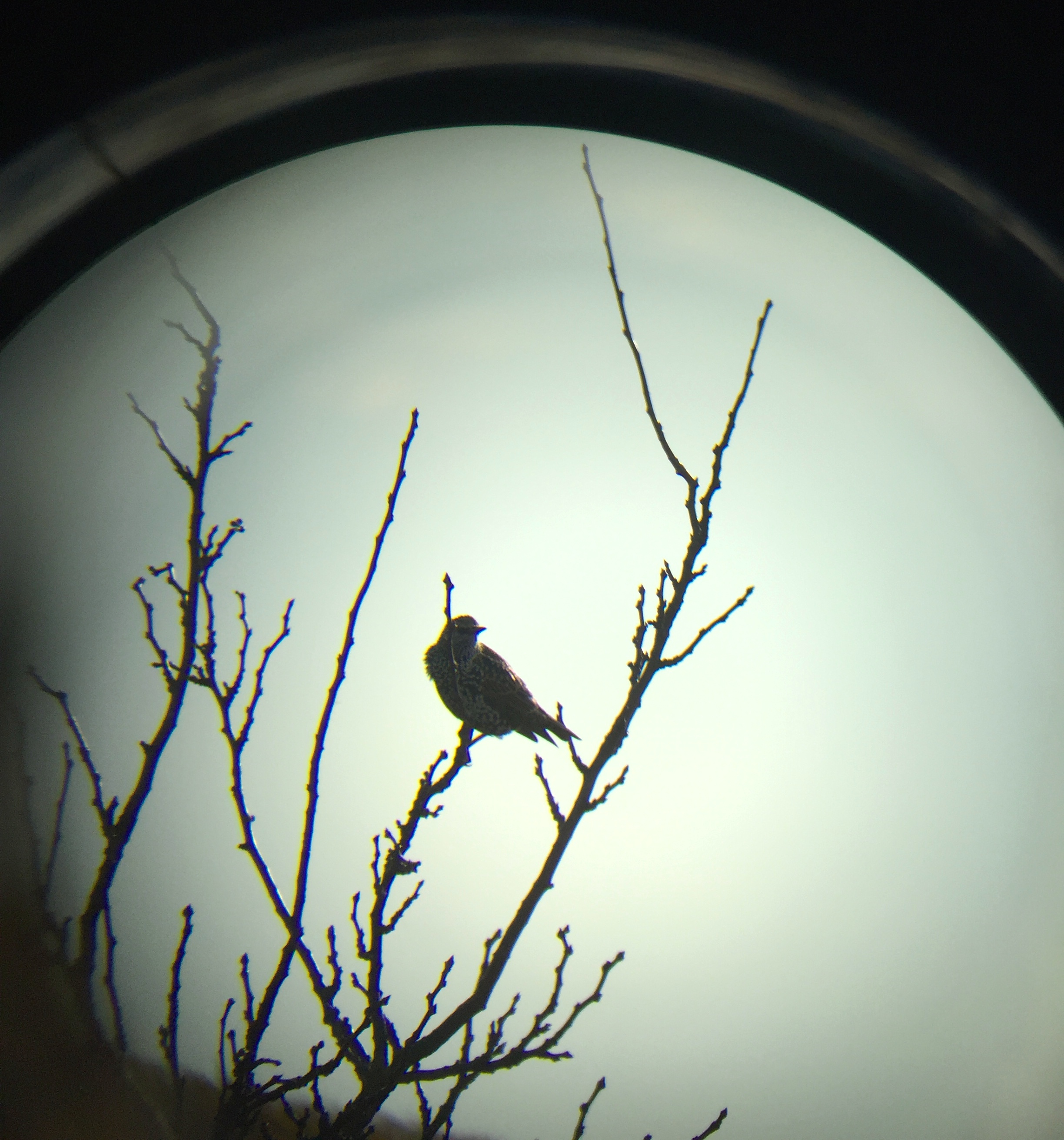
I looked out of my study window yesterday and could see a bird sitting on the tree in the corner of the nearest vineyard. I couldn’t make out much more than it was a bird so I pointed my telescope at it, zoomed in, and saw it clearly. Covered in speckles. A thrush I guess.

Just for fun I held my camera up to the eyepiece of the telescope and got this shot.

I quite like it! It’s got almost a vintage feel to it.

It got me thinking of the way we look at things.

We focus in on parts of reality to try to clarify what we are looking at. We do that all the time. We might focus on certain parts of what we see and hear because they catch our attention, spike our curiosity or whatever. If we weren’t able to do that how could we make sense of our world? Our brains are receiving information from the external world (and at the same time from our inner bodily world) through our senses of sight, hearing, taste, smell and touch. How could we make sense of this information tsunami if we didn’t sift, select, and focus? Our left hemisphere is especially good at doing this. It’s no coincidence that the left hemisphere controls the right hand and that’s the hand most of us use to “grasp” things. That’s what this focus-ability does for us. It helps us to grasp things.

But I think it does something else too. It frames and it excludes. It sets whatever it is we are paying attention to not just centre stage, but often fills the entire stage. I’m not sure it’s helpful to think of these skills are either “good” or “bad”. They just have advantages and disadvantages. The major disadvantage is that this framing removes the object of our attention from its context. So unless we take the results of our grasping and let go off them as we pass them back to the right hemisphere for re-contextualising, then we form incomplete and, actually, imprecise understandings of things.

Funny that, really. You’d think we could be more precise by being more focused. Turns out focus is only part of the process. We need the context too.

Here’s a crop of that photo above to let you see the thrush a bit more like it was when I put my eye to the telescope.
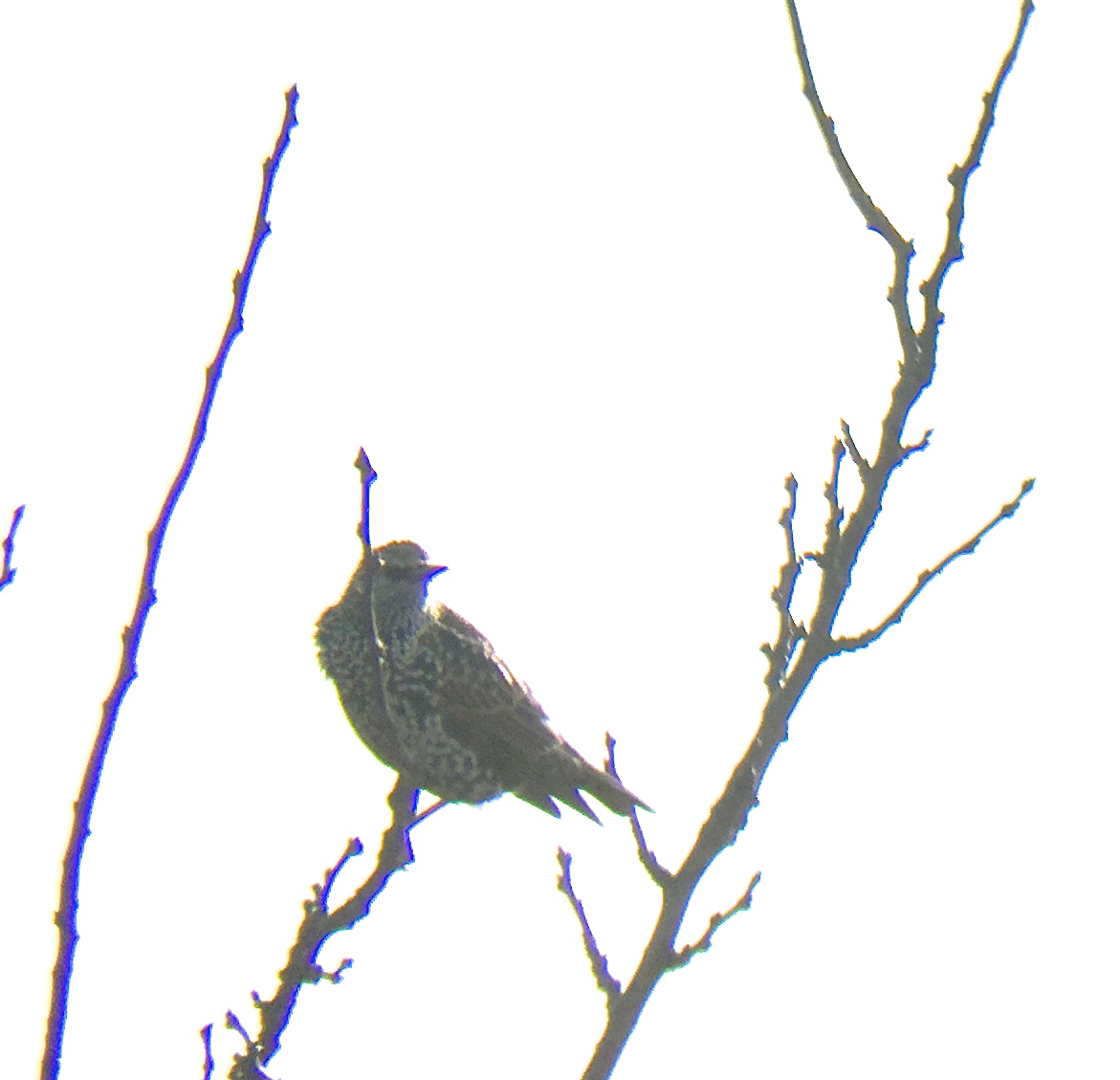
crop thrush


Read Full Post »

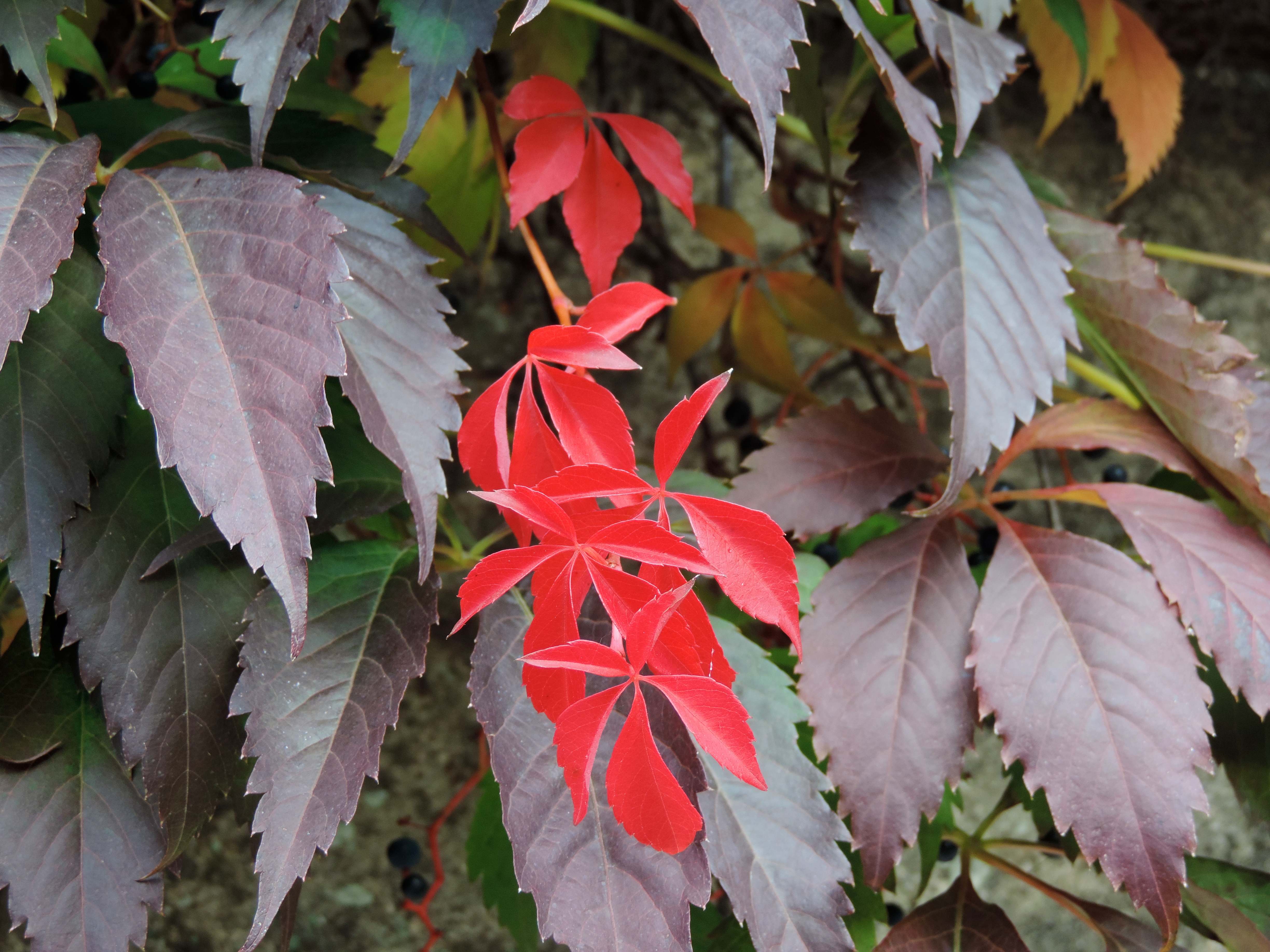
berries

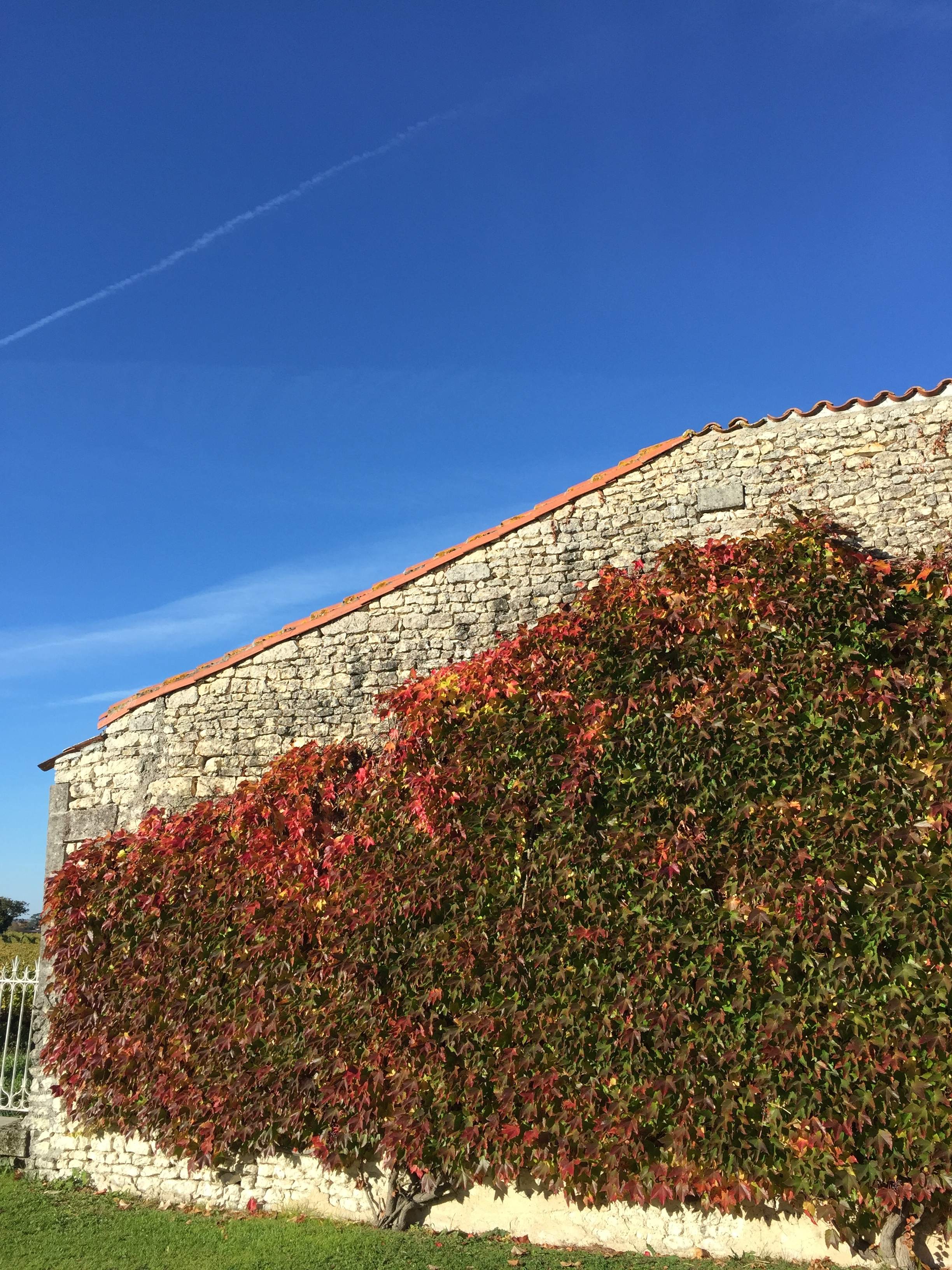
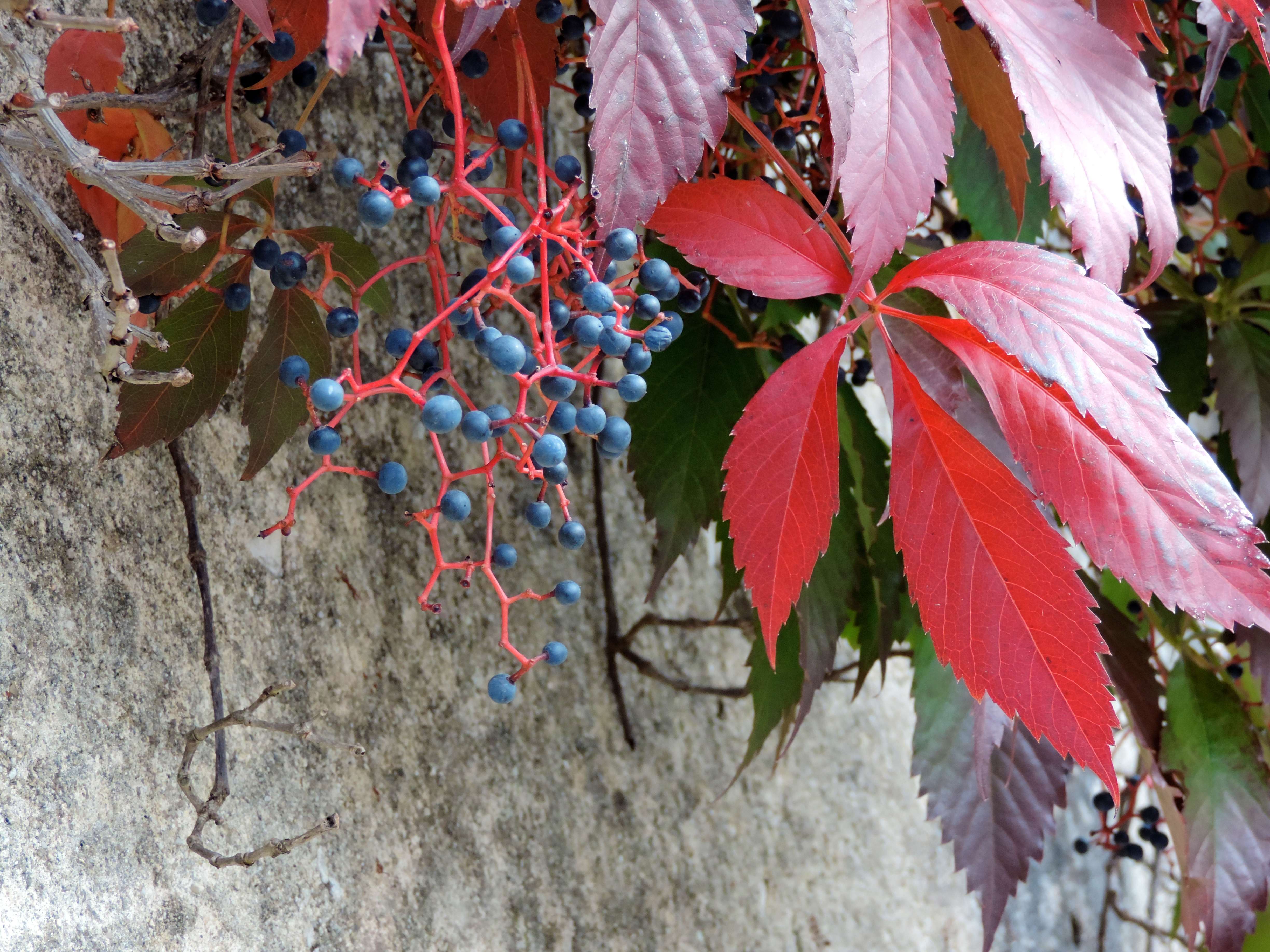
At this time of year the Vinge-viérge, (Boston Ivy, or, Japanese Ivy) that grows over the wall at the edge of my garden develops these incredible little blue-black berried on red stems as the leaves around them turn their own glorious shades of red.

wall

It’s a big plant and for most of the year it is full of the rustling sounds of birds. Just now there are warblers and finches and sparrows and redstarts all flying in and out of the dense foliage. That came to mind as I read the following passage from Robert Brady’s The Big Elsewhere. Here he is reflecting on the birds flying into the trees for shelter during a snowstorm.

Who knows what forms of natural “friendship” abide out there in the deeps of the real world, how far these homely allegiances go, and where they integrate like two hands clasping.

Don’t you love that? “Like two hands clasping”

Or how far back in time they reach, how they began to be – seems as much an interweaving of wild wisdom as a mosaic of chance that worked out well. Compromises were made, benefits were exchanged.

That reminded me of the biology teacher’s question about whether or not the students loved Nature and whether or not they thought that Nature loved them back.

Doesn’t it seem that we are surrounded with the evidence of “an interweaving of wild wisdom”?

…..and there at the hearts of the trees the birds can enjoy the quiet that abides in a plant, and in exchange for the gift of the motion that abides in a bird; plants seem to appreciate rhythms of all kinds – they dance with grace and beauty in the wind…

Oh I love that. The mutual appreciation of stillness and motion.

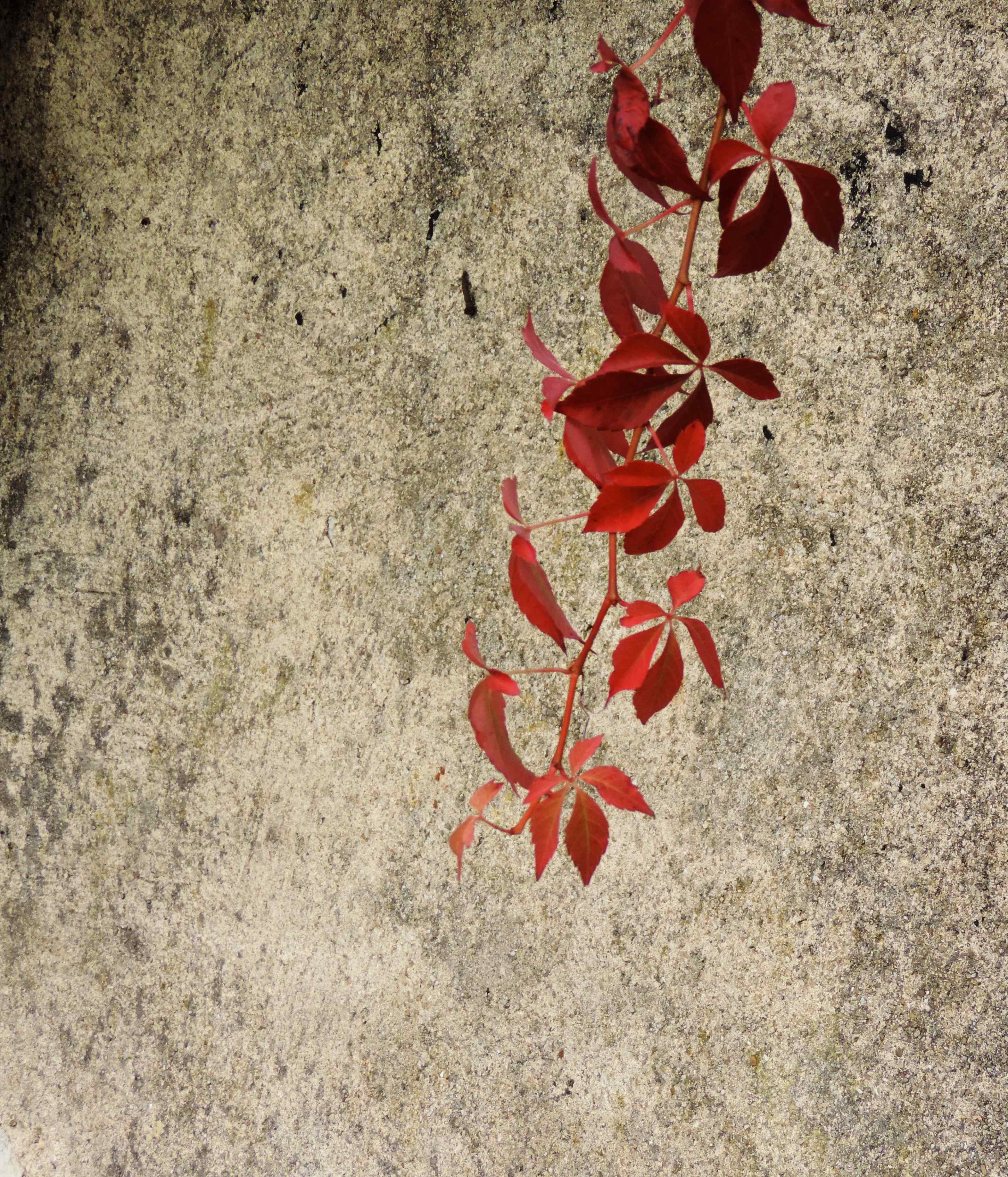
Talking about grace and beauty, here’s another couple of photos of the ivy –

splash of red

This one reminds me of how everything changes but each individual changes at his or her own speed and rhythm.

simple

And this image reminds me of the “Japanese Ivy” version of the name of this plant.


Read Full Post »

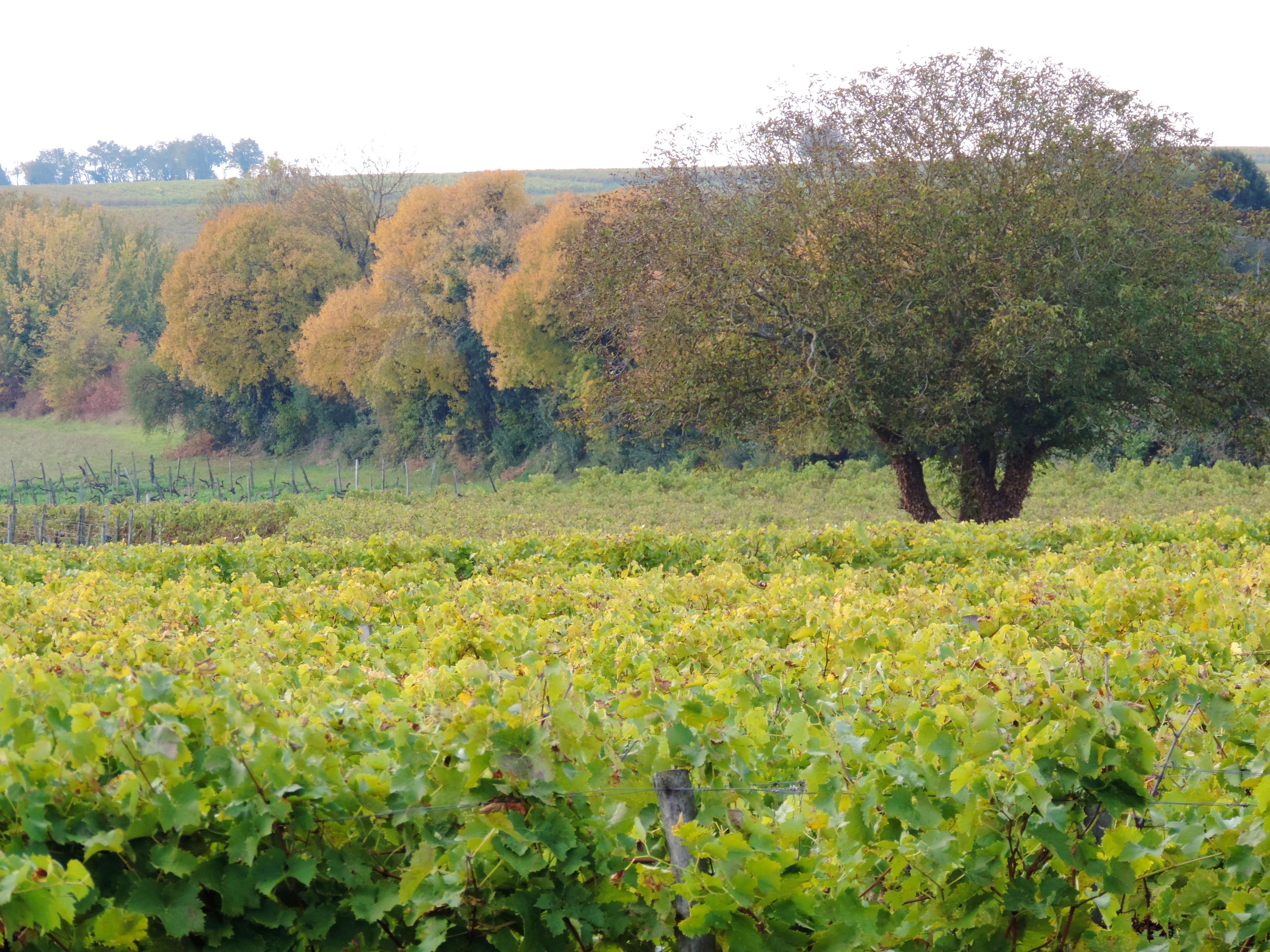
vineyard early autumn

In his “The Big Elsewhere”, Robert Brady after building a dry stone wall, says

…that any worthy effort is a dialog, that wisdom is a living thing, not frozen in time, not a doctrine or a dogma, not a monument, not a library, not a printed book or ether page, and that you are born with wisdom ready and waiting to be known to you.

So true….that we are never done learning, never complete in our knowledge. That should keep us humble, and teach us to live with uncertainty, and be a constant stimulus to our curiosity. When he says “…you are born with wisdom ready and waiting to be known to you”, then I recall Elizabeth Gilbert, from her “Big Magic” 

The universe buries strange jewels deep within us all, and then stands back to see if we can find them. The hunt to uncover those jewels – that’s creative living.

But it also sets me up to hear Bob Brady’s next point –

What does living wisdom tell us? Amongst other things, that the solution is where the problems are: in ourselves.

After the best part of forty years working as a doctor with each day filled with one to one consultations with patients I’m more convinced than ever that the only healing which ever occurs comes from within the individual. Each of us is unique and as “complex adaptive systems” we are self-healing. Good medicine is what supports the personal, unique wisdom of the organism.

Prolonged lack of contact with that wisdom lies at the heart of our problem, and if we continue in our current way we are ended: the real thing won’t stand for it. Existence must be a dialog with the present, as the living, thinking person is taught by any art, any worthy endeavour. You are instructed and guided by the very task, the very ongoing. You are taught the true way most truly only by traveling it, not by standing still and listening to others tell you the way, or by looking at an old map of where others have gone.

I think we gloss over the fact that we are adaptive creatures. We are constantly adapting. We are “open systems” continuously picking up energy, information and molecules from the environments in which we live and adapting our whole being to the changes. We are dynamic creatures, never fixed, never static, constantly learning, developing and growing. The only way to learn to live is to learn by living!

Bob Brady goes on to distinguish dead from living wisdom –

Dead wisdom obviates dialog by saying: “Do it this way because we have always done it this way.” Dead wisdom souls a dead society. Living wisdom, on the other hand, like all that is ongoing, is always and ever new. Living wisdom is green, the green of grass, the green of leaf, green of the living layer beneath the bark of a tree. It is the green youth and hope in hearts that are alive.

Tradition, dogma and “evidence” can all become “dead wisdom”, because they can all claim a certainty which will ultimately turn out to be at best incomplete, and at worse false.

Living wisdom is “always and ever new”.

You’ll learn it today.

Read Full Post »

Yesterday I wrote about the experience of following your curiosity when something catches your eye.

Today I want to share with you some photos I took deliberately.

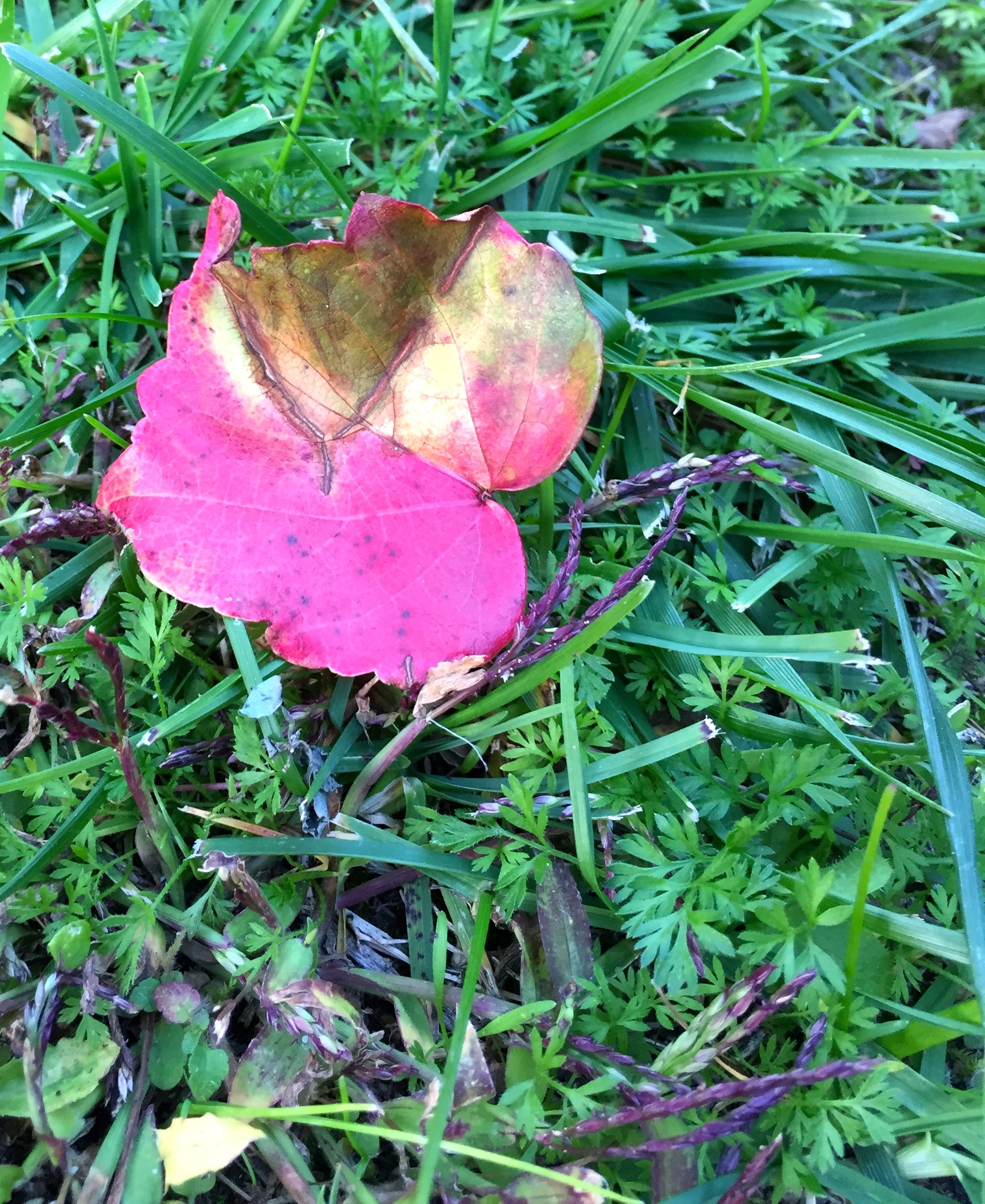
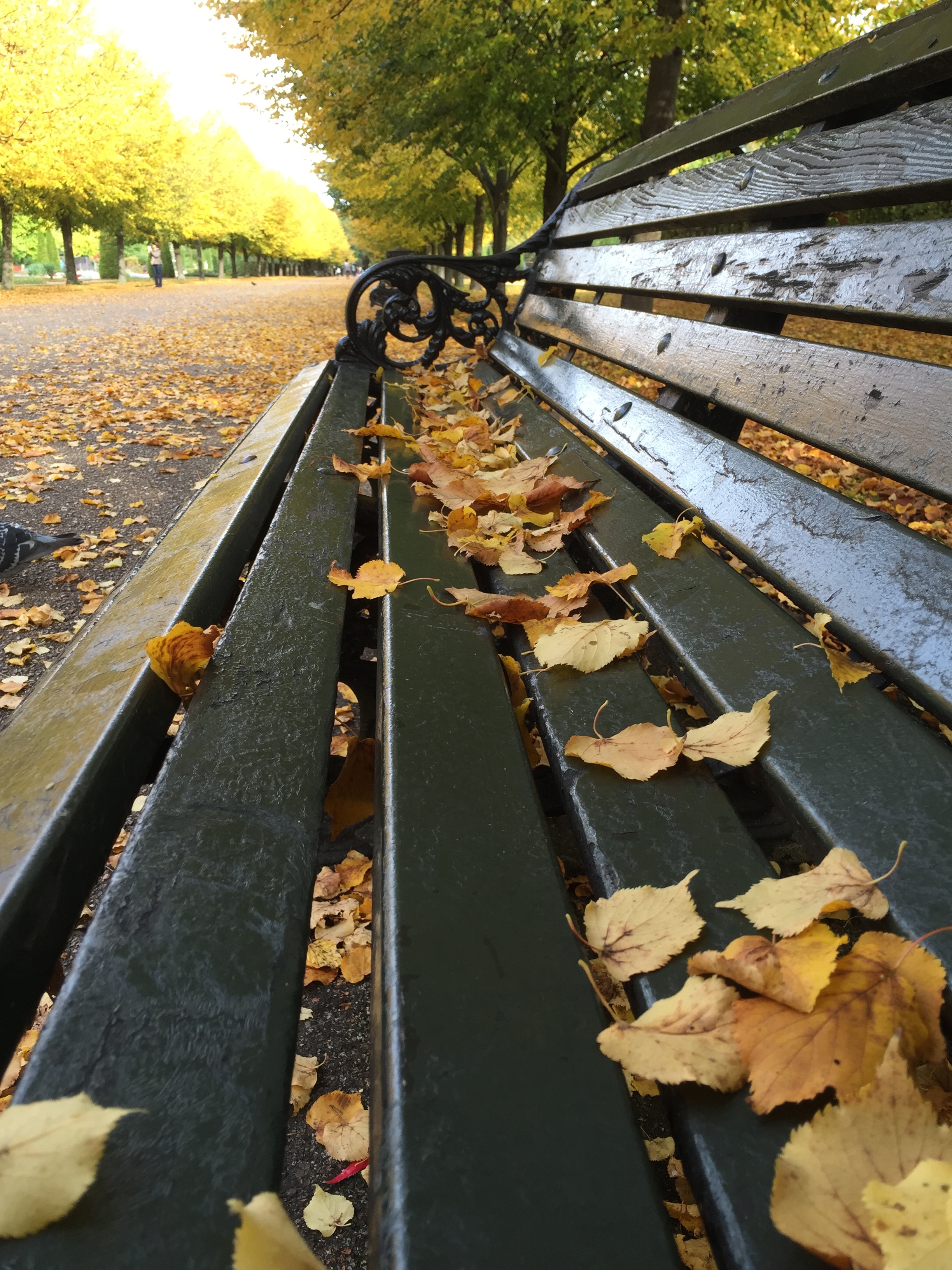
I love this time of year. I love when the leaves start to develop their rich and different colours then just begin to fall to the ground. I noticed a few lying on the grass so I went out to look for a red one first.

red leaf

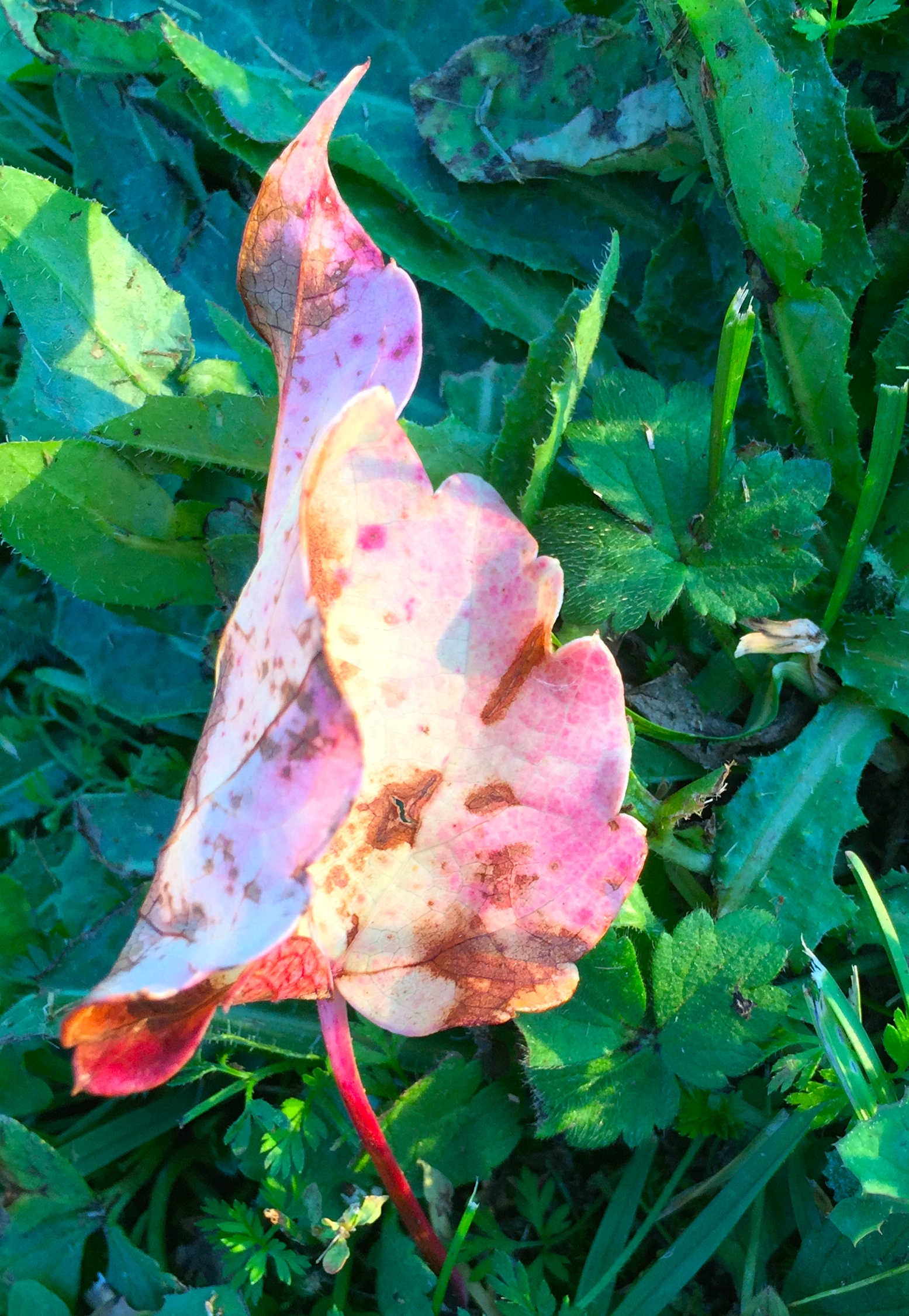
Already in its redness I could see hues of pink and decided to look for a pink one next.

pink

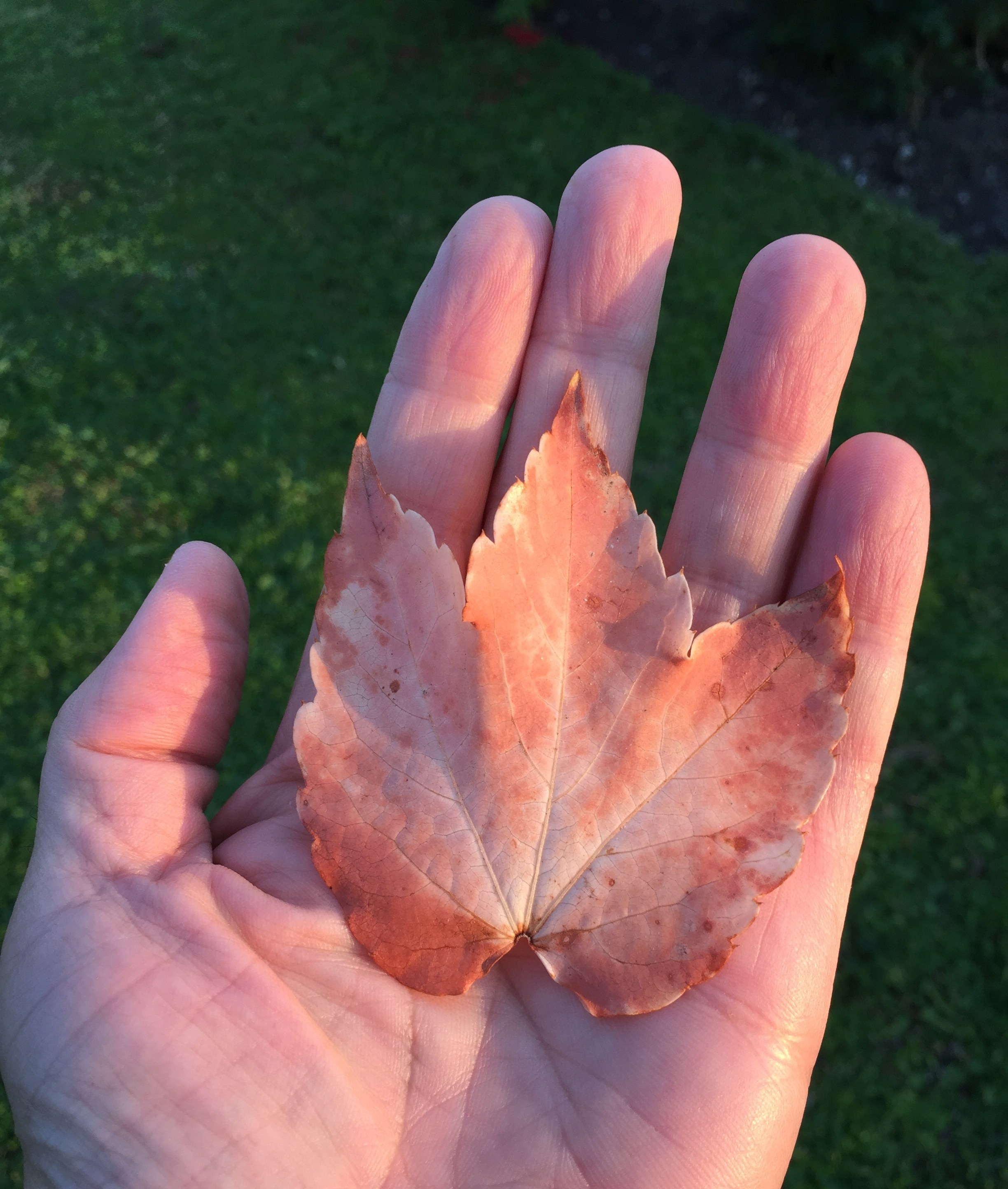
Within the pink leaf I thought there was a suggestion of something close to the colour of the palm of my hand.

flesh

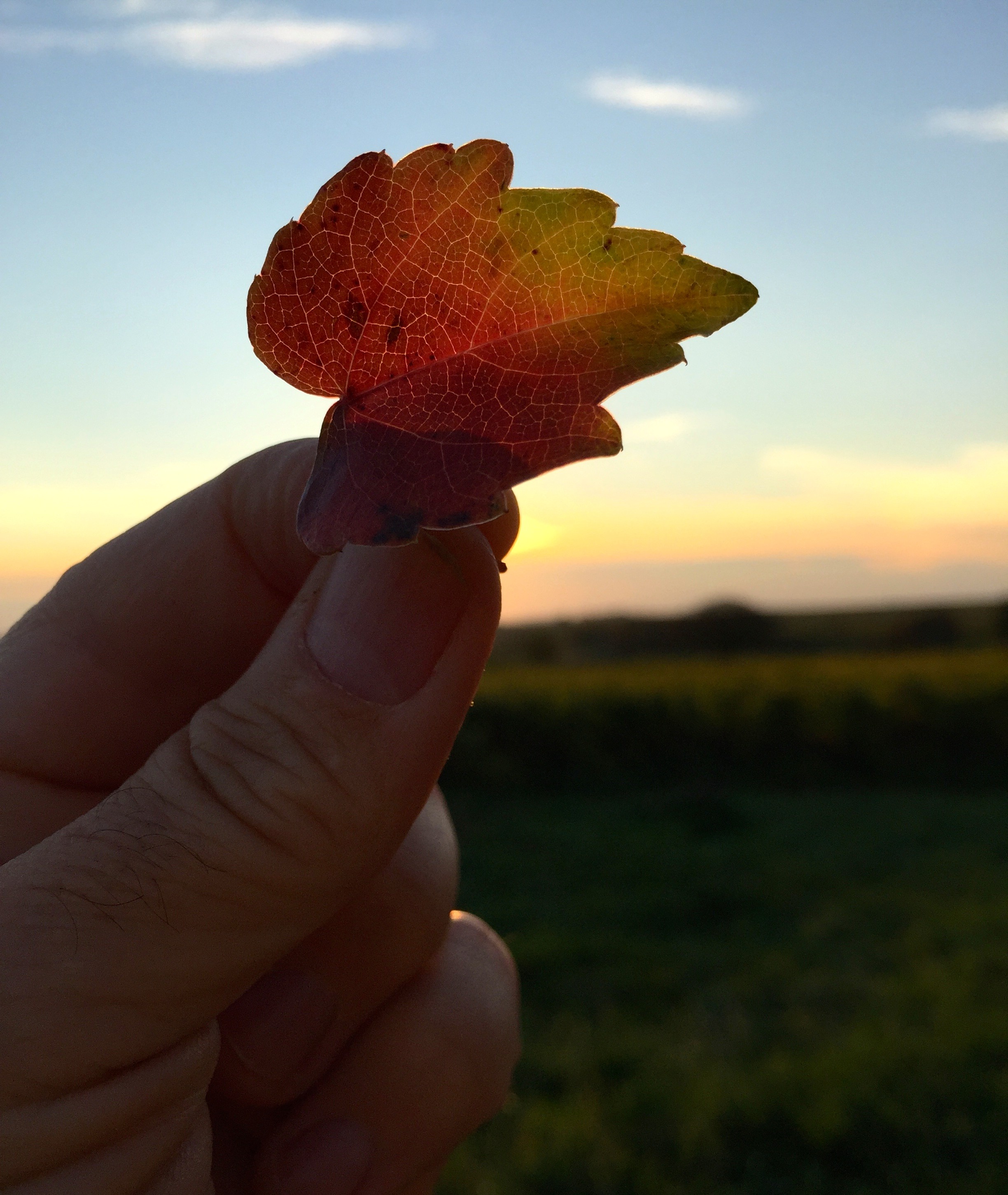
Then I found one which made me think of the world around me as the sun began to set. So I held it up in front of the sun, capturing its full glow.

sunset leaf

Wow! You can have a lot of fun looking for diversity at this time of year. So many different colours. So many different patterns. Every one of them unique.

Read Full Post »

That’s a funny phrase don’t you think – “eye catching”?

How can something “catch” your eye?

But it does, doesn’t it? I do think you can observe with intent. I’ll write a post about that tomorrow, but today I’d like to share what happened yesterday evening.

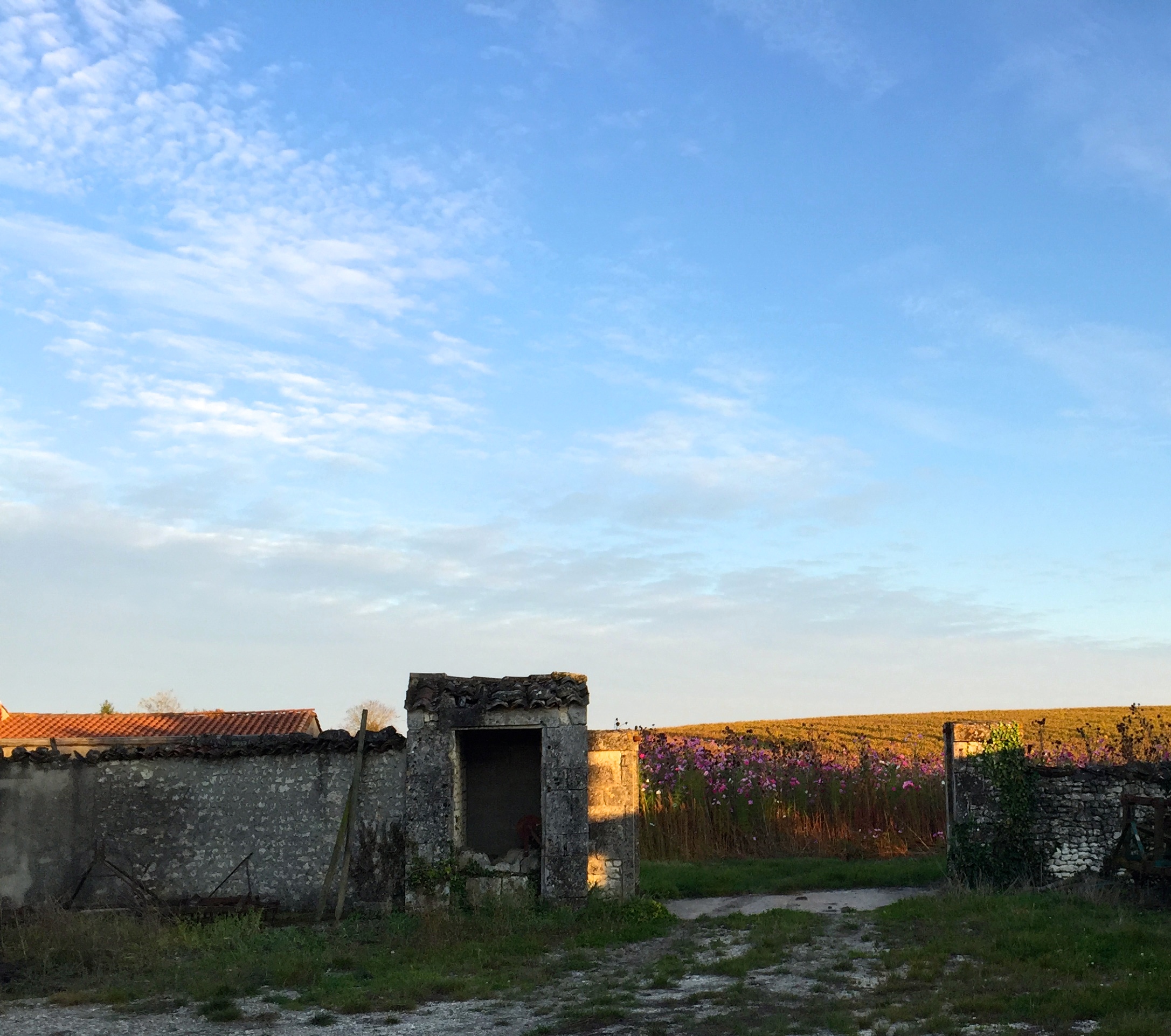
Every other monday evening I take a yellow bag of papers, tins, plastics and so on for recycling, along our little road a couple of hundred yards to the collection point for the pick up on the tuesday morning. I’ve done that every fortnight for this last year but as I turned to walk back home last night something caught my eye – something just in the corner of my eye –

the yard

Can you see? Just to the right of the old well….something in the field. I went closer to have a look.

flower field

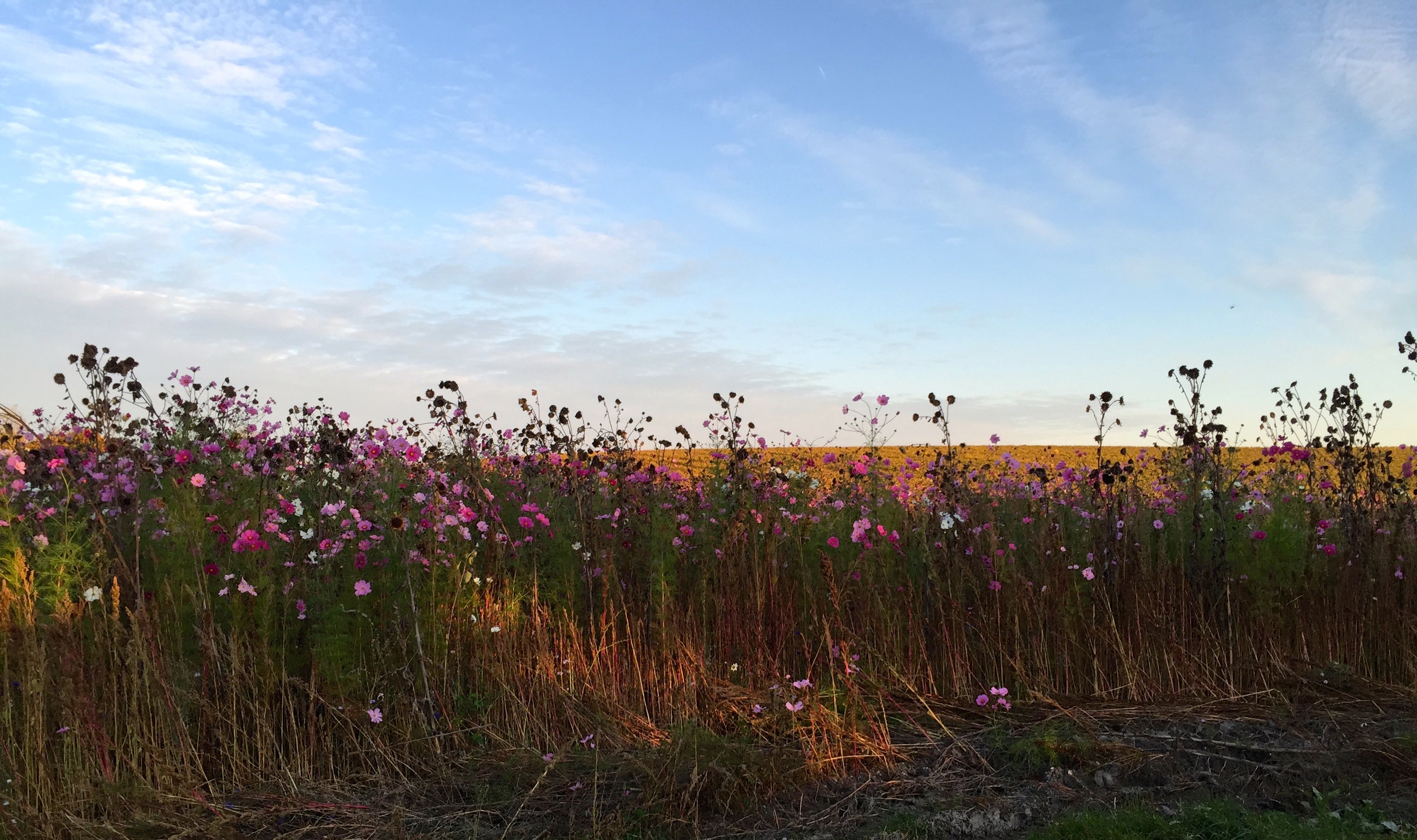
Wow! Look at these flowers! Spectacular!

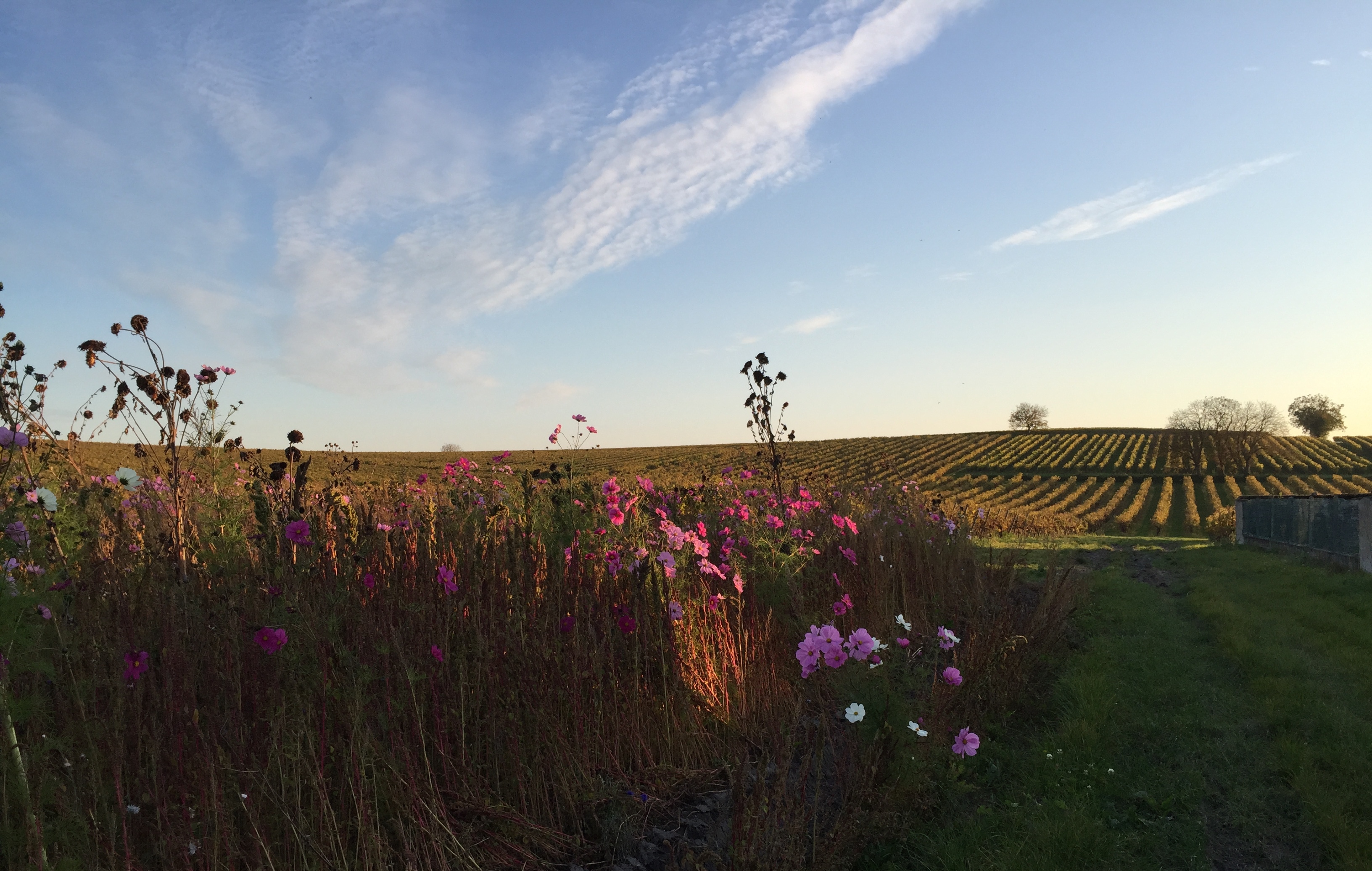
The sun was about to set and as I looked to my right I saw the low rays sliding across the vineyard and lighting up some of the petals. I’m really pleased with this one – just look!

sunlit

If the colour hadn’t caught my eye, if I hadn’t been curious enough to walk into the field, if I hadn’t looked along behind the old wall…..I’d have missed this.

So there’s my tip for today – if something catches your eye, follow your curiosity!

Read Full Post »

IMG_3445

Marcel Conche says this about thoughts –
To meditate is to be waiting, like lying in wait, for thoughts that are going to surprise us, bringing sudden clarity.
and he quotes Heidegger –
“We will never succeed in having thoughts, they come to us,” said Heidegger
This reminded me of what Liz Gilbert describes in her “Big Magic” about how ideas come to us. She suggests we think of ideas as living their own lives, wandering around the world looking for a partner to work them in order to bring them to fruition. I liked that concept. It’s maybe a stretch of the imagination to think of ideas as entities living their own lives, but then, maybe thoughts are a bit like that too?
Here’s Conche again –
We anticipate, with variable probability, the result of an action, and it is for this reason that we act. Yet we don’t anticipate thoughts. The philosopher is, in this regard, similar to the artist. Thought is “work of a poet,” said Heidegger.
Again and again he suggests the approach of the artist – not least because he sees Nature as a continuous creative process.
Liz Gilbert says we need to turn up every day prepared to do the work. She describes what others have called the “discipline” of the writer, but that’s not a word that’s ever had much appeal to me! Maybe we could call it a habit? (or what I’d tell patients about making better dents!)
Conche says that what we need to encourage thoughts to come to us is a kind of ease (an absence of anxiety), and setting aside any preoccupations with our selves.
What is required so that thoughts come to us? First, the soul must reach “freedom from anxiety” (ataraxia), serenity, a sort of negative happiness that we can call “wisdom”—a wisdom that is not the aim of philosophy, but its condition. Then and correspondingly, preoccupation with oneself must be absent.
Ha! Did you ever watch the movie “What about me?” by 1 Giant Leap?

Read Full Post »

IMG_3131

I only recently stumbled across the work of Michel Conche, the French philosopher.

He says this about Nature – that Nature is like an artist. Nature is a poet, continuously improvising and creating.

I like that.

In one of his works where he writes about the Tao Te Ching, he says

The Tao Te Ching allows the artist and the philosopher to live according to Nature, to place their confidence in the flow of things, to be led by inspiration, unlike the man of action who attempts to master Nature and the course of things through calculation.

The reference to “the flow of things” particularly resonates with me. As does living a life “led by inspiration”. But the phrase “unlike the man of action who attempts to master Nature and the course of things through calculation” really struck me. It immediately made me think of the definition of the scientific method which I saw a student on the train learning years ago – “Observation, Description, Explanation, Prediction, Control”. And it reminded me of the left hemisphere approach to the world which is described so clearly in Iain McGilchrist’s “The Emperor and His Emissary” – how we use that half of our cerebral cortex to analyse, measure, categorise and “grasp” things.

Conche uses this language of the “man of action” vs the “artist”, not to suggest that artists don’t “do” anything, but reflecting the thinking of the Tao Te Ching and concepts such as “wu wei

Because he is about to create, he finds himself on the margins of society and fixed forms. If he consents to a paid profession, it is only to earn what is necessary for life and work. Literally, the artist “works without acting” (wei wu wei: Chinese for “non-action”), because, contrary to the entrepreneur who sets an objective for himself and then uses means to obtain it, the artist cannot know in advance what the work will be. He advances step by step, innovating where necessary, incapable of rationalizing his steps.

We’ve lost touch with so much of that “artistic” way, haven’t we? With our emphasis on outcomes, goals and targets.

The man of action is the opposite of the artist, because he wants to know in advance all things concerning his actions, in order to move forward in complete safety. He wants, as much as possible, to avoid risk, which is precisely what the artist cannot avoid. To master Nature and the course of things by calculation is the dream of the man of action; nothing pleases him more than the progress of science and technology. The artist places his confidence in the flow of things, allowing himself to be led by inspiration.

Ha! There’s that thing about fear again! As Elizabeth Gilbert said in her “Big Magic” –

…when I refer to “creative living”….I’m talking about a life that is driven more strongly by curiosity than by fear.

So if we understand Nature as an artist, “led by inspiration”, “driven more strongly by curiosity than by fear”, “continuously improvising”, placing “confidence in the flow of things” – how does that feel?

Doesn’t it feel very different from the view of Nature as a mechanism, measurable, and controllable?

I like this idea of Nature as an artist – becoming not being!

Read Full Post »

IMG_3411

It’s almost the 100th anniversary of the birth of Roland Barthes and I’m seeing more and more articles about him here in France. Here’s one quote which struck me the other day –

Vitality in old age does not lie in proving that one can continue to carry on doing what one has always done but precisely in making a break – a rupture, a commencement, a vita nova.

More and more of us are living longer and longer. So how are you going to spend your extra years if you get them? Working at the same job for longer? For many that might be a necessity. For a few years anyway, but for another twenty or more?

It’s almost a year since I stopped clinical practice, sold my house and moved to France.

I was born and raised in Scotland and worked there as a doctor for just under forty years. There’s no doubt I feel deeply connected to all of that past. But I’d had a long term plan to live part of my life differently.

So here I am learning a second language and living in a different culture. That’s what I planned and I do think that broadens and deepens my experience of life. I also wanted to live in a different climate but I hadn’t foreseen just how much I’d enjoy being barefoot in a garden every day for weeks on end. Nor how great a pleasure it is to be able to eat most of your meals outside.

The house where I’m living is south facing and surrounded by vineyards as far as I can see. I think it’s that seamless connection between the garden and the open countryside which makes me feel closer to Nature than ever before. I used to look out from my flat in Scotland to the mountains in the distance. It was a beautiful view. But in hindsight it seems that Nature was at a distance there, and now I’m actually living in it.

Picking vegetables which grow in the garden, preparing and eating them is an unexpected delight. There’s a daily covered market nearby too selling local, fresh and seasonal produce. I’d forgotten the pleasure of eating according to the season, but there is something wonderful about eating the first strawberries and figs, then waiting till they come around again next year.

I’m reading more than I’ve ever done. I’ve got more time to think and reflect, and I’ve several writing projects on the go. I’m taking lots of photographs and I’ve begun to reconnect with my piano and my guitar. This feels like a creative time of life.

Who knows what this next year will bring? All I can say is I’m glad I took Roland Barthes’ advice – even though I didn’t know I was doing that at the time!

Read Full Post »

DSCN4431

You’ll maybe have noticed the by-line at the top of my blog – “becoming not being”. That was a phrase I encountered when reading the works of the French philosopher, Giles Deleuze. I suppose I’m still surprised how little that understanding informs our lives.

From the version of the “scientific method” which dominates our thinking, to the increasingly control driven methods of politics, the economy and society, we seem to privilege a view of the world which is based on what is fixed and “measurable” – data, categories, statistics and metrics.

Yet, that view gives us such a poor representation of reality as we find it in Nature.

Heraclitus, about 2500 years ago, wrote about change. He pointed out that we “cannot step in the same river twice”.

Philo, in the first century BC, said

“In a procession the first ranks get out of sight as they move further. In a torrent the waves stream faster than our capacity to perceive them. Similarly in life, things pass by, move away and although they seem firm, not one of them remains fixed for a single moment. All flee continuously.”

The twentieth century saw the splitting of the atom, and with that, the confirmation that there are no solid, fixed irreducible entities at the base of reality.

Yet it’s only now, in the last years of the twentieth century and the first years of the twenty-first that we are seriously grasping what all of those insights mean.

The controlling ethos of measurements and norms might be everywhere still, but the seeds of change are sprouting.

For me, understanding that we can’t fix, box, contain and pin down reality is liberating.

The constancy of change, of becoming, seems to offer a different way of living – more free, more diverse, more creative.

We really are the co-creators of our universe and our daily lives. I wonder what kind of world we’ll co-create in the years ahead? And although that’s a question no-one can answer, the thrill, for me, is in knowing that I can, and will, contribute to the change.

And so will you.


Read Full Post »

berries

“L’émerveillement du quotidien” is one of my favourite French phrases. It captures an attitude of mind and an approach to life which I think both opens me up to new experiences and enriches my every day.

There’s a sense of wonder in that phrase – of amazement, of delight and of awe. A “wow”!

I’m very taken with the philosophers who emphasise difference – because looking for difference not only helps me to be aware of novelty and transience. All of which together contributes to valuing uniqueness, diversity and dynamic change.

But there is also curiosity here. Elizabeth Gilbert, in her “Big Magic”, emphasises curiosity –

I believe that curiosity is the secret. Curiosity is the truth and the way of creative living……In fact, curiosity only ever asks one simple question: “Is there anything you’re interested in?” Anything? Even a tiny bit? No matter how mundane or small?…..Following that scavenger hunt of curiosity can lead you to amazing, unexpected places….Or it may lead you nowhere. You might spend your whole life following your curiosity and have absolutely nothing to show for it at the end – except one thing. You will have the satisfaction of knowing that you passed your entire existence in devotion to the noble human virtue of inquisitiveness.

And that should be more than enough for anyone to say they that lived a rich and splendid life.

There you have it – it’s not about ends, it’s about means. It’s not about goals, targets or ticking things off the to do list. It’s about following your inquisitiveness.

Because we’ll just never be done with discovering and learning!


Read Full Post »

« Newer Posts - Older Posts »