Feeds:
Posts
Comments

Archive for the ‘photography’ Category

During this pandemic our horizons have been drawn closer, our worlds have become physically smaller and our social worlds have either diminished completely, or have been translated into the virtual world of messaging, video calls, and emails……something which can be enriching, even vital, but which still seem second best to the physical-social world of shared time AND space, and, especially of touch.

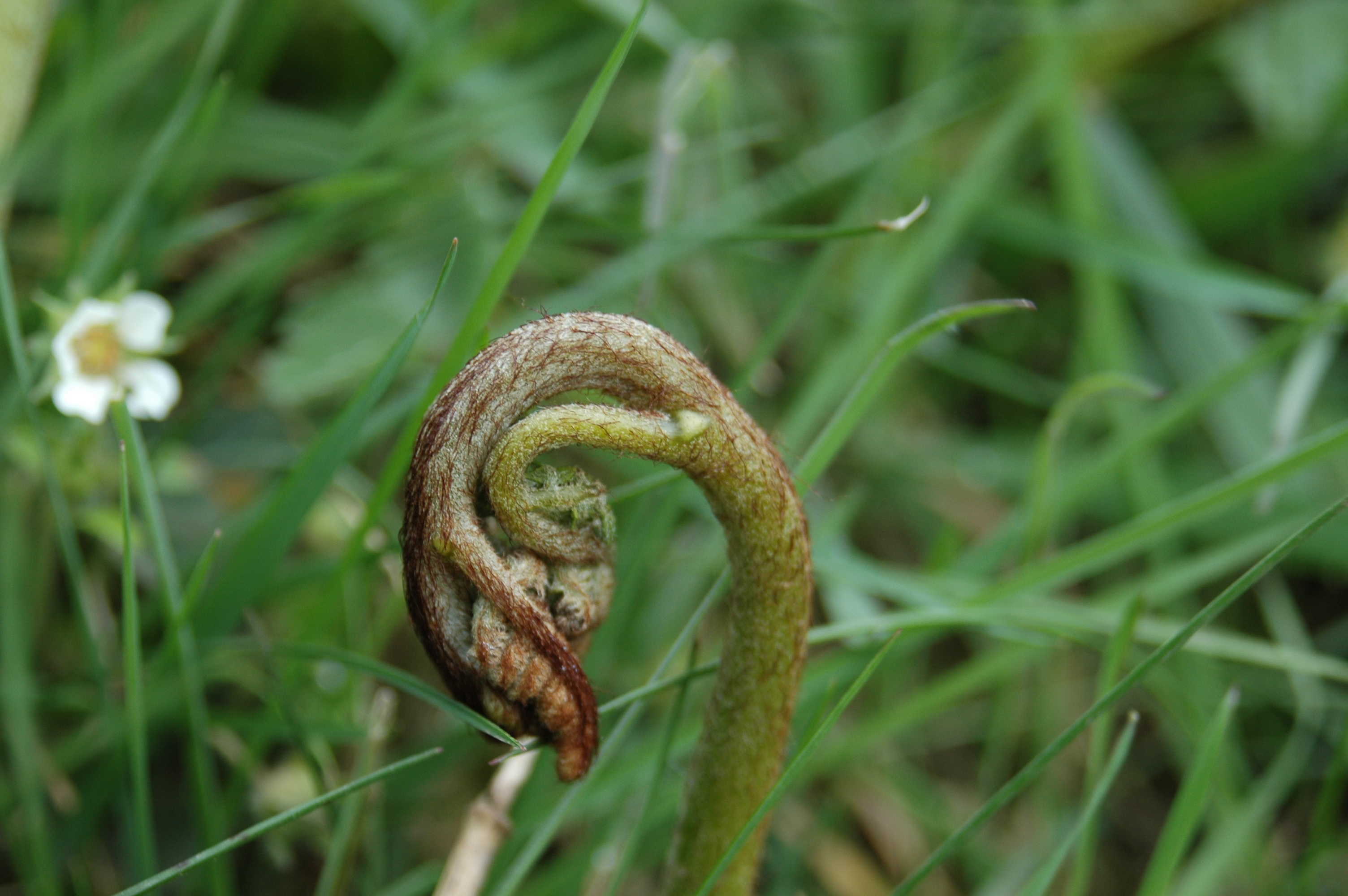
It’s a time where there’s a sense of collapsing into ourselves, of withdrawal, and of separation. Which is one of the reasons why this image is particularly appealing to me today. It reminds me of the fact that in Nature there are cycles and seasons. There are times, for example in the winter, when creatures and plants withdraw into themselves, hibernate, go dormant, on in old Scots “courie in“. In other words, there is a time in Nature when it makes sense to fold inwards, to snuggle, to curl up. But the appearance of a first crocus plant in my garden this week reminded me that there is another season around the corner – Spring – and that in the Spring time we see the opposite direction of movement…..a shift towards expansion, reaching up and beyond, of unfurling and unfolding.

I chose the French word “epanouissement” for my word of the year this year…..it means to flourish, to open up, to unfurl, in the way you see a plant move from the phase of a bud to a fully opened, multi-petalled blossom or flower. So I think of that word as I look at this fern unfurling.

I don’t think this unfurling motion is something we need to wait for. It’s not just that we are in winter and spring is around the corner (if you live in the Southern hemisphere, of course, you are in summer, and it’s autumn that’s just around the corner!).

No, I think that every day we can find a way to tune into this unfurling – this expanding, developing, growing, shift from potential to realisation. One way I try to do that is to deliberately choose two activities every single day – one activity of learning, and one of creating. Because I think learning and creating are our two most fundamental ways of growing and developing.

I have had a love of learning all my life, and my curiosity and appetite for discovery and understanding has only grown over the years. It utterly delights me to learn something every day. Amongst my learning activities I do language learning. Every day I learn a little French and/or Spanish. It’s become a habit (I use Duolingo to embed that habit) and I do it formally, following exercises, and informally reading in French, every day. I’m just a beginner at Spanish but I’ll move on to reading Spanish soon. I’m always learning other things too. Questions pop into my head as I live an ordinary day, and I pursue some of those questions online, using wikipedia, blogs, youtube, podcasts and articles.

I also love to create – for me that’s primarily photography and writing – but playing music is part of it as well. Well, in the creative areas of life, I find there is also always something more to learn – whether that be at the piano, on the guitar, on the computer, or in writing exercises.

So, I think unfurling happens all the time for we, humans. We just have to choose to become aware of it and give it some time and attention.

Read Full Post »

I think this skeleton of a leaf is beautiful. For me it reveals the often hidden, or difficult to see structures which underpin reality. But what it does most is make me think about the two forces of the universe….

The flowing force – the energies which vibrate throughout the entire cosmos. And the structuring force – which gathers some of the flowing forces together to make patterns, shapes, forms and objects.

I like this way of thinking. It’s definitely not new! The yin and yang forces of Chinese thought are sometimes described as “active” and “passive” and I can see how that relates to “structuring” and “flowing”. Others translate these forces into “masculine” and “feminine” and while I do love the ancient myths and legends, the rich symbolism of art throughout the ages, a lot of people find it difficult to apply gender to these forces, and, sadly, once you add in hierarchies and male-dominated culture, then the “feminine” seems to lose out to the “masculine”, so, for me, thinking of the “flowing force” and the “structuring force” is more helpful.

Clearly we need them both to be working in harmony, or in an “integrated” way with each other if we are to have the reality which we experience.

One of the key books I read which helped me understand these concepts was “The Crystal and the The Dragon” by David Wade. I highly recommend it. He uses the crystal as the symbol of the structuring force, and the dragon as the wild, flowing force. But “the universe story” as described by Thomas Berry in “The Great Work” is a brilliant, engaging, description of this same idea. Thomas Berry calls them the forces of “wildness” and “discipline”.

Whatever the metaphors, symbols and words you find work best for you, I think it really helps to understand and be amazed by the reality of every day life, if you raise your awareness of these two fundamental forces.

Try it, and see what you think…..

Read Full Post »

When I lived in Scotland the first snowdrops to appear each year always caught my attention. These small white flowers hang like little bonnets, which gives them the appearance of being discrete. They aren’t showy, or majestic, but they are obvious all the same. I think it would be hard not to notice them.

Here in France we don’t have snowdrops. Well, not in this part of France anyway. I’ve never seen them growing wild, and I’ve looked many times in nurseries and garden centres for the little bulbs so I could try growing some in my own garden, but I’ve never found them. Somehow, that makes them even more precious, and, perhaps, somewhat obviously, it gives them a new significance for me. I see them now as emblematic of the country of my birth.

Snowdrops don’t appear for long but they are one of those flowers which marks the cycle of the seasons. There are many other flowers which do that, of course, but the snowdrops seem to manage to break through the winter soil, push up their thin, delicate, green stalks, and unfold their beautiful white petals before most of the other flowers do. In that sense, they are like the beginning of something for me. I know that after I see the first snowdrops, the crocus flowers won’t be far behind, and already I find I’m starting to look forward to the daffodils and tulips.

Every flower is new, of course.

No individual flower repeats itself. Every year each unique, particular bulb wakes up, pushes upwards and shares the beauty of its own petals in its own time, its own place, and its own way. That reminds me of the classical spiritual practice of approaching every day as if for the first time……because that’s the truth…..this day has never been lived before. Everything you see, everything you hear, everything you smell, taste and touch, everything you feel, everything you do, will be for the first time today. It might be a lot like yesterday, but, actually, it’s different.

Starting your day with the knowledge that this day is a new day, and that every experience and event which occurs will happen for the very first time, opens up your potential to wonder and to learn. It opens up your curiosity and your consciousness, filling your day with discoveries, delights, and wonder.

All of that is good for the health of your right cerebral hemisphere – this is the part of the brain we use to discover novelty, to see things in their singularity, to appreciate the holistic nature of reality. And just as we develop muscles by exercising them, so we develop mental functions and neurological structures by exercising them.

New every time – a great way to increase the quality of your life, a great way to encourage growth, a great way to become enchanted again by this world we live in.

Read Full Post »

Stone circles, dolmens, single standing stones, cairns and burial mounds…….I have a fascination for all of these objects. There are a lot of them in Scotland (like this one at Lundin Farm) and there are a lot in France.

I was born, grew up in, lived and worked in Scotland. I emigrated after I retired from the NHS in 2014. I now live in the Charente, near the town of Cognac….a small town with a big reputation, not least due to the spirits made and exported around the world from here.

I had an intention to come and live in France for a long, long time. I wanted to live at least a part of my life in a different culture, a culture fashioned in a different language. I feel this move has widened and deepened my experience of life. But I don’t feel I’ve lost my Scottishness. It’s fascinating to live that weave of two languages, and two cultures. It really does give me the sense of an enriched, enhanced life.

I think we humans all share the same small planet. We all breathe the same air, drink water from the same water cycles, eat food grown in the same biosphere. Frontiers are artificially drawn lines on the globe. We all came from the same nomadic first tribes. We are all descended from the same first humans. When I come across these ancient neolithic structures I feel connected…..connected vertically back down a family tree to the past, and horizontally around me to everyone, and everything, else currently sharing planet Earth with me.

There’s an old classical spiritual exercise about standing back from your immediate surroundings. You can think of it in the same way as looking at the world once you’ve climbed a hill. You can think of it in the same way as those images from space which show our blue and green planet spinning slowly. When you look “from on high” then you get a different perspective. You see something whole. You see something inter-connected. You see the flows of clouds in the atmosphere, the flows of water in the oceans, and you realise you are a small, but unique, individual in a much greater whole.

Well, I think something similar happens when you encounter a stone circle. I’ve often had the sensation that I feel different inside the circle from what I do on the outside. I don’t mean that in any spooky way, but I just mean that the action of stepping inside one of these ancient structures, created surely with immense effort by men and women with rudimentary tools, lets you have a different perspective. You can feel connected, not just to multiple generations of ancestors, but to those deep currents which run through every human being – the desire to create, to interact with what is around you, to make something new, something special, to make a work of art, a work of the spirit, a work of quality.

We human beings don’t just survive. We change the world as we live in it. We create the world as we live in it. We discover and we make meaning. We create experiences, and the opportunities to have experiences, for ourselves and for others.

What kind of world are we creating now? What experiences are we making for ourselves and for others? What opportunities to enhance and enlarge life are we making and seizing?

Read Full Post »

Water fascinates me. Maybe it fascinates you too? Because it’s pretty universal to find that little children love playing with water, isn’t it? They love to play with it in their bath, in a tub, at the beach, in a pool or a pond…..they love to make snowballs and snowmen, to sledge down snowy slopes, to jump in puddles in the rain.

I don’t think that fascination leaves us. It’s a core energy which courses through us for our entire lives. Hey, around 60% of the human body is water. Water, in various forms, flows around us, into us, out of us, circulates within us. We need water much more quickly than we need food.

Maybe one of the most fascinating things about water is how it is present around us in gas, liquid and solid form. We see it in the air when we breathe out on a frosty day, creating little, temporary clouds which vanish, quickly, into the air. We don’t see it in the air as we speak and sing (which is why we’ve ended up wearing masks during this pandemic – that coronavirus rides the water droplets from one person to the next). We see it mostly as liquid….in a glass, in a puddle, in the rain, in the oceans, rivers and lakes.

Sometimes you can see a mist rising from the surface of a loch, float above the surface, and drift across the face of the forested hillsides like ghosts. Other times, like in this photo, you can see the water turn from liquid to solid. Do you remember that lesson from school? How cooling most substances down causes them to shrink, but how freezing water expands it? Weird, huh? Water is weird. We really, really don’t understand it.

In this photo you can see the edge between the solid frozen water, and the still liquid form. You can see the trees reflected in the mirror-like surface of the liquid water, and you can see the white frosted edge of the solid ice. I think, in this image, that gives the lock a nice “yin yang” appearance. Somehow, by doing that, it captures the sense of dynamism, of how the one form exists in the presence of the other, and of how the liquid and solid forms are constantly shape-shifting, from the one into the other.

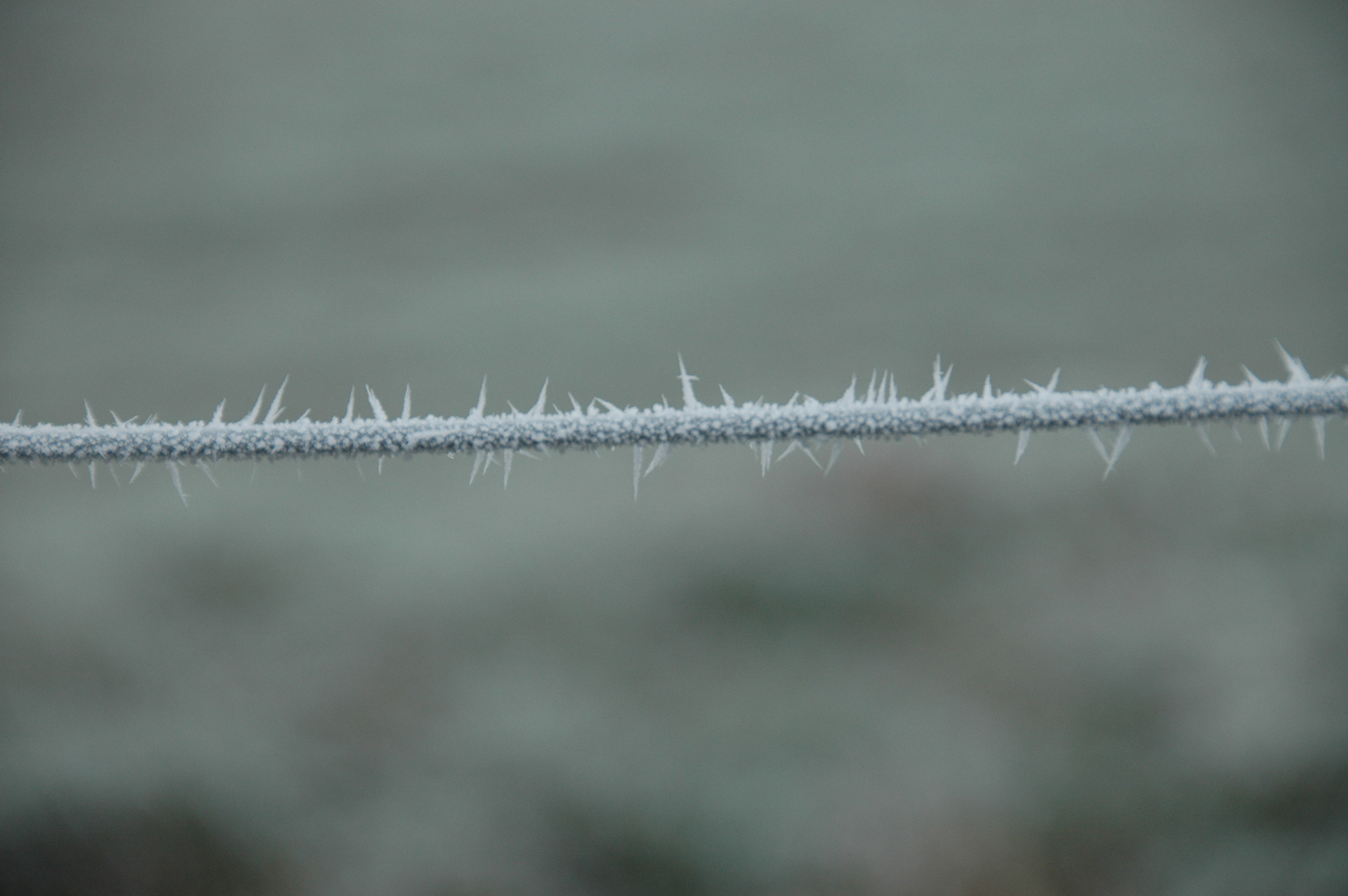
As water freezes it takes on all manner of shapes – you know that no two snowflakes are identical, don’t you? Don’t you think that is astonishing? I do. But when water freezes on the surface of something else it is also able to create the most incredibly beautiful shapes.

Read Full Post »

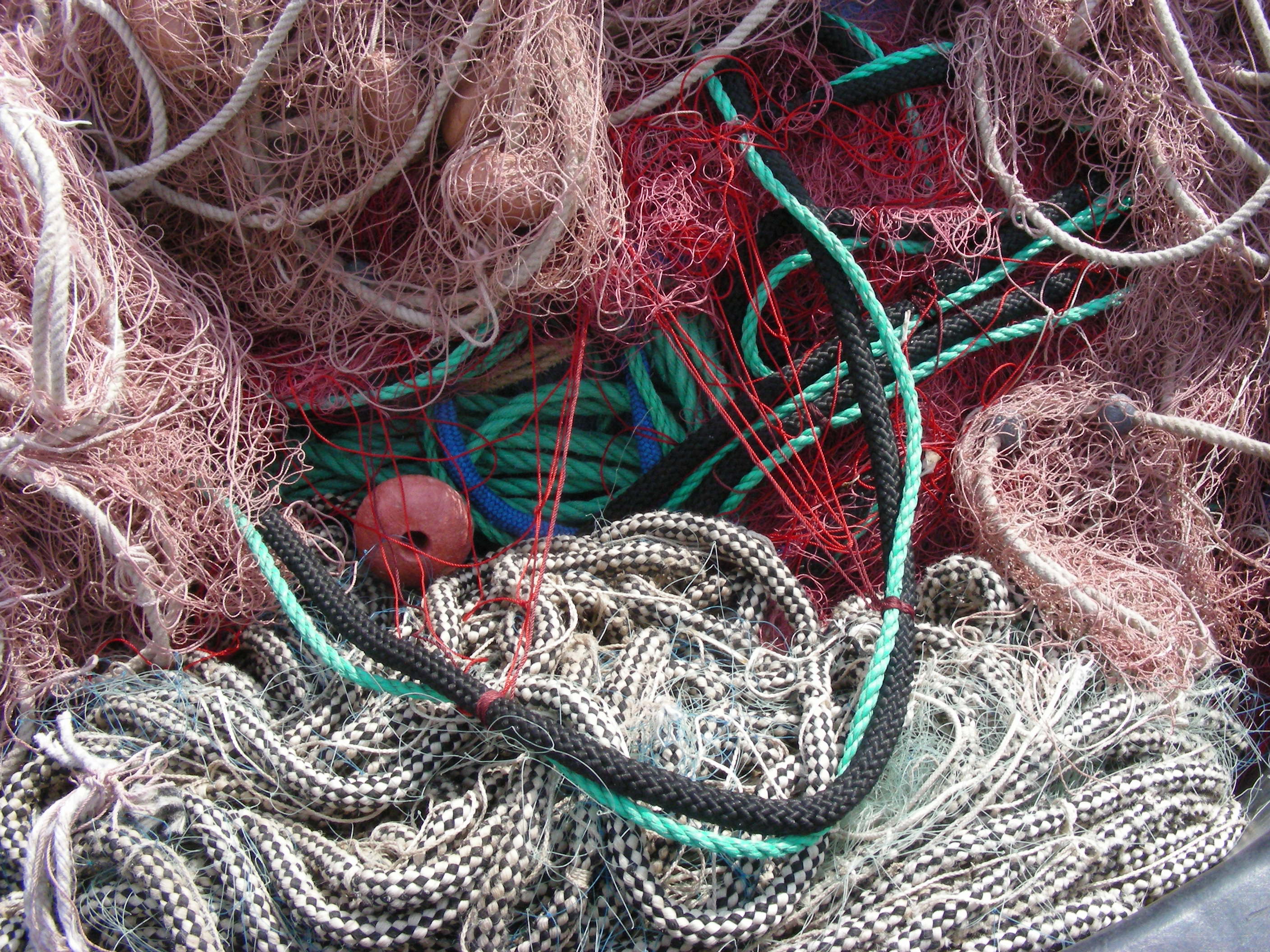
It’s not hard to find a pile of nets and ropes on the dockside at any little fishing village or port. I often find them quite fascinating and sometimes, like this one, quite beautiful. Look at the gorgeous palette of colours in this photo!

Without fail these images make me hear the word “entangled” in my head, and that’s one of my favourite words. It captures both the idea that everything is connected, and the fact that you can’t touch, or interact, with any single “element” without affecting everything else. It’s like the “butterfly effect”, where a small change in a complex system cascades throughout the entire network and has unpredictable significant over all changes – in the case of the butterfly effect linking the changes in air pressure and movement in one part of the world to storm and hurricane systems in other parts.

Well, that’s sure something we’ve had proven to us during the last year isn’t it? Even now, we hear of a “mutation” in the coronavirus, in one country and within a few days we’re hearing of it turning up around the entire planet. We sure are all “entangled” with each other, aren’t we?

There’s an aspect of this entanglement which has bothered me during this pandemic, and it comes up in the way that politicians and, also, many experts, are dealing with it.

It seems pretty clear that the present emerges out of the past. In other words we find ourselves in this current predicament because we’ve been living in a certain way. Yet, repeatedly, governments don’t want to admit “mistakes” or to look back and understand how our societies became so vulnerable. Probably because they don’t want to admit responsibility, but sometimes because it doesn’t fit with their favourite set of beliefs.

Would the health services in Western Europe be under such stress if they had been better resourced and organised over the last couple of decades? Of course, we can’t know for certain, but if the present really is entangled with the past, then can’t we try to understand how we became so vulnerable?

And if the present is also entangled with the future, which surely it is, then if we are to become more resilient then we need to create healthier societies. This virus has made it absolutely clear that those who will be hit hardest are those who are already the most frail and vulnerable.

I’d like to see politicians begin to lay out plans for our “exit strategy” from this pandemic which don’t rely entirely on technological fixes, but which, instead, firstly, develop and deploy better health and social care, to be better able to help and heal when help and healing is needed, but, secondly, to reduce poverty, poor housing, poor education, poor nutrition, inequality and environmental damage.

That would seem like a good place to start.

Read Full Post »

One of the most striking things about life in France is the importance of the “boulangerie” – the bakery. Really only the tiniest villages don’t have one, and if a small village is about to lose its boulangerie then the entire village feels like it is in serious decline.

It’s tempting to think that the hub of French culture is the cafe, the bistro, and the restaurant, and I don’t want to downplay that because that sector really does bring life to many towns and communities. The fact that all of those have been closed here in France since the middle of October and at the moment there is no definite prospective date for re-opening them has utterly changed what it feels like to live in France. When I walk through the main centre of my local town, Cognac, it feels very, very empty……particularly because all the cafes, bars and restaurants are closed.

But throughout the whole pandemic, the boulangeries have stayed open and although they might restrict the number of customers in the shop at any one time, there are queues outside them pretty much every day. Bread retains a key place in French culture and the French diet. It would be strange to sit down for a meal in a French restaurant and not be served a basket of fresh bread. The price of a “baguette” is set by the government and all boulangeries offer baguettes at that price – a price related to a fraction of the average hourly income (I think – it might be something a bit different from that, but the principle is that bread should be affordable to everyone).

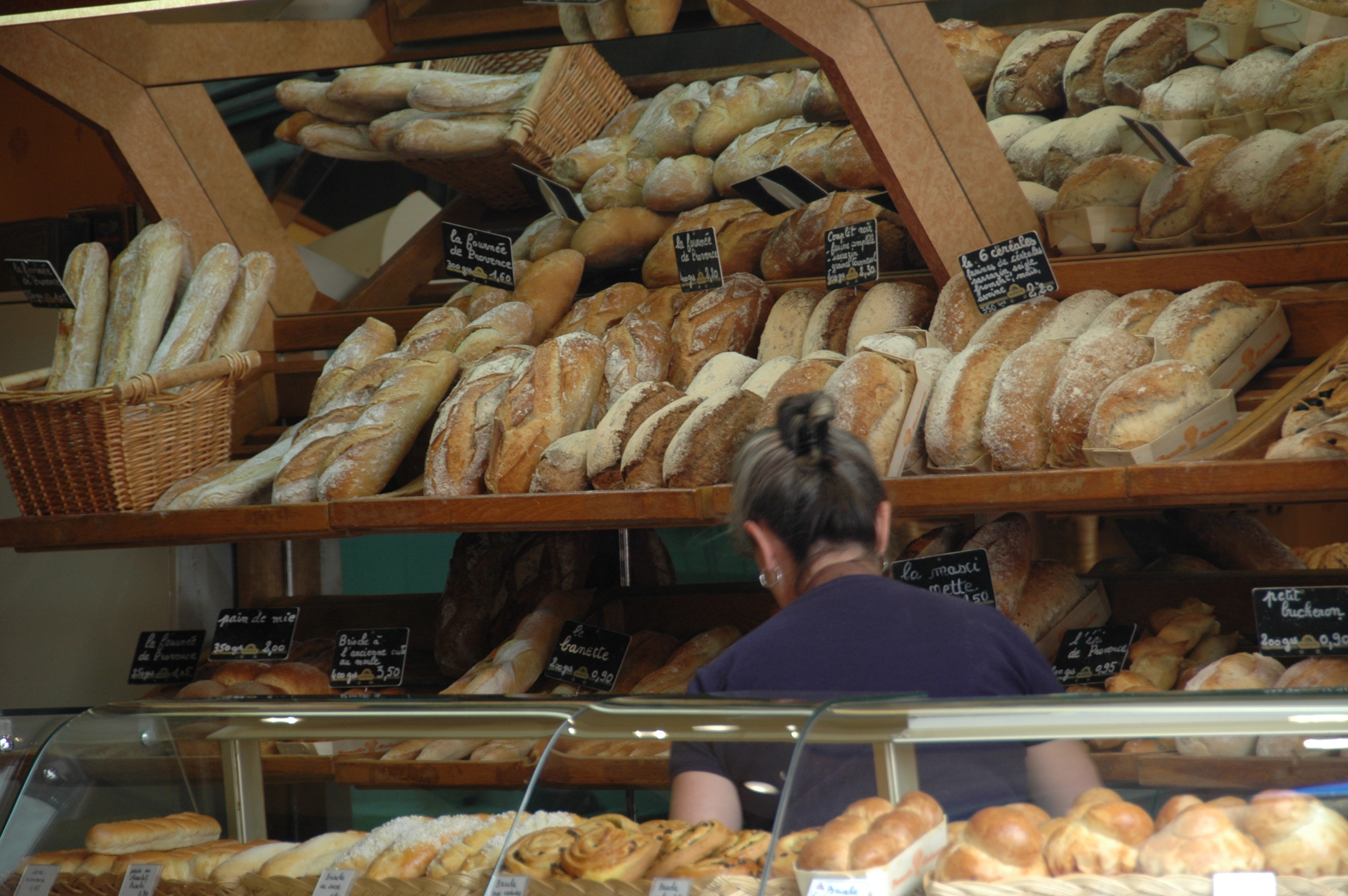
A typical boulangerie looks just like that one in the photo above. There is always a range of different breads on offer, and always a range of pastries and cakes. I know a lot of people now have gluten sensitivities but it doesn’t seem impossible to find a particular bread that even they can eat. One of my local boulangeries makes a bread they call “All Black” and not only is it one of the most delicious breads I’ve ever tasted, it seems to cause no problem at all for people who are gluten sensitive, even if the baker doesn’t advertise it on that basis. The thing is there remains both a huge diversity of grains and recipes in French boulangeries and different parts of the country also have their own particular local breads.

The typical boulangerie in France is owned and run by a single baker, and he or she (mostly he) has often chosen baking as a way of life. In fact, in many cases this remains one of the crafts and lifestyles handed down through the generations…..something which you can still find in a number of areas of trade and work in this country. I really admire that. It enables someone to choose work which feels meaningful, purposeful, important and satisfying. There’s far too much work in the world which is not like that.

On thing you won’t find in a boulangerie is industrial, plastic-wrapped, sliced, white bread. You can find it in supermarkets but even there the greatest amount of the bread for sale is baked on site and looks sort of like what you see in that photo above.

I know that both from the perspective of carbohydrates and gluten that in some cultures now bread is not held in such high esteem. But, here, in France, it remains a key part of life – freshly baked, locally produced, bread from a baker who has dedicated his life to making it.

Vive les artisans!

Read Full Post »

I reckon one of the most important lessons I’ve learned in life is the importance of context. There’s a huge tendency to “abstract” elements from reality – to take things to pieces and examine the pieces; to reduce the whole to a selection of parts; to consider only a single episode or moment in a life story; to pull a single thread from the entire matrix and try to follow just that; to measure what can be measured and disregard the rest. This tendency to “abstraction” is coupled with a tendency to “generalise”, so all is labelled, categorised and filed away; to give precedence to the “average”, the “norm” and the “typical”, over the “individual”, the “specific” and the “unique”.

Our left hemisphere is the champion of all that. Abstraction, labelling, categorisation and generalisation are at the heart of the way it engages with the world. All that can be useful. It can help us to “get a grip”, to “grasp” things, to make predictions and exert some control over the future (at least in small ways for short periods of time).

But it isn’t enough.

Throughout my decades of work as a doctor I interacted with people one-to-one, one after the other, always encountering a unique human being in a specific situation with a particular life story. I never saw two identical people in two identical situations with two identical life stories.

To make a diagnosis, to achieve a better level of understanding, and to establish a personal bond with each patient demanded that I brought my right hemisphere into play. I had to seek the connections, make connections, discern the meaning from the contexts, the contingencies and the uncover the unique, singular story. Only by doing that could I understand this person, in this situation, at this point in their life.

I got thinking about all that again this morning as a I looked at this photo. I mean, at first glance it’s a photo of someone in traditional Japanese dress. At second glance they are standing in front of a statue of Hume, the Scottish philosopher, dressed as a classical Greek scholar. Well, there’s a combination you don’t see every day! I have seen lots of people in traditional Japanese dress, but mainly when I’ve been visiting Kyoto. Not in Scotland. I’ve walked down the High Street in Edinburgh countless times past this statue of Hume

Only once did I see someone wearing a kimono, standing having their photo taken next to it.

So it’s the context of these two figures which makes this photo what it is. Either character by him or herself might tell a different story. But seeing them together here is a sort of “satori” – a “kick in the eye” – it makes me stop, take note, and reflect.

It inspires me to reflect about the importance of contexts and connections, of juxtapositions and synchronicities. And it inspires me to reflect on the two great traditions of philosophy and thought – the Eastern, Taoist/Confucian/Shinto/Buddhist with the Western, Enlightenment/Rationalist/Greek and Roman.

That’s an incredibly rich source of inspiration!

Follow your own special way through the thought chains and connections which unfurl, unravel, and open up before you when you look at this.

Read Full Post »

This pandemic has been going on for months now, and in many countries office workers have been working from home. I had to deal with a government agency recently and I could tell from the background sounds that the person I was speaking to wasn’t working in an office, so I asked him if he was at home. He replied that he was and he thought it was great. He no longer had to commute for about an hour and half in each direction between home and work every day, and when he wanted a coffee, he said, he could just reach behind him and switch on the coffee machine – no queue to join! He sounded relaxed and happy.

In surveys I’ve read it seems a lot of office workers are hoping they will never have to return to an actual office. Maybe this will be one of the big bonuses to come out of the pandemic……a shift away from commuting, from impersonal workspaces, and an increase in both quality of life, and time spent locally with friends, family and in local businesses and communities.

I took that photo above many years ago, one evening as I walked through Aix-en-Provence. I guess these two folk found a way to access free wifi! But that image comes back to me now as I think about how we are breaking out of the old ways and habits of office working.

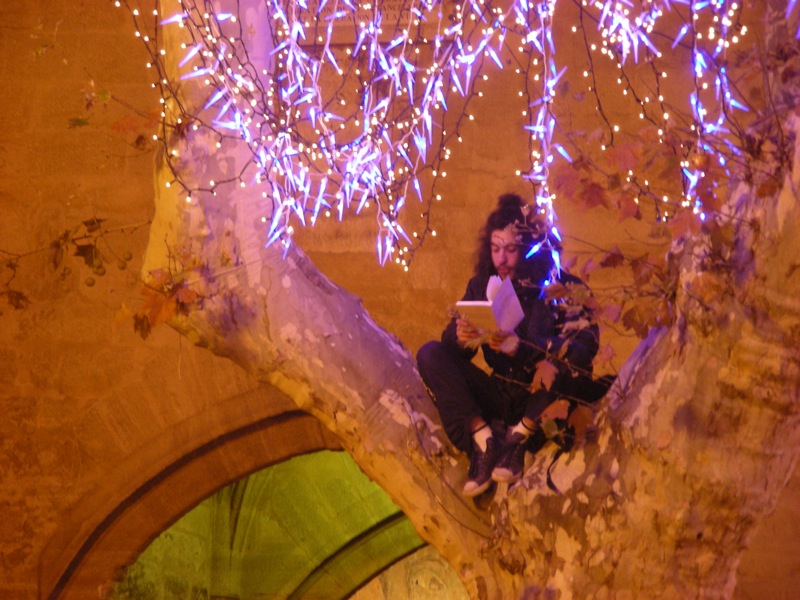
On another evening in Aix I came across this man sitting high up in a tree, reading a book. I don’t know why he picked that particular spot but I remembered him just as I was writing about the unusual places a lot of us now work from, or study in.

I do think one of the main lessons we are going to get from this pandemic is to challenge our orthodoxies, and our habits. You can even make a case for saying that we got to where we are today by doing things the way we’ve been doing them, so if we want to get out of this and not fall back into it, perhaps we are going to have to get creative and come up with new ways of living, new ways of working, studying and sharing our time and space.

Maybe this isn’t the end of the office as we’ve come to know it, but it surely challenges the dominance of the current model. If that leads to more flexibility and more diversity then I think that can contribute to a better, healthier way of living.

Apply this same thinking to education and you can already see that the way we’ve been delivering education to children and young people is also going through a potential revolution. I’m a bit of an optimist at heart, and I can’t help thinking that, although these changes bring lots of challenges and difficulties, they can also bring us the opportunities to learn and to teach differently.

Read Full Post »

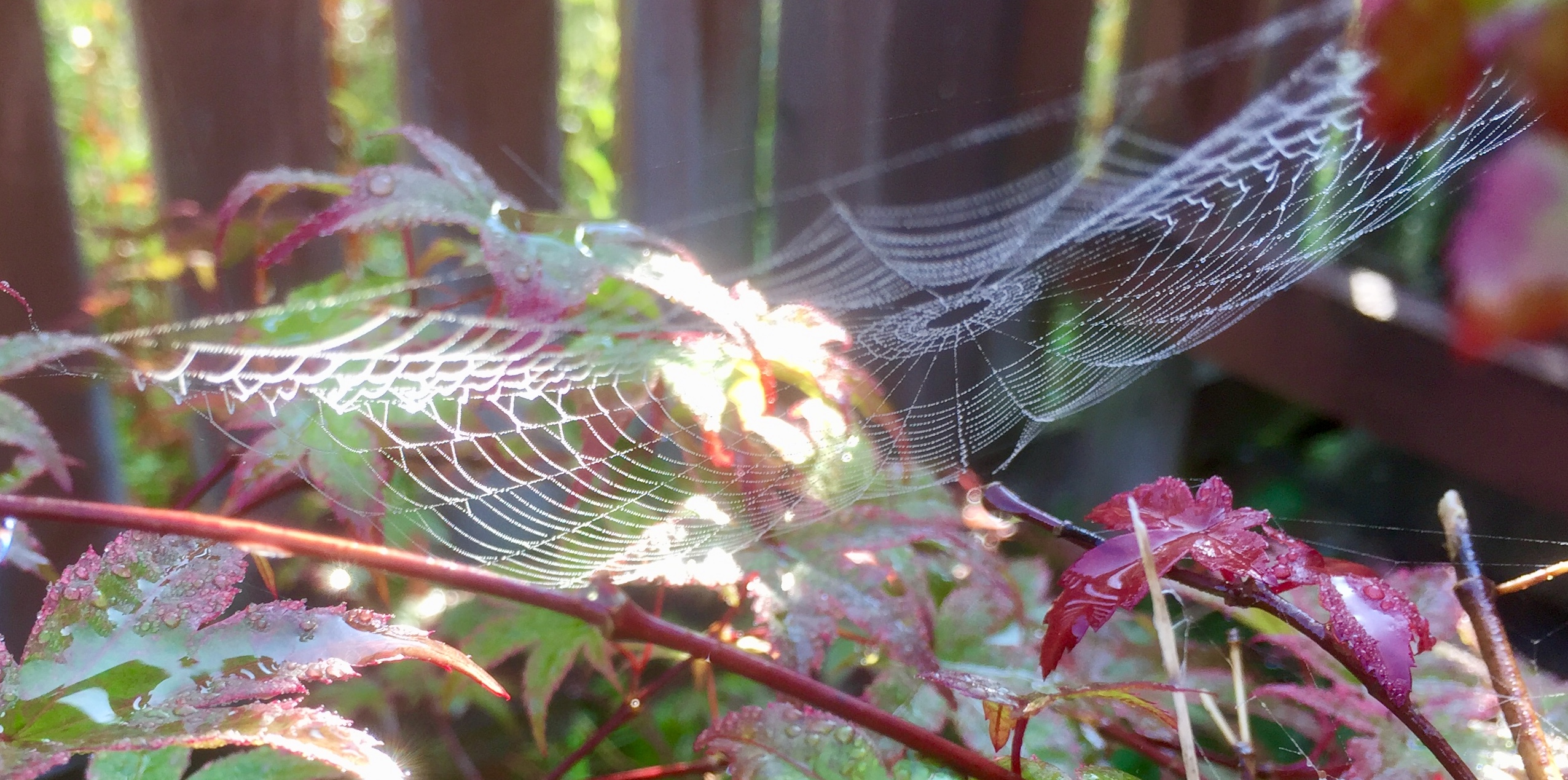
Webs fascinate me. They are such beautiful structures woven each by a single spider. How do they do that? Spiders have far more rudimentary neurological structures than mammals, but they certainly have brains which enable them to create these webs. Exactly how they know how to spin a web is a mystery. I also think it’s pretty incredible that the actual material from which the web is made is created in the spider’s body.

I wrote yesterday about the underlying structure of reality which is built upon the concept of a network – nodes with connections. In a spider web, the nodes are where the threads meet and the threads are the connections. The fact that the entire web is inter-connected is what enables the spider to detect the movement of a fly when it is caught on the web, and to know exactly where to find it.

But as that example hints, webs exist, not as separate entities, but in complex dynamic relationship with other creatures and with the environment in which they are created.

This photo is of a complex of wind-borne seeds stretched between several stalks of a plant. I don’t know if there is a spider web hidden in the middle of these seeds. I couldn’t see one. But it is reminiscent of the web I’ve shared at the top of this post. But there needn’t be a web inside this seed group. Perhaps they just all attached onto each other as they were released by the plant, and have formed a structure that looks just like a web, because each seed is connected to several other seeds through those fine filaments which are designed to carry the seed on the wind.

However this structure came about it shows how nothing exists in isolation. Not only are these seeds connected to each other, but they are connected, both physically and historically, to the plants which produced them, and so on back in time to the seeds from which these particular plants grew, connecting back over decades, centuries, aeons. They are also connected to the visible and invisible surrounding environment in which they exist. They interact with the wind, with passing creatures, and with other plants.

When you pause to consider anything from the perspective of its connections, you find yourself following trails which extend both back and forward in time, as well as connections to other objects, creatures, energies, physical and environmental phenomena. Really, if you were to attempt to tell the story of a single seed from the moment you encounter it back beyond its origins, and forward into the rest of its life story, then you’d find yourself lost pretty quickly. There seem to be no limits to the chains of connections and relationships we can uncover for any single object, creature or person.

So, really, nothing is completely knowable. There is always more to discover. There are always paths, connections and relationships which change our understanding of what we see in this present moment.

I think that fact keeps us humble, and stokes the fires of our wonder.

Read Full Post »

« Newer Posts - Older Posts »