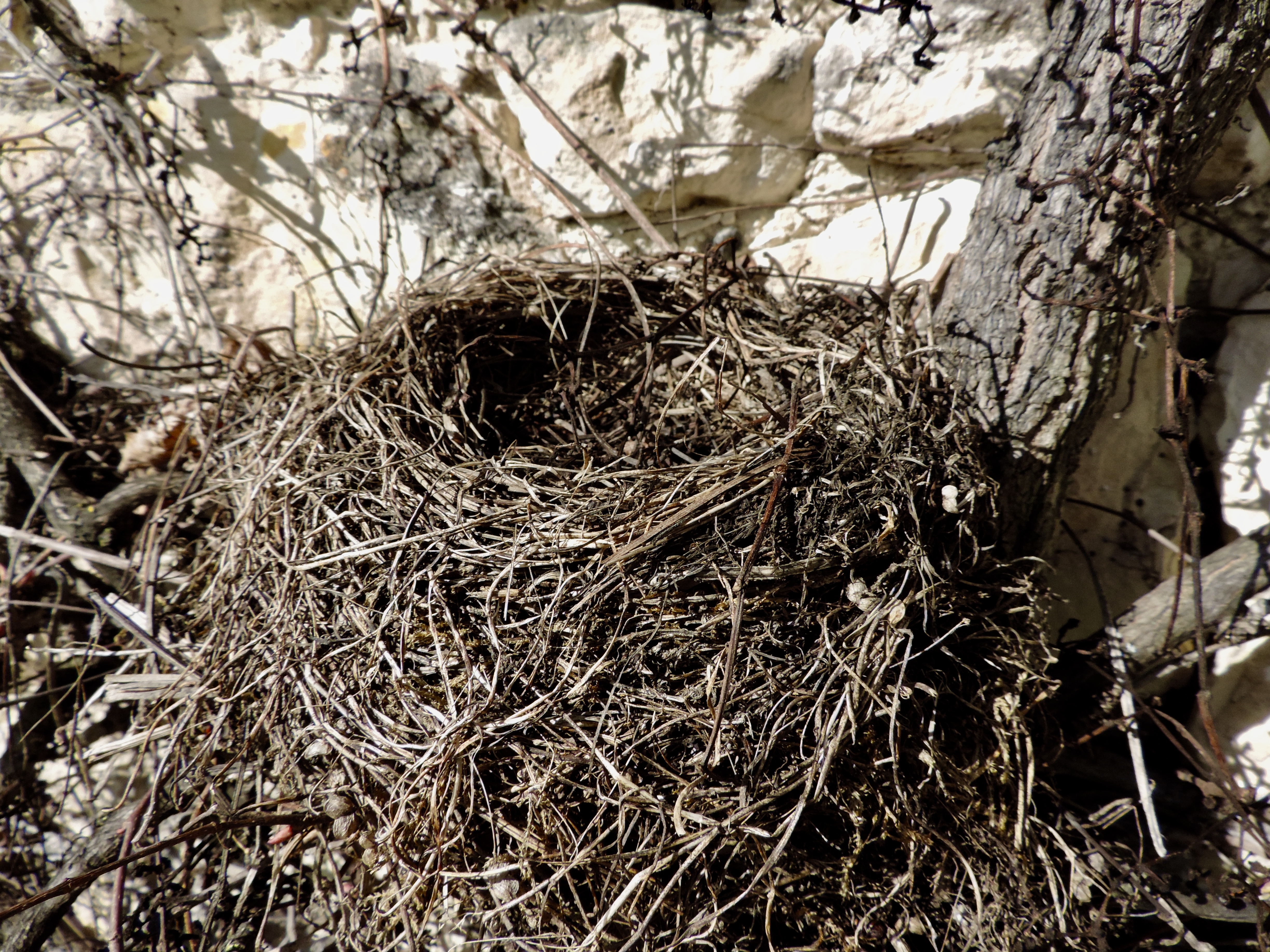
Once the leaves fall from the vine the nests built by several birds over the spring and summer are revealed. I don’t know which birds make these particular nests but I do know a blackbird is one of the most likely candidates.
Seeing this nest again made me think about the concept of “home”. What makes a place a “home”? What makes the place where you live “home”?
I remember when I was a GP in a small village in South West Scotland that I was surprised how some young adults had never travelled as far as Glasgow, the big city, less than an hour away by train, bus or car. I also remember how loyal many patients in Portobello were to their town, and didn’t really see themselves as citizens of Edinburgh….same thing in Leith, where people even call themselves “Leithers”. It seems wherever I go I find people who call this particular place “home” and are extremely resistant to ever living anywhere else.
My “home” town was Stirling. That’s where I was born and brought up. But the other places I lived over the last forty years or so have also felt like “home”. I feel “at home” here in this small village south of Cognac in South West France now.
It seems we are able to attach to pretty much anywhere. Is that the definition of “home”? The place we are “attached to”? The place where “we belong”? But isn’t it also true for many of us who have lived in several different places that we have a sense of “home” in many of them? “Home” it seems to me is not a singular, exclusive concept. We can feel at home in the place where we are living now, and we can still have that sense of having left a “home” once we move away from here.
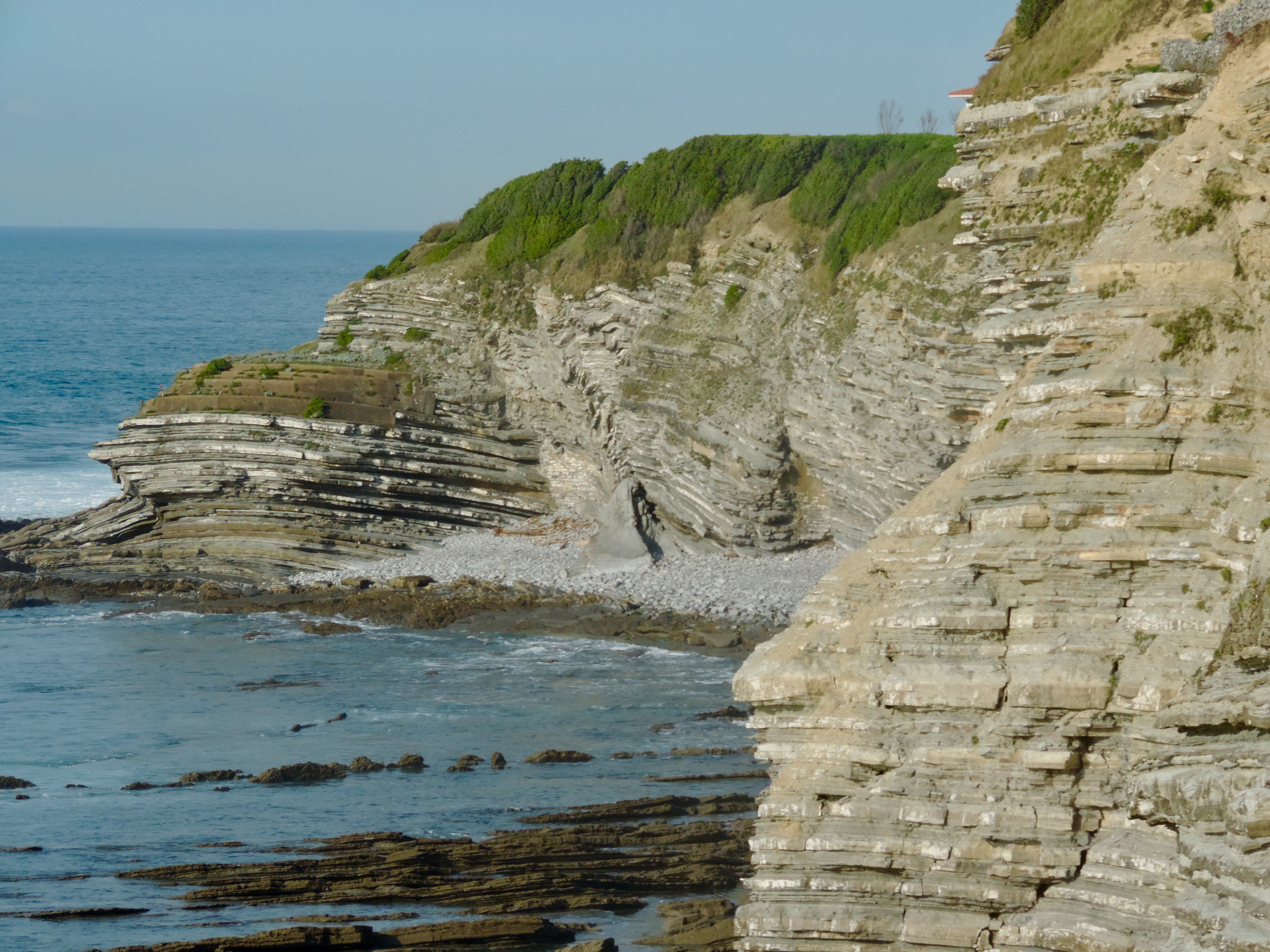
I love a view like this. These cliffs are shaped like water. The layers and folds look like currents and waves. This isn’t a coincidence is it? We see these echoes and resonances everywhere we look. I’m not a geologist so I can’t tell you exactly how these rock forms are created, but it’s pretty obvious that when land meets the sea, they co-create their shapes…..the shape of the land is fashioned partly by the sea, and the shape of the sea is fashioned by the land.
They also change the content and nature of each other, with the minerals and micro-organisms in the rock washing into the sea, and those in the sea soaking into the rock.
Nothing exists in isolation in this world. Everything exists within its own environments an contexts. The apparent boundaries and barriers are more fluid and more porous than we realise. Everything is influencing everything else through a vast, complex network of connections and relationships.
We humans are like that too. We are constantly exchanging materials, energy and information with everyone and everything else. That’s why I find it more helpful to think of the flows of reality and to focus on the connections more than on the so-called “parts” or “entities”.
The truth is that the way I live, the way I behave, communicate, and connect with others influences and changes them, and vice versa…..everyone else influences me.
We are nothing less than the co-creators of reality.
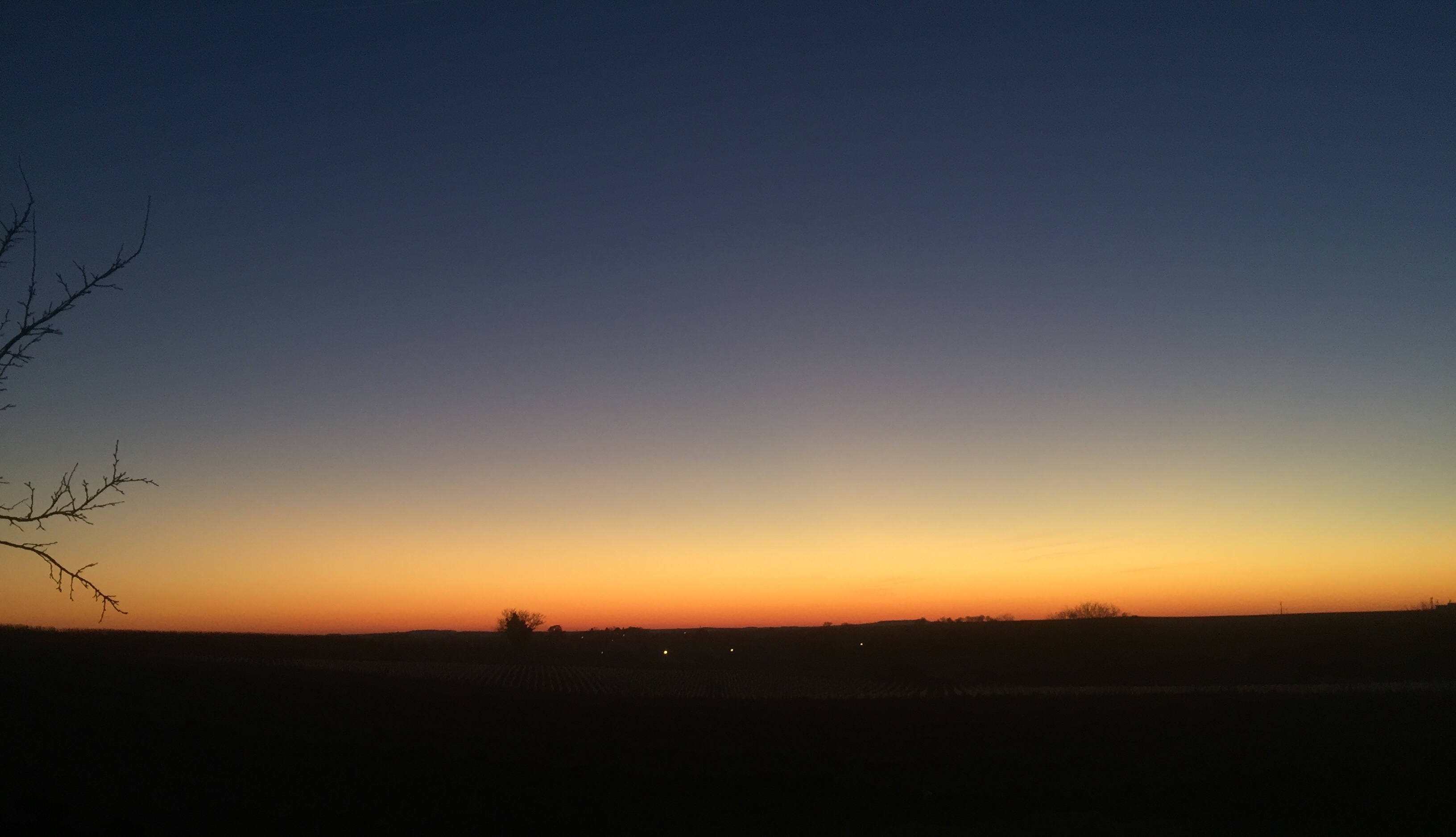
When I looked towards the Western horizon late in the evening I saw this glow.
Isn’t that interesting? I didn’t notice the vineyards, the village of Salles d’Angles on the hill. I didn’t see the Sun, because it had already slipped below the horizon. What I noticed, and what I’m struck by again, is the glow.
First of all, it is just stunningly beautiful. It reminds me that our attention can be caught by beauty, by wonder, awe and amazement……even if a lot of the time these days we find our attention caught by threats. Have you come across the term “doom scrolling”? Where you keep scrolling down through your social media, be it Twitter, Facebook, Instagram or a newsfeed, and you glance at story after story, image after image, which unsettles you. You find yourself becoming more anxious, angry, despairing, and fearful.
That’s not by chance. It’s by design. Whether it’s advertisers trying to seduce us, or scare us, into buying somebody’s products or services, or it’s power-mongers trying to manipulate you into supporting them, or pressing your buttons to try to control your behaviours. There are a lot of people trying to get into your headspace – in their interests, not in yours.
But we can still choose to invest our attention in beauty, wonder, awe and amazement. We can still choose to invest our attention in whatever nurtures us, integrates us (remember that integration is the creation of mutually beneficial bonds between well-differentiated parts), whatever promotes our growth and well-being.
Second, this glow that I see on the horizon is a radiance of light from the Sun. But we all radiate. We all glow. We give out vibes. We send out signals. We create waves which influence, or impact on, others. So, that makes me wonder……
……what kind of glow am I radiating today? A glow of beauty, joy, delight, love? Or a glow of fear and hatred? Huh! It’s not binary, is it? Chances are we send out waves from the entire spectrum every single day!
So, maybe the question is, what colours am I going to consciously include in my glow today?
The colours of love, beauty and wonder? The colours of delight and joy? The colours of “Bienveillance” and “Emerveillement”? (My two French words of the year – roughly, and inadequately, translated as “well wishing” and “wonder”)
Yes. Those are the colours I want to choose from my palette today.
How about you? What colours are in your glow? What are you radiating out into the world today?
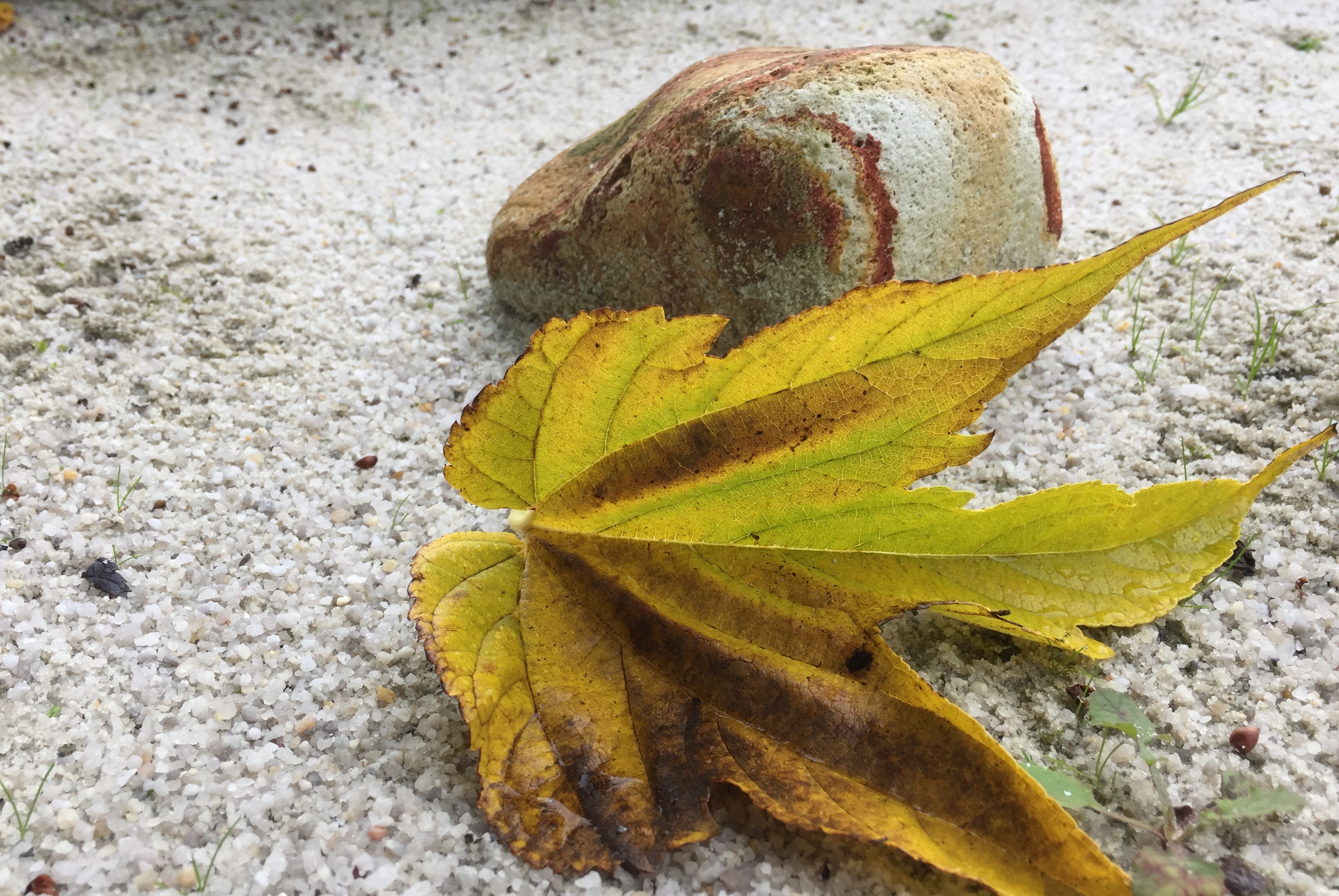
There are three elements in this image which inspire me to explore an underlying theme. The elements are the leaf, the stone, and the sand. The underlying theme is change.
The leaf changes quite fast. Over the course of a single year it grows from a tiny bud, to a full sized green leaf powering the tree, capturing the energy from the sun and the carbon, oxygen and hydrogen from the air, to create the solid substance of the tree. Then as autumn comes the metabolism changes. We can’t see that directly but we can see the effects….a change in colour from green to yellows, browns and golds. Then the leaf falls from it’s stalk to the ground. Once on the ground, the change continues as it biodegrades into the soil. Nature wastes nothing. The leaf nurtures the soil.
The stone changes more slowly. If you look carefully you can see several different seams of colour, each a different combination of minerals. These minerals came together over many, many years, and it has taken a long, long time for the stone to split from a much larger mass, and centuries and centuries of wind, rain, and sun to shape it.
The sand that both leaf and stone are sitting on has taken even longer to form. It always astonishes me when I come across fragments of shells and fossils of sea creatures high up in mountains, far away from the sea. It reminds me that the history of the planet is immense and that change in the surface shape of the Earth occurs so slowly it can seem unchanging.
Three rates of change. The more complex the structure, the faster the rate of change. Which brings me to the fourth element in this photo….the photographer. That’s me in this case! Well, my life changes faster than the sand, the stone or even the leaf. Every cell in my body changes minute by minute. All my tissues and organs are renewing themselves daily. It’s quite mind boggling, and it’s why I like to think in terms of “flow” instead of in terms of “objects” or “parts”.
We are all transient manifestations of being in the One great Flow.
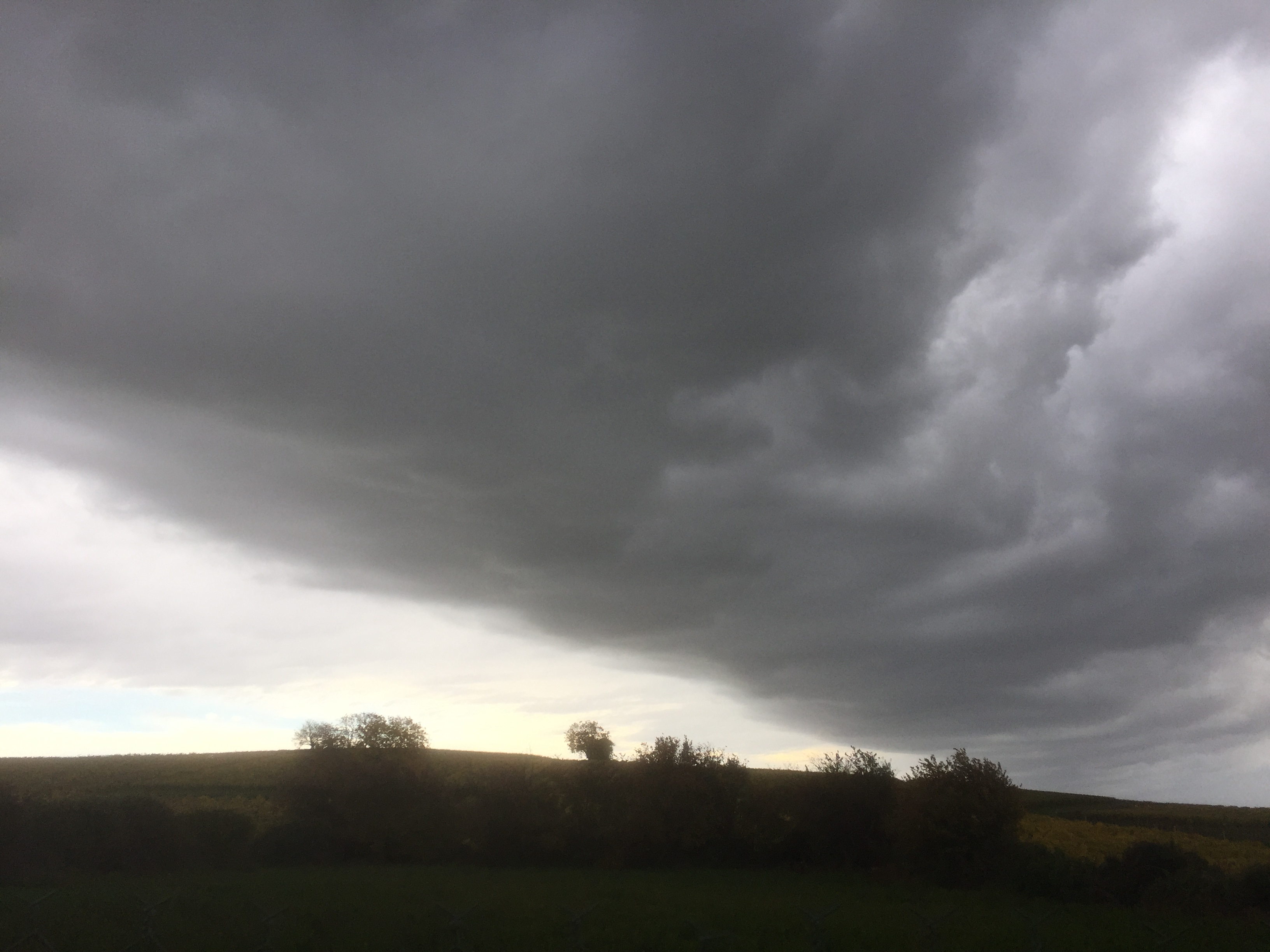
When you look at a sky like this you know a storm is coming. When it’s as dramatic as this it can be quite intimidating. At very least I know to prepare a little, unplugging my router and other equipment in case it gets fried by lightning (and, yes, it’s happened once since I came to live here). We also have an issue with heavy rain overwhelming the drains and then pouring down the driveway so another preparation is sandbags along the bottom of the garage door (and, yes, it’s happened more than once since I came to live here).
But sometimes, even a dramatic sky like this just passes over with hardly any rain, and no significant thunder and lightning. It seems impossible to predict at a local level. Even when the storm does come, it doesn’t last. Maybe just half an hour or so, or sometimes an hour or two, but usually it’s pretty brief.
I know that it’ll be different in different parts of the world, and I’m also aware of the absolutely catastrophic effects that dramatic, severe weather can have….most recently here down in the Valley of Roya just north of Nice where whole roads and parts of villages were washed away. Tragic.
I’ve also seen news coverage of the after effects of that storm, and as in other parts of the world when such calamities occur, what you see is dozens, if not hundreds, of people immediately appearing to do what they can to help….helping people to safety, cleaning up, making food, donating food, water and clothes. It is impressive. It is very impressive. You see it every time, no matter which country it happens in. You know some people don’t have a very good opinion of human beings and I know we can be an aggressive, exploitative species, but what impresses me so much more is this ordinary straightforward instinct to help and to work together to relieve the suffering of others.
Fundamentally, I believe that people are good. That’s my starting point. If things don’t turn out that way with an individual or a group then I adjust my attitude and behaviour to stay safe, to protect myself. But I start by believing in human goodness. In fact, I don’t know how I could have worked as a doctor for forty years without believing that. Everybody seems to be “worth saving”. Everybody who needs help “deserves” it. I know it’s complex and I’m not trying to be simplistic or naive here, but I really do believe that your experience of life changes when you start from a belief that people are fundamentally good.
I recently came across Rutger Bergman’s latest book, Human Kind, and he takes exactly this idea as his starting point….what if we believed that humans were basically good, instead of believing they are basically evil, or bad? I recommend it. It’s worth a read.
I saw this framed poster a couple of years ago in a shop in Copenhagen. I kinda wish I’d bought it! It’s a simple but elegant representation of something which has become my core model when I consider reality – networks.
When people say everything is connected to everything else they are right and the easiest way to both visualise and explore that is the network.
A picture of a network is simply some nodes connected by lines. The nodes might be people in your life, including you, with each line representing relationships. The nodes might be cells in your body, some more directly interconnected than others but all living in each other’s influences. The nodes might be neurones in your brain, each of which is connected to up to 50,000 other neurones! Can you imagine that? It’s literally mind boggling.
Networks can map thoughts, feelings and actions. They can help us trace the influences on any single moment cast by the past and the future if each node is an experience, real or imagined.
We have two halves to our cerebral cortex and it seems the left half is particularly good at noticing and exploring the nodes – the parts, the elements, the items, components or data. The right half, on the other hand, is particularly good at noticing the links, the bonds, connections and relationships.
Think of the constellations in the night sky, each twinkling star a node. When I look out now I see Orion has reappeared and makes his way each night across the winter sky from east to west. He’s been gone all summer and now he’s back I know winter is coming. But how do I see Orion? By tracing the invisible lines which connect the individual dots (stars).
When I first read about complexity science it was this model of networks which made it all clear to me, and, in particular, learning about the non-linear nature of the relationships between the nodes in living creatures helped me grasp the concept of the “complex adaptive system”…..which shone a bright light of understanding on everything from self-healing, to uniqueness.
There have been many epidemics in human history, and there will be many more. Some of those epidemics spread so much they become pandemics.
We discovered how to cope with these raging fires of infection many, many years ago…..
You have to isolate the infected from the rest of the population until they aren’t infectious any more. In the past that involved closing off whole walled towns, or sending the sick to isolated places.
That is still the basis of control – reduce the spread by reducing the opportunities for the virus to spread from one person to another.
In this current pandemic most countries have gone for “lockdowns” – which are more and more harmful the longer they go on. They are a desperate, short term measure. The other main policy has been to promote social distancing…..make people stay away from each other and touch each other less. This is also a pretty desperate, ultimately harmful, measure.
The most successful countries have gone for “Test, trace and isolate”.
No-one has been successful pursuing a “let it rip”, or “herd immunity” strategy. No wonder. It’s a bonkers, inhumane idea. Which infectious diseases have human beings ever successfully overcome by going to herd immunity? Not TB, not HIV, not malaria, not cholera, nope, not even smallpox, polio or measles (effective vaccines have played a significant role in these latter diseases)
This
Identify the infected and keep them at a distance from the non-infected is how to control an epidemic. It always has been, and it is now. The problem with Covid-19 is that over 80% of those infected, and able to spread it to others, are asymptomatic. That means the only way to identify those who are infected is by testing.
I know most western countries have really struggled to get their testing capacity up to speed quickly enough and some, like the UK, even abandoned testing for a while (apart from testing the sick in hospital). But that doesn’t mean it’s the wrong way to go. It’s intolerable to isolate whole populations and bring work and social life to a halt for long periods, or even repeatedly.
There’s only one way – “Test, trace and isolate” – do it intelligently, effectively and on a sufficient scale and fully support those who need to isolate for the period of their isolation.
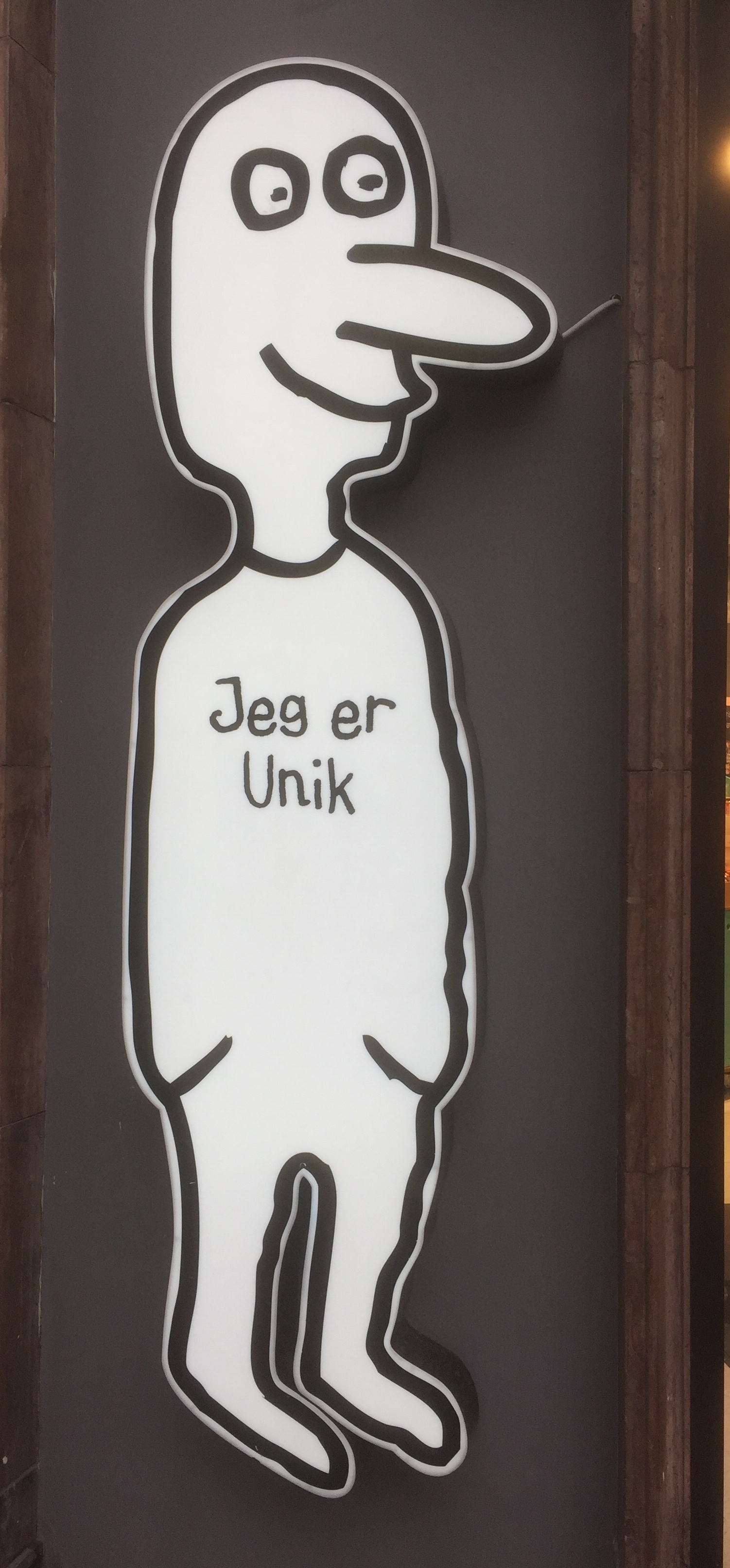
A couple of years ago I saw this image on the front of a shop in Copenhagen. Uniqueness is an important quality for me. Every single patient I ever treated was unique. Every single one had a unique story to tell me. I feel unique. I see you as unique.
So, what makes someone unique?
Is it your DNA? That’s part of it. There are no two human beings with identical genomes. Is it your face, your eyes, or your fingertips? That’s part of it too. There is scarily effective face recognition equipment already deployed everywhere from airports to security cameras. You can even get access to your phone by having it recognise your face. Iris recognition technologies have been around for some time allowing restricted access to closed spaces, and fingerprinting has a long history in detection work.
So, each of these characteristics can be said to be unique to you, but none of them captures your uniqueness, because YOU can’t be reduced to your fingertips, your eyes, your face, or your DNA. Maybe these features can help to name you….to tell others how to identify you from within a crowd, or a group.
But is this the same as “identity”?
I don’t think so. The reason why I don’t think so is that identification has spilled over from the capture of these physical features to encompass a whole person.
You are not reducible to any of these features, just as you are not reducible to any other “characteristics” such as country of birth, ethnicity, gender, religious belief, height and weight, or hair colour.
You are a person, and a person has a subjective reality, a life of memories, experiences, imaginings. A life of emotions, thoughts and beliefs. A unique, and singular story to tell, which is not, and never can be, the exact same as anyone else’s story, past, present or future.
Our uniqueness isn’t found in our characteristics or our features. It’s found in our connections….the connections which connect the past to the present, the present to future, our selves to other people, our unique set of experiences and life events, the contexts and environments of our existence. It’s found in the invisible nature of our subjective reality, with our own consciousness, our own unconscious being, and our ever changing, ever developing sense of self and person.
I abhor the reduction of a human being to a data set.
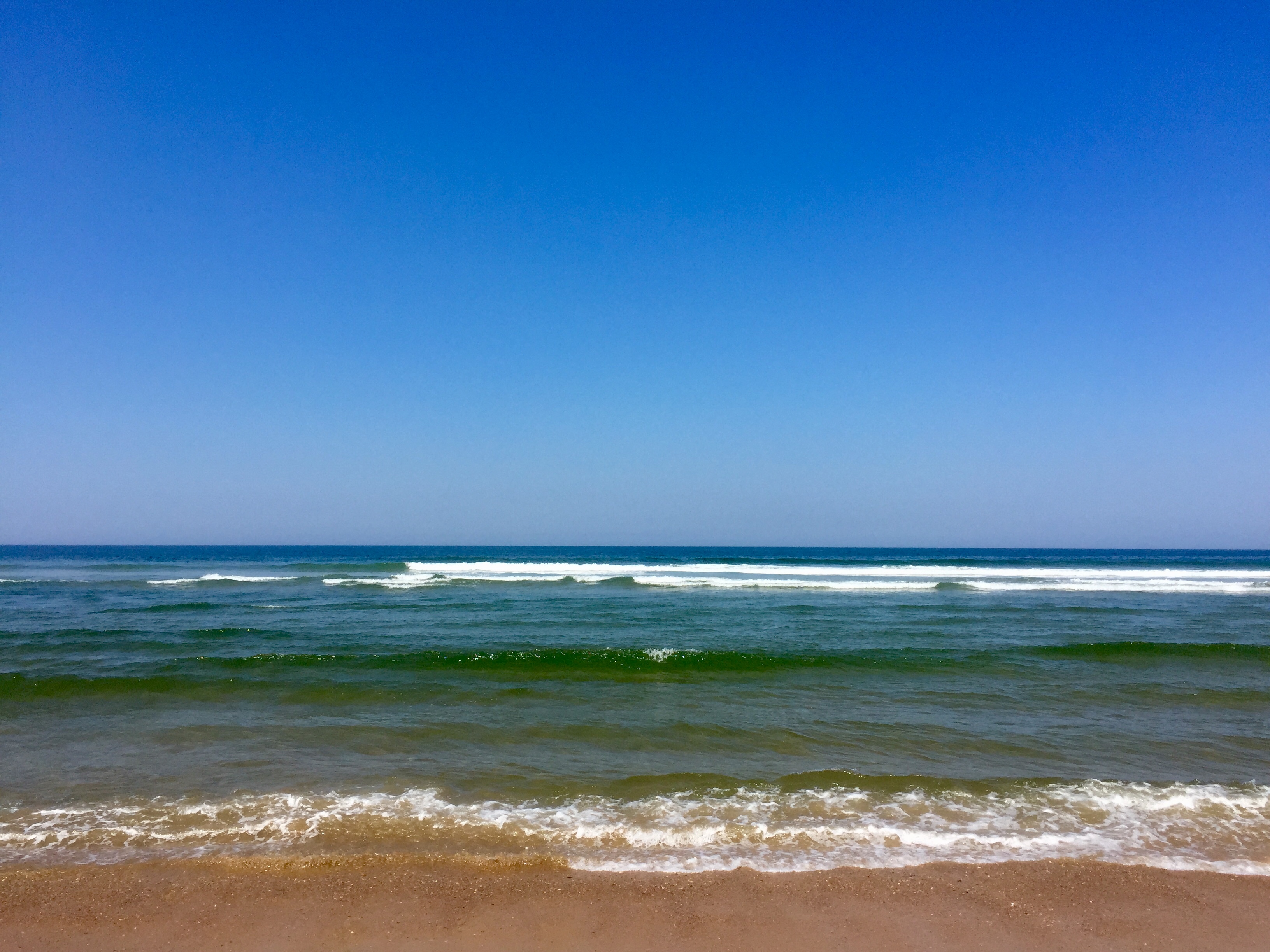
If I drive about an hour west from here I come to the edge of France. This particular stretch of coastline is called “La Cote Sauvage” (the wild coast) and it’s where you can stand and look out across the Atlantic Ocean. There’s something life expanding about gazing out over this immense expanse of water. It makes you take a deep, deep breath and fill your lungs, which is one way of making yourself a little bigger! The air is filled with that scent of saltwater, of clean air, and of distant, invisible places.
Many of us are drawn to the sea. We talk of “the pull of the sea” or the “call of the sea”. My ancestors, on one side of my family, came from the Orkney Isles, off the north coast of Scotland. I don’t know if that connects to a Viking thread or not, but I do know that the Vikings were great sea travellers. There are even some suggestions that they sailed as far as the continent we call North America. But, wherever they went, what induces a sense of awe and almost incredulity for me, was that they set out across expanses of sea like this one. They had no idea where they were going. There were no maps, and they didn’t even know if the ocean had an edge that you might fall off when you got there. They just set off.
What were they thinking, these ancient mariners? Did they just think, oh I can see the edge of the water over there in the distance, I think I’ll go and have a closer look? In much the same way that we drawn to go to the edge of a cliff, or a high building, so we can peer over and see what we can see. Did they think there might be new land there? New territories to conquer or treasures to grab?
I don’t know but I think the same questions can be applied to any of the sailors who set off across unknown seas like these. Given that I am a bit of a fan of the “and not or” idea I wouldn’t be surprised if it was a bit of both….with other motivations blended in as well.
It’s a bit of a metaphor for life, isn’t it? On any day we stand at the edge of an ocean, an expanse of possibilities stretching from here to eternity. What lies out there? The future. Is the future just waiting to be discovered? Probably not, is the answer. How many routes can we take to cross that sea? An infinite number, is the answer.
The bit that doesn’t work in this metaphor is in the answer to that first question….”what lies out there?” The future is not a distant place. It’s not just lying there, passively and patiently waiting to be discovered. Why not? Because the future is “emergent”…..that is, as in all complex systems, the future cannot be predicted from even a complete knowledge of the present, because complex systems come up towards “bifurcation points” where they might go one of two ways….towards greater complexity or towards collapse and chaos. When they pass through these points they show this quality of “emergence” which is defined as a state which could not have been predicted from the previous knowledge. When that emergence is of a certain degree of significance everything is different….the system has undergone a “phase change”.
So the future isn’t out there waiting because we are still busy making it. It will arrive when we get there. A sentiment we know well from the advice to “cross the bridge when you get there” (knowing that when you get there, there might not be any bridge, or even a gap to cross).
It’s our imagination and our curiosity which propel us onwards on this voyage of creation. Every day, every moment, even, co-creating with the rest of Existence, the next moments, the next days, the near and distant futures, which are still a gleam in their parents’ eyes.
There’s a way of looking at history where you can trace the development of a theme over decades, or even centuries. One of the themes I’m aware of is control.
Maybe the control issue has become particularly apparent because of this pandemic……in two ways.
Firstly, there’s our inability to control the spread of the coronavirus. Yes, I know, governments around the world and thousands of scientists are trying to exactly that – control the spread of the virus. But they can’t really. They can bring in measures which enforce changes in personal and collective behaviour to try to reduce the opportunities for the virus to jump from one person to another, and some countries are managing that better than others. But we can’t get rid of the pesky thing from the whole planet and as we live in a hyperconnected age reducing the incidence to zero in one country doesn’t guarantee it won’t make its way back.
Secondly, we are now subject to more controls, more restrictions than most of us have ever known. We are being monitored, surveilled, documented and followed to unprecedented degrees.
This second kind of control is not specific to infections of course. In many walks of life we are now subjected to increased levels of control. I retired from clinical practice as a doctor almost six years ago now, but in the last few years of work the level of monitoring and control of my daily “performance” increased many fold. A combination of “annual appraisal”, “revalidation” and “job plans” with an emphasis on what can be measured eg patient numbers and consultation length, diminished professional autonomy and steady forced everyone to somebody’s declared “norms”.
A lot of the desire for control is extremely well intended, but a lot of it isn’t. I’m not sure where the balance lies these days, but I suspect most money and resources go into enabling those with power and influence to keep and increase what they have through the control of the rest of us. A lack of transparency creates the suspicion that extra controls “in your interest” aren’t really in our interest!
But all this goes a long way back doesn’t it? And I’ve been thinking this morning how one of the origins is the idea that Man is separate from Nature and that we are either chosen to, or that we are choosing to, dominate and control Nature. Nature is seen as something separate from us, something to be exploited, a resource to be tapped, and potentially damaging phenomena are to be fought and controlled.
But that’s not right is it?
We are not separate from Nature. We emerge within all that is. We exist within the existence of the whole world. We are unfathomably hyperconnected with the whole of Planet Earth.
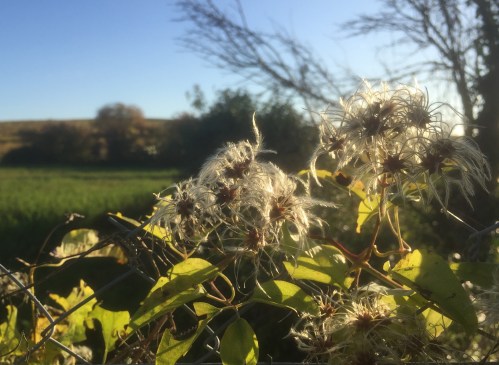
When you look around, you see that other forms of life thrive without having such an emphasis on control. Look at this photo I’ve shared today. It’s one plant which uses a particular form of seed dispersal – wind. It gambles the whole of the future existence of its species by letting go. It creates the forms and methods which give it the best chance of working well with the rest of the planet, from the wind, to the sun, to the soil, and holds its sons and daughters up to the heavens, then waits. Waits for the wind to blow, and to carry them to fertile lands.
OK, so we aren’t plants. And I’m not saying we can live the same way that they do, but there’s a lesson here, don’t you think? Something to reflect on. It’s in that action of “letting go”. Letting go in a way which maximises your ability to survive and to thrive.
How are we going to do that? How are we going to shift away from obsessive desires to control to learning to work with, to collaborate, to share, to learn with humility that we can’t control nearly as much as we’d like to?
I welcome constructive criticism and suggestions. I will not, however, tolerate abuse, rudeness or negativity, whether it is directed at me or other people. It has no place here. ANYONE making nasty comments will be banned.


 Heroes Not Zombies