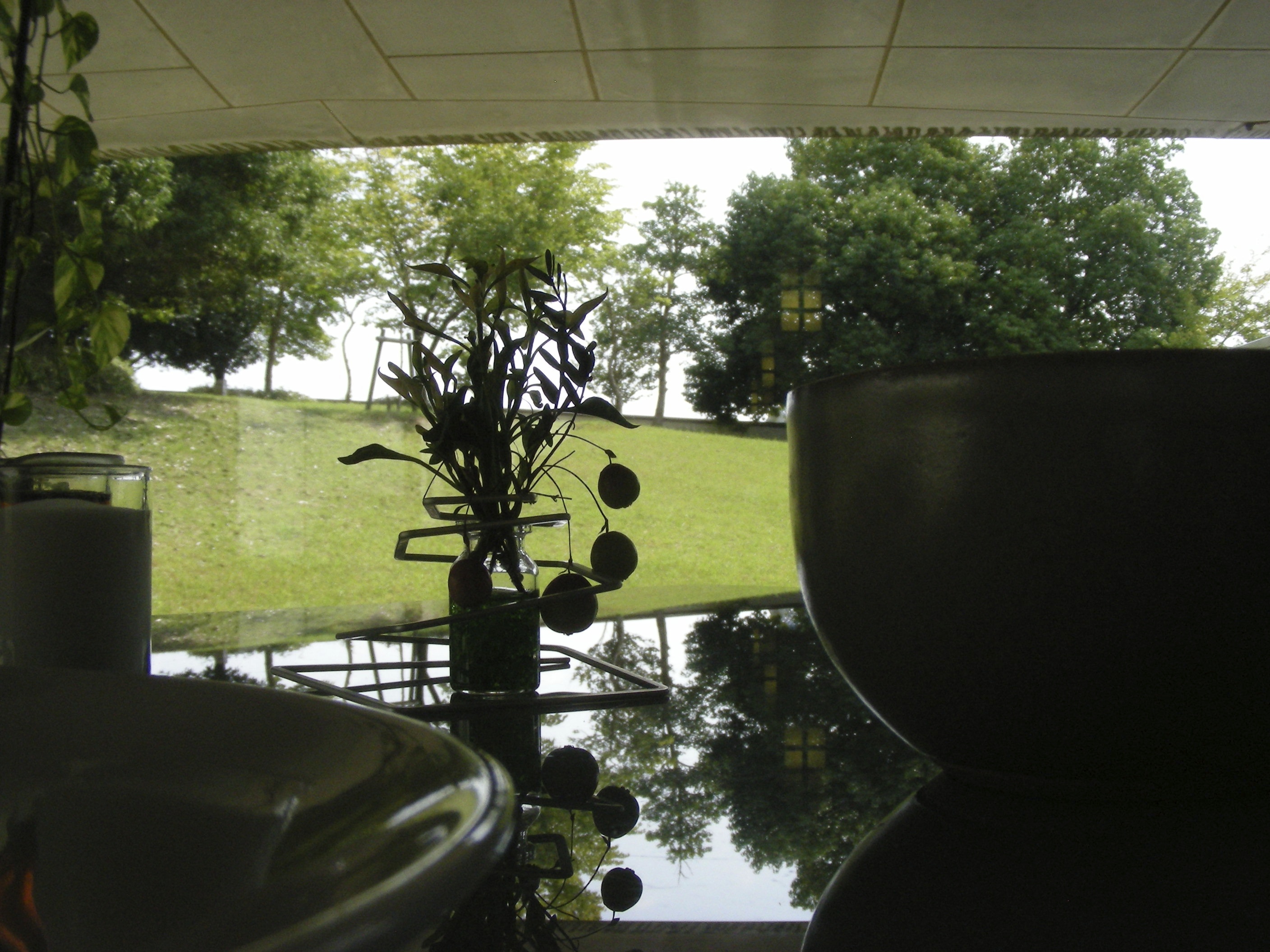
I took this photo in a tea house when visiting Japan a number of years ago. That tea house was one of the most peaceful places I’ve ever been, and I think part of what made it feel such a positive, healing place, was that they slid back the paper screens over the windows to reveal a terrace with an awning, and then all you could see were trees, bushes, and grass.
I was very fortunate to spend almost half my career working in Glasgow Homeopathic Hospital, which became the NHS Centre for Integrative Care once it moved into new, purpose built premises. Although the location of the new build was at the back of a major hospital site, just next to the railway station, the architect designed the L-shaped building around a garden. All the patient care rooms and spaces faced into the enclosed garden, which could be accessed by stepping out onto decking once you’d slid aside the French windows. Everybody commented on it. Patients and staff. We all felt the peace, the calm, the comfort, and the security which seemed to come from such closeness to green nature.
There’s pretty famous research into that phenomenon in the world of architecture. We know that patients recover more quickly, with less complications and less need for painkillers post-op if their hospital room has a view of green nature (as opposed to having no window, or a view of a wall).
We know, too that there are social as well as health benefits from the “greening” of cities.
But the other thing which occurred to me when I was remembering my trip to the tea room, was that those moments of peace which we all need, don’t have to involve learning any special techniques. There’s no doubt that various forms of meditation, and of cognitive behavioural exercises can be helpful, but there’s something powerful, even necessary, about just taking a pause.
Maybe not even just pausing by sitting and looking, which I’ve recommended before, but sitting with a cup of tea, or coffee, or some other favourite beverage, sipping, gazing, and contemplating freely.
I think it add to the quality of life. It’s a way of slowing down.
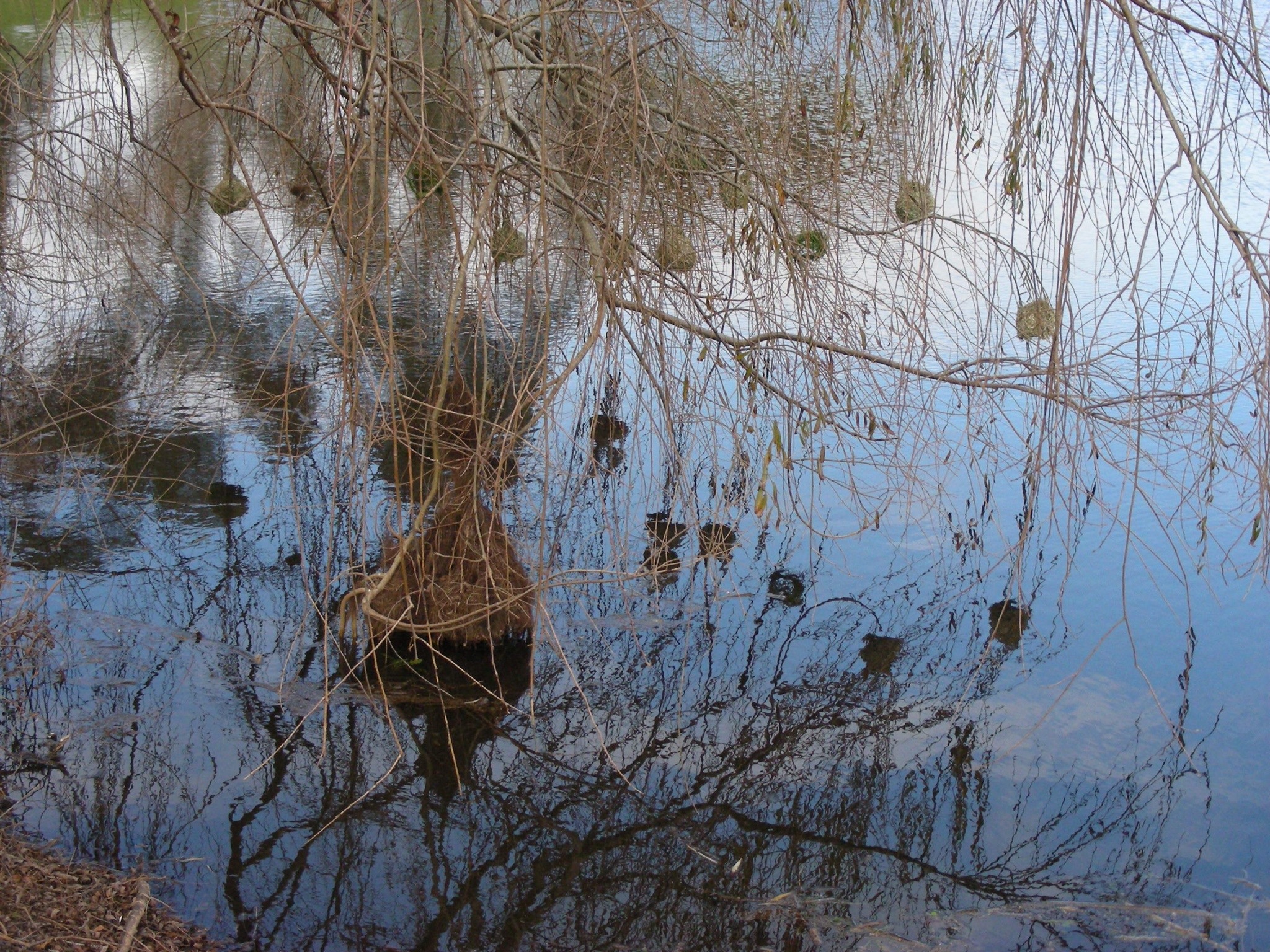
A few years ago, during a visit to friends in South Africa I saw these nests hanging from this tree. They are weaver birds. The nests they build hang like balls from the branches, and the entrances are at the bottom. How strange is that? You’d think that even if they didn’t make open nests like most birds, that they’d have an entrance in one of the side walls, a bit like the nesting boxes you can buy and fix to a post or tree in your garden, but no, these birds build this unique design of a nest with the entrance at the bottom. How they don’t all fall out remains a bit of a mystery to me, but I’m sure some ornithologist could explain it to me.
However, it wasn’t just the unique design of the nest which struck me, it was how many there were all hanging together in the one tree. I’ve found several birds nests in the garden here over the years. The great vine which used to cover the high stone wall (which has since collapsed, taking the vine with it) used to be a bit of a community hub for nests. But the mulberry tree and the buddleia bushes have only ever had single nests in them. There is a noisy flock of sparrows living in a mass of wild creepers and ivy on the wall of an old barn just along the lane a bit, but I haven’t managed to actually see their nests. However, I bet they are in there.
So, I’ve seen different densities of communities of nests and that got me wondering about the whole concept of community.
What communities do we humans live in?
I live in a pretty small village in rural South West France. I used to live in a moderately sized town in Central Scotland, and before that I lived in the great city of Edinburgh. Each of those environments enabled both different lifestyles and the opportunities to belong to very different communities.
This pandemic with all the restrictions in movement, and the months of confinement to our own homes has highlighted a couple of important things about communities, and I was thinking about them when I looked at this photo this morning.
One is that we can think of communities as the active, live, web of relationships in our lives. Whether we’ve been connecting over zoom, messenger apps, email, telephone or by letter, we’ve been more connected recently to our communities of relationships than ever before.
When we live in one place and work in another, our time, attention and energies are divided between different communities by geography. My daily commute on the train between home and work used to take over an hour and I used that time as a sort of personal time between the home/family community and the work one. Maybe there was even a kind of commuter community on the train. Certainly over the years I became familiar with a particular number of fellow travellers, but I didn’t really interact with them, so I probably can’t call them a community.
But that leads me to the second insight which the pandemic has made clear. We all share this one small planet. The virus knows no boundaries, no borders. The decisions taken in one country affect millions of people living in other countries. Scientists around the world began to co-operate more intensely and more openly than perhaps ever before. The scientific community, you could say, helped the scientists to discover new ideas, to learn lessons from each other and to problem solve together at speeds never seen before.
The truth is, that just as the “self” is in fact multiple, so in the “community”. We exist within a multilayered hyper-connected web of communities….plural. Maybe that realisation is a reasonable source of hope for the future. Because if we all retreat into separate, closed communities, we humans, are going to fail. The pandemic could be the least of our problems. If we don’t work together to deal with diversity loss, climate change and pollution, then we aren’t going to survive as any kind of community at all.
Well, in fact, I’m hopeful. I’m hopeful because I’ve seen the distributed global communities of personal and professional relationships thrive during these lockdowns. We can learn from that. Yes, maybe even home-working has started to revive some local, physical communities too, and maybe it’s starting to change the nature of larger communities in cities too, but, in particular I’m hopeful because we’ve rediscovered, or re-valued the importance of our communities of relationships and we now have the tools to enable us to grow them.
Maybe we are on the cusp of major change here…..maybe we are about to learn, or re-learn, the importance of understanding that reality is about us living together….sharing one planet, sharing one planet with all forms of life, sharing one planet with one environment.
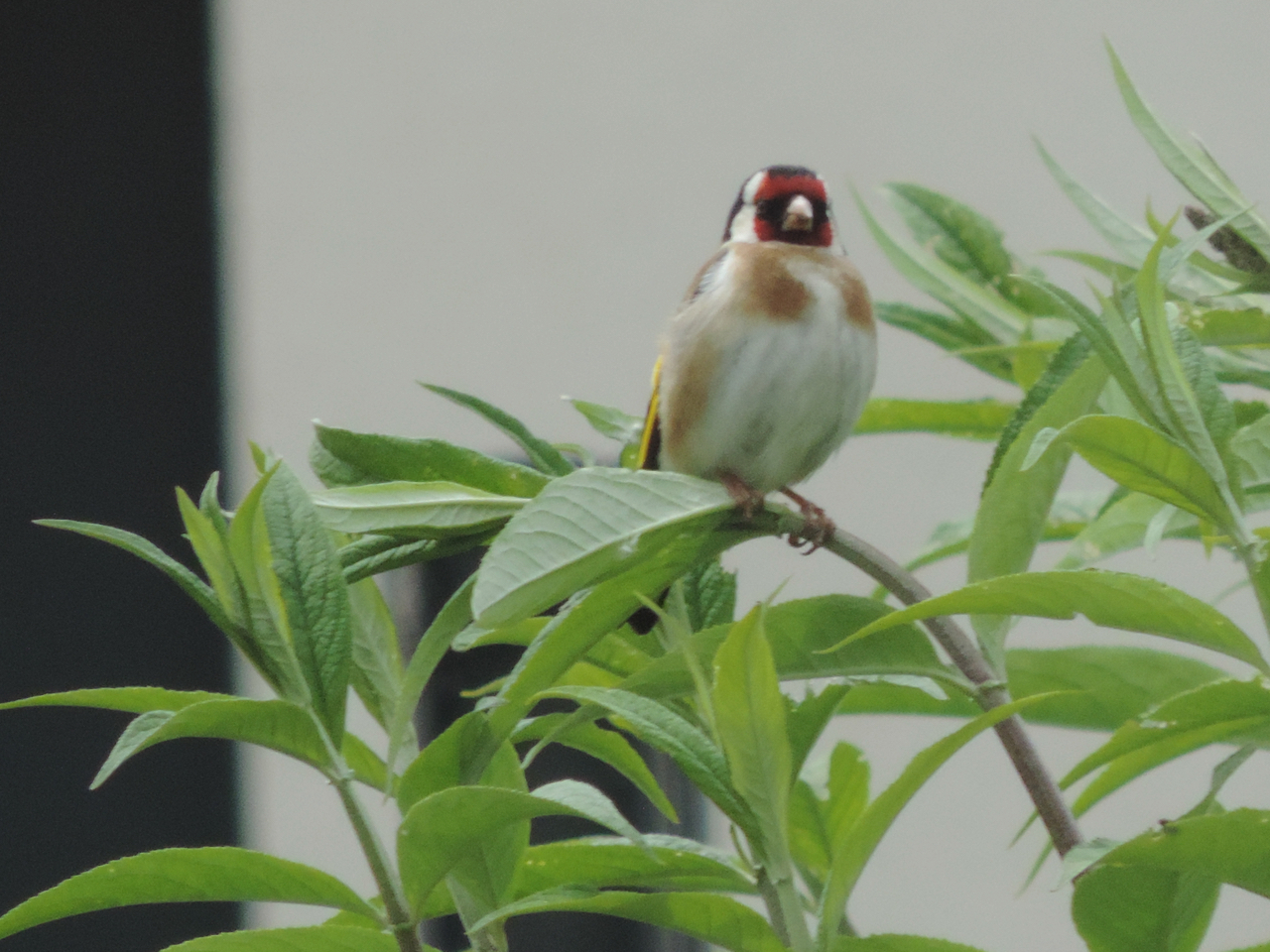
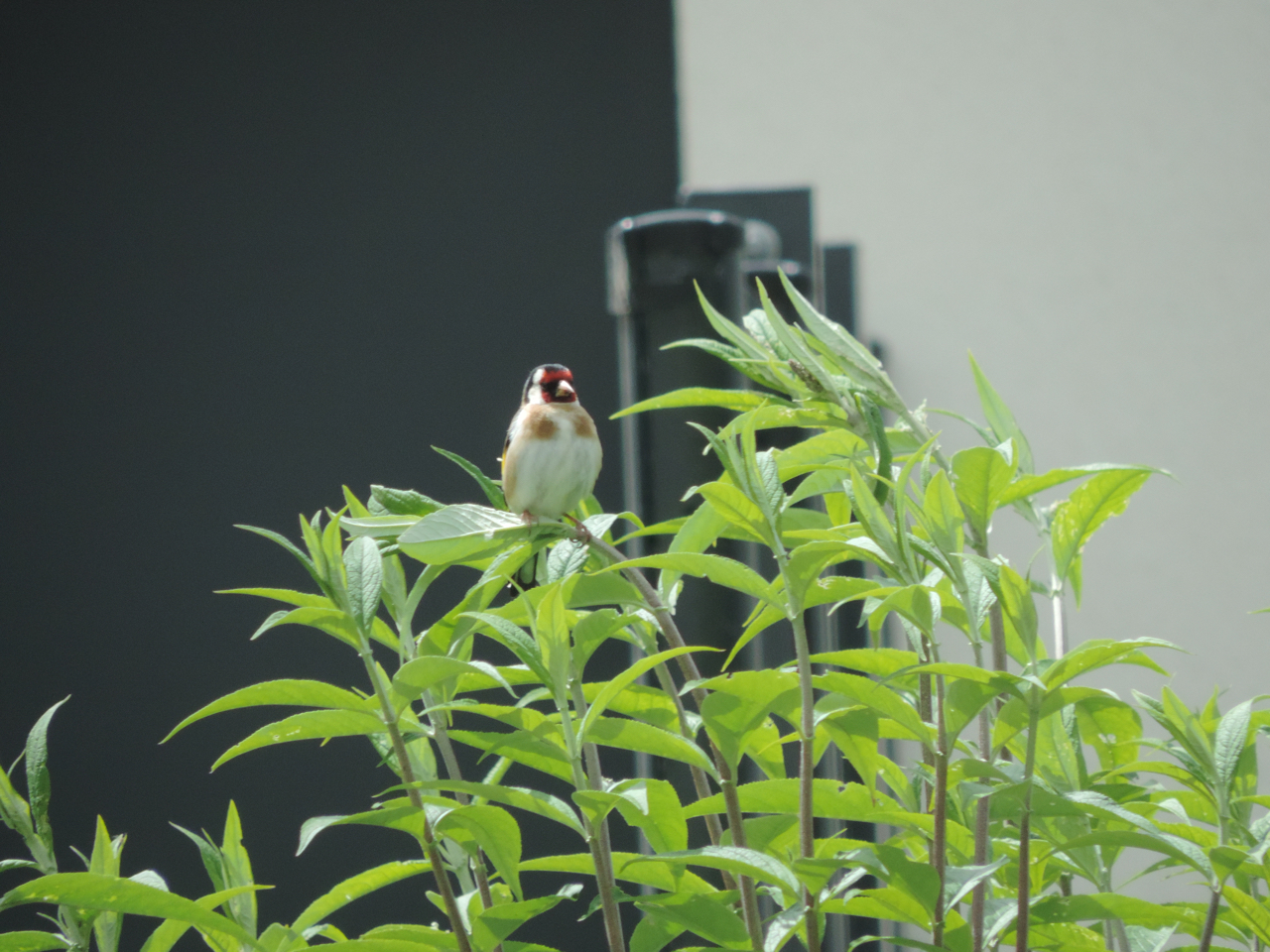
I’ve seen goldfinches flying through the garden from time to time. They tend to appear in noisy, busy, small flocks, making a lot of noise, bringing a splash of bright colours, and after a few seconds, or maybe a minute, they are gone.
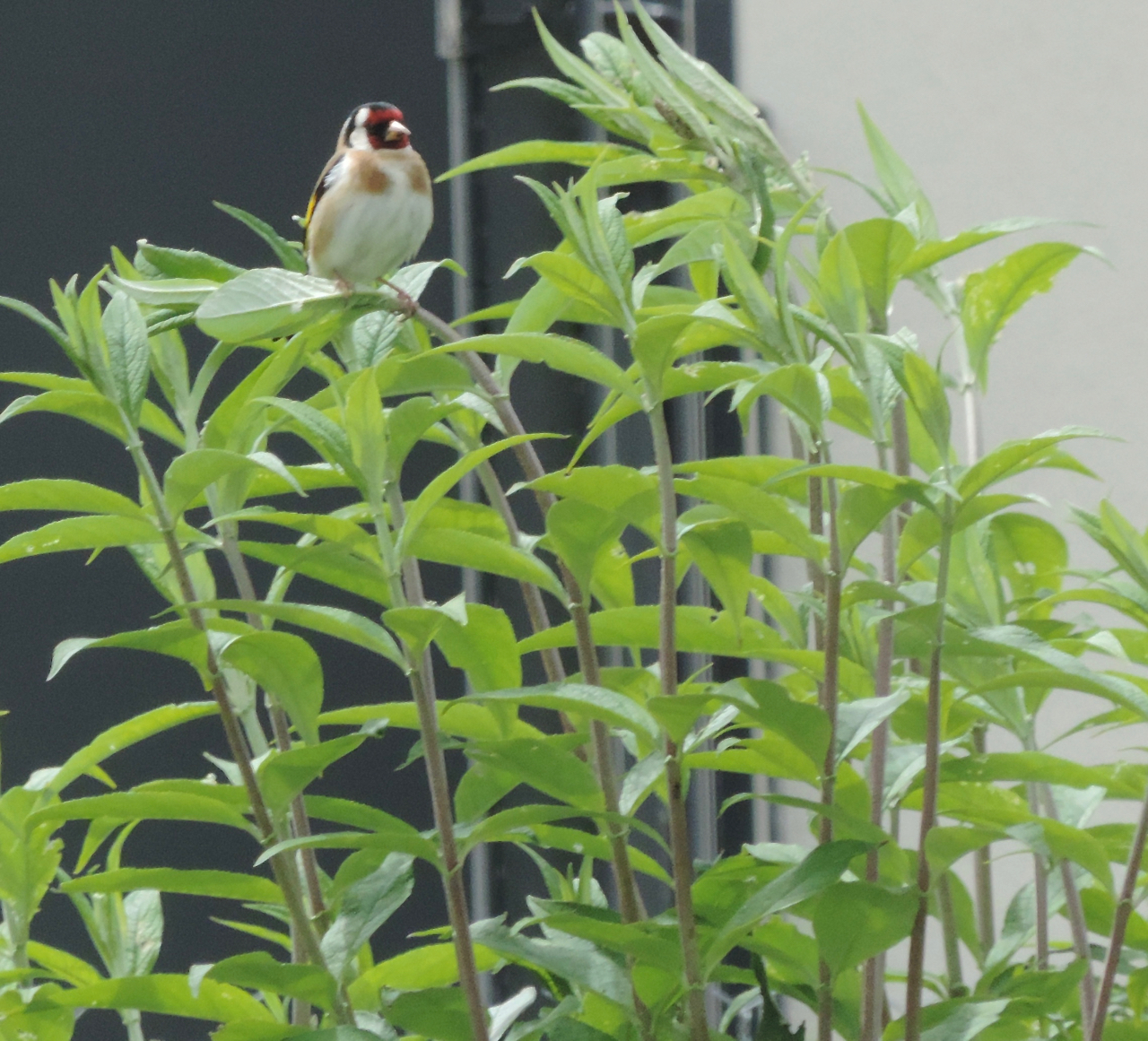
So, I was very surprised to look out the window the other day and notice this one sitting in one of the buddleia bushes. I was even more surprised when he stayed there for a long time – I mean, maybe half an hour or more – just looking around, all by himself.
He came again the following day, and sat in exactly the same place.
I haven’t seen him since.
Apparently, in some traditions, a goldfinch is a good omen, a sign of abundance and prosperity. It symbolises diversity, creativity, joy and simplicity.
Interesting, huh?
Whatever the symbolism (and we meaning-seeking, meaning-creating, humans can’t avoid seeing the symbolic values in everything we perceive), spotting this solitary goldfinch, at peace with the world, just taking his time to look around, was a powerful example of that value which I place so highly in my life – “l’émerveillement du quotidien” – the wonder/marvel/amazement of the every day.
What I find is that my life is enhanced by two things – awareness and curiosity. If I notice something, then give some time and attention to it, it often delights me. It also sparks my curiosity – what is that? what’s it doing there? – and sends me off to explore on the internet which deepens my experience and makes it even more meaningful.
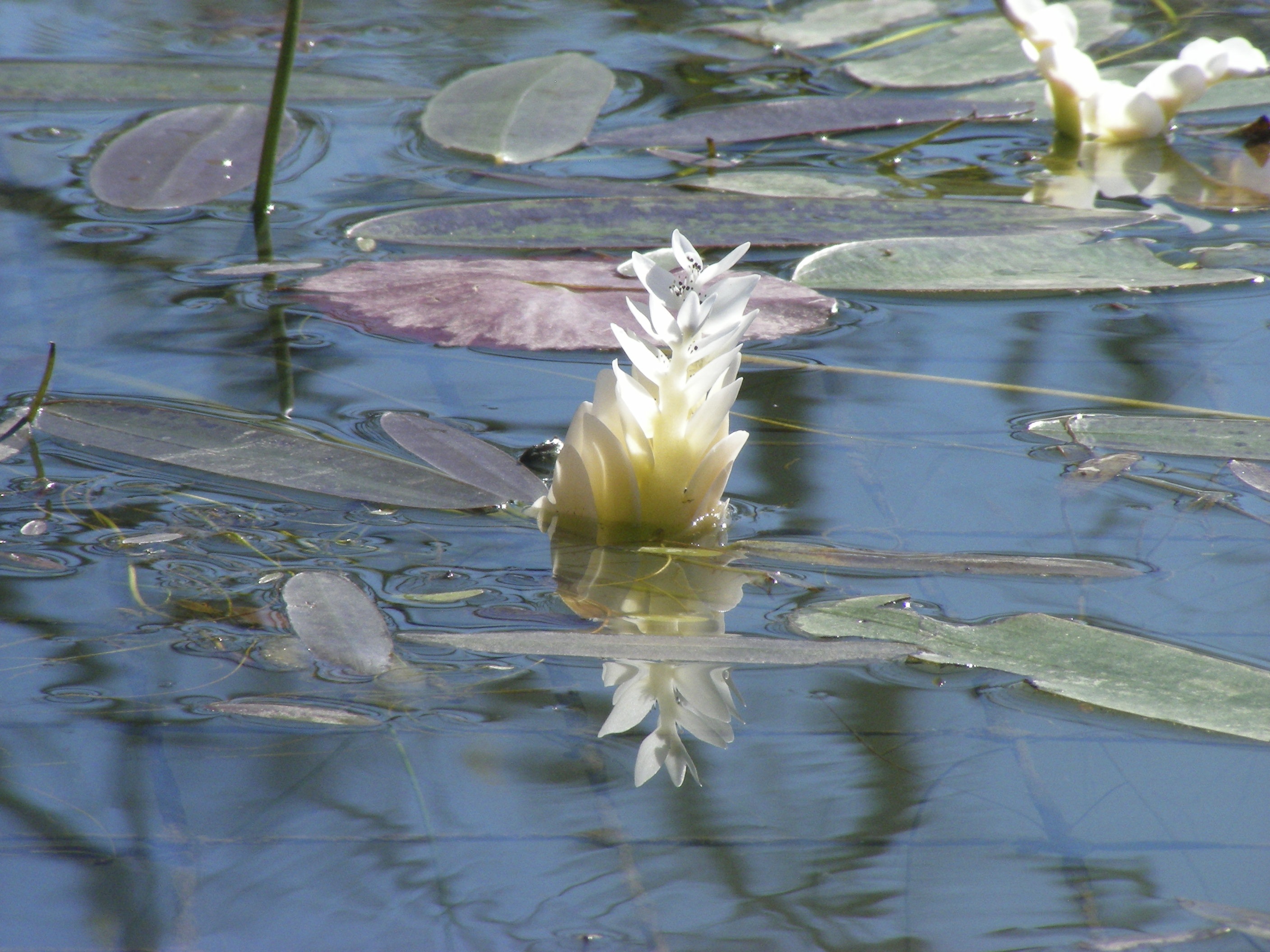
Sometimes it’s easy to spot the uniqueness in whatever it is we are looking at. Like this flower here, it is SO unusual to me that I could hardly have missed it. I’ve never seen petals forming this towering, layered shape before. And, of course, the reflection, as always at least doubles the impact of the flower.
In all my years working as a doctor I found that every single patient was unique. Everyone had a singular, personal, different story to tell. No two people had shared the same life, had identical experiences, responded to whatever they’d encountered the same way. No two patients had the same memories, the same imaginings which formed their fears, anxieties, hopes and expectations. Nobody had exactly the same beliefs and values. Nothing was black and white.
Every life was nuanced, shaded differently, shaped uniquely.
But superficially, it wasn’t like that. Superficially, patients were classified and categorised according to their diagnosis. Too often their pathologies were the sole presentation.
I even found that despite having an open, questioning style, when I asked patients to tell me their story, many simply told me their diagnosis, perhaps what treatments they were receiving, perhaps what interventions they had undergone already, but then they stopped. In other words they told me about the shared, common features of the disease they’d been told they had.
It could take a little more prompting to get them to describe their symptoms and their suffering and it could take a little more to get them to tell me who they were, to share with me their life story, their beliefs, values, expectations, fears and memories.
But the more personal the story, the more obviously unique it would be.
Sometimes I have to remind myself of that. It’s easy to judge and dismiss people we don’t know – celebrities, politicians, strangers – to put labels on them and then to look no further. But the truth is, the more we get to know someone, the more unique we realise they are, and the more unique we realise someone is, the more we have the chance to understand them.
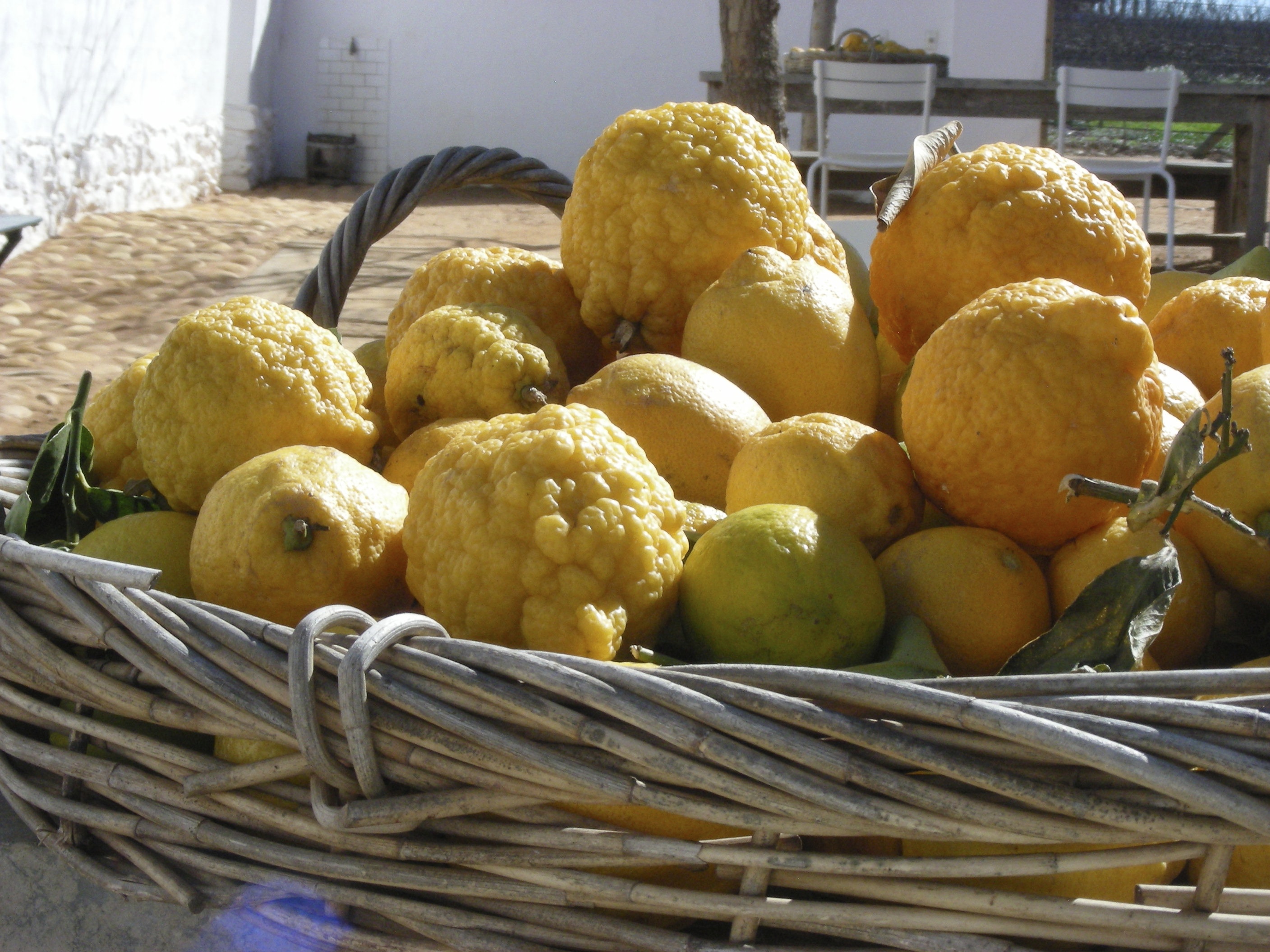
I took this photo at a wine farm in South Africa several years ago. Isn’t this the most incredibly diverse collection of lemons? I bet you’ve never seen a display of lemons like this at the supermarket. I know I haven’t it.
Fortunately there’s been a bit of trend in recent years to offer us “ugly” fruit and veg – by which the marketers mean fruit and veg which isn’t all uniform in appearance and size. The thing is, some people like that, but others don’t. We’ve been trained by corporations and governments to not simply accept uniformity but to even seek it.
But it’s not natural.
Nature is not uniform.
In fact as biodiversity decreases, which is what is happening now in the world, thanks to climate change and our industrialised, money-focused societies, our collective, and personal, security is under ever greater threat. There’s good reason to think that loss of diversity, erosion of soils, destruction of rainforests, and urbanisation are contributing to the rise of new pathogens, of which COVID is our more spectacular example so far. How many more are on the way? There are already worrying reports about other “novel” coronaviruses and influenza viruses being detected in different parts of the world.
I know that for many people when traveling from place to place they find a reassurance in the presence of the same fast food outlets, the same hotel chains, the same shops, the same brands. But, seriously folks, I think we have to break free of that false security. Because that’s what it is. False.
To shift our values from standardisation to uniqueness might turn out to be one of the best things we can do….not just for ourselves, but for the planet.
The lockdowns forced a lot of people out of offices, commuting and city centres, into their homes, streets, neighbourhoods, and for many people it’s been a bit of an eye-opener. For many there is now a desire for more flexibility at work, a desire for more local shops and services, a desire to connect and build within local communities.
I hope that grows.
Because, hey, when life gives you diverse lemons, make unique lemonade!
At one point in my life I was reflecting on what I was trying to achieve as a doctor. Maybe that seems an odd statement to you, but I think we fall very easily into routines and paths which we then “live” largely unconsciously. That’s what’s behind my “heroes not zombies” blog title. Whether it’s about saying “an unexamined life is not worth living”, or it’s simply about wanting freedom and autonomy, I’m wary of the automatic pilot approach to life. I want to be aware, to understand and to consciously choose, as much as I can. I want to move from being a zombie, controlled by hidden, and some not so hidden, forces, to being the hero of my own story – the main character, the subject, the one who is living this life.
I’m sure we all go through cycles and phases of self-reflection. For many people there is a peak of this around the age of 40, but, really it can happen any time and at any age. I believe it’s a good thing to pause and reflect from time to time. I think that’s essential to our personal growth.
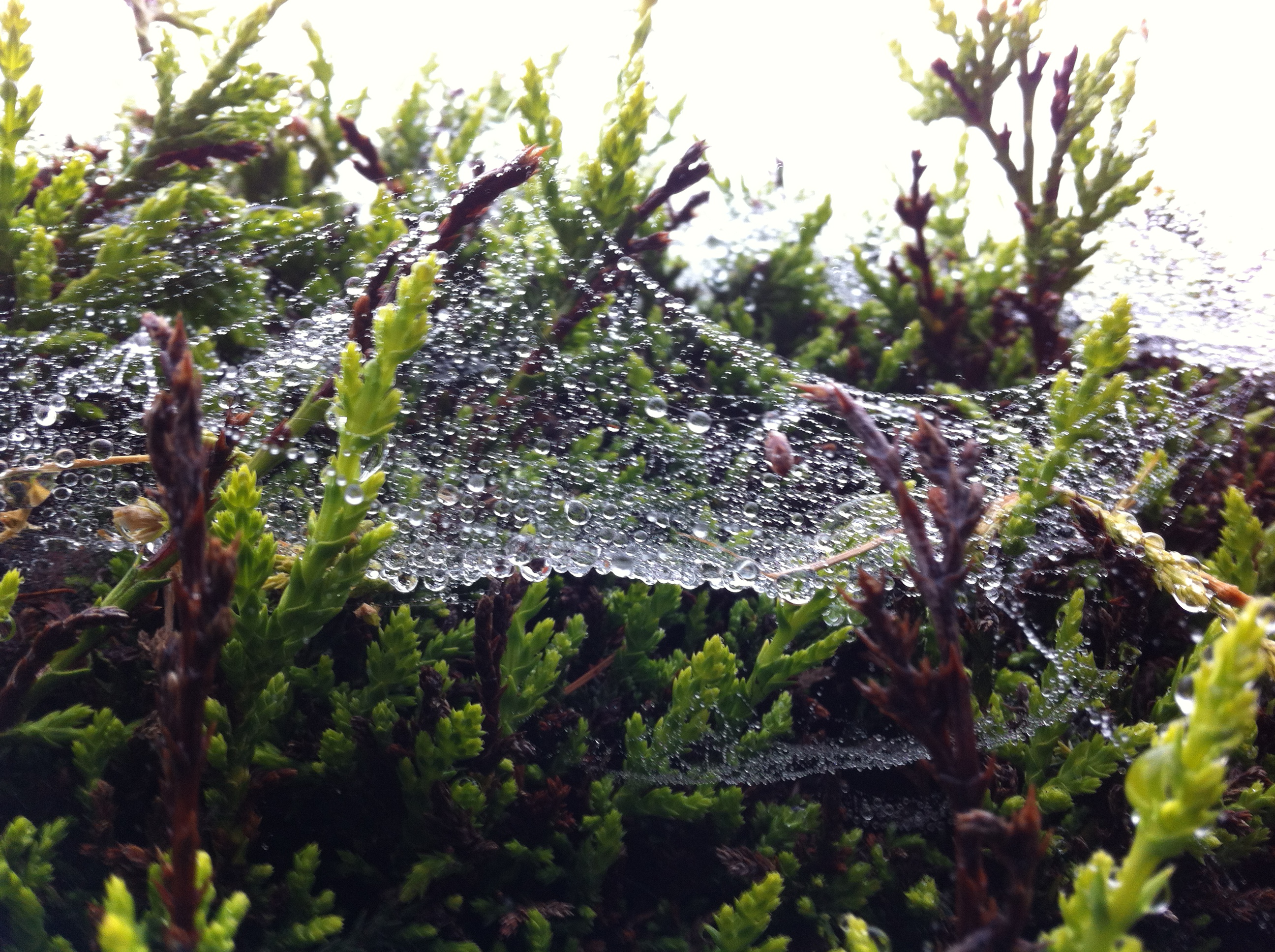
So, as I reflected on that question which would appear to me from time to time – “what does a doctor do?” – I looked at a spider web like the one above, early one morning as the dew drops sparkled on it, making it all the more beautiful, and revealing both its presence and its structure. What struck me was that whilst there were many elements coming together to make this web appear as it was, that morning, one element, light, suddenly seemed the one I wanted to focus on.
As I played with the words we use which are based on light, I hit upon three which I thought captured some of the most important aspects of my job.
Lighten. In all cases, I saw my job as trying to lighten other’s load. Maybe this was the first, and most important, part of all that I did. My job was to alleviate suffering. When someone left my consulting room, their life should feel a little lighter than it was when they entered. Certainly, it shouldn’t feel darker, and it shouldn’t feel heavier. Even when I’d had to give news of a serious disease. Giving news wasn’t enough. I needed to lighten the burden of that news by increasing how much the person understood, helping them to make more sense of what was happening, and helping them to realise that they were cared for, that they weren’t alone with this.
In fact, “diagnosis” is a big part of that. To me, diagnosis is not simply an act of labelling and categorising. It’s an act of understanding. It’s taking the messy chaos of experience and saying “I recognise this pattern” “I know what’s going on here”. What I found, time and time again, was that the very act of diagnosis lightened the load. Almost universally people start to feel better once they have a sense that they know what they are dealing with. Understanding, in my experience, shines a light.
Brighten. But then I thought, that’s not enough. Well, maybe it’s enough for some people who will go off with their new understanding and deal with it in their own way, but for many patients, I could do more. I could start to relieve the suffering, but I could also begin to help them build the positives in their life. I could help to actually brighten their days, both by giving reasonable hope, and by establishing an ongoing relationship of care focused on identifying and supporting their inner strengths, and teaching, coaching and enabling them to begin to grow in the light of this illness. This was a kind of turning a negative into a potential positive, because I’d find that for many of us, an illness was telling us something. It was suggesting that we should change something. And that required a development of strengths and skills.
Enlighten. In some cases, that work went to a whole other level. Someone would get nothing short of a revelation. They would suddenly understand the origins of their suffering, and they would gradually become aware of their own thought patterns, their own behaviours, and of the conditions in which they were living which were impacting on them so adversely, and they would say “That’s it. I’m changing.” Not just they would change some habit or other, but they would change direction. Get out of a toxic relationship. Leave a soul crushing job. Enter into education or training, or take the leap to begin something their heart had longed for, for many years. It was like they had a sudden enlightenment and said “I’m not going to live my life this way any more. I’m going to choose this other path instead”.
So, there I had it. My three light-based verbs. Lighten, brighten and enlighten. And of course, what happened from there? I applied those same three verbs to myself. That’s how I made the biggest changes in my life…..seeking some understanding which would lighten my load, turning towards positives, strengths, and emotions like joy, awe and wonder to brighten my days, and thinking outside the box I’d built, to change direction in the bright light of enlightenment.
The day I walked in a forest and encountered scattered, gorgeous red petals from some bushes, I came to an intersection. The path split and you had to choose which way to go. Smack on the intersection was this guidepost, which clearly directs you to go right. The fact that the arrow was painted the same shade of red as the petals strewn on the path struck me as not a coincidence. Somehow, it gave weight to the instruction. It helped me feel, yes, this is the best way to go. It “fitted” with what else I could see.
I’ve often wondered about this whole instruction/direction thing. I mean, who decided the path to the right was the best one to take? And why? I suspect it was laid out like this to make sure that everyone went the same way as they walked through the woods.
Shortly after I moved to this village in South West France, I came upon a panel near the church. It had a large map of the village and surrounding countryside and it had a couple of suggested walks traced out in coloured, broken lines. You could choose to follow the yellow walk, the blue walk or the green one. They were connected, so if you followed the shortest one, you’d find an intersection, where you had the opportunity to leave that route and expand into the intermediate walk, and, in that walk, there was a point where you could choose to leave that and follow the longest path. All the walks began from, and returned to the church. The panel said there were markers along the way. A bit like this red arrow, but rather than arrows, the markers were just “way markers” with dabs of paint according to which walk you were following. Some of the markers would have all three colours on them, and some, just one. You get the idea? Well, we set off to take one of the walks but pretty quickly, the markers vanished. Every intersection we came to seemed to lack any kind of marker whatsoever. Well, we eventually found our way back to the church, but wondered if the markers had all long since disappeared. The next time we decided to follow the route “clockwise” instead of “anticlockwise”, and guess what? There were clear markers at every junction. Whoever had set out the paths had painted the posts so they could be seen clearly as you followed a clockwise direction round the vineyards. But because they only painted one side of the posts, when you followed the paths anticlockwise, you couldn’t see a single marker!
Who decided there was only one way to follow the circuit? And when they did decide that, why didn’t they make that clear on the map at the start?
So, what’s this all about?
There’s no doubt directions and markers can be helpful. Very helpful. But rather too often they are a bit rigid, assuming that there is only one “right way” to go, and that everyone should go the same way.
That’s when I have a problem with them.
Life isn’t set in stone. Human beings are not all identical. There really is no such thing as “one size fits all”. So, I’m wary of “guidelines” and “direction indicators” and want to understand what lies behind them. So often nowadays, even the markers and signposts are missing. We are fed into a computer algorithm and coerced, pushed or pulled, along the same “choices” to make the same ones as everyone else. That problem is compounded by the way companies keep their algorithms secret. You don’t get to see the values, beliefs and intentions which the companies use to create them. And what if your personal values, beliefs or intentions are different from theirs?
In health care there are metre high piles of “clinical guidelines” and “protocols” now which every practitioner is expected to follow. I understand the good intention behind the creation of these things, but we have to accept that the future can’t be predicted, and that every patient is actually different, so there can be no single guideline or protocol which will guarantee the best health care for everyone.
Alongside that, I think the overuse of guidelines and protocols undermines the healthy development of both expert skills and “professionalism” and tends to give more weight to “processes” than to people (patients and practitioners).
That whole thing has got much worse during the pandemic, with an explosion of plastic arrows on the ground directing your movement and coloured strips setting new, otherwise invisible boundaries and limits. It all leads to a feeling of being micro-managed. It’s not comfortable.
How do we go forward in a better way? I suspect we need more transparency, more accountability and more flexibility on the part of the creators of these directions. A bit more humility would also help to prevent arrogance and righteousness in those who think they know what’s best for you better than you do yourself.
What’s your experience of directions, of markers, of guidelines, protocols and algorithms?
I’ve long thought that there is a dilemma at the core of the human being which comes from two apparently opposite needs. The need to belong, and the need to be an autonomous, unique, separate self.
How do we achieve that?
We are social creatures. We’ve evolved that way. We have the most sophisticated and complex neurology which allows us to do much more than create connections and relationships with others. It allows us to empathise, to get in tune with, others. It enables us to influence and be influenced by others.
This pandemic has shown us even more clearly than ever that we are social creatures. We need our relationships. We need our families, friends, colleagues.
From the moment we are born we need to create healthy, strong relationships with others…..without them, we would die.
It’s also pretty clear that we all share this one little planet, and that the air, the water and the nutrition that we all need exists in inter-connected cycles and ecosystems – all without borders.
But we are all unique and separate individuals. We each have a finely tuned immune system which recognises anything which is “not me”. We have well-developed personal boundaries and borders. And we are all actually unique. The universe has never created you before, never created anyone identical to you before, and never will in the future. As we weave the events, experiences and relationships of our lives into our personal biology, we develop a completely unique set of memories, beliefs, values, characteristics and behaviours. We are all different. We all have a unique narrative to share.
You might think what we need is a balance between these two needs – a balance between separateness and belonging. But balance doesn’t seem to be quite the right concept to me.
It seems that we need to be healthily separate and healthily connected, both a the same time. We need to see, acknowledge and respect the uniqueness of every human being we meet, AND we need to build bonds of commonality, as well as understanding the vast interwoven networks of co-dependency and co-creation without which none of us could exist.
I guess it’s back to my favourite “and not or” – we really, really need to pay attention to, and nurture, both of these needs – in ourselves and in others.
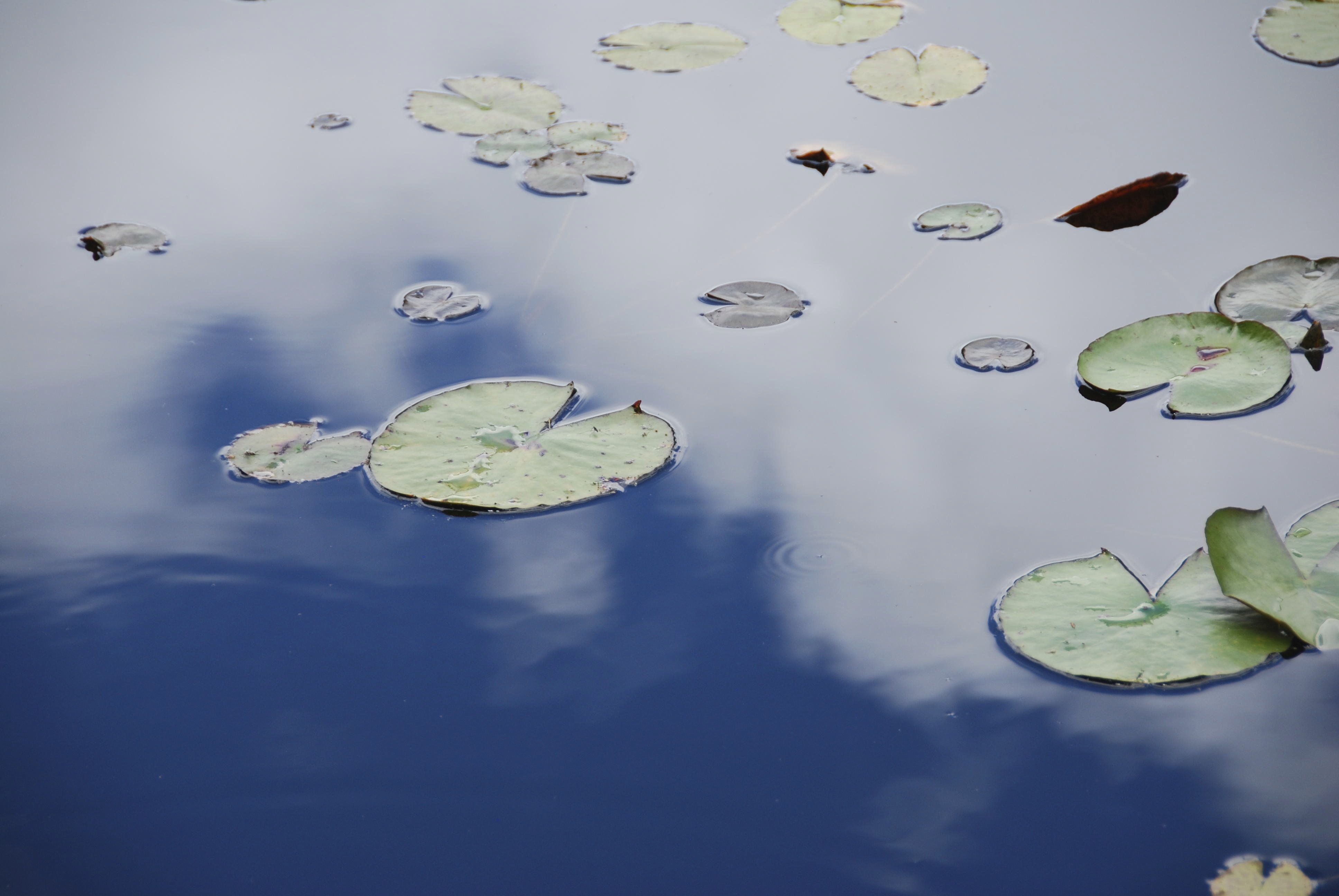
The phrase “The Floating World” is a beautiful one. I thought it was quite magical the very first time I came across it. I think where I first read it was in Kazuo Ishiguro’s novel, “An Artist of the Floating World”, a book which I still think has the ability to put me into an entirely different state of mind.
In the past it referred to a “pleasure seeking” urban culture but in modern usage
“the term ukiyo is used to refer to a state of mind emphasising living in the moment, detached from the difficulties of life.”
I really like the phrase and, in particular, I like the modern usage of the term. Living in the moment, detached from the difficulties of life, sounds pretty appealing to me. But there’s a strange paradox there, isn’t there? From one perspective I think the advice to be present, to be really aware of the time, place and circumstances which we call “here and now” is the only way to really engage with reality. After all, if our minds are busy wandering off down memory lane, or busy creating fantasies and fears about the future, then life, itself, is passing us by.
But on the other hand, what’s this “detached from the difficulties of life”? Is that a good piece of advice? Is that not escapism? Well, I suppose it could be escapism. T S Eliot said humans beings couldn’t bear too much reality after all. The entertainment industry and the psychoactive drug industry are both heavily focused on detaching people “from the difficulties of life”. Didn’t the Romans say the way to rule a people was through “bread and circuses”? In other words, make sure they aren’t hungry and keep them distracted with entertainment. Well, seems to me that’s still the most used strategy by those who wish to wield power over others in this world – whether they be politicians, businessmen or members of the 0.01%.
But isn’t there also a long, well established teaching about the power of non-attachment to reduce suffering in the world? Actually, I don’t think “non-attachment” and being “detached” are the same thing, but I won’t go into that in any more detail here.
My dilemma is how to be fully present, fully engaged with my life, moment by moment, yet not drown under the weight of difficulties, my own, those of others, or those of society.
Well, here’s where the floating world idea comes back strong. Look again at the ways of translating “ukiyo” – floating, fleeting, transient. Let me pick up that last word first. I have no doubt at all that an awareness of transience heightens my senses of delight and wonder. I relish the seasons of the new fruits and vegetables. I’m glad that those seasons don’t last all year round. I love to see the migrating birds arrive in my garden, and knowing that they will only be here for a few weeks before the fly south again, somehow, intensifies my delight in seeing them. I’m already looking forward to the hummingbird moths and the different coloured butterflies which will be attracted to the buddleia bushes in the garden once they flower. Knowing that we don’t live forever makes it all the more important to engage with life every single day…….not to run away from it, or pretend it doesn’t exist, but to fully engage with it.
Ultimately, this idea of a floating world is a counsel to “flow” through life, and that, I would say, is one of my highest aspirations. I want to experience the flow of Life through the cells and fibres of my being. I want to experience the flow of Nature, of existence, of the Universe, through the creation of every single unique moment and experience of my life.
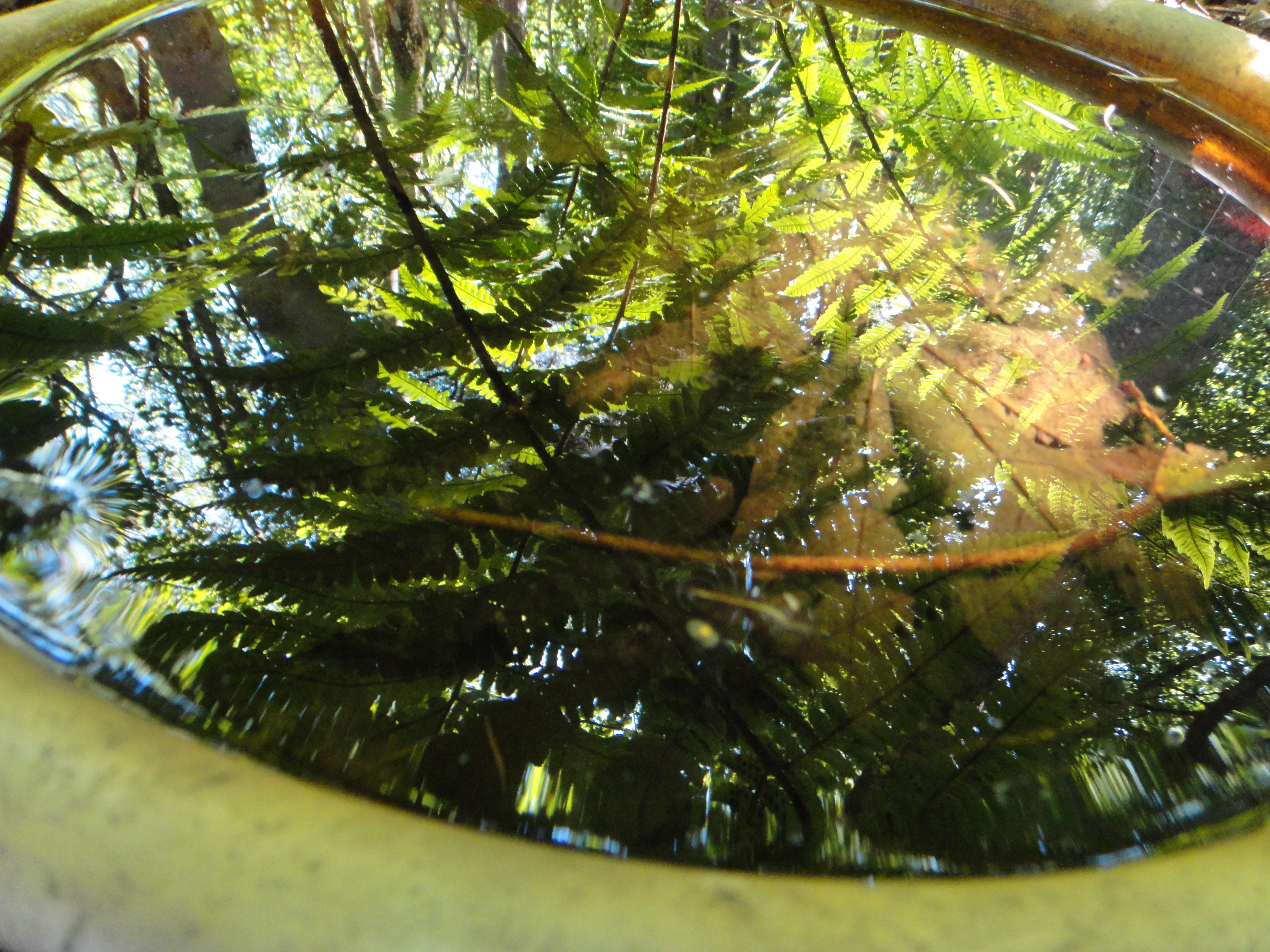
I came across this old stone bowl in the middle of a forest over ten years ago. The bowl was full to the brim with water. I don’t know what the bowl was doing there. I don’t know if someone threw it away, or placed it carefully here. I don’t know if they filled it with water, or if the rain fell day after day, between, and onto, the leaves of the trees which surround it. I don’t know its history.
But it stopped me in my tracks because of its beauty. Beauty can do that. It can be what we call “arresting beauty” because it captures us, catches our attention, slows right down and pulls us in.
I crouched down and took this photo. This is one of my photos which I return to again and again. Yes, partly because it gives me pleasure just to gaze at it. Within seconds I’m transported back into the depths of the forest. I can smell the damp bark of the trees, see the rich diversity of greens in the ferns, the bushes, the mosses and the trees. I can hear the birds singing.
But also because this is one of those images for me which works as a powerful metaphor of the mind.
When I look inside the bowl, the first thing I notice is the surrounding forest reflected on the still surface of the water. Isn’t that interesting? The first thing I notice is the world represented in the bowl. The first thing I notice is not the water itself. In fact, it’s quite hard to really see the water. When I look more closely I see ferns and I see tall trees and I see patches of blue sky above the roof of the forest.
Isn’t this a bit like how we perceive the world? Don’t we allow all the stimuli from the environment to set off cascades of chemicals and electricity inside our bodies and send them up towards the right cerebral hemisphere where we explore them, appreciate them, connect to them, and hand off some of that activity to the left cerebral hemisphere where we re-present it all to ourselves, match it against memories and knowledge, re-cognise it, analyse it, name and categorise it? Then send out the ripples and waves of that mental activity back towards the right hemisphere to be re-integrated into the whole, to offer it back to ourselves to give us the opportunity to make sense of it all, to seek meaning in it and weave the threads into our unique, personal stories.
I look more closely into the bowl to try to see the water itself, but it’s still not so easy. After all, how do we manage to see our own minds? How do we manage to see the processes which are going on which allow us to have this experience?
What do I see next? The hint of something below the surface. Are those brown leaves lying there? What else lies in the depths of the bowl? That gets me wondering again about the unconscious – all that activity which goes on just beyond our ability to be aware of it – all the processes of the mind and body which keep us alive, which nourish us, which defend us, which promote our growth. Now and again we catch some glimpse of what might being going on below the surface of awareness, of consciousness. We might glimpse it in our dreams. We might glimpse it in coincidences, synchronicities, in our imagination. We might glimpse it in meditation.
And what if the water in this bowl represents the self, the ego, the “I” who perceives and experiences? The water, the consciousness, which is filled with the reflections of the world in which we live our embedded, embodied lives?
The water, the deep subconscious below, and the bright reflective, surface above?
And after all this wondering, and mind wandering, I return to the sheer beauty, the magic, of this simple, old bowl of water lying in the depths of the forest, waiting for the opportunity to make my day special.
I welcome constructive criticism and suggestions. I will not, however, tolerate abuse, rudeness or negativity, whether it is directed at me or other people. It has no place here. ANYONE making nasty comments will be banned.



 Heroes Not Zombies