Feeds:
Posts
Comments

Archive for the ‘photography’ Category

two trees

The first thing to catch my eye was the light…..the colour, the deep, vibrant red of the setting sun. I picked up my camera and stepped out into the garden.

As I framed the shot the silhouette of the tree drew me to it, the contrast of the black in front of the red, the spindly shapes of the bare branches over the soft, flowing bands of clouds.

Then as I looked the second tree came into my field of attention, its shape, and its soft haziness. It looked to me like it had elements of the clouds behind it and the tree in the foreground, but melded both into something unique in itself – less spiky than the foreground tree, and less black too, but more angular and edgy than the clouds and blacker than them.

Looks good.

Click!

Not a typical sunset photo. Not a typical tree photo either. It draws me in…..

What goes through your mind in those moments leading up to “click!”?

Read Full Post »

I read a lot about complexity, and especially about complex adaptive systems, because it’s the most useful conceptual model I’ve found so far when I’m considering real life issues like health, illness, economics, personal growth (and so on!). An article entitled “Occupational Science and Social Complexity” by Aaron M. Eakman recently reviewed this model in the context of occupational science, and I thought I’d share a couple of the sections with you because he nicely clarifies some key points.

In the article there is a good summary of “characteristics [which] are common to complex systems”. He describes seven of them, and I’ve put in bold what I consider to be amongst the most important points to take on board –

1) Relationships between components of the system are non-linear,
meaning that a small perturbation may lead to dramatically large effects. By contrast, in linear systems the effect is always directly proportional to a cause.

2) Local rules affecting the relationships between components of the system lead to the emergence of global system order;

3) Both negative (damping) and positive (amplifying) feedback are often found in complex systems. The effects of an element’s behavior or the emergent behavior of the system are fed back in such a way that the element itself is altered.

4) Complex systems are usually open systems; they exchange some form of energy or information with their environment.

5) Complex systems are historical systems that change over time, and prior states may have an influence on present states.

6) The components of a complex system may themselves be complex systems. For example, an economy is made up of organizations, which are made up of people – all of which are complex systems.

7) Complex systems may exhibit behaviors that are emergent; they may have properties that can only be studied at a higher system level.

Think what these characteristics mean when you are considering a human being, an organisation, or a society. What are seeing are organisms or organisations which are undergoing constant, unpredictable change. You can guess how things are going to go, based on prior knowledge and experience of other situations which you judge to be similar, but you’re going to have to be constant alert to the fact that things are very likely to go some other way entirely, and you’ll need to adjust your choices accordingly.

In fact living creatures, particularly multi-cellular ones, like human beings can be thought of as a particular kind of complex system – a “CAS” (Complex Adaptive System).

Complex adaptive systems are special cases of complex systems which are adaptive in that they have the capacity to change and learn from experience. John Holland describes a complex adaptive system as a dynamic network of many agents (which may represent cells, species, individuals, firms, nations) acting in parallel, constantly acting and reacting to what the other agents are doing. The control of a complex adaptive system tends to be highly dispersed and decentralized. If there is to be any coherent behavior in the system, it has to arise from competition and cooperation among the agents themselves.

In other words, we don’t just constantly change, frequently in unpredictable ways, but we adapt – our changes are not entirely random, they are informed – informed by prior knowledge and experience and informed by constant feedback in the here and now.

That last point about coherent behaviour arising from “competition and cooperation” is a challening one. There are a lot of people who think that competition is THE key in understanding life and evolution. There are others who say, no, it’s cooperation which is the key. It seems the reality is, it’s both.

Complexity science eschews reductionism and determinism by focusing on the emergent properties of a system and the non-linear interactions of a system’s components. Complexity science recognizes that such systems cannot be understood simply by understanding the parts – the interactions among the parts and the consequences of these interactions are equally significant.

Modern Medicine is still stuck in the reductionist and deterministic paradigms. And the problem is they just do NOT reflect reality. We don’t just need the science which shows us how particular cells or organs work. We need the science which shows how what happens when active agents begin to compete and co-operate. We need to discover just how a complex system adapts, repairs, heals and evolves. The old idea of “fixing” the “wonky bits” only works (and only for a limited time) where the scenario conforms to reductionist and deterministic paradigms (in Acute Care for example)

One more thought provoking point from this article –

Finally, Byrne (1998) has asserted that as a basis for social action: Complexity/chaos offers the possibility of an engaged science not founded in pride, in the assertion of an absolute knowledge as the basis for social programmes, but rather in a humility about the complexity of the world coupled with a hopeful belief in the potential of human beings for doing something about it.

Byrne, D. (1998). Complexity theory and the social sciences. New York: Routledge.

I couldn’t agree more.

Humilty

and

Hope

Let’s proceed on that basis.

Read Full Post »

Yesterday was the shortest day of the year in the Northern hemisphere, so I popped out to the garden and captured the last of the light after the sun sank below the horizon.

last light of the shortest day

I noticed that there was a plane way above me, heading north, so took another shot to include that too.

flying into the night

Look carefully, it’s just above and to the right of the tree at the far left of the frame.

Read Full Post »

rocks like water


In the second part of the A to Z of Becoming, Y stands for the verb, “yield”.

How can yielding help you grow?

Well, to yield is to be flexible. It isn’t about giving up. It’s not about being “soft”. Look at the photo above and see how the rock yields to the water, and the water to the rock. They become something distinct together by yielding a little to each other, so the rock contains the path of the water, and sets the banks of the river, but the water doesn’t give up. It flows continuously against the rock, not penetrating it to go straight through (have you ever seen a river which is perfectly straight?), but by yielding to the rock’s firmness, its strength, and carrying on.

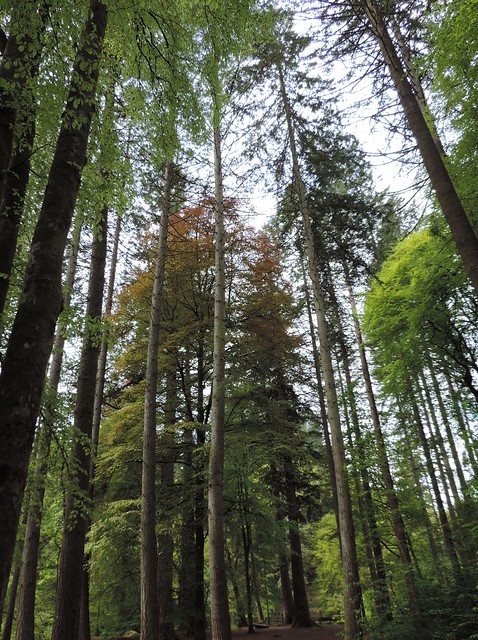
Look at these trees below. They are amongst the tallest, oldest trees in Scotland.

Hermitage


When the wind blows, they yield. They sway. They give a little. And in so doing, absorb some of the strength of the wind. And the wind yields a little of its strength to the trees. The wind does not pass through the forest in a straight line, but the trees don’t break in half and fall over (except when they do!), so they grow stronger and taller and live longer, with an interplay of firmness and yielding.

To yield is to be adaptable, to be flexible. It’s not about giving up. It’s about absorbing the force pressing against you, adapting, and flowing on.

Do you need to yield a bit to grow?

Read Full Post »

Can hugs make you healthier?

Here’s an interesting study from Carnegie Mellon University. The researcher, Sheldon Cohen, said

We know that people experiencing ongoing conflicts with others are less able to fight off cold viruses. We also know that people who report having social support are partly protected from the effects of stress on psychological states, such as depression and anxiety. We tested whether perceptions of social support are equally effective in protecting us from stress-induced susceptibility to infection and also whether receiving hugs might partially account for those feelings of support and themselves protect a person against infection.


The researchers measured over a two week period, frequencies of interpersonal conflicts, the level of perceived social support and receiving hugs in about 400 healthy adults. They then exposed the participants to a common cold virus and monitored in quarantine to assess infection and signs of illness.

The results showed that perceived social support reduced the risk of infection associated with experiencing conflicts. Hugs were responsible for one-third of the protective effect of social support. Among infected participants, greater perceived social support and more frequent hugs both resulted in less severe illness symptoms whether or not they experienced conflicts.


“This suggests that being hugged by a trusted person may act as an effective means of conveying support and that increasing the frequency of hugs might be an effective means of reducing the deleterious effects of stress,” Cohen said. “The apparent protective effect of hugs may be attributable to the physical contact itself or to hugging being a behavioral indicator of support and intimacy. Either way, those who receive more hugs are somewhat more protected from infection.”

Hugs, however they actually do their stuff, have long been one of my most favourite ways of staying healthy! (And even if they had no “protective effect”, they’d still be good, wouldn’t they?)


Read Full Post »

John Berger writes

Because true translation is not a binary affair between two languages but a triangular affair. The third point of the triangle being what lay behind the words of the original text before it was written. True translation demands a return to the pre-verbal. One reads and rereads the words of the original text in order to penetrate through them to reach, to touch, the vision or experience that prompted them. One then gathers up what one has found there and takes this quivering almost wordless “thing” and places it behind the language it needs to be translated into. And now the principal task is to persuade the host language to take in and welcome the “thing” that is waiting to be articulated.

Interesting, huh? That mechanical translation matches word to word then seeks to get the grammar correct, but is the original idea or meaning translated well that way?

As I begin to live in a country where the language is not my first language, I find that, at least in this first phase, I’m translating all the time. Reading or hearing French and translating it into English in my head to understand the meaning. But already there are phrases which seem to require no translation, and phrases that pop into my head fully formed in French. I’m guessing that gradually I’ll do less and less translation.

But actually although Berger is talking about translating a text from one language into another, I think maybe the same issues apply to all communication. I have an idea or a feeling to express, pick some words, some phrases. I’m translating it into written or spoken language. Aren’t I? Which leads me to wonder about the rich diversity of inner lives. I’m sure we all get that experience, from time to time, where we think that someone else seems to come from another planet. Where their worldview is so different from ours that we don’t even seem to be speaking a common language, despite the fact that a superficial observation would lead to the conclusion that we are indeed speaking the same language.

When Berger mentions the third point of the triangle, I suspect he is thinking of our inner lives. That leads me to three questions today.

  1. How can I know my inner life?
  2. How can I express or show my inner life?
  3. How can I know the inner life of another?

For me, the first involves practices of awareness and reflection, the second, creative acts, and the third requires ongoing dialogue. Isn’t it interesting that all three have no end? I will never know myself completely, never be able to fully express myself, and never fully know another. That makes me feel both excited and humble.

Excited because all that is an adventure, a voyage of discovery, and a constant stream of revelation and wonder. It is the ‘émerveillement du quotidien‘.

Humble because nothing can be known completely, fully or finally. Montaigne knew that with his ‘Que sais-je?

Over to you now. How do you answer those three questions? You, personally, in your own life?

  1. How can I know my inner life?
  2. How can I express or show my inner life?
  3. How can I know the inner life of another?

Read Full Post »

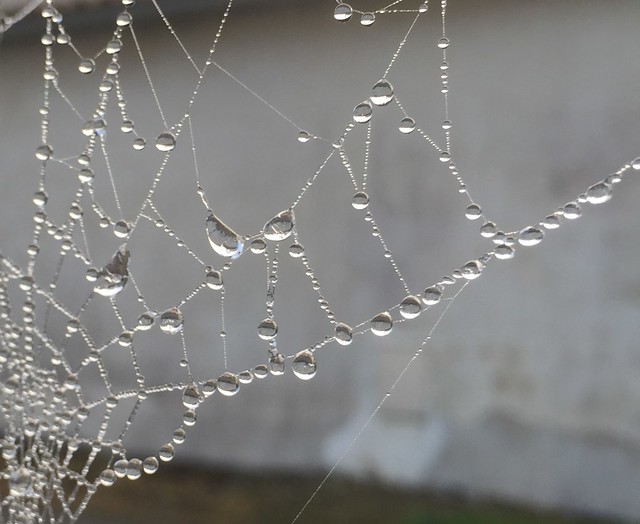
webdrops

Why do I find the dew-soaked, rain-soaked spiders’ webs so appealing?

Three reasons, at least –

First, they are just so beautiful.

Second, each drop becomes a little lens, which shows the surrounding world upside down. Reminds me how everything we experience is through our personal lens, so our view of the world is always our unique, singular view.

Third, because the form/concept of links and nodes describes so well the phenomena of the world. Shifting our perspective from seeing a world of objects, to seeing a never-ending web of links, hubs or nodes, connections and relationships is exciting!

Read Full Post »

In the second part of the A to Z of Becoming, we’ve reached the troublesome letter “X”! In the first part, I chose “eXcite“, and in this part I’m going for “eXtol” (yes, I know they both start with an “e”, but make me a suggestion – what verbs do you know actually start with an “x”?)

To extol means to praise….to enthuse about, to rave about, to passionately, lavishly praise. So, it struck me, how appropriate to be choosing a verb which means to praise this month.

What, or who, would you like to praise, and why?

I’ll start……

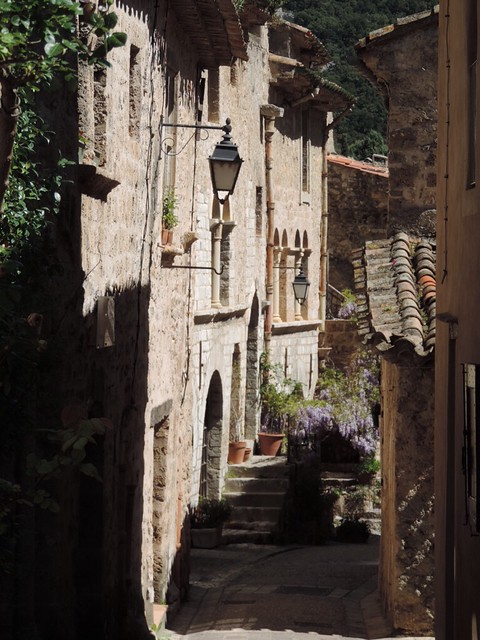
In April we visited one of the most beautiful villages in France – Saint Guilhem le Désert – it looks like this –
Saint Guilhem le Desert

In this village we stumbled across a tiny perfumier run by man called Nicholas Jennings. Here he is –

nicholas

Look behind him at his wonderful desk where he selects the various natural scents to make the products he sells in his shop.

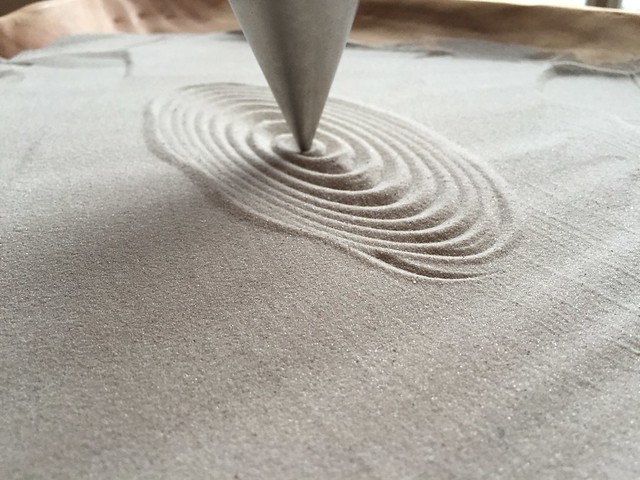
At the door of the shop, he had a wonderful pendulum drawing intricate designs on sand. Nicholas and his friend, Ludovic make them.

So, now that I have my study set up in my house in France, I’ve got my own “pendule de sable” hanging in the window.

Look!
Pendule

Written on the sand

Isn’t it wonderful?

So, there’s one thing for me to “extol”! The amazing, totally absorbing, pendulum of the sand.

And while I’m at it, I can enthuse about Nicholas and his wonderful perfume shop, and the village where it is – Saint Guilhem le Desert.

The village is on one of the paths of the pilgrims to Compostella – you can know that from seeing the saint-jacques shells everywhere…..

DSCN1100

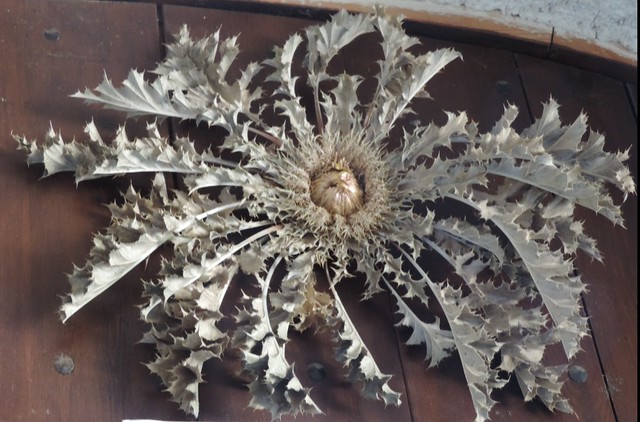
There’s something else unique in this village, and that’s the dried “cardabelles” on the doors. This is now a protected plant, but the villagers can gather them in season. It’s believed to bring luck and protection.

Cardabelle


So, as I set the pendulum in motion once more, I’m not only absorbed in the uniqueness of every single design it makes, but I remember Saint Guilhem le Desert, the cardabelles, the shells along the pilgrim’s way, and Nicholas and his shop.

See what joy can follow when you start to “eXtol” something?!

Your turn……….


Read Full Post »

Joy

Joy

the magpie rhyme 

Read Full Post »

behind the vine

Now the leaves have fallen from the vine, it’s a different kind of beautiful.

Read Full Post »

« Newer Posts - Older Posts »