Sometimes we just need to pause, slow down, step off the wheel, take a few deep breaths.
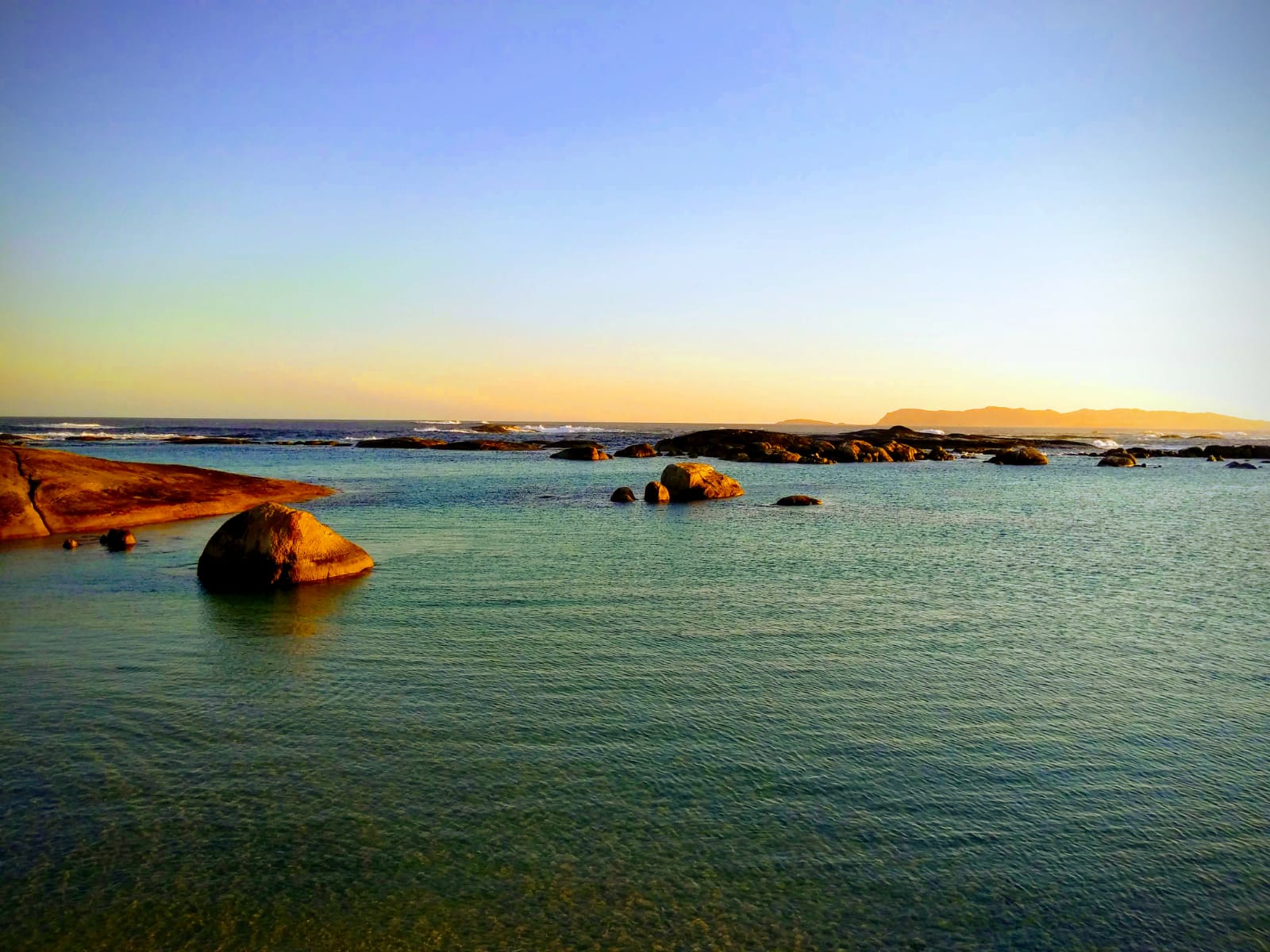
There are many ways to do that, but one I find effective is to contemplate a peaceful scene. Here is one such scene. I love the calmness of the sea, the green of the water, slowing morphing into blue the further we look (the distance is usually blue isn’t it?) then on the horizon I see where the deep blue sea meets a golden bank of air before my eyes ascend towards the deeper and deeper blue of the heavens. I see long, flat, smooth rocks, languishing on the golden horizon and soaking themselves in the peaceful green water in the middle of the scene. I see some breaking waves splashing white where the green water turns blue, and these are pleasing waves, the kind you hear breaking with sighs as the ocean exhales on the beach.
Find your own way around the scene. Take your own route. But just spend a few moments, or even minutes, allowing yourself to take it all in……..
We often look at the world this way….just a peek through a narrow gap. We can see a bit this way. It’s a way of being focused. If we narrow our gaze we can ignore everything except what’s in the target zone of our attention.
You know we have “two brains”, right? I mean the recognition that we have a cerebral cortex which is divided into two, non-symmetrical parts. Why do you think the brain is like this? Why not just have one, whole brain? Why did evolution prefer to develop the cortex in two significantly different hemispheres?
Well a lot of people have tried to claim that the right half does these things, and the left these other things….like the right is what we use to “do art” and the left is what we use to “do logic”. But we know that’s not true. The brain is not like a clock, a car, or a computer. It doesn’t function with one part doing “this” all by itself whilst other parts do “that”.
But Iain McGilchrist figured it out. In his “The Master and His Emissary” he lays out what I find to be a convincing thesis – each hemisphere engages with the world differently – in other words, each hemisphere gives us a different way of approaching, understanding and interacting with, the world.
What the left hemisphere allows us to do is like what you see in this image. We use it to narrow our gaze. We use it to focus in on “parts”, to analyse them, label them, categorise them, in order to try and “grasp” and manipulate them. The right hemisphere, on the other hand (see what I did there?), is used to enable a broad gaze. We use it to focus on the connections, to explore the bonds and relationships, to discover what’s new, and to see things in the broader view, or in “the whole”.
What amazes me about this is that we use both halves simultaneously pretty much all the time. They are in constant interaction, giving us the ability to “integrate” and “synthesise” what they focus on.
The trouble comes when we fail to pay enough attention to one of the halves – actually, in our modern world, it’s the right hemisphere we fail to attend to sufficiently. We get stuck in our world view of seeing reality as composed of separate parts which we can label, categorise and control. We get hooked on a mechanistic model. And, well, reality is not like that. That picture is incomplete and can lead us astray.
So, we do need these abilities to focus narrowly, to separate out elements, analyse them and organise that knowledge, but we ALSO need to be constantly aware of the big picture. We also need to see the contexts, the connections and the circumstances. It’s this that enables us to see uniqueness.
When it comes to this pandemic, we need to understand and analyse the COVID-19 virus. It will be a real boost to us to discover how to improve our treatment of people who are infected with it to try and reduce the potential damage they might suffer. But we need to use that other half of the brain too and see what the circumstances are in which this pandemic has arisen. We need to join up the dots. We need to see the connections and the contexts.
Isn’t it clear that one reason why this pandemic is so damaging is that we don’t have enough good health care? I think this issue is the same whether you live in the UK, France, the US, Spain, Belgium….you name it. It’s not the sheer number of people who are suffering from significant effects of this virus – after all, it seems about 80% of those who catch it don’t even get any symptoms. It’s that the small percentage of people who DO suffer serious effects from it still constitute numbers potentially too big for our health services to cope with.
Why do you think there is this constant message about “protect the NHS” in the UK? The NHS shouldn’t need “protecting” from sick people! It’s very purpose is to treat them. But the truth is there aren’t enough staff, there aren’t enough hospital beds, there isn’t enough equipment, there isn’t enough PPE, there aren’t enough testing materials, or laboratory resources.
There isn’t enough decent, safe social care available for the elderly. There isn’t sufficient support for people whose incomes are hit by forced closures of their workplaces. There isn’t enough decent housing. There isn’t enough decent nutrition because the current model of industrialised farming and processed food production is feeding both obesity and nutritional deficiencies of important vitamins and minerals which are needed for healthy immune systems.
And so on……
Unless we use our whole brains and address the underlying weaknesses, vulnerabilities, insufficiencies and injustices in our societies we will find not just this pandemic hard to handle, but we’ll set ourselves up for more of the same.
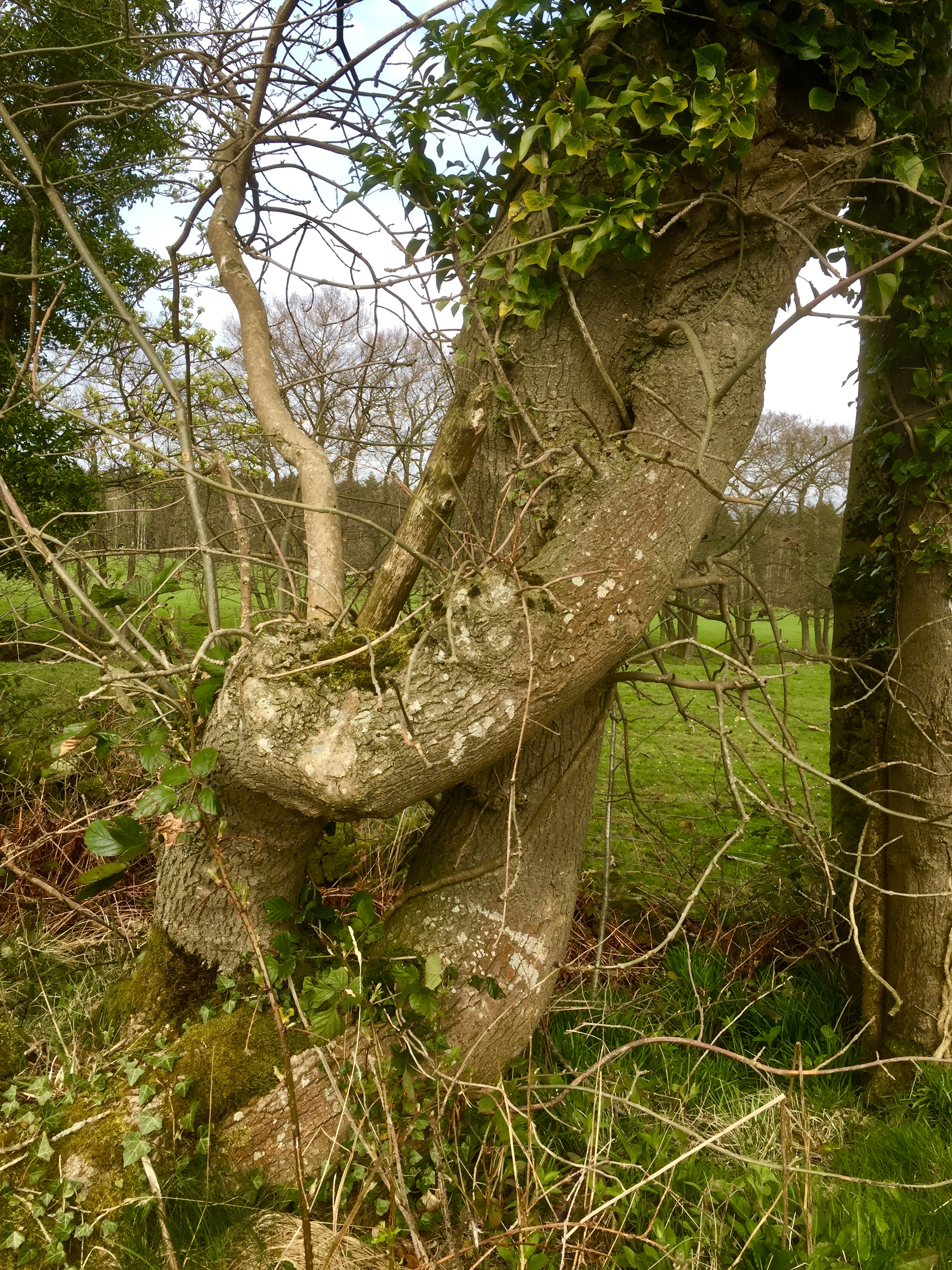
I’ve stumbled across trees like this a number of times. The first time I saw a tree trunk taking such a convoluted, twisting path I was quite astonished, but more than not I see such patterns not just in a single tree, but in a tree’s relationship to another tree.
It’s not that common to find trees entangling themselves in each other like this. Of course, there are other plants, for example, “climbers”, which have the ability to entwine themselves on whatever they can reach, as their core characteristic. But in trees, it’s not so obvious. You know why? Because they do most of their entanglement below ground….in their root systems, which we now know from forest studies, are vast entangled webs of connections between trees with microfibres and fungi creating most of the functional connections between them.
We humans are perhaps the most sociable creatures of all. We certainly have the most highly developed systems within our bodies and brains to enable us to pick up signals, make responses, create bonds and connections, and to co-operate with others.
A bit like with the trees, most of those connections go on underground. Well, not below the soil, as they do in tree world, but in the sub-conscious. I think we tend to forget that. Our oldest, most developed, most evolved systems of function are unconscious. From everything to do with maintaining a healthy living body, to the detection of information and energy, to the whole vast world of emotions. It mostly happens below the level of consciousness.
We don’t have to think about making our heart beat. We don’t have to think about releasing insulin or adrenaline. We don’t have to be conscious of our processes of digestion. Our emotions, like our dreams, emerge from our sub-conscious.
Neuroscientists have discovered that our conscious thought making processes are actually much slower than our unconscious ones. Much slower, and starting just a bit later than the unconscious ones.
That’s quite something. We tend to imagine that we are primarily conscious, reflective, analytic, critical, rational creatures. But actually our survival, and our maintenance of healthy life occurs below the level of conscious awareness. We interact with, form bonds with, relate to, and entwine ourselves with other humans and with the rest of the “more than human” world through ancient, highly evolved un- or sub- conscious processes. They work. They are highly refined and they are fast.
I think it’s a mistake to think of our conscious processes as “superior” or “higher”. Rather, they give us the ability to create spaces, to stand back, to pause, to see, hear, become aware and reflect, and then to make choices and express our will. They are wonderful processes and we wouldn’t be fully human without them.
But let’s not dismiss or belittle our processes of entanglement which connect us to all that is more than our individual selves. Let’s not dismiss them, because if we do, we delude ourselves into thinking we are completely separate, isolate individuals existing as if in a vacuum.
We aren’t. We emerge from, and exist within, all that exists. We are entwined.
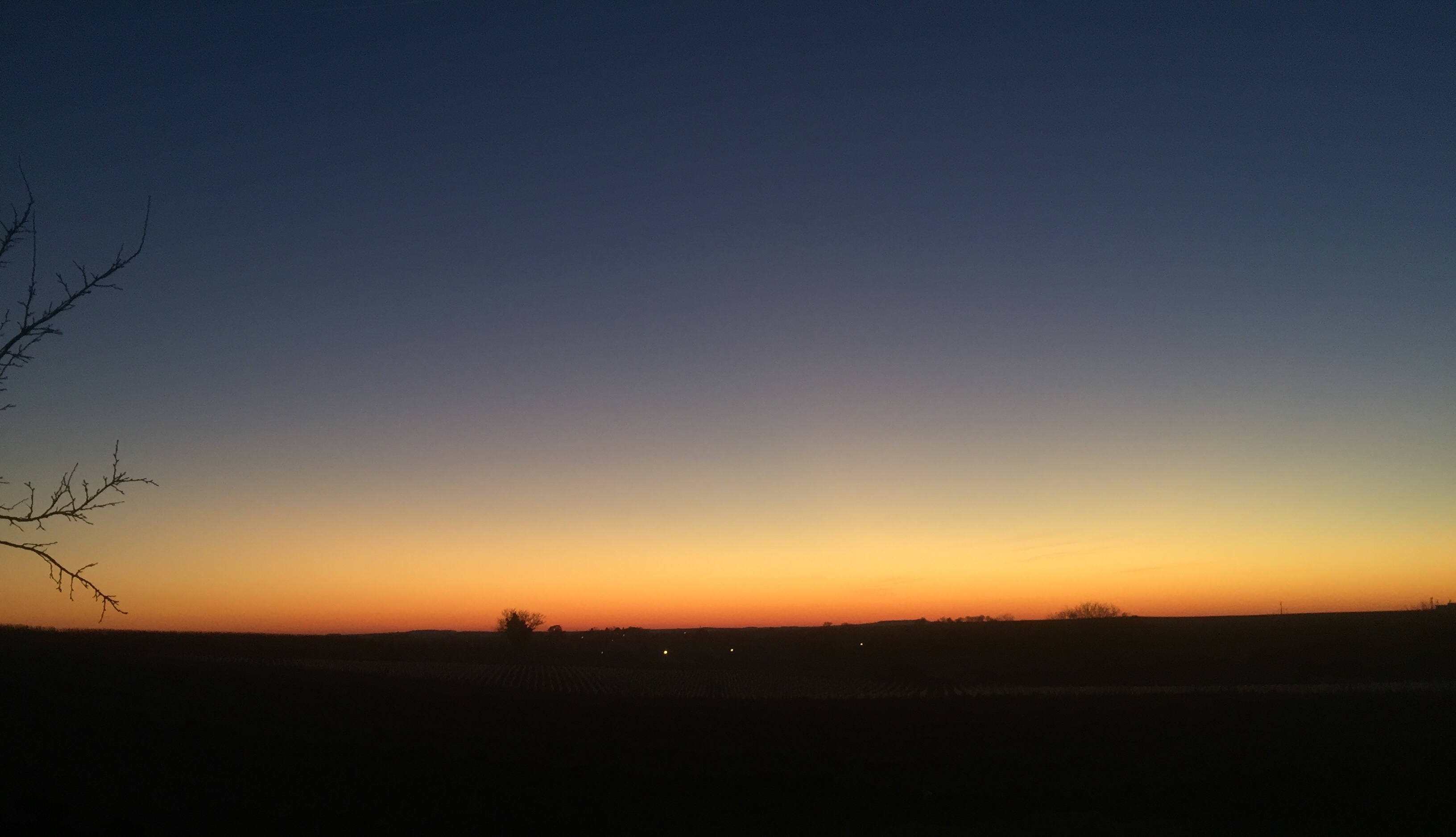
When I looked towards the Western horizon late in the evening I saw this glow.
Isn’t that interesting? I didn’t notice the vineyards, the village of Salles d’Angles on the hill. I didn’t see the Sun, because it had already slipped below the horizon. What I noticed, and what I’m struck by again, is the glow.
First of all, it is just stunningly beautiful. It reminds me that our attention can be caught by beauty, by wonder, awe and amazement……even if a lot of the time these days we find our attention caught by threats. Have you come across the term “doom scrolling”? Where you keep scrolling down through your social media, be it Twitter, Facebook, Instagram or a newsfeed, and you glance at story after story, image after image, which unsettles you. You find yourself becoming more anxious, angry, despairing, and fearful.
That’s not by chance. It’s by design. Whether it’s advertisers trying to seduce us, or scare us, into buying somebody’s products or services, or it’s power-mongers trying to manipulate you into supporting them, or pressing your buttons to try to control your behaviours. There are a lot of people trying to get into your headspace – in their interests, not in yours.
But we can still choose to invest our attention in beauty, wonder, awe and amazement. We can still choose to invest our attention in whatever nurtures us, integrates us (remember that integration is the creation of mutually beneficial bonds between well-differentiated parts), whatever promotes our growth and well-being.
Second, this glow that I see on the horizon is a radiance of light from the Sun. But we all radiate. We all glow. We give out vibes. We send out signals. We create waves which influence, or impact on, others. So, that makes me wonder……
……what kind of glow am I radiating today? A glow of beauty, joy, delight, love? Or a glow of fear and hatred? Huh! It’s not binary, is it? Chances are we send out waves from the entire spectrum every single day!
So, maybe the question is, what colours am I going to consciously include in my glow today?
The colours of love, beauty and wonder? The colours of delight and joy? The colours of “Bienveillance” and “Emerveillement”? (My two French words of the year – roughly, and inadequately, translated as “well wishing” and “wonder”)
Yes. Those are the colours I want to choose from my palette today.
How about you? What colours are in your glow? What are you radiating out into the world today?
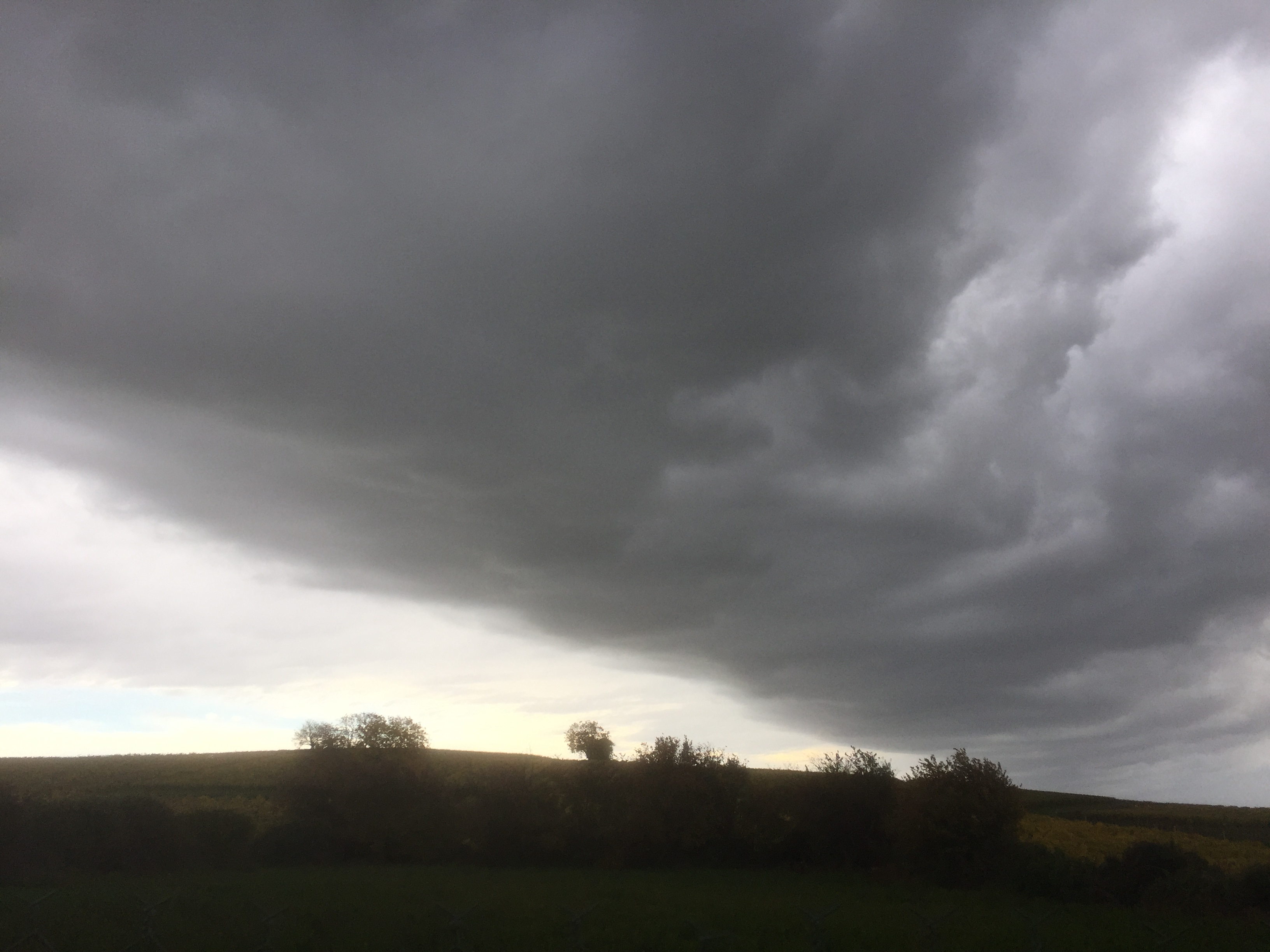
When you look at a sky like this you know a storm is coming. When it’s as dramatic as this it can be quite intimidating. At very least I know to prepare a little, unplugging my router and other equipment in case it gets fried by lightning (and, yes, it’s happened once since I came to live here). We also have an issue with heavy rain overwhelming the drains and then pouring down the driveway so another preparation is sandbags along the bottom of the garage door (and, yes, it’s happened more than once since I came to live here).
But sometimes, even a dramatic sky like this just passes over with hardly any rain, and no significant thunder and lightning. It seems impossible to predict at a local level. Even when the storm does come, it doesn’t last. Maybe just half an hour or so, or sometimes an hour or two, but usually it’s pretty brief.
I know that it’ll be different in different parts of the world, and I’m also aware of the absolutely catastrophic effects that dramatic, severe weather can have….most recently here down in the Valley of Roya just north of Nice where whole roads and parts of villages were washed away. Tragic.
I’ve also seen news coverage of the after effects of that storm, and as in other parts of the world when such calamities occur, what you see is dozens, if not hundreds, of people immediately appearing to do what they can to help….helping people to safety, cleaning up, making food, donating food, water and clothes. It is impressive. It is very impressive. You see it every time, no matter which country it happens in. You know some people don’t have a very good opinion of human beings and I know we can be an aggressive, exploitative species, but what impresses me so much more is this ordinary straightforward instinct to help and to work together to relieve the suffering of others.
Fundamentally, I believe that people are good. That’s my starting point. If things don’t turn out that way with an individual or a group then I adjust my attitude and behaviour to stay safe, to protect myself. But I start by believing in human goodness. In fact, I don’t know how I could have worked as a doctor for forty years without believing that. Everybody seems to be “worth saving”. Everybody who needs help “deserves” it. I know it’s complex and I’m not trying to be simplistic or naive here, but I really do believe that your experience of life changes when you start from a belief that people are fundamentally good.
I recently came across Rutger Bergman’s latest book, Human Kind, and he takes exactly this idea as his starting point….what if we believed that humans were basically good, instead of believing they are basically evil, or bad? I recommend it. It’s worth a read.
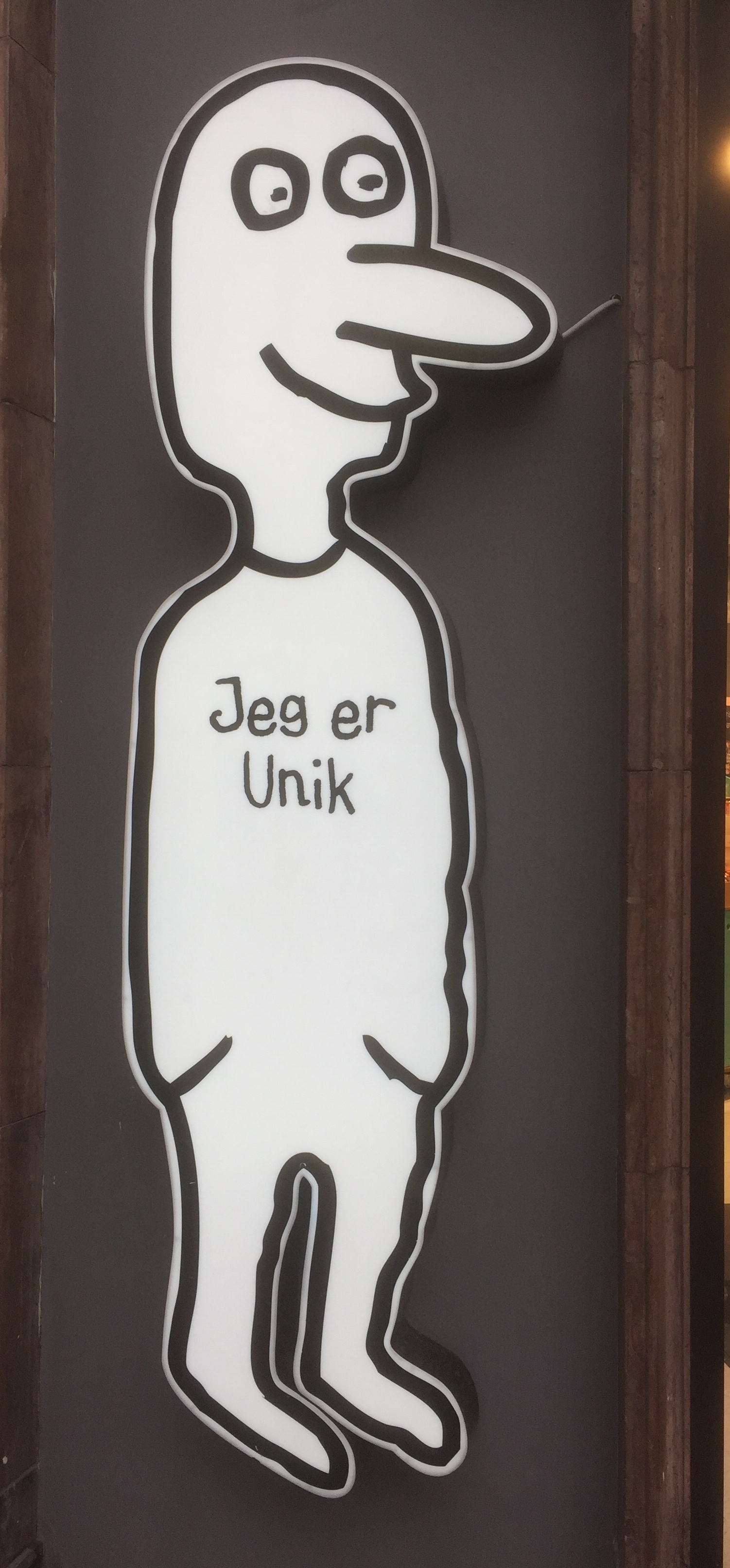
A couple of years ago I saw this image on the front of a shop in Copenhagen. Uniqueness is an important quality for me. Every single patient I ever treated was unique. Every single one had a unique story to tell me. I feel unique. I see you as unique.
So, what makes someone unique?
Is it your DNA? That’s part of it. There are no two human beings with identical genomes. Is it your face, your eyes, or your fingertips? That’s part of it too. There is scarily effective face recognition equipment already deployed everywhere from airports to security cameras. You can even get access to your phone by having it recognise your face. Iris recognition technologies have been around for some time allowing restricted access to closed spaces, and fingerprinting has a long history in detection work.
So, each of these characteristics can be said to be unique to you, but none of them captures your uniqueness, because YOU can’t be reduced to your fingertips, your eyes, your face, or your DNA. Maybe these features can help to name you….to tell others how to identify you from within a crowd, or a group.
But is this the same as “identity”?
I don’t think so. The reason why I don’t think so is that identification has spilled over from the capture of these physical features to encompass a whole person.
You are not reducible to any of these features, just as you are not reducible to any other “characteristics” such as country of birth, ethnicity, gender, religious belief, height and weight, or hair colour.
You are a person, and a person has a subjective reality, a life of memories, experiences, imaginings. A life of emotions, thoughts and beliefs. A unique, and singular story to tell, which is not, and never can be, the exact same as anyone else’s story, past, present or future.
Our uniqueness isn’t found in our characteristics or our features. It’s found in our connections….the connections which connect the past to the present, the present to future, our selves to other people, our unique set of experiences and life events, the contexts and environments of our existence. It’s found in the invisible nature of our subjective reality, with our own consciousness, our own unconscious being, and our ever changing, ever developing sense of self and person.
I abhor the reduction of a human being to a data set.
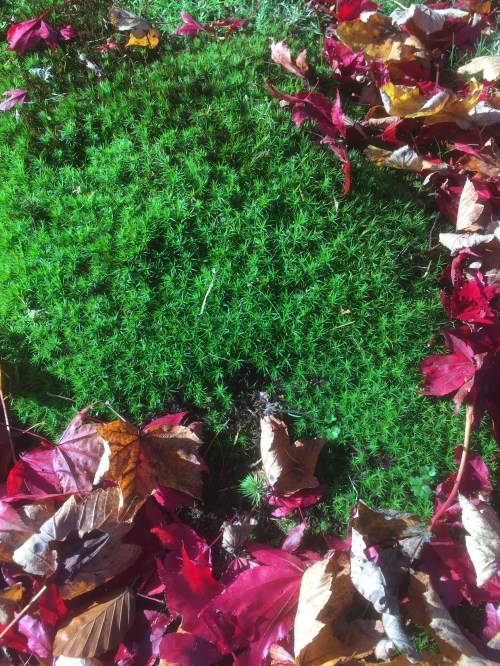
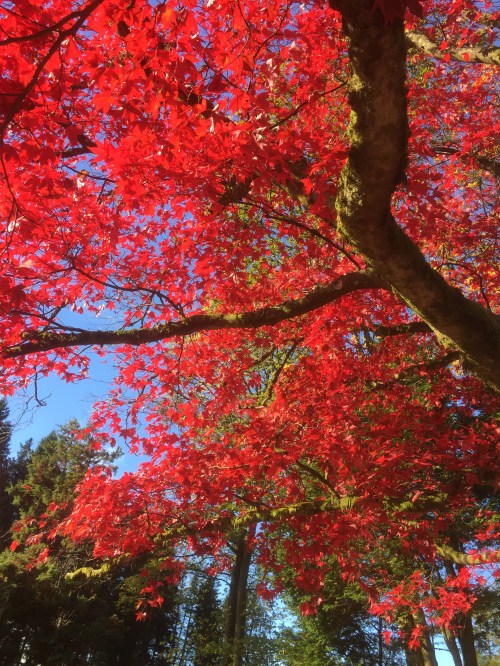
I took this photo in a Japanese Garden in Scotland in October two years ago. I’m steadily working my way through my digital photo library (from oldest to newest) and I’ve just reached October 2018…..which is pretty appropriate given its now October 2020.
This photo leapt out at me. I just LOVE it! Those gorgeous reds and greens together are quite stunning!
The next two photos also really transfixed me…..
I just think they are breathtakingly beautiful.
And, hey, isn’t a great idea to share some beauty today?
From the perspective of complexity science an “attractor” is an area of organisation within what otherwise appears as a chaotic system. Think of the phenomenon of a “Black Hole”. It’s like a sink hole where everything, even light, disappears into it. It’s like a point in the universe which pulls everything within its reach into its centre. A “Black Hole” is a sort of attractor.
An attractor appears around a focus, and once it is there it exerts this kind of “gravitational” or “magnetic” pull on anything which comes close to it. But the simplest way to think about it is the emergence of a consistent pattern in the midst of chaos. If there weren’t these points of organisational focus in the universe then space would be even, smooth and featureless. But space isn’t like that. It’s full of features, full of phenomena, of areas and points of organisation.
You can see something similar happen in the brain where distinct networks of neurones which “fire together”, “wire together”. There are examples of brain imaging which show the thickening of neural pathways when something is repeated…for example, when practising the piano (where you can see a thickening of the brain nerves used to control the fingers). It’s sort of a neural equivalent to what happens to muscles when someone practices body building.
The same thing happens with our habits of thought and emotion. The loops which start to fire in relation to particular thoughts or emotions have a pulling power. Many years ago I read a book by the psychologist Edward de Bono, “Water Logic”, where he described this tendency for thought patterns to become embedded in our brains by likening them to the way water makes its way down towards the sea from the heights of a mountain. The rain falls pretty evenly over the high lands, but starts to run together to form streams, rivulets, rivers and finally estuaries into the oceans. The next rain which falls tends to follow the paths already carved out by the previous rain.
I thought that was a pretty powerful image and I shared it with many patients over the years. It helped explain phenomena like flash-backs, compulsions and addictions to some extent. But I always thought it was only part of the story, and it wasn’t until I discovered “attractors” that I realised what the other part was.
So, it seems to me, that events which are accompanied by strong emotions can make new attractors in our minds. They can be traumatic events, accompanied by fear, anger, shame, or pain. Or they can be life-enhancing events like joy, wonder, tranquility, or a sense of one-ness with the world.
When we recall one of those events we are drawn back into the same original pathways and loops. Or when something new happens which is pretty similar to one of those attractors, then the whole thing kicks off quickly and powerfully once more.
Once I understood this I realised we can actively create our own new attractors, by having, and/or re-creating, the kinds of experience which we want….the ones of love, joy, belonging, tranquillity, awe or transcendence.
Attractors, it seems, are not fixed entities. They need to be fed to keep them growing, and neglect makes them likely to wither away. The more attention we give them, the more powerful they become.
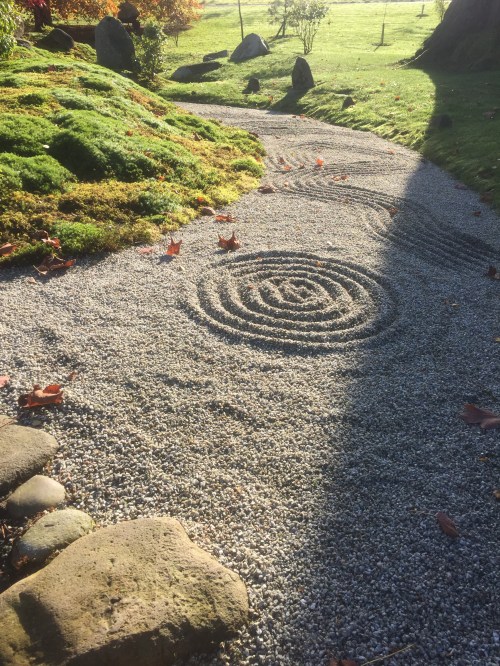
I was thinking about this today when I looked at this photo of mine, taken in a zen garden in Japan. What I like about this image is not just the spiral, which is indeed very attractive, but the wider scene – how there are different flows, paths, bends, loops and spirals across the whole expanse of the stones. Can’t we do this with our minds? Create our own unique inner landscapes of pattern by becoming aware of existing attractors, and actively creating new ones?
I’m pretty keen on biology….as you might imagine for a doctor! I’m interested in how the body works, the way the different cells, organs and tissues all function so beautifully together. I’m interested in discovering the connections within us with all the incredible feedback loops and cascades. I find it all fascinating.
But it was very clear to me from very early on in my work as a family doctor that human beings can’t be reduced to biology. There’s more to us than biology can explain. I often refer to the three flows which pulse through our very beings every moment of every day – the flows of materials, energy and information. Biology is pretty good at shining a light on the first two flows, but its the third one where things start to get so uniquely interesting when thinking about human beings.
One of the aspects of information flow is art. Now, I don’t mean to reduce art to information, or at least, not in the sense that information is “data”. I mean information as signals, not simply data. Information as meanings. So language, music and visual art all connect with us, and our whole being responds. You can blush because someone says something to you. Your heart can race because you hear a certain song. You can catch your breath, or feel a range of emotions, from disgust to delight, when you see a work of visual art.
Our lived environment is not just physical. We imbue it with meaning. We react to particular colours, designs, patterns, sounds, scents and physical touch. A particular taste can set off a cascade of memories….one of the most famous examples being Proust’s “madeleines”.
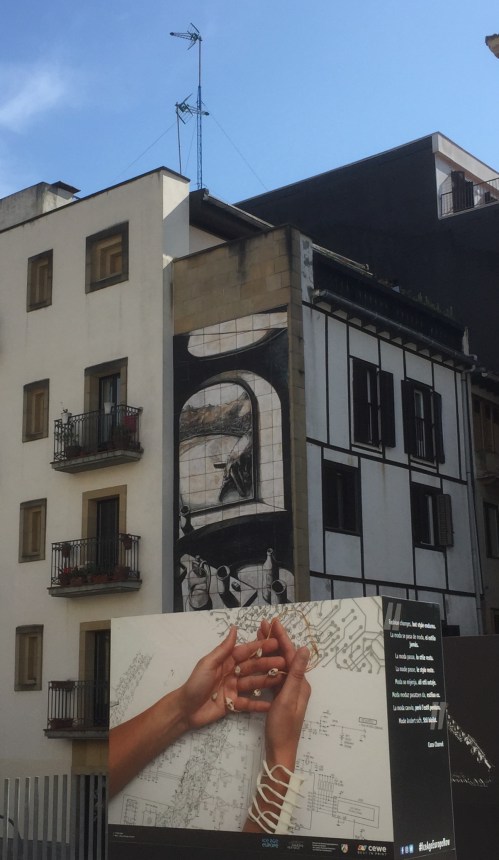
I think both street art, and advertising, affect us deeply. The images trigger certain responses within us…..maybe certain emotions, certain thoughts, or particular memories. But whatever they do, they change us. And because we are not compartmentalised, those changes ripple through our entire being. We don’t keep them in our heads.
I think we’re often quite unaware of the images and art around us. They often exert their influence in sub-conscious ways. But I like to be aware of them. I like to notice them, stop, and reflect.
In this photo I’ve captured both street art and advertising. What do you feel when you see them? What do you think when you see them? What effect do they have on you? (If any….because of course we are all affected differently by different images)
We co-create our lived reality, we humans. We do it collectively and we do it as individuals, creating and publishing, or “showing” our creations. We do that whether we are artists, or writers, or whether we simply talking to each other. We change the lived environment by constantly changing our behaviour, our language and by using our creative powers.
What kind of reality are you going to co-create today?
Maybe one the most important concepts at the base of all my understanding of people, of Life, and of the world, is that everything is connected. Nothing exists in isolation.
If I want to understand a patient, a friend, a relative, or myself, I have to follow as many of the threads which create the rich tapestries of Life as I can. I can never know them all. The daily judgement is deciding that I know enough to act, keep an open mind and awareness, and watch to see how things change after the act. I don’t really know any other way to live.
In scientific terms we humans are “open systems”. That means we don’t have impermeable walls or borders which separate us out from the rest of existence. It is just not possible to know an individual in total isolation. Our whole being is continuously immersed in flows of materials, energies and information which change us as we change them. We are influenced by, and impacted by, the environment in which we live, the food and drink we consume, the behaviours and emotions of other human beings, and the experiences of all non-human life every day. And vice versa……everything we do, what we consume, what we discard and excrete, how we act towards other humans and other forms of life changes the planet we share every day.
I loved hearing the stories patients had to tell me. Every single story was unique. Every story was a story of events, experiences, and change as a result of interactions between the person and their vast interconnected webs of environment and relationships.
I was taught that good medical practice is based on making a good diagnosis. A diagnosis is an understanding. It was my job to listen to the story, examine the patient, and, if necessary order some tests, to discern the patterns within their experience which I had been taught to recognise. In my early years as a doctor those patterns were almost exclusively pathologies, or diseases. Over time I came to understand that diagnosis, or “understanding”, needed to be both deeper and wider than that. It wasn’t enough to name the disease. A doctor had to learn to see and understand the person who was experiencing the disease. That shift from pathology to person involved teasing out the threads, exploring the influences, the impacts and the personal responses.
Each of us have distinct patterns which occur and re-occur throughout our lives. Patterns of thoughts, emotions, behaviours run through our stories. Patterns of memory, experience and fantasy cycle and spiral across whole lifetimes.
They are amazing. They are remarkable. They are astonishing. I can’t see a time will come when I’m done with this. It seems to me that every day there are new patterns to discern, threads to follow, new connections to find and to create.
What a life! What a remarkable, awe-inspiring, wonderful phenomenon is Life.
I welcome constructive criticism and suggestions. I will not, however, tolerate abuse, rudeness or negativity, whether it is directed at me or other people. It has no place here. ANYONE making nasty comments will be banned.




 Heroes Not Zombies