Feeds:
Posts
Comments

Archive for the ‘psychology’ Category

Continuing on the theme of sense making…….I’m endlessly curious about how we human beings do three things – perceive the world, make sense of life, and influence our day to day experiences of reality. Each one of those contributes to the richness of our unique daily lives. No two of us have the exact same experience at the exact same time and place. Never. We will all bring our previous experience, our memories, habits and distinct patterns of being to the present moment.

I think that perhaps one of the most powerful, and certainly most magical, qualities we have is the power of imagination. Some people seem to think we can separate imagination from the perception of reality very easily, that there is a permanent and impermeable barrier between the two. Sometimes I wonder if there’s a connection between that thinking and what doctors used to describe as “the blood brain barrier”, an invisible border between the body and the brain which drugs couldn’t cross. We know it’s not that simple now. But is there a big stretch between that thinking and the idea that some illnesses are “all in your head”? I mean, whatever did that really mean? I remember hearing someone claiming that for a certain patient “her pain is all in her head”. What did that mean? That it didn’t really exist? That she was either lying or deluded? What a way to dismiss a person’s lived experience. What a way to undermine a relationship of trust. What a way to fail to understand.

I think our power of imagination doesn’t switch itself off and on. Blimey, it even keeps going while we are sound asleep!

Perception is a creative act. It involves memory, signals from the environment, signals from within our own bodies, as well as our creative powers of imagination which enable us to make connections, see patterns and create images which we hope provide us with good representations of the world.

Sense making is also a creative act. Whether we draw on numbers, words, stories, images or similarities, making sense of the world is an act of imagination, a creative act of imagination.

Our daily lives are creative acts. We are much more the active agents of our experience than we realise. We are not blank slates for someone else to draw on. We are not data to be fed into an algorithm. Algorithms, statistics and data do not KNOW us better than ourselves. We are creating ourselves every moment of every day.

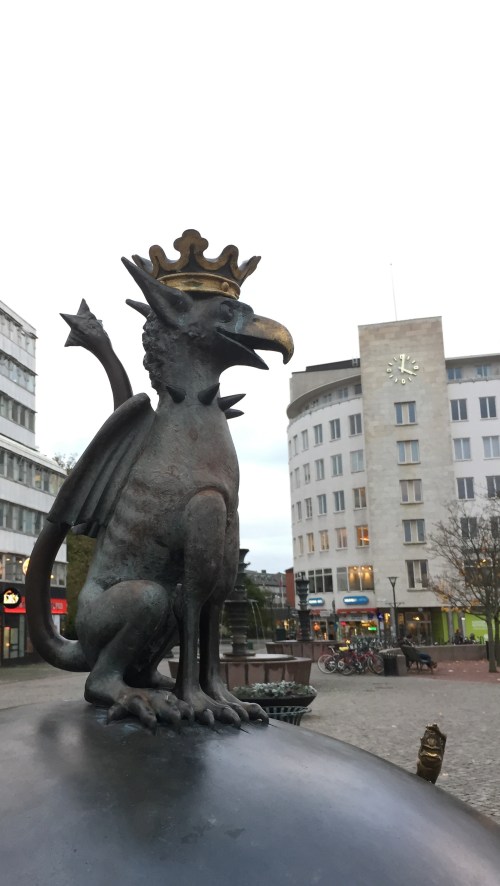
This photo is of a public work of art, placed in a square in Malmo. It’s a griffin with a crown. A griffin? An imaginary creature. There are no griffins in Nature. But we respond to this, don’t we? We react to it. It influences us. Part of the genius of this sculpture, I think, is the crown. Placing the crown on this creature’s head increases its impact and magnifies its significance and importance.

I’m well used to living with imaginary creatures. I come from Scotland. And, no, I’m not thinking of the Loch Ness Monster. I’m thinking of the imaginary creature which adorns castles, flags and buildings throughout Scotland.

The unicorn.

A magical, mythical creature of incredible power.

I’m not going to describe my own responses to the unicorn today. Instead I’d like you to notice what your own responses are. When you look at an image of a unicorn, what do you experience? What images spring to mind, what thoughts enter your head, what feelings emerge within you? What do you imagine?

Read Full Post »

“Words were originally magic”

Have you ever read that sentence before? It was coined by Freud in 1915, and used by Steve de Shazer as the title of his book about his “solution focussed approach” to brief psychotherapy.

Do you think writing “freedom” repeatedly over the front of this office block works some magic? Who decided to write this in this particular place? Were they being ironic? Pointing to the fact that offices are actually soul-less, regimented places of control….the antithesis of freedom? Or were they trying to cast a spell….to make people feel more free by presenting the word to them?

I don’t know. I don’t know the history of this office block in Malmo.

We are told we now live in a world of “post truth” where words are used to confuse, misdirect, obscure, lie and evade…..where words are used to persuade and manipulate……where words are propaganda….ways to influence and control whole populations one three word slogan at a time. “Take back control”, “Get Brexit done”, “Build, build, build”………

Well it seems that words are losing their magical power when they are used so cynically and when they aren’t backed up with actions. But still, they work a magic over millions of people who voluntarily give up their freedoms and quality of life for the sake of a privileged few (just as Montaigne’s friend, Étienne de La Boétie, described in “Discourse on Voluntary Servitude” back in 1577)….inequalities are increasing massively, wealth and power is becoming ever more concentrated while “strong men” narcissists bewitch large numbers of people into supporting them.

Ok, political rant over! Back to health care….my specialist subject! As a doctor you have to be really careful about the words you use. Telling someone they have X months to live can become a self-fulfilling spell. People give up, or gain hope, depending on the words the doctor uses….and how they use them (by which I mean the contexts in which they use them, and whether or not they are used within already established relationships of trust). In a good consultation the doctor is on the alert for specific words which the patients might use, words which might hold the key to both diagnosis and prognosis. Which words does the doctor pick up on, and ask you to say more about?

We have to be especially careful of using words as labels…..such labels can put people into boxes. It’s a danger in health care, but also in wider society….the fast track path to prejudice and injustice.

Words are still magic. They still have enormous power. It’s worthwhile staying aware of that……

Be a hero, not a zombie!

Read Full Post »

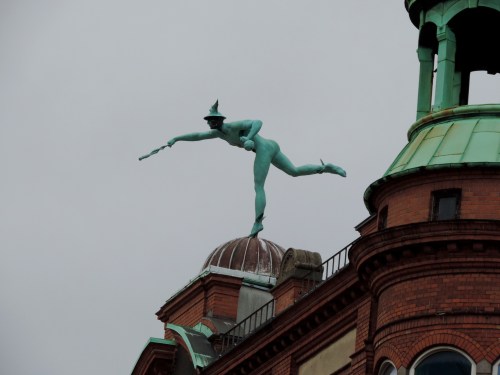
Here’s Hermes in Copenhagen. He gets around. I wonder if he is one of the most commonly represented gods from Greek mythology? Probably you’re more likely to encounter him in Europe! Hermes, the Greek god, was known as Mercury to the Romans, who also associated him with the Germanic god, Odin. He’s a complex god with layers and layers of meanings which human beings have attributed to him through their stories and myths.

He’s maybe best known as the Messenger God – able to cross boundaries and connect the conscious to the unconsciousness worlds, the living world and the underworld of the dead, the physical world to the spirit world.

But he’s also known as a God of Fertility, a Protector of shepherds, thieves and tricksters. A great orator or communicator, who helps to persuade people. But also a healing god.

The symbol of healing – the staff with the entwined snake, is doubled in Hermes hand, to have two snakes entwined with each other, but people often mix those two symbols up and use the “hermetic” one, the caduceus, when they mean the symbol of healing, “the rod of Asclepius“, which only had one snake, and no wings! But I think this just shows how fluid and changeable symbols can be.

I wonder what people intend when they place a statue of Hermes in the middle of a city like this? Is there a hope that the inhabitants will see it and think of communication, connections and healing? Is he there as a reminder that there is more to life than the physical, conscious world reveals?

Does he do anything for you? Would you like to have his image somewhere in your personal environment to help you make sense of the world?

I’ve just picked Hermes here as an example. If you look around I’m pretty sure you’ll come across other characters from stories in your environment and in your daily life……maybe characters from myths, religious texts, folklore….or maybe more modern characters from literature and art. Here’s my challenge – see how many you can spot in your own life this week. Note them down, find out about them, and see what comes up for you.

Read Full Post »

One of the unique ways we humans make sense of the world is through art, particularly through visual art. There are many examples of cave wall art in France, although, so far, the only one I’ve visited personally is Lascaux. Those prehistoric paintings are astonishing. Nobody really knows why the people who created them exerted such an immense amount of time and energy into painting them. Mostly, they are drawings of the animals which lived in that part of the world. But why spend hours underground painting the images of them, using only basic candle light to show them what they were doing?

There’s something about making images, making likenesses, which is a kind of magic. The images change our experience of time and place. They are a way for human beings to deepen their lives, to imbue them with more mystery, more beauty, more delight, more meaning….

Living with images, created works of art, changes our lives. That’s partly why we like them, why we enjoy them, why we support the activities of these artists.

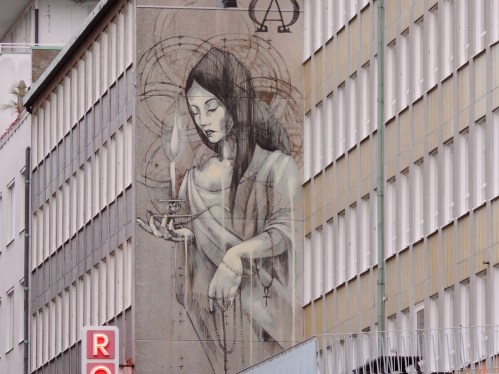
This photo is of a mural I spotted in Malmo three years ago. It’s by a South African street artist, “Faith 47”. I don’t know anything about this artist, or this particular work of art, and, probably, most people who see this haven’t read anything about it. It works as itself. It works as an image.

So, what do you see here? What I notice first, is the main subject, the woman with the long dark hair. She’s wearing robes, holding a lit candle on a candle stick, and she’s gazing down, as if in contemplation. This evokes a sense of Spirit, doesn’t it? In fact, the way she is holding the candle is quite unusual….open palmed, with the palm turned upwards….isn’t it just as we see in some statues of the Buddha? Well, it seems like that to me. It’s a gesture which is “not grasping”, not holding onto, not clinging….a gesture of non-attachment, of waiting to receive whatever is offered, of openness. In her other hand she has a string of beads. Strings of beads like this continue the theme of Spirit, with both Buddhist and Christian traditions containing the use of beads in relation to prayer. Maybe other religions do that too, I don’t know. But hanging around her left arm is also a chain with an “ankh” symbol attached to it….the ancient Egyptian symbol for “Life”.

Up above the main figure is the symbol of “Alpha and Omega”, a traditional symbol of God and Christ. Then behind the main subject there appears to be a kind of work in progress…..overlapping circles. The overlapping circles I know best are the ones used in the “Seed of Life”, and the “Flower of Life”. Overlapping circles like this have been used in a huge number of different cultures and traditions…if you’d like to read more about them, check out this article.

Two overlapping circles are often representative of a union of opposites, of the masculine and the feminine, of heaven and earth, of spirit and body. I like that this one isn’t complete. That evokes the Japanese preference for the “unfinished”, which is related to the issue of transience and beauty….leaving the observer to “complete” the image for themselves.

Well, there you have it. This single image evokes Spirit in human culture and tradition for me. It evokes the union of opposites, or, as I would prefer – integration…..the creation of mutually beneficial bonds between well-differentiated parts! It evokes the Spirit of the Divine Feminine for me too. It’s a peaceful, contemplative image which stops you in your tracks and takes you both deeper and higher at once, puts you in touch with meaning and purpose in the busy ordinary day.

How about you? How do you find this image? If you were to pass it as you walked through the city, don’t you think it could make your day a bit different?

Read Full Post »

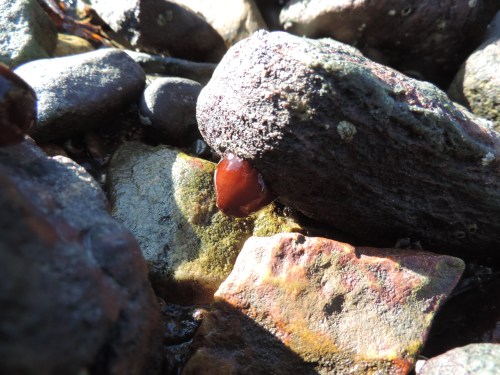
This looks like a bird, don’t you think? That’s interesting because in fact it is a stone on a beach with a little sea creature clinging to its undersurface, looking for all the world like a bright orange beak, and a tiny shell attached to the side just where you might expect to find an eye if this was a bird.

So, my mind has taken a combination of a stone and two completely different sea creatures and created a image for me which makes me think “This looks like a bird”.

We do that all the time. All the time. When we look at clouds we see patterns which make us think they look like faces, creatures, or other familiar shapes. We see people who look like people we know. We see likenesses in babies features which remind us of parents or grandparents.

This “looks like” ability isn’t unique to human beings of course. Flowers, insects and many other creatures are brilliant at developing shapes and forms of other life forms….either to attract what they want to attract, or to repel what they want to repel.

But we humans take this “looks like” ability to a completely different level. We use “representation” to become aware of, or to create, connections between things which we would otherwise miss. We use it to know, quickly, what we are looking at, or at least, to make a preliminary, perhaps “good enough” assessment.

But we also use it to connect to others. We look for similarities, symmetries echoes and reflections, to form bonds, attachments, relationships. We look for some aspect of a person or their life and say “I identify with that”, or “me too”, or “I sympathise with that”, “I understand that”.

Even in the circumstances where we look closer and realise that what we perceived at first wasn’t really what we thought it was…..this is not a bird….that ability of do the “looks like” thing turns something mundane into something just a bit more magical. It’s a way of “re-enchanting” the world.

I think we take this power to a whole new level when we start to employ symbols, art and language. I’ll say more about that tomorrow.

Read Full Post »

Yesterday I wrote about new beginnings, about choosing what and when to start, but I’ve been thinking about it since then and I realise beginnings are paradoxical. They are both easy to find and impossible to find. Why do I say that?

Well they are easy to find because every action, every thought, every experience is, in fact, brand new. Life moves and flows continuously. This present moment has never existed before, not for you, not for anyone you know, not for the planet, not for the universe. So every present moment is a beginning (and, yes, it’s an ending too, because no experiences are exactly repeatable)

They are also impossible to find because everything is connected. We human beings are “complex adaptive systems”. That is we are massively interconnected, both in our own being, and in our contexts, relationships and environments. We are “open systems”. That is there are no impermeable barriers between an individual and the rest of the universe. The atoms, molecules and cells which make up our bodies are changing all the time, as we breathe in, ingest and absorb new materials, and breathe out, expel and excrete other ones. Energy and information flow into and through us continuously.

So what? Well, all this means it can be very hard to trace back from now to a “start point”, or a “beginning”. For example, when a patient would come to see me and complain about a particular problem, and I diagnosed a certain disease, where did that disease start? With the first symptom? With the first symptom which was troublesome? With the pre-conditions before the first symptom began? I was taught to explore a patient’s “past history” to see how this illness might fit in the trajectory of their life. I was taught to explore their “family history” to see if there were family patterns or dispositions. I was taught to explore their “social history” to find out what was happening in their work and social life. I could go on……

A beginning is pretty much arbitrary. It’s where we choose to begin. Think how you would tell your life story to another person. What would you say first?

As I progressed in my work experience I changed my introductory question to each patient, from something like “What’s the problem?”, or “How can I help you?” to “Tell me your story”.

Yep, “tell me your story”. Sometimes a patient would be a bit taken aback with that beginning, but I’d just maintain eye contact, show I was listening and wait. Sometimes I’d have to say a little more to get things going, for example to explain that I wanted to understand what they were experiencing and how it might have come about so I’d like them to just tell me about it in their own way, but usually, people would just start to speak.

Where a person chose to start, and how they told their unique story, was always interesting and relevant. As the consultation progressed I’d often ask another question “When did you last feel completely well?” This was a particularly useful question to be followed up with “Tell me about the weeks and months leading up to that time”.

Those were beginnings. Different beginnings. All useful and all relevant.

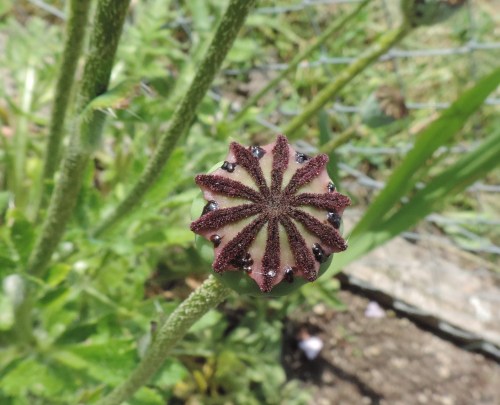
I came across this photo of the seed head of a poppy the other day and it’s so beautiful that I just decided I’d like to share it with you. How does it fit with today’s thoughts about beginnings? Well, all plants live cyclical lives, with phases passing through seed, germination, growth, perhaps blossoming or fruiting, and scattering the new seed before dying back for the next cycle. Does the beginning of that cycle start with the seed in the ground, or the seed in the seed head waiting to be dispersed? Or somewhere else?

So, back to beginnings. Whatever you want to begin, begin today. Even if its a habit, a routine, a task you’ve experienced before and stopped, because even when you stop, you can start again. You can start today. After all, you’ve never lived this day before.

Read Full Post »

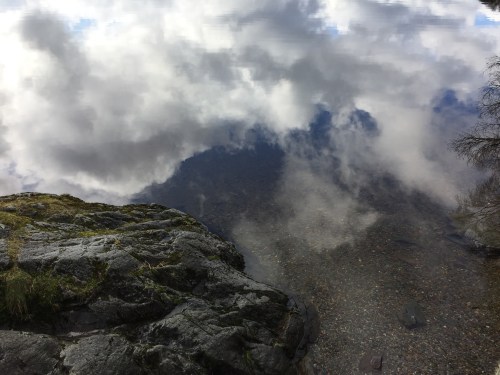
When you look at this photo I think it seems to be a mountain with clouds and sky just above it. But you immediately recognise that’s not quite right.

So then you see this and you think it’s trees with the sky above….maybe one of those forest pictures where the photographer directs the camera straight up to the sky and catches the topmost branches of several trees. But that’s not quite right.

In the first photo, the apparent mountain in the foreground is an odd shape. Mountains just don’t look like that, then, in the second photo, what’s that rock doing balanced on top of the trees?

The thing is, these are both photos of reflections on the still water of a loch. Once you know that, the whole image makes sense.

This inspires a train of thought in my mind…..about how we perceive and make sense of reality. It’s a complicated business but it involves context. It helps to know where you are when you are looking around and what you can see in the immediate environment. There is nobody standing at the edge of this loch wondering what they are looking at. They know where they are and how they got there.

We make sense of reality by spotting patterns, but we need to learn the patterns before we can spot them. A bit chicken and egg-ish isn’t it? In normal life these two aspects of the same thing are iterative…..we are constantly learning and spotting patterns, the more we learn, the more we spot, and the more we spot, the more we learn.

Medical Practice is like that. Doctors learn pathology and the natural history of diseases. In other words, they the patterns of illness. The better a doctor knows the patterns, the more easily they’ll be spotted – or diagnosed. And the more diagnoses a doctor makes, the better the knowledge of patterns. We call it experience. I always felt that a good diagnosis was crucial in good health care. If the diagnosis was wrong, the chances are the treatment would be wrong.

In my first Paediatric job, my mentor told me on the first day that his goal for my six months with him was to teach me how to recognise a sick child. When he said that I thought it was a pretty bizarre thing to say. I mean, wasn’t it obvious when a child was sick? Wasn’t the goal to diagnose ie name the sickness? Well, of course, he was right. I was wrong. What he wanted to teach me was that very first important step…..how to recognise, in an instant, that this child was ill and needed immediate attention. Working out exactly what the disease was and how to treat it came a close second, but if you didn’t recognise that the child was sick, all was lost. It turned out that learning was by experience, encountering sick children and healthy children of all ages, to become familiar with what was normal behaviour and demeanour at different developmental stages. That teaching was crucial for my practice as a GP. It let me walk into someone’s house and know instantly that this child needed close attention and help.

The clues, and the signs, were in the contexts, the environments and the relationships. Yes, some were in bodily or facial “signs”, but mostly they were in behaviours and responses.

I suppose it’s that kind of experience and learning which made me suspicious of reductionism and generalisations. Every individual is unique and can only be understood within their contexts, their environments and their relationships.

Diagnose, like pattern spotting, is like joining up the dots. It’s got a lot to do with connections and behaviours. It’s not all about “data” and “measurements”. Especially when considering the real, actual, unique individual here and now.

Read Full Post »

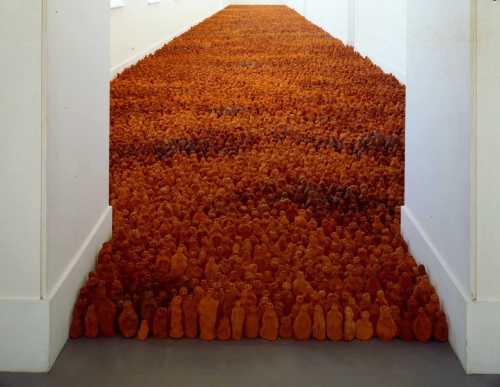
One of my most favourite sculptors is Antony Gormley, he who made “The Angel of the North” which stands beside the M1 in the North of England. His “The Field”, which I saw in Inverleith House in the Edinburgh Botanic Gardens years and years ago left an indelible mark on me. I recalled it in my mind time and time again as I wrestled with the paradox of what makes every patient unique and what they share with others.

But I was thinking again of his work the other day and I remember “Capacitor” which is what you see in this photo at the beginning of this post. This was one of the works he created from an outline shape of his body. In this case he made it with dozens of metal rods.

Maybe this came to mind because for the first time since I moved here almost six years ago I came across a hedgehog in the garden after dark, as I was out closing the shutters for the night.

I have such a clear memory of being in the same room as “Capacitor”….how awkward and dangerous it felt to be anywhere near this work. Like it could take your eye out, or pierce your body if you got too close.

So, you can see why that’s come back to me now. When I’m out and about now I sometimes think everyone has got on a suit that makes them look like “Capacitor”. Except all the spikes are invisible. Has this become the famous “new normal”? All of us increasing our stand-offishness (is that a word?). All of giving each other “a wide berth”. Everyone now regarded as a potential threat.

Then it struck me…have you seen the images of the coronavirus?

It’s a ball of spikes!

Yikes! It’s turning us all into images of itself!!

Read Full Post »

Sheer beauty.

What is it that I love so much about this world?

The wonders of the everyday. Or “L’émerveillement du quotidien”. It’s normal for me to find myself wondering about something I’ve just seen or heard.

I suppose for most of my working life my days were filled with patients. I never tired of that. I never got bored of that. Every day each patient would present to me a unique a story, a new, and singular problem, puzzle or conundrum to unravel. Each patient would be asking me to help them make sense of what they were experiencing and to support their abilities to heal, to cope, to adapt. Maybe they didn’t quite use that language but that’s always what I heard.

Before I became a doctor, way before, right back as early as I can remember I was driven by curiosity. I wanted to learn, discover and explore. It strikes me now that it isn’t a long way from curiosity to wonder.

People have always amazed me. They still do. Life has always amazed me. This Earth, this planet, the solar system, this universe which we all live in have always amazed me, filling me with an infinite supply of curiosity.

But there’s something else.

Beauty.

Look at this photo of a glorious, immersive sunset, where every single element of the sky and the Earth changes colour. Look at the palette! It is just breathtakingly gorgeous.

I see beauty everywhere. Which isn’t to say I find everything I see beautiful, I don’t. But there is “so much beauty in this world” (do you know what movie that comes from? Here’s the answer).

I am a very visual person. I think visually. I sketch and diagram as I think. I love photography and I think I “have an eye for it”. I see what I find amazing, curious or beautiful and I try to take a photo or two. Then I return to those images again and again, year after year, and I find that, like with this one, the delight, the pleasure, the amazement in beauty like this never fades.

Of course there are other senses and I don’t just experience beauty visually. I love music. I collected “records” long before people starting calling them “vinyl”. I still have them. I still play them. I spent hours and hours ripping CDs onto iTunes and I don’t even know where those libraries are any more! But I stream music now. Every day. Several times a day. I used to discover new music on the radio. I took the back off an old radio when I was a teenager, attached two wires to the speaker using clips, and fed the audio directly into a cassette recorder. I still have some of those recordings…..studio sessions on John Peel’s programme on Radio 1.

I’ve long had a love for movies. I love them for their stories and for their beauty, oh, and I often love them for their music. I compiled short clips of about a hundred movies to teach doctors and other health care workers about our unique human strategies for coping and adapting. I could have taught those strategies without movies but the beauty, wonder and emotional engagement which came with the movies made them much easier to learn and to remember. I probably have a whole vocabulary of coping and adapting based on movie characters, scenes and plots.

There is beauty all around us. I delight in images. I delight in music. I delight in movies.

Where do you find beauty? Where did you find beauty today?

Read Full Post »

I know there’s a colour called “sea green” but I must say that most times I look at the sea, I don’t think “Look how green the sea is!” But on this particular day, I did. In fact, the singular most striking feature of the sea in this photo is how green it is. Growing up in Scotland I’m used to seeing the land as green….the hills, glens, fields and forests. There is a lot of green in Scotland. I associate those greens with Nature, and with Life.

When I think of a calm, soothing landscape, I usually envisage one which is green, but this green seascape isn’t calming at all. The fact that the wind is whipping up the waves and causing them break far from shore tells me this is a day of a more “active” form of weather…..not a day of peace and ease. And there’s something else in this scene which makes it a bit disturbing….the lighthouse.

The lighthouse? Why should that be disturbing? Well, what’s a lighthouse for? For warning people sailing in this area. Why this area? Because there are dangerous rocks, and/or dangerous tides here. If you’re not careful around here then you could run aground, and even lose your life.

Noticing the lighthouse and realising that I was feeling unsettled as I looked at this image reminded me that we are constantly bombarded with warnings these days – “yellow weather warnings” (what is yellow weather by the way?), “red weather warnings”, “danger to life”, “virus warnings”, “health warnings”, “safety warnings”…….there’s no end to it.

What do all these warnings do? Keep us safe? Maybe. But one thing they certainly do is trigger our inner warning systems. There’s a part of the brain which is called the “amygdala” which has a key role in our alert system. It sets off the famous “Fight or flight” response, flooding our bodies with adrenaline, speeding our hearts and our breathing, tensing our muscles, tightening our stomachs, preparing us to take action. What kind of action? Survival actions.

This essential survival system comes with a problem however….when it’s constantly triggered it sets a higher level of body defence…..that’s the inflammatory system…..and a chronically alerted, activated inflammatory system is at the basis of most chronic disease – from heart disease, to any form of “-itis”, to autoimmune diseases and chronic psychological problem states like chronic anxiety, phobias and depression.

So, I think it’s important to be able to do something about that, and here’s a simple, but helpful exercise – take three very deep breaths, slowly one after the other, completely filling your lungs, then gradually letting all the air out bit by bit. Repeating that big, deep breath three times.

That’s it.

Sure, there are loads more things you can do, but, believe me, this is a good start! Firstly by consciously choosing to do these three breaths you’re taking your attention away from the alarm state. Secondly, this form of breathing changes the chemical balance in your body, changing the oxygen/carbon dioxide ratio in a way which triggers cascades of anti-inflammatory change in your whole system. Thirdly, it triggers the vagus nerve, slowing the heart and pretty much literally steadying your nerves. Finally, this all breaks the loops, helping your break out of stuck hyper-activated circuits….a kind of “re-set” if you like.

If you want to extend these benefits and deepen them, the next thing to do is call to mind a calming, safe, relaxing scene…..preferably one you once experienced. Re-create that event, or that circumstance for a few moments and the emotions which arise with it will begin to dilute the alarm state and deepen the benefits of the three breaths.

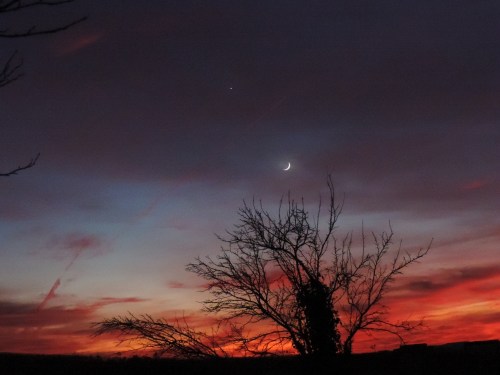
You might want some help with this. I find a sunset helps. Here’s one taken from garden on a night where the crescent moon sat above the plum tree and the planet Venus hung in the depending night sky just above the moon.

You might well have a photo of your own somewhere on your phone…..a peaceful, pleasing, calming scene, which you, yourself witnessed. If you do, mark it as a favourite and keep it handy. It could be just what you need.

Read Full Post »

« Newer Posts - Older Posts »