Feeds:
Posts
Comments

Archive for the ‘psychology’ Category

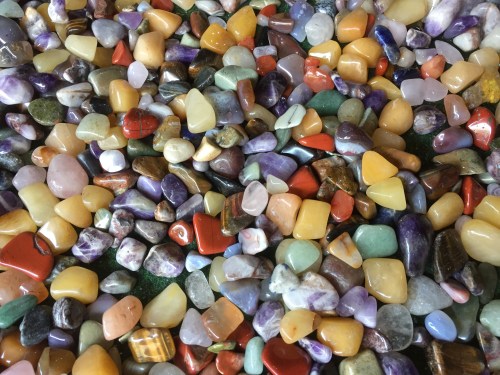
This is a photo of a small part of something called a “Scratch Patch”. It’s an area about the size of a large room. The floor is covered with polished stones. You pay for a container/jar and can then spend as long as you like filling it with the particular stones which attract you most.

I shared a photo of a pumpkin stall at a farmers’ market the other day to demonstrate the beauty of diversity but then I came across this photo which shows exactly the same thing in the mineral world.

We have a bit of an ambivalent attitude towards stones I think. Maybe because they are inanimate we don’t often value them as much as we do plants or animals, but on the other hand, “precious” stones are considered to be amongst the most valuable objects in the world.

At a simple level many of delight in spotting and picking up a few “interesting” stones when we are out walking – whether it’s through the vineyards, or along a beach. You probably have some favourite stones of your own. Maybe in your pocket, at the bottom of a bag, or on a shelf somewhere in your house.

We must know, instinctively, that stones are not all the same. Otherwise how would we notice some but not others? Why would we choose to pick up and keep certain ones?

I think the attraction of uniqueness runs right through everything in this universe. We humans, each of us unique in our own right, are delighted by uniqueness, whether we find it in our gardens, the paths we walk along, the flowers and trees which grow around us…….

I have often said that what I looked forward to most on a Monday morning was the first clinic of the week. Every single week I knew I’d meet unique patients. Every single day I knew I’d hear unique stories which I’d never heard before. Every single consultation was unique, never to be repeated.

For me, good Medicine couldn’t be reduced to protocols, guidelines and algorithms because every single human life is a unique one. Every single human being is “extraordinary”, not reducible to a class, a type, or a disease. Every encounter occurs only once.
Read Full Post »

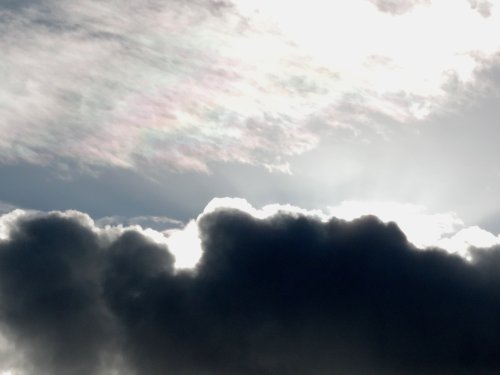
I see two symbols of hope in this one image – a cloud with a silver lining, and the beginnings of a rainbow (or, if you prefer, the emergence of colour out of monochrome)

We human beings need hope. I’m not sure if it’s possible to live without it. That might sound dramatic but I expect you’ve heard tales of seriously ill people “turning their face to the wall”, and dying. Or, maybe the opposite, maybe you’ve heard those who recover from serious illness described as “fighters”, which doesn’t mean they have defeated an enemy, it means they have dug deep, found wells of hope and belief, and have healed.

Whenever I saw a patient with a serious disease I knew there were roughly three possible future paths – improvement, deterioration and something inbetween (a kind of continuation of the present). You can see that with common, acute infections, such as a cold or flu, and you can see it with this COVID-19 virus too. Some people make a complete recovery, some go downhill quickly and die, others recover well enough to leave hospital but continue to have disabling symptoms (people are calling them “long haulers”).

Perhaps one of the silver linings from this latter group is the growing recognition in Medicine that some viral infections can produce seriously disabling chronic states. Sadly, in my own work, I saw patients with diagnoses from “Post Viral Syndrome”, to “ME”, to “Chronic Fatigue Syndrome” who had been dismissed and/or not believed by other doctors. These patients were hit by a double whammy – illness and disbelief. That was always hard. I hope this pandemic might have changed the mindsets of some physicians who have dismissed such chronic states as “psychological”, “depression”, or “fraud”.

But to return to the issue of hope. What makes the difference? What influences which of these three paths lie ahead for you when you get sick? The improvement path, the decline path, or the chronic illness path? The truth is we don’t know. But I sure hope there are people invested in research projects to try to shed a light on this issue. The other truth is that nobody can accurately predict which of these paths lie ahead for any single patient.

Yes, of course, we can use statistics and probabilities, but when it comes to an individual, those generalities don’t determine the outcomes. I’d be explicit about that with patients, and I’d say, the truth is that for this individual, their path may well be the improvement path, so why not take on board that truth? Taking that on board is a kind of hope.

A little further down the road things might look very different. Someone who was getting better might decline. Someone who looked as if they had no chance might make a stunning, and unexpected recovery….and so on. But as the story proceeded, so did the three options. At every point, every day, those three paths lie ahead – improvement, decline or staying much the same. Is it ever helpful, then, to give up hope? If we hope, then don’t we try our best? Don’t we put in our greatest efforts? If we don’t hope, the danger is that we give up.

Because, here’s the other piece – the self-fulfilling prophecy. How often does it seem that what we anticipate, what we expect, comes to pass? Is it possible that hope can contribute to improvement and that despair and hopelessness can contribute to decline?

What do you think?

I think we human beings need hope. And I think hope contributes towards improvements. And even when things don’t improve, we can always change what we are hoping for. Changing what we hope for keeps us realistic, but being realistic doesn’t mean we have to give up all hope.

What’s your experience?

Read Full Post »

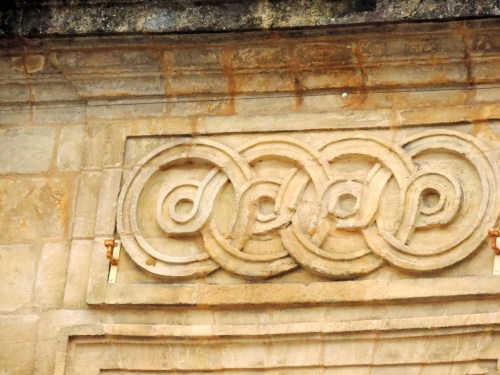
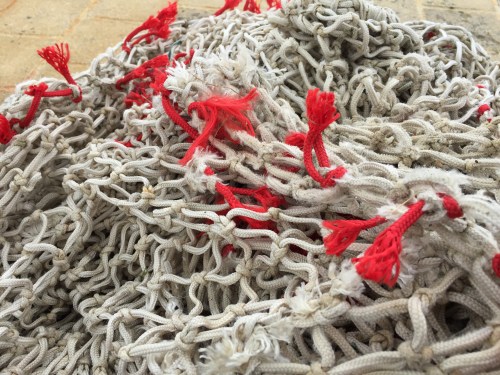
When you look at these two photos, how do you respond?

Do you find you prefer one to the other? Or do you like both, equally?

The design on the left is all straight lines and right angles, whereas the one on the right is of interlocking circles and loops.

Some people find straight lines and right angles somewhat aggressive. I seem to remember reading that the architecture of Waldorf Schools and other Steiner inspired buildings seeks to avoid these “harsher” lines and angles. The hospital where I worked for the last two decades of my career, “The NHS Centre for Integrative Care” (formerly, “Glasgow Homeopathic Hospital”) was designed to have as many curves, and as few right angles, as possible. The main reception desk was curved and open, and even the walls of the inpatient unit were a series of curves which evoked the image of gentle waves. I liked that.

As I was born and grew up in Scotland, the typical Celtic designs of knots and loops were familiar to me from an early age. Although the image on the left is also of intertwining lines, it isn’t typical of the Celtic drawings I know.

But maybe the straight lines and right angles are more appealing to you? If they are, why don’t you tell me about them? I’d be interested to hear what your preference is, and why.

Read Full Post »

I’m convinced that the Self isn’t a thing. There is no entity, or measurable, directly observable object, called “the Self”.

Some say the Self is an illusion, but I was always impressed by the philosopher, Mary Midgely’s response to that…..which was to ask if the Self is an illusion who, or what, is having this illusion? I’m not convinced that the Self is an illusion.

Some say the Self is multiple, that there is a “community of selves”, or that the Self is multidimensional. Different dimensions, or aspects, of the Self are activated and expressed in different relationships, and different contexts. I’m convinced that the Self is multiple.

Some say the Self is a narrative, a story. I’ve got a lot of time for that idea. I’m pretty sure we weave together the events and experiences of our lives into our personal story both to make sense of life, but also to have a sense of Self, a sense of identity.

But that isn’t enough.

There’s more to who I am than my story. There’s my body. There’s my unconscious and subconscious reality, all the breathing and heart beating, and organ and cell and tissue function that is vital to me but of which I normally have zero awareness so can’t weave into a story.

I’m convinced of a Life Principle, a Life Force, or a “Vital Force”, not as an entity, not as an object, not as something “outside” of the body and the Self, but as something manifest AS the body and the Self and probably more besides….

There’s a red thread runs through life…..the thread of the Self as more than a construct, a narrative, an illusion, a force…..isn’t it just wonderful to experience that, to savour that, to enjoy that, to get to know that?

Read Full Post »

There’s something which really bothers me about modern management theory and practice – “efficiency”.

“Why should that bother you?” you ask.

Well, because it seems to me that it usually means getting the greatest return from the least input or effort. And I’m not sure that’s always a good idea. I’m coming from the perspective of health care. I despaired of the annual cuts after cuts after cuts in the NHS. Every year I saw colleagues who retired or moved away, not replaced. Every single time someone left the remaining staff were asked to “absorb” the missing colleague’s workload. Every year there were more budget restrictions, more closures of beds and services, all in the name of “efficiency”.

So what has happened now that a pandemic has hit? Not enough beds, not enough equipment, not enough staff. Even now, weeks into the crisis, frontline staff lack adequate amounts of PPE (Personal Protective Equipment). All the pressure to “protect the NHS” was due to the fact it had been pared down to the bone over at least a decade. There was, and there is, no, or little, resiliency in the system. Yes, they redirected staff and reallocated beds to deal with the COVID-19 patients, but did so at the expense of the care and services which those staff and beds were normally employed for.

Is it really a good idea to have “just in time” ordering and delivery systems for something like the NHS? It doesn’t look like it. Is it really a good idea to have as few beds as possible, as few hospitals as possible and as few staff as possible? It doesn’t look like it.

Nature doesn’t do it this way.

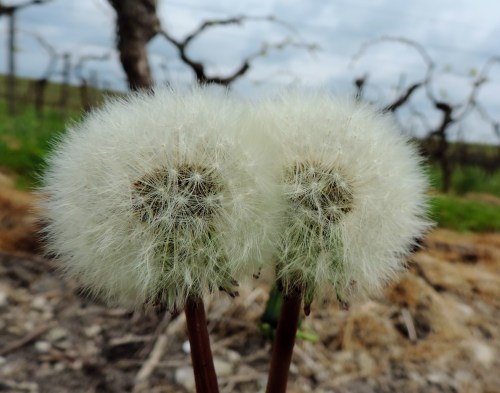
Nature goes for abundance. Look at the seedhead in the photo at the start of this post. How many seeds are there from that single plant? Way more than you’d “need” for reproduction and spread you might think. Would it not be more “efficient” for the plant to produce, say, half that number of seeds? Or maybe only ten percent? It doesn’t look like it.

Complex adaptive systems are Nature’s way of enabling adaptability and resilience. All such systems have what scientists call “redundancy” – by which they mean there are “belt and braces” approaches, there are several pathways to achieve the same thing. It’s by drawing on those “extra” resources and methods that Natural living organisms survive and thrive.

I think we need to learn that from Nature. There’s been way too much paring back, stripping down, and minimising going on. If we want resilient services, and resilient societies we aren’t going to get there by “efficiently” going for the least, the cheapest, the quickest and the meanest.

Here’s what Nature does –

It goes for more……

Read Full Post »

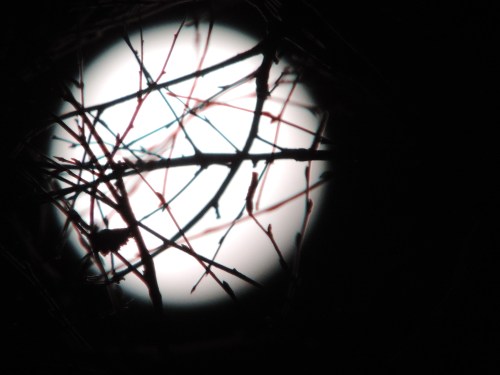
These two images were taken within seconds of each other. Both are a picture of the full moon through the branches of a tree.

But they look very different don’t they?

In the first one, the tree is to the fore. We notice the pattern of twigs, buds and branches, with the full moon as a white, circular background. If you look carefully, you can even see different colours, some reddish, some bluish, in the tree….although I’m still not sure where those colours came from!

In the second one, I’ve allowed the light of the moon to dominate, whiting out the tree in front of it….almost completely, but what this has done is reveal the parts of the tree lit by the moon, but just outside of the intense white light of the moon itself. This does two things…..it creates a sense of a swirling circle of branches around the moon, with an opening in the tree which just happens to be moon-shaped. This is an illusion – there is no moon-shaped gap in the tree.

I love both of these images, and don’t actually have a preference, but I realise that just by altering the exposure setting in the camera, I alter the entire frame of the shot….and that the two different frames give very different experiences of reality.

That’s what frames do. They shape our experience of reality. The frames we use all the time are fashioned out of our beliefs, values, habits of thoughts, and established attitudes. They aren’t easy to change. They aren’t even that easy to see. But I think it’s important to try to become aware of them, given how powerfully they shape our perception of reality.

Read Full Post »

Here is my secret. It is very simple: It is only with the heart that one can see rightly; what is essential is invisible to the eye.

Le Petit Prince. Antoine de Saint-Exupéry

I often notice, and photograph heart shapes, but in this particular photo what I like best is that the heart is in a path.

I like that because I think this is the most fundamental value for me. It’s not a simple value….this heart-focused one….but its complexity adds to it, rather than diluting it.

The heart is a symbol of love for us. If I want to live the best life I can live, I believe it has to be a life of love. Love in all its forms. Love in the form of care and compassion. Love in the form of passion and desire. Love in the form of bonds and relationships. Maybe we don’t speak much about these forms of love these days, but it’s always something I think we can do with more of.

The heart is also a symbol of the soul. “Heart felt”, “heart warming”, “good hearted”, “heart to heart” are all phrases which suggest authenticity and depth. It is the antithesis of the superficial and careless. It nurtures. It supports. It nourishes.

The heart is an important part of the body for processing emotions. We now know there is a neural network, of the kind of cells we used to thought you found only in the brain, around the heart. What does that network do? It seems to be involved in the generation and management of emotions.

The heart also focuses us on qualities rather than quantities. What we see, what we feel, what we know, with the heart can’t be examined under a microscope, weighed, measured or have a monetary value attached to it.

A path of the heart is a path of love, emotion and quality.

What is essential is invisible – and can only be seen with the heart.

Read Full Post »

Human beings are very, very social creatures. By that, I mean we connect with others, cast our thoughts and imaginings into whatever we are paying attention to, and by creating these bonds, these links, these resonances with “others” we change ourselves.

We’ve known this in biology for a few years now but it’s still a concept which is developing. We continue to isolate the individual from their environment and their relationships when we study them. But that is never going to be a successful strategy. If we really want to understand someone we must, at very least, consider their social environment. Why?

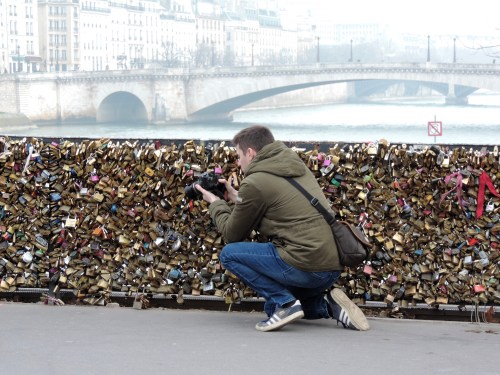
Because we become what we do, and we do what we notice others doing. Look at this photo. Did this phenomenon start in Paris? This “love locks” idea of fastening a padlock to a bridge? Maybe, but you can find the same phenomenon around the world now. However, just looking at this example in Paris – it’s hard to see any spaces left to fix another padlock…..SO many padlocks have been attached! I wonder who fixed the very first one?

Of course, there’s a “meta” level in this photo, because I didn’t just photograph the locks, I photographed this guy taking a photo of the locks. I, sort of, did what he was doing…..which makes me wonder now if anyone was taking a photo of me taking a photo of this guy photographing the locks…..

Social media platforms like Facebook, Instagram, Youtube and Tiktok thrive on this basic human characteristic…..we seem compelled to copy, to mimic, to repeat and to share what we witness. How quickly has “taking the knee” spread around the world in recent weeks? And why now? It’s not that this gesture appeared for the first time this year…..but this year, it’s caught on and spread like wildfire.

As I understand it the field of economics hasn’t caught up with this insight yet. The currently dominant “neoclassical” or “neoliberal” model seems to think of every human being as an individual, living autonomously, independently making their own choices in complete separate isolation from everyone else. Well, human beings are not like that. Happily there are newer schools of economic thought which are based on the understanding that human beings are such social creatures…..that it’s a mistake to assume we are all independent free agents making uninfluenced personal choices.

When I started out on these daily posts at the beginning of the lockdown period here in France back in mid March, I mentioned the fact that we are all influencers. Whatever we do influences other people. And that’s why I decided to share these little pieces of wonder, amazement, delight, beauty and understanding……to, hopefully set off all those fabulous phenomena in other people wherever they live……to hopefully increase the wonder, amazement, delight, beauty and understanding in YOUR life, as well as in mine.

Read Full Post »

Just below the long bridge from the mainland to Ile d’Oleron, at low tide, you can see lots of people out gathering seafood, digging up the shells from the mud. I like this photo I took of them one day. I like the blue colour of the scene and the way people are scattered across the beach. I imagine they almost look like notes on a musical stave.

There’s a growing understanding of human beings, human behaviour and character which comes from taking an evolutionary approach. I think that sometimes it’s a bit overdone, but there are significant insights to be gained by taking this perspective.

For example, one way to understand the brain is to use the “triune” model – the idea that you can see three, distinct, regions or parts – the brain stem, the limbic system and the cerebral cortex. Taking an evolutionary perspective we can see that the vital life-sustaining functions of the brain stem are shared with many creatures much further back along the evolutionary tree than human beings. Then we can see the functions of social connection and the emotions which seem to be the domain of the limbic system….functions shared with other mammals. Finally, the cognitive functions of the cerebral cortex, and the development of the frontal regions in particular, are shared with higher primates. This model can help you to get a handle on brain function but it falls down when you take a too reductionist approach to it…..a common problem with a lot of neuroscience which, at worst, degenerates into a kind of phrenology. The brain is a much more complex, massively interconnected, distributed network. It can’t be so easily divided into three separate parts.

Psychologists often explain to people about the alarm function of the amygdala and how it developed to keep us safe as hunters and gatherers but that now that we live in urban environments, pretty free of daily predators, those ancient circuits have a tendency to alert us to imaginary existential threats, rather than real ones.

Last year I read “The Emotional Mind. The Affective Roots of Culture and Cognition” by Stephen Asma and Rami Gabriel which brilliantly places emotions in a central role in human behaviour by tracing the evolutionary path of affect. It wasn’t an easy read, and I was glad I’d read so much about neuroscience and evolutionary psychology before I came across it, but it really has helped me understand the emotions as “adaptive strategies”…..something I’ve explored in my book, “And not or”

As I was looking through my photo library I found this photo quite close to the one I’ve shared at the beginning of this post –

See any similarities?

Ha! Sometimes I think it helps to remind ourselves that we humans are part of Nature, not apart from Nature. We have a lot in common with all other forms of Life as we mutually strive to survive and thrive.

If remembering our hunter gatherer origins helps us to remember that, then it’s a good thing!

Read Full Post »

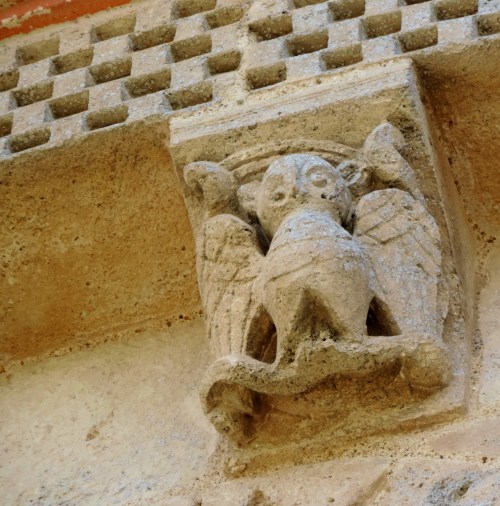
I’m fascinated by carved objects on buildings. Often they are above a door or a window. Other times they are under a roof overhang, or somewhere in a garden or building. Certain buildings, like churches, are often highly embellished with these works of art. This owl is on a church wall. I know most of the carvings on churches relate to saints and important people in the Christian faith, but many of them are really not so directly related (think of all the gargoyles!). Who chose them, and why?

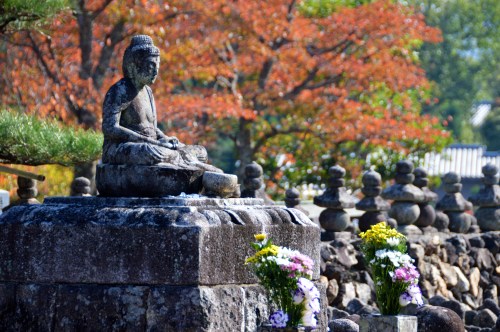
When I’ve traveled around Japan I’ve seen lots and lots of statues and statuettes….particularly buddhas.

However, it’s not at all uncommon to find figures like this for sale in Garden Centres here in France and I’ve noticed them a lot in French people’s gardens and houses.

There’s also quite a controversy raging just now about statues, with calls for the removal of statues of famous people whose actions and values communities no longer wish to celebrate (although maybe they were never celebrated, despite standing there for decades).

All this got me thinking about the symbolic power of objects. I wonder if you have any in your house? Or your garden? I wonder which ones you notice in your Public spaces?

Maybe we should assume that they are intended to exert some influence over us. For example, I think many people with the buddha statues often see them as objects to help them to remain calm. One of the first phrases I encountered here, in the Charente, was “Soyons zen” – “Let’s be “zen” – or calm”.

I have quite a lot of owls in my house. I feel an affinity with them and I think they help me access reflection, contemplation and wisdom.

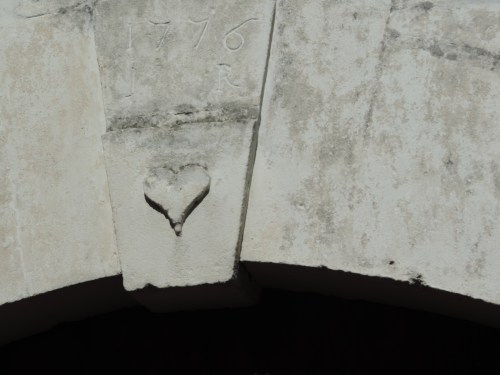
A common “device” over doorways is a heart.

I can certainly see the point of that! In fact, I think I’d quite like having a house where there was a heart over the doorway. Maybe it would help everyone who entered to remember the importance of “seeing with the heart”.

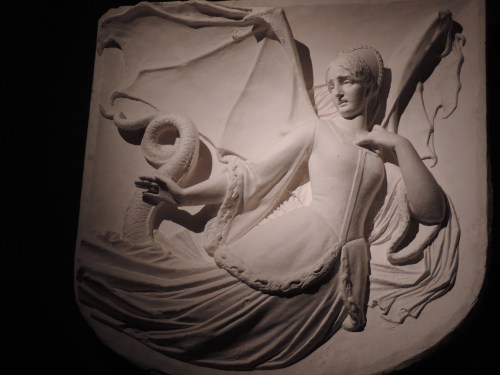
There’s a really interesting mythical one in this part of France (and I believe elsewhere in Europe too) – Melusine.

Half woman, half serpent (or dragon), with wings, there are a number of variations of the Melusine myth. Here’s a passage from wikipedia about her

One tale says Melusine herself was the daughter of the fairy Pressyne and king Elinas of Albany (now known as Scotland). Melusine’s mother leaves her husband, taking her daughters to the isle of Avalon after he breaks an oath never to look in at her and her daughter in their bath. The same pattern appears in stories where Melusine marries a nobleman only after he makes an oath to give her privacy in her bath; each time, she leaves the nobleman after he breaks that oath. Shapeshifting and flight on wings away from oath-breaking husbands also figure in stories about Melusine.

I wonder what influence her presence has on the people who live with her likeness on their walls?

One of the things which makes we human beings so unique is how we handle symbols and metaphors. We don’t just see objects as “things”. We attach value and meaning to them. They provoke emotions in us. They provoke our memories, stimulate our imaginations.

The objects to which we attach symbolic value, either individually, or as part of a culture, or society, have an influence on us. We often choose them exactly for that reason.

What symbolic objects are there around you in your daily life? And are you aware of the influence they have upon you?

Read Full Post »

« Newer Posts - Older Posts »