Feeds:
Posts
Comments

Archive for the ‘psychology’ Category

a little galaxy
In 1911 Frederick W Taylor published the “The Priniciples of Scientific Management”. This approach to work had a profound influence, leading to the use of the term “Taylorism” to capture the essence of his message. It’s a message which still holds sway today. In fact, the term “Taylorism 2.0” is being used to describe the modern form.

It’s clear that Taylor’s idea of science was not that curious, exploratory discipline based on wonder, but the desire to control – the desire to produce pre-determined outcomes through systems created by measuring what could be measured.

Right there, in that text is his declaration of intent – one which chills me every time I read it!

In the past the man has been first; in the future the system must be first

If there was one thing I would say to try to improve health care, for example, it would be put the human beings first, and the system second – the system and the management created to deliver the system, should, in my opinion, be the servants of those human beings who are caring for, and trying to help, the other human beings (the patients).

Is it any wonder that professional satisfaction amongst doctors is so low when they’ve signed up to something they probably didn’t understand was “Taylorism 2.0”

So what is this “Taylorism 2.0”?

I first came across it in an article about workers in a French supermarket internet-ordering section. Let’s call it “click and collect” – in the UK, there are now many “click and deliver” services from supermarkets, but in France, the delivery bit doesn’t seem to have taken off yet. Instead you can order your shopping online, then you go to the “Drive” and pick up your order.

But what happens between clicking on the items you want on the web catalogue and finding your shopping at the counter in the “Drive” building of the supermarket?

Well, you have staff who are called “pickers” – they go round picking the products off the shelves  – either of a supermarket (often a “hypermarket”), or from a warehouse (more commonly the former so far) – and collecting them into boxes ready to be handed to the customer when they turn up at the “Drive” counter.

These pickers are managed not just according to the principles of “Taylorism” – which involves measuring whatever can be measured and setting the targets and goals to be achieved i.e. the time taken to get a particular item from the shelf, the number of items an individual “picks” in an hour, in a shift, or whatever. As the article made clear every aspect of the job which could be measured was measured and monitored. Each picker has a portable device strapped to their wrist and receives the instructions for what to pick next from the computerised control office. The device shows exactly where they are at all times of the day, and measures the time taken for each and every action. What can’t be measured and monitored this way is the interaction between the staff and customers, so that is controlled by teaching them scripts which they have to learn by heart and stick to – you’ll know the kind of thing – “have a nice day”, “happy to be of service”, “thank you for waiting” and so on….

What takes all this measurement and control to the next level is not just the introduction of the new technologies which allow better monitoring and measuring, but the introduction of game theory.

Yes, you read that right. Game theory. The big new addition is “gamefication” – or how to introduce principles from cognitive behavioural psychology and game theory to get the most out of the workforce.

Just to give you a taste of this, it can include awarding points for numbers of items picked and delivered, numbers of customer orders completed, shortest times taken to get frozen goods from the shelf to the customer and so on. The points are fed back to individuals and teams and the scores are ranked. So an individual can see instantly at all times their best times, their highest number of order completions and so on….which inspires them to try to always get personal bests. But more than that, the team, or all the members of a particular shift will get collective scores and be ranked against other teams, other shifts or even other stores across the country – an enormous expansion of the “employee of the month” idea.

There can be a number or rewards attached to the rankings as extra incentives.

There’s a lot more involved than this but maybe this introduction will give you an idea.

So, what’s this got to do with health care?

Again, just as an example, let’s look at one particular system – the application of “QOF” (“Quality Outcomes Framework”) points in Primary Care in the UK.

General Practitioners have a substantial amount of their income pegged to their “QOF” points – these are points allocated for achieving particular targets on management-set protocols, mostly they related to the numbers or percentages of patients in a practice who have been entered onto particular disease registers, who have been asked about smoking habits, have had a BP check and so on, or the numbers of percentages of patients with specific conditions who have been prescribed the recommended drugs.

Not only does this prioritise the things in health care which can be measured at the expense of things which can’t (like communication skills, empathy, creation of therapeutic alliances, depth of understanding, caring etc) but it gamefies the whole system by awarding points, ranking individuals and practices, and rewarding points with income. So the doctors motivate themselves to try to achieve what the management want them to achieve.

Welcome to Taylorism 2.0 – where the system comes first – more now than ever before.

Read Full Post »

DSCN4108

In my twelve monthly themes, August is the month of travel.

I came up with this as the theme for this month because in France every August is the month of the “grand depart” – it’s the beginning of the annual holidays for thousands and the roads, airports and ports become very, very busy this month (starting this weekend)

I am a great believer in travel. I love to visit other places, encountering other cultures, traditions, foods, architecture, art and history, as well as other natural environments from the one I happen to live in. Where I live now is vine country and to visit a forested area, a mountainous region or the coast can be a stimulating change.

I think most of us also need a break now and again. We need to step out of the routines and habits and demands of our daily lives to be able to see them from “on high“. And we also need to rest.

I was taking photos of clouds the other day (as I do!) and I noticed this plane’s trail with a strange and clear break right in the middle of it and I thought – what a brilliant visual metaphor for August – travel AND taking a break!

So, where are you going to go? When are you going to take a break? Even if it’s just for a day, or a weekend, I think it’s important.

Read Full Post »

butterflyLooking up from my book I saw this butterfly and captured a photo of it with my iPhone. The sky looks pretty grey but it was actually just some clouds passing by as I was relaxing with a book out in the garden. Within a few moments there was blue sky again. I’m struck by how the sky changes so quickly. Clouds are a great reminder of the transience of Life with their constant making and unmaking of themselves, their constant appearing from apparently nowhere and disappearing apparently into nothing. The fact the sky looks so grey in this shot also reminded me of how often we take a moment in time and react to it, then the reaction can live for a long time afterwards. There’s no doubt that the ability to expand our focus of attention, stretching it in time and/or in space, can radically change our inner experience and hence our mood. I suspect that the relationship between moods and emotions is a bit like the ripples which spread out over the surface of a pond after a stone lands in the water. The moment the stone lands creates a condition – just like a word, a gesture or an action might trigger an emotional state in us – but that the state spreads out to become our longer lasting state of mind (a mood) – in much the same way that the ripples can be seen long after the stone has disappeared, or the wake can wash onto the shore long after the boat which caused it has sailed by.

the Charente

Butterflies can be a trigger for us to think of transience (but also of metamorphosis – I think I’ll return to that in another post) so, the butterfly against the changing sky worked as a strong prompt for me.

Sometimes we just need to place events into their larger contexts in order to alter the impact they can have on us. It’s great to be focused on the present moment, but it’s also important to be able to set the present moment into our larger story.

Read Full Post »

Hoopoe

July, in my twelve monthly themes, is the month of rest.

One of the things I’ve noted about several of the birds which frequent my garden, is that they often find a place to perch.

Most of the time they are flying around, or running around, looking for food, carrying it back to the nest, and so on. But from time to time, they just sit.

Usually on a post, like this Hoopoe, but other times it’s on a favourite plant pot, a TV ariel, or a telephone wire.

So, I’m wondering…..where are your favourite perches?

Where do you like to pause, or take a “time out”?

Whether it’s to just sit still for a little, in order to be better able to see the world, or whether it’s to just settle your mind and your emotions so you can slip out of reactive mode and into responsive mode, I think it’s invaluable to have these pauses in life.

If you’re not in the habit of taking them, this would be a good month to start.

Read Full Post »

bridge

When medicine is practised in a fully human way, employing all parts of the doctor’s brain, not just the thinking/analytical knowledge-based functions, then something deeper and more powerful than mere symptom-relief can occur.

As far as I know there are no “artificial healing agents” in the world. Drug companies may claim their products can cure, but it’s only the individual human organism which can cure. As a complex adaptive system, like all other life forms, we have the ability to defend ourselves, to repair damage, to recover from illness and even to adapt and grow. All of those abilities are natural and innate. If a drug, an operation, or any other medical procedure helps it does so by supporting, or better, stimulating these natural mechanisms of self-healing.

But how does that happen?

One element is what Lewis and colleagues, in “A General Theory of Love”, describe as the limbic connections between two human beings. In their book they explore three aspects of this – limbic resonance, limbic regulation and limbic revision.

Every person broadcasts information about his inner world…..If a listener quiets his neocortical chatter and allows limbic sensing to range free, melodies begin to penetrate the static of anonymity. Individual tales of reactions, hopes, expectations, and dreams resolve into themes. Stories about lovers, teachers, friends, and pets echo back and forth and coalesce into a handful of motifs. As the listener’s resonance grows, he will catch sight of what the other sees inside that personal world, start to sense what it feels like to live there.

That’s a beautiful description of what I think is necessary in any good doctor-patient consultation. It’s not so much a matter of the doctor “getting out of the way”, but of “tuning in”. Quite literally. “Getting on the same wavelength”. Why? Not just to communicate effectively but to understand more fully. In an older fashioned way of expressing it, it’s about “putting yourself in the patient’s shoes”. And from a perspective of “heart rate variability” it’s about achieving not just limbic resonance, but heart and brain resonance too.

The first part of emotional healing is being limbically known – having someone with a keen ear catch your melodic essence.

I don’t know if there has to be emotional healing for their to be bodily healing too, but I suspect that to be true. Sure, suturing a laceration may be all that is required for the skin to be restored, but why do some apparently simple lesions heal quickly, and others fester and scar? Might that have something to do with the depth or breadth of the healing?

After resonance, comes regulation.

Our neural architecture places relationships at the crux of our lives, where, blazing and warm, they have the power to stabilise…..But people do not learn emotional modulation as they do geometry or the names of state capitals. They absorb the skill from living in the presence of an external modulator, and they learn it implicitly.

There’s something about a really good consultation which involves safety, confidence and hope. However, I do think all of those qualities are more likely to emerge from a place of love, care and compassion. Maybe those are the key “regulators” which calm, soothe and stabilise the patient’s limbic system.

People who need regulation often leave therapy sessions feeling calmer, stronger, safer, more able to handle the world.

How often have I had that feedback? Very often. Perhaps because that was a conscious aim of holistic, “integrative” practice.

The third element Lewis describes is “limbic revision” –

Knowing someone is the first goal of therapy. Modulating emotionality is the second. Therapy’s last and most ambitious aim is revising the neural code that directs an emotional life.

I think what he is referring to making lasting structural changes – in his, psychotherapeutic, context that’s about changing the patterns of neural connections in the brain to change the person’s emotional life. I didn’t work as a psychotherapist, but as a general practitioner with homeopathic and integrative skills. As such I didn’t separate problems into “mental” or “physical” categories, so while I see exactly what this “limbic revision” is and agree that it is important, I think a holistic doctor, whose patients are often seeking help with problems in different parts of their bodies, it was a broader “neurobiological revision” which was required.

Understanding the “limbic” aspect of medicine, is, however, an excellent place to start.

Read Full Post »

It strikes me that the practice of Medicine (I’m specifically referring to the world of Medicine for humans here), begins and ends with a relationship between human beings.

I’ll just focus on the doctor-patient relationship here, because that’s how I spent my working life. But I suspect that much of what is relevant to this relationship is also true for other health care workers, and perhaps even in other areas of human life.

When I say the practice of Medicine begins and ends with a relationship between human beings, I mean that the whole, unique person who is the patient has to be understood, cared about and attended to, by the whole unique person who is the doctor. Both individuals are important. I think this is partly why there are no doctors who are the best doctors for everyone, and I think it explains how in a group General Practice, each of the doctors in the partnership will have a specific loyal cohort of patients who always seek a consultation with that one particular doctor.

I also think this means that the whole person must always be considered. Anything less is reduced, and anything reduced is less than human.

In this context, I recently read “A General Theory of Love”, by Drs Thomas Lewis, Fari Amini and Richard Lannon. [ISBN 978-0-375-70922-7]. This book describes the model of the triune brain, which you might have come across elsewhere. (My introduction to that model was Dan Seigel, and later, Rick Hanson). It’s the observation that we have three brain regions – the brain stem, which is responsible for survival, and is found even in reptiles (henceforth to be known as the “reptilian brain”), the limbic system, which is responsible for memory processing and emotions (called the “mammalian brain”, because all mammals have this part), and the neocortex, which is massively developed in humans and seems to give us the capacities for abstract thought, conscious decision making and rational analysis.

In “A General Theory of Love”, Thomas Lewis and his colleagues focus on the limbic system – they describe in detail how this part of the brain helps us to “feel” other people’s feelings. It’s the kind of phenomenon that others call “heart feelings”. Without this part we’d have the reptilian survival strategies or the cold, analytic distancing of the neocortex. Let me be really clear here – this is a simplification and human beings are a lot more complicated than that. But this is a useful simplification which clarifies certain truths about what it is to be a human being.

In this post, I want to just bring to your attention some of the points the authors make when taking this perspective on the practice of Medicine, because I think health care is in a dire and degenerating situation in the world.

The last century saw a two-part transformation in the practice of medicine. First, an illness beset the relationship between doctor and patient, then radical restructuring attached the residual integrity of that attenuated tie.

I think the illness and the radical restructuring they refer to developed from a general reductive de-humanising of health care. Iain McGilchrist has shown how a “left hemisphere approach” has come to dominate society and I find that explanation helpful. Lewis says

American medicine has come to rely on intellect as the agency of cure. The neocortical brain has enjoyed a meteoric ascendancy within medicine even as the limbic star has fallen into disfavour.

Whilst this focus is a little different, the basic point is actually the same. By coming to rely on data, figures, statistics and techniques, we have reduced the human-ness of medicine. We’ve increasingly denigrated the patient’s narrative, the individual’s subjective experience, and the place of heart felt caring.

The limbic brain has a crucial role to play in attachment, and Lewis describes attachment theory along with the physical and social consequences of disordered attachment incredibly clearly. And here’s one of the most important points in this book – the physical reality and hence importance of relationships, emotions and attachment –

Medicine has lost sight of this truth: attachment is physiology

The radical restructuring they refer to is seen throughout Western Medicine – its the rise of bureaucracy. We see it in the proliferation of protocols and guidelines, of the prioritisation of measurement – what others have referred to as “Taylorism 2.0” (the modern equivalent of Taylor’s “scientific management”) – at the expense of what cannot be measured – the lived experiences of the patients and the health care workers.

Good physicians have always known that the relationship heals. Indeed good doctors existed before any modern therapeutic instruments did…

For many years, the medical community hasn’t believed that anything substantive travels between doctor and patient unless it goes down a tube or through a syringe.

They neatly sum up their thesis with

medicine was once mammalian and is now reptilian

Corporations and organisations have taken the high ground imposing their limits, their rules and regulations on those who try to care.

A corporation has customers, not patients; it has fiscal relationships not limbic ones.

The use of terms “customers”, “clients” and “consumers” in the area of health care has always disturbed me. Now I think I understand more clearly why!

I concur with this conclusion –

Before it is safe to go back to the doctor, a mammal will have to be in charge. And before that can happen, our physicians will have to recapture their belief in the substantive nature of emotional life and the determination to fight for it.

I’m not sure I’ve heard any politician, manager or profession leader say this so clearly – the problems facing health care are not ones of efficiency, targets and “better” guidelines. The problem is we need to make health care more human.

We need Medicine based on love, care and attention….where the heart is the keystone.


Read Full Post »

paeony

If you look at the header of this blog page, you’ll see the byline “becoming not being”.

I was inspired by the writings of the French philosopher, Giles Deleuze, when I began this blog. He emphasised the difference between “être” and “devenir”. Here’s why –

Really everything in this universe constantly changes. It’s just that some things change more slowly than others. All living creatures, however, change quickly and unceasingly. Maybe you realise that none of the billions of cells which make up your body live as long as you do? Some of your cells only live a few days, whilst others have a life expectancy of a few years. The biological truth is that your body now contains very few cells which were there ten years ago.

We are more than our physical bodies. Our thoughts, feelings and sensations are in constant motion and we process all that information unceasingly. Hopefully, we mature, develop and grow through our lives. Discovering more talents, learning more skills, developing our behaviour and maturing our personalities.

We are more than single beings in isolation as well. We are incredibly social creatures. We live our days in constant exchange with other humans, with other animals and with the wider natural environment in which we live. It’s difficult, indeed I’d say impossible, to understand a person in isolation. We have to see each individual in the contexts within which they live.

How do we hold all these changes together and have some sense of stability? How do I still recognise myself in the flux of all these changes?

Well, partly, we do that by telling stories. Each of us is a narrative self. When you meet someone, you introduce yourself by telling where you came from, where you are now, and maybe also, where you hope to go. In other words, you tell a simple story with a beginning, a middle, and, if not an end, then at least a potential plot direction!

All living organisms are like this. It’s just that we have evolved to a greater level of complexity than other creatures and we, we humans, are the storytelling species.

So, if we focus on “to be” (on “être”) then we reduce the subject to an object. We pin down just part of a person to a particular place and time and we then try to label and categorise them on the basis of a small set of features or characteristics.

I find it so much more satisfying to focus on “becoming” (on “devenir”). It’s slippier, it’s more complex, but it’s more alive. And, fundamentally, it’s a much better reflection of reality.

Try it for yourself – try focusing on becoming instead of being…..

Read Full Post »

To the sea again

I’ve reached “Y” again in my “A to Z of Becoming”, and the first “becoming” verb I thought of for the letter “y”, was “yearn”.

This is a tricky one, because yearning has a bit of a bad press. It’s often associated with wanting what you don’t have, or, in other words, with dissatisfaction. But I think it emerges from something very positive and creative.

When we yearn for something there is the possibility that we are getting in touch with our heart’s desire. The French philosopher, Deleuze, whose writings were the original spark for this blog, talked of “lines of flight” – and interesting metaphor to change the way we think about things. When we look up at the sky and see a plane flying past the moon
Flying past the moon

, we can see a bit of a trail. We can see something of where it’s come from and what direction it’s heading in. It’s an image like that which came to my mind when I read about the “lines of flight” and for me it’s an encouragement to see something in its context – the context of where it’s come from and where it’s going.

When I think of yearning from this perspective, it seems to me that yearning arises from our heart felt desires, from our deepest longings. So, one of the benefits of yearning is to become aware of what our heart’s true desires are.

As K D Lang sang in “Constant Craving”

Maybe a great magnet pulls
All souls to what’s true

Do these heart desires push us forward from within, or are they magnets pulling us towards something, somebody, some place?

When you stop and reflect and wonder about what stirs your longings, your yearnings, you have at the chance to get in touch with some of your most heart felt desires.

There’s something else about yearning – it pulls us out of balance.

I know people talk a lot about balance as a good thing, but it isn’t everything. All living creatures are “complex adaptive systems” and one of the main ways that such systems grow and develop is by tending towards the “far from equilibrium” points. At those places the system can fall to pieces, tipping into chaos, or it can transform to a whole new level, as we see in “dissipative systems“. The “far from equilibrium” points are where our yearnings take us.

So, there’s something potentially enormously creative about yearning. It can pull us towards the new and the heart-felt.

Remember John Masefield’s poem?

I must go down to the seas again, to the lonely sea and the sky,
And all I ask is a tall ship and a star to steer her by;
And the wheel’s kick and the wind’s song and the white sail’s shaking,
And a grey mist on the sea’s face, and a grey dawn breaking.
I must go down to the seas again, for the call of the running tide
Is a wild call and a clear call that may not be denied;
                                                          And all I ask is a windy day with the white clouds flying,
And the flung spray and the blown spume, and the sea-gulls crying.
I must go down to the seas again, to the vagrant gypsy life,
To the gull’s way and the whale’s way where the wind’s like a whetted knife;
And all I ask is a merry yarn from a laughing fellow-rover,
And quiet sleep and a sweet dream when the long trick’s over.

zen seascape

Read Full Post »

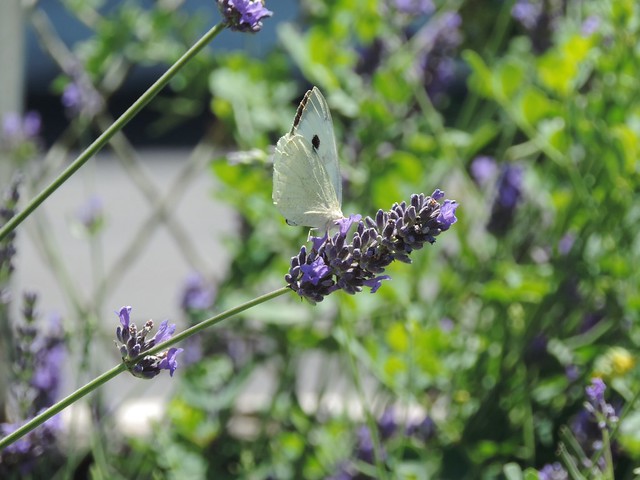
Butterfly on lavender

I recently read an interview with Anne Dufourmantelle, a psychotherapist and philosopher in Paris, who talks about the concept captured by the French word “douceur” (In fact, she has a book entitled “Puissance de la douceur”)

“Douceur” is one of those words which is difficult to translate into English but it has elements of softness, gentleness, goodness, mildness, and sweetness. “Allez-y en douceur!” means “Gently does it!” or “Easy goes it!”. And in the plural, “les douceurs de la vie” translates as “the pleasures of life”

In the interview (and in the book, which I’ve since purchased and read), she talks of the “absolute necessity of ‘la douceur'” in modern life, and I agree with her wholeheartedly.

She says she was looking for a word which would capture the connection between “the body, the spirit, sensation and intention”, and it was the word “douceur” which seemed to best fit the bill.

Let me try to translate a couple of her phrases for you –

“Douceur au sens de force de vie, de puissance, car notre première expérience sensorielle et émotionnelle est d’avoir été enveloppé dans la chaleur et la douceur d’un autre corps…La douceur donne naissance à la vie, elle est, pour l’humain, une nécessité absolue.”

[my translation – Douceur as a life force, a power, because our first sensory and emotional experience is to be enveloped in the warmth and the softness of another body…..La douceur gives birth to life, it is, for the human being, an absolute necessity.]

To make this concept clearer she says that if douceur was a gesture it would be a caress. Isn’t that lovely?

And somewhere (I can’t find it now) I’m sure she says that a flower could be a symbol of “douceur”.

I think she is right that kindness, gentleness, goodness, softness disarms and has great power – it comes from our own sense of vulnerability and that of others. It’s a humble stance – but powerful in the way, as we saw when it was used by Gandhi and others who advocated non-violent resistance. One image which comes to my mind when I think of this is the anti-vietnam war protesters in the 60s giving flowers to the police and the security forces. (OK, I know, the flower power thing went off from “peace and love” to “sex and drugs” but, well, there was a good hearted idea in there!)

Anne Dufourmantelle’s recommendations for how to increase the “douceur” in your life seem completely consistent with those which I find myself writing about again and again in this blog –

She recommends paying attention to details – gestures, facial expressions, the play of the light, all the little, fleeting, amazing things (“toutes ces minuscules chose fugues, merveilleuses…”) which surround us. And she recommends seeking out and, I’d use the word “relishing”, sensations – smells, tastes, sights, sounds, what touches our skin.

I love how she has taken this single concept and used it to link together bodily experiences, a way of engaging with everyday life, and a power of change which can be used to create more goodness in this world.

Read Full Post »

Yesterday was the summer solstice. Or to be more globally correct, the “northern solstice”.

I also know that if you live in Scotland, you’d know yesterday was “midsummer’s day” (Although I suspect you’ll have looked out the window and thought “What??!!”)

However, here in France, yesterday is known as the first day of summer. Either way, it was “the longest day”.

Just after the sun set on the longest day I took this photo from my garden. If you look carefully you can see the moon, Jupiter (just to the right of the moon), and Venus (a bit further to the right). In fact, Jupiter and Venus are moving closer together in the night sky and will converge completely on June 30th.

Were there any celebrations where you live this weekend? Or did you mark this day in some personal way?

I ask because a time like this offers a great opportunity to connect yourself more consciously to the rhythms of the Earth and our solar system.

Deliberately connecting to what is greater than you is a lovely way to develop your quality of your life.

Read Full Post »

« Newer Posts - Older Posts »