Feeds:
Posts
Comments

Archive for the ‘psychology’ Category

home herbs

In my A to Z of Becoming, I have two verbs for the letter “R” – reflect and relish.

Both reflecting and relishing have a part to play in deepening our experience of life. I think there’s a subtle difference in these two verbs which is revealed when we think of time – we reflect on what was. We reflect on what we did, what we thought, what we felt….at a particular time. We also reflect in the here an now, as in reflecting back to someone else what they have just said, but even in this “here and now” reflection is focused on what just happened. Isn’t it?

Relish, however, is very firmly focused on the here and now. Even if you decide to relish a memory, your relishing is still happening now – the focus of the experience is the re-living, or re-enjoying, whatever it was as you bring it back into the present.

Relish means to “enjoy greatly” (synonyms include – enjoy, delight in, love, like, adore, be pleased by, take pleasure in, rejoice in, appreciate, savour, revel in, luxuriate in, glory in)

To relish something involves intensifying the experience you are having, because to really “enjoy, delight in etc” you have to fully focus on it. So, let’s think for a moment about some of the qualities associated with relishing.

Presence. To really relish something, someone, or some experience, you have to turn up. You have to “be here now“, as Ram Daas said, and as Eckhart Tolle teaches in “The Power of Now“. Our minds often wander off into the past or the future, remembering something, worrying about something, planning something. Presence requires us to bring ourselves, and our attention into this moment. If you set out to relish something, that very intention will help you to be present….and being present will increase your relishing!

Awareness. A main theme of this blog is “heroes not zombies”. We live a lot on auto-pilot. To relish something we need to become aware of the sensations, feelings and thoughts which are being evoked. We need to be aware, awake, or “mindful”. My first encounter with awareness was in the book of the same title by Anthony De Mello (you can get a pdf of that book here). Mindfulness is the word made popular by Jon Kabat-Zinn. I found Dan Siegel, the founder of Interpersonal Neurobiology (IPNB), to be a really good teacher of mindfulness meditation. However you do it, whatever practice you follow, the key is to break the habits of non-awareness.

Open-ness. If you’ve already made you mind up about something, you’re not going to fully appreciate it in the here and now. If you think you’ve seen all there is to see, or know all there is to know, about something, your mind will have closed up. To really relish something you have to open your mind to the specific, the new and the amazing.

Gratitude. Finally, gratitude is a great partner to relishing. When we approach an experience with gratitude in our hearts, it sets us up to relish it. On the other hand, the practice of relishing something increases the gratitude we feel.

I know we often think of relish in the context of taste and food (I’ve even used a photograph here of the mint and chives near my front door), and food can be a good place to practice relishing, but if you go back and look at those synonyms for relish, I’m sure you’ll find a huge variety of targets for you practice on.

Ask yourself each morning this week when you wake up – what am I going to relish today?

Ask yourself each evening this week – what did I relish today?


Read Full Post »

rose

In Saint-Exupéry’s “The Little Prince”, the little prince talks about the rose he has been looking after.

“To be sure, an ordinary passer-by would believe that my very own rose looked just like you, but she is far more important than all of you because she is the one I have watered. And it is she that I have placed under a glass dome. And it is she that I have sheltered behind a screen. And it is for her that I have killed the caterpillars (except for the two or three saved to become butterflies). And it is she I have listened to complaining or boasting or sometimes remaining silent. Because she is my rose.”

Can you ever “park” the personal? Can you ever set aside the “subjective”?

In “The Little Prince”, the rose which the prince looks after means so much more to him than any other rose. Isn’t this an essential truth about one of the ways in which we experience difference in this world? We develop personal relationships. We don’t just form personal relationships with other people, but with other creatures, with certain plants, trees, even with certain inanimate objects. Children often form intense attachments with particular objects – a blanket, a teddy bear, a soft toy. Does this phenomenon disappear? Or do we just move our attachments to other “more grown up” objects – a pen, a car, a favourite cup?

Could you make a list? Could you describe the people, places, creatures or objects which you are particularly attached to? The ones which mean the most to you? You’ll find that your list is very specific – and very different from anyone else’s.

Read Full Post »

To be fully alive is to be engaged with the rhythms and patterns of the natural world, but to be fully human is to reflect upon and celebrate this relationship – David Fideler


There is a tendency to reduce thinking to rational thought. But thinking is not only about logic.

Thinking involves contemplation, reflection and the experience of sensations and emotions.

It does seem to me, however, that one way to move from zombie to hero mode, is to think – in the fullest meaning of thinking – to become aware and then to make conscious choices

Read Full Post »

The living world is a realm of dynamic processes. A flower is not a thing, but an event, like a butterfly emerging from a chrysalis. But with the word, we take a living event and freeze it forever into a useful but stable category. As Goethe wrote, “How difficult it is, though, to refrain from replacing the thing with its sign, to keep the object alive before us instead of killing it with a word.”

  • David Fideler, in “Restoring the Soul of the World”

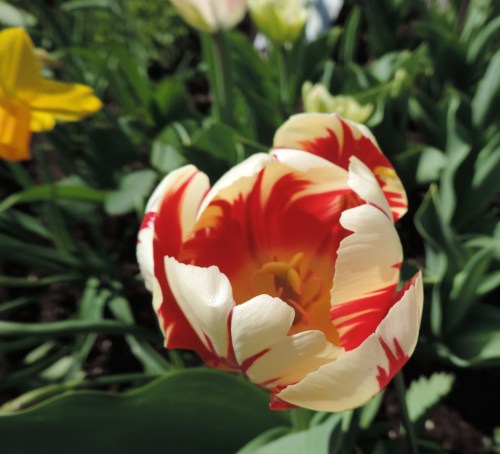
When you see a tulip opening in the warmth and light of the sun, you know in your heart this is not a thing, but an event.

Iain McGilchrist says, in “The Master and His Emissary”, that we use our left hemisphere to label and categorise. In so doing, we take the actions, the verbs of the real world and re-present them to ourselves as nouns, or as objects. If we stop there, we mis-understand the world. But if we re-present them to our other hemisphere then we can see the links, the connections, the what he calls “the between-ness” of the re-contextualised representations.

How much more wonderful the world seems to me when I see dynamic processes and connections all around me, rather than a collection of separate and separated “objects”.

Read Full Post »

Wingspan

One of the great things about learning a second language is how you keep stumbling across words which are difficult to translate exactly into your first language. I find that doesn’t just expand my vocabulary, but it increases the ways I have to think about, and express, my experiences.

So, here’s a new word for me, and, if you don’t speak French, it’ll be a new word for you too – épanouissement.

I have a Larousse English-French dictionary app on my iPhone – here’s what it says about this word – “blooming”, “opening up”, “lighting up”, “fulfilment”, “self-fulfilment”.

Doesn’t that give you a nice, rich and deep range of ideas and concepts all at once? I love that.

When I took this photo yesterday, I was lucky to catch the bird stretching out its wings and then when I looked at the image on my computer I thought that the combination of the bird stretching out and the tree blossoming really conveyed one underlying phenomenon.

Isn’t this what Life does in the Universe?

Life emerges, expands, grows, matures, expresses itself.

Don’t each of us, as living beings, express ourselves to our fullness? And doesn’t a tree do that, a bird do that, just as you and I do that?

I wouldn’t claim to know what life is all about, but it seems to me that this Universe manifests itself through “épanouissement” – it opens up, it blooms, and it lights up the cosmos with a constant process of self-fulfilment.

Daily I become the most “me” I can become.

Daily the bird in the tree becomes the fullest expression of its unique life. Daily the tree grows from one form to another through the seasons, expressing the uniqueness of its own particular life.

I hope you enjoy both your own personal “épanouissement” today, as well as having the opportunity to enjoy that of some of the other lives around you.


Read Full Post »

The “N” in my A to Z of Becoming, can stand for “nourish”, so here’s my focus for this week – what nourishes my heart, feeds my soul?

Looking back over the series on re-enchanting life which I posted over the last couple of weeks (scroll down to read them, if you haven’t seen them already), I realise that everything which I find enchanting, stirs my blood, sets my heart beating stronger or faster, and touches me right down to the core of my soul.

Beauty is one of the common factors. Difficult to define but don’t we sure know it when we see it, hear it, touch it?

Love is one of the common factors. Wherever love stirs, the heart leaps and the soul expands.

You’ll have some of your own, I’m sure, but here’s just a few photographs I’ve taken recently which nourish me –

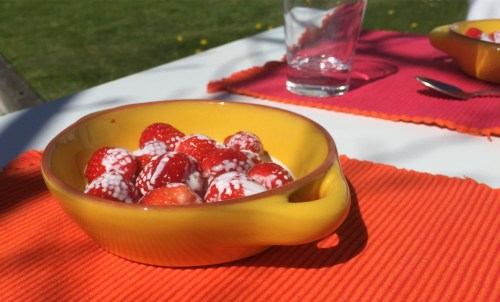
…the first “gariguettes” of the season – wow! what a taste!

The love locks in Paris – it’s as if they exude love into the air, surrounding you, filling you, gladening your heart.

Relaxing by a pool at lunch time, seeing the simple pleasures of sharing a bite to eat, of chatting with friends, of reading, sailing a boat, or simply snoozing..

Cheers! Here’s to whatever nourishes your heart, your soul, your body and your mind. May you taste it, feel it, hear it, see it, know it, be amazed by it, every single day.

Read Full Post »

Vineyard early April

I’ve been away from home for about three weeks, and when I returned I noticed that the vineyards are starting to blossom with wild flowers.

As I look out from my house or from my garden I see vineyards in every direction. I see trees, flowers, bushes, birds, butterflies and blossoms. I hear beautiful birdsongs both during the day, and at night. I look up into the clear night sky as I did last night and the more I look the more stars I can see.

So, today, I am reminded about the importance of our natural environment in deepening my experience of life. In Japan there is something called “forest bathing”, which is just about spending time amongst trees. It seems that not only do we gain a psychological boost from being in the forest but the trees produce anti-inflammatory substances which we breathe in.

Richard Louv wrote a book about the importance of Nature for our health – he coined the idea of “vitamin N” (N for Nature) and he postulated that many of us are suffering from a disease – “Nature Deficit Disorder” – for which the cure is, of course, enough doses of Nature!

I know we are not separate from Nature, but rather that we emerge from within it and never exist outwith it on this Earth, but it is all too easy in our increasingly urbanised societies to become cut off from the healing influence of Nature.

Wherever you live, I expect that within half an hour or so of travel, you can find a park, a wood, a beach, a riverside walk, a lake or some other abundant area of plants and animals. Pop along now again. I bet you’ll feel the better for it.

Read Full Post »

Lens

In my A to Z of Becoming, J can stand for the verb “join”.

When we think of “joins” we might think of connections, or of interfaces. We can think of bonds and relationships. We can think of the quality of a connection.

Iain McGilchrist, in his Master and His Emissary, shows clearly how the two halves of our brain are well designed to approach the world in two distinct ways – the left hemisphere tends to approach the world by drilling right down, by isolating parts and examining them. It’s great for focus and for labelling or categorising. It is largely responsible for how we see the world as full of “things” – objects which are separate from each other.

The right hemisphere, on the other hand is great at putting things together, seeing the patterns of connections, focusing on the relatedness rather than on the things. This approach to the world doesn’t see anything as isolated and unconnected. It’s great for seeing the contexts, for appreciating the whole without breaking it into parts.

He makes the point that our societies have developed in a strongly “left hemisphere way” and suggests it would be better if we got our right hemispheres working more effectively, and, especially it would be better if we used our whole brains instead of only half of them.

So, here’s something to explore this week. Instead of using the lens of objects and parts, how about looking for the joins? How about seeing the connections, reflecting on the relationships in your life? I don’t just mean the relationships you have with other people. I mean the relationships between you and the world….the world of objects, as well as the world of other subjects!

Whatever you turn your attention to next, see if you can put it in its context, see if you can see it as a transient, emergent part of the whole, see it as inextricably part of the flow.

Here’s a passage from the teaching of Thich Nhat Hahn where he uses a piece of paper to illustrate this idea beautifully –

If you are a poet, you will see clearly that there is a cloud floating in this sheet of paper. Without a cloud, there will be no rain; without rain, the trees cannot grow; and without trees, we cannot make paper. The cloud is essential for the paper to exist. If the cloud is not here, the sheet of paper cannot be here either. So we can say that the cloud and the paper inter-are. “Interbeing” is a word that is not in the dictionary yet, but if we combine the prefix “inter-” with the verb “to be,” we ha vea new verb, inter-be. Without a cloud and the sheet of paper inter-are.

If we look into this sheet of paper even more deeply, we can see the sunshine in it. If the sunshine is not there, the forest cannot grow. In fact, nothing can grow. Even we cannot grow without sunshine. And so, we know that the sunshine is also in this sheet of paper. The paper and the sunshine inter-are. And if we continue to look, we can see the logger who cut the tree and brought it to the mill to be transformed into paper. And wesee the wheat. We now the logger cannot exist without his daily bread, and therefore the wheat that became his bread is also in this sheet of paper. And the logger’s father and mother are in it too. When we look in this way, we see that without all of these things, this sheet of paper cannot exist.

Looking even more deeply, we can see we are in it too. This is not difficult to see, because when we look at a sheet of paper, the sheet of paper is part of our perception. Your mind is in here and mine is also. So we can say that everything is in here with this sheet of paper. You cannot point out one thing that is not here-time, space, the earth, the rain, the minerals in the soil, the sunshine, the cloud, the river, the heat. Everything co-exists with this sheet of paper. That is why I think the word inter-be should be in the dictionary. “To be” is to inter-be. You cannot just be by yourself alone. You have to inter-be with every other thing. This sheet of paper is, because everything else is.

Suppose we try to return one of the elements to its source. Suppose we return the sunshine to the sun. Do you think that this sheet of paper will be possible? No, without sunshine nothing can be. And if we return the logger to his mother, then we have no sheet of paper either. The fact is that this sheet of paper is made up only of “non-paper elements.” And if we return these non-paper elements to their sources, then there can be no paper at all. Without “non-paper elements,” like mind, logger, sunshine and so on, there will be no paper. As thin as this sheet of paper is, it contains everything in the universe in it.

Read Full Post »

In my A to Z of Becoming, one of the verbs beginning with “I” is “imagine”.

As it happens, I’ve chose “imagination” as my keyword for this year. Do you do that? Do you choose a “word for the year”? 

I think I have a very active, very well developed imagination. My feeling is that I used my ability to imagine every day at work as a doctor to help me understand my patients. For me, good medical practice is dependant on the ability to empathise. Without empathy there is a diminished level of understanding. In fact, the complete lack of empathy, resulting from a failure of imagination, as a cause of cruelty, was highlighted by the author Ian McEwan, and others, after 9/11.

Since retiring and moving to France, I’ve begun to experiment with writing fiction as another way to use my imagination. What startles me, and repeatedly surprises me, when I write fiction is how my imagination comes up with things I hadn’t expected. 

Maybe that shouldn’t surprise me because every night when we dream our imaginations are producing the unexpected, aren’t they?

That got me thinking…..is there an off switch for imagination?

Are we ever not using our imagination?

When we fear something, we are imagining whatever it is we fear. When we worry about something, we imagine whatever it is we are worrying about. When we experience something we bring our imaginations into the experience as we create the subjective experience for ourselves. When we remember something we re-create the memories using our imaginations. When we plan to make something happen, we use our imaginations to create the plan.

Actually, I think, there is no off switch for the imagination.

However, when we are on auto-pilot, when we are in zombie mode rather than in hero mode, we are not aware of the activity of our imagination, and we are not making conscious choices.

Those are the two key elements to moving from zombie to hero mode, I reckon –

First, become aware.

Second, choose what to do.

So, here’s two things about imagining to explore this week.

What are you currently using your imagination for? And, what are you going to choose to use your imagination for?

Read Full Post »

The Atlantic

People crave certainty.

We want to know, for sure, what the results will be of our actions. We want to be able to predict what is going to happen in the world, and in our lives.

Don’t we?

Two examples spring to my mind.

1. The daily weather forecast.

Every day millions of people listen to, watch or read the weather forecast. We want to predict what the weather will be like tomorrow, in a few days time, next week or the week after even……

2. The focus on “outcomes”.

Knowing for sure the results of our actions – in Medicine, we want to know for sure what will happen if we have treatment X, and we want to know for sure what diseases we will get and what effects they will have on us. In Economics, we want to know for sure that if we introduce this particular policy then it will have the results we desire. In engineering we want to know for sure that the machines we make will consistently and reliably do the job we design them to do.

That’s how it is for us humans. We’re afraid. We know that none of us live for ever but that’s a terrible knowledge to have. We want power over the unpredictable. We want to control the present in order to control the future.

But does the world work like that? Is Life like that?

I don’t believe those who predict futures, but I’ll listen to what they have to say, and make some choices all the same. If the weather forecast says it’s going to pour with rain tomorrow but has a good chance of being sunny in a couple of days time, I might choose to put off my trip to the beach tomorrow, and, instead, to plan to go in a couple of days time.

But do you know what I find most satisfying of all?

To “seize the day”.

If I wake up tomorrow and the forecast is wrong…..there’s bright sunshine and clear blue skies, then it’s great to set off to the coast, and not wait for a “better day” a couple of days ahead.

And what about control – of diseases, of economies, of machines and so on? We don’t control any of that.

Look at that lighthouse in the image above.

Does it control the Atlantic Ocean?

Does it ensure that shipping will not hit rocks?

No, neither of those things.

It gives us the opportunity to be aware, and so let’s us make adaptive choices. (In the case of the lighthouse, to be aware of the rocky coast and to change direction)

But if the opposite of control and prediction is “out of control” and unpredictable, then I don’t know any human beings who can manage to live that way.

So, for me, it’s not about trying to be out of control or to relish unpredictability. Despite the fact that the delusions of control and fallibility of predictability will always be unsatisfying, disappointing or frustrating.

I do think there is another way.

The other way has something to do with awareness, with resilience, and with living in the present moment, but I think I’ll take the time to explore that in more detail in future posts.

Read Full Post »

« Newer Posts - Older Posts »