Pumpkins are one of the most prolific and successful plants in my garden. They appear even where I haven’t seeded them (they must be in the soil now after five years of planting) and once they start to grow they spread across the entire vegetable patch reaching out towards every border.
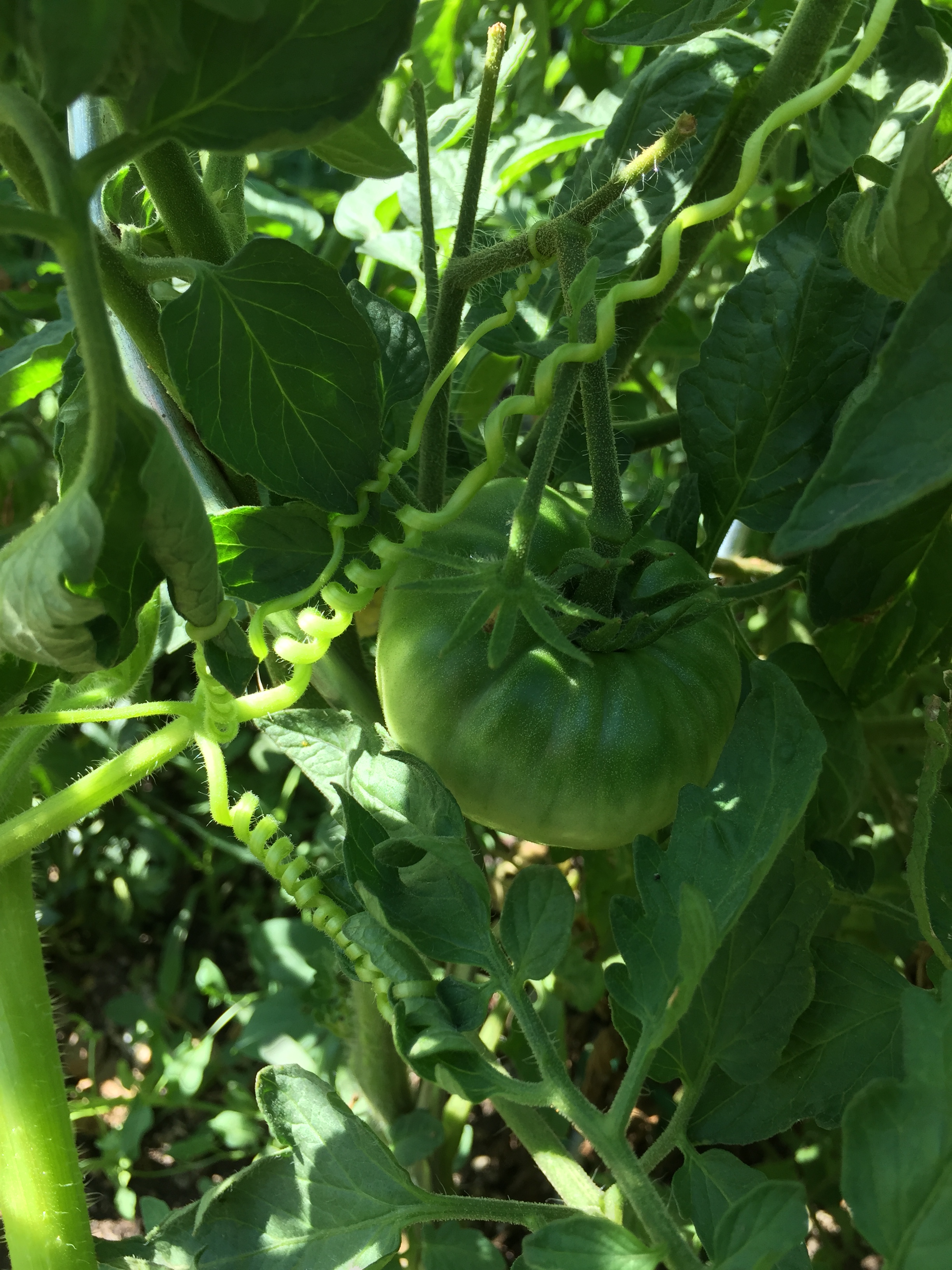
On their way around and over the other plants they send out these tendrils which catch on to whatever they can touch. The tendrils then spiral intensely creating these powerful bonds which the plant uses to anchor itself and pull itself up on the surrounding plants, fences, walls and so on.
I think these bright green coils are astonishing. I’m amazed by them. How does the plant know when it’s touched something else….another plant, a part of the fence, or whatever, and then how does it move its tendrils to wrap around whatever it has connected to, and then how does it “wind itself up” like this?
Plants don’t have brains. We know that. But they sure have the ability to sense – they can sense touch, they can respond to light, to gravity, and as far as I know can seek out the nutrients they need. They can unfold their leaves to gather up the Sun’s energy to transform it into sugars and structures. They can fold their leaves up to protect the plant from too much sun. We tend to think of plants are creatures which stay put, but I can tell you pumpkin plants to anything but stay put!
I think we under-rate the plant world. It is astonishingly diverse, incredibly resilient and is far more sentient than we realise. Plants have the ability to move much more than we realise because we don’t see them walk or run anywhere, and we know they don’t have muscles or limbs. But, goodness, they are not still. They reach out, spread, grow and seek what they need to survive and thrive.
I wonder how they communicate with each other? I wonder if the pumpkin here in this photo communicates with the tomato plant it has found and fastened itself onto? I don’t reckon they “think” or “speak” like we do, but they surely make connections, exchange energy, chemicals and information, and doesn’t that amount to a vast amount of communication?
Seeking, connecting, communicating, pulling together……..I guess we’re at our best when we do that too, aren’t we?
It strikes me there is a paradox at the heart of what it is to be human. We each have a sense of being different from other people. We experience what Freud termed “the ego”. It’s a sense of “self”, of a kind of centre of the universe from which we observe and interact with everyone and everything else. Our immune system is finely tuned to quickly recognise anything that is “not me”, to identify it as a potential threat and to mount inflammatory and/or allergic responses to contain and/or expel it. We need to know that we matter, that we have value and worth, and whilst some of that comes self-referentially as “self-belief” and “self-worth”, a lot of it comes from that other, somewhat paradoxical theme – the fact that we are social creatures.
We need to belong. Complete isolation is a punishment – we call it “solitary confinement”. We need to find common ground with others, to be accepted by a family, a group, or a community. We need to find and express what connects us to others so that we can share our experiences with them.
This paradox of separateness and belonging is never “resolved” if we see them both as opposite, unconnected poles. Although they are undoubtedly difficult to reconcile, they need to be “integrated” – in other words we need to find how we can connect them to each other in ways which will enhance and develop both.
It’s important to grow and mature as an individual. It’s important to feel free, to have personal autonomy. It’s also important to grow as communities, as a species, (if we want to evolve), and even as an integral part of all Life on Planet Earth. We share the same air, the same water, the same limited “resources”. We create waste which cannot be contained. What I do affects others. There’s no getting away from that.
If an individual takes a strong exclusive position on one of these two needs, they lose their necessary connection to the other one. That results on the one hand in selfishness and narcissism, and on the other, as auto-pilot, group-thinking, which sets them up for domination and manipulation by others.
These things make us sick. They set in train the forces of dis-ease.
To be healthy and fully human we need self-belief and self-knowledge. We need freedom and autonomy. We need to belong, to form loving, caring and mutually beneficial relationships. We need to find common ground with others. And we need to see ourselves as inseparable individuals emerging from, and embedded within, the whole – the whole species, the whole living planet, the whole universe.
What supports, encourages and maintains a healthy immune system?
The answer is lots of things, and no one thing by itself. There isn’t a magic pill or single technique which will keep your immune system healthy, but I thought it might be worthwhile just summarising some of the things which have a good chance of helping.
Nature
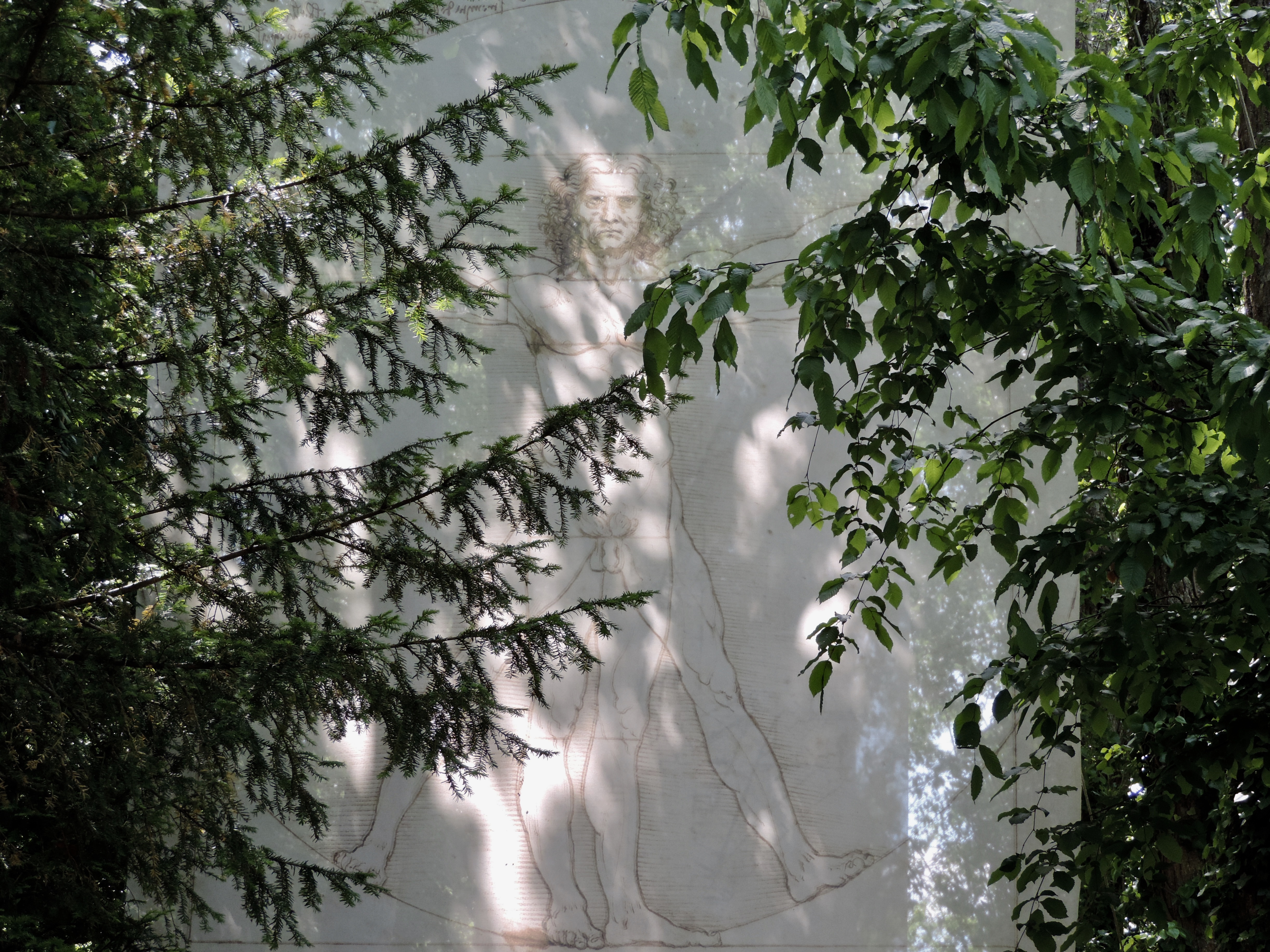
My first one is Nature. Japanese scientists have shown that “forest bathing” boosts immune activity. It seems that trees actually send out certain chemical which boost particular immune defence chemicals in the human body. But there’s probably a holistic, experiential element active as well. In other words, it’s probably not all down to particular molecules in the atmosphere. Because we also know that just spending time in natural environments boosts health….to the extent that Richard Louv describes Nature as “Vitamin N” and hypothesises that most of us are suffering from “NDD” – “Nature Deficit Disorder”. It seems that whether we are in a forest, in a garden, up in the hills, walking along the sea shore….all of these places are probably positive for our health and our natural defences.
Physical activity
There seems to be ample evidence that physical activity and many forms of exercise can both boost positive moods, and reduce unhealthy levels of inflammation which damage the immune defences. The bottom line is the more inactive your are, the worst it is for your whole system. Physical activity can include walking, jogging, gardening, sports, swimming, cycling – there’s a wide enough range there for pretty much everyone to find some kind of physical activity they can enjoy.
Diet
There are gazillions of articles about so-called healthy diets, or “anti-inflammatory” diets, or whatever. It’s mind-bogglingly confusing! But I think there are certain well established themes which run through every single “healthy diet”. It starts with eating mainly plants. Diets high in fruit and veg turn up again and again in research which identifies what seems to help to reduce chronic diseases, boost immune defences, and even encourage longevity. The second part is minimising what damages us – and that comes down to refined sugars and artificial chemicals more than anything else. How do you do that? Well, most simply by eating what is prepared by hand at home. The more processed, the more industrialised the “food” we eat, the more we are exposed to the harms. Ideally the more you can eat locally produced, seasonal foods, the better. And the more you can eat food from farms which don’t use artificial chemicals or industrialised techniques, the better. But the bottom line is “the less processed the better”. The third part is not eating too much – of anything! Whether you do that through an “intermittent fasting” diet, or simply by stopping snacking between meals, limiting consumption to what we need is good for us.
Supplements
I’m not a fan of supplements. Probably because I’m one of those weird people who finds it nearly impossible to swallow capsules and most pills! I also think we evolved to get what we need from Nature. However, again and again we are finding that Vitamin D deficiency makes us vulnerable. I’ve read a number of studies showing that vitamin D deficiency is most prevalent in patients who get the most severe forms of COVID. But vitamin D deficiency has been implicated in a host of chronic illnesses. So I do recommend it.
Other supplements? I’m pretty convinced about the value of two others when it comes to viral immune defence – Vitamin C and Zinc.
So, that’s what I take, and that’s what I’ve recommended my whole family takes. Vitamin D (4000 iu), Vitamin C (1G) and Zinc (15mg) every day just now. But you should find out for yourself, because we are all different sizes and ages and the amounts to take vary. So, be clear, I’m not prescribing these supplements for you….do your own research and ask health care professionals who trust, and, especially, ask your doctor if you are already taking medication. Immune defence is certainly not all down to supplements but they are worth some consideration.
Stress
There are undoubted, unavoidable links between the immune system, the nervous system and the endocrine system. Stress and emotional distress undermine the body’s defences. How you manage stress, and what practices work best for you, will differ from person to person, but it’s likely to involve some form of mental practice such as Meditation, Cognitive Behavioural Therapy, Heartmath, Visualisation, keeping a Gratitude Diary, or something like that. That’s in addition to spending time in Nature and taking exercise, both of which also reduce stress.
Maybe you already know what you can do to reduce stress, it’s just you find it hard to set aside the time to do it. Well, now is the time! Start today!
Emotional intelligence – there’s a link between stress and emotional intelligence – by that, I mean that learning to handle our emotions lowers stress, and that stress makes emotional turmoil worse. This is way too big a subject to tackle in a single blog post but I thoroughly recommend learning about your emotions, and how to handle them.
Love
I’ve left this one to last because I guess it’s the least “scientific” factor, but whether it’s longevity studies or studies of well-being, again and again human relationships are shown to be important. We need to be engaged, we need to love and to feel loved. We need that in relation to other people, to other creatures, to Nature, to Life. And that’s pretty tough in times when were are forced into social distancing, or even worse, social isolation. That’s why it’s so important for societies to make sure that whilst physical distancing might reduce the chances of spreading the virus, people are not isolated. We need contact, communication, simple checking in to see if we are ok, or if we need any particular help. We need to know that we are valuable, appreciated, even loved. Without that we are likely to suffer from more stress and less effective defences.
I am sure there’s a lot more you could add to this subject, but my bottom line is that I think we don’t pay enough attention to consciously, actively improving our well-being and our immune defences. If there was ever a time to do that, it must be now.
Every living organism has the capacity to stay healthy and to repair any damage it incurs. In other words, they all share the ability to survive. Plants, micro-organisms, animals, humans…..every creature which lives has the ability to survive. Otherwise it wouldn’t exist.
We’ve discovered a fair number of the processes which enable us to survive and to repair when we are damaged. A whole bunch of these are called “homeostatic” processes – they are complexes of cells, chemicals and feedback loops which maintain a certain stability of the “internal environment”. They keep the working relationships between all the cells, tissues and organs in balance. Things tip too much one way or another, the homeostatic system kicks in and returns the organism to a more balanced state. When we are damaged, for instance, when we break the surface of our skin, or break a bone, then the body mobilises “inflammatory” processes to pour cells and chemicals into the damaged area, seal off any breaches in the defences, and start to lay down repair tissue.
Isn’t it amazing how the body does this?
There’s a huge tree just behind my neighbour’s house. One day about three years ago, in a storm, a large cluster of branches were broken off at the top of the tree, turning it from a pretty symmetrical plant into something that looked like a giant had taken a big bite out of it. Now that gap has gone. The tree has repaired the damage and has, almost, become symmetrical again.
Survival and repair. These are the fundamentals of life aren’t they? But they aren’t enough to fully describe Life. There’s a third element in every living creature – growth.
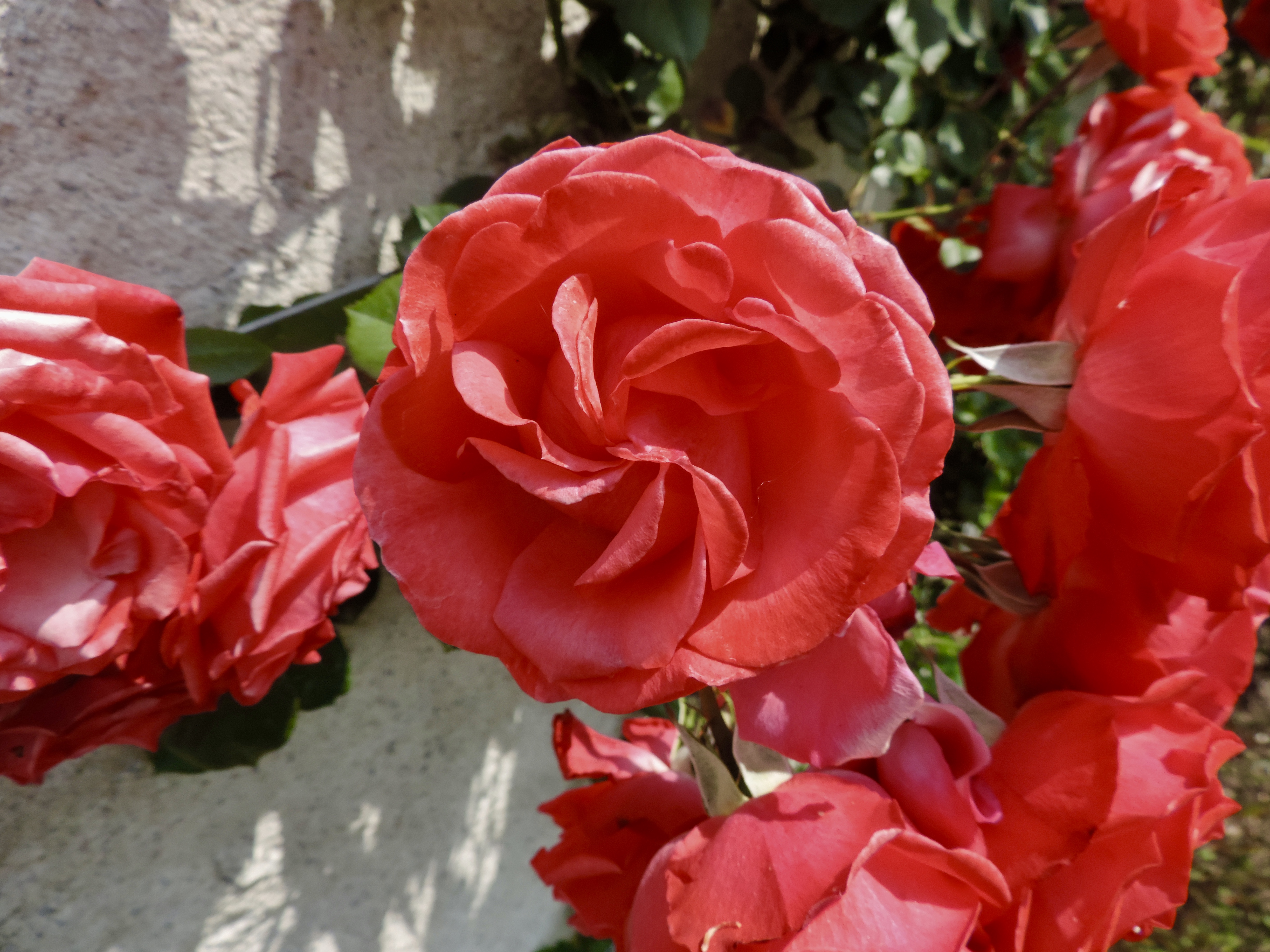
This rose in the image above is unfolding the petals from one of its buds. The unfolding is like a spiral, like one of those paper windmills you used to play with as a child. It’s utterly beautiful. This unfolding is an expansion, an opening up, a revealing and a stretching out to manifest itself. This rose is declaring “Here I am!” This rose is showing the world she exists by performing the third element of Life – growth.
Not just growth which is about becoming bigger, taller, thicker. Not just growth which expands the reach of the plant into the surrounding territory. But growth which reveals a whole new aspect of the rose. Before the flowers open up like this, the rose looks quite different. Green, leafy, thorny. But without flowers.
My littlest grandson is just seven months old now and seeing him start to “flourish”, start to “unfold” and “reveal” himself is like watching a miracle. Those first new behaviours and sounds are such a thrill, that emergence of interaction, of recognition and connection…..it’s breath-taking.
I used to find a similar awe and wonder when witnessing the unfolding and revealing of a patient as they moved beyond survival and repair into the fullness of health……seeing in that process the revelation of their uniqueness.
I think we tend to take these things for granted, because they happen all the time….these processes of survival, of repair and of growth.
But it’s worthwhile pausing from time to time and becoming aware of them….in the flowers, the trees, the birds, the other animals which share your world……in people you meet, people you love and in yourself.
I know it’s tempting to think of time as a straight line, running from then, through to now, and onto whenever. But what pleases me so much more is to become aware of phases and cycles……those circling, looping, spiralling movements of Life.
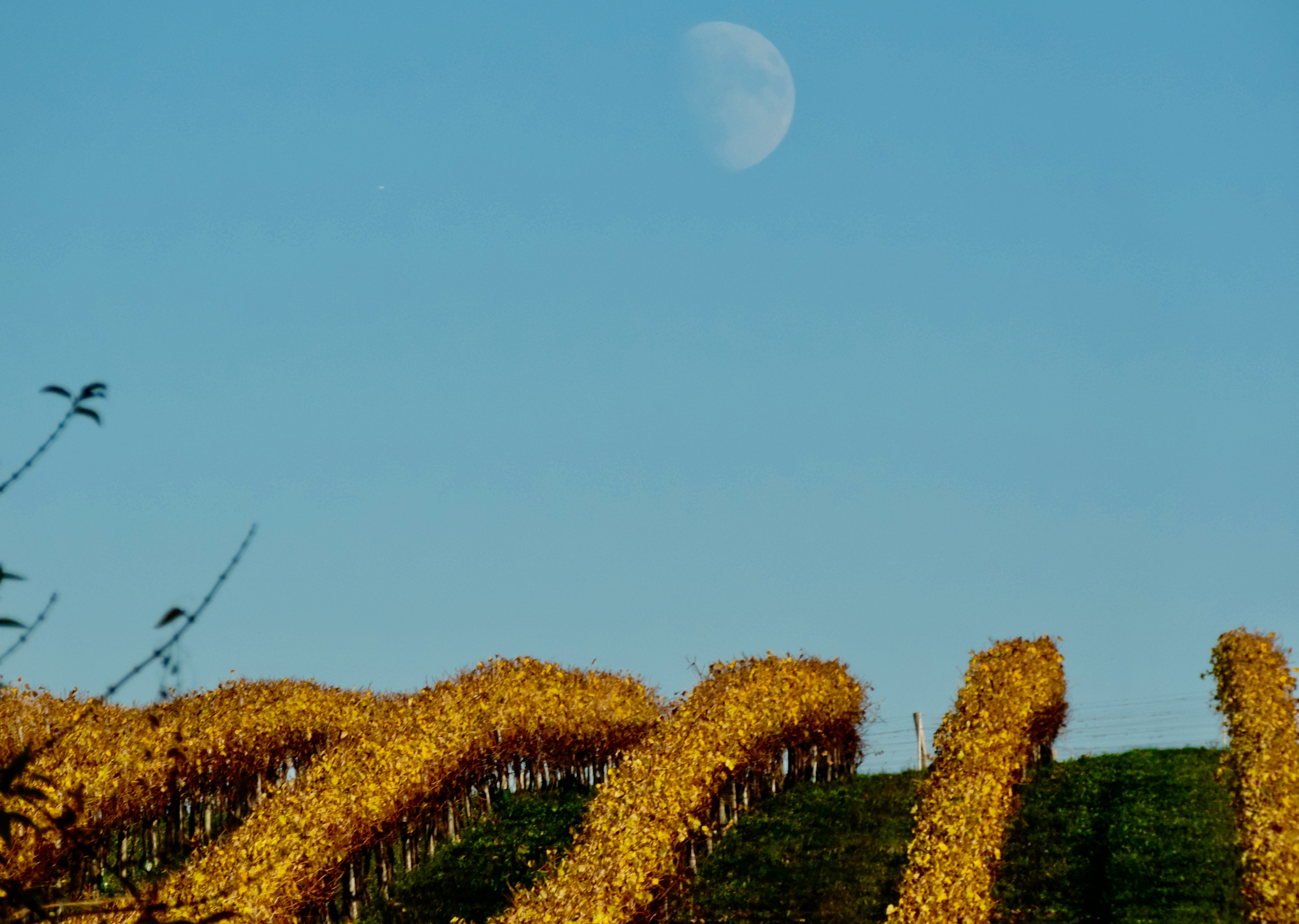
In this photo, the first thing I see is the Moon…..that celestial object which never stays the same. Every single night or day when we look at the Moon we see its shape is a little different from what it was yesterday. Surely this must be one of our most ubiquitous examples of constant change….the phases of the Moon.
We know that a lot changes here on Earth in sync with the Moon phases. We see the effect on the tides as the oceans and seas reach further up the beach, or recede away from the land to a greater distance. We know that there are rhythms of change in incidence of psychological phenomena too…..the old word “lunacy” is not without foundation in reality. We also know from “biodynamics” that seeding, planting and harvesting at different moon phases can produce different results. Yet, somehow, perhaps because night skies above cities are rarely clear, many of us have lost touch with our knowledge of Moon phases.
Do you know what phase the Moon has reached tonight?
Check tonight and see if you are right.
The second thing I see in this photo is the vines. There are vineyards everywhere in this part of France. Each of these lines is called a “wire”, and each vineyard has several “wires”. Here, near the town of Cognac, almost all the grapes go to the production of the drink of that name – “cognac” (but also to another product called “pineau”). The big “cognac houses” have contracts with many local growers, each of whom dedicate the harvest of a certain number of their “wires” each year to the distillery. By selecting particular amounts of the harvest from several, diverse regions within this grape growing area, they get a mix of flavours….some from land which is near the sea, some near forests, some very high in calcium content, and so on.
Watching the phases of the vine growth and grape production over the course of a year brings a certain rhythm to life. A rhythm attached to the seasons. In this photo the vines are all turning gold as they do every autumn. I love this season of the year for its glorious colours.
Attuning ourselves to natural phases and rhythms sets a background sense of time which stretches over longer periods than how long it take the hands of the clock to make their way right round its circular face. And it sets a rhythm completely different from the rigid, relentless movement of our digital devices as they show us what number of hours and minutes, or even seconds, have “passed” since we last looked!
Phases and seasons……cycles and rhythms………which ones do you attune to?
We often look at the world this way….just a peek through a narrow gap. We can see a bit this way. It’s a way of being focused. If we narrow our gaze we can ignore everything except what’s in the target zone of our attention.
You know we have “two brains”, right? I mean the recognition that we have a cerebral cortex which is divided into two, non-symmetrical parts. Why do you think the brain is like this? Why not just have one, whole brain? Why did evolution prefer to develop the cortex in two significantly different hemispheres?
Well a lot of people have tried to claim that the right half does these things, and the left these other things….like the right is what we use to “do art” and the left is what we use to “do logic”. But we know that’s not true. The brain is not like a clock, a car, or a computer. It doesn’t function with one part doing “this” all by itself whilst other parts do “that”.
But Iain McGilchrist figured it out. In his “The Master and His Emissary” he lays out what I find to be a convincing thesis – each hemisphere engages with the world differently – in other words, each hemisphere gives us a different way of approaching, understanding and interacting with, the world.
What the left hemisphere allows us to do is like what you see in this image. We use it to narrow our gaze. We use it to focus in on “parts”, to analyse them, label them, categorise them, in order to try and “grasp” and manipulate them. The right hemisphere, on the other hand (see what I did there?), is used to enable a broad gaze. We use it to focus on the connections, to explore the bonds and relationships, to discover what’s new, and to see things in the broader view, or in “the whole”.
What amazes me about this is that we use both halves simultaneously pretty much all the time. They are in constant interaction, giving us the ability to “integrate” and “synthesise” what they focus on.
The trouble comes when we fail to pay enough attention to one of the halves – actually, in our modern world, it’s the right hemisphere we fail to attend to sufficiently. We get stuck in our world view of seeing reality as composed of separate parts which we can label, categorise and control. We get hooked on a mechanistic model. And, well, reality is not like that. That picture is incomplete and can lead us astray.
So, we do need these abilities to focus narrowly, to separate out elements, analyse them and organise that knowledge, but we ALSO need to be constantly aware of the big picture. We also need to see the contexts, the connections and the circumstances. It’s this that enables us to see uniqueness.
When it comes to this pandemic, we need to understand and analyse the COVID-19 virus. It will be a real boost to us to discover how to improve our treatment of people who are infected with it to try and reduce the potential damage they might suffer. But we need to use that other half of the brain too and see what the circumstances are in which this pandemic has arisen. We need to join up the dots. We need to see the connections and the contexts.
Isn’t it clear that one reason why this pandemic is so damaging is that we don’t have enough good health care? I think this issue is the same whether you live in the UK, France, the US, Spain, Belgium….you name it. It’s not the sheer number of people who are suffering from significant effects of this virus – after all, it seems about 80% of those who catch it don’t even get any symptoms. It’s that the small percentage of people who DO suffer serious effects from it still constitute numbers potentially too big for our health services to cope with.
Why do you think there is this constant message about “protect the NHS” in the UK? The NHS shouldn’t need “protecting” from sick people! It’s very purpose is to treat them. But the truth is there aren’t enough staff, there aren’t enough hospital beds, there isn’t enough equipment, there isn’t enough PPE, there aren’t enough testing materials, or laboratory resources.
There isn’t enough decent, safe social care available for the elderly. There isn’t sufficient support for people whose incomes are hit by forced closures of their workplaces. There isn’t enough decent housing. There isn’t enough decent nutrition because the current model of industrialised farming and processed food production is feeding both obesity and nutritional deficiencies of important vitamins and minerals which are needed for healthy immune systems.
And so on……
Unless we use our whole brains and address the underlying weaknesses, vulnerabilities, insufficiencies and injustices in our societies we will find not just this pandemic hard to handle, but we’ll set ourselves up for more of the same.
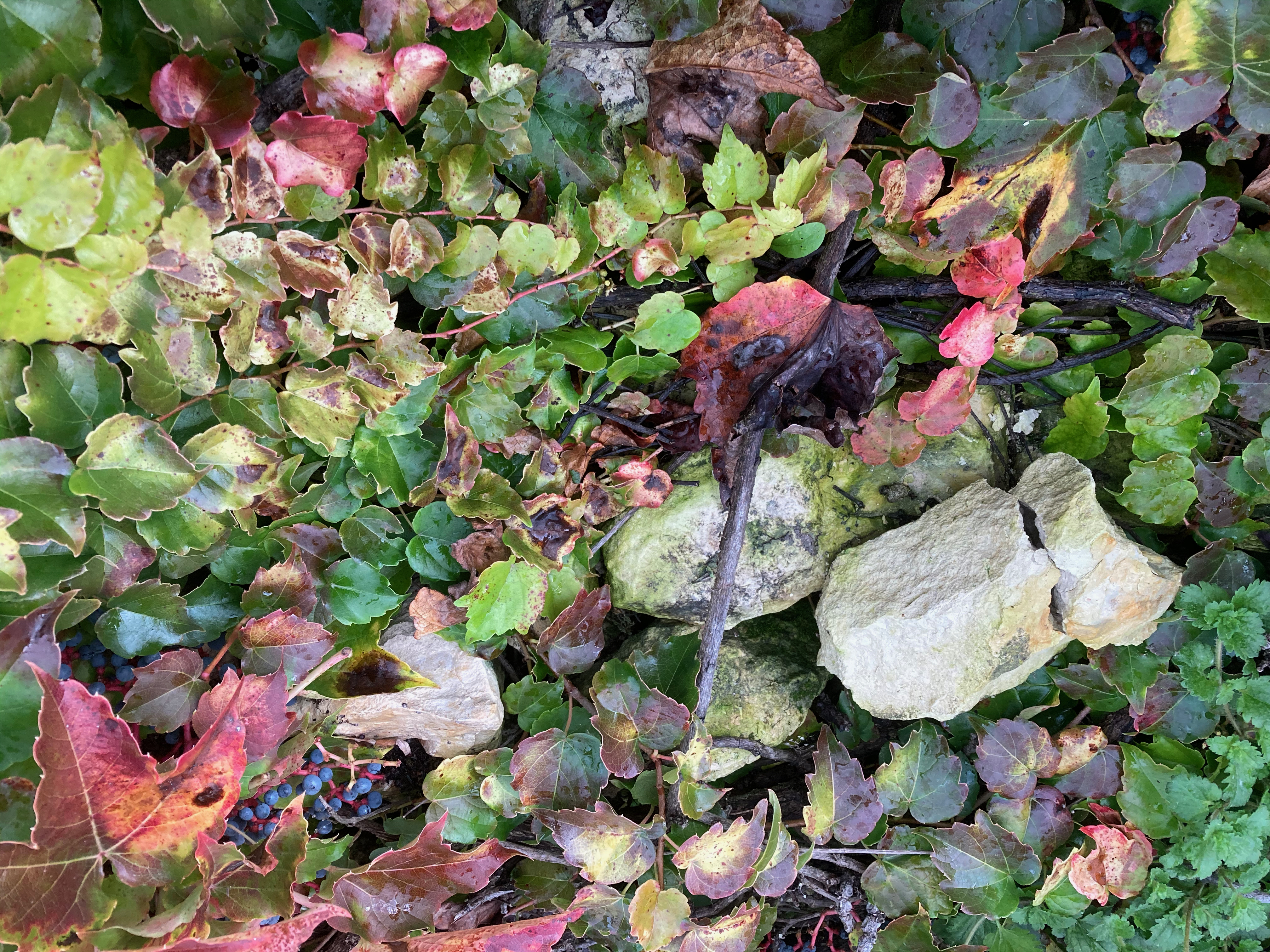
It’s ten months now since the wall fell down. I’m sure that the pandemic has slowed up almost everything this year, but it sure takes a long, long time to get things done in this neck of the woods!
I strolled through the garden the other day and took this photo at the lowest part of the gap in the wall. As it’s autumn now, the vine which used to cover the entire wall has now started to turn from green to red and gold. The stones have lain where they fell for months now and the vine just grew over them. You can see in this image the remnants of the wall, the living vine, the fruit it produces (It’s “Boston Ivy” by the way, or “False Vine”) and the gorgeous autumn colours of the leaves as we move towards winter.
I think this image is just beautiful. I love it. I love how much there is to see in it and I adore the overall combination of elements. It reminds me of the four stages of the cycle of reality – growth, maintenance, falling to pieces, emergence.
Using the lenses of “systems science”, “complexity science”, and, in particular “CAST” – “Complex Adaptive Systems Theory” (which is my MAIN lens for understanding reality) I can see that this image represents the stage where things are falling to pieces. All systems undergo this. After a stage of fairly stable fulfilment, as we see in summer and early autumn, there is a stage of letting go, of order crumbling to be replaced by something more chaotic, more wild, more “disordered”. Well, this is it.
What comes next? Emergence, novelty, a new phase, a stage of “reorganisation” building on the path followed so far. Almost always this new phase is unpredictable. Always it is unpredictable at a detailed level, but almost always it is unpredictable at a macro level.
This pandemic feels like a phase where the old order dies. It feels like a time of change. And we are all wondering “what comes next”? Can we play an active role in creating the new phase, you and I? I hope so. Because the old order got us to where we are and we want to move on from there now, don’t we?
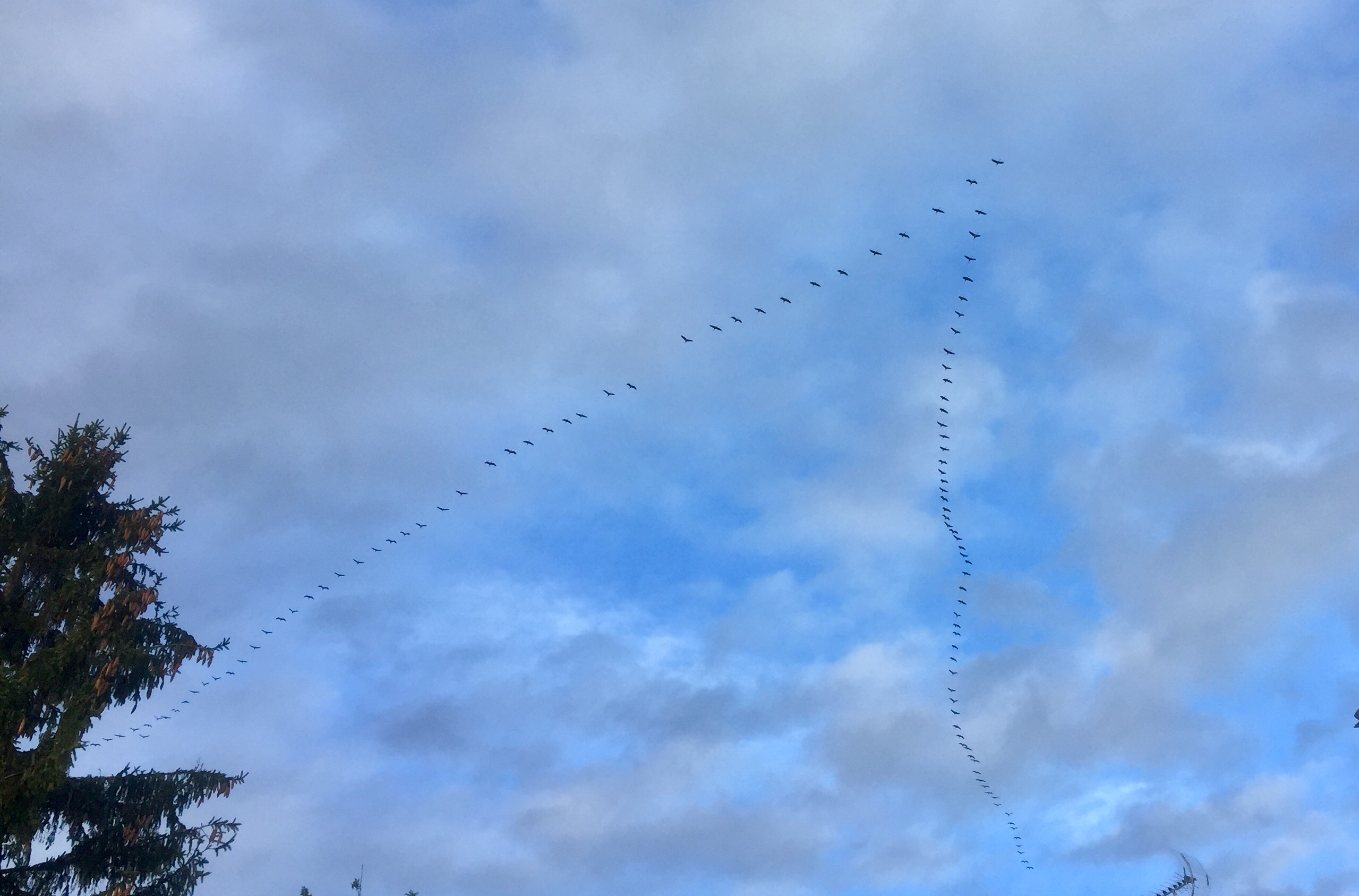
Here in Europe autumn is a season of great change where we move from summer to winter. One of the most astonishing phenomena of this season is migration. Look at this fabulous flying V of cranes heading south! I wish I could let you hear the incredible noise they make, but my little phone recording really doesn’t do them justice.
These are only one of the species of bird which migrates. The hoopoe and the redstart have already left my garden and I still have no idea where they go or how they manage to find their way back to exactly this small square of the Earth every Spring. The other birds I see around here flying in similar great V shapes are geese, but I haven’t seen any passing by yet.
Don’t you think it’s an astonishing phenomenon, this ability of these little creatures to navigate and fly across thousands of miles from one exact place to another? As far as I know nobody has managed to fully understand how they do that. But it’s also amazing to me that they have the energy and the determination to make the huge effort of flight over these enormous journeys.
Birds, of course, are not the only creatures to migrate. Many others do, from fish to butterflies. So it’s an important, significant natural phenomenon of Life. Many many more creatures migrate in the sense of moving from their original habitats to other ones, but don’t do this regular back and forth seasonal migration. In fact whilst millions of creatures live their entire lives in on physical location, or niche, millions of others either travel long distances within their lifetimes or over generations…….like humans, for example!
The BBC show, “Who do you think you are?” is often fascinating, tracing someone’s ancestors over centuries past. Normally, the stories take the subject to several countries, and as they tend to focus on only a small number of this person’s ancestors in a one hour show, we know that if they explored more fully they’d find origins in multiple and diverse locations.
The only living creatures to experience nation-state borders and barriers to this freedom of movement are human beings. Why do we do that? Why do we erect these utterly artificial and pretty arbitrary barriers to human movement, if it’s in our nature, as it is in so many other species, to migrate?
I find the rules and regulations around “citizenship” difficult, confusing and unjust. I don’t understand why two families living in the same street, with children in the same schools, adults working, shopping and enjoying life in the same offices, factories, stores, cinemas, theatres and sports halls, should have different rights and responsibilities. It sets up discrimination, prejudice and resentments.
Why don’t we change that? Change it to habitats. Why can’t we have the same rules, rights, obligations and responsibilities for all the inhabitants of the same habitats? Call that habitat a nation state if you must, but the important point is to treat all inhabitants equally under the same law.
I know that the whole issue of borders and migration is a difficult one, and I’ve read Rutger Bergman’s “Utopia for Realists” where he advocates no borders. Maybe that’s an aim worth having, but I think it will be a long and difficult road to get there. However, would it be so difficult to argue that all the inhabitants of the same habitat be given the same right and obligations?
This isn’t an issue of “nationality”, not even of an individual’s life story of several “homes”, or of ancestors from particular areas of planet Earth. It’s about how we live together in the present time, based on the present, not the past. It’s about developing fraternity, solidarity, equality, justice, fairness, and freedom. Can’t we learn this from Nature?
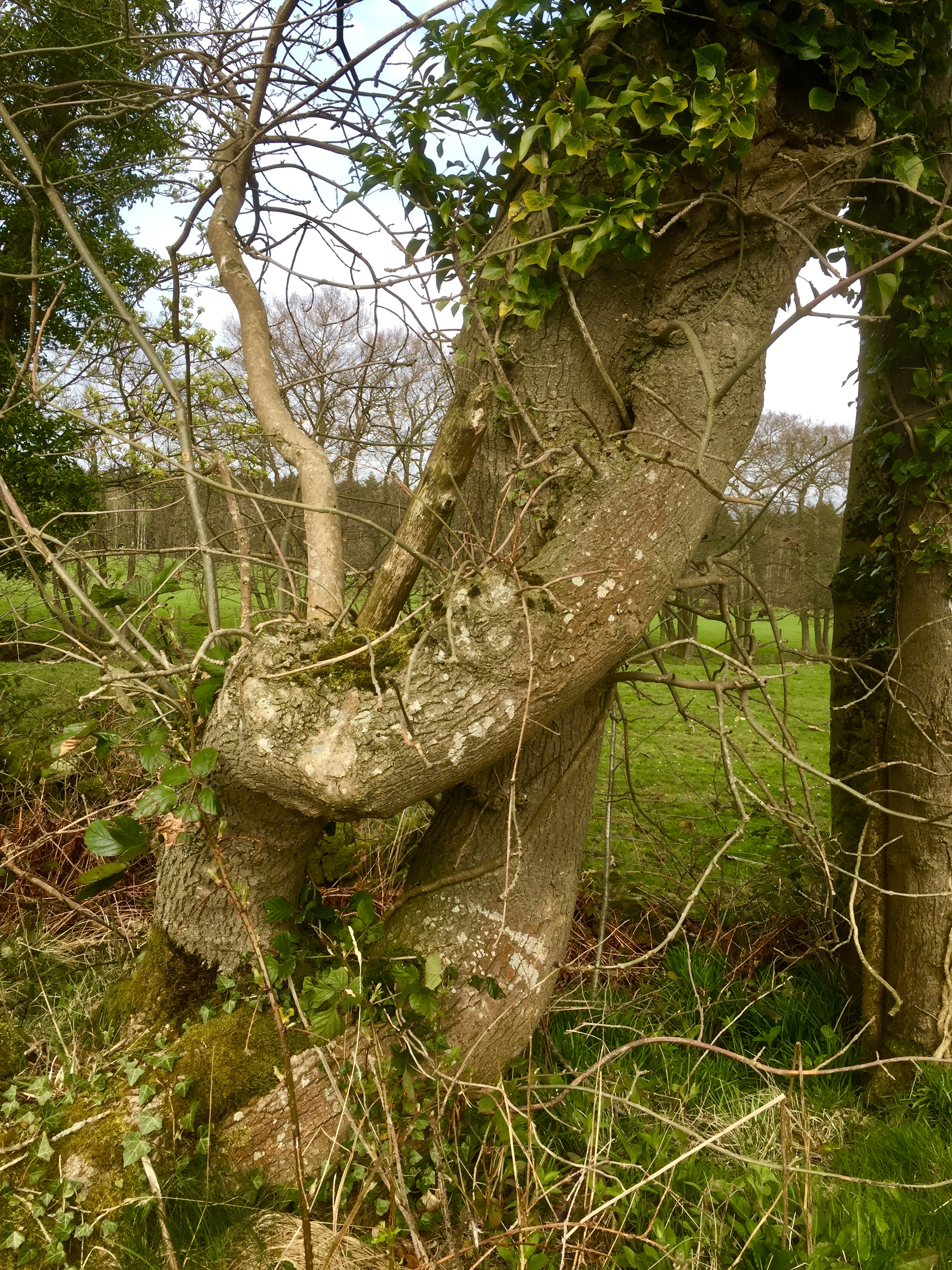
I’ve stumbled across trees like this a number of times. The first time I saw a tree trunk taking such a convoluted, twisting path I was quite astonished, but more than not I see such patterns not just in a single tree, but in a tree’s relationship to another tree.
It’s not that common to find trees entangling themselves in each other like this. Of course, there are other plants, for example, “climbers”, which have the ability to entwine themselves on whatever they can reach, as their core characteristic. But in trees, it’s not so obvious. You know why? Because they do most of their entanglement below ground….in their root systems, which we now know from forest studies, are vast entangled webs of connections between trees with microfibres and fungi creating most of the functional connections between them.
We humans are perhaps the most sociable creatures of all. We certainly have the most highly developed systems within our bodies and brains to enable us to pick up signals, make responses, create bonds and connections, and to co-operate with others.
A bit like with the trees, most of those connections go on underground. Well, not below the soil, as they do in tree world, but in the sub-conscious. I think we tend to forget that. Our oldest, most developed, most evolved systems of function are unconscious. From everything to do with maintaining a healthy living body, to the detection of information and energy, to the whole vast world of emotions. It mostly happens below the level of consciousness.
We don’t have to think about making our heart beat. We don’t have to think about releasing insulin or adrenaline. We don’t have to be conscious of our processes of digestion. Our emotions, like our dreams, emerge from our sub-conscious.
Neuroscientists have discovered that our conscious thought making processes are actually much slower than our unconscious ones. Much slower, and starting just a bit later than the unconscious ones.
That’s quite something. We tend to imagine that we are primarily conscious, reflective, analytic, critical, rational creatures. But actually our survival, and our maintenance of healthy life occurs below the level of conscious awareness. We interact with, form bonds with, relate to, and entwine ourselves with other humans and with the rest of the “more than human” world through ancient, highly evolved un- or sub- conscious processes. They work. They are highly refined and they are fast.
I think it’s a mistake to think of our conscious processes as “superior” or “higher”. Rather, they give us the ability to create spaces, to stand back, to pause, to see, hear, become aware and reflect, and then to make choices and express our will. They are wonderful processes and we wouldn’t be fully human without them.
But let’s not dismiss or belittle our processes of entanglement which connect us to all that is more than our individual selves. Let’s not dismiss them, because if we do, we delude ourselves into thinking we are completely separate, isolate individuals existing as if in a vacuum.
We aren’t. We emerge from, and exist within, all that exists. We are entwined.
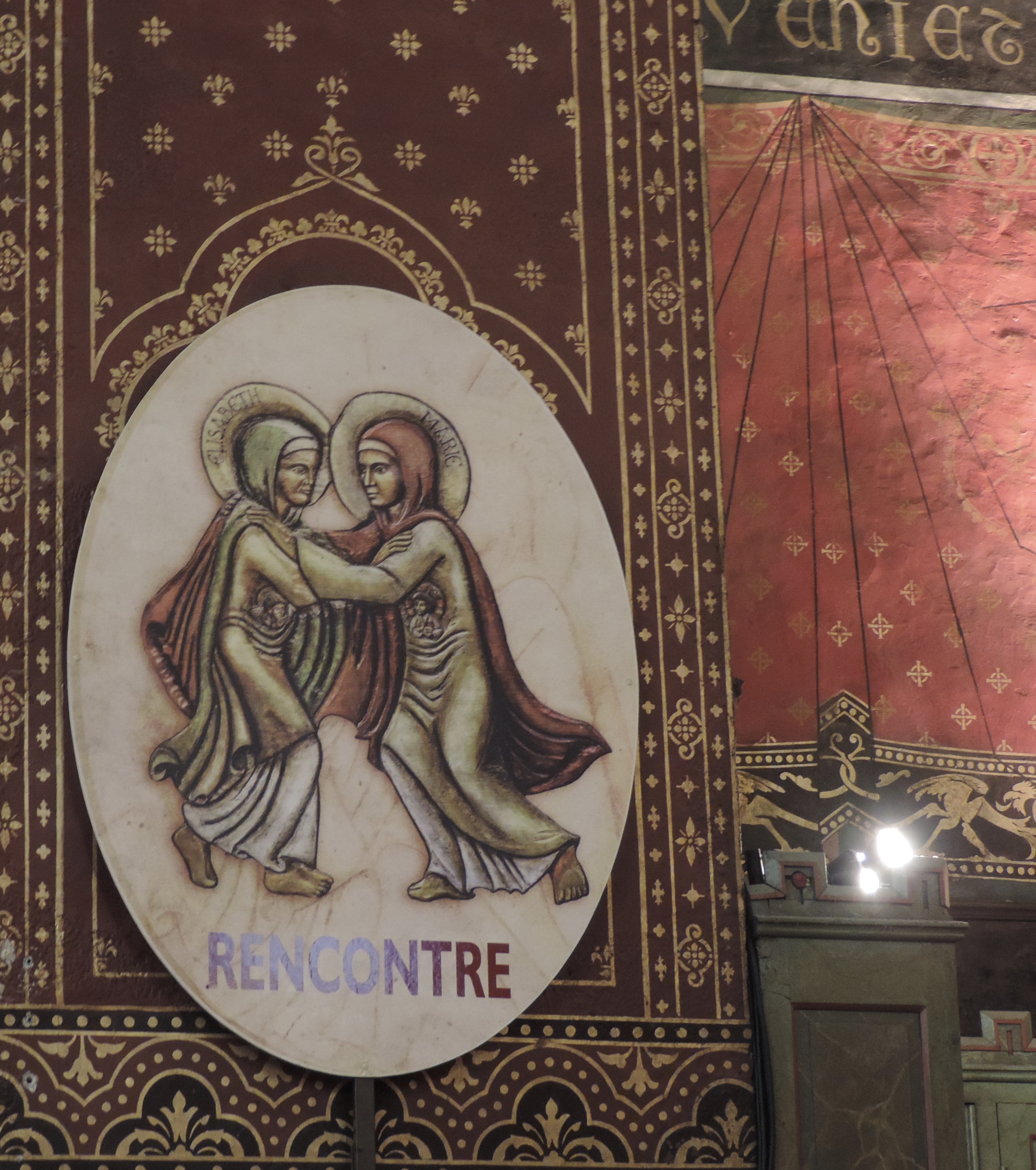
I saw this on the wall of a church in Saint-Jean-de-Luz in Southwest France. A “rencontre”, as you can probably tell from the drawing, is a meeting. I haven’t seen this portrayed in other churches but I really liked that it was displayed so prominently in this one.
For me, the key to understanding Life is revealed in connections, relationships, or bonds. In fact, it is revealed in a very special kind of connection – one which increases “integration”.
Integration is “the formation of mutually beneficial bonds between well differentiated parts”. I think this is easily understood when you think of the human body. We have several organs, from a heart, a liver, a pair of kidneys, a pair of lungs, a brain, and so on. All of these separate, distinct, structures have their own particular functions to carry out and they must carry them out in a way which is more than harmonious…..they must act to promote mutual benefit. The “integrative” connections exemplify collaboration and co-operation. Our organs do not compete with each other….not for energy, food, or protection. Not in a healthy state, anyway.
So, here is the basis of natural health – harmonious, well-integrated, collaborative relationships between distinctly different parts.
You can scale that up – so that a healthy society is a diverse one composed of unique individuals who relate to each other in mutually beneficial ways. You can scale it up further to consider whole ecosystems, or even the global biome, and see that this is the basis of Nature.
Much has been made of the role played by competition in Nature, and in particular in the story of evolution. But, competition has only ever been one part of the story. Without collaboration, without the creation of mutually beneficial bonds, Life would not exist, and it certainly wouldn’t evolve.
When I see this image of a “rencontre” I’m also reminded of the story of the Little Prince and the fox, as told by Saint-Exupery in his “The Little Prince”. In particular I remember the passage where the fox asks the Little Prince to “tame” him – by which he means to create a bond between them, and gives the example of rose which the Little Prince tended to in his home. The Little Prince claims that his rose, of all the roses in the world, is special to him. He cares for her, looks after her, and feels for her. What makes her special is the bond – the bond of care. The fox points out that if he and the Little Prince form such a bond, then they will be very upset when they have to part – because these bonds of care matter to us. They matter to us more than anything.
We can’t have too much of this type of connection in our world. In fact, we need a whole lot more of them – we need the bonds of “integration”, the “mutually beneficial” ones, the bonds of “care”.
I welcome constructive criticism and suggestions. I will not, however, tolerate abuse, rudeness or negativity, whether it is directed at me or other people. It has no place here. ANYONE making nasty comments will be banned.




 Heroes Not Zombies