Feeds:
Posts
Comments

Archive for the ‘science’ Category

I’m pretty keen on biology….as you might imagine for a doctor! I’m interested in how the body works, the way the different cells, organs and tissues all function so beautifully together. I’m interested in discovering the connections within us with all the incredible feedback loops and cascades. I find it all fascinating.

But it was very clear to me from very early on in my work as a family doctor that human beings can’t be reduced to biology. There’s more to us than biology can explain. I often refer to the three flows which pulse through our very beings every moment of every day – the flows of materials, energy and information. Biology is pretty good at shining a light on the first two flows, but its the third one where things start to get so uniquely interesting when thinking about human beings.

One of the aspects of information flow is art. Now, I don’t mean to reduce art to information, or at least, not in the sense that information is “data”. I mean information as signals, not simply data. Information as meanings. So language, music and visual art all connect with us, and our whole being responds. You can blush because someone says something to you. Your heart can race because you hear a certain song. You can catch your breath, or feel a range of emotions, from disgust to delight, when you see a work of visual art.

Our lived environment is not just physical. We imbue it with meaning. We react to particular colours, designs, patterns, sounds, scents and physical touch. A particular taste can set off a cascade of memories….one of the most famous examples being Proust’s “madeleines”.

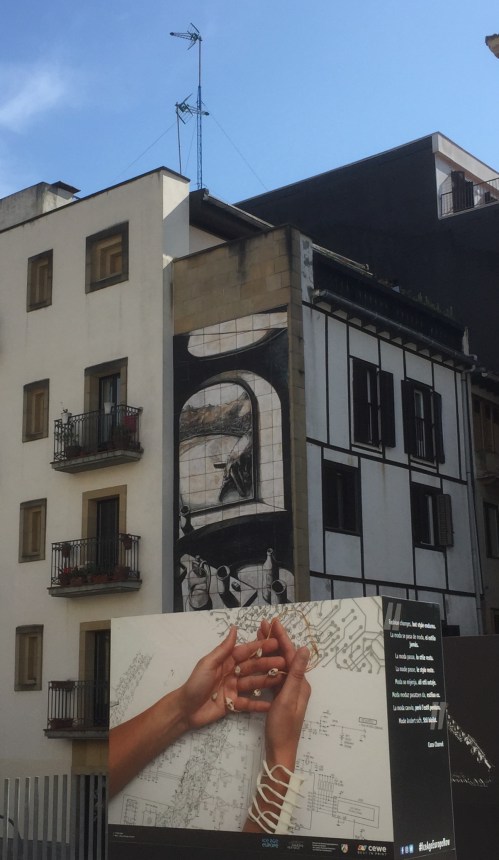
I think both street art, and advertising, affect us deeply. The images trigger certain responses within us…..maybe certain emotions, certain thoughts, or particular memories. But whatever they do, they change us. And because we are not compartmentalised, those changes ripple through our entire being. We don’t keep them in our heads.

I think we’re often quite unaware of the images and art around us. They often exert their influence in sub-conscious ways. But I like to be aware of them. I like to notice them, stop, and reflect.

In this photo I’ve captured both street art and advertising. What do you feel when you see them? What do you think when you see them? What effect do they have on you? (If any….because of course we are all affected differently by different images)

We co-create our lived reality, we humans. We do it collectively and we do it as individuals, creating and publishing, or “showing” our creations. We do that whether we are artists, or writers, or whether we simply talking to each other. We change the lived environment by constantly changing our behaviour, our language and by using our creative powers.

What kind of reality are you going to co-create today?

Read Full Post »

Maybe one the most important concepts at the base of all my understanding of people, of Life, and of the world, is that everything is connected. Nothing exists in isolation.

If I want to understand a patient, a friend, a relative, or myself, I have to follow as many of the threads which create the rich tapestries of Life as I can. I can never know them all. The daily judgement is deciding that I know enough to act, keep an open mind and awareness, and watch to see how things change after the act. I don’t really know any other way to live.

In scientific terms we humans are “open systems”. That means we don’t have impermeable walls or borders which separate us out from the rest of existence. It is just not possible to know an individual in total isolation. Our whole being is continuously immersed in flows of materials, energies and information which change us as we change them. We are influenced by, and impacted by, the environment in which we live, the food and drink we consume, the behaviours and emotions of other human beings, and the experiences of all non-human life every day. And vice versa……everything we do, what we consume, what we discard and excrete, how we act towards other humans and other forms of life changes the planet we share every day.

I loved hearing the stories patients had to tell me. Every single story was unique. Every story was a story of events, experiences, and change as a result of interactions between the person and their vast interconnected webs of environment and relationships.

I was taught that good medical practice is based on making a good diagnosis. A diagnosis is an understanding. It was my job to listen to the story, examine the patient, and, if necessary order some tests, to discern the patterns within their experience which I had been taught to recognise. In my early years as a doctor those patterns were almost exclusively pathologies, or diseases. Over time I came to understand that diagnosis, or “understanding”, needed to be both deeper and wider than that. It wasn’t enough to name the disease. A doctor had to learn to see and understand the person who was experiencing the disease. That shift from pathology to person involved teasing out the threads, exploring the influences, the impacts and the personal responses.

Each of us have distinct patterns which occur and re-occur throughout our lives. Patterns of thoughts, emotions, behaviours run through our stories. Patterns of memory, experience and fantasy cycle and spiral across whole lifetimes.

They are amazing. They are remarkable. They are astonishing. I can’t see a time will come when I’m done with this. It seems to me that every day there are new patterns to discern, threads to follow, new connections to find and to create.

What a life! What a remarkable, awe-inspiring, wonderful phenomenon is Life.

Read Full Post »

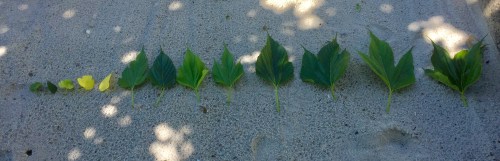
The leaves are starting to turn and to fall. There’s a large mulberry tree in my garden. I’ve never known a mulberry tree before but one of the things which astonishes me about it most is the diversity of its leaves.

Look at this photo. I gathered up a bunch of the leaves which had fallen and laid them out in size order. Isn’t that incredible?

Diversity is a key feature of Nature. Every single living creature is unique….not necessarily in its outward appearance, but in its existence.

The more complex, more evolved a creature is, leading up to the most complex of all creatures…..human beings, the more unique each one is. Why is that? It’s all down to connections.

If you only make measurements, and collect “data”, then you risk missing the uniqueness of whatever it is you are exploring. But if you take into consideration the environments, contexts and situations where your subject of study exists then you quickly realise that no two are the same. Yep, they can be the same weight, the same height, can be categorised and classified according to a limited set of “characteristics”, but their existence extends beyond their measurements.

Everything which exists is connected to, and constantly interacting with, the flows of materials, energy and information which course through the planet. I think this is the key to understanding uniqueness – it’s not in a data set, it’s in a complex network of connections.

To uncover uniqueness we need to explore individual existence, pulling together the past, the present and the possible futures, with a, frankly, inexhaustible web of relationships, bonds and connections.

The more we take a “holistic” approach, the more clearly we see the uniqueness of the person. The more we take a “reductionist”, or “abstract” approach, the more the person disappears into a collection of data.

Your uniqueness can’t be reduced to your gender, your race, your nationality, your size, the colour of your eyes or your hair. It lies in your singular existence, your blend of narrative, sensations, experiences, memories, hopes, thoughts and aspirations. It lies in your memories and your imaginings.

Read Full Post »

I find that the turning points of the year are a good time for some reflection. We’ve just passed through an equinox last week and, here in France, the summer heat has gone, and autumn has most definitely begun. Autumn is one of my favourite seasons (I have three other favourites! Ha! Ha!) and I’m looking forward to the leaves starting to turn golden, yellow, red and orange….gorgeous. But just as New Year is a like a gate to path through, watched over by Janus, the one with two faces, one looking forward and the other looking back, I think all these turning points are like gates.

Well, what a year 2020 has been so far! I know that Life is truly unpredictable but we sure didn’t see this coming, did we? For me, there are other factors in play which have turned 2020 into a bit of a waiting game. I find I’m constantly waiting for something….when is the virus going to go away? When are the restrictions going to be lifted? When can I travel again? Will there be a vaccine? Will there be new effective treatments for people who catch the virus? When are the Brexit trade negotiations going to be completed? How is that going to affect currency exchanges and therefore my income? When are the new regulations on residency coming in here in France, and when will my application for permanent status be approved? I could go on…….

You’ll have your own list, but do you notice something? Those are all about the future? They are all about what might happen, what is said to be going to happen but hasn’t happened yet…..and so on. So, let’s take a moment to turn the other way and look back. Let’s take a moment to reflect.

I think this pandemic is having impacts which are both personal and collective. It’s provoking many of us to think about how we live our lives. It’s making us think about what’s important. It’s a brake on that human tendency to take things for granted. I’ve read a couple of articles in the French Press recently taking another look at Sartre, and what he said about freedom during the time of the Nazi occupation. There’s something about living more consciously within limits and constraints which changes what we think about freedom, and which heightens the value of conscious presence. So, I’ve found that. That now, more than ever, I’m repeatedly drawn back to the here and now. I’m becoming more aware, making more conscious choices.

Let me give you an example or two. I’m more conscious now of what I eat, wanting to have a diet which encourages health and resilience. So, I’ve discovered new places to buy locally produced foods (which haven’t been shipped from half way across the planet) and I’m actually delighting in shopping trips for fresh fruit and veg, for locally sourced foods like honey, small farm meats and dairy and so on. I have also researched supplements and started boosting my levels of Vitamins C and D, and my levels of Zinc. The top three I identified as being important in immune health. I’m also more conscious, you might even say wary, about going anywhere. I don’t just pop out anywhere unthinkingly any more. I make a more conscious, deliberate choice.

Another positive change for me is a deepening of my connection with the natural world. I’m living in a house on the edge of a village in the heart of cognac-making vineyard country. The house has a garden with a fabulous mulberry tree right in the middle. The tree has grown enormously since we came to live here. I’m convinced we like each other! So, I spend as much time outside as I can. I’ve noticed that the days have been much quieter. Not all days, but there are certainly more days which sound like Sundays. And I’m hearing more bird calls and conversations than ever before. I’ve read about others having similar experiences…..as if humans stepping back a bit has allowed other creatures to step forward. I’m also convinced that spending time in the open air is good for, and time engaged with Nature is even better.

Collectively I think this virus has brought us an enormous opportunity to see things more clearly and to speak up for change. It’s clear that our health services have been inadequate and precarious. We shouldn’t have to be exhorted to “Protect the NHS” – the NHS is there to protect US! It’s clear that huge swathes of society are living precarious lives…..the poor, the long term sick, black and ethnic minorities, and so on. It’s clear that care of the elderly is inadequate and vulnerable. It’s clear that millions of people carry out vitally important jobs but they are undervalued and underpaid. It’s clear that globalisation in favour of capital has made whole countries less resilient, with elaborate distant supply chains breaking down. It’s clear that education is a mess and stuck in some very old ways of working. It’s clear that mass spectacles, mass tourism, mass anything really, just aren’t such a clever idea.

So what? you might ask?

Well, in my work as a doctor, I always thought that everything hinged on making a good diagnosis. If I didn’t see clearly what the patient was experiencing and couldn’t make sense of it, then treatment was going to be partial at best, and useless or harmful at worst. So I think we need to start by making some good diagnoses here….and diagnosis, for me, involves a kind of reflection.

Imagining, creating and spreading the possible solutions comes next. But we’d better start doing that soon!

How about you? What comes up for you as you reflect on your own life and our collective lives in the light of the 2020 pandemic so far?

Read Full Post »

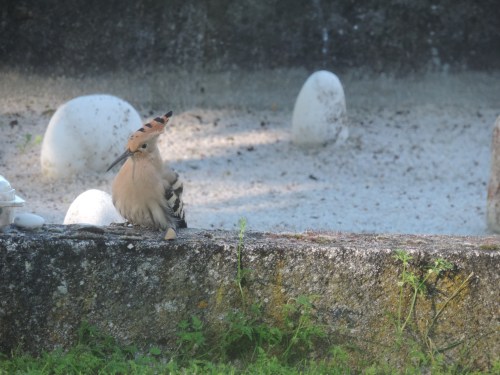
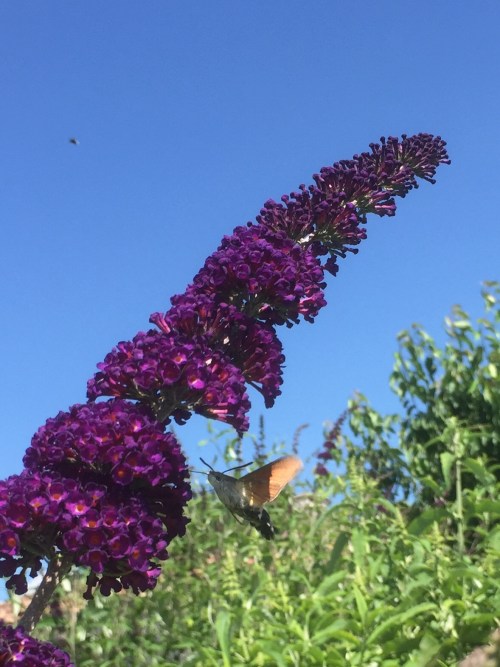
Now that summer is over, here in the Northern Hemisphere, it’s time to say goodbye to some distinctly different summer visitors. Here are two which spend time in my garden every summer and which have both disappeared now.

The one on the left is a “hoopoe”. Isn’t he beautiful? I think he’s such an exotic bird. I never saw a bird with such a long beak, long plume on his head, and such markings until I came to live here in South West France. I think the hoopoe is migratory so I reckon they are all off to Africa now (if you know better, let me know!). Amazingly, they’ll re-appear in the Spring.

The one on the right is a “humming bird moth”. Incredible! What a creature! You hear them coming before you see them because their wings emit a deep, throbbing hum. Look at his long proboscis probing right down into the depths of the buddleia flowers to suck up the sugars, as he hovers around the plant. The buddleia flowers are all so small that slipping that long thin proboscis into each one is a feat of precision flight and skill. It’s utterly amazing to watch. I’d never seen one of these creatures, either, before I moved here, but they are present every day while the buddleia is in bloom. I don’t know where humming bird moths go when they aren’t here. Do you?

Does this make me sad? No, it doesn’t. It makes me feel connected to the seasons and to Nature’s cycles of life. I know that each of these astonishing creatures will reappear in my garden again next summer, as they have done for the past five years. That delights me.

I’m sure it’s good for me to be so connected and aware that I notice and am enthralled by these little creatures. I’m also sure it’s good for me to be in harmony with the cyclical reality of Life.

Are there any special creatures or plants, perhaps, where you live, which particularly delight and amaze you? Are they only around during certain seasons of the year? Take a moment to think about them today. I bet that helps make this a better day.

Read Full Post »

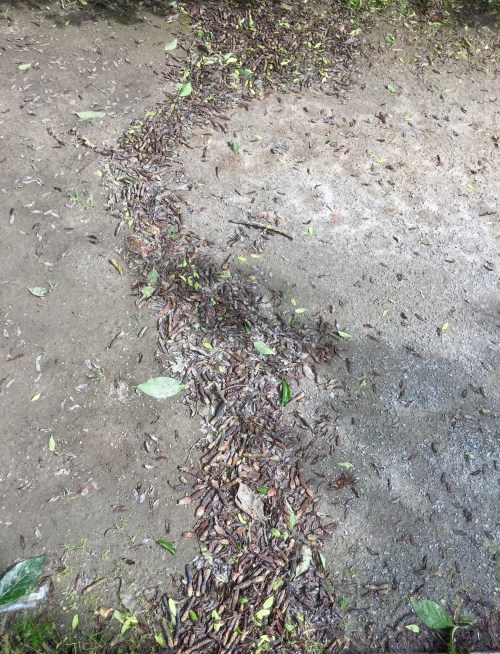
We change the world every day. Just by living. Here’s a photo of a path. It shows a distinct gathering of seeds, leaves and other plant materials in a curving line. You know, instinctively, or because you’ve seen something like this before, that water has passed this way. Sure, maybe an artist did it. Maybe someone like Andy Goldsworthy, the sculptor, who creates fabulous works of arts from natural materials, but, no, somehow we just know, this particular trail was not created by any human hand.

One of the things which fascinated me when I came across this was the fact that the creator of this “natural art”, or, more mundanely, if you wish, of these marks, was water. Water carried these seeds, leaves, etc then it seeped away, leaving them in its wake.

I look at this and I think….this is what we do, we humans. Day by day, moment by moment, actually, we change the world, we leave our traces, we gather some things together, and discard them, or set them aside. We metabolise what we take into our bodies, and we excrete the products of that metabolism. We change the world with every breath.

This is happening on such a massive scale now that some scientists refer to this present time as the “anthropocene” – because human beings are now producing large scale changes to the very geology of the planet (and certainly to the biology of the planet!)

I don’t think we can avoid this. We change the world by existing. But we can become more aware. We can, individually, and collectively, try to understand just what changes we are bringing about. We can use that understanding to ask ourselves if we want to make other choices, if we want to try to make different changes.

And yes, I think that can be applied at all kinds of scale. If we develop more inter-disciplinary, integrated sciences and arts, then I believe we have the chance to reach better understandings, and make different choices. The key, I believe, lies in exploring the trails, seeking the connections, discovering the influences and factors involved in any change, and shifting our focus from trying to control to trying to understand reality.

How does the world change when we concentrate on competition and consumption? How does the world change when we concentrate on co-operation and sustainability? How does the world change when we prioritise quantities, data and statistics? How does the world change when we prioritise qualities, experiences and relationships? How does the world change when we prioritise money? How does the world change when we prioritise health? You get the idea….feel free to add, or to choose, your own.

Read Full Post »

We humans seem to develop the habit of making binary choices. You can either choose this OR you can choose that. I suppose we make either/or choices on multiple occasions every day. It’s not something to avoid. If we tried to avoid it, we’d be paralysed. What would we have for breakfast? Where would we go today? Which tasks would be pay attention to and put our energy into? Let’s be clear, we make, and we need to make, binary choices all day long.

But I think this becomes a problem when we try to see the whole life through this lens. It’s a problem when we select out too little of complex reality to try to reduce it to either/or choices. That’s too simplistic, and it detaches us from the real world, leads to mistakes and regrets, pushes us into divisions and conflicts.

So we also need to see the “whole”, to look at “the bigger picture”, to take a “view from on high“. In other words we also need to explore the contexts and connections which exist, to follow the trails, the feedback loops, the influences and flows.

To do that, we need to stand back from time to time, take stock, pause and reflect. I think that’s happening a lot during the time of this pandemic. A lot of habits, routines, behaviours have changed now, or at least, for now. We are having to adapt. Is this virus going to go away any time soon? Doesn’t look like it. So, how am I going to live now? What’s important to me? What paths aren’t looking so clear now, and which other ones seem to be opening up?

Our brains have two enormous divisions – the left and the right cerebral hemispheres. Each of these halves engages with the world differently, and if, Iain McGilchrist’s thesis is correct (which I believe it is), then we’ve been paying way too much attention to the way the left hemisphere engages, and not nearly enough to the right. Here’s one of the key differences – the left makes binary choices. It separates, divides, and abstracts. It simplifies, categorises and labels. The right, however, seeks connections. It synthesises, contextualises, looks for the bigger picture, the “whole”. It prioritises relationships over objects.

The truth is we need both halves of our brains. Surprise, huh? But we need to learn to get them working together better than they’ve been doing. We need to learn the habits of joined up thinking, of humility, and of open-ness.

And not or – that’s the way I see it!

Read Full Post »

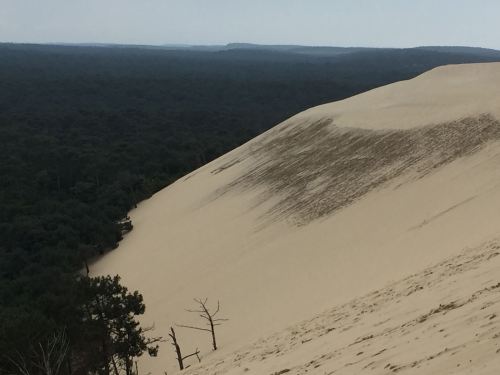
This is the largest sand dune in Europe. “Le Dune du Pilat“, just south of Bordeaux. Isn’t it astonishing? When you visit it you can climb to the very top, either by trying to trudge up through the soft sand (not recommended), or by climbing the long, long, wooden staircase (take your time, and stop to catch your breath as often as you need, it’s a long way up!)

The light sand, it seems to me is typical of the “dis-integrating” force of the universe. It’s a quality of “disorder”. Whereas the dark forest seems typical of the “organising” force, with diversity of life forms, ever more complex, ever more structured and organised to create living creatures. Think of the scientific concept of “entropy” – the movement of phenomena in the universe towards the lowest energy states and towards the least degree of organisation or order. Life is the universe’s most incredible drive in the opposite direction. From simple atoms, to joined up molecules, to single cell life forms, to complex multicellular ones all the way up to the complex plants, animals and other forms of life which strive every day to survive and thrive, we see a whole direction of travel which is against entropy.

There’s an expansive force in the universe which increases diversity, options, potentials, possibilities, by creating more and more connections between all that exists. And there is a contracting force, which dis-integrates, dis-mantles, and dis-solves what has been created. And, here’s the thing……if there was only one of these two forces active, we’d have nothing at all.

That helps me to understand and even relish the qualities of the seasons, from the expansive growth periods of Spring and Summer, to the contracting, resting periods of Autumn and Winter.

It helps me to think of my in-breaths which expand my lungs and swell my chest, and my out-breaths which travel back towards the world around me. It reminds me of how I take in substances, atoms, molecules, with every inspiration and ingestion, to work the body’s alchemy on them, transforming them into more Life within me, and how I expel other substances, with every expiration and excretion, to continue the circles and cycles of universal Life.

The essential rhythm of the universe. The forces of creation, gathering and connecting, integrated with those of breaking down and dispersing…..

One isn’t “good” and the other “bad”. We can’t choose to “have” only one of them. This is the Nature of Existence, this constant, dynamic, interplay of these two incredible forces.

Read Full Post »

I’ve got a shelf on one of my bookcases where I keep some of the books which have most significantly changed the way I think. OK, to be honest, there are too many books in that category to fit on one shelf but I do like the little collection I’ve gathered together there. I think of them as sources of light – they have all shone some light of illumination for me – and they still have the power to do that.

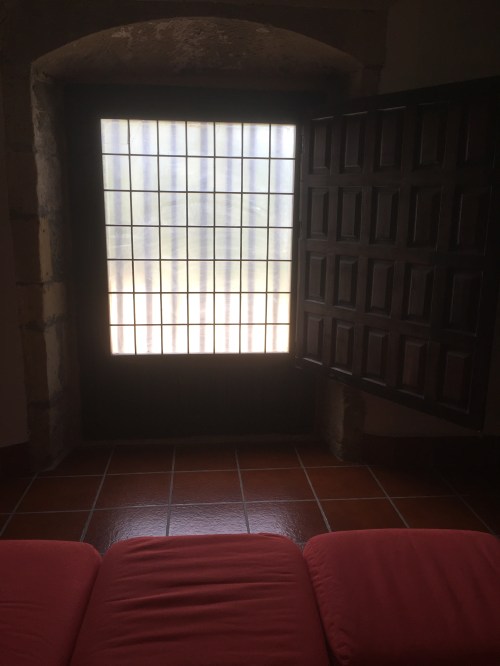
I thought of one of the insights I gained from those books when I looked at this photo I took in a museum in San Sebastian. It’s a photo of a window, but isn’t it a strange kind of window? I mean, you can’t see anything out of it…..you can’t see the outside world from inside the room. But then I thought, what it is doing is letting the light in. What it’s doing is illuminating the room, changing what and how you see the world around you as you stand inside this room. And it isn’t just any old window, is it? It’s not just a plain rectangle of clear glass. It’s filtering the light, softening it, changing it, before it enters the room. The window might be passive, but it’s still actively changing the experience of being in this room. Being in this room would be different if the window was different.

All that got me thinking about flow, because that’s one of the key insights I gleaned from some of the books on my special books shelf……that all that exists emerges from within a constant flow – a flow of material substances (atoms, molecules, compounds etc), a flow of energies (light waves, sound waves, heat, gravity, strong and weak forces of attraction etc), and flow of information (symbols, words, language etc) All three of those flows are modified by contexts, changed by the world around the perceiving, experiencing subject.

I find that becoming aware of these flows makes me appreciate the world more, makes me wonder more, makes me delight more. I love to look for the connections, for the relationships and bonds between each of us, and between us and the non-human world. I love to consider the directions of these flows – to visualise the flow of materials, energies and information which are surging through my being – and to consider how they are changed within me – how they are modified just because I exist – how they are modified by the choices I make.

That makes me aware of my role as a window in other people’s worlds too. How do I illuminate (or shade) the worlds of others? How do I modify these flows and send them onwards to enter the lives of others?

Because one thing is for sure – I don’t exist in isolation – I emerge from within these three genres of flow and I affect the lives of others as I modify and/or pass on these molecules, energies, words, stories, images and ideas. So maybe I should pay attention to how I am living and how I am interacting with all these currents, these waves, these whole rivers of flow.

Maybe I should be aware of what kind of window onto the world I am, and what kind of window you are too. How do we change the rooms/communities/worlds we each live in?

Read Full Post »

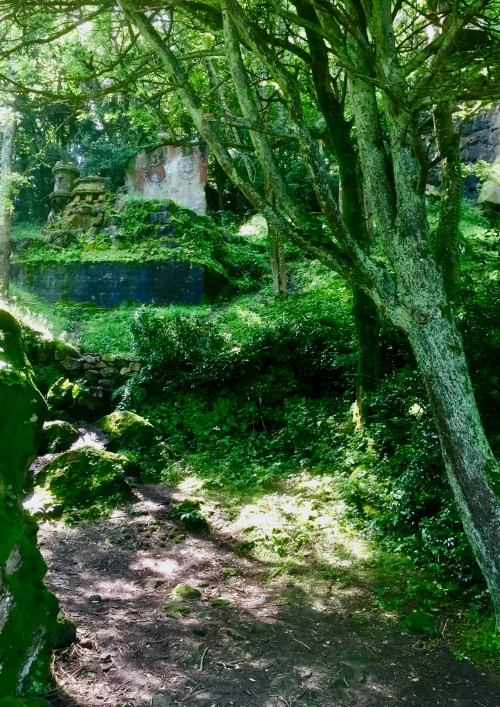
Oh I just LOVE how green this image is! Such a rich green environment pulses with Life! It declares diversity, vibrancy, energy and flourishing. This green is the expression of THE core emotion experienced in some way or another by everything that lives – SEEKING (See Panksepp’s work on that – which I’ve written about in my book, “And not Or“)

All forms of Life drive themselves forward to find what they need to survive and thrive. This is what he calls “Seeking” behaviour. I chose those words carefully there…..”drive themselves forward…” because that’s another defining characteristic of living forms…..they all demonstrate “self-organising” capacities. They move, grow, change, act, according to movement and forces within themselves. Machines, on the other hand, need to be created and driven by external forces. In fact, Maturana and Varela refine this “self-organising” capacity, noting that living forms have a special kind of self organisation which they called “autopoiesis” – “self-making capacity”. We living creatures can grow and reproduce.

I know nobody has ever identified a particular “force” or “mechanism” for all of this. I know that “vitalism” has been dismissed by most scientists. But clearly there is something there we could call “the Life Force” isn’t there? Even if all we are doing is describing the presence of a phenomenon, a behaviour or characteristic. I think that’s how I see it. It’s this “self-organising”, “autopoietic” characteristic which vibrates, throbs, beats, resonates, responds, adapts, grows and acts…..I don’t think it comes from somewhere else…..I think it infuses the entire universe and expresses itself in what we call Life.

So, it’s not a thing or an object, this “Life Force” for me. It’s a presence, an experience, a colour, a sound, a scent, an ever-changing phenomenon.

This is it. This green vision of a forest. This is vibrant, pulsating, Life.

Read Full Post »

« Newer Posts - Older Posts »