Feeds:
Posts
Comments

Archive for the ‘science’ Category

What do you think when you look at these lemons?

Do you think some of them look lumpy and ugly? Does it bother you that some of them are really small, and others really big?

I think they look beautiful. I love their diversity. The fact that some are very nobbly whilst others are smooth fascinates me. I love the shades of yellow and green in their skins. I adore seeing the small ones cradled amongst the large ones. I’m fascinated by their shapes.

In this one basket you can see that every single lemon is unique.

It’s harder to see uniqueness if the producer, or merchant, sets standards with a narrow range, stipulating limits on the degree of diversity he will accept.

The practice of setting “norms”, “standards” and narrow expectations tends to obscure uniqueness, but uniqueness is still the essence of reality.

Diversity reveals uniqueness to us.

It shows us that every single lemon, every single flower, every single creature, every single human being is unique. Each one comes to life at a particular time in a specific place. Each one has its own unique experiences as it grows….experiences differences in weather, climate, interaction with other forms of life.

I think we humans have obscured the fact of uniqueness in two ways.

Firstly, through “mass” anything….from mass production to mass consumption. A focus on the mass blinds us to uniqueness.

Secondly, we tend to confuse “individuality” with “uniqueness”.

We all want to be treated as individuals, don’t we? I know I do. But a focus on individuality carries a danger of fragmentation. It separates us. Mary Midgely, the English philosopher wrote about the phenomenon of “atomisation” very well. She warned of the dangers of failing to the see the whole when we examined something only in its parts, or its “atoms”. And, in particular, she objected to the neoliberal idea that there is no such thing as society, that the best way to structure a society is for everyone to pursue their own selfish interests in a free marketplace. Those ideas have destroyed communities.

I don’t want to be “just an example of a group”. I don’t want to be treated as “just a number”, as a statistic. I want to be seen, known and treated as an individual. How do I square that circle? By focusing on uniqueness.

Our individuality is often defined by listing our differences from others, our separateness from others.

But our uniqueness combines our differences with our commonalities.

How so?

“No man is an island”

I don’t exist separate from something called Nature. I don’t exist apart from something called The Earth. I don’t exist disconnected from other human beings. I don’t exist separate from other forms of Life.

It’s taken the universe 14 billion years to make YOU. It’s never created YOU before. It will never create YOU again.

“Be yourself, everyone else it taken”

When you meet someone, when you make a new friend, when you get together with your family, you tell your story. You tell the story of where and when you were born, of the events and experiences of your life and how they shaped you.

That story is unique.

Just like everybody else’s.

It’s the circumstances, the contexts, the environments, the specifics of time, place, and experience which create our uniqueness, and the uniqueness of our story.

As a doctor, nothing gave me greater delight than to have the privilege of hearing unique human stories every single day of my work.

I love diversity.

I love uniqueness.

I find it beautiful.


Read Full Post »

When I noticed this tree in the forest I thought it had a long deep groove running the whole length of its trunk. It was as if it folded in on itself. But then I looked more closely and I saw that a better explanation was that there were two trees growing together. You could trace two distinct trunks all the way up, each spreading its own branches high above the forest floor.

I was even more taken with this when I saw it as two entwined, two organisms, two life forms, living, surviving and growing together. It reminded me of the myths of the soul….that each of us is in search of the other half….each of us longing for our soul mate.

But maybe I’m wrong. Maybe this is one tree which has partially divided itself…..partially, but not completely, so that now it appears as almost two trees instead of one. But does it really matter? Do I care whether these are two trees living intimately together, or one tree manifesting two clearly visible aspects of itself?

The first idea stimulates my thoughts about how important relationships are. It makes me think about how I can’t fully understand anyone, or any thing, in exclusion from its relationships. We are all embedded in vast networks of other people, other creatures, plants, micro-organisms, elements and molecules. We all come into being through a process of emergence within those networks. We all survive and thrive only because of those relationships and networks.

The second idea stimulate my thoughts about our multiple selves. I’ve never been able to understand anyone, including myself, by reducing them to a single, solitary self. Miller Mair’s “Community of Self” really impressed me. It struck me as true. I know a distinct self as a doctor, which is quite different from, yet completely connected to, my self as a parent for example.

A homeopathic doctor in Paris once told me he saw every patient as like a diamond, with different facets glinting in the sunlight. Each facet represented an aspect of that person. That impressed me too.

Then, much later, I read the works of the French philosopher, Gilles Deleuze, and his focus on “a multiplicity of singularities” seemed to me to be saying the same thing, just in a different language.

We are all multiple.

We are all a complex of multiple, distinct, unique “singularities” – both within ourselves, and within our world.

We are all One.

Read Full Post »

I love the concept, and the phenomenon, of flow.

Look at these grasses below the water. You can easily tell that the water is flowing strongly and making them all point in the same direction. You can even see the water. But you can’t see the flow.

It’s like when I’m in the garden. It can be a cloudless, blue sky day, or a grey, cloudy day, but at around 4pm I will feel the wind start to blow on my face. I’ll hear it rush through the trees, shaking their branches and rattling their leaves. But I can’t see it. I can’t see the wind. Just the effects of the wind.

Flow is like that. It’s an invisible force made visible by the way it shapes the world.

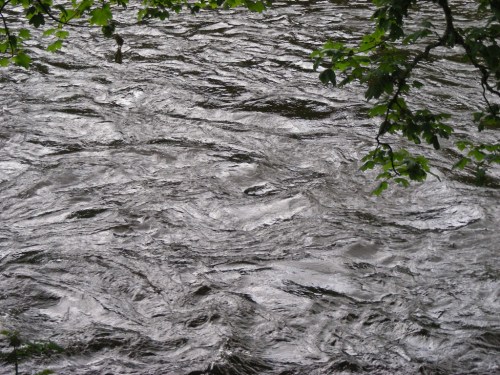
Look at this river. You can tell that it, too, is flowing fast, can’t you? There aren’t any rocks sticking up for the water to foam against but you could swear you can see the currents. Beneath, through, within, the water, is the flow.

We are like that too. We human beings. Life flows through us, shaping us, bending us, pushing us on, encouraging us, driving us onwards. Life flows through us making us grow, mature and develop.

It doesn’t help to resist that flow. Well, that’s not completely true, is it, because there is something in response, in reaction, which is a kind of resisting, a kind of pushing back on, leaning into, or standing against, which shapes us.

Flow doesn’t have a starting point.

Flow doesn’t end.

Flow is.

Many years ago, as I walked to the train station one day on my way to work, I came across an excellent example of how to respond to flow –

Surf it!

Read Full Post »

One evening this week, at sunset, the sky was glowing. I went outside into the garden, as I often feel compelled to do at  sunset (as I write that I think of the scenes in “City of Angels” where the angels gather on the beach at dawn….guess I’m an evening angel!).

This is what I saw.

As I looked up across the vineyards to the top of the hill I could see the silhouettes of vines and trees – there are a lot more vines than trees around here! I zoomed in with my camera and framed this shot.

I love this.

It delights me. I find it calming, soothing, and comforting. There’s a single tree, which makes think about how we are living our separate lives now. But it doesn’t strike me as lonely. Maybe that’s because I know no tree exists in isolation. Even when there are no other trees nearby, it is intimately and massively connected to the environment in which it lives, with roots stretching out widely and deeply, constantly exchanging nutrients with millions of other organisms.

I see a tree like this and think how connected it is to the four elements –

Earth – with deep, wide root systems

Air – to collect carbon dioxide and breathe out oxygen

Water – captured from the air, the rain, and the soil

Fire – directly turning the Sun’s energy into power to break down the carbon dioxide, build its physical structure of trunk, branches, leaves and roots, make sugars, and pull nutrients up from the depths.

This tree, this vineyard, this sky, this world GLOWS.

We are all intimately connected.

That delights me.

Read Full Post »

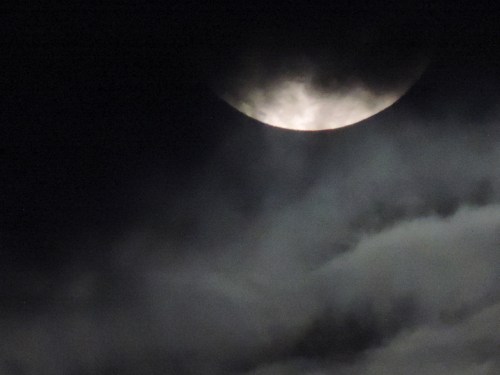
Why does the Moon fascinate us so much?

This recent full moon has been a particularly bright one, shining its white, white light across the countryside. It pulls me outside to gaze at it. I love to look directly at it, seeking out the shadows, forms and craters on its surface, recalling the old childhood stories of “the man on the moon”, seeing a face there.

It’s such a different light from sunlight. Well, of course, because sunlight comes directly from the Sun, and moonlight is sunlight reflected. I think that’s part of the Moon’s mystery for us. I’m often attracted to the sight of something which is lit by the Sun but where the Sun is implied. I know that the light I am looking at is coming from the Sun, but it looks like the object is radiating light itself.

Here are a couple of examples.

These white petals, and even the bright green stalks look like they are glowing from within.

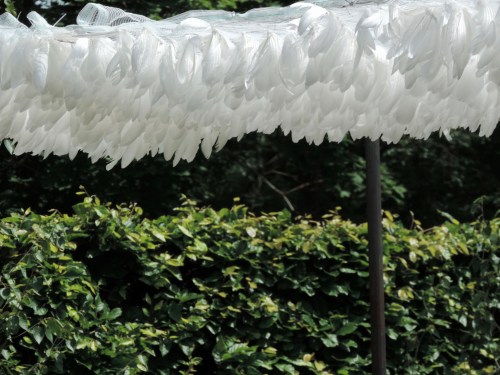
These white feathers, too, look like a glorious lamp with the light at its core softened by the feathers themselves.

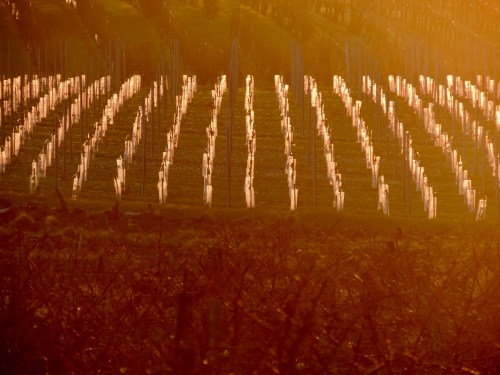
This is a young vineyard where each new vine is protected by a plastic case. When the sun is low in the sky it looks like a field of lamps, or candles lit to remember the sun by.

But it’s not just about the light.

We become familiar with the phases of the Moon at an early age, and whilst a lot of city dwellers can’t even tell you what phase the moon is at tonight, maybe in this time of pause and retreat, more of us will be aware of it. Maybe the skies are even clearer now, so the Moon will be more visible.

Because we are familiar with the progression of waxing and waning, of full moons, crescent moons and new moons, whenever we see the Moon I think we have some anticipation. We see a particular shape and we know it’s about to change.

We know that as small slivers of the moon appear, more will emerge, more will fade, and the cycle will, reassuringly repeat.

The Moon is one of the most tangible examples of the cyclical nature of time and Nature.

We know that, every single month it will appear to us in its fullness, and in its crescents.

I don’t know about you, but that, for one thing, is somehow deeply reassuring.

It’s a rhythm I can see with my eyes, feel with my heart, and think about with my mind.

I know…..there’s a whole lot else to consider here. I haven’t even touched on the influence of the Moon on tides and our internal body fluids. Nor have I explored the myths and stories.

But maybe I’ll leave that to you……..

Happy exploring!

Read Full Post »

You know I think that, especially in times like this, we think of life as being incredibly fragile. It’s easy to see it as transient and fleeting, subject to being extinguished in the blink of an eye.

All that might be true, but there is an opposite equal truth.

Life is an incredible power.

Maybe life is one of the most, or even, THE most powerful force in the universe.

At one time this planet which we all share had no life on it all. Now you can find it everywhere.

Some of the most successful life forms are micro-organisms. They have spread into pretty much every single ecological niche you can think of. You find them in volcanoes. You find them on the deep sea bed. You find them under metres of ice.

There’s even a theory that single celled creatures like bacteria got together to create multicellular organisms – including, eventually human beings. Did you know that there perhaps ten times as many bacteria in your body than there are “your” own cells? Each of us is actually a symbiotic community of cells.

Astonishing (and a bit creepy too somehow!)

There are regions of the world where there is a huge diversity of plants. The Fynbos in South Africa is one of those. Periodically fire burns through that region destroying all the flowers, but the heat from the fire stimulates the germination of seeds in the soil which then spring up as flowers. Some of the species of flower which appear haven’t been seen for decades. Some were thought to have become extinct. But no, they come back to life (or maybe the were never dead?)

Albizia Julibrissin, the Persian Silk tree, taken to London in 1793 was thought to have disappeared but after the German bombing of London in 1940 its seeds germinated and it began to grow again – 147 years later!

I’m sure we’ve all lots of experiences of flowers popping up in the most unlikely places!

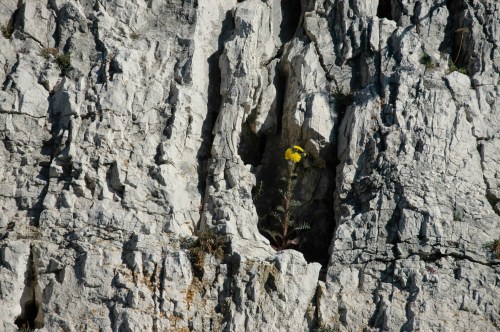
The photo I’ve shared at the beginning of this post, of the little flower appearing in the forest floor, reminded me of all that.

Yes, life is delicate and fragile, but it is also THE most incredible force in the universe. We would do well to remember that.

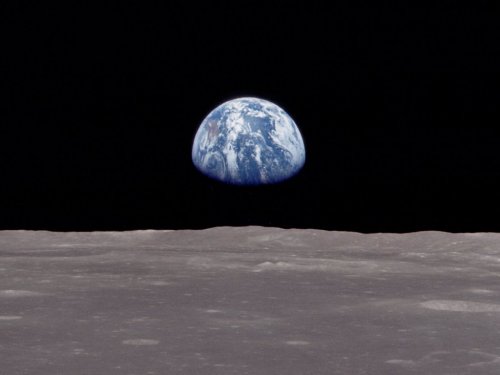
I think that’s partly why I don’t like all the war language which is being used during this pandemic. We are not at war with corona virus. We are, I hope, learning how to live with it. There are already scientists telling us these pandemics arise because we haven’t learned to live with all the life forms on this Earth, that our destruction of habitats and environments, our pollution and urbanisation, are the root causes of the emergence of this particular pandemic and will remain the cause of the future ones unless we learn to respect Life and to learn to live together, learn to adapt to life together on this little blue planet.

Read Full Post »

One of the strongest characteristics which human beings have is our ability to make links.

We connect what we see to what we have already seen and to what we imagine we might be able to see.

There’s a lot in that sentence, but I’m not going to unpick it right now….suffice to say we blend the perceptions of the present with memory and imagination.

That is an incredible power.

It helps us to discern patterns which we use to recognise what we are perceiving and to be able to make reasonable assumptions about the future.

For example, as a doctor I learned how to diagnose. Diagnosing involves listening to a person’s description of their experience and to their telling of their story, examining them physically if needed, then conducting certain tests if still not in a position to make a good diagnosis. A diagnosis enabled me to do two things – firstly, to recognise both the likely disease or pathology underlying the patient’s experience, and secondly, to gain an understanding what that meant in this person’s life. Yep, diagnosis is more than naming a disease. It’s about arriving at a level of understanding – an understanding of this illness in this person’s life.

Once I had a diagnosis I could then decide how to act. I could decide what to do and how quickly I had to do it. At that moment I’d be imagining certain futures. If I do this, then what might happen, and if I do that instead, what might happen? How quickly might those possible futures become real? To answer those questions I needed a knowledge of the patterns of disease – how is this disease likely to develop based on what we have all seen so far?


I picked this image today to reflect on our ability to recognise patterns around us, AND to apply those patterns widely. When we look at something, we don’t just “see it as it is”, because everything we see, hear, smell, taste, touch, sets off chains of memory and imagination.

So when I look at this particular tree I see these three enormous swirls. They look like whirlpools and water eddying around hidden rocks. A while ago I learned about complexity science and it really opened up my understanding of the world.

There are certain characteristic features of complex systems and one of them is the existence of “attractors”. “Attractors” are kind of organising points. They are part of what creates the differences within any given system or object. I’ve seen some scientists describe reality as “lumpy” rather than “smooth” and although I don’t really like that language I understand what they mean.

The universe is not uniform.

The phenomena of the universe are not distributed uniformly.

There are three common kinds of attractor –

Point attractors – these organise the surrounds around a single point. These three knots in this wood look a bit like three point attractors.

Loop attractors – this is where there are two centres of attraction acting together as one. They produce what looks like an infinity loop, or a figure or 8. They are a way of seeing polar opposites as part of the same system.

Strange attractors – also called complex attractors. This is where there are a number of centres of attraction all interacting within the same system. It can be hard to see any patterns here but we can recognise them when we seem the whole system. In other words, if we zoom in too close and focus only on certain parts we can’t see the way this system as a whole behaves. But when we stand back, zoom out, climb the hill, “take the view from on high”, or however else you want to describe it, we see that all the apparently separate parts are actually interconnected and working together.

I think as you encounter the world, you’ll see examples of these three kinds of attractor everywhere. See how many you can spot this week.

Ok, so, let me be clear. This is MY interpretation of these things. I’m not a complexity scientist. I just wanted to share how I make sense of my life and the world I live in.

I hope that there might be something here which sheds a light on things for you too.

Read Full Post »

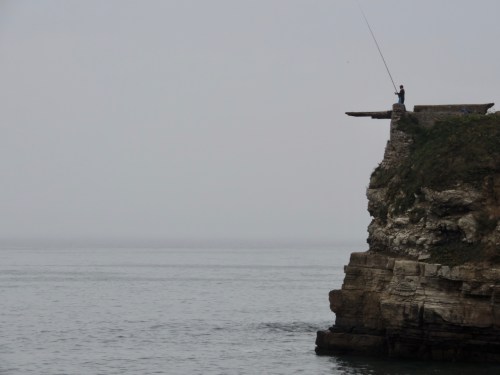
I took this photo in Gijon, Spain a while back. I’ve returned to look at it many, many times.

There’s something hear which captures my attention and provokes my thoughts.

I’ve always been struck by two things in this image. The first is the solitary nature of the fisherman. It reminds me how we humans are constantly addressing two apparent opposites. We are highly social creatures. We need relationships. We need to connect. We want to share. On the other hand, every one of us is unique. Every one of us experiences this universe from the position of the subjective self. There’s no alternative to that. We need to know that we exist, that we are seen and heard, that we can exert our will and make a difference in the world. We all need some time alone. Alone with our thoughts, our memories, our sensations and experiences. And, yes, it’s also great to share.

The other thing is the distance between this fisherman and the water (and therefore the fish!). It looks a LONG way down. I can’t see his fishing line but I can see that the rod he is using seems huge. There does seem to be a man-made ledge at the top of this cliff so I’m guessing it’s a good place to fish. And as I’ve never fished in my life, I know nothing about fishing, but I’m going to guess that a good place to fish is where you catch fish. There would be little point in standing there dangling a line into the sea far below if you never caught a fish, would there? (Or maybe there would. Sometimes I wonder if the main pleasure from fishing comes from the solitude, not from catching anything. But maybe some of you do go fishing and you can tell me)

As I look at this image again today, well into our third week of lockdown in the midst of this pandemic, I see a third thing – hope.

Hope?

Yep, hope.

Here is a man, a solitary man, standing far above the source of what he hopes for (fish?), but with sufficient hope to actually stand there.

I think that’s one of the things we need at this point – hope.

I hope for an end to this pandemic and its deaths and confinements.

I hope for a re-evaluation of the world we live in.

I hope we carry forward our new-found admiration and respect for all the people in under-valued jobs who keep our societies going – the health workers, the carers, the cleaners, the food producers, the transporters, the cashiers, the shelf-stackers, the teachers, the people who keep the water flowing, the lights on, the heating working, the researchers and innovators……has this list got an end? I’m sure you are already thinking of other workers whose importance to us all is suddenly coming to the fore.

I hope we shift our focus and our energy away from competition and control towards co-operation and helping.

I hope we learn from this experience.

I hope that what we learn leads us to make different choices.

I hope we take forward this valuing of human beings and relationships and build it into our new societies.

What do you hope for?

Let’s begin to imagine what kind of world we want to build together in the light of what we know now.

(My list of hopes is by no means complete. I only hope I can inspire you to start to make your own list)

Read Full Post »

I love the places where one element meets another. The places where constant change is right in front of my eyes.

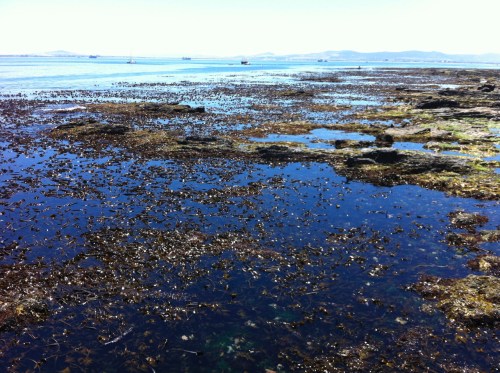
These are borderline places, zones of transition and transformation. There’s a word for spaces and regions like these – liminal spaces.

This first photo today is of one such area. You can see its coastal and that the tide is out revealing rocks, plants, seaweed, and rock pools. I love the colours in this photo and how you just know that, despite this being a single, still, image, it is already changing and won’t look exactly like this in a few moments time. I see some ships in the distance too and wonder about the people onboard, making a journey, transitioning from one place to another, from one life perhaps to another.

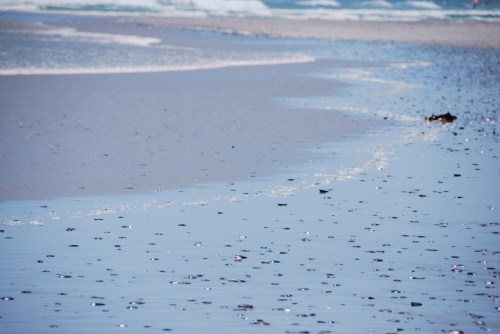
Here’s my second photo

Staying at the coast for this one….an image which is almost entirely composed of shades of blue. You just know that this apparently blue sand is wet, and that as it dries it will turn golden. There are no hard edges in this photo. Just gentle curving lines where the sea turns to surf, and the water bubbles up with escaping air. This is a calming image to me. I see it and I can hear the rhythm of the waves breaking on the shore. I can smell the fresh, invigorating sea air (and hope it won’t be TOO long before I’m allowed out to experience it again).

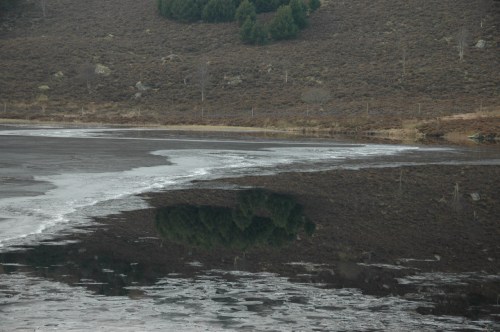
Number three…

Take in Scotland one winter this one shows either the spreading ice on top of the loch, or maybe it was receding….who knows? I can’t remember. But again you can almost see this changing before your eyes. There are edges here which are highly reminiscent of the ones in the second image….of the sea breaking on the shore. Although this time it is ice breaking on the water, or water eroding ice. The bonus in this image is the reflection. You can see the trees on the slope of the hill, but they are much darker on the surface of the water, which seems kind of dream like to me. A glimpse into the Earth’s unconscious.

Finally…..

The low morning mists at the foot of Ben Led seem to mimic the shape of the hills above them. The mist rises and falls the way the land rises and falls. There is clear ground between me and the misty zone, and clear ground rising above it, creating a very special kind of mysterious liminal space I think. Beautiful.

Here we all are. In the midst of this pandemic. Nothing is the same. Everything has changed and, often frighteningly, continues to change so quickly we can’t even see what’s coming. But this pandemic will end. And what then? What kind of world will we live in together after this? Sure, there will be forces which try to get right back on exactly the same track as we were on before, but something else seems to be emerging in this liminal space….a re-evaluation of what’s important in life, of relationships, of the kind of work different people do, of how we are so inter-dependent, so connected. Of how we share this one single planet on which Life exists without borders.

Let’s use this space, this region, this zone, to reflect and to think. After all, many of us the time to do so now. Let’s use this time to imagine how we humans might better live on planet Earth. Together.

What do you hope will be different afterwards?

What do you imagine the post-pandemic world might look like?

How might health care change? How might work change? How might education change? How might economics and politics change? [add your own question here…..because everything might change]

Read Full Post »

What a combination! Sunlight and flowers!

I’ve a number of photos of this type. I like to get down on the ground with the sun above and in front of me, and photograph the petals of a flower as the sunlight makes them glow.

It looks like LIFE to me.

And it reminds me of how Richard Feynman once said that trees are made from air, which, of course, shocks you when you hear him say that. We think surely trees are made from the soil? But no, not so much. They capture carbon dioxide from the air, capture the sun’s rays and then they use them to break the carbon dioxide down to get that building block of organic life – carbon, and in the process push out the oxygen they’ve released into the atmosphere. He was asked…but what about water? They need water and that comes up from the soil through their roots. Aha, he said, well, yes, but where does the water come from? The air.

Of course he was exaggerating to make a point because trees are made of a lot more than carbon and water. But did you know that the roots of trees are covered in micro-organisms, little fungi which reach into the tree roots and outwards into the soil. These tiny creatures gather up and transfer into the tree nitrogen, phosphorus, potassium, zinc, magnesium and other micro-elements which the tree needs to survive and to grow. They also help the roots gather up water and form part of a kind of immune defence against pathogens for the tree. In return the tree transfers up to 60% of the sugars it makes to feed these little fungi.

Amazing, huh?

A real lesson in co-operation, collaboration, and symbiosis. In fact a principle we’d do well to learn from. How can we live better on this Earth? In more symbiotic ways, which turn out to be more creative than our consumption and destruction methods which produce “waste” (something which doesn’t exist in Nature)

Did you know that researchers tried treating some flowers with antibiotics and found that their lovely scent disappeared? Turns out than in many cases the scent of a flower is actually produced by the population of bacteria which lives in it symbiotically.

Huh! Turns out this symbiosis thing can be pretty damn beautiful!

Read Full Post »

« Newer Posts - Older Posts »