Feeds:
Posts
Comments

Archive for the ‘science’ Category

We’re all trying to peer into the distance.

In the next few days…..what measures will my government introduce? When am I going to run out of food, and when do I need to brave the outside world to go and buy some more? What challenges am I going to face this week?

In the next few weeks……..How many people are going to catch COVID-19? How long will the pandemic last? How long will the lockdowns and shutdowns last? How are we going to get out of these current restrictions?

In the next few years…..what kind of world are my grandchildren going to grow up in? How will society change? How will the economic and political structures change? How will countries and people become more resilient?

We’ve always done that, we humans. We are blessed and cursed with the power of imagination. We can imagine all kinds of wonderful futures, invent, create, plan, innovate. And we can imagine all kinds of terrible futures, paralyse ourselves with fear and anxiety and the interminable….but what if? and what if?

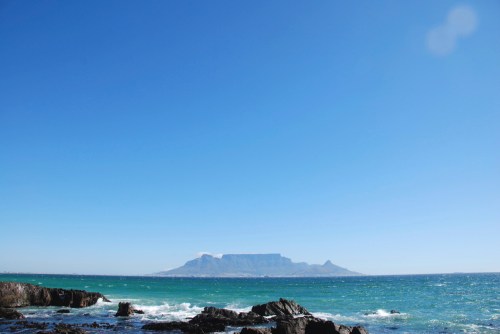
I was thinking of all that as I looked at this old photo I took of Table Mountain (who knows when, or even if, I’ll get to stand at that point on the Earth again?).

I was admiring the beauty of the scene, of the waves breaking on the rocks in the foreground, the rich palette of colours of the water in the mid-ground and the glorious Table Mountain in the distance.

Funny how that got me thinking about the futures we imagine and which seem to inhabit our everyday more and more just now, because, actually, there is no future in this scene. It is all present, all at once. The rocks, the sea, the mountain. I’m not standing there imagining what any of them might look like one day. I’m standing there basking in the beauty of the present reality.

Well, that brought me back to right here, right now.

Nobody can reliably describe a future which doesn’t exist yet.

I know, I know, there are philosophers and physicists who will argue that time isn’t linear and that matter doesn’t really exist, and I understand all that, but even so, it seems to me that we live in an emergent world, one which unfolds moment by moment, inventing itself, constantly creating novelty.

I know we can discern patterns and we use those patterns to predict the future. I know our scientific method has developed along those lines….describe, measure, predict, control…..though I’m not sure that’s been the best way to go. I’ve still got a preference for émerveillement….for wonder, awe, curiosity and amazement over data and controls. But we are complex adaptive systems, we humans, we life forms, we Earth-creatures, and complex adaptive systems constantly develop, adapt and evolve, sometimes in small steps, and sometimes in giant leaps. We change. Everything changes. The future surprises us all the time because it is novel.

So, I find myself coming back to what I used to explore with patients. What if our human super-power of imagination is trained on fears and anxieties? In what way does that help us? What if our human super-power of imagination is trained on creativity and compassion? In what way does that help us?

Because, you know what? I don’t think it helps to be judgemental. Fears, anxieties, creativity and compassion all exist for a reason. We can make choices. We can decide what to focus on, which “hungry wolf to feed” (do you know that teaching?)

They are seeds inside us, aren’t they? They include fear, anxiety, creativity and compassion.
Which seeds will you nurture today?

Read Full Post »

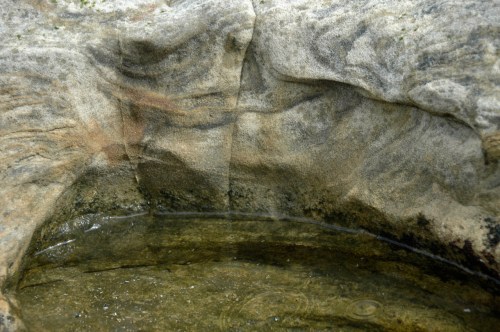
When I look at this the first thing I think is “how beautiful”. It’s like a work of art, isn’t it?

Look at the sweeping lines, the layers, the smooth surfaces and the ripples in both the water and the stone.

The next thing I think is how similar AND different the water and the stone are…..those colours, surfaces and lines, but the stone which changes over millennia while the water changes over seconds.

The third thing I think is how the universe began, fourteen billion years ago or so, first with only a couple of different atoms, then a few more as the creative and destructive furnaces of the stars kicked into action, and how every single element we’ve found on this planet was created, atom by atom, in those vast clouds of stars millions of light years away. Then over millions of years how the Earth was fashioned into the incredible substances, structures, materials.

It astonishes me.

The fourth think I think when I contemplate this image is how all the water, all the rocks, all the air which moves around as winds across the face of the Earth and the Sea, all the heat of the Sun which beats down upon us, makes this one, precious place for us all to live.

One of my favourite books of all time is Thomas Berry’s “The Great Work”.

Read Full Post »

When I took this photo I was attracted to the white flowers, but when I looked at it on my computer it seemed to me that the white flower in the middle of the shot had turned into a butterfly.

When I looked closer, it hadn’t.

But like some of those optical illusions, once you’ve seen it, you can’t unsee it! So, now whenever I look at this image the first thing I see is a white butterfly, which transforms itself before my eyes into a flower. Given that perhaps one of the key characteristics of butterflies is transformation, that seems strangely appropriate.

OK, I know butterflies don’t transform into flowers, or vice versa. Well, not directly anyway. (You could argue that everything which exists on Earth is made from the same atoms which have made everything else) However, just seeing that has taken this image to a new level for me.

In a few short moments I can let my mind follow the path of a butterfly, its eggs, its caterpillar stage, its chrysalis, and on to a new butterfly. And I can let my mind follow the path of the flower, the insects which come seeking sweetness, the pollen spreading, the new seeds forming and scattering, a green plant shooting up through the dark earth, and a new flower stretching out its petals under the warmth and light of the Sun.

And it all seems WHOLE. I see an intertwining of Nature’s cycles and rhythms unfolding before my mind’s eye.

I hope you can too.

Read Full Post »

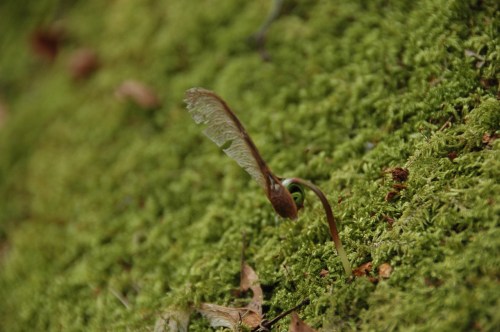
You know these seeds which helicopter down from the trees? Strangely one-winged and decidedly “wonky” looking?

Well, maybe humans wanting to make something which would be carried on the wind wouldn’t design it like this, but, hey, Nature’s designs are the best!

So, sometime, maybe last autumn, this little seed spirals its way from a tree, who knows which tree, and tumbles and flies and skips and zigzags its way through the air, to land here, on the forest floor. Then, a few months later, who knows how it knows, it wakes up, yawns and starts to stretch, feeling that Spring is around the corner.

And look at it now!

Out of the pod uncoils a long stem, probing down through the moss to find nutrients, and begin to grow itself into a tree!

I mean, do you ever stop and consider something like this?

Have you any idea how it happens?

We can’t even tell if an individual seed is alive or not, is viable or not, until it wakes up and begins to develop. Isn’t that incredible? That we can’t even tell if it alive or dead? Nobody can.

Then how do the cells start to divide and “differentiate”? That means start to develop into the different cells which will produce all the different parts of the tree.

One of my most favourite and most memorable lecturers at Edinburgh University was the Professor of Anatomy, Professor Romanes. He used to start a lecture with a box of coloured chalks and one of those giant rotating blackboards which gave you one screen after another. By the time he finished he’d produced what were no less than works of art showing each different kind of cell, each different kind of tissue, in a different colour. We were transfixed.

He gave a series of lectures on embryology taking us through the various stages of development of a foetus from a fertilised egg cell to a ready to be born baby. I remember thinking at the time, and those thoughts are still with me, “how on earth does that happen?”

I mean, how on earth does a single fertilised cell divide and multiply and differentiate to produce all the organs, all the tissues, all the parts of a human body, and every one of them in the “right” place?

It utterly amazed me.

It still does.


Read Full Post »

The phrase “everything is connected” immediately appeals to me and strikes me as true.

The first thing I think of is the human being.

Although I was taught Medicine in parts, learning about cells, tissues, organs and even systems separately, it was an almost unspoken given that all the parts were connected. In Second Year of Medicine at the University of Edinburgh, one of the main subjects was Anatomy and we were put into groups of six to spend a year dissecting a human body. Our guide was a three volume textbook, “Cunnigham’s Manual of Practical Anatomy”, along with “Gray’s Anatomy” (probably the most beautiful textbook I ever possessed). I was a bit overwhelmed with the sheer number of pages in these texts and asked one of the tutors “Which bits of this book do we need to learn?” He replied, “Which bits of human beings do you think patients will ask you about once you’re qualified?” “Ah, you mean we have to learn it ALL?” He smiled and walked away.

It would be a full two years after that before I met an actual live patient, but, hey, they don’t teach Medicine that way any more do they?

I don’t remember a single lecture about holism, but somehow it was a core value for me right from the start. However it was over a decade after graduation before I came across “Psychoneuroimmunology” and “Psychoneuroendrocrinology” which were fields of study looking at the connections between the Mind, the Nervous System, the Endocrine System and the Immune System. I think that’s where I first encountered a more holistic science, one focused on “systems” not “parts”.

It was much, much later when I encountered “Complex Adaptive Systems” and both “Chaos Theory” and “Complexity Science”. Somehow I think we are still in pretty early days of developing the sciences of the connections. But it sure still excites me!

As a GP I also had to be aware of the individual patient’s connections between themselves and the rest of the world….their relationships, their work, their housing, their family and so on. Those are threads you never quite get to the end of. I think that makes us humble, that knowing that we will never know all there is to know.

Sometimes it seems to me that our minds are like fractals, vast webs of mirrors reflecting similar patterns of reality to each other. Actually, as I write this I remember “Indra’s Net” – where every drop reflects every other drop. I think we humans are great at spotting patterns, and regularities, and that, combined with our ability to use metaphors and symbols enables us to appreciate the incredibly rich, dense nature of reality.

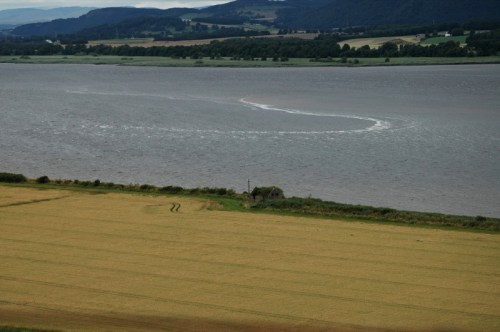
When I saw this shape on the surface of the water I wondered if it had been caused by a boat, or was it something lying on the river bed? But look at the shape drawn by the farmer who has been working this field. What a gorgeous echo of the shape on the river. One of the things that happens when we appreciate these connections is an experience of beauty and wonder intimately entwined.

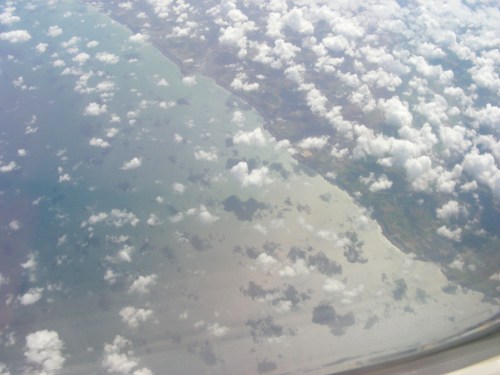
One time when flying over the English Channel, I looked down and saw the shadows of the clouds on the water’s surface just before the coast. Ooh, that still pleases me so much to contemplate this image! I love the fragility and impermanency of the little clouds. I love the even more ephemeral nature of their shadows on the Channel. And I love that transition of density of the clouds from the area above the water to the area above the land, how you can see in that the dynamic, ever moving dance of the land and the water and the air. Magic!

What connections have you spotted today?


Read Full Post »

I don’t think of myself as a separate object any more. There is a constant stream of materials, energies and information flowing into me. I ingest some when I eat, I breathe some into me when I inspire. Heat, light, sound, gravity, and many other energies I can’t detect, influence and shape me, some stimulating my senses, some influencing the flow of fluids and elements around my body and into and out of my cells. The way my body and brain have evolved allows my whole being to interpret all these flows, to make sense of them, attach values to them, to allow me to respond and react.

I am changed.

Second by second, minute by minute, day by day and year by year, I am changing. Not a single cell remains the same over my life time. The idea of an “internal environment” is quite an old one now, but more than ever we understand that this is a dynamically changing environment, not a fixed one.

We process all these streams and flows. We create new cells, break down some molecules, make some new ones. We make new connections in our brains, strengthen some feedback loops in our body and weaken others. We make sense of now in the light of the past and the myriad of possible futures.

Then these streams continue on their way. We breathe out certain molecules, subtly changing the mix of gases in our immediate environment. We radiate heat, make noises, and we act.

We send out materials, energies and information into the universe every single moment of our lives.

These flows influence, disturb, change and shape our environment, other people, and all the other forms of life we share this planet with.

So, sometimes, I think it’s a good idea to pause, take stock, reflect, and ask ourselves – what shape are the waves that I’m making?

Because these shapes repeat and echo and ripple out way, way beyond the worlds we can imagine.

What kind of world do we create when we send out angry waves? Waves of fear? Waves of kindness? Waves of joy?

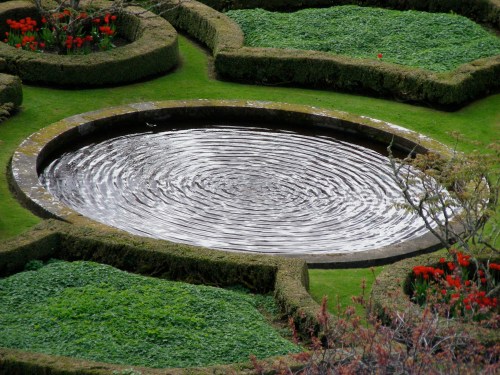
I was thinking about this today because I came across this photo I took at Dunrobin Castle many years ago. The concentric shapes of the ripples in this fountain completely fascinate me. It’s mesmerising. Alongside that, I heard from a couple of people in the last couple of days how much they enjoy my blog posts, and how they have been reading them for years. I didn’t know that. Like any author who publishes a book, I don’t tend to hear from my readers. Yes, I know, some of you hit the “like” button, or make a comment, but I have realised before that only a tiny minority of readers do. And that’s how it should be. After all, when I think of all the books I’ve read and enjoyed in my life, how many of those authors (even just the living ones! 😉 ) have I contacted to let them know that? Almost none.

I know people blog, and tweet, and put posts on Facebook for many reasons, but I think it’s always important to wonder about what shapes the waves are that we are sending out into the world. They will travel further and for longer than you think.

I hope I’m sending you some waves of wonder, some waves of joy, some waves of kindness and some waves of beauty. Because that’s my intention.

Read Full Post »

It’s many years since I stumbled across these two trees in a forest, but it’s an image which still captures me every time I see it.

I mean, just look at this….as best I could tell these are two trees growing close to each other in a wild forest. So close that one day they joined together. What began as closeness grew into entanglement. In my photo library I’ve labelled this photo “loving trees”. Of course, I don’t know if trees do love each other or not, but I do know there is a growing body of evidence revealing that trees communicate and co-operate much, much more than we ever thought they did.

I don’t mean to anthropomorphise the trees but I do think this kind of phenomenon reveals something about the underlying life forces which shape our universe. It’s natural for living organisms to connect, to get close to each other, to share and to collaborate. I know the dominant narrative of Nature and Society for many years now has been one of competition with every single plant, insect, animal or whatever fighting for its life and competing with every other creature for the common resources. But competition is just one phenomenon we see in Nature, and it may turn out not even to be the most important one.

I think we haven’t paid enough attention to co-operation and collaboration in our world. Look at human beings for example. Our extraordinarily developed brains absolutely excel at making connections and creating relationships. Human babies wouldn’t survive for long with out these innate skills. We understand the importance of infant-parent attachment much better now. We even know that without healthy, loving attachment in the earliest years a baby’s brain will grow less neurones, and make less connections between them. These early experiences of love, care, attention and belonging set us up for life. Conversely, their lack limits us and makes life a whole lot tougher.

I’m always struck by how you can see in any emergency, whether it be a road accident, someone falling ill in the street, or something even more dramatic like a natural disaster or a terrorist attack, there are always many people rushing to help. It’s a human instinct. Actually I don’t think this is reserved to humans. We can see all kinds of co-operation and collaboration in the other kingdoms of life – other primates, other mammals, birds, insects, flowers and trees. The word “ecosystem” refers to the complex, inter-twined, co-dependent, elaborately connected webs of inter-being, connecting all sorts of living creatures and creating the conditions for life and growth.

I often think we get more of what we pay attention to, so I often think it’s a good idea to pay attention to relationships, to love and to care.

I’d like to see a world where we recognise that co-operation, collaboration and sharing is the natural counter to competition, grabbing and hoarding.


Read Full Post »

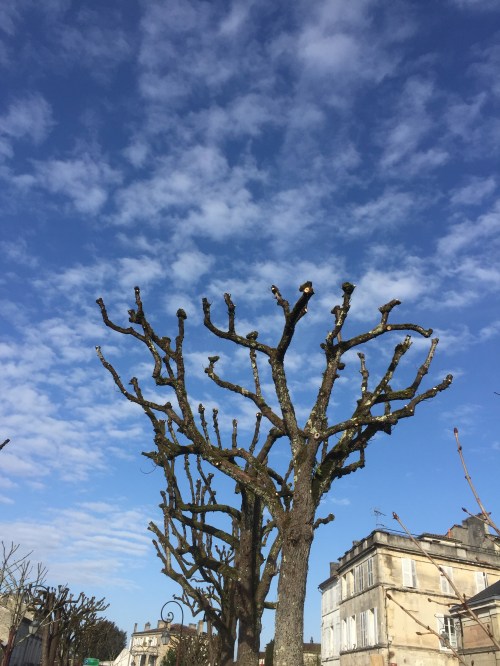
One of my favourite parts of Cognac is the Place Beaulieu (“beaulieu” means “beautiful place”). When I was there the other day I was struck by the shapes of the pruned trees. It’s not uncommon to see trees pruned as hard as this, and I thought they looked both beautiful and rather shocking.

One glance and you know these are not trees allow to grow free and wild. Someone has a clear vision of what shape they’d like them to be, and cuts them back severely each year to channel their growth, to become the shape which matches the clear vision.

I remember thinking only human beings interfere this much with other parts of Nature, to make plants grow where they want them to grow, to weed out the ones they don’t want. Only humans create gardens and tame animals to make “pleasing” spaces and comforting pets.

But is that true?

Suddenly I remember a scene from one of David Attenborough’s films – the puffer fish –

I mean, that’s pretty something, huh?

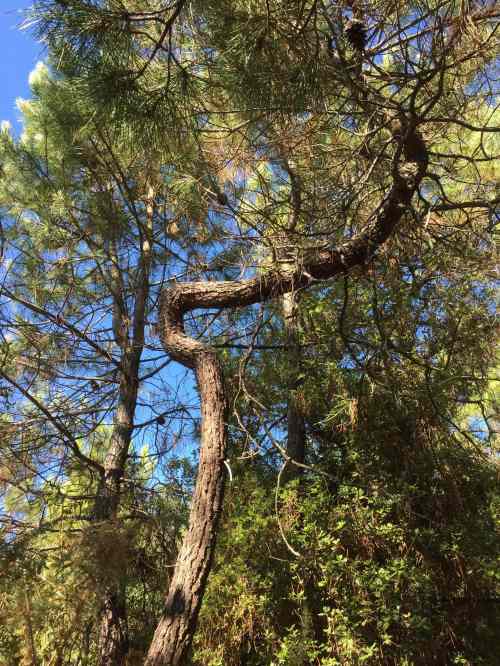
Then I thought I’d find a wild tree in my own photo collection. A tree which is obviously untamed. Two sprang to mind.

This one, which I saw a while back in the Charente Maritime. I mean, what’s been going on here? Just what’s the story this tree could tell if only we spoke its language?

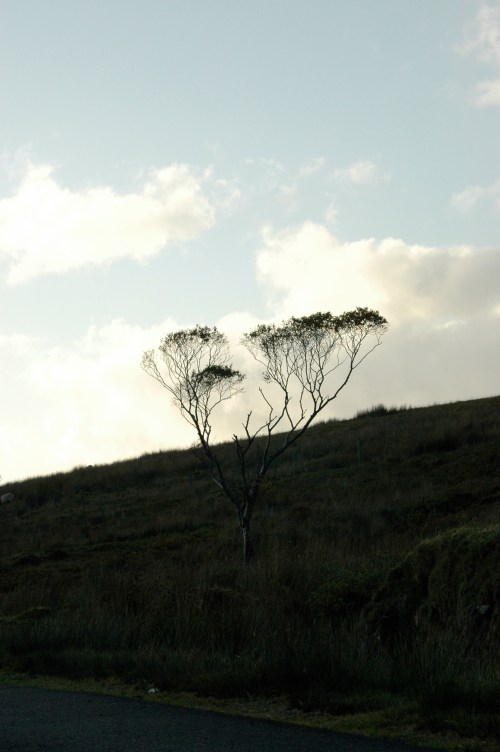
And, this one…..

…which I photographed twenty years ago, in Scotland, on a trip to Skye.

When I glanced at this photo I thought to was two or three separate trees on the horizon. Then I looked more closely, and in the underexposed foreground you can see this is a single tree, growing at the side of the road. Isn’t it beautiful? It’s really a classic of the “tree-shape”, of that iterative branching and re-branching that creates a pattern we can see rivers make as they approach an estuary, when we look at them from high above, like from a plane or a satellite. The exact same pattern we can see inside us when we look at the anatomy of our lungs, or our circulatory system, because both the air and the blood flows around inside our bodies along channels which look a lot like this.

See where a thought can go? This one just started with looking up and noticing the shapes of the pruned trees against a blue sky. I think it’s good to let your thoughts flow. I mean, who wants clogged up thoughts?

Read Full Post »

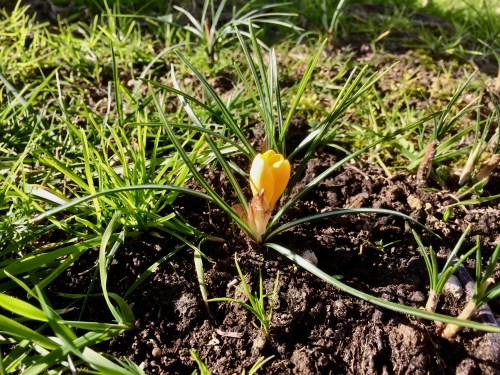
Here they come! The first little crocus flowers.

It’s the middle of January, and here in the Charente we have blue skies and a bitingly cold wind blowing from the North East (the literal opposite direction from the prevailing winds which come from the South West).

Every year in late autumn I poke some more holes in the grass around the mulberry tree and plant some crocus bulbs. Last time I planted about fifty of them. I’ve lost count of how many I’ve planted in the last five years. We have an image in mind of a carpet of yellow, purple and white crocus flowers covering the ground at the foot of the tree, but, so far, it’s never looked remotely like that, so I just keep adding a few more every year.

Did you know that there is no scientific way to tell if a seed is dead or alive? No way to know which have the potential to burst out of their shells and make their way through the soil towards the Sun. Any botanists out there can correct me, but I suspect the same applies to bulbs. There’s no way of knowing which will produce full-blown flowers, and there certainly is no way of knowing which of them will appear first.

That means that every single year the sight of the first crocus is a surprise and a delight. It’s like making a discovery. Even if I know it’s me who planted the bulbs there. That delight doesn’t go away with the appearance of the first flower either. Every single new plant brings an equal measure of delight. It’s the gift that goes on giving!

This is one of the occasions where I am struck by how we humans can welcome and embrace uncertainty. We’d like to think we can control things. We’d like to think we can predict things. And there are certainly cases where we can, but more often than not, we can’t. I worked as a General Practitioner for four decades of my life, and the core skill of a GP is to be able to handle uncertainty.

In the Primary Care setting, a GP (Family Doctor), tends to be one of the first to be consulted when a patient becomes unwell and can’t manage their illness by themselves. In my training I was taught this meant I’d see a lot of patients with “undifferentiated illness” – because in the earliest stages of illness things can be pretty vague. There might be a bit of a fever, or just a symptom or two….feeling tired, or achey, of slightly nauseous. In these early hours or days there might not be much to find amiss on a physical exam, or at least, not much to find which is distinctive of any specific disease. A few days, or even hours, later, it can be glaringly obvious! Which is why GPs learn to assess the severity of a patient’s symptoms, the over all level of their health, and the need for any urgency. We learn to review the situation as quickly and frequently as appropriate. We also learn that the future is not predictable at the level of the individual patient. We can have a good knowledge of the likely progress of certain pathologies, but we can’t predict the future path of an individual’s illness. Same thing goes for any treatment. Whether or not a certain treatment is so-called “evidence based”, only the unfolding story of this particular patient in the days and weeks ahead will reveal the course of the illness and the appropriateness of the treatment.

I can see that you might read that and despair, thinking, surely the doctor can do better than that? Surely they can predict the future with certainty. Well, nope, they can’t. What that means is that the uniqueness of the individual can never be set aside. The particularity of the person can never be replaced by the categorisation of their illness by diagnosis, or by the likely effectiveness of any treatment. At all the times, the GP has to make a judgement, based on knowledge and experience, use that judgement to decide what to do, then, crucially, follow up.

That’s why I don’t think it’s a good idea to chop the delivery of health care into little pieces. Dealing with the whole person has got a time dimension to it. We need to know how things are progressing, and make another judgement, another decision, in the light of the changes.

So, I might have started writing this thinking about a little yellow crocus popping up, by I find my train of thought exploring uncertainty, unpredictably and the Practice of Medicine, (who saw that coming?!)

Where that takes me to is – I think there are at least three crucial elements to good Medical Practice –

  1. Time – sufficient time for the patient and the doctor to get a good understanding of what’s going on
  2. Continuity of care – follow through of every event into an emerging story over hours, days or weeks
  3. Open minds – never closing down the thought processes by ticking a box, or issuing a prescription, knowing that the future, in all individual circumstances is uncertain.

I’ll leave you with one of the “new”, newly emergent, crocus flowers, by which I mean one of the new variety I planted last year which has just popped up to say hello!

Read Full Post »

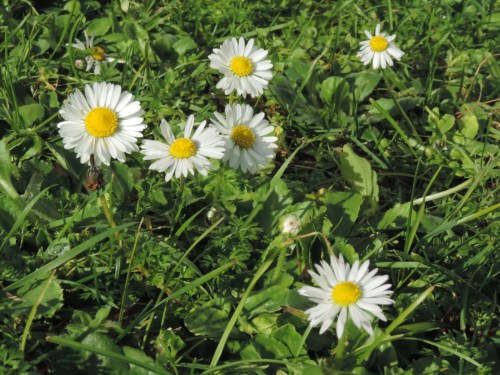
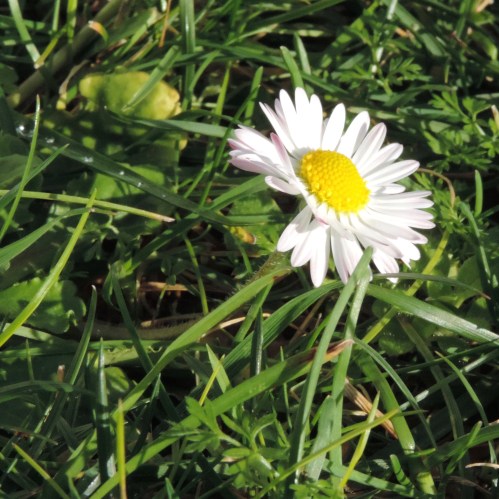
It’s almost the end of the year and a few days I go something caught my eye when I walked out into the garden here in the Charente – daisies!

I don’t know why, but I’ve always associated daisies with the summer, and I don’t remember ever seeing them flower around the time of the winter solstice, but, who knows? Maybe they do! Perhaps if you’ve more botanical knowledge than I have you’ll be able to enlighten me. However, what I’m saying is this is the first time in my life that I’ve been aware of daisies flowering in the winter time.

So what, you might ask?

Well, here’s why this interests me……

I find that when I notice something different, something new to me, that it slows me down, draws me into the here and now, makes me more present. I felt compelled to turn around, get my camera, then go back out and take some photos of these daisies. I enjoy getting down in the grass to take a close up of the small flowers which grow there, and for a few moments, as I frame and focus, I lose myself in this action. Lose myself in the sense of interrupting the almost chaotic nature of the endless flow of thoughts which seem to occupy my busy brain, and focus for a bit, on looking, on discovering, on photographing these little flowers.

So, there’s the first thing. They take me to another place, to another pace.

Second, as is often the case when I slow down, notice, savour and become absorbed by something, I find a sense of wellbeing, of joy, and of transcendence occurring. I feel nurtured by that.

Third, I start to think about what I know about this family of plants – the daisy family – what I know about them is that they have been used by humans, for hundreds of years, to treat injuries. They have a reputation for stimulating and encouraging repair and recovery. Bellis perennis (this common lawn daisy), Chamomilla, Calendula, Echinacea, Millefolium, Arnica, are all members of what we now call the Asteraceae (the daisy family). And they are all members of Nature’s Pharmacy of healing plants, used particularly in the treatment of injuries. There’s an interesting quality which many of the flowers share which relates to this repair-ability they seem to have – when you walk across the grass, standing on daisies as you go, if you stop and look back, it’s hard to see which ones you stepped on – they have great resilience, great ability to withstand and recover from trauma. Isn’t that interesting?

Fourth, and this is because of what I’ve learned over the years about these little plants, as I wander around the garden, crouching down to take the photos, I start to wonder about resilience. How resilience, which incorporates both an ability to withstand trauma, and an ability to recover from it, is much neglected in Medicine. Even in the treatment of injuries, I wasn’t taught much at Medical School about resilience or how to stimulate and nurture it. But isn’t this an essential part of all healing? This poorly understood phenomenon of self-defence, self-regulation and self-repair. I know now it’s a common feature of all “complex adaptive systems“. But that’s not something taught at Medical School either…..

Fifthly, and, if you are familiar with my thought from other posts on this site you’ll see this one coming, I feel humbled. I feel humbled by the astonishing phenomenon of the lives of these pretty flowers. I feel humbled by the realisation of the limits and partial nature of all human knowledge, and, certainly my own! I feel humbled to be in touch with the natural phenomenon of resilience, and ponder what I can do, what we can do together, to stimulate and support the resilience of ourselves, our loved ones, of other living creatures, of ecosystems, of Nature, of our planet Earth.

Read Full Post »

« Newer Posts - Older Posts »