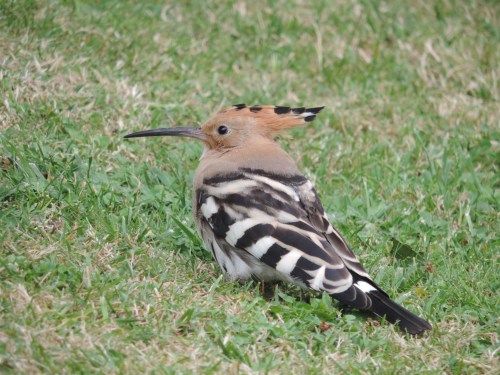
Striking bird, huh? I’d never seen a “hoopoe” until I came to live here in the Charente. I still find them very exotic. It’s as if the bring a touch of far away into my garden.
Every Spring a couple of them turn up, then a little later, I’ll see them together, mum, dad, and a rather large offspring. I don’t know where they nest so I don’t see the young bird till he or she arrives in the garden hopping quickly here and there to wherever mum or dad find a worm or a grub. Beak open astonishingly wide to receive the newly discovered food.
At first, the young bird just seems to hang around watching and waiting, but after a few visits begins to drill that long beak down into the grass searching for food itself. Never seems to find any though! So still rushes across to the parents every time they strike lucky – which they do with amazing regularity.
Then a time comes when the young bird is there in the garden by themselves, drilling down here, drilling down there. I’ve seen them do this for literally hours without seeming to find a single thing. The first time I saw a day like that I got worried that maybe the young bird would never learn the skill of finding food….and then what?
But you know what? They stick with it, and, finally, start coming up with the goodies. I’ve no idea how they do that. Seriously, if you’re a bit of an expert in birds, can you tell me? How does the hoopoe know where to drill down into the earth for food? Clearly it’s not random. Well, actually, I think for the young bird, that at first, it is pretty random. But then they learn. I wonder what they learn? I wonder what they sense and how they develop that sense?
Well, yesterday was the First of September, and the weatherman said it was the first day of Autumn here. He explained that meteorologically July is the month with the hottest average temperatures, so that’s considered the height of summer, making June, July, August the summer months. January has the coldest average temperatures, so that’s the depth of winter, making December, January, February winter. Spring and Autumn fit in between those two trimesters. The Equinox, when the number of hours of daytime exactly matches the number of hours of night, falls on September 23rd. That’s when it will usually start to feel like autumn here.
Still, after a week of blue skies and warm days, the 1st September was grey and a bit rainy. As if to say “I told you so”. (Although, the sun is back out again today, the 2nd)
One change I’ve noticed though, is that the hoopoes have gone. Haven’t seen them for two or three days now and I suspect they’ve headed south. They spend the winter months in Africa before coming back here next Spring. By the way, how do they do that?? How do they find their way to Africa then back to the same garden here in the Charente? How much energy does it take to fly all that way? Honestly, I’m finding Life more amazing every day. It’s just full of things to wonder about!
So this feels like a marking of a new cycle right enough.
If you’re reading this in the Southern hemisphere of course, you’ll be seeing winter fading away and the early signs of Spring appearing. Isn’t that amazing too?
These rhythms feel ancient, deep and fundamental to me. There is something so pleasing about these natural cycles. It seems important somehow to be aware of them, and to adjust, to adapt, to tune in, to get in harmony with them. Doing so seems to add to the feeling that life is good.
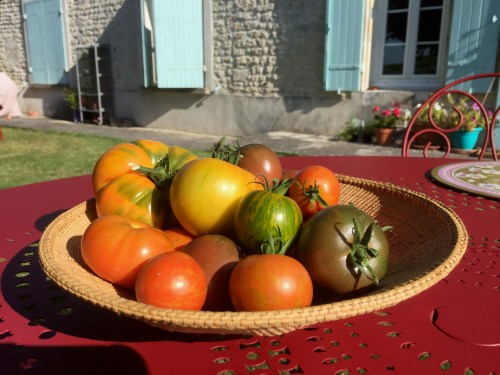
Here’s a small basket of the tomatoes we picked from our garden this morning.
What strikes you about these tomatoes?
Well, what strikes me is their diversity.
They are a huge range of sizes, colours and shapes, partly because they come from different plants chosen because they are different varieties.
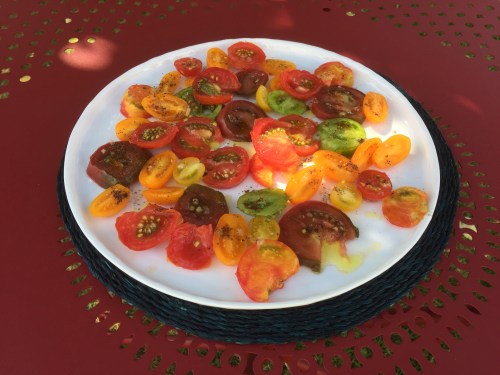
I SO prefer this to a packet of same-size, same-colour, same-variety tomatoes we can buy in one of the local supermarkets. Even just to look at….but also to taste! Here’s a simple plate from yesterday.
Only tomatoes, a drizzle of olive oil, a touch of salt and pepper. That’s it! Mmmmm….
I could leave this post right here. It’s enough, isn’t it, to celebrate colour, taste, freshness, locally sourced food, and the simple pleasures which make a day delightful.
But I’m not going to.
Because what strikes me about both of these images is the issue of diversity. We live in mass society – mass production, mass consumption, mass conformity. This last element is necessary to ensure the efficient workings of the first two. Without mass conformity, mass production and mass consumption go belly up. (yes, I choose my words carefully – he! he!)
There are enormous pressures to consume in this society, and equally enormous ones to produce. A lot of value is attached to both. Did you ever come across an old black and white comedy, “The Man in the White Suit”, about an inventor who creates a totally indestructible fabric? The lead character is a scientist whose discovery industry immediately tries to suppress, because it would mean people could have clothes which would last a lifetime…..and sales of clothes would plummet!
I remembered this old film the other day when I took my car to the garage to have worn-out shock absorbers replaced (ouch!). The mechanic told me that shock absorbers used to last 100,000 km but now they last only about 80,000 km. Guess that’s progress!
Jacques Ellul, who lived, researched, taught and wrote in Bordeaux, produced an astonishing analysis of mass society in his lifetime. I’ve just finished reading two of his main works (in English) – “The Technological Society” and “Propaganda“. Although both were published in the 1960s, they are extremely pertinent in 2019. He shows how a focus on “technique” – by which he means setting goals, then creating measurable processes to achieve them – brings a whole host of improvements and progress to human life, but, inevitably, is accompanied by widespread and deep de-humanisation. Plans, judgements, decisions, resources, all become grist to the mill of mass production and mass consumption. Mass society needs conformity, controls, rules, regulations, norms and standards. There is no room for “variance”, “diversity” or “uniqueness”.
He also showed how mass conformity is produced through targeted propaganda, focused on the “individual”. Now, doesn’t that seem a paradox? Don’t we tend to think of “mass” at one end of a spectrum and “the individual” at the other? Well, it turns out that apparent paradox is the key to mass control.
Long after Ellul published these works, the world saw the birth of a new politics, represented clearly by Ronald Reagan in the US and Margaret Thatcher in the UK. It was Thatcher who famously said “there is no such thing as society”. The new politics became known as “neoliberalism”. With the spread of neoliberalism society became increasingly atomised. The idea was that everyone was on their own and in competition with everyone else, and through “the market”, and a form of “social Darwinism”, the weak, the inefficient, the failures, would die off, and the strongest, “best”, people and methods would win the day.
It’s a toxic mix. Mass plus individualism.
But, hey, I hear you say, I AM an individual! I am NOT the same as everyone else! I’m not just a robot, a machine, a cog in a greater machine!
I hear you.
But here’s my take on that – individualism divides us. It sets us against each other and ignores what we share and what we have in common. It feeds the divisions, prejudices, hatred and fear of “the other” which have become all too common. But I don’t want to be just a data point in Cambridge Analytica’s memory banks. I don’t want to be a mere pawn of Facebook, Twitter, Youtube, Instagram….my details harvested to target me with highly crafted propaganda to make me conform, or to support a small group who have, and want to hold onto, riches and power.
How do I resolve that paradox? I sure don’t have it all figured out but I have some thoughts…..
I don’t think we need to subscribe to either of these extremes – a data point in the mass, or an individual ego, disconnected from the rest of the planet. I think there is a third option.
Uniqueness.
Isn’t that the same thing as individuality? No, I don’t think so. For a whole host of reasons, but, for starters, because “individualism” prioritises separateness and difference. It’s a form of what the English philosopher, Mary Midgely called “social atomism” – see her “The Solitary Self” and “Science and Poetry” for her analysis of this problem. Uniqueness, on the other hand, demands an examination of contexts, of circumstances, connections and environments.
To fully experience and understand the uniqueness of this moment, it helps to see it as a dynamic, changing-before-your-eyes, event. I am unique because of the myriad of connections and flows which make me who I am. I have emerged from a particular family with it’s family tree, in a specific place, at a specific time, and continue to grow and develop through a unique and personal chain of experiences which I weave into a story I call “being me” (or better “becoming me”!)
Every single day at work as a doctor I’d meet patients who came to tell me their own, unique, and personal, story. It’s how I got to understand them. It’s how I made diagnoses, offered treatments, therapies and practices to help them re-experience health again. No two patients ever told me the same story. Not in a lifetime of practice.
And here’s the key – the way I revealed their uniqueness (to myself, and often, to themselves too), was by uncovering the connections, the flows, the contexts, environments and events of their lives.
I never wanted them all to be the same. I never wanted them all to become the same. In health, as well as in sickness, every person turns out to be unique.
OK, this is a personal bee in my bonnet, but I have a hunch that if we tipped the scales a bit, away from a focus on the mass, away from a focus on the individual, and towards uniqueness, that we might begin to create a better world. Maybe it would draw us away from competition and division towards cooperation and connection.
Does this make sense to you?
I mean, it’s a bit of a leap from a basketful of tomatoes!
But before I go, here’s one of my favourite Mary Oliver poems, The Summer Day, which doesn’t use the word “uniqueness” but it seems to me to be all about it…
The Summer Day
Who made the world?
Who made the swan, and the black bear?
Who made the grasshopper?
This grasshopper, I mean-
the one who has flung herself out of the grass,
the one who is eating sugar out of my hand,
who is moving her jaws back and forth instead of up and down-
who is gazing around with her enormous and complicated eyes.
Now she lifts her pale forearms and thoroughly washes her face.
Now she snaps her wings open, and floats away.
I don't know exactly what a prayer is.
I do know how to pay attention, how to fall down
into the grass, how to kneel down in the grass,
how to be idle and blessed, how to stroll through the fields,
which is what I have been doing all day.
Tell me, what else should I have done?
Doesn't everything die at last, and too soon?
Tell me, what is it you plan to do
with your one wild and precious life?
In a recent article about advances in microscopy, a truly incredible innovation, the ability to look inside living cells will give us (according to the journalist who wrote the article)
Seeing the shape and structure of biological molecules is important because they are the cogs and wheels that make living things work. They work inside and between cells, which are the building blocks of human life.
“cogs and wheels”, huh?
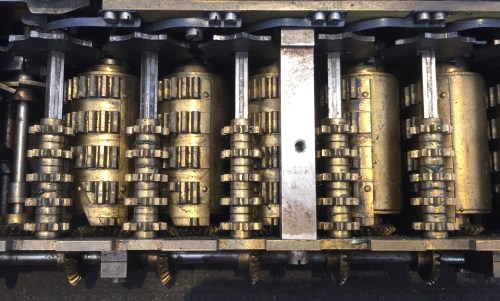
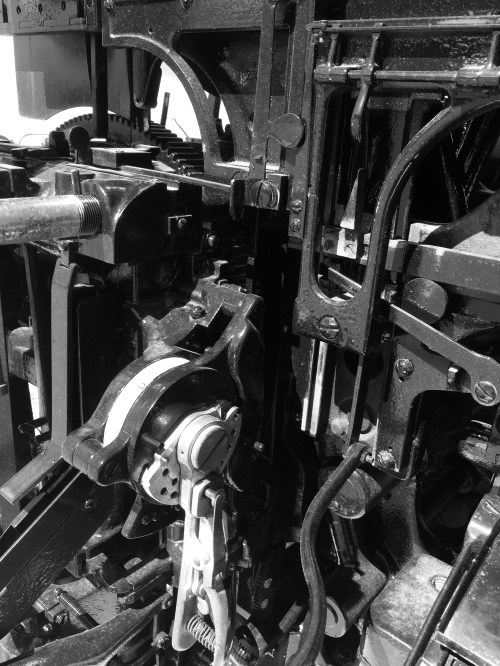
See that photo at the start of this post? That’s a photo of cogs and wheels. You don’t see these inside cells. Living creatures are not “built” from “building blocks” – walls and machines are.
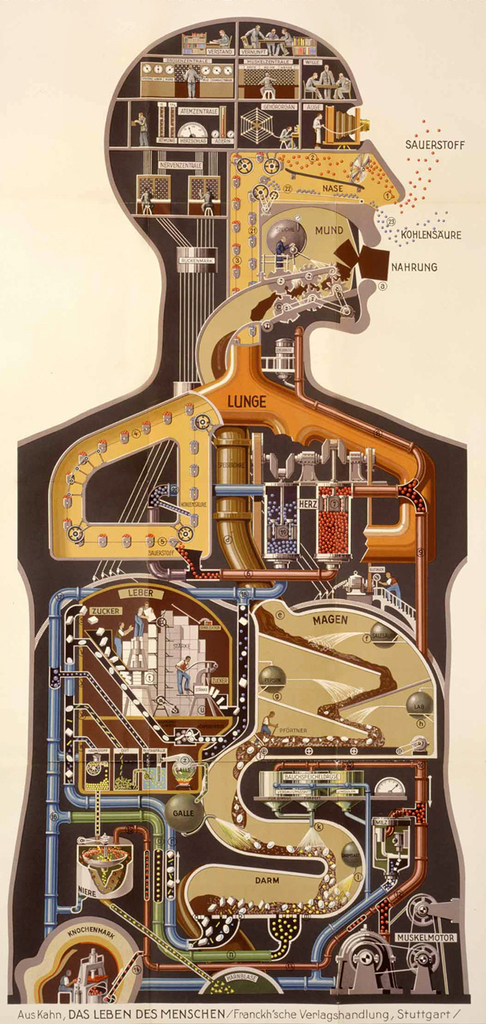
Here’s a machine.
Would you ever be fooled into thinking this was a living creature?
I don’t think so.
In fact, in the footage from this imaging technology that I’ve seen so far, the most amazing and striking thing is that everything you see is on the move. The inside of a cell is full of bustling activity and movement. Not cogs. Not wheels. More like even smaller creatures inside the living creature we call the cell. They seem more like what we see outside of the cell – in whole organisms, like in our own bodies – teeming communities of tiny creatures which we call cells, co-operating and collaborating to function as a whole.
The biologist, Lynn Margulis, developed the theory of endosymbiosis, which described how bacterial sized organisms may have evolved together to become the highly specialised structures inside each, and every, living cell.
In 1966, as a young faculty member at Boston University, Margulis wrote a theoretical paper titled “On the Origin of Mitosing Cells”. The paper, however, was “rejected by about fifteen scientific journals,” she recalled. It was finally accepted by Journal of Theoretical Biology and is considered today a landmark in modern endosymbiotic theory. Weathering constant criticism of her ideas for decades, Margulis was famous for her tenacity in pushing her theory forward, despite the opposition she faced at the time. The descent of mitochondria from bacteria and of chloroplasts from cyanobacteria was experimentally demonstrated in 1978 by Robert Schwartz and Margaret Dayhoff. This formed the first experimental evidence for her theory. The endosymbiosis theory of organogenesis became widely accepted in the early 1980s, after the genetic material of mitochondria and chloroplasts had been found to be significantly different from that of the symbiont’s nuclear DNA. [wikipedia]
We are not machines. Machines are not alive, and they don’t evolve. Crucially, machines don’t show “emergent properties“. They are predictable because they are not alive, and they don’t develop new, impossible to predict, behaviours and characteristics.
I think we do Life a huge disservice when we think of creatures as machines.
We are actually infinitely more complex, more amazing, more puzzling, more wonderful than anything that tired old metaphor can come up with.
So, can we move on please? And talk about Life without reducing it to something inferior – a machine.
Yeah, I know, but, first of all I was trying to get a photo of about a dozen hyper swallows zipping and zooming this way and that above my head, but, hey, I only got one! And only just!
The fact I only got one (in the middle of a summer’s day, by the way) reminded me of that old adage about how spotting one swallow doesn’t mean that summer has arrived. Which brings me to the subject of anecdotes….
Since the rise of “Evidence Based Medicine” I’ve heard it said many times that anecdotes are not evidence, and that a whole bunch of anecdotes isn’t evidence either. Only rigorous, controlled trials, statistically analysed provide evidence. But my problem is that I spent my working life meeting, listening to, conversing with, and treating, one patient at a time. Each patient came and told me a unique story. Not a single patient told me an identical story to one I’d heard before. I tailored my treatments for each patient according to their unique story and the way things progressed from there was unique, and also unknowable.
I had no way of knowing whether or not an “evidence based” treatment would deliver the promised results in this particular patient. On the grounds of probabilities and experience, of course, I could go forward in good faith and with some confidence, but I learned that I always had to be prepared to be surprised when the patient returned. It seemed that no two patients experienced exactly identical effects of the same treatments. Didn’t matter whether I’d prescribed painkillers, antidepressants, anti-inflammatories, antibiotics (seeing a pattern here?) or whatever, the future course of an individual life was, and always will be, unique.
Emergent – that means the future unfolds as it happens in ways which could not be wholly predicted from the knowledge of the past and the present. All living organisms display emergent properties. It’s a characteristic of all “complex adaptive systems”.
So, whilst I could never generalise from an individual “anecdotal” experience to apply it to every other patient, the truth is, generalisations can’t be applied to every single patient either.
The tendency to dismiss individual stories as irrelevant to medical practice has always struck me as illogical. Irrational even. It might make sense in a research environment, but the individual story remains crucially important in the clinical one.
In deciding on a particular course of treatment with a patient I’d want to take into consideration what I’d learned was good practice, and what the research evidence had shown about the various different options, but, on the day, in the room, with this unique individual sitting with me, and, maybe even more importantly, when they’d return to report what had happened, THE most important thing was them – their story, their experience, their life.
I didn’t know any other way to practice – it was one patient at a time. Ultimately, the patient was always more important than any data – despite the fact a junior doctor told me, not that many years ago, that she’d been taught “Never listen to patients. They lie all the time. The only thing you can believe is the data”
Nope. That’s no way to practice Medicine!
Oh, before I finish, thinking of “one swallow at a time” reminds me of one of my most favourite books about creative writing – Anne Lamott’s “Bird by Bird”. Recommended.
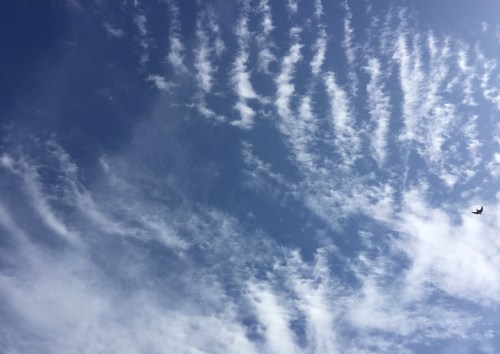
What do you see when you look up at a sky like this?
The first things to catch my eye are the patterns in the clouds. I just love seeing these ripples, waves and swirls. I can delight in densities and the transparencies. I love how the blue beyond shows through and appears as lakes, streams and rivers in the white land of the cloud.
Then the next thing that happens for me is noticing that some of these patterns here look familiar. They remind me of something else, in the same way that sketches and doodles do, in the same way that paintings and photographs do. My eyes are drawn to the blue zone in the cloud which I can easily see as a pair of lungs – well, I’m sure that’s at least in part due to my working as a doctor all my life – but the idea of a pair of lungs breathing this cloud into existence delights me! Bear with me for a moment longer, because, and this comes and goes for me, I can then see what looks like a head above “the lungs” with a face looking out towards the right hand side of the image. Sometimes that looks SO clear to me that it almost spooks me out! And then I look again and I just can’t see it.
If you’ve been reading the posts on this blog for a bit, you’ll know what’s coming next……the image sets of a train of thought for me.
This time what I start to think about is creation.
I love to see clouds emerge, change, and disappear before my very eyes. So often they look like a work of art, like a piece of performance art. I see it happen and it amazes and delights me.
This, I think, is the essence of the Universe – creation.
The Universe has been creating since its beginning. As best we know, first elements, like hydrogen and helium, then clouds and densities which form into stars, those sources of all the elements we know….and so on, with the rest of the Universe Story…..right up to the creation of the Earth – as far was we know, the only planet like this in the entirety of existence – yeah, I know, people tell you that there are chances there are other Earth-like planets out there somewhere, but we haven’t found any yet.
And on this Earth, creation continues, with the elements forming into molecules, molecules combining and synthesising to create cells, and so to living organisms, no two organisms living identical lives……to the most complex of living organisms in the universe (as best we know)….human beings, no two of whom have ever been, or ever will be, identical.
And so to this day, this day which has never existed before, and will never exist again, where every event, every experience, every body, is new today.
Creation. It’s the essence of the Universe. It’s the essence of Life. The constant, never-ending, creation of novelty, of emergence, of uniqueness.
Yep, all that from a cloud…..how’s that for a creative thought?
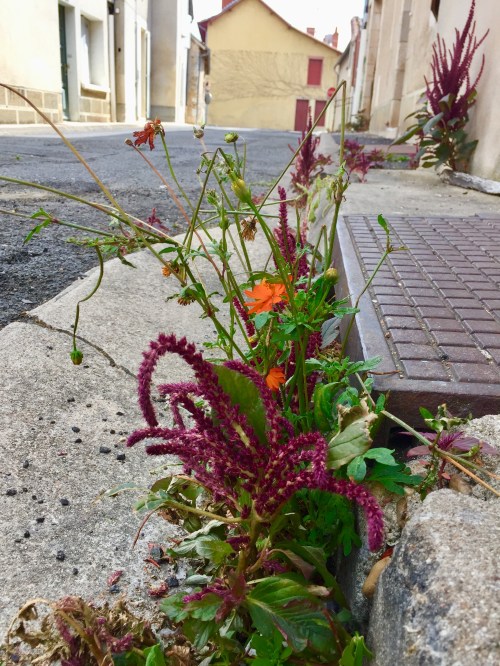
I noticed this little profusion of diversity at the edge of a pavement the other day. Now that I’m reviewing the photo I see really stark contrasts between the natural and the built environments.
On the right hand side here we can see a drain cover cast in heavy iron and imprinted with regular rows and columns of slightly raised boxes. It even looks heavy. It looks rigid. Fixed. You would bet that these covers were produced in a factory. It’s likely that thousands of these almost identical objects were churned out from a production line using a template, or a mould, so that they are as similar as possible. If the factory has “quality control” it’s likely that any which are significantly different from the others will be rejected. The goal is standardisation, efficiency, same-ness.
Human beings are great at this kind of work. We take raw materials from Nature and beat them into the products which we can mass produce. These things are useful. Look at the other useful things human beings have made in this picture. The concrete poured to create kerb stones, drainage paths, and gutters. The tarmac laid and levelled to make roads. The houses built with stone, cement, wood and glass. These are just some of the things which make up our built environment.
But taking centre spot in this image is Life. Bursting out of this manmade environment is a flourishing, a profusion of colour. A tiny, micro-system of flowers. Somehow we know nobody planted them there. Nobody sowed the seeds there. They got there of their own accord, blown in the wind, dropped by animals, carried along by streams of water after a rain. Then they took their chance and growth kicked in. First of all just small green shoots, which grew quickly and diversified. Each developing according to the typical shape of a plant of its species. They look chaotic, disordered, different. You know they haven’t been manufactured.
It doesn’t take long for wild unpredictable nature to make its mark. That’s the essence of Life. That’s the underlying truth of all organisms, including we humans. We grow in unpredictable, diverse ways to create complex communities of Life.
You know, don’t you, that we need all of this. The ability to act on opportunity, the ability to adapt to changing circumstances, the ability to form complex networks of relationships, and the ability to create the environments in which we live.
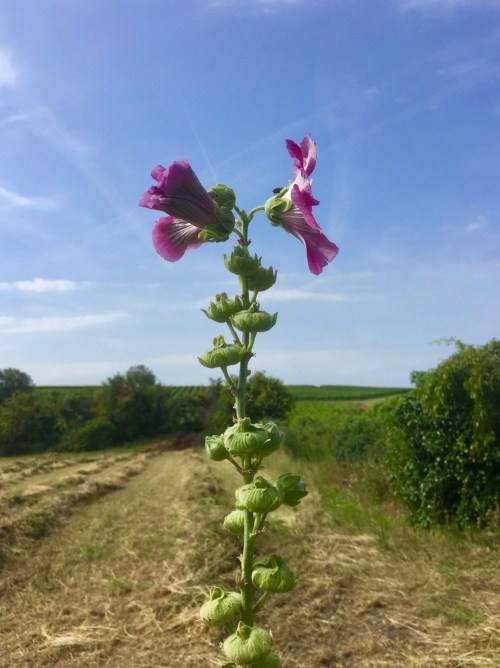
One of the signature plants here in the Charente is the Hollyhock (“rose trémière”). They are astonishing plants which surge upwards of two metres and they produce glorious brightly coloured flowers. It’s not just their rate of growth and their ultimate towering stature which impresses me though.
What really attracts me to them is how surprising they are. You never know, from year to year, just where one is going to grow, you never know which ones are going to grow to the greatest heights and you have no way of knowing just when they are going to produce these fabulous flowers, not only at the tops of their stems, but apparently randomly along the length of each plant.
In a sense, I see them as the local Charentaise version of the Japanese cherry blossoms. In Japan the appearance of the cherry blossom is much anticipated and celebrated. More than their beauty, the blossom is a symbol of transience which inspires people to “savour the day” – because, like the blossom, nothing in life will last. It’s the transience of the cherry blossom which makes it so meaningful.
Well, for me, I equally anticipate the appearance of the hollyhocks and their glorious, towering flowers. I think because each and every one of these amazing plants stands alone, they inspire me to think about transience in a similar way to cherry blossom, but they do something else too. They remind me, every time, of how the future path of any individual life is so unpredictable.
Why should that be something to relish?
The essence of my working life as a generalist medical doctor was to meet with patients one at a time. I’d look forward to every Monday morning because it would be the start of a working week filled with people who would come into my room, sit down, and tell me the most amazing, unique stories.
No two people told the same story.
Understanding a patient’s story is a way of helping them to make sense of what’s happening in their life. It’s also part of what doctors call making a diagnosis. I always saw diagnosis as a level of understanding, not a conclusion, not a label, not a category to place a patient into, not a starting point in a protocol, but the beginning of an understanding.
With that initial understanding would come some sense of the past. In other words it could be the start of making sense of how the present illness had come about, what events and circumstances had contributed to it. But what also came was an opening up of a set of possible/potential futures. Doctors call such an analysis a prognosis. I’d look ahead, taking what knowledge and experience I had of people, of disease, of the typical life history of certain illnesses, and see this unique, particular patient in that context.
Doctors have to be careful when making a prognosis. It’s always only an estimate, an informed expectation. But at the level of the particular, the unique, the individual patient, the path ahead would only be revealed over time.
Remembering that kept reminding me to be humble.
Remembering that kept reminding me that in Life, we never have ALL the information. We always make our understandings and our predictions on the basis of partial, and limited information. There will ALWAYS be more to discover, more to learn, more to learn about everyone.
There’s a fairly new term in biology and philosophy to describe how the future unfolds this way. It’s called “emergence”. Emergence is the development of new patterns, new behaviours, new structures, which could not have been predicted in detail from the prior knowledge. It’s typical of all living organisms.
The individual hollyhock plants remind me of that. They demonstrate this “emergence” beautifully.
Their daily growth astonishes me. Their ultimate size astounds me. Their particular flowers amaze me. I know each seed holds this kind of potential, but I have no way of knowing which particular seed will grow a plant of this actual size, in this particular place in the garden, the driveway, the street, or the roadside.
See, for me, not knowing what lies ahead isn’t primarily a frightening thing. Sure, it’s possible to begin to imagine all the things which can go wrong, to press the fear and panic buttons, but that’s rarely very helpful. Instead, I found, and I still find, I look forward primarily with hope and a positive expectation, and if things don’t turn out that way, I reassess, take stock and consider a different future. It’s a process, not an algorithm leading to an end point. It’s a way of living, deepening and broadening knowledge and understanding at the level of the individual whilst looking forward, with realistic hope, as we interact with, and adapt to, the present.
It’s great to be astonished every day.
I love to be amazed and delighted at the unfolding present. I find it thrilling to witness the future making itself known through this phenomenon of emergence.
Hollyhocks do all that for me. Are there particular plants which are special for you? And why?
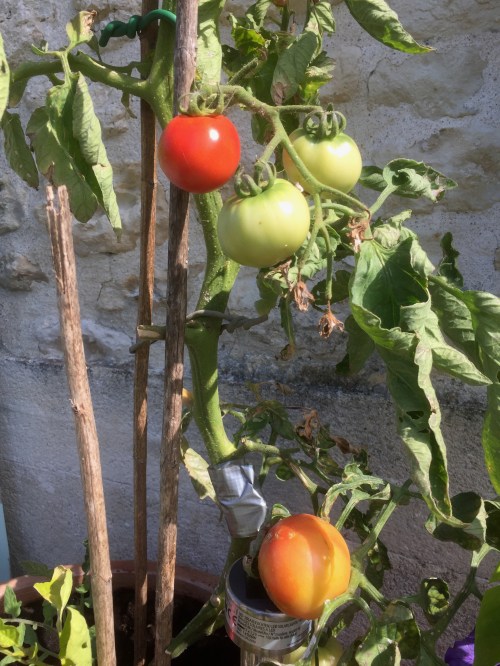
Just over a month ago we had a brief but intense storm which did a bit of damage, including snapping the stem of this tomato plant. Most of the plant was at right angles to its base, but there was a thin sliver of stem still connected. So I got out a rather unorthodox gardening tool – gaffer tape – and taped it up around the break. (Reminded me of putting plasters on broken arms and legs!) And look at it now!
We had the first of the ripe tomatoes the other day and they were delicious.
Now part of me is just amazed at the resilience of plants, but mostly it makes me think about a fundamental characteristic of all living creatures, including human beings.
A new concept in science, and biology, started circulating a couple of decades ago. It goes by the name of “complex adaptive systems“. Basically, this applies to all forms of life because they all have vast interconnected networks of cells and molecules. When you get these vast networks certain characteristics appear, and, in the case of living organisms that includes “self-making capacity”, termed “autopoiesis” by Maturna and Varela. That means the ability to make itself, which encompasses growth, repair and reproduction. I find it a more useful term than the old “homeostasis” used in biology and Medicine, which suggested the maintenance of a stable, internal environment, but didn’t capture the key features of repair, growth and reproduction.
There’s an older term, not used very much in Medicine (I don’t know why), which is the ability to “self-heal”. I think self-healing is just an aspect of autopoiesis.
This is exactly what the story of this tomato plant demonstrates. The capacity of a living organism to heal, to repair, and to grow again – given the right support. And here’s the nub of what I want to say – that’s what we doctors actually do – we support self-healing. At least, that’s what we do when we don’t cause harm!
Yet it’s common to think that doctors can heal, that they can cure diseases. And it’s common for people to believe that drugs do that. They heal. They cure. Except they don’t.
Neither doctors nor drugs heal or cure.
What they do (optimally) is support self-healing. It is ALWAYS the organism which heals itself. There is no healing, no cure, without autopoiesis doing what it does. Which isn’t to say it can always do that all by itself. Nope, it might need help. That help, however, is not a substitute for self-repair and self-healing.
Good treatments can do one of two things – they can nurture the conditions for self-healing, or, they can directly stimulate some aspect of it.
Maybe it would be good to remind ourselves of that. The power of healing lies in the natural functions of the complex adaptive system. I think it’s worthwhile considering that when undertaking any form of treatment. Is this treatment going to nurture the conditions for my self-healing, or harm them? Is it going to directly stimulate some aspect of my self-healing, and, if not, then what is it doing?
Of course, there’s also a lot more to think about than just treatments. What nurtures the conditions for autopoiesis in my life? And what impairs it? That takes us into a whole related area of the environment, of food, movement, relationships, adequate housing and finance……what comes up for you when you start to consider that?
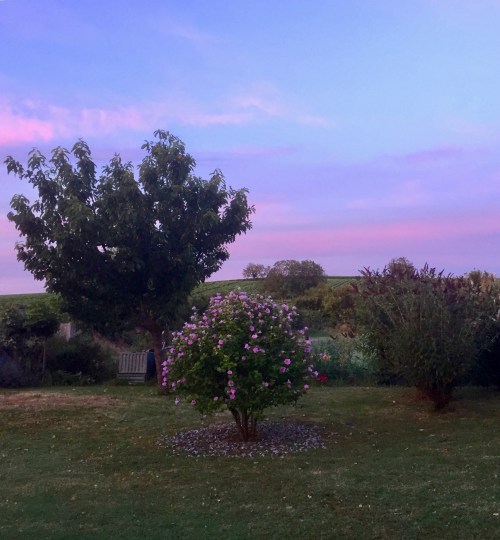
This morning, at dawn, the clouds in the sky turned pink….a pink echoed in the flowers of this bush in the garden.
Pleasing, isn’t it?
It got me thinking about how often we come across this in life…..where there are resonances, where one phenomenon seems so “in tune” with another. When we encounter them I think we stumble across what is Beautiful, Good, and True. It thrills the mind, delights the heart, and enlivens the body.
Think for a moment about how we function, we human beings. There are so many individual cells within our body that nobody can count them. Billions of them. And here’s the amazing thing. They work together all the time. When our body is in a state of good health, all these cells, all our tissues, all our organs and our systems are working in harmony with each other.
Some people say they are “integrated”. What does that mean? I like Dan Siegel‘s definition –
integration is the creation of mutually beneficial bonds between well differentiated parts.
Notice the two elements of that definition.
“Mutually beneficial bonds”. Isn’t this a fundamental fact of life? We exist in relationship. As does every single cell and part of our being. A particular kind of relationship – a mutually beneficial one. We are perhaps the most social of creatures, wired and genetically determined to form bonds with others. If a newborn baby didn’t do that life wouldn’t last very long. We need the loving attention and care of others from the moment of our very first breath.
The second part of the definition is “well differentiated parts”. Uniqueness and diversity are also facts of life. No two cells are fully identical, not when we consider them in their contexts of time and space. We don’t develop healthy hearts and minds by making all the heart cells and brain cells the same. We need them to be different. But we need them to work in harmony with each other. Not in competition with each other.
When we live in harmony with others and with the rest of the planet I suspect we give ourselves the best possible chance of health and thriving. In fact, is this not the origin of “dis-ease”? Where we fall out of harmony with ourselves and our world? Maybe we need more emphasis on resonance and harmony, and less on competition and individualism…..
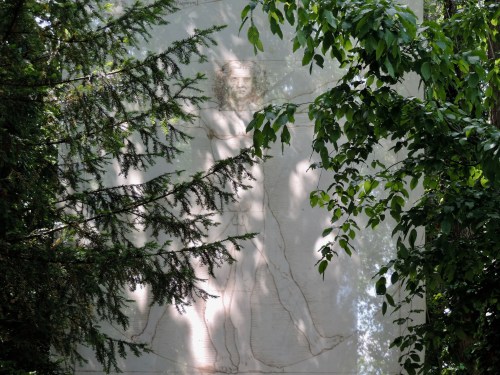
I recently visited the Chateau de Clos Lucé in Amboise, in the Loire valley. This is where Leonardo da Vinci spent the last years of his life. He was invited to live there by François I in 1516. The king provided Leonardo with a place to live, 700 gold ecus a year, and financed his works, in turn for the pleasure of his company and daily discussions with him. Leonardo only lived three more years, dying in 1519, which is why, on this 500th anniversary year of his death, the chateau is hosting a major exhibition of his work. (As an aside I find it fascinating and inspiring that Leonardo was given free range “to dream and work” – what kind of society could we have if we funded creatives and academics to “dream and work” together, without goals, funding applications or publication demands?)
There are a number of Leonardo quotations around the chateau and the gardens. This one caught my eye –
You know that medicines when well used restore health to the sick: they will be well used when the doctor together with his understanding of their nature shall understand also what man is, what life is, and what constitution and health are. Know these well and you will know their opposites; and when this is the case you will know well how to devise a remedy.
After a lifetime career in Medicine, I’m less sure now that medicines do “restore health to the sick”. I think it’s biology which restores health. Human beings are complex adaptive systems, and all such organisms have both “self-healing” and “self-making” capacities. The best medicines stimulate those natural processes of healing. The next best support the processes. Many of the ones we use reduce symptoms, or reverse an imbalance in the body, both of which are reasonable goals and acts, but are they directly involved in restoring health to the sick? Do you think that’s just semantics? I don’t. I’d have a hope for the future that we’d develop the treatments which really do support and stimulate the natural processes of healing, and that’s what Leonardo says, in other language, at the end of that quotation – “when this is the case you will know well how to devise a remedy”.
When what’s the case?
Oh, yes, understand “what man is, what life is, and what constitution and health are”.
Ah! Well, there lies both the problem and the signposts to the solutions…..
A couple of years into my work as a General Practitioner I started to wonder what health is. Nobody taught us what health is at university, and the clinical training of a young doctor focuses on learning diagnostic and therapeutic techniques – identifying pathologies and treating disease states. I went back and looked at my Clinical Medicine textbooks. I searched the index for “health” – no entries. Nope, not one. That set me off on an exploration, looking for an understanding of what health is. The medical school textbooks were no help. Oh yes, there was that old World Health Organisation definition –
“a state of complete physical, mental and social well-being and not merely the absence of disease or infirmity.”
But all that really does is substitute the word “well-being” for “health”. It does suggest health is multidimensional – physical, mental and social – and it does suggest health is something positive, not just the absence of disease or infirmity. But does it really take us much further that irritating “Brexit means Brexit”?
While researching the issue of the absence of health in medical textbooks, I discovered there was a kind of parallel anomaly….biology textbooks didn’t have a definition of life. Really? Well, yes, it wasn’t uncommon to find a biology textbook without the word life appearing in the index.
So what is life?
One of the more satisfying descriptions I read was from Maturana and Varela’s, living organisms demonstrate a “self-making” capacity, which they termed “autopoiesis” and that lead me down the path of the complexity scientists and their definition of “complex adaptive systems”. I still find that a good starting place.
That leaves us with two more areas to explore, according to Leonardo. What is man? and What is a constitution? Remember he was writing 500 years ago, and we would probably now say “What is a human?”, rather than “what is man?”. Let’s leave constitution aside for just now, as it’s pretty embedded in the issues of what is a human and what is health?
What is a human being?
There have been a couple of books published recently which put this question centre stage again. Douglas Rushkoff’s “Team Human“, and Paul Mason’s “Clear Bright Future“. Both of these books are concerned about the impact of technology on human beings and on our societies. Rushkoff says –
being human is a team sport. We cannot be fully human, alone. Anything that brings us together fosters our humanity. Likewise, anything that separates us makes us less human, and less able to exercise our will.
In other words, he focuses on the innate sociability and need to act co-operatively in human beings. I’ve heard Paul Mason say at least two interesting definitions of what is a human – human beings “use energy to counter entropy” – in other words we are a creative species. And human beings are “co-operative, imaginative and linguistic” – the combination of which makes us a unique species.
All of these ideas are interesting to me. And I find it refreshing that these questions are coming to the fore now. Surely this is a timely and positive response to the mechanical, data and statistics driven reductionism which is so utterly de-humanising.
I continue to explore what it means to be human, and I find some of the more impressive answers in the works of philosophers, from the classical schools to Spinoza, Bergson and Deleuze (to name just a few!)
Of course, I could write about this for hours! Ha! Ha! But I’ll stop here and leave the possibility that these are questions you might like to pursue for yourself.
Let me summarise – because I think this is a lifetime project as well as potentially the basis for a whole curriculum –
What is Life?
What is a human being?
What is health?
The answers which appear from those studies could, possibly, give us the remedies of the future – the ones which actually do “restore health to the sick” – and, yes, more than that, allow us to create healthier societies filled with people who fulfil their potentials, creatively, co-operatively, and artistically…..can I even say “spiritually?”
I welcome constructive criticism and suggestions. I will not, however, tolerate abuse, rudeness or negativity, whether it is directed at me or other people. It has no place here. ANYONE making nasty comments will be banned.

 Heroes Not Zombies