Feeds:
Posts
Comments

Archive for the ‘science’ Category

There’s an old ruined tower in the middle of one of the vineyards nearby. The other day there I went inside it, looked up, and took this photo.

My first thought was, wow, what a beautiful blue sky! How perfectly framed!

Then I thought, whoah, wait a minute, this is a metaphor isn’t it?

Because I’ve been thinking a lot recently about how we define who “we” are. I’ve been getting disturbed with all the xenophobic comments flying around the world these days. The people who say they don’t like “foreigners” and want them “to go back to their own countries”, or want to “close the borders” to protect “us” from “them”.

See, there’s at least two questions there. There’s how shall we live together? And who is included in that classification “we”?

Imagine you live in that tower. How big does your world appear? Where are your boundaries, your walls? If “we” are the people inside these walls, then “they” are the ones who live outside.

And don’t we all set our walls?

Don’t each of us feel similar to certain others, and maybe even connected to certain others, or maybe even in relationship with certain others?

Are those just the people who live in the same house as us?

Or those in the same street, the same town, or city, or nation state?

Or do we set the walls around those who are similar to us in some other way? Same sex, same religion, same ethnic group, born in the same nation state?

Isn’t the kind of world do we create for ourselves at least partly down to where we set those walls? How narrow we create our perspective? Or how wide?
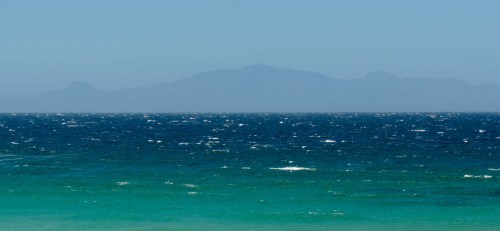
How do you feel when you broaden your perspective? When you can see further, see wider, see deeper even?

I don’t know about you but I feel I breathe more easily. I feel my body, my mind, my soul, is nourished by the broader, more expansive view.

Let’s take this a wee step further and look at the famous “earthrise” image.
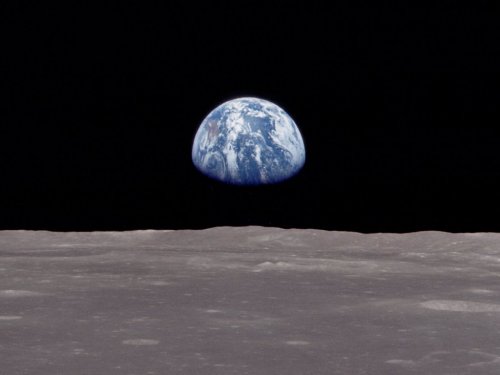
The earth rising over the horizon of the moon.

What if we think of “we” as being all of us who live on that beautiful, small, blue, white and green planet?

Because we do.

Every single atom in your body has previously been shared with other people, or other animals, or other plants, or other rocks or gases in this one small planet.

Every breath you take, draws in molecules from the same atmosphere as every other living, breathing form of life.

Every breath you breathe out contributes to that very same atmosphere.

We all share the same air.

We all share the same water.

We all share the same sunlight.

Don’t we all share the same earth?

Why divide it artificially into boxes? Little boxes marked “my country”, “my race”, “my family”, “my religion”?

If we are going to divide this planet up into these little boxes, then we still have to answer the question of how we can best live together – box to box. From within my walls, to you, within yours.

Here’s two short videos which changed my perspective on these questions…..
 

Read Full Post »

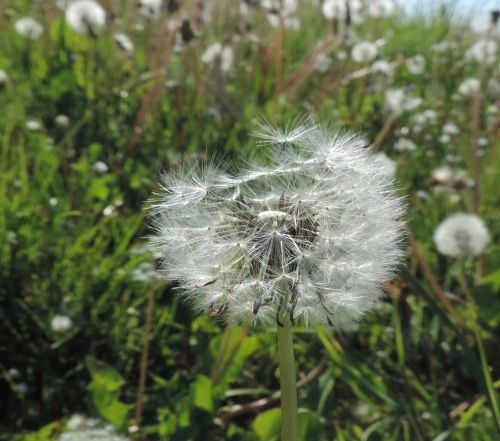
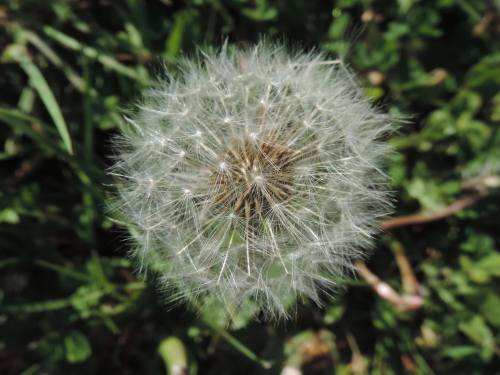
Common sense would tell you the world is made of things. We are objects surrounded by other objects. The left hemisphere of the brain is great at narrowing our focus so we can separate some of what we are looking at from its environment, and its connections. So I can stumble across this beautiful dandelion seed-head and focus the lens of my camera right onto “it”. Isn’t “it” gorgeous?

But then and object, or a thing, needs to have some kind of consistency for us to see it. I mean, look what happens a second or two later, when the wind blows –

It’s changed already! And why did it change? Because something happened. Some of the seeds blew away when the wind blew. So if I want to understand this “thing”, this “dandelion” that I’m looking at, I need to see more than what the first image can show me. I need to know that these plants we call dandelions have evolved a method of multiplying and thriving – they have created these astonishing little means of dispersal of their offspring, of their seeds. So when the wind blows, as it always does, these children of the parent plant will fly away to land somewhere else, maybe far away, maybe close by –

and then the cycle starts again with each seed germinating, pushing its roots down into the dark earth, and it’s leaves and flower up to reach the sun, and the bees and the butterflies and who knows how many other kinds of insects will come along and spread the pollen in the yellow flowers to fertilise them and produce these magnificent seed-heads again.

So this is what this object, this thing, called the dandelion does. And it’s hard to know to where to begin its story, but maybe we begin by following one single seed, blown on the wind. We don’t know which way the wind will blow, how far the seed will travel, whether or not the ground it lands on will enable it to germinate and whether or not it will be able to successfully grow into a green leafed, deep rooted, yellow flower and whether or not the insects will cross pollinate it with its neighbours, whether near or far, and produce seeds of its own.

So many unknowns.

But also, and here’s the point, so many happenings.

So many events.

So many occurrences.

This object, this thing, which we call a dandelion. Is it really reasonable to think of it as a thing? Or is it more useful to consider it as so many happenings.

That’s the point I heard the physicist, Carlo Rovelli, make in his interview with Krista Tippett, in an OnBeing podcast. Have a listen. He puts it more beautifully than I do. He says the universe isn’t made of stones, its made of kisses. (Not things, but happenings)

Read Full Post »

We have a large mulberry tree growing in the middle of the garden. It’s huge leaves make a perfect canopy to shade you from the glare of the summer sun.

In the autumn they fall massively giving me ample opportunity to enjoy a bit of “rake-y” – the meditative experience of raking up the fallen leaves. I find that deeply satisfying!

In the winter time the tree is bare, all branches and twigs but its shape against the moon at night is entrancing.

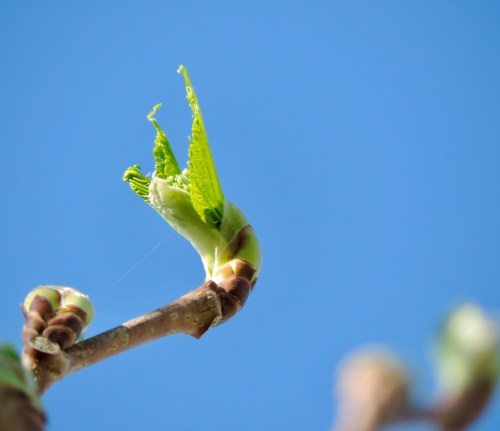
Now in the Spring the new leaves are starting to grow. The first of them began to emerge last week. Look at this one! I could have picked one of several dozen like this but I stopped to photograph this one.

It astonishes me.

Out of the end of this stick of a twig first a swelling green bud appears, then these leaves start to unfold themselves. Really they are so tiny compared to how they will look when fully grown. The biggest leaves will be larger than your hand. But for now, this emerging leaf is so small it’s only just begun to acquire the recognisable shape of a leaf.

Look at the colour of it in the sunshine! That light, bright green, somehow just shouts “I’m alive!”

As I looked at it I remembered the time Richard Feynman asked the question “Where do trees come from?” and shocked the listener by answering “They come from the air”. Here’s an article which includes the video of him talking about this very subject. He says most people would answer “They come from the soil” but he says it is more correct to say they come from the air, because they are made mainly of carbon which they capture from carbon dioxide which is in the air, and from water which comes directly from the sky as rain, or through the soil after it’s fallen from the sky.

Isn’t that an astonishing thought? We humans certainly can’t do that. We can’t make solid massive forms like trees out of the thin air.


Read Full Post »

I was eating some berries at lunch time – strawberries, raspberries and blueberries.

Stopping to take a closer look…….look at the shape of a star on this blueberry.

Well, it turns out this is pretty standard. All blueberries have this element of their appearance.

Have you noticed that before?

Have you seen that little star there before you pop the berry into your mouth?

Noticing is one of the lessons I’ve learned yet again from this little ordinary, everyday experience, but there’s something else here.

That something else for me is a reminder that we are “all made of star stuff”. From the origins of the universe, the time of the energies before the formation of hydrogen and helium, to the evolution of stars, those great powerhouses of fusion producing the first larger elements, magnesium, lithium, carbon….all the way up the Periodic Table to Iron….to the next great leap – the supernovae. As the supernovae exploded they produced all the other known elements of the universe.

From our Sun, to our Solar System, to our precious, tiny Earth, all emerged from these first elements. That carbon, that oxygen, that hydrogen, all the elements you might find in one little blueberry….it all came from the stars.

As best we know, from the beginning of our planet Earth, not a single new natural element has appeared. All of us, from blueberries, to you and me, are made from those original atoms, created by aeons of fusion and fission, of cycles of combining together, and cycles of blowing apart.

Takes my breath away….

And you know what? The blueberries taste great. I enjoyed combining their star stuff into mine…….

Read Full Post »

Last November I was invited to address the Faculty of Homeopathy at their Congress in Belfast. I prepared a talk entitled “Images of Health. Pictures and stories” based around some of my own photographs and covering the key principles of health which guided me through my career as a doctor.

Here’s the video of that talk. I hope you enjoy it, find it interesting, or even inspiring. (by the way, if Google pops up any ads along the bottom of the video, just click the “x” box to make them go away 😉 )

I wrote a book to accompany this talk. It’s called “Escape to Reality” and I’ve published it (so far) only as a Kindle e-book. You can find it on Amazon.


//ws-eu.amazon-adsystem.com/widgets/q?ServiceVersion=20070822&OneJS=1&Operation=GetAdHtml&MarketPlace=GB&source=ac&ref=tf_til&ad_type=product_link&tracking_id=leckridgecom-21&marketplace=amazon&region=GB&placement=B01LZE4UVL&asins=B01LZE4UVL&linkId=&show_border=true&link_opens_in_new_window=true

Read Full Post »

Do you ever look outside and see a grey sky and rain and think, shame, “it’s not a nice day”? I do.

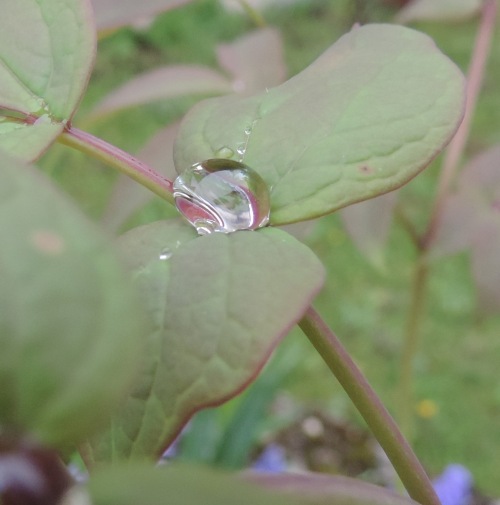
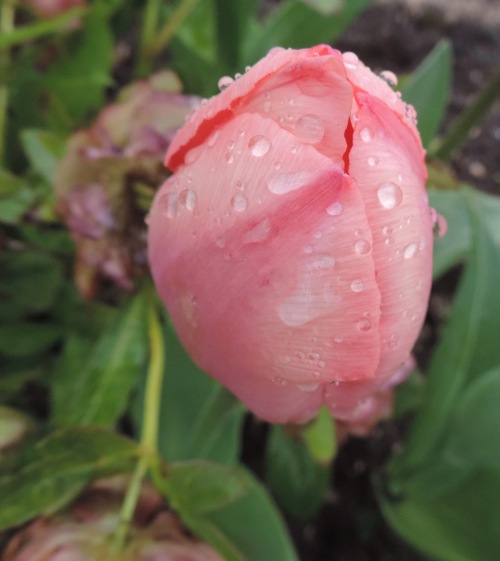
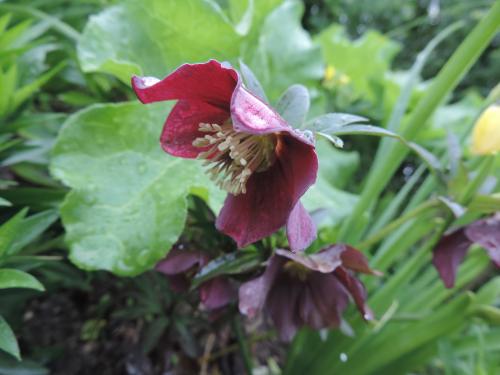
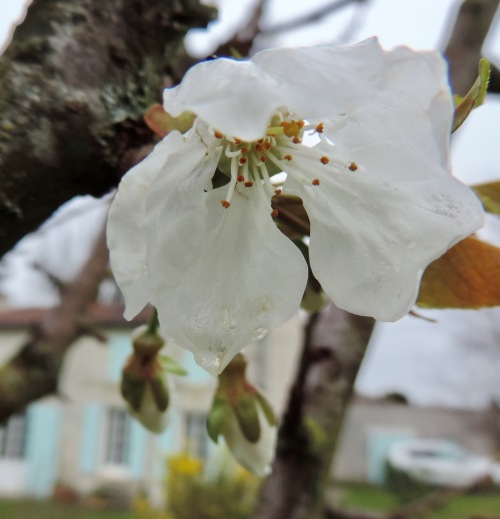
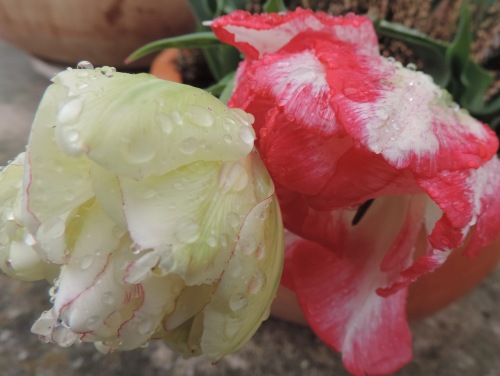
But the other day when I caught myself saying that I thought, hang on, when the rain falls on the flowers it makes them extra specially beautiful, I think I’ll go out and take some photos.

Here are some of my favourite ones.

I think the rain magnifies their beauty, not making them similar in any way, but highlighting how unique each and every one is.

I also love the image of the single rain drop. It’s like a jewel. I’m never finished finding water extraordinarily wonderful. And, in a certain sense, water is never finished finding us extraordinarily wonderful either, is it?

Here’s to the sparkling beauty of uniqueness.

Here’s to the magic of water.

Read Full Post »

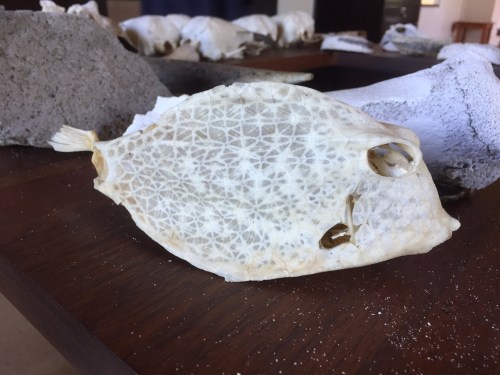
Look at the skeleton of this beautiful fish. The intricate and delicate structure of the bones is a stunning demonstration of the nature of networks. We can see the whole skeleton is made up from two simple elements, nodes and connectors. Whether we zoom in to study just one group, or out to look at the larger regions we see a variety of different patterns based on these two simple elements.

If you start at any point on this skeleton you’ll be able to trace a path to any other point without ending up down some disconnected cul de sac. In other words every single point is connected to every other one….either in simple one or two step connections, or through an almost infinite variety of pathways across the whole structure.

This is one of the most fundamental patterns at the heart of reality – networks of nodes and connectors.

You can see the same design in all forms of life, especially in multicellular organisms, all kinds of plants, animals and human beings.

Networks of nodes and connectors are the essential fabric of the universe.

Two of the best books I know about this phenomenon are Linked by Barabasi, and Connected by Nicholas Christakis and James Fowler. I recommend them both. They show how this apparently simple structure builds up into the most complex of phenomena, from individual organisms, to social groups and whole ecosystems.

Once you see things this way you can’t help but see connections everywhere. It’s the science which demonstrates the limitations of reductionism and abolishes the notion of atomisation.

Read Full Post »

tree-vine-fog

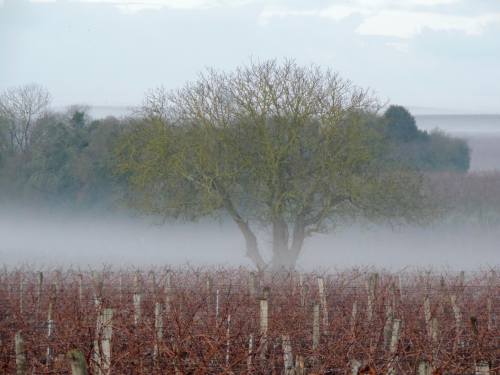
As I was opening the shutters yesterday morning I caught sight of some swirls of mist lying amongst the vines towards the next village. I took a few photos. Here’s one of my favourite ones. It pleases me. Enormously. There’s an entrancing beauty to it. And it’s one of those photos which stimulates all kinds of thoughts for me.

I look at this and I think of two of the fundamental forces of the universe – the ones which Thomas Berry called “wildness” and “discipline”. The large tree in the centre of the image grows wild. It grows naturally and it spreads out above and below ground creating this ever branching structure which looks like its reaching out to the world. It looks like it’s stretching upwards and outwards to feel the sky and the moist air. In front of it are rows and rows of vines, trained and pruned by human hand, disciplined to grow along the wires. The vines form a complex web of life. As I look at them now it’s hard to discern where one plant stops and the next one begins.

When I think of these two forces, I think of the two hemispheres of the brain, each with its distinctive style of engaging with the world. The right hemisphere exploring, seeking the new, making connections. The left hemisphere exploiting, grasping, structuring. Iain McGilchrist writes in “The Divided Brain“, that the right hemisphere characteristically seeks to care, it seeks to engage with “the other” empathically. The left hemisphere seeks to control, seeking to deal with “the other” by categorising, labelling and separating.

How we see these forces at work in the world today!


Read Full Post »

red-veg

Peter Brabeck-Letmathe, the outgoing chairman of Nestlé’s intention is for Nestlé to develop food scientifically – synthetic food which will be better than “natural food”. He rejects the notion that food grown in the ground is best for us. He says

Nature is not good to human beings. Nature would kill human beings. The reason why homo sapiens have become what we are is because we learned to overcome nature.

What do you think when you read this?

Is “Nature not good to human beings”? Does Nature seek to “kill human beings”?

I was pretty astonished at this claim because I think human beings are part of Nature, not something outside of “it”. If we want to learn what’s good for us my own feeling is that we should look to the rest of Nature. As Idriss Aberkane says of “biomimicry”, Nature is a library, a source of knowledge, not a source of repository of fuel to burn.

So where does this idea that Nature is trying to kill us come from?

Well, as chance would have it I read an interview with the French philosopher, Michel Onfray, at the weekend, and he mentioned the definition of life given by Bichat, the physiologist

Life is the sum of the forces which resist death

That’s an interesting definition of life – life is resistance. Is death constantly attacking life? I think that’s a pretty miserable and negative understanding of life. But I think it might come from the notion of entropy. You know about entropy? Entropy is “the gradual decline into disorder”. The second law of thermodynamics states “entropy always increases over time”. You can probably see how this observation can lead you to think that we are only alive as long as we resist death, disorder, and decline. But is that enough to lead you to conclude that Nature is trying to kill us?

It seems to me that this entropic force in the universe is only one of the major forces at play. What Thomas Berry referred to as “wildness” is another way of thinking about this force. It’s the chaotic force. If this was all there was, or if this was the dominant force, what would the universe look like? Would there be stars? Would there be galaxies of stars moving together? Would stars have planets? Would there be any complex living organisms? How could there be? There is a second force. One Thomas Berry calls “discipline”. It’s the ordering principle, the structuring principle, which contains, limits and holds together. But what if that was the only force in the universe? What would the universe look like then? Would it be any more than a dense ball of energy? Would it be expanding? Would it show diversity? Or would whatever existed by “more of the same”?

I think there is a third force at work in this universe, because it seems to me, without it, there is a tendency for the first two forces to cancel each other out, or for there to be a significant tendency towards either chaos or uniformity.

That third force is creativity. The creative force is a force of integration – it integrates the two forces of wildness and discipline to produce astonishing levels of complexity. Look at the history of the universe. Is it a history of endless decline and degeneration, or one of stasis and constriction? Or is it a story of ever increasing complexity and diversity?

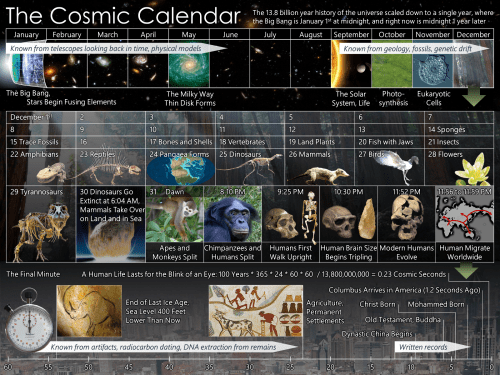
It’s this latter, isn’t it? The universe is on a course of increasing complexity. We humans, with our bodies, our brains and our consciousness, are the most complex phenomena the universe has produced so far. But we haven’t been about for very long.

cosmic_calendar

(the cosmic calendar)

The universe is on a course of increasing diversity. Not just the rich diversity of species and life forms on planet Earth, but in the diversity of unique human beings. Not one of us ever repeated. No single experience of a whole life ever duplicated.

So is Nature a threat to us? Or is Nature a manifestation of the creative force of the universe?

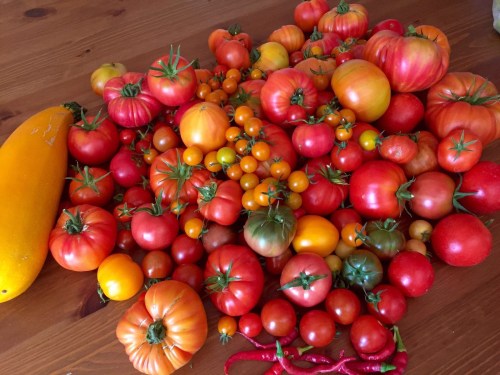
I’m opting for the latter view. And I’m going to continue to enjoy the fruits of that rich creative diversity, just like you see in my photo at the start of this post. I won’t be swapping “real food” for synthesised, chemically “enhanced” stuff any time soon!

Read Full Post »

twelve-project-day-seven

Day seven of the twelve images over twelve days, one photo from each of the months in 2016 – Happy New Year to you, by the way (I’m writing this on the 1st of January 2017)

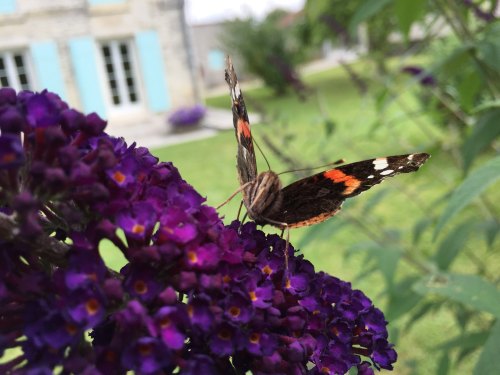
We have a number of buddleia bushes in our garden. Most of them produce these amazing purple flowers (one produces white flowers) which butterflies and hummingbird moths just love. I like to sit close to these bushes where I am surrounded by dozens of these beautiful creatures. The wings of the hummingbird moths are so fast that they emit a deep buzzing sound so you know when they are around, but the butterflies are completely silent.

I can watch them for ages. I love to see them up close like in this photo. You can see them delicately slipping a long proboscis into the centre of each little flower. They are so quick and so accurate. And of course their wings are painted so gloriously.

The butterflies stimulate two trains of thought for me – unpredictability and change.

I’ve tried to see if they work around a bush in any kind of methodical way but I can’t see that they do. Every move seems totally random. They’ll be selecting one little flower after another to explore, then suddenly they fly off into the air, zigzagging around, up, down, left and right, then might settle again on the exact same flower they had just left, check out a different part of the bush or fly off to a neighbouring bush. There’s just no telling where they are going to go next. Their whole movement seems to embody randomness. It’s quite something.

Then if you stop to think about how the butterfly you can see is only one stage in a cycle of astonishingly different forms you realise very quickly why they are the symbols of metamorphosis and change. From egg, to larvae (caterpillar), to pupae (chrysalis) and the beautifully winged creature. A life of the most incredible phases and changes. As far as I know nobody has managed to explain how this cycle of change came about. We change throughout our whole lives, and our bodies change a lot, but not as much as these butterflies. Maybe our most astonishing changes are on the inside – our psyche and and our spirit?

Then when I get thinking about these butterflies and wonder where they go when the buddleia are not in bloom I find that many of them are migratory, traveling between Africa and Europe, cycling back and forth between very specific locations. How do they do that? How do they find their way over hundreds, no thousands, of miles? But wait, it’s even more amazing, because for some of them the journey is long it takes several generations of them to complete it. Now how do they do that? How does the great great grandchild of the butterfly which left my garden find its way back to my garden when its parents and grandparents had never ever lived here?

So, here’s what the butterfly in this photo is the symbol of for me – curiosity and the unfathomable depths of our human lack of knowledge and understanding?

So much to learn, so much to discover, so much to understand.


Read Full Post »

« Newer Posts - Older Posts »