Feeds:
Posts
Comments

Archive for the ‘science’ Category

twelve-project-day-three

Day Three of the Twelve project – 12 images, one for each month of 2016, used to create 12 posts, one each day for the 12 days of Christmas.

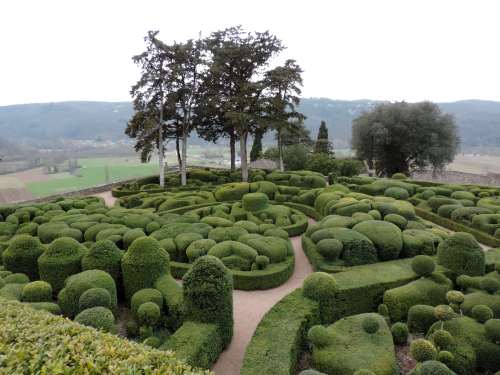
In March 2016, I visited Marqueyssac gardens in the Dordogne. This wonderful place has several, vastly different areas, from woodland scattered with art works, to winding rocky paths on the edge of a cliff, to this astonishing area of topiary.

I’ve seen lots of topiary elsewhere but usually its the odd bush shaped like an animal, or a small planting of bushes shaped into pyramids or spheres, but here…..well, for a start there are more shaped bushes here in one space than I’ve ever seen before, and, more interestingly, they retain a fundamentally organic form. They don’t just look like bushes fashioned to appear like something else. They retain the diversity you usually associate with Nature. The way they grow together also gives a strong impression of a community, or, from a little further back, a whole organism.

This was my inspiration this year for my writing about the two universal forces – whether we think of them as the forces of chaos and order, of wildness and discipline, or of flow and structure, we find them at work everywhere. And here, in Marqueyssac we see how something utterly entrancing emerges when we get a true integration of these two forces.

This has been such a year of divisions. Dualistic, or binary, thinking seems to be on the rise – you have to choose sides. One is good, the other is bad. You can choose science or art, reason or emotions, right wing or left wing….and so on. When we do that with the fundamental forces we end up emphasising order and control at the expense of freedom and wildness, or we choose structure over flexibility, but actually, in the universe, the greatest beauty, and the release of the greatest potential comes when we aren’t forced to choose one at the expense of the other.

I think the clearest way to think about integration is to consider the relationship between our heart and our lungs. They are completely different organs, grown from distinctly different (“well differentiated”) cells. The heart works best as a heart, and the lungs work best as lungs. Neither would do so well if our body chose between them and supported only the heart, or only the lungs. Turns out that the heart can’t be at its best without the lungs, and the lungs can’t be at their best without the heart. They work together for their own, and for each other’s mutual benefit.

That’s the definition of integration which I like best – the creation of mutually beneficial bonds between well differentiated parts.

And that’s what I see when I look at Marqueyssac gardens – discipline and wildness, structure and chaos, beautifully integrated.

Even without any of these thoughts, these gardens would have been wonderful to visit. Take your time. I spent about three or four hours there and could probably have spent longer (if I’d started earlier!) What an experience! It stays with me, not simply as a memory, but as an inspiration, a series of images, a stimulus to my imagination and my thought.

Places like these are the special places on the Earth – they act as our muses. They lift our spirits, and reach deep down into our souls.
 

Read Full Post »

pink-and-green

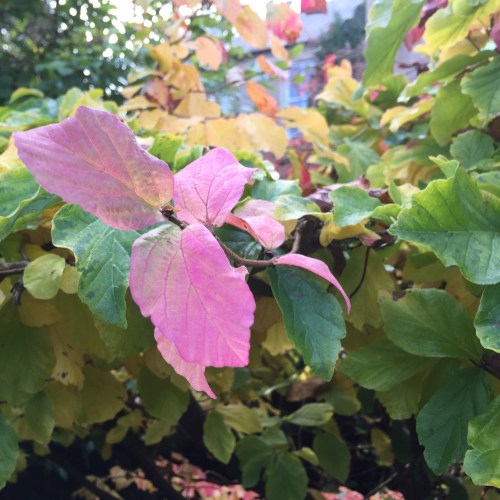
Of all the hundreds of trees and thousands of leaves I saw on my walk the other day, why did I stop and photograph this particular group?

It was difference which caught my eye. The striking pink of these leaves amongst the abundance of green ones stopped me in my tracks.

I love diversity. I find it beautiful.

Everywhere I look I see uniqueness. Every patient who walked through my consulting room door was different. Every one brought a brand new, unique story to tell me. And next time, when they would return, they, too would be different, because all of us change all of the time.

Mary Oliver begins her new collection of essays, “Upstream” with

One tree is like another tree, but not too much. One tulip is like another tulip, but not altogether. More or less like people – a general outline, then the stunning individual strokes.

Nature loves diversity. Mono-cultures are more vulnerable, less resilient. By making new connections between diverse, well-differentiated individuals, the processes of integration create novelty and stimulates growth.

So I hope this current wave of division and hatred of “the other” which we are witnessing in the world today will diminish.

I hope the current wave of homogenisation which characterises globalisation will be countered by millions of us reclaiming, not just our individual uniqueness, but the beauty and value which we find in diversity.

We need to find a better way to live together than the creation of binary divisions and calls to exclude, remove or eliminate “the other”.


Read Full Post »

no-straight-lines

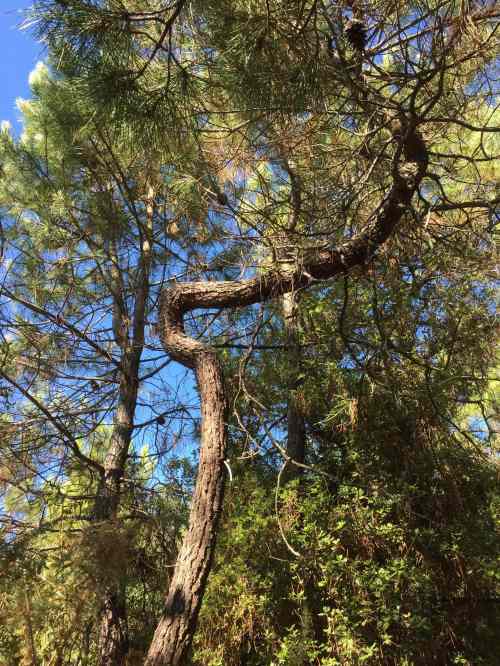
Look at the shape of this tree!

It heads up from the ground, reaching for the sky just as pretty much all trees do, then suddenly it’s taken and almost ninety degree swerve to the left, but not for long, because then it turns abruptly upwards again, only a little later to take another almost ninety degree turn to the right, after which is takes a much more relaxed ascent, bending slowly upwards.

It caught my eye.

It caught my eye because it was so unusual, so striking, and so unique. None of the other trees around it had shapes or trajectories even remotely like this one.

So what happened? What’s the explanation for the particular shape of this tree’s life?

I realise that’s a question which lay at the basis of my consultation with patients. An individual’s life story has a distinct and unique shape. Are there any explanations for that shape? Which life events made the biggest impact? What kind of impact did they make and, crucially, how did the person respond to those events?

But even without the context of illness, I think life is like this for all of us. We are gaily living in one particular way when, bam! someone happens, there’s a change, an event, and life continues afterwards but in a completely different direction.

What shape is your life story? What changes of direction has it taken and why?

I love how no two life shapes are the same, because no two lives are the same.

And there’s something else to consider when gazing at this tree…..you couldn’t predict it. If you were taken to the forest and shown a seedling, you couldn’t draw the exact shape it will manifest as it grows. DNA analysis isn’t going to give you your answer. Generalising to say most trees of this type will grow this particular way isn’t going to give you an accurate answer.

Every single life is unique, and the shape of every life emerges in the living it.

Read Full Post »

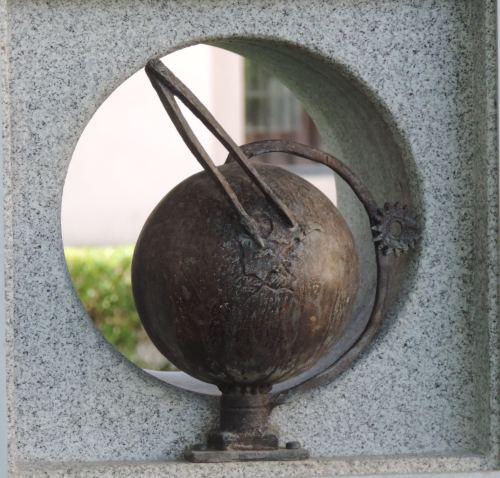
dscn7600

Barrie Condon, a retired Professor of Physics, generously shared his new book, “Science for Heretics” with me. He thought I’d like it. He was right. The subtitle of the book is “Why so much of science is wrong” and his aim is to provoke the reader into questioning both the claims of science and its methods. He uses the device of three characters, The Believer, The Sceptic and The Heretic, throughout the book as he considers several fields of science including mathematics, physics, and medicine.

The Believer is one who science reveals the Truth and will one day enable us to understand everything in the universe. The Sceptic accepts the basic tenets of science but retains some doubts about whether of not we will ever be able to understand everything. The Heretic doesn’t buy the whole project. He thinks the universe is not completely knowable and that our scientific theories which shape our views what we see are simply the projections of our human brains.

He particularly attacks the use of theory in science which tends to be translated into “laws”. He clarifies that no such “laws” exist and sets out the case for a return to observation and experimentation instead. I really enjoy his writing style and some passages particularly stood out for me.

For centuries we have been measuring all sorts of things but generally only recording the results we expected and ignoring the rest.

This captures two of my main objections to so much of medical practice – the reduction of human beings to measurements and the belief that the particular measurements which are made allow us to completely understand a patient and their illness. Although I have heard of a medical teacher say “Don’t listen to patients. They lie all the time. You can only trust the results.”, my own experience of doctoring couldn’t more diametrically opposed from that view. ONLY the patient’s experience can be trusted. Measurements, sadly, frequently mislead, and ALWAYS need to be set in the context of this individual patient.

Life saving claims for medicines need careful examination. Drugs do certain things which are beneficial to the human body in disease, but they inevitably have other effects which can be deleterious or even fatal.

I wish more doctors made that more clear every time they write out a prescription.

He’s even better on physics and cosmology.

For me, the two most important things he has to say are, firstly –

Science gives us theories that purport to explain how the universe works. This breeds confidence in scientists who then go on to do things that carry certain risks. These risks are rationalised away on the basis of existing theory. Even if our Heretic is wrong in saying that all theory is actually erroneous, history shows us that most or perhaps all theories ultimately prove incorrect. Our perceptions and calculations of risk are therefore also likely to be erroneous. Science generally also assumes a high degree of control over experimental conditions and again this faith seems misplaced. While we may routinely underestimate risk, we also routinely overestimate our ability to control it.

This is SUCH an important point. He’s arguing for a greater use of the “precautionary principle”. Instead of assuming that everything we produce, all our chemicals, all our technologies are safe until proven otherwise, we should be more wary. What we need is a whole lot more humility and the ability to confess that we really don’t know very much at all. And we certainly way overestimate our ability to control things. It’s the arrogance of believers which frightens me most – people who are so sure that they, and only they are right – I’m on the side of the Heretics in Barrie’s terms. It’s likely that what we think we know at any point will be proven not to be quite right in a few years time (or, indeed, to be completely wrong).

The second important conclusion he reaches is that there are no fundamental laws of the universe…..apart from, maybe, two –

As well as a possible law for uniqueness, the Heretic is open to the possibility of a second law governing complexity, namely that it increases with time.

Well, there he puts his finger on what I’ve written about many times on this blog – that the most important characteristics of the universe are its tendency to create uniqueness and its trend of ever increasing complexity.

Take those two undeniable features on board and try and practice science or medicine by measuring, generalising and trying to control the future! Good luck with that.

Thank you, Barrie Condon, for your delightful, humorous, thought-provoking, paradigm-challenging book. If it was an integral part of science education we might be able to look forward to a better world.

Read Full Post »

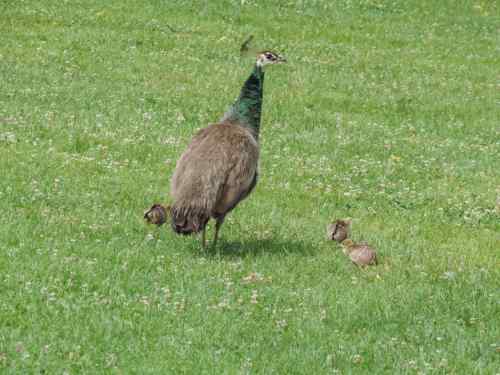
cygnet

peachicks

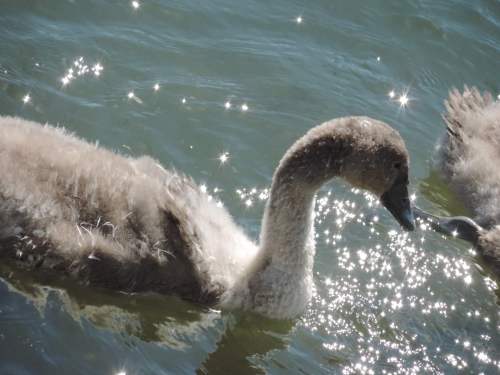
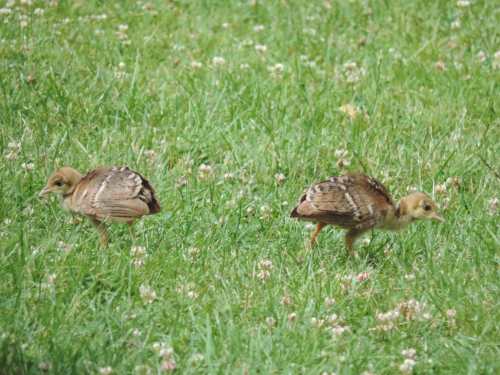
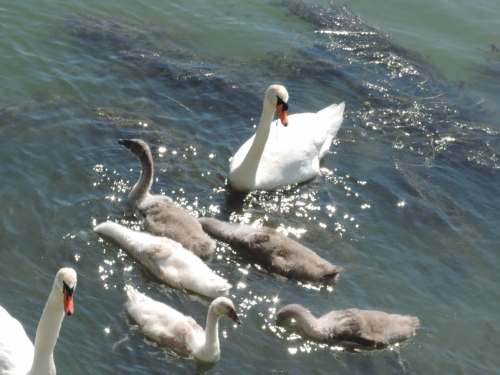
On a recent trip to the nearby town of Saintes, I chanced across two little families.

Do you know what these particular chicks are going to look like when they grow up?

We are all dealt a certain hand when we are born, a particular and unique pattern of DNA. Our personal pattern shares a lot with others of course. All we humans have distinct DNA patterns that distinguish us from other animals. The surprise really is how shared the common patterns are. Some patterns are the same in humans, chimps, fruit flies and earthworms. Fruit flies and earthworms? I’m not too astonished about the similarities between humans and chimps (over 95% similar genome apparently), but fruit flies and earthworms? Who’d have thought it?

But there’s more to how we begin than our DNA code. From the very first moments of life we begin to develop differently. We humans have fingerprints for example, and there are no two identical sets of fingerprints in the world – ever. We have unique patterns all over our bodies, not just in our fingertips. Our eyes, for example, are also very distinctly different. We’re all becoming a lot more familiar with that uniqueness as we use our fingers to gain access to our mobile phones, or our irises and fingers to gain access to particular rooms, buildings, or even countries.

Babies develop distinctly different patterns of behaviour from their very first hours in this world. If you are a parent of more than one child you’ve probably wondered many times how can your children be SO different when they both came from the exact same parents, and grew up int he exact same family?

It’s so, so difficult to know what a little one is going to become. We can’t know what events will occur in their lives. We can’t know how their personalities will develop, what coping strategies they will acquire, what choices they will make.

But all of that is ok. It’s the nature of life. It unfolds. Little ones grow, change and develop every single day. And when I say little ones, I don’t just mean little human children. We see the same, albeit over shorter timescales, when we watch chicks grow into adult birds, or seeds grow into flowers, vegetables or trees. We see it everywhere.

I’m sure at some point you’ve chanced across an old photograph of yourself, your parents, or your children and you recognise them. Instantly. But oh how they’ve changed! Oh, how I have changed! And isn’t that second insight often quickly followed by “but I still feel the same me” (or some variation of that).

What’s the best thing we can do for the little ones?

Nurture them.

Love them in their developing uniqueness, knowing that from those very first days they are already different from us, and it’s our job to help them on the way to becoming all they can be.

If you’re still not sure what those chicks at the start of this post are going to turn out to be like when they grow up – here’s a couple of hints –

swan family

peacock family

Your children are not your children.
They are the sons and daughters of Life’s longing for itself.
They come through you but not from you,
And though they are with you yet they belong not to you.

You may give them your love but not your thoughts,
For they have their own thoughts.
You may house their bodies but not their souls,
For their souls dwell in the house of tomorrow,
which you cannot visit, not even in your dreams.
You may strive to be like them,
but seek not to make them like you.
For life goes not backward nor tarries with yesterday.

You are the bows from which your children
as living arrows are sent forth.
The archer sees the mark upon the path of the infinite,
and He bends you with His might
that His arrows may go swift and far.
Let your bending in the archer’s hand be for gladness;
For even as He loves the arrow that flies,
so He loves also the bow that is stable.

Kahlil Gibran (On Children. From “The Prophet”)

Read Full Post »

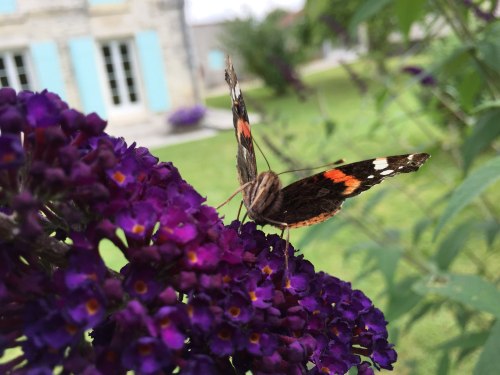
butterfly

I was sitting in the garden yesterday next to some buddleia bushes which are very, very popular with the butterflies. I watched a few of fly around, then took this one’s photo when he landed on the blossom near me.

Isn’t this creature both beautiful and astonishing? The colours and patterns on its’ wings, its’ delicate antennae, the long proboscis probing deep down into each little flower to gather up nectar? Have you watched a butterfly flying and feeding like this? Its’ movements seem completely random. It doesn’t start on one flower then move outwards or around in some obvious pattern. It will select this flower, then that one over there, then that one next to it, then it flies up into the air and lands on a completely different part of the bush, only to reappear again on the original flower a few moments later.

We can’t predict exactly which direction a butterfly is going to fly next.

Butterflies are almost a symbol of unpredictability. The apparent randomness of their flight is one of their key characteristics. When scientists discovered that everything on Earth was actually connected, they picked the butterfly as an example to explain how small changes lead to large, unpredictable ones. “The butterfly effect” poetically describes how the flapping of a butterfly wing in one part of the world can change the air movement there, which sets off a cascade of interconnected changes, leading to a hurricane in another part of the world.

Small changes that we make can lead to huge changes down the line. That always makes me think two things – first that if I want to bring about a big change, the way to do it is to keep making small changes. In other words, the choices and actions I make in my daily life, are the best, indeed maybe the only, way to bring about the changes in the world I want to see. The second thing is there are no guarantees. Despite the claims of some to know that if we do this or that, then the outcome will be exactly this other thing, that’s just not true. It’s better to stay humble and realise that not only is there much I don’t know, but I have no way of knowing exactly how things are going to turn out. Some people find that frustrating, but I think it’s empowering. It means I need to make my choices and actions on the basis of my values, not on the basis of control. I can’t control the future. But I can sure choose to act in loving ways. I can sure choose to act in “integrative” ways, building healthy, mutually beneficial bonds between me and the others (the well differentiated parts). I can choose to create. I can choose to increase diversity. I can choose to tolerate. I don’t need to be in control of the future.

Butterflies are magnificent examples of change. They go through four utterly different, distinct phases of life – egg, caterpillar, chrysalis, then winged insect. The four phases are so different that some people still think a butterfly is more than one creature. No wonder they are the symbol of change and metamorphosis.

All of life is change.

We are all in a continual process of becoming. It’s a characteristic of life – emergence – an unfolding, a developing, a creative changing reality.

Butterflies are also great examples of connectedness. I see that two ways. First of all, the day the buddleia bushes in my garden began to bloom the butterflies appeared. The more the blossom, the more the butterflies. You could almost think both the blossom and the butterflies emerge from the same source. They are certainly intimately connected. Mysteriously connected.

Secondly, some butterflies, like some birds, are migratory. They spend some part of their lives in one part of the world, and some in others. For the British “painted lady” butterfly that involves distances as far apart as Africa and the Arctic Circle. If that’s not enough to astonish you, wait till you hear this! They complete this migration over SIX generations. Yep, no single butterfly makes the full trip. No butterfly and its’ immediate offspring makes the single trip. It takes SIX generations to make the round trip.

How does that work?

I read that they navigate “using a time-compensated sun compass” – a what?! How does THAT work?

No wonder we see butterflies as symbols of change, metamorphosis, mystery and complexity.

Don’t we live on just an incredible planet? Isn’t life, literally, astonishing?

Every, single, day.


Read Full Post »

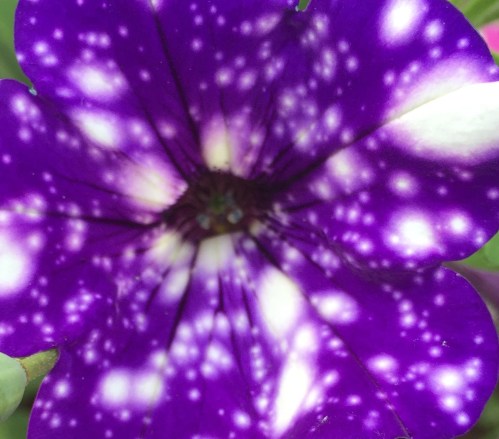
night sky flower.jpg

I’ve just finished reading Andrea Wulf’s “The Invention of Nature” which is her biography of Alexander von Humboldt. I thoroughly recommend it. It’s a big read but a great one. I must confess I’m one of the apparently many who has never heard of Humboldt but am I glad I know something about him now.

One of the most amazing things about Humboldt is how he saw, described and wrote about Nature as a complete interconnected web, and he did this at the end of the 18th, and beginning of the 19th centuries. What an insight! What a vision! What an understanding! His enthusiasm for Nature and his insatiable curiosity are infectious, even now. But it’s his underlying fundamental insight which thrills me most. He describes ecology before the word was even invented. He sees the damage caused by short term economic greed and, more than that, he describes the environmental consequences of these short sighted actions. He demonstrates how the interconnected web of Nature means that these simple minded grabs for wealth will produce long term, far reaching negative consequences for many.

Seeing our world and everything in it as intimately, inextricably interconnected is the basis of holistic science. This is a science of wonder, exploration and discovery. He uses the best scientific instruments of the time to measure whatever he can measure, but he does something which scientists today so often fail to do. He uses the measurements to discover the connections. He puts things together rather than dividing them up. He sees nothing as existing in isolation. In other words he uses reductionist methods in a holistic way.

Reading about him is one of the clearest examples ever of integration. The two halves of his brain both worked brilliantly together. He pursued the new and climbed the highest mountains to see the world as a whole (right cerebral hemisphere). He measured, analysed and categorised (left cerebral hemisphere). Then he put it altogether in a vast web of contexts (right cerebral hemisphere again). What a great demonstration of using the whole brain. Of course I’m simplifying here. I’m sure he didn’t use his brain in such a linear fashion, but, still, I think it’s magnificent.

I thought about him again as I looked at this wonderful flower (see the image above). It’s called “Night sky”. Isn’t it stunning? Doesn’t it immediately show you how the human brain both discovers and creates connections?

That we can see the starry heavens in the soft purple petals of an earthy flower…….


Here’s a short video clip of Andrea Wulf talking about her book –

Read Full Post »

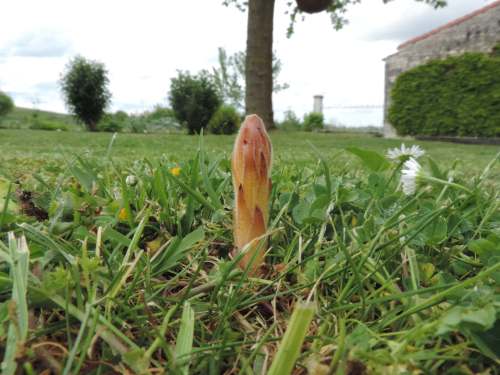
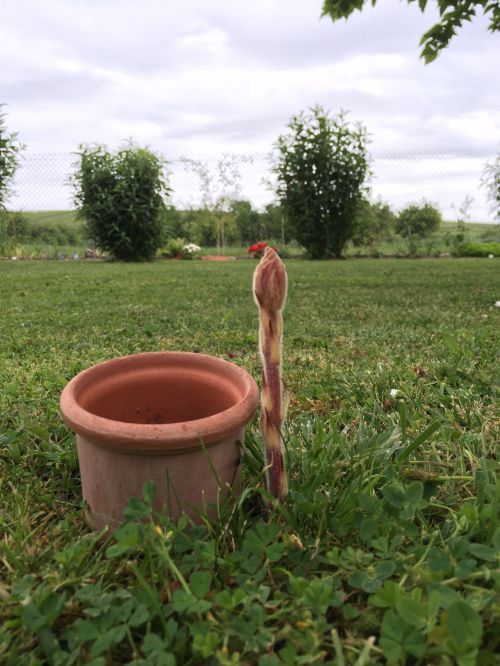
On May 10th this suddenly appeared in the grass one morning. I definitely didn’t notice it before so I think it emerged overnight.

May10

What is it? I had no idea. So I decided to wait…..

May19

May 19th, 9 days later. Still no idea what it is but I put a little flowerpot next to it to stop me accidentally kicking it over or mowing it down when I was cutting the grass. What was it going to do next? Unfurl like a fern? Reveal itself as an asparagus? I’d just have to wait a bit longer…..

May25

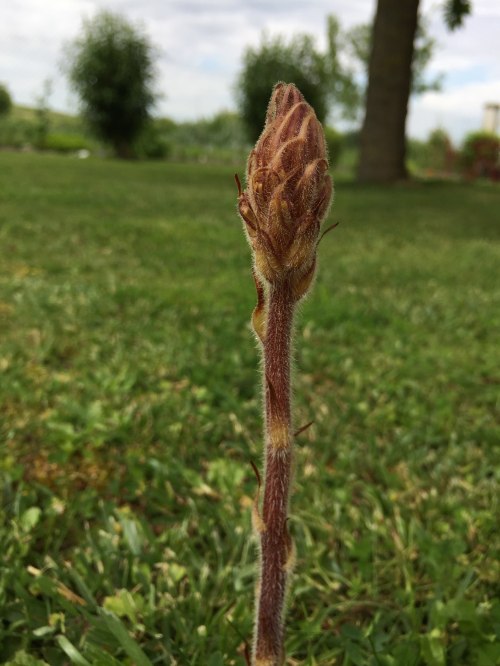
May 25th. A further six days on. Wow! Look how tall it’s grown! I still can’t tell what’s going to happen next. I’ll wait another week….

June2side

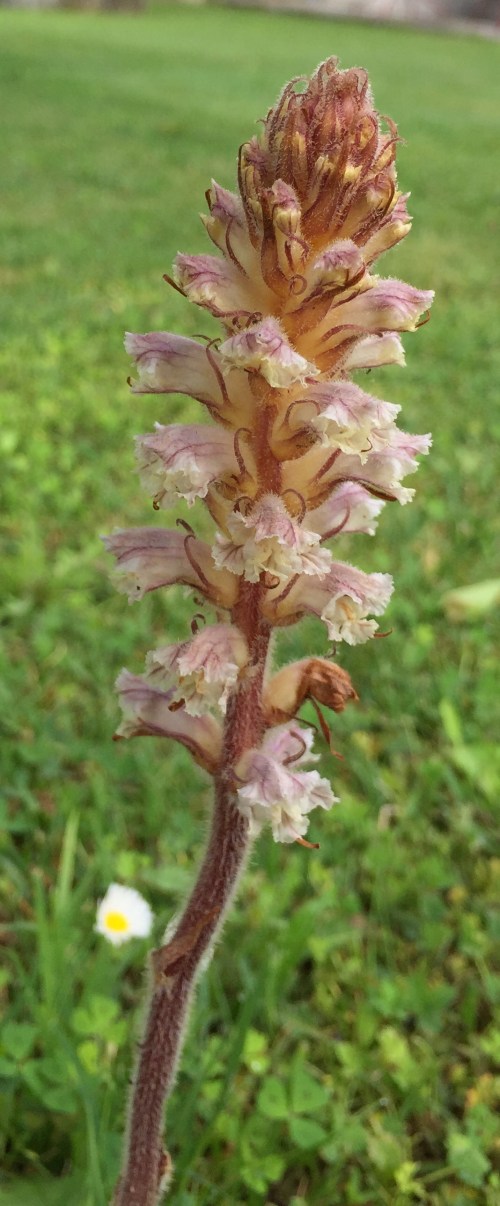
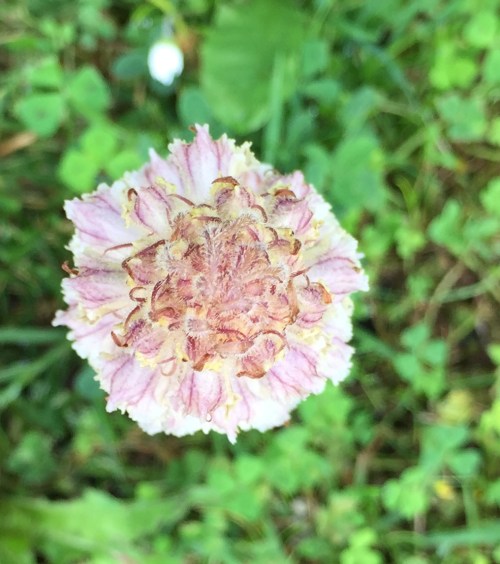
June 2nd. Oh look at these beautiful, delicate flowers it has revealed now! I took a photo from above too….

June2above

Well, that’s been worth waiting for, don’t you think?

I still don’t know what it is. The app on my iPhone, “Plantnet”, suggests it is a “Broomrape”. But maybe one of you has better botanical knowledge than I do and can either confirm that, or make a different suggestion?

Becoming…..it’s the only way to find out what anything “is”. See that tagline at the top of my blog? “Becoming not being”? Life is an emergent, dynamic process, constantly developing, changing, growing. Isn’t it just beautiful and awe inspiring to watch?

Read Full Post »

hailstone

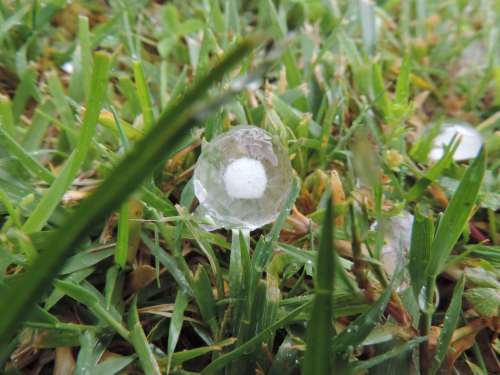
The other day I heard a strange noise and looked out of the window. The grass was covered in white balls. I opened the front door and as I did so the hail began to fall much harder. The white balls were bouncing back up a couple of feed from the ground they were hitting it so hard. It didn’t last long. Just a few minutes.

Once it had stopped I took a wander to have a look. (And of course take some photos).

Look at this one. Yep, it’s a hailstone but what thoughts spring to your mind when you look at it.

The first thing I thought was that it looked like an eyeball. That was a strange feeling….to look at it and feel like it was looking right back at me. Have you ever tried that? Just looking right into someone else’s eyes (it’s best if they’ve already agreed to do this!) for a few minutes. Just looking, without smiling, without saying anything, without making any faces. It is powerful. Very powerful.

The next thing I thought was that it looked like a cell, complete with a nucleus. Got me wondering for a few moments about the first cells on Earth. Where did they come from? Well, not from the sky in a storm, as far as I know….or did they??  No, I’m pretty taken with the idea that the first cells (of the kind we are made of) were created by other cells getting together and specialising to perform different functions. So some became ribosomes, and some became mitochondriae, others formed the boundaries, the cell walls, whilst others became nuclei.

How did that all happen?

And how does it continue to happen? Every day, these billions of cells in our bodies containing this incredibly elaborate, interconnected set of elements, none of which would be a cell without the others.

And, no, I don’t know where the first cells came from either – the simpler ones without all these amazing parts….

Then I wandered around taking a few more photos and quickly came up against the old teaching that there are no two snowflakes the same. Well, I can tell you, I looked at a lot of hailstones. I picked several up. I photographed a few of them. But I never found two the same.

Don’t you think that’s astonishing?

That these ice particles fall in their millions from the sky, all of them not long formed out of cloud particles, and no two of them are the same.

Uniqueness. Isn’t that one of the most fundamental qualities of our world?

OK, one last thought….as I held a hailstone in my hand, it didn’t take long for it to melt into water. Well, there we go, that ages old cycle of change and transformation. That deep rhythm of the beating heart of the world. Ice to water, water to vapour, vapour to clouds, clouds to water again to fall as rain, or turn to ice and fall as hail, seeping away into the dark earth, slipping between between the blades of grass, to make its way to the underground waterways, emerging as springs, streams, rivers and finding its way back to the sea to be warmed by the sun again, whipped up by the wind again, and rise again to become clouds.

Oh, I just love that. Don’t you?


Read Full Post »

prisms of light

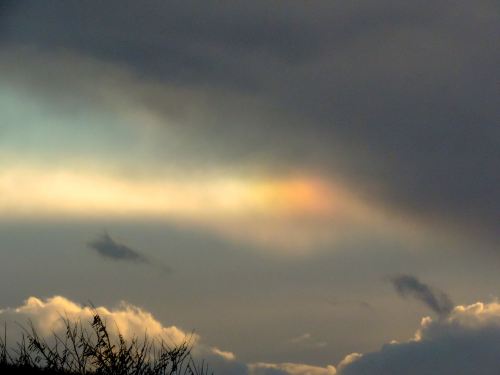
This caught my eye.

It was a stormy day with the wind blowing strongly from the West. One minute I’d look out and see blue sky, then the next, an enormous black cloud would roll over making it seem that night had fallen early. Minutes later, maybe after a few peals of thunder, a heavy shower, or even some hailstones, the cloud would move on and there was blue sky again.

Then late in the afternoon I looked out and what caught my eye was the colour.

There was this little prism of coloured light between the clouds.

That’s unusual here in the Charente. I go once a week for a French language lesson with a local retired Cognacaise woman and I can’t remember how it came up but I showed her a photo of a rainbow which I’d seen while back visiting family in Scotland. She said she’d seen a rainbow when she was a girl but not since.

That little statement startled me. Then I thought, how many rainbows have I seen since I moved here just over 12 months ago? And I couldn’t remember seeing any.

Can that be right?

Are there rainbows pretty much every week in Central Scotland but virtually none in the Charente?


Read Full Post »

« Newer Posts - Older Posts »