Feeds:
Posts
Comments

Archive for the ‘science’ Category

Shiny new leaves

Oh, wow! Look at the new leaves coming out on the vine at the end of my garden!

Look how shiny they are! Brand new and glistening!

I love to stumble across these moments of emergence, seeing the Life Force surging through the bare stalks and bursting into colour and shape like this.

It reminded me – there is no such thing as a fixed object in this universe. You can see that easily when you encounter the leading edge of life, but if you think anything you see is a fixed object, then you are either just not paying close enough attention, or you aren’t looking for long enough.

Becoming not being, that’s the way of the universe.

Read Full Post »

cogwheel
Andreas Weber, who coined the term “enlivenment” (to follow the “enlightenment”) describes how biology is changing to a more life-focused understanding, than the till now dominant reductionist parts-focused one –

Such eminent biological and systems thinkers as Lynn Margulis, Francisco Varela, Alicia Juarrero, Stuart Kauffman and Gregory Bateson have opened up a picture in which organisms are no longer seen as machines competing with other machines, but rather as a natural phenomenon that “creates” and develops itself in a material way while continuously making and expressing experiences

I like that. It captures a lot in a few words. We are self-making, self-developing creatures who are bodies (not who have bodies). And we continuously make (co-create) and express (not least through our stories and our art) our experiences.

Read Full Post »

Charge your batteries

I was surprised to see this street in Paris with its row of recharging stations, and every one of them occupied by an electrically powered car having its battery recharged.

An encouraging sight in a city battling with air pollution issues, in a world undergoing climate change.

It also provoked a few moments of thought about how I re-charge MY batteries, and I thought it might be good to ask you what you do to re-charge yours? Are you aware of your energy levels on a day to day basis? And if you are, do you do anything about it? Burn up, store or re-store your energy?

Oh, and I also just found the shot I took to be really pleasing. I applied one of the “Photos” filters which came already installed on my iPad……nice, isn’t it?

Read Full Post »

The Atlantic

People crave certainty.

We want to know, for sure, what the results will be of our actions. We want to be able to predict what is going to happen in the world, and in our lives.

Don’t we?

Two examples spring to my mind.

1. The daily weather forecast.

Every day millions of people listen to, watch or read the weather forecast. We want to predict what the weather will be like tomorrow, in a few days time, next week or the week after even……

2. The focus on “outcomes”.

Knowing for sure the results of our actions – in Medicine, we want to know for sure what will happen if we have treatment X, and we want to know for sure what diseases we will get and what effects they will have on us. In Economics, we want to know for sure that if we introduce this particular policy then it will have the results we desire. In engineering we want to know for sure that the machines we make will consistently and reliably do the job we design them to do.

That’s how it is for us humans. We’re afraid. We know that none of us live for ever but that’s a terrible knowledge to have. We want power over the unpredictable. We want to control the present in order to control the future.

But does the world work like that? Is Life like that?

I don’t believe those who predict futures, but I’ll listen to what they have to say, and make some choices all the same. If the weather forecast says it’s going to pour with rain tomorrow but has a good chance of being sunny in a couple of days time, I might choose to put off my trip to the beach tomorrow, and, instead, to plan to go in a couple of days time.

But do you know what I find most satisfying of all?

To “seize the day”.

If I wake up tomorrow and the forecast is wrong…..there’s bright sunshine and clear blue skies, then it’s great to set off to the coast, and not wait for a “better day” a couple of days ahead.

And what about control – of diseases, of economies, of machines and so on? We don’t control any of that.

Look at that lighthouse in the image above.

Does it control the Atlantic Ocean?

Does it ensure that shipping will not hit rocks?

No, neither of those things.

It gives us the opportunity to be aware, and so let’s us make adaptive choices. (In the case of the lighthouse, to be aware of the rocky coast and to change direction)

But if the opposite of control and prediction is “out of control” and unpredictable, then I don’t know any human beings who can manage to live that way.

So, for me, it’s not about trying to be out of control or to relish unpredictability. Despite the fact that the delusions of control and fallibility of predictability will always be unsatisfying, disappointing or frustrating.

I do think there is another way.

The other way has something to do with awareness, with resilience, and with living in the present moment, but I think I’ll take the time to explore that in more detail in future posts.

Read Full Post »

Tiles and moss

Wherever you look on Earth, you’ll find Life.

Whether it’s the moss on the tiles here, or flowers by the roadside, trees, grass, insects, birds, fish……and, if you use microscopes, you can find bacteria in every environment on, and in, our planet.

There is Life in the most astonishing places. In the mouths of volcanoes, deep, deep under the sea where no light has ever reached, high up on the tallest mountains…..it’s everywhere.

Life is such a creative force, gathering what it finds here – chemicals, sunlight, energy – and creating more Life from what it finds.

Life is such a social force, working not just in competition with other organisms, but, crucially, in collaboration with them.

Life is such a force for change, constantly developing, growing, reproducing, evolving.

And here we are…..human beings. Life with consciousness. A form of Life which knows that it is alive and can think, and feel, and reflect.

Isn’t this all so amazing? That the Universe should have this drive towards ever greater complexity? That the Universe should seem to celebrate such astonishing diversity and uniqueness? That the Universe should produce consciousness?

Read Full Post »

Sometimes I read something that both inspires and concerns me. This recent article about the scientists working to “solve ageing” and a $1M prize for scientists to “hack the code of life”, is just one such article. The prize relates to a challenge to teams to restore “vitality and extend lifespan in mice by 50%”. Several wealthy individuals and coporations seem to be actively engaged in these pursuits.

There is an increasing number of people realising that the concept of anti-ageing medicine that actually works is going to be the biggest industry that ever existed by some huge margin and that it just might be foreseeable

It hasn’t taken long for people to ask the question about quality of life if we do manage to enable people to live 120 years or more. What I like within that discussion is the concept of “healthspan” instead of “lifespan” – how many years of quality healthy life can we have? And I was very glad to read this –

The standard medical approach – curing one disease at a time – only makes that worse, says Jay Olshansky, a sociologist at the University of Chicago School of Public Health who runs a project called the Longevity Dividend Initiative, which makes the case for funding ageing research to increase healthspan on health and economic grounds. “I would like to see a cure for heart disease or cancer,” he says. “But it would lead to a dramatic escalation in the prevalence of Alzheimer’s disease.”

This kind of thinking seems still far to uncommon. We cannot create healthy lives by “curing one disease at a time”. And even if we were able to cure a number of chronic diseases, we have to think through what it means for people. We are all going to die from something. Can we reasonably choose to avoid dying from one disease without increasing our chances of dying from others?

Instead this kind of approach is needed, and is beginning to be explored –

By tackling ageing at the root they could be dealt with as one, reducing frailty and disability by lowering all age-related disease risks simultaneously, says Olshansky.

I don’t know about ageing, but it does seem to me that we could do with researching how we maintain health, how we develop resilience and vitality, and how we support growth and development. In other words, how do we stay healthy exactly? And how do we become healthy again when we are ill?

But apart from the scary ideas of genetic engineering and other “bioscience” technologies held by the richest individuals and companies, what would it mean if we could enable the average person to live 120 years?

What would it mean for education? What would it mean for work? What would it mean for living together?

What do you think?

How might living to 120 change the way you are living your life now? How might it change your plans?

Read Full Post »

The cognac cellars

Becoming not being

You’ll see that phrase up at the top of the home page here, just underneath the heroes not zombies title.

Such a phrase can lead me off in many directions. For example, it brings a focus on verbs instead of nouns. Nouns are words we use to name things. We categorise with nouns. We put things into defined boxes and then argue about the purity of the box’s contents. Verbs on the other hand are action words. It’s harder to pin a verb down. It’s always changing. Every Sunday you’ll find a post here about a verb (put the phrase “A to Z of becoming” in the search box and you’ll find lots of them).

Becoming not being is about change, about transience and about process.

Eric Cassell says in his “Nature of Clinical Medicine

I say that “thinking about processes differs from thinking about a thing in at least four aspects. Process implies change, a direction of change, a rate of change, and a purpose, result, or outcome of change”

Who I am today is different from who I was yesterday, last week, last year. I am still me and the nature of change in a human being is of constant adaptation and evolution. It’s developmental. The cells in my body are constantly changing, some dying off, some being born. The connections in my brain are constantly changing – with every thought, every image, ever memory, every sensation.

I AM change.

There are many directions of change in the Universe, but the one which fascinates me most, is the one which underpins “The Universe Story“. If we start about the time when there were only Hydrogen atoms, and follow the change through to the emergence of Life, and on to the births of you and I, we see a direction of change – towards every greater complexity, from fairly simple atoms to complex adaptive organisms – and up into the emergence of consciousness. With this direction of change we see more and more diversity in the Universe.

The direction of change is towards ever greater connectedness and ever more uniqueness.

The rate of change is not constant. We see that with evolution. There are no smooth transitions from one life form to another. The changes occur in leaps. We see that in the development of a child. One day they can’t stand up, then from another day they can. One day they can’t walk. Then they can.

Change occurs in quantum leaps.

Cassell mentions “a purpose, result of outcome of change”. The thing with outcomes, is that they are only what you describe at the time you describe them. Outcomes lead to new changes. There isn’t a stopping point. You could say the same about results. So what about purpose? I think purpose is discovered, and/or created through narrative.

The narrative of change creates and reveals meaning in our lives.

The photograph at the start of this post, is of a cognac cellar. The barrels sit there in the dark for years as the cognac constantly changes, every year producing a unique new flavour.

Becoming not being.

Read Full Post »

air and water

water and fire

air water and fire

air water fire earth and Life

Read Full Post »

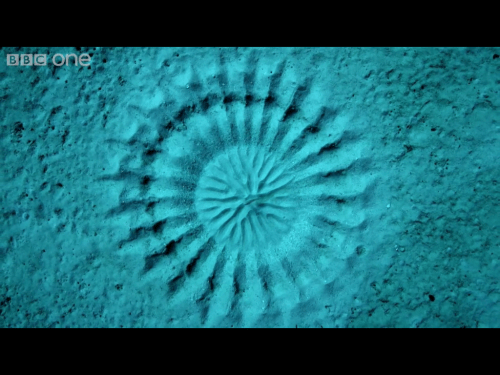
Look at this!

I saw it on a French Nature programme, but it’s originally from the BBC.

If you look carefully you’ll see the little puffer fish at the centre of his creation. Isn’t it totally amazing?

How can such a wee fish make such a perfectly accurate circular pattern like this? And isn’t it just beautiful?

Apparently this is what the male puffer fish creates to attract a female. If the female fish is satisfied with the creation she lays her eggs right in the middle of it, he fertilises them, then she lays more, which he fertilises. Then she swims off.

The way he makes the pattern, it creates a perfect consistency of sand in the middle for the protection of the eggs. In other words, from an engineering perspective, it’s brilliant. 

But what amazed me most was how he makes it so beautiful, and how the beauty of the pattern attracts the female.

Are you aware of any other creatures, apart from human beings, which produce creative works of beauty? I know certain birds, and some other creatures, can create incredible nests, but ones which seem to be created to be beautiful? I didn’t know other creatures did that.

Read Full Post »

In Eric Cassell’s “The Nature of Clinical Medicine”, he postulates that a key problem with Western Medicine is the focus on disease, at the expense of seeing, hearing and understanding the person who may, or may not, have the disease. At Medical School I was taught it was very bad practice to refer to “the gall bladder in bed 3” or to say “I admitted a case of pancreatitis last night”. Despite that we continue to think of disease as paramount in patient care, and we even create our health care services around the diagnosis and “management” of disease. Whole protocols of procedures are created, distributed and enforced around the concept of diseaes. Doctors and nurses are told what to do with a patient with disease X on the basis of “the best evidence”, where “the best evidence” refers to group studies which seek to “control for” individual factors – a process which prioritises the disease over the individual experience of it.

Eric Cassell enumerates “8 problems with using disease language”.

Disease names, for example, coronary heart disease or carcinoma of the breast, wrongly imply that a disease is a concrete thing (as opposed to an abstract concept) that can be found separate from the patient in whom it is found.

I read the phrase about disease being a concept, not a concrete thing, many years ago, and it had a big effect on me. Disease is exactly that – a concept. It’s a pattern of change which we name. Yet how many people, patients or health care professionals, think of a disease as being a thing? If you look at recent slogans used in health care, and in charity campaigns you’ll see the kind of thing. They are full of war metaphors about fighting this, beating that, kicking cancer’s butt, and so on. 

Disease names, for example, renal cell carcinoma or ulcerative colitis, incorrectly imply that the disease and its behavior are independent of the persons in whom they are found.

There are NO diseases which exist outside of people (or other living organisms). A disease is ALWAYS found in the context and the environment of the person who is suffering. 

Disease names, for example, lupus erythematosis or chronic obstructive pulmonary disease, mislead the unwary into believing that the name refers to one thing whose manifestations in individual patients are more alike than dissimilar. Just as the word tree refers to a class of things whose members are more alike than not, when, unless one wants to use trees or their wood, their variations are more important than their similarities.

What does every patient who attends an asthma clinic have in common? Asthma? How similar does that make them? Is this the most important fact to know about this person who is attending today? It’s individual differences, not the similarities, which are the most important.

Disease names, for example, multiple sclerosis or pneumococcal pneumonia, fool the unsuspecting into believing that what is referred to is a static entity, like the Bible, the Statue of Liberty, or the map of the New York City subways, rather than a constantly unfolding process that is never the same from moment to moment. The history of disease concepts depended on and furthered the classic separation of structure and function in which abnormal function was believed to follow from abnormalities in structure. This distinction seems to have been derived from the idea of form (which goes back to the Greeks) and its consequences that loomed large in 17th- and 18th-century medicine (King, 1978). The hard and fast distinction between structure and function itself is invalid. Structure is merely slower function, in that it changes at a lesser pace than the process called function—put in mind how bony structure changes in response to trauma or age so that it continues to perform its original function. Even the Statue of Liberty and the Parthenon are constantly changing.

As best I can understand, change is the nature of reality. There are no static entities. Even the ones which look static, are just changing more slowly, or less perceptibly. As Cassell says, “structure is merely slower function”.

Having named a disease within the patient, for example, diabetes mellitus or metastatic adenocarcinoma of the lung, physicians may be fooled into believing that they know what the matter is at this particular time and why. The disease may be the sole underlying reason why the patient is sick, but more often other factors—physical, social, or psychological (or all three)—have been crucial in the generation of the details of the illness and its losses of function (Cassell, 1979).

This is a common error. Just because an abnormal reading is found, that does not necessarily mean the explanation for the patient’s suffering has been found. For example, it has been clearly shown that there is no direct linear relationship between a lesion and the pain a patient is experiencing. Pain can change irrespective of the findings in the MRI scanner.

Disease names, for example, amyotrophic lateral sclerosis and psoriasis, inadvertently cause physicians to fall back on definitions of disease that are now accepted as outmoded because they fail to provide an adequate basis for treating the sick.

Disease names can, and do, change as we develop our understanding.

Using disease nomenclature to describe human sickness encourages the belief that only research into (molecular) mechanisms of diseases holds promise for understanding and treating human sickness.

You’ve probably encountered one of the ways in which “patient centred” is being used – pharmacogenomics. The idea that as long as we find not just the genetic code associated with a particular disease, but the genetic codes which seem to indicate responsiveness to certain drugs, then all we need is the genetic code. This isn’t to say that molecular or genetic research is not of value. It’s just not enough.

Finally, focusing on naming the disease takes attention away from the sick person.

Ultimately, this is Eric Cassell’s main message, and if only we made this the foundation principle of health care then we might have better medical education, more useful research, more effective treatments, and even health care organisations constructed around people, not diseases and drugs.

Read Full Post »

« Newer Posts - Older Posts »