Feeds:
Posts
Comments

Archive for the ‘science’ Category

Eric Cassell has a new book out. The Nature of Clinical Medicine. Maybe not a title which grabs your imagination but I was very influenced by two of his earlier works – The Healer’s Art, and The Nature of Suffering. In particular, I appreciated the way he articulated the difference between “disease” and “illness”. It seemed to me that the patient’s illness could only be understood by including their story, their reports of the invisible, subjective experiences we call symptoms. 

When I studied Medicine in Edinburgh, the first three years of the six year degree course had a curriculum of “medical sciences” and so my first degree was a BSc in Medical Sciences. It was only when we entered into Year 4 that we were introduced to patients and to a curriculum of “clinical medicine”. So, the first time I saw “cirrhosis of the liver” it was in a perspex box marked “cirrhosis of the liver”. It was a full two years later before I encountered a person who had “cirrhosis of the liver”. 

I know Medical degree curriculae and teaching methods have changed a lot over the years, but what Eric Cassell does, so eloquently, in this book, is make the case for the practice of “Clinical Medicine” which does NOT focus on the disease. Instead, he argues, it needs to focus on the patient. 

The major problem is, simply stated, that when persons are sick, the sickness has an effect on every part of them, and if attention is paid only or even primarily to the pathophysiology, the disease, or the body, then the other aspects and particulars of sickness will get inadequate attention and the impact of the sickness may go on and on. That probably did not matter so much in the era of acute diseases because the patient was either soon well again or died. Now that the overwhelming majority of medical problems come from chronic diseases, from persons with enduring disability secondary to diseases, birth defects, or trauma, and from an aging population, the inadequacies of disease-centered medicine cause problems for individuals and for populations.

Even if this way of focusing on disease paid off in terms of managing acute illness, he makes the point that the world has changed, and now doctors primarily have to help patients who have chronic illnesses. A continued focus on pathophysiology, is a focus on disease, and it runs the significant risk of failing to understand or help the person who actually has that disease.

If no disease is believed to be present or cannot be found, generally the patients’ problems are shunted aside, symptoms are treated simply because there are treatments, or the patients are essentially dismissed or placed in a category of lesser interest.

This is one of the worst effects of a focus on disease. When the test results return normal readings, the patient is declared to be disease-free, and either dismissed, categorised as having a mental illness, or is prescribed medication to attempt to dull the symptoms they are experiencing even though the doctor can’t explain the presence of those symptoms. Sadly, this often results in loss of trust, breakdown of the doctor patient relationship, and ultimately a failure of care.

It is this almost single-minded focus on disease entities, especially hunting for their ultimately molecular origin, that marks Western scientific medicine and creates difficulties for physicians in the multiple other things they do, from counseling to treating suffering. 
Read Full Post »

I read a lot about complexity, and especially about complex adaptive systems, because it’s the most useful conceptual model I’ve found so far when I’m considering real life issues like health, illness, economics, personal growth (and so on!). An article entitled “Occupational Science and Social Complexity” by Aaron M. Eakman recently reviewed this model in the context of occupational science, and I thought I’d share a couple of the sections with you because he nicely clarifies some key points.

In the article there is a good summary of “characteristics [which] are common to complex systems”. He describes seven of them, and I’ve put in bold what I consider to be amongst the most important points to take on board –

1) Relationships between components of the system are non-linear,
meaning that a small perturbation may lead to dramatically large effects. By contrast, in linear systems the effect is always directly proportional to a cause.

2) Local rules affecting the relationships between components of the system lead to the emergence of global system order;

3) Both negative (damping) and positive (amplifying) feedback are often found in complex systems. The effects of an element’s behavior or the emergent behavior of the system are fed back in such a way that the element itself is altered.

4) Complex systems are usually open systems; they exchange some form of energy or information with their environment.

5) Complex systems are historical systems that change over time, and prior states may have an influence on present states.

6) The components of a complex system may themselves be complex systems. For example, an economy is made up of organizations, which are made up of people – all of which are complex systems.

7) Complex systems may exhibit behaviors that are emergent; they may have properties that can only be studied at a higher system level.

Think what these characteristics mean when you are considering a human being, an organisation, or a society. What are seeing are organisms or organisations which are undergoing constant, unpredictable change. You can guess how things are going to go, based on prior knowledge and experience of other situations which you judge to be similar, but you’re going to have to be constant alert to the fact that things are very likely to go some other way entirely, and you’ll need to adjust your choices accordingly.

In fact living creatures, particularly multi-cellular ones, like human beings can be thought of as a particular kind of complex system – a “CAS” (Complex Adaptive System).

Complex adaptive systems are special cases of complex systems which are adaptive in that they have the capacity to change and learn from experience. John Holland describes a complex adaptive system as a dynamic network of many agents (which may represent cells, species, individuals, firms, nations) acting in parallel, constantly acting and reacting to what the other agents are doing. The control of a complex adaptive system tends to be highly dispersed and decentralized. If there is to be any coherent behavior in the system, it has to arise from competition and cooperation among the agents themselves.

In other words, we don’t just constantly change, frequently in unpredictable ways, but we adapt – our changes are not entirely random, they are informed – informed by prior knowledge and experience and informed by constant feedback in the here and now.

That last point about coherent behaviour arising from “competition and cooperation” is a challening one. There are a lot of people who think that competition is THE key in understanding life and evolution. There are others who say, no, it’s cooperation which is the key. It seems the reality is, it’s both.

Complexity science eschews reductionism and determinism by focusing on the emergent properties of a system and the non-linear interactions of a system’s components. Complexity science recognizes that such systems cannot be understood simply by understanding the parts – the interactions among the parts and the consequences of these interactions are equally significant.

Modern Medicine is still stuck in the reductionist and deterministic paradigms. And the problem is they just do NOT reflect reality. We don’t just need the science which shows us how particular cells or organs work. We need the science which shows how what happens when active agents begin to compete and co-operate. We need to discover just how a complex system adapts, repairs, heals and evolves. The old idea of “fixing” the “wonky bits” only works (and only for a limited time) where the scenario conforms to reductionist and deterministic paradigms (in Acute Care for example)

One more thought provoking point from this article –

Finally, Byrne (1998) has asserted that as a basis for social action: Complexity/chaos offers the possibility of an engaged science not founded in pride, in the assertion of an absolute knowledge as the basis for social programmes, but rather in a humility about the complexity of the world coupled with a hopeful belief in the potential of human beings for doing something about it.

Byrne, D. (1998). Complexity theory and the social sciences. New York: Routledge.

I couldn’t agree more.

Humilty

and

Hope

Let’s proceed on that basis.

Read Full Post »

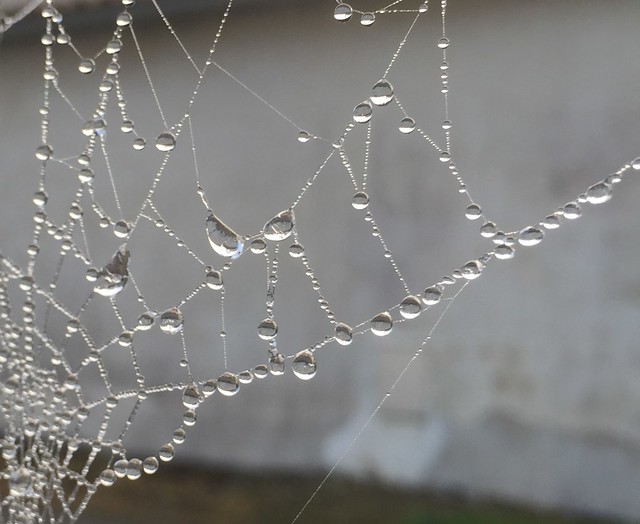
webdrops

Why do I find the dew-soaked, rain-soaked spiders’ webs so appealing?

Three reasons, at least –

First, they are just so beautiful.

Second, each drop becomes a little lens, which shows the surrounding world upside down. Reminds me how everything we experience is through our personal lens, so our view of the world is always our unique, singular view.

Third, because the form/concept of links and nodes describes so well the phenomena of the world. Shifting our perspective from seeing a world of objects, to seeing a never-ending web of links, hubs or nodes, connections and relationships is exciting!

Read Full Post »

Rainbow fountain

I’m using this photo of a rainbow appearing in a fountain because I think rainbows are a symbol of hope, as well as being a phenomenon which exists only in the presence of the subject (the observer), and a fountain which is symbolic for me, of the life force, that flowing healing energy which enlivens and heals us all.

Isaac Judaeus lived from 855 to 955. He was physician to the Fatimid rulers of Qairawan in Tunisia, and his works were amongst the first to be translated from Arabic into Latin at the time of the great translations which brought Arabic thought and science to the notice of the West. His books had a big influence on Western medieval medicine, still being read into the 17th century. There’s a small book of his, Guide for Physicians, which only exists in Hebrew translation, where he sets out his ethical conception of medical practice (remember this is writing from the 9th and 10th centuries). I’ve only read a few of his aphorisms, but this one, in particular, caught my eye.

Comfort the sufferer by the promise of healing, even when thou art not confident, for thus thou mayest assist his natural powers

What’s he saying here?

First of all that physicians should comfort the sufferer. Sadly, that’s an element of health care which patients don’t always experience. Shouldn’t physicians always offer care and comfort?

Secondly, they should do this “by the promise of healing”. He goes on to say “even when thou art not confident”. Wouldn’t this be deceit in some situations? One of my earliest experiences as a young doctor was admitting a very elderly, very ill lady to the ward where I worked. Her also very elderly daughters were hugging each other on the seat outside the ward, wringing their hands, crying and upset about what was happening to their mother. I thought I’d comfort them and said “Don’t worry. Your mother is in the right place now. I’m sure she will be fine” They smiled to me just as one of the nurses came out of the ward and called me aside. “That patient you just admitted doctor? She’s just died”. Well, that taught me a lesson. But it didn’t stop me practising with hope, practising with the expectation that there was a potential for things to go well. It just taught me never to assume I could accurately predict the future!

I still believe that. I believe none of us can predict the future….especially not in the case of the particular, the specific, individual circumstance. I was surprised many times throughout my career when patients did so much better than the textbooks would have predicted. So, I often thought, the truth is that as you look forward from this point in time, there are a whole range of potential paths leading from here into the future. In the situation of illness, some of those paths will be largely ones of decline, some of stumbling along, and some of steady, or sudden, improvement. And nobody, but nobody, can accurately predict which path this particular patient will take. Therefore, at each stage of the process, hope is not only possible, but is as reasonable an option as any other.

That’s what I understand about “the promise of healing” – it’s not really a promise, in the sense of a guarantee, but a potential (in the way we say something may be “full of promise”). And I think acting from that perspective contributed to the improvements patients experienced.

That’s the final part of Isaac Judaeus’s aphorism – “for thus thou mayest assist his natural powers”.

I can’t see there is any healing other than that brought about by the human being’s “natural powers”. I’d describe them now in terms of systems theory, or complexity theory. Those natural powers are the power shown in any “complex adaptive system” – the powers of self-regulation, self-defence, self-healing…..the “autopoietic” “self-making capacity” of a person.

Medical acts, medicinal substances, physicians’ interventions are only truly healing when they work with, not against, this capacity. That’s why doctors should always remain humble. It’s not what we do that heals. It’s what we stimulate and/or assist….the astonishing self-healing powers of the human being.

In contemporary thought, these “natural powers” Isaac Judaeus refers to are often wrapped up in the idea of the “placebo effect”, but, sadly, that’s a concept so entangled with ideas of trickery and deceit that the “self-healing” powers get lost in it.

So, here’s what I get from that old aphorism –

  • offer comfort and care
  • offer hope and the promise/potential of healing
  • and in so doing assist the natural or self-healing powers found in every human being

One of my hopes for the future of Medicine would be that we learn many other ways to assist those “natural powers”.

Read Full Post »

image


There is something magical about flying through clouds. They look so solid, but they’re not. It’s impossible to be sure about their edges….where does a cloud begin? Where does it end? Despite their absence of a solid nature they make pretty impressive shadows on the Earth below. And they are in a state of constant becoming, perpetual change.

I saw these particular ones above the Garonne as the plane was landing in Bordeaux carrying me to the next big chapter of Life.

Read Full Post »

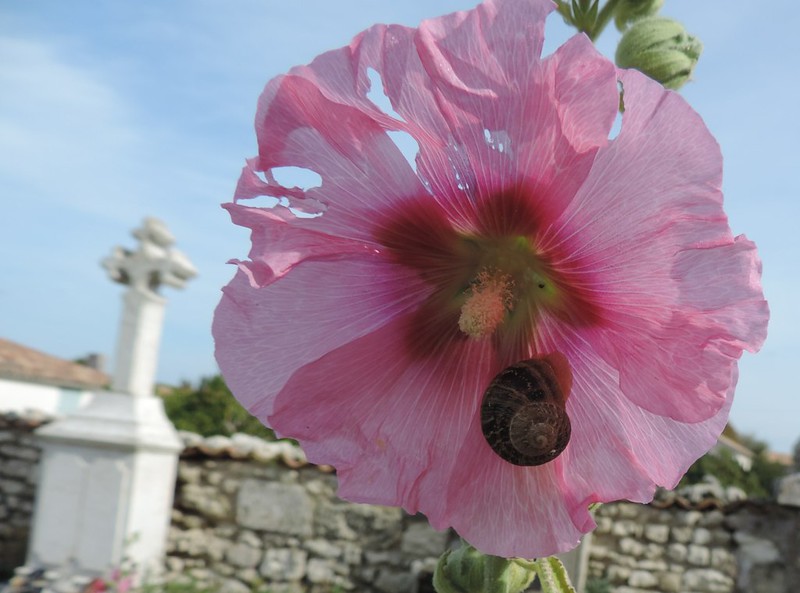
hollyhock

I recently stumbled across a reference to the paradigm of “relational science”. I hadn’t seen that term before but here are a list of characteristics of “relational science” with each one compared to its “Cartesian” counterpart.

  • PROCESS vs substance
  • BECOMING vs being
  • HOLISM vs atomism
  • RELATIONAL ANALYSIS vs either/or split analysis
  • MULTIPLE PERSPECTIVES vs dualistic objectivism/subjectivism split
  • COACTION vs split interaction
  • MULTIPLE FORMS OF DETERMINATION vs efficient/material causality

If you’d like to read about this in more detail google “Fundamental Concepts and Methods in Developmental Science: A Relational Perspective” – which is an article by Willis Overton and Richard Lerner. In that article the authors write –

As a derivation from these relational categories, the relational developmental systems paradigm characterizes the living organism as a spontaneously active, self-creating (autopoetic, enactive), self-organizing, and self-regulating nonlinear complex adaptive system. The system’s development occurs through its own embodied activities and actions operating in a lived world of physical and sociocultural objects, according to the principle of probabilistic epigenesis. This development leads, through positive and negative feedback loops created by the system’s action, to increasing system differentiation, integration, and complexity, directed toward adaptive ends.

Some of this language might be familiar to you from other posts I’ve written on this site, but I’ve never seen them pulled together as “relational science” or come across the concept of “relational developmental systems” before.

If change is the pervasive phenomenon which it seems to be, it makes much more sense to focus on process instead of arbitrarily separated parts. In terms of health, I think this means we need to understand the processes of repair, resilience and effective functioning of healthy organisms, not trap ourselves in the limited focus on pathological change within tissues or organs.

A focus on becoming instead of being also undermines the outcome based approaches to care which are so prevalent. Health is a dynamic, lived experiences, not a series of fixed states.

Multiple perspectives allow to understand illness much more fully – again, not limiting ourselves to the pathological changes within cells, tissues and organs, but taking on board the subjective phenomena of illness (pain, stiffness, breathlessness, dizziness, weakness etc), as well as the narrative of the person who is ill through which we make sense of the experience, and beyond all that, to situate the individual person’s illness within the contexts in which they live – their relationships, family, genes, work, social and environmental conditions etc.

Co-action shows that change comes about not least from the interactions between individuals. This knowledge gives us the opportunity to shift the perspective of health care from that of a doctor treating an object, to that of a doctor and a patient co-creating better health for an individual.

Last but not least, all of this thinking leads us to a consideration of the emergent nature of change in living organisms – which means we can never be completely certain how things are going to go in any individual situation. Something which, surely, should bring some healthy humility to the practice of Medicine.

You’ll see this is all entirely consistent with the features of complex adaptive systems, and of integral theory. And it is also utterly consistent with my blog byline of “becoming not being” which I first encountered in the study of Deleuze’s work.

I really think this “relational science” explains reality much better than the old, reductionist, mechanistic, linear paradigm which is still so prevalent.

Let me finish this post with a re-iteration of Overton and Lerner’s excellent summary –

the living organism as a spontaneously active, self-creating (autopoetic, enactive), self-organizing, and self-regulating nonlinear complex adaptive system


Read Full Post »

Celtic knots

I’ve always found Celtic knots attractive. I think they are both beautiful and fantastic symbols of important characteristics of reality – the indivisible inter-connectedness of everything, and the dynamic, flowing qualities of Nature.

Alan Watts, that great teacher of Zen principles, talks about the reality of inter-connectedness in one of his essays. He says –

interdependence and virtual identity with all other forms of life which the divisive and emboxing methods of our current way of thought prevent us from experiencing……….The so–called physical world and the so–called human body are a single process, differentiated only as the heart from the lungs or the head from the feet………..our intellectual and scientific “establishment” is, in general, still spellbound by the myth that human intelligence and feeling are a fluke of chance in an entirely mechanical and stupid universe—as if figs would grow on thistles or grapes on thorns………wouldn’t it be more reasonable to see the entire scheme of things as continuous with our own consciousness and the marvelous neural organization which, shall we say, sponsors it?
 I love that word he uses – “emboxing”. I’ve never seen that word before. Maybe he invented it, but it’s great. The way we label and classify after focusing on only certain aspects of any phenomenon separates and divides. It puts whatever we are looking at into a box. When we apply this technique to ourselves we divide ourselves from the Nature, from the Earth, and even from the Universe.
Dividing ourselves from Reality produces a dangerous delusion. As Watts says, “wouldn’t it be more reasonable to see the entire scheme of things as continuous with our own consciousness and the marvelous neural organization which, shall we say, sponsors it?”
I particularly like his reference to the human body – because if we really did understand ourselves as intimately and inextricably connected to the universe then maybe we’d stop classifying whatever is not “us” as “them” or “it”. Then we would have a chance to create a world which was more like the human body – made of well-differentiated parts which relate to each other in mutually beneficial ways – the reality of integration, not the delusion of division and separateness that seems to result in exploitation, plunder, killing and rape.

Read Full Post »

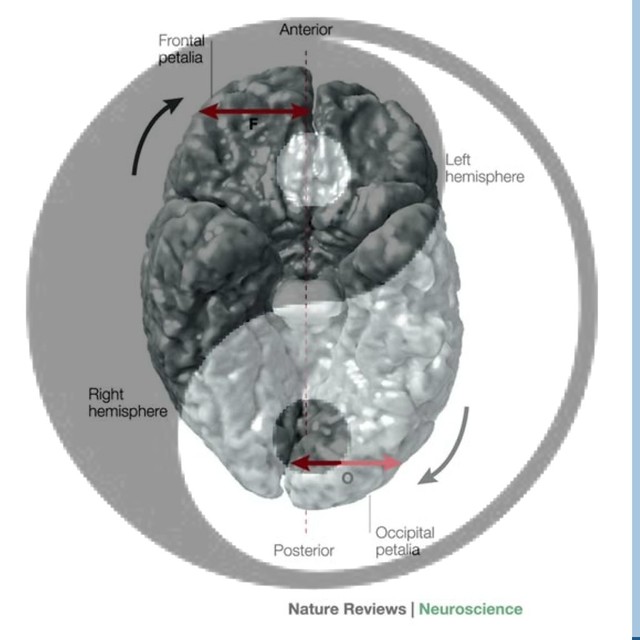
left hemi right hemi

In “The Secret Life of Pronouns”, the psychologist, James Pennebaker discusses two different kinds of thinker – categorical or dynamic. I hadn’t heard of this distinction before but in the briefest of nutshells –

A categorical thinker is someone who tends to focus on objects, things, and categories. The opposite end of this dimension are people who are more dynamic in their thinking. When thinking dynamically, people are describing action and changes

That sounds very familiar to me. In fact, its got a lot in common with Iain McGilchrist’s left and right hemisphere approaches to life. The left hemisphere RE-presents reality to itself, labelling, listing, naming, categorising. Whereas the right hemisphere focuses on what he calls “the between-ness”, connections, relationships, or the whole.

For the last few months, I’ve been sharing on this blog a series of posts under the title “The A to Z of Becoming” where I take one verb each week for you to think about, and play with. I deliberately chose verbs because I think it’s the “doing words”, the “action words” which determine the kind of life we experience. This is partly in tune with William Glasser’s Choice Theory, and partly with Deleuze’s focus on change, or difference, which provided me with the fundamental principle of this blog – “becoming not being”.

So, there is something insightful about this distinction, but, the way my mind works, I also find myself balking at the “two value” use of “or” – I SO much prefer “and”! (Which is something I picked up from the General Semanticists, before I even heard of Deleuze.

So, maybe now I can be more aware of when I am thinking categorically and when I’m thinking dynamically (and, yes, I DO have a preference!)

Read Full Post »

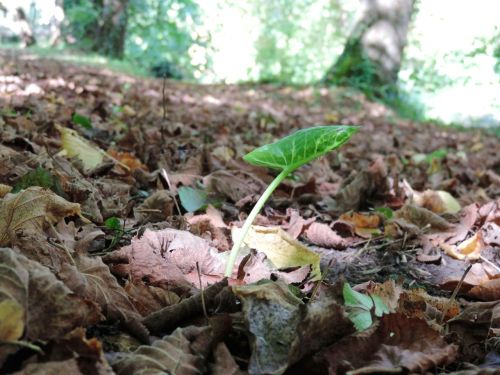
As I was walking in a forest the other day I came across this –


new growth in the forest

I often feel a kind of thrill seeing new growth like this. It’s the emergence of Life on Earth. This little seedling might well grow up to be one of the great trees of this forest. How does it do that? How does this one little seed begin to sprout, begin to reach upwards through the decaying leaves on the forest floor, and seek out the sun, the air, and the rain?

And then a little further on, I find this tree….


tree

Don’t adjust your screen – it’s the right way up!

Look at these twists and curves and corners, as the tree reaches first this way, then another. Who could predict which way any of these branches would grow? Who could predict what this tree would look like today if they were seeing it back when it was one of those little seedlings pushing its way towards the light?

I see this everywhere.

I saw it every day with every patient I ever met. Who could have predicted how this person would be today, what life they would be living, and how they would be experiencing it?

Nobody.

That’s what gets me about the irrational arrogance of those who claim to know. Those who claim certainty. I am never convinced by those who claim they know what the results will be of a particular treatment for a particular individual. They can throw the term “evidence based” about as much as they like, but if they think that label gives them some magical ability to predict the future for individual human beings, then they are quite likely to be mistaken.

I don’t like the irrational arrogance of certainty in any area. I don’t like it in politics, matters of belief, wordview (religious, atheistic or scientistic), in economics, or any other human domain. Life is not predictable. Living organisms cannot be properly understood if represented as mere objects. All living forms are dynamic, open, complex systems. All are unique and together they are diverse. Commonalities matter, but so do differences.

If there is one thing I always doubt, it’s certainty.

But then, like Montaigne, I’m fond of saying “mais, que sais-je?” (“but what do I know?”)

Read Full Post »

Rose hips

Last few grapes

Human beings are very adept making medicines from plants.

Have you come across the Sacred Science project? (They have made a thought provoking documentary about plants used in healing in the Amazon – you can find it on vimeo, but google sacred science to learn more).

Many, many years ago in the Botanic Gardens in Edinburgh I saw an exhibition of the uses of plants by desert peoples. I’ve never forgotten it. I was so impressed with the market stalls they set up, with one displaying plants used to die clothes beautiful colours, and another one showing plants used to treat a variety of diseases. I remember thinking how on earth did they figure that this particular plant was great for dyeing your clothes purple, but this other is a great cure for diarrhoea?! It was that exhibition which introduced me to the whole field of ethnobotany……the study of Man’s relationship to plants.

A few years later I read that Samuel Hahnemann, the founder of homeopathy, first experimented with Peruvian tree bark (Cinchona). When I read about that medicine, which had been used to treat “swamp fever”, a disease we now know as “malaria”, I remember thinking how did the indigenous peoples of Peru know that this particular plant would treat this particular disease – a truth we confirmed many, many years later when we isolated the chemical, quinine, from this same tree, and found it was a good treatment for malaria.

I don’t know the answers to those old questions, but I am still fascinated by potential benefits we humans can receive from plants.

As I write this I’m watching the last few days of the grape harvest in Charente. Those grapes will be used to make cognac, using processes not that dissimilar to the ones we use in Scotland to make whisky from grain. I’m just learning that the various areas within the cognac-producing region of France produce extremely different flavours – just like the different regions of Scotland produce distinctly different whiskies. In both cases, the specific interactions between people and plants in these countries produce distinct and unique results.

What’s your favourite human-plant interaction?

Read Full Post »

« Newer Posts - Older Posts »