On youtube you can find a series of beautiful short videos in a series titled “Nature is speaking”. Each is narrated by a famous actor. Do go and check them out.
Here’s my favourite, with the truly magical voice of Kevin Spacey…….
Posted in from the viewing room, life, science, video on October 7, 2014| 1 Comment »
On youtube you can find a series of beautiful short videos in a series titled “Nature is speaking”. Each is narrated by a famous actor. Do go and check them out.
Here’s my favourite, with the truly magical voice of Kevin Spacey…….
Posted in from the dark room, from the living room, life, personal growth, photography, science on September 20, 2014| Leave a Comment »

As I walked along the banks of the Charente recently I saw these berries catching the sun.
As ever, I’m caught by the sheer beauty of the image, but it also sets my thoughts off on two different, related tracks.
Berries are full of potential. They contain the seeds of life itself. This is how this plant, this species, creates its future, offering these berries as gifts for other creatures to eat, to digest, to carry elsewhere. This plant can’t walk or run, but it isn’t confined to this one little space on Earth. This plant lives in a bigger world than the few square metres where it has its roots, not least by creating berries. By creating berries and offering them freely it not only adds to the Universe, but adds to the lives of other creatures too.
We’ve no way of knowing where each of these individual berries will end up. We can’t tell their story forwards, other than by using our imaginations. But we know they are full of potential.
The other track my thoughts go down when seeing this image is the one of diversity and difference. No two of these berries are identical. I love the variety of colours, shapes, and size in this little group. How that is magnified on the World scale!
Nature loves diversity……the unique expression of individual life in every organism, every circumstance and every event.
So, this little image says a lot to me – about beauty, Life, growth, potential, connections, relationships, uncertainty, unpredictability, difference, diversity, creativity, expression, and……..[add your own thoughts here]
Posted in from the consulting room, from the dark room, from the living room, health, life, narrative, philosophy, photography, science on September 5, 2014| Leave a Comment »

That’s the statement I came across in an interview with a “new realist” philosopher the other day. I’m not going to get into what on earth is “new realist” here just now but when he was asked if science (or more precisely Physics) had proven that the universe had no purpose, that it made no sense?
Well that’s a claim we often hear from people who claim the only reality is physical, the universe is random, and evolution isn’t “going anywhere”. This isn’t a world view I’m attracted to.
My understanding is that human beings exist, and that we all have consciousness and subjective experience. Values are important to us. For example, you can look at that photo above and describe it according to its botanical classification. I look at it and see a beautiful image. It’s the beauty of the image which strikes me.
This philosopher said that science is the study of objects, whereas for human beings it was often something not at all like an object which brought meaning to life. The example he gave was democracy. He said what colour was democracy? What were its dimensions? Science has no answer to these questions. Because democracy is not an object, it’s something which gives lives meaning.
I don’t know about you but that certainly gets me thinking. What about the “sciences” which don’t deal with objects? Like economics, or psychology, or “social sciences”?
Then I got to thinking about health and how, as a doctor, I needed to understand the body in a scientific way. I needed to know what to measure when, and what to do with the results. But I also needed to understand the lived experience of a person. When they talked to me about pain, about an itch, about nausea or dizziness, they were not talking about objects which could be measured. And what about the narrative…..how a person experienced and made sense of their illness?
So, there is something helpful in this idea of science being the study of objects. It helps us see the relevance of science and the absurdity of scientism (which claims ultimate and absolute authority for the “truth” as revealed by science.
Objects are an important part of reality, but they sure aren’t everything that exists!
Posted in life, science on August 22, 2014| Leave a Comment »

It seems there is no end to astonishing discoveries on this planet Earth. Now we’ve discovered Life half a mile under ice where the sunlight never, ever reaches. In a subglacial lake in Antarctica scientists have over 4000 species of single celled organisms. But how can they exist when there is no sunlight, and so no photosynthesis?
As photosynthesis is impossible without sunlight, the Lake Whillans bacteria must get their energy from a different source. This could be existing organic material, or, like the ‘chemotrophs’ found in gold mines and near deep-sea hydrothermal vents, the bacteria might run on chemical reactions involving minerals in the Antarctic bedrock and carbon dioxide dissolved in lake water.
Bacteria have sure learned how to live in environments human beings couldn’t survive in!
Posted in from the consulting room, health, life, psychology, science on August 18, 2014| 2 Comments »
Here’s an interesting recent research study looking at how the micro-organisms which live in our bodies might influence our behaviour. The researchers
concluded from a review of the recent scientific literature that microbes influence human eating behavior and dietary choices to favor consumption of the particular nutrients they grow best on, rather than simply passively living off whatever nutrients we choose to send their way.
It seems that different organisms have different nutrient needs and that are able to send signals which will increase the chance of them getting what they want. Amazing, huh? The communication seems to be two way, because its also been found that changing your diet changes the “flora” (that’s the community of micro-organisms in your gut) within 24 hours.
Some of the signals apparently go through part of the autonomic nervous system.
“Microbes have the capacity to manipulate behavior and mood through altering the neural signals in the vagus nerve, changing taste receptors, producing toxins to make us feel bad, and releasing chemical rewards to make us feel good,” said Aktipis, who is currently in the Arizona State University Department of Psychology.
Given that there are about 100 micro-organisms to every human cell in the human body, the concept that each of us is a living community of highly diverse cells is a strong one. There must be an immense amount of inter-cellular communication going on that we totally unaware of as we live our lives.
Makes you wonder, doesn’t it? Gives “acting on your gut feelings” a whole other dimension!
Posted in from the consulting room, from the dark room, from the living room, life, neuroscience, perception, photography, science on August 14, 2014| Leave a Comment »
Just seeing – vision – amazes me. We know so little about how it happens.
At university I learned about the visual cortex – the area of the brain which processes the signals from our eyes and created the images we “see”. I remember being strangely surprised to think through what it meant that light waves hit the backs of our eyeballs and then that energy was transformed into electro-chemical signals which sent information back along the “optic nerve” and how the exit point from the eyeball where the nerve goes off to the brain received no light information at all so should always be present a gap in the image we see. But there is no gap to see! Our brains seamlessly, instantaneously and constantly process all the information from our eyeballs and creates this experience of moving images which never have any holes in them!
We now know that there is a lot more of the brain involved in creating images for us than we previously thought. Read this wikipedia article for starters.
So, what amazes me is not just how we experience this seamless visual image, but how we instantly know what we are looking at. Take a look at these photos I took of people on the Miroir D’eau in Bordeaux. The first one is taken pointing the camera at a mirror which is reflecting the image from outside the building I’m in. People are in the mist created by the water spray. The second is outside with me actually on the Miroir and the people in the mist. The third is a shot taken after the mist has settled.
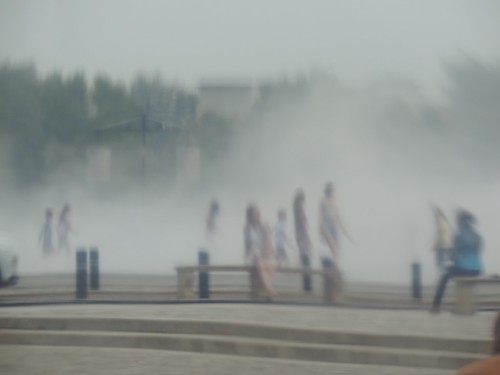
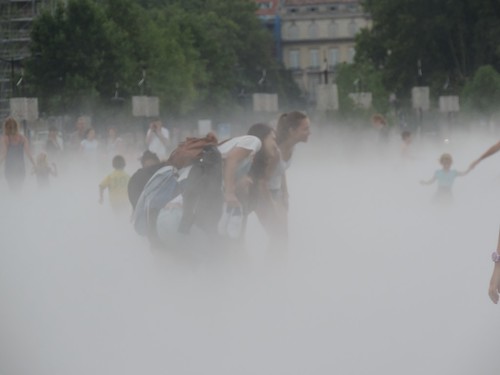

In all three shots we know we are looking at people. Sure, as the images become more clear we can see more detail, but isn’t it interesting that we have a pretty good idea of what we are looking at right from the first image?
Wow! Isn’t the ability to SEE just amazing? And how wonderful that we continue to learn how we do that. We often forget that our level of understanding is just our current level. It’s never complete. It’s never the “full story”. What more will we learn even in my lifetime?
Posted in from the dark room, from the living room, life, photography, science on July 22, 2014| Leave a Comment »

I came across a discussion the other day where various scientists were asked to say which species would take over the Earth if human beings eliminated themselves. (I think the question was provoked by the movie “Planet of the Apes”)
The discussion raises interesting questions for us. What does it mean “take over the Earth”?
In what sense? As one of the respondents pointed out bacteria have already far exceeded human beings in numbers (also in sheer biomass) and in adaptability – there are bacteria everywhere – in the mouths of volcanoes, in ice flows, at depths of the ocean unreachable by human beings and living on, and in, human beings to the extent that about 90% of the DNA found in your body is bacterial.
Insects such as ants also exceed humans in biomass and numbers and can co-ordinate activity amongst millions in ways which are just astonishing to human beings.
Many organisms already live many more years than human being do – some species of trees for example live hundreds of years.
So if the question is about colonising, adapting to, and surviving on, planet Earth, we’ve already been surpassed.
Which begs the question about simple evolutionary theory – if evolution is about survival of the fittest with random mutations being selected for, what’s the evolutionary advantage in producing such complex creatures as human beings?
Different species have adapted in extremely different ways. Isn’t it a bit naive to think of human beings as being in control of the Earth in any sense? And isn’t diversity beautiful? And astonishing!
Oh, and when it comes to evolution isn’t it the evolution of consciousness, not survival of the fittest that helps us to understand our place in the universe?
Posted in education, from the consulting room, from the living room, from the reading room, health, life, neuroscience, personal growth, science on July 7, 2014| Leave a Comment »
There are something like 100 billion neurons in your brain – a literally mind boggling figure. Are you really able to imagine what a 100 billion of anything looks like?
As if that weren’t challenging enough, each neuron has up to 50,000 connections with other neurons, and each connection (a synapse) is an electro-chemical switch of a sort – passing information and energy across the gap between two neurons. This makes the total number of states of the brain (number of “on” or “off” neurons) a figure which is……well, unimaginably huge!
I was taught at university that a synapse was a pretty simple connection between two cells where on neuron released a chemical, which then crossed the gap and stimulated the next neuron. This, of course, is a huge oversimplification.
Researchers have recently managed to describe a single synapse much more accurately.
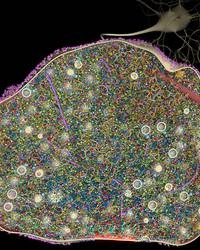
The new model shows, for the first time, that widely different numbers of proteins are needed for the different processes occurring in the synapse,” says Dr. Benjamin G. Wilhelm, first author of the publication. The new findings reveal: proteins involved in the release of messenger substances (neurotransmitters) from so called synaptic vesicles are present in up to 26,000 copies per synapse. Proteins involved in the opposite process, the recycling of synaptic vesicles, on the other hand, are present in only 1,000-4,000 copies per synapse. The most important insight the new model reveals, is however that the copy numbers of proteins involved in the same process scale to an astonishingly high degree. The building blocks of the cell are tightly coordinated to fit together in number, comparable to a highly efficient machinery. This is a very surprising finding and it remains entirely unclear how the cell manages to coordinate the copy numbers of proteins involved in the same process so closely.
It’s not just the numbers which are astonishing, its the complexity, and that last sentence particularly struck me – “it remains entirely unclear how the cell manages to coordinate the copy numbers of proteins involved in the same process so closely”
Just how much DO we know about how the human body works? How much DO we know about how it evolves to this level of complexity, both through an individual lifetime from the fertilisation of a single egg cell to a fully grown human being, and throughout history from single celled life forms to the multi celled human beings?
Humility. That’s what we need as scientists. Humility. Our ability to discover and understand is astonishing, but so far pales in comparison with the complexity of a single human being.
I’m amazed.
Posted in from the consulting room, from the living room, health, life, personal growth, photography, science on July 3, 2014| Leave a Comment »
“Evidence Based Medicine” is a movement in crisis according to a recent BMJ article by doctors who want to improve it. Many of the responses to the article call for better statistics, more effectively communicated, and one in particular makes a plea for less but better protocols. One doctor talks about a friend who worked as a sailor in command of a nuclear submarine. He said the crew had to learn and consistently apply a small number of protocols and suggests that doctors should do the same.
There is a confusion at the heart of this comment, and in some of the assumptions behind statistics based medicine.
The confusion is that human beings are just complicated machines.
One way to clear up some of this confusion is to think about the differences between the terms complicated and complex.
Machines can be complicated. Technology can be complicated. Anything which is made up of many, many parts which are connected up can be complicated.
So, aren’t human beings complicated then? Aren’t human beings made up of many, many parts which are connected up?
Yes.
Any living organism has many, many parts which are connected up, but there’s a difference.
Living organisms are complex adaptive systems.
Complex adaptive systems have certain characteristics we don’t see in machines not matter how complicated they are. Here are four of them (there are more!)
Non-linear connections
You’ll have heard of the butterfly effect? Where a butterfly flapping its wings in the Amazon can cause a hurricane in another part of the world? What that illustration tells us is that very small changes in the starting condition of a system can cascade to rapidly produce very large changes in the outcome. This is the nature of most of the connections in living organisms
Emergence
Complex adaptive systems continuously behave in unpredictable, novel ways. Emergence is a term from biology which describes novel behaviours which could not have been predicted from an examination of the previous state.
Co-evolution
All living organisms exist within specific environments and because they are “open” ie constantly exchanging materials and energy with their environment, both the organism and the environment are constantly influencing each other, constantly responding to each other, and, in fact, even affecting each others evolution. You cannot fully understand a living organism by isolating it from the environment in which it exists.
Autopoesis
This is a term which means “self making capacity”. Not only can living organisms repair themselves, but they can grow, mature, develop and even replicate themselves.
Yes, all that is pretty complicated. But not in the same way a nuclear submarine is complicated. Advanced technologies might seem as if they are alive, but they aren’t.
If we forget this, we try to engage with living organisms as if they are just complicated machines which can be broken down into separate measurable parts, each of which can be managed by the application of protocols.
Living organisms need to be understood as complex, not complicated.
Posted in from the dark room, from the living room, life, narrative, perception, personal growth, photography, science on June 23, 2014| 1 Comment »
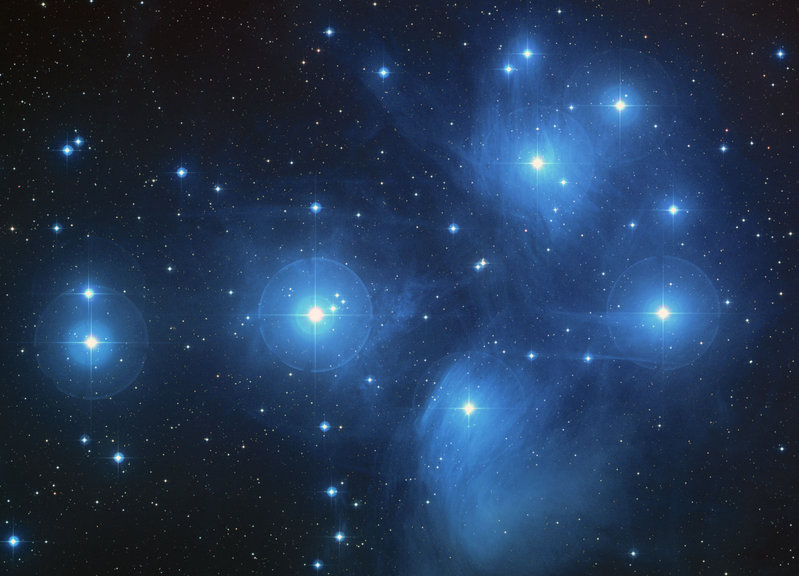
Which of the constellations in the night sky do you recognise? I wonder if one of them is the seven sisters – “Pleiades”.
I read the following in Gary Lachman’s “A Secret History of Consciousness”
In a fascinating chapter of Cities of Dreams, Gooch sets forth the evidence that this undistinguished group, made up of fourth-magnitude stars—not particularly brilliant—was not only known to our ancient ancestors, but appears in the mythology of many disparate peoples, and in exactly or nearly exactly the same context. For example, for the ancient Greeks, the story went like this: Orion the hunter came upon six sisters and their mother one day in a wood. Burning with lust, he chased the sisters through the wood for five years, whereupon Zeus took pity on the girls and changed both them and Orion into stars, hence the constellations of Orion and the Seven Sisters. Strangely, a very similar myth exists among the Aborigines of Australia. Wurrunna the hunter was out in search of game, when he too came upon a group of seven girls. He grabbed two of them and took them as wives on the spot. However, the trees in the forest took pity on the girls and suddenly grew to a tremendous height; the five free sisters climbed to the sky, as did the other two, thus escaping Wurrunna……..The Pleiades are always known as the Seven Sisters, and they are always hunted. Likewise, they always escape, either through magical means or through the intervention of a god………The Pleiades also have the unchallenged distinction of being the only constellation noted and named by every culture on the planet, past or present.

 Heroes Not Zombies