Any botanists reading this?
If so, what’s going on here?
Why do some of these flowers have six petals…..

and some have seven…….?

Nature loves diversity
Posted in from the dark room, from the living room, life, photography, science on June 10, 2014| 2 Comments »
Any botanists reading this?
If so, what’s going on here?
Why do some of these flowers have six petals…..
and some have seven…….?
Nature loves diversity
Posted in from the dark room, from the living room, life, perception, science on June 9, 2014| 1 Comment »


There’s no doubt that spider webs are beautiful, but spider’s silk is a very complex fibre which has remarkable qualities. It’s strength is legendary, but now researchers from Oxford, Strathclyde and Sheffield have discovered that one of the main ways spiders use their webs is, well, musical.
Most spiders have poor eyesight and rely almost exclusively on the vibration of the silk in their web for sensory information,’ said Beth Mortimer of the Oxford Silk Group at Oxford University, who led the research. ‘The sound of silk can tell them what type of meal is entangled in their net and about the intentions and quality of a prospective mate. By plucking the silk like a guitar string and listening to the ‘echoes’ the spider can also assess the condition of its web.
Dr Chris Holland of the University of Sheffield, an author of the paper, said: ‘Spider silks are well known for their impressive mechanical properties, but the vibrational properties have been relatively overlooked and now we find that they are also an awesome communication tool. Yet again spiders continue to impress us in more ways than we can imagine.’
Isn’t that amazing and wonderful? That spiders set and sense the vibrations and frequencies in the silk they weave to know how healthy their webs are, and to know, from the “music” of the web, what they have trapped.
Wonder!
Posted in books, from the dark room, from the living room, life, philosophy, photography, science on June 4, 2014| Leave a Comment »
One of Henri Bergson’s concepts is that evolution is a creative process.
Bergson saw life as an immense current of consciousness, a spiritual force, brimming with potentialities, penetrating matter and organizing it, “colonizing” it, as it were, in the service of increasing its own freedom. Matter, resistant to life’s impulses, impedes its advance and scatters its energies. Yet, as he argues in Creative Evolution, this current of consciousness seems to have been successful in at least three attempts to gain a foothold on matter: in the plant world; in the world of the insects; and in the vertebrates, who have so far culminated in ourselves.
He says
The vegetable world has fallen asleep in immobility…..In the world of the insects, specifically in the ants, what life gained in social organization and cooperation, it lost in initiative and independence; here instinct rules supreme…..the ant shows little in the way of intelligence, being completely dominated by instinct


If in plants and insects life has “stalled,” in the vertebrates there still remains the possibility of setting free “something which in the animal still remains imprisoned and is only finally released when we reach man.”8 For Bergson, humankind is the front line of evolution, the tip of the élan vital’s advance, the being in which the life force has most successfully organized matter to its own end of increasing its knowledge of itself and its freedom
Posted in from the dark room, from the living room, life, neuroscience, perception, philosophy, photography, psychology, science on May 26, 2014| 1 Comment »

There is an astonishing amount of information from the environment flooding into your brain every single second. Think just about the information picked up by your sensory organs. All the sounds your ears can hear, all the light, colours and shapes your eyes can see, all the scents your nose can smell, all the textures your body can feel, all the flavours your tongue can taste. All of these, plus all the information being sent to the brain from within your body, plus all the information generated by your brain itself (your thoughts, memories, imaginings), are continuously flooding through the billions of neurones in your brain.
Why doesn’t that overwhelm us?
I’m nor sure anyone can fully answer that question, but at least we do know we have two ways of dealing with all these continuously changing information flows.
One way handle it is to use our brains as filters or valves.
William James, the psychologist said
one function of consciousness is to carve out of the vast sensory environment—what he called the “blooming, buzzing confusion”—a manageable, edited-down version. Only a limited amount of information reaches our conscious awareness, and for the very good reason that the majority of it is irrelevant.
The “blooming, buzzing confusion”….nice phrase!
He thought that
consciousness selects from the world at large elements that are of particular value and interest to it
In other words, consciousness enables us to “edit” the information flows, to focus on what is of “value and interest” – that, of course, opens up a whole other can of worms about how we decide what is of “value and interest”, but let’s leave that for another day.
Henri Bergson, the philosopher, argued that the brain’s function
was to act as a kind of “reducing valve,” limiting the amount of “reality” entering consciousness.
He said
“The brain is the organ of attention to life,” and the part it plays is that of “shutting out from consciousness all that is of no practical interest to us
Same idea as James…..the brain, or consciousness at least, as an editor, or a valve. In both cases the idea is that we reduce the full flow of information and pay attention to only part of it.
Iain McGilchrist argues that this is primarily the function of the left hemisphere – which “re-presents” the information flows to the brain.
There are great benefits to be had from being able to abstract information from the vast rivers washing through our brains, to be able to focus, and to concentrate on, just a subset, or a part of the world. We use this ability to both “grasp” and manipulate the world…..to exert our will on it, to exert control.
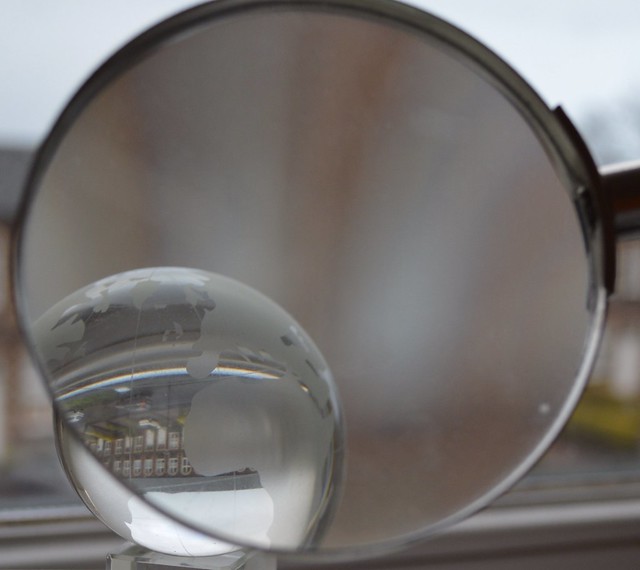
The downside is that we can begin to forget that we’re doing the editing in the first place. We lose sight of the filters and valves and think that what we “see” is all there is.
As Gary Lachman says in his “Secret History of Consciousness”
Yet one drawback to the brain’s highly efficient ability to focus on necessities is that it “falsifies” reality, which, as Bergson earlier argued, is in truth a continuous flow of experience…….The mind constantly takes snapshots, as it were, of reality, which enables it to orient itself amidst the flux. The problem is that science, which takes the most comprehensive snapshots, makes the mistake of confusing the photographs with reality itself.
Just as we have an immediate, irreducible awareness of our own inner states, through intuition we have access to the “inside” of the world. And that inside, Bergson argued, was the élan vital
there is a process in the brain that is itself antireductionist and is concerned with creating wholes out of parts, and hence with giving meaning to our experience.


Posted in from the consulting room, from the living room, from the reading room, from the viewing room, health, personal growth, science, video on May 21, 2014| 1 Comment »
I like Michael Pollan’s views on food. You might be aware of his “food rules”……summarised in the following seven words
Eat food. Not too much. Mostly plants
What he is great at doing is bringing together knowledge from a number of disciplines (nutrition, economics, agriculture, anthropology, politics and so on), and weaving them into a seamless, and convincing narrative. He does that wonderfully in this google talk where he discusses his latest book, “Cooked”. Settle yourself down and watch this. It’s just under an hour, but that includes the Q&A, and I recommend skipping the over two and half minute intro from the google staffer!
In “Cooked” he describes learning the four transformations of food – using fire, using pots (water), baking (air) and fermentation (earth). His argument is compelling and the area of fermentation (using microbes to produce cheeses, pickles etc) is a completely fascinating new subject to explore.
One of the gems from this talk is his telling of the answer he received from someone working in the food processing industry when he asked what we could do about the obesity epidemic. The answer was “Only eat what you have made yourself”. He thinks that one principle (probably hard to adhere to 100% but a good target to aim at) would result in a healthier and more nutritious diet.
This piece doesn’t just get you thinking about the place of food in your life, it gets you thinking about the food industry, about politics and about how we might create a more sustainable way of life just by considering this important (probably central) issue of what we eat, and how it is prepared.
Posted in from the dark room, from the living room, life, perception, personal growth, philosophy, photography, science on May 14, 2014| Leave a Comment »

We have developed a strange way of thinking about the relationship of human beings and Nature. In fact, that very sentence is an example of how we think. There’s us, human beings. And there’s Nature. They are different. We separate ourselves out from other forms of Life, and from all the other ways Life manifests itself in Nature. We think we are not the same as other creatures. Maybe a bit like apes, maybe a bit like other mammals, but certainly not like flowers or trees. And even if we identify with LIFE in its multitude of forms, we still think of ourselves as separate from the other forms of Nature – earth, rock, water, wind, energy.
But we don’t stop there. We don’t just consider ourselves separate from, and in some way outside of, Nature. We tell ourselves Nature is there for us to exploit, to consume and to control. We think of being in a constant battle with Nature, wrestling with its power and its potential to do us harm. We conceive of the evolution of Life as a perpetual competition, a striving to survive, and only the strongest will win that battle.
But what kind of lives does that kind of thinking create for us? What kind of Nature does that attitude bring into existence? What daily experience do we have when we live from that perspective?
Over the last hundred years, physics has shown us that there are no separate, discreet, irreducible “particles” which are the “building blocks” of reality. We have begun to understand (or maybe rediscover) that any sense of separateness is a creation of the human mind. In particular we use our left cerebral hemisphere to filter and re-present the phenomena of reality to ourselves. This gives us a view which declares boundaries, and which creates the impression of separateness. As we explore the connections, the bonds and the relationships we begin to experience Life quite differently. And as we take on board the phenomenon of integration – of the creation of mutually enhancing bonds between well differentiated parts – we begin to see how co-operation is the basis of evolution, at least as much as, if not more than, competition.
So we can change our focus, taking on board Einstein’s question of whether or not we think of the universe as a friendly place, and then we see in Nature not just the inter-connectedness of everything, but how this Earth is perfectly created to sustain and develop Life itself. How everyday life is only possible because of the innumerable beneficial links between ourselves and others, between ourselves and other species, between ourselves and those who have lived before us, and between ourselves and the rest of the Universe from which we emerge.
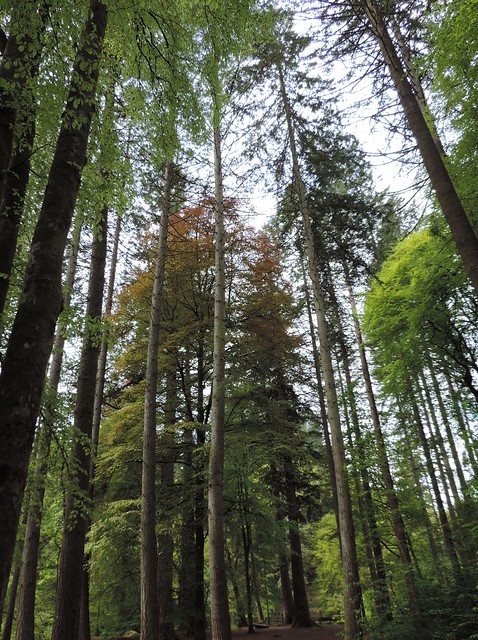
The image above is a path. I think it is beautiful and shows an intimate relationship between human beings and trees. Here’s another path, quite different from that one, but which also makes me think about the paths we create as we live in this world.

Maybe it’s time to create a better path? A more “natural” path?
Posted in from the dark room, from the living room, from the music room, life, music, photography, science on May 12, 2014| Leave a Comment »
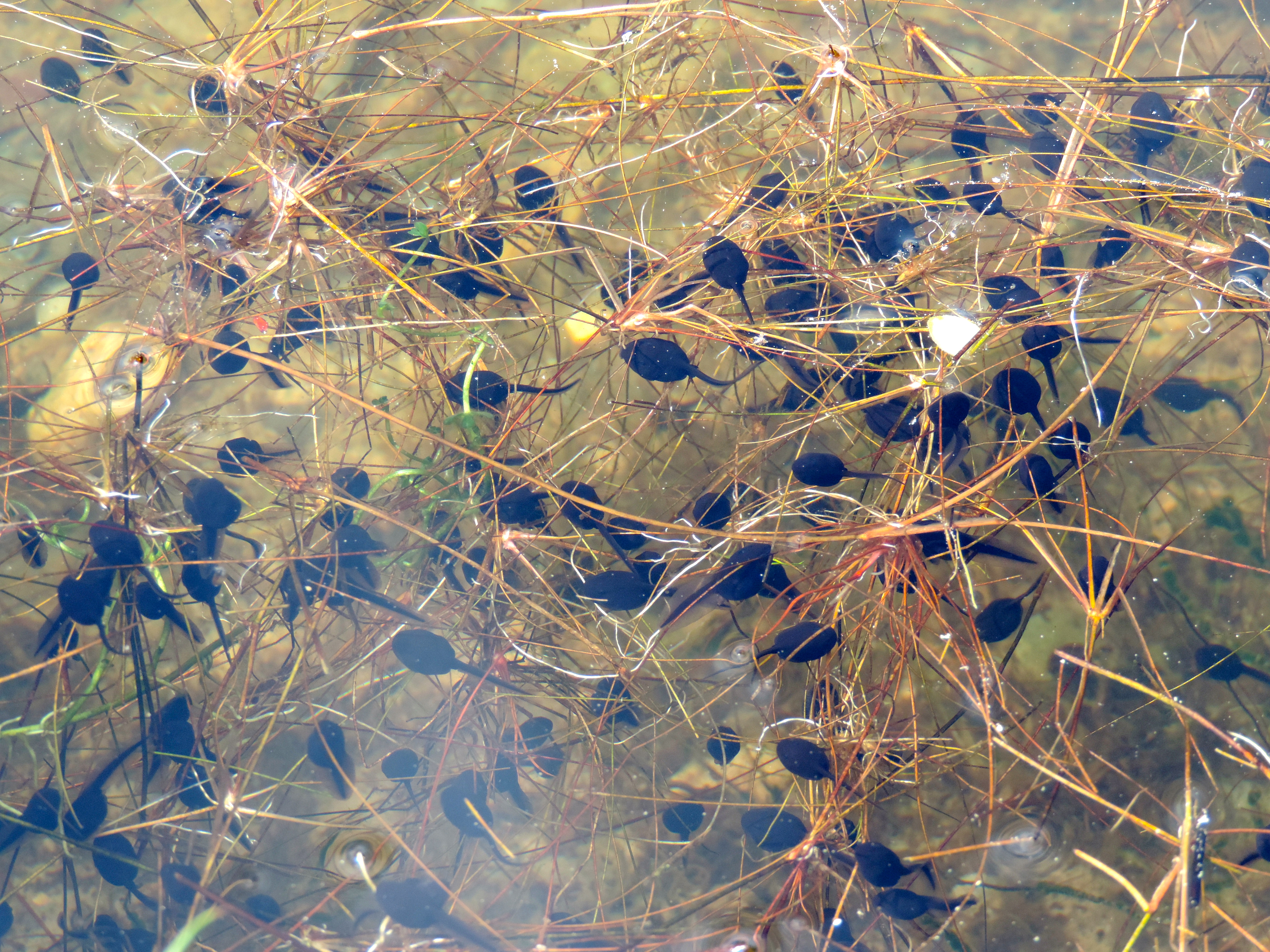
Spotted these tadpoles in a pond up near Aberfeldy yesterday. This shot of them captured only a small portion of the hundreds swimming around the edge of the pond.
What do you think about when you think of tadpoles?
I bet you don’t think what I do.
Here’s what happens when I see tadpoles. I hear a song in my head. “Share it” by Hatfield and the North.
Do you know that song? Do you know why I hear it when I see tadpoles? Well, when I was a teenager, my friends and I were great fans of bands like Soft Machine, Caravan, Camel, and Hatfield and the North. So when Hatfield and the North played the Student Union at Edinburgh University we went along. My friend Ian seemed to know all the words of their songs and sang along. At the end of the concert, Ian made for the front and asked Richard Sinclair, the singer a question. The question?
“I can make out all the words of ‘Share it’ apart from the first one. It’s “something is screaming in my ear” but what’s the something? Richard Sinclair leaned down from the stage and whispered one word into Ian’s ear. What was the word?
Tadpoles.
If you don’t know the song, here it is
Listen carefully to the very first word. You’ll see he wasn’t kidding!
But do you know what amazes me most about tadpoles? Metamorphosis.
During metamorphosis, a tadpole loses it tail, grow legs, loses its gills and grows lungs, rewiring it’s nervous system and on and on…..the number of changes are astonishing. How does it do that? We know a little bit about some of what’s involved (hormonal changes and different responses in different tissues to the same hormones) but we absolutely don’t know how these these massive changes are co-ordinated.
Amazing. Completely amazing
Posted in books, education, from the dark room, from the living room, from the reading room, life, neuroscience, personal growth, psychology, science on May 10, 2014| Leave a Comment »

It seems we didn’t evolve into human beings in a smooth, seamless way, but more with a pattern of great leaps and long, slow changes.
One of these great leaps was in the growth of the size of the brain. One of our pre-human ancestors, Homo erectus, had much smaller brains than we do, but over the course of 200,000 generations (2 million years), their brain size roughly doubled in size, taking them up to about the same size as brain as we humans have (since about 500,000 years ago).
As Stephen Oppenheimer states, rapidly increasing brain size was a key feature that set humans apart from the walking apes that lived before 2.5 million years ago. Since then our brains have trebled in volume. This increase was not gradual and steady: most of it came as a doubling of volume in Homo erectus 2 million years ago. The greatest acceleration in relative brain size occurred before 1.5 million years ago – early in our genus. Modern humans – and Neandrathals – living before the last ice age 20,000 to 30,000 years ago had bigger brains than do people living today. (from)
Interestingly, brain size in humans hasn’t increased over the last half million years (indeed it’s shrunk a bit!), but what has happened is rapidly increasing asymmetries in the brain. It’s not just that our massive cerebral cortexes are asymmetrical, but within each area of the brain there are highly specialised areas. In other words, its a story not just of an increase in size, of adding more and more neurones, but of complexity.
Here’s one of the puzzles about evolution though – how on Earth did brains evolve so quickly? You might say 2 million years doesn’t seem that quick but look at the speed of change.
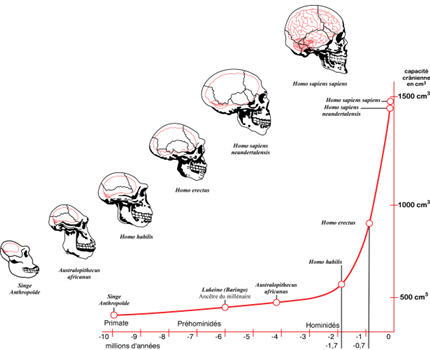
This is why some people refer to the growth of the human brain as the second “Big Bang”…….although I do like the idea of a “Great Leap”!
Posted in books, from the dark room, from the living room, life, personal growth, philosophy, photography, science on May 8, 2014| 1 Comment »


I came across this phrase of Emerson’s the other day
Tis curious that we only believe as deep as we live.
And the first thing I thought was “Tis curious that we only live as deep as we believe”! But then I decided to track it down and see it in its context. It comes from his “The Conduct of Life” in the section where he writes about beauty. There are some real gems in that piece of writing.
Our books approach very slowly the things we most wish to know. What a parade we make of our science, and how far off, and at arm’s length, it is from its objects! Our botany is all names, not powers: poets and romancers talk of herbs of grace and healing; but what does the botanist know of the virtues of his weeds?
Can we really know about plants only by treating them as objects to measured, weighed and classified? And what happens when we apply that approach to human beings too?
We should go to the ornithologist with a new feeling, if he could teach us what the social birds say, when they sit in the autumn council, talking together in the trees. The want of sympathy makes his record a dull dictionary. His result is a dead bird. The bird is not in its ounces and inches, but in its relations to Nature; and the skin or skeleton you show me, is no more a heron, than a heap of ashes or a bottle of gases into which his body has been reduced, is Dante or Washington.
“The bird is not in its ounces and inches, but in its relations to Nature”. Wow! How true is that? And isn’t that exactly where our present approach often falls down? We fail to see what we are studying in its “relations”.
The motive of science was the extension of man, on all sides, into Nature, till his hands should touch the stars, his eyes see through the earth, his ears understand the language of beast and bird, and the sense of the wind; and, through his sympathy, heaven and earth should talk with him. But that is not our science. These geologies, chemistries, astronomies, seem to make wise, but they leave us where they found us.
and
Science in England, in America, is jealous of theory, hates the name of love and moral purpose. There’s a revenge for this inhumanity. What manner of man does science make?
These last two passages raise a subject we don’t hear much about, but I think we are beginning to hear more now, and will hear even more in the years ahead. It relates to Einstein’s famous question about the Universe….
And it also relates to Iain McGilchrist’s point about the two different approaches to the world from our two different cerebral hemispheres. If it’s true, which I think it is, that we create the world we live in through what we pay attention to, what our values and beliefs are, then what kind of world do we create from this detached, materialistic scientism?
What is life like for someone who sees things that way? And what’s life like for someone who sees things the way Emerson is suggesting? Do you think the Universe is a hostile place, that everything happens by chance, and nothing has any meaning?
What I share here in this blog is just my experience, just snippets from the life of me, how I experience life, what stimulates my thinking, my passions, my imagination. But it’s the way I approach the world which creates this particular world I’m living in and sharing with you.
Posted in from the dark room, from the living room, life, personal growth, photography, science on April 24, 2014| Leave a Comment »
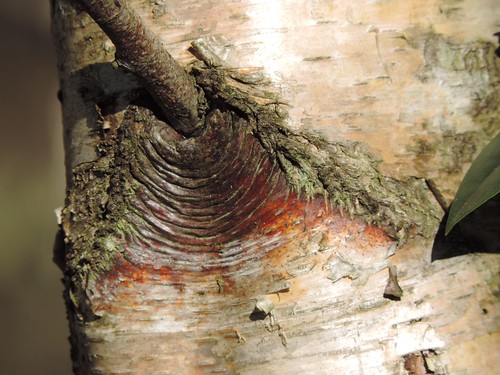
Take a look at this photo. It shows the growing new(ish) branch emerging from the trunk of a birch tree.
What stuns me is the beauty and the complexity. We don’t just see the new branch emerge like a stick or a stem, but we see all those ripples of activity on the main part of the tree.
I find all new life amazing but this is the first time I have noticed such elaborate and beautiful effects on a tree. It’s clear that how this birch tree grows is surprising and, I suspect, neither completely explained by science, nor in any way predictable in detail.
Could anyone predict exactly where a particular tree will produce new branches, and can anyone explain how the cells organise themselves to differentiate and multiply in this specific pattern?
I find it engaging and wonderful.

 Heroes Not Zombies