Prayer is a pretty universal human activity. Even if you don’t pray formally I’m sure you’re very familiar with prayers in places of worship, or in peoples homes. You’ve probably seen athletes whispering prayers and turning their eyes up to the heavens at the start line, or holding their hands high in thanks after crossing the finishing line first.
There are many types of prayer, some learned by heart and recited, others personal and spontaneous. However I think there are at least two genres of prayer which most of us engage with, and both have been shown in many studies to have beneficial effects on health and quality of life.
The two are hope and gratitude.
Without hope life shrivels up. When all hope is lost people collapse, disintegrate or even die. I think hope is an essential aspect of a healthy life. We all need a reason to get up in the morning, a belief that our children and grandchildren can live healthy flourishing lives.
Gratitude and the practice of writing a gratitude journal is a powerful way to improve quality of life. It focuses us on what’s positive, makes us pay attention to the daily small wonders and delights. It’s an antidote to frustration and discontent.
Sometimes something catches my eye and makes me smile. Usually it’s an unexpected juxtaposition of two things. I guess that’s how jokes work…they bring together two apparently unconnected things and they surprise you.
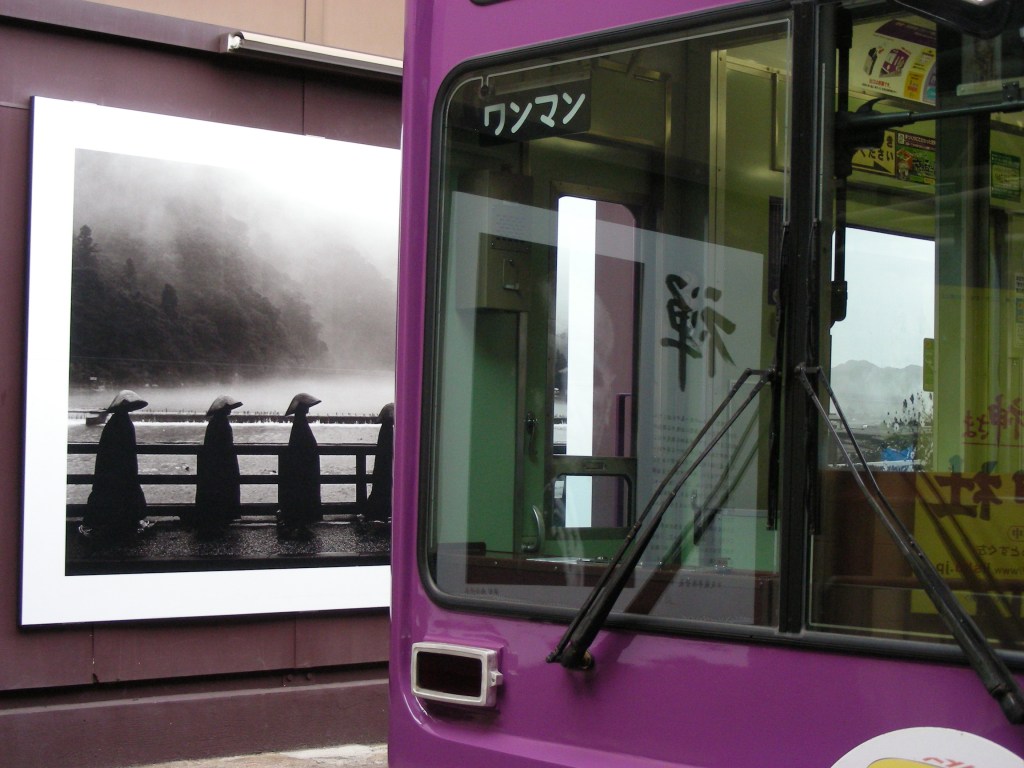
I had just stepped off this tram in Kyoto when I noticed the black and white photo on the wall. I couldn’t help seeing it as a virtual queue of people making their way onto the empty tram which would then depart, taking them with it.
I did wonder for a moment if I looked away, waited a moment, then looked back, whether I’d see a space where the tram had been and a photo of a landscape with no people visible.
The garden of the house we’ve bought is pretty large and it has a wooded area at the top. The whole garden is somewhat neglected and the wooded area in particular is a dense thicket of vines, massive brambles and the biggest creepers I’ve ever seen in my life.
I’ve written about integration a number of times on this blog describing how it involves both chaos and order, or, as some would say, wildness and discipline. Well this woodland area is a great example of too much wildness. I have a feeling that if I ever make it all the way through the thicket to the back of the garden I might discover Sleeping Beauty in her glass case!
I’ve read a bit about the concept of a forest garden where various plants, including some edible ones, are planted amongst the trees, and I fancy trying that idea. But I’m also very aware of the benefits and delights of “forest bathing” so just want to be able to enjoy spending some time amongst the trees.
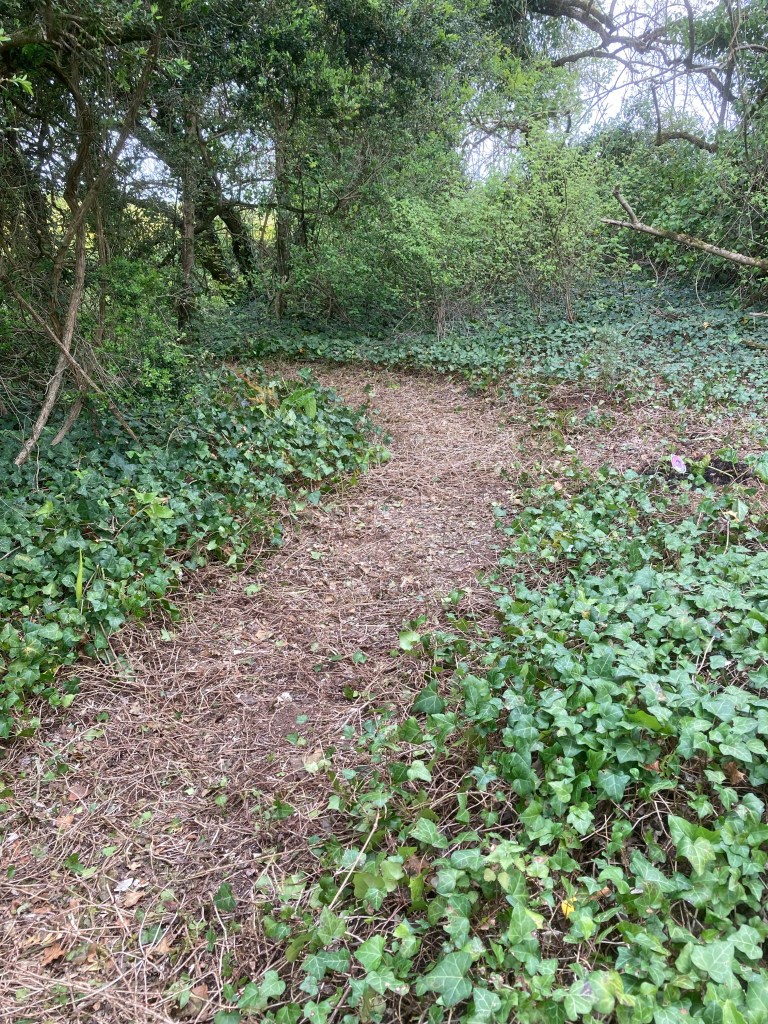
Here’s my plan – start by creating some simple paths. This involves cutting down and removing enough brambles, creepers and climbers to create a passageway through the trees. Then I set the lawnmower to its highest setting and ran it over the ground covering vines to make a path. The next step is clearing the floor of the path of roots and creepers and the edges of the path of thorns, dead trees and saplings.
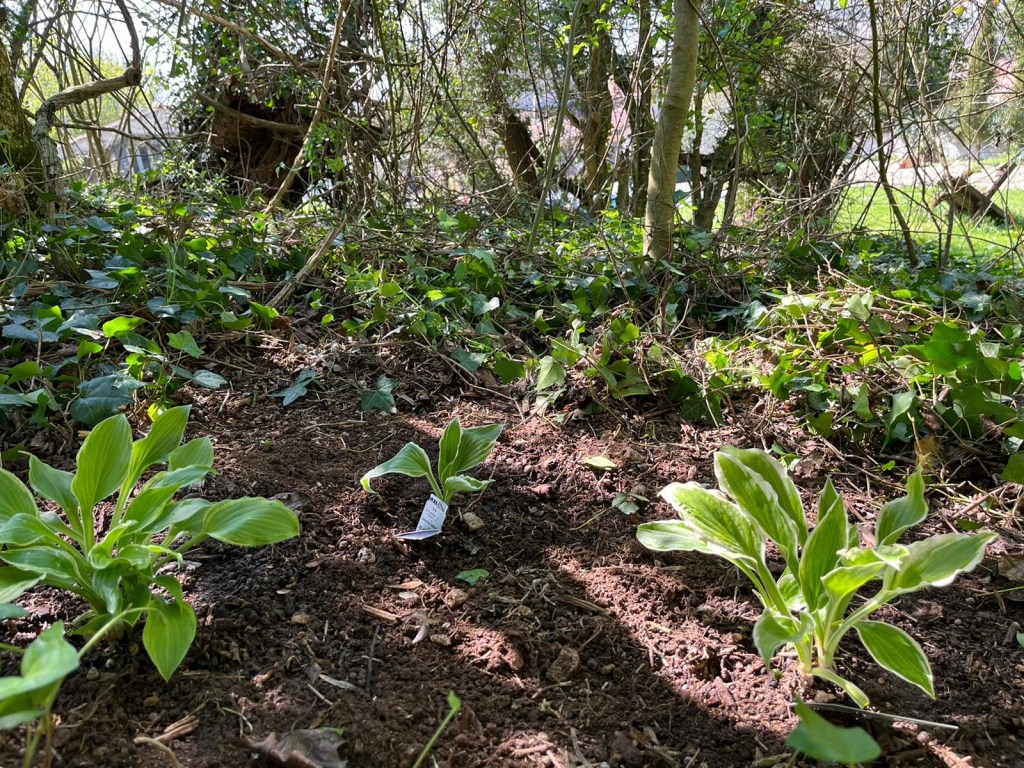
The photo at the beginning of today’s post is of a part of the first path I’ve made.
All this work, and it’s a lot of work, is immensely satisfying. I can now see the sun shining through the trees and clearings. It’s like seeing the woodland breathe again. I’m walking the path a few times a day to establish it, but also to enjoy the experience of being surrounded by birdsong in amongst the trees.
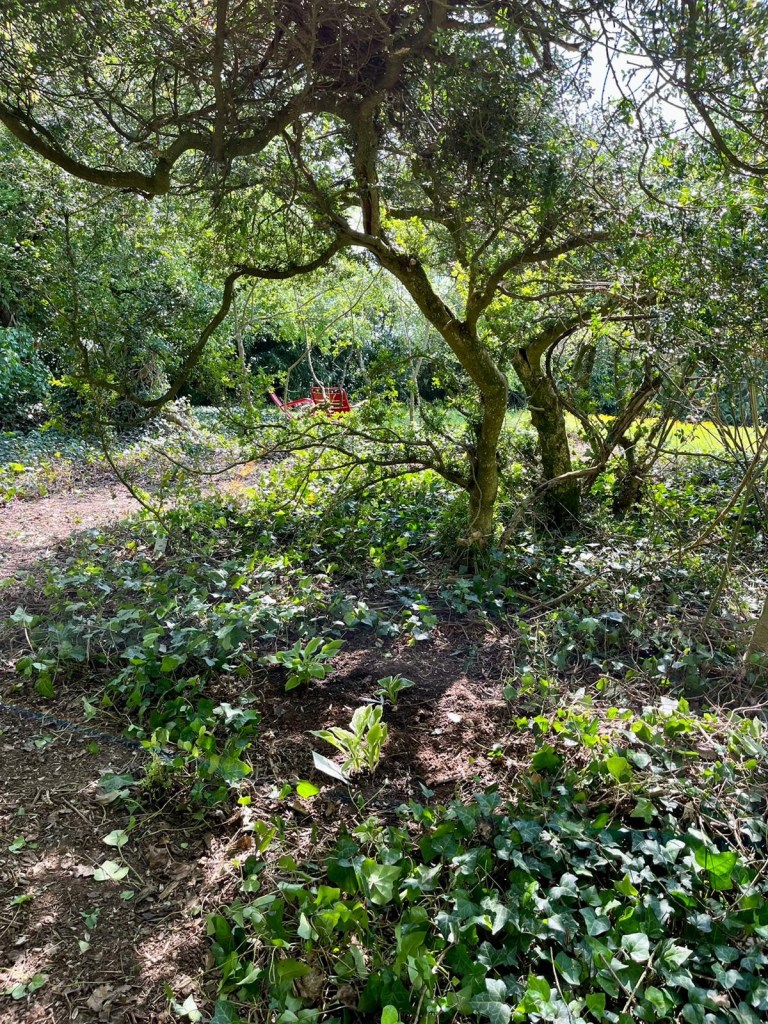
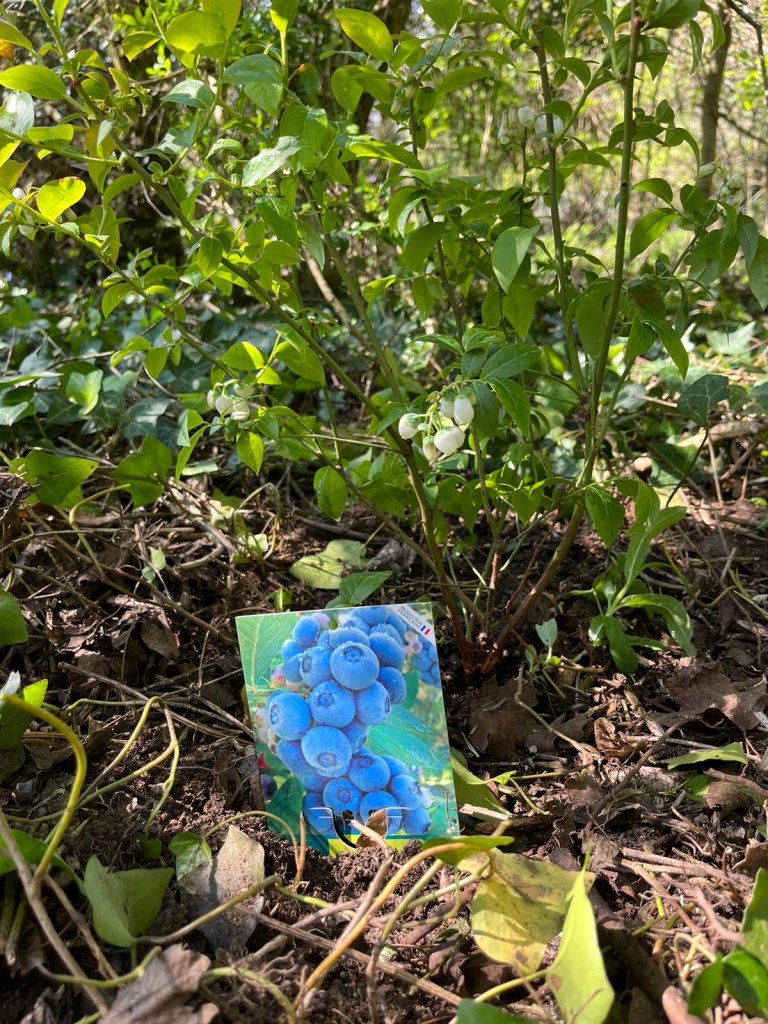
So, I’ve arrived at the next stage and have planted a fern, a blueberry bush and some hostas along the margins of the path.
This is all new to me. I haven’t been a gardener before moving to France and I haven’t even lived somewhere with a garden for many years. So I’m exploring, reading and learning. It could be a bit daunting to try to introduce some order into the wild areas but I’ve decided to take it a little bit at a time. I’ve scoped out the rough direction of the next path but this first one is already bringing me a lot of joy.
I’ve known for many years that spending time in natural environments is good for body, mind and soul, as is gardening, but it’s only now that I’m experiencing the reality of that knowledge for myself.
I’ll bring you updates in the weeks and months ahead and I’m very open to advice and recommendations.
People aren’t simple. Any attempt to reduce a person to a single category dehumanises them. You can’t see, can’t hear, can’t understand someone if you put them into one or even several boxes.
To reduce a human being to a statistic or a particular characteristic does exactly that. It reduces them.
I had a habit of beginning a consultation with a new patient by saying “tell me your story”. They would then tell me a unique narrative, constructed from an endless variety of threads.
I stumbled across a Twitter spat the other day about Covid deaths. The U.K. government publishes the number of people reported each day to have died with a positive Covid test in the last 28 days. The argument was along the lines “but did these people actually die from Covid or something else?” And was this over-reporting or under-reporting.
One argument was the measure was absurd because someone might have died from walking in front of a bus but have had Covid recently. Others said such trauma cases were excluded. I thought “what a strange argument. On the one hand, death from a road accident is surely not a death from Covid, but on the other hand covid is known to seriously impair cognitive function so maybe if they hadn’t had Covid they wouldn’t have walked in front of a bus”.
One thing we know about Covid is it’s more likely to kill you if you have “co-morbidities”, if you’re elderly, frail and/or poor. All of which highlights the fact that neither life nor death are simple. Trying to categorise or label them is fraught with difficulties and misunderstandings.
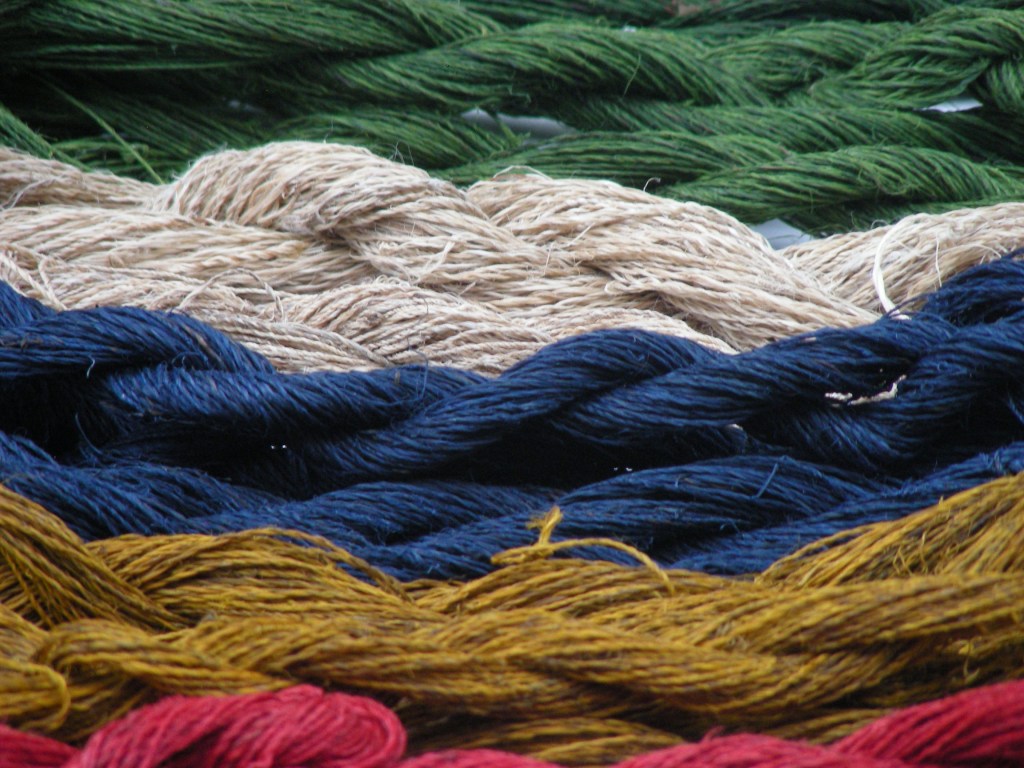
So my preference is to avoid reductionism as much as possible. All deaths are multifactorial. All lives are multifaceted. Our individual stories are rich tapestries of multiple, probably countless, threads, some of which can be known, many of which never will be.
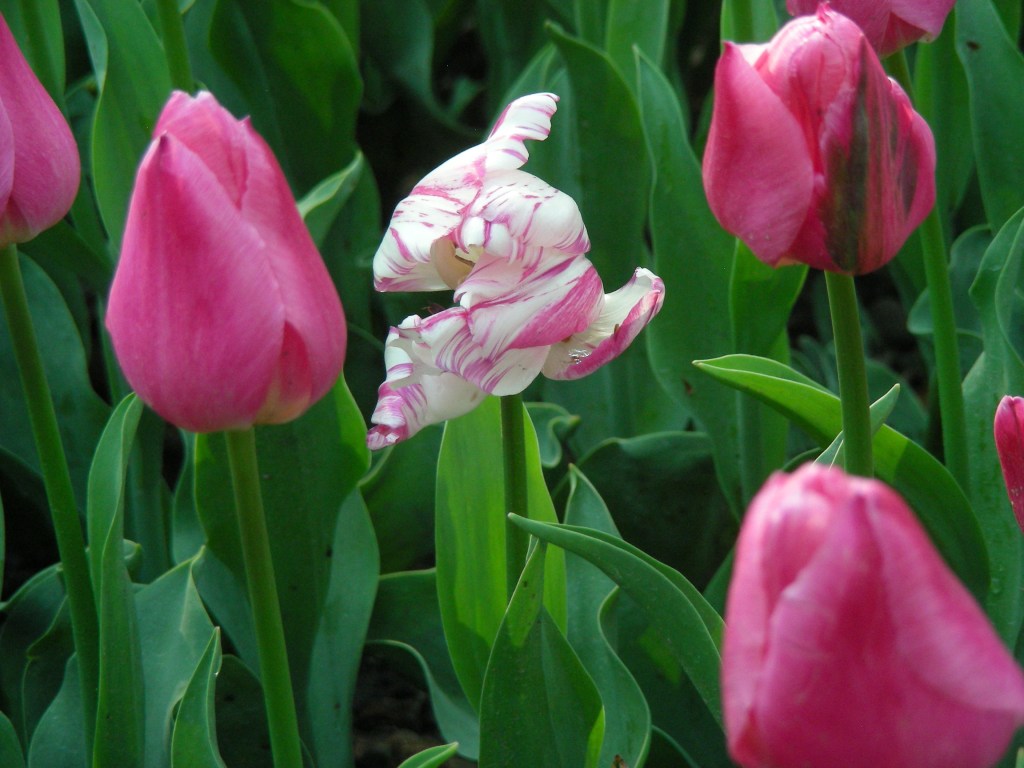
I never cease to be amazed by the transition from a bud to a flower. That tight knot of petals unfurling by growing and opening up at the same time is a wonder to behold.
I think it’s the opening up aspect which appeals to me so much. There’s a sense of revelation there. I see the tight little bud as a container of a secret, and the unfolding of the petals as a revelation.
In French there’s a wonderful word – épanouissement – which translates as blossoming, growing, maturing – used to describe this stage of a plant’s life, but also used to describe a feature of human personal growth and development.
The idea of an unfolding of potential, of growing into one’s own uniqueness, of flourishing and blossoming, delights me.
There is so much beauty and wonder in this “normal” phenomenon. I’d include this idea of épanouissement in my concept of health now.
Health is much more than the absence of disease. It’s a state of flourishing which involves revelation, opening up to the world and to others, and the expression of uniqueness.
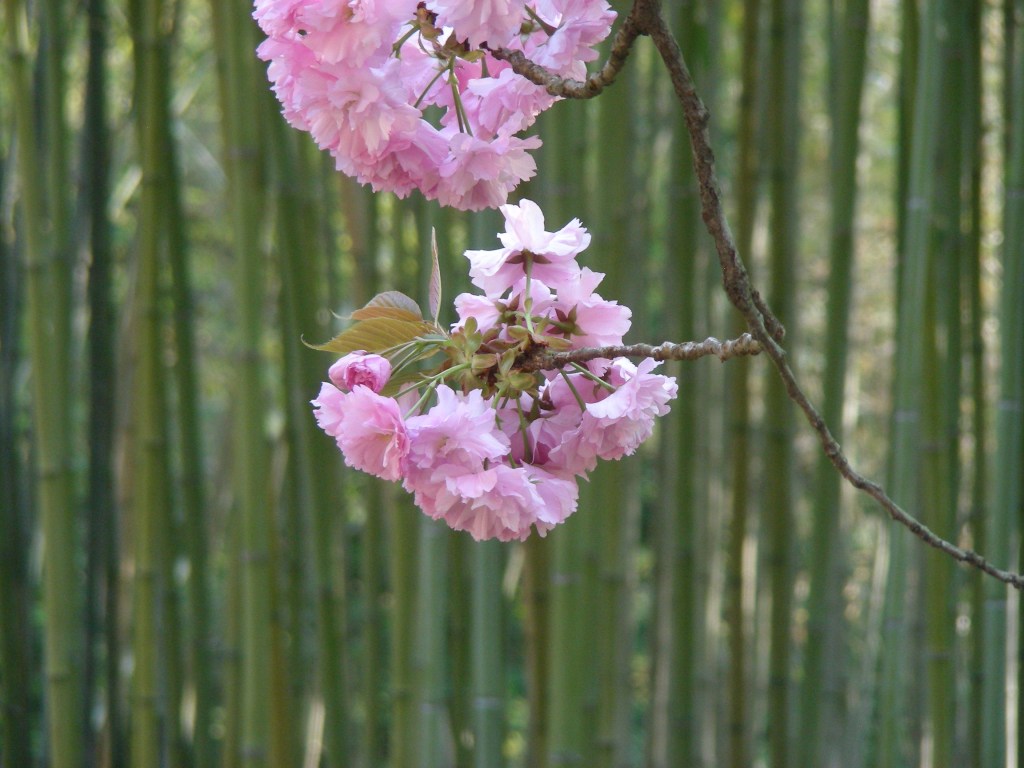
Should I ask you to choose? The flower or the bamboo, which do you prefer?
I don’t think that would be such a good idea.
There is a lot of binary thought around. People choosing this or that. People divided into two camps, us and them.
It’s not healthy and it’s a distortion of reality. Reality is more “and not or” than it’s binary.
I was thinking about this the other day when I came across a discussion about whether or not it’s human nature to be competitive or cooperative. A pretty futile debate I reckon, like most binary debates, because it’s human nature to be BOTH competitive AND cooperative.
I’d argue the same about “nature Vs nurture”. We all have a genetic inheritance and we all change constantly under the influence of culture and society.
I’m extremely wary of simplistic, narrow, views. Maybe it’s not as dramatic or as easy to argue for something more complex, more nuanced, more integrated, but that’s how I see reality all the same.
We have two cerebral hemispheres, each with it’s unique way of engaging with the world, and we thrive when we use both at the same time.
We are open, massively interconnected creatures, constantly growing, changing, adapting. We are not “this or that”. We are both “us AND them”.
Do you find that certain numbers appeal to you so much they influence your daily life?
For me, one such number is three.
Body, mind and spirit is one triple which sits at the core of my understanding about both health and disease.
Past, present and future is the basic structure of narrative. My consultations often began with me inviting the patient to “tell me you story”.
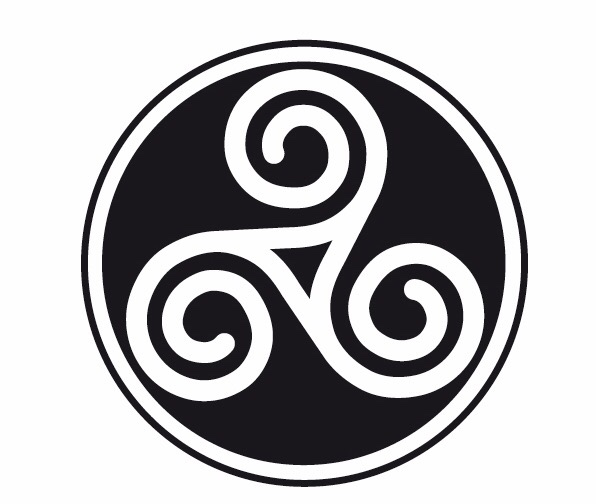
I love the triskele symbol which is part of the Celtic culture of drawing….the three looping lines.
I could go on…conceptually, aesthetically, practically….I find threes everywhere.
However, I should add, I’m not a fan of distinct exclusive categories so I often see my triples and triads as a Venn diagram of three overlapping circles.
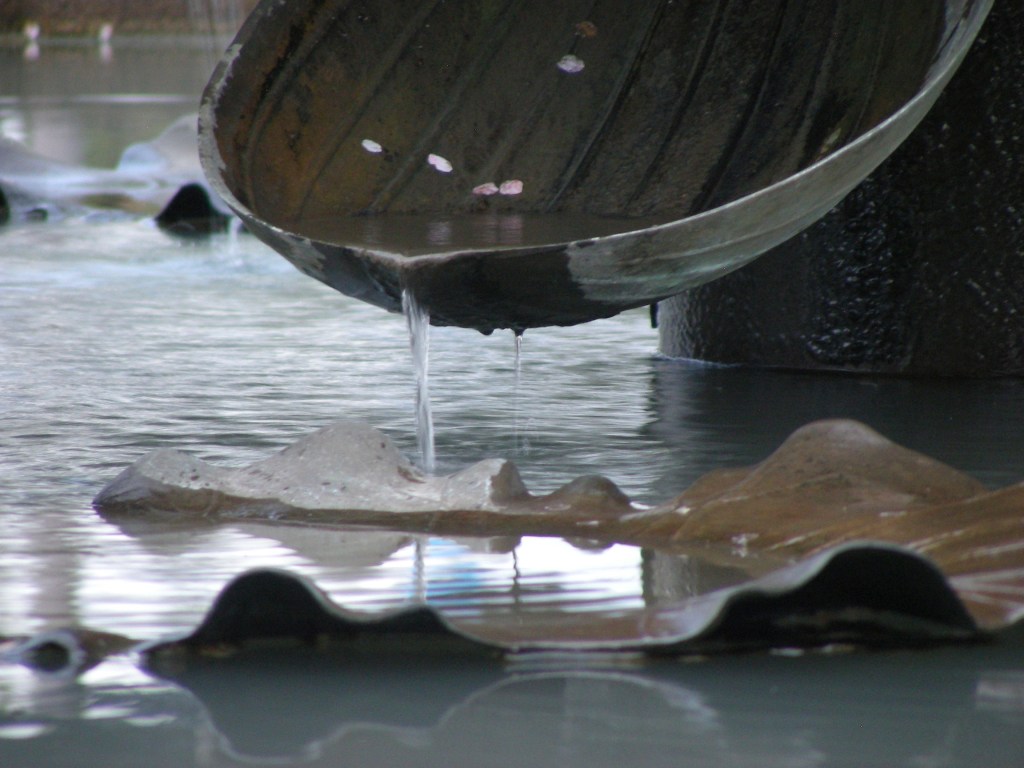
Water is beautiful. It appears in a seemingly infinite variety of shapes. I love to see a fountain like this where the water gathers under the lip of a bowl then steadily flows in a single stream down to a pond. In this particular case a metal plate resembling a leaf catches the flow temporarily before it continues outwards into the rest of the pond. The pattern of ripples on the surface can be utterly mesmerising.
What you don’t get from looking at this photo, is the sound the water makes as it spills over and splashes down into the pond, but that sound, a uniquely “watery” sound really adds to the magic.
Through its different stages this water appears as one body – shape shifting as it goes.
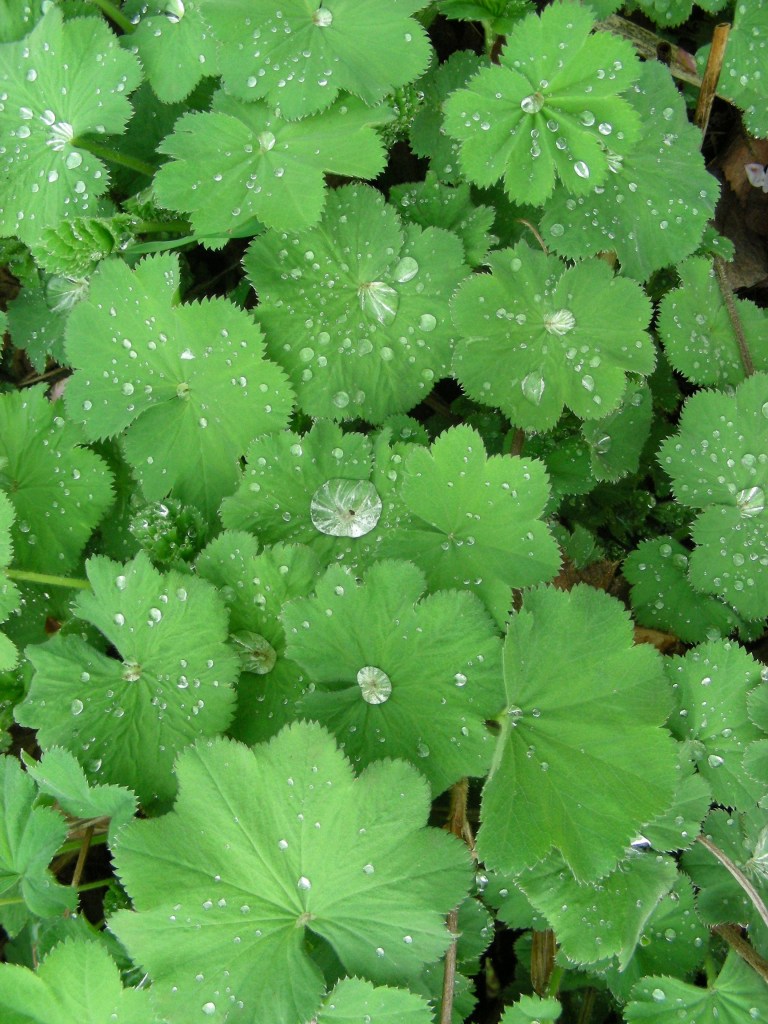
On the other hand, rainwater or dew collected on these leaves forms discrete little jewels, each one sparkling in the light and, on closer inspection, acting as a tiny lens in which you can see the world around it.
Both of these images show water in its pure liquid form, but we know that under different conditions it can form sheets of ice, infinitely diverse crystal snowflakes, or endlessly changing clouds and mists.
I was very fortunate to be able to visit Japan a number of times. I was fascinated by it on every visit. So much was just so different from my experience of Scotland and European countries.
This photo is one of many I took in Kyoto. It’s a good example of how obviously different life is there from, say, that in Edinburgh or Glasgow.
Look at the width of the street, the architecture of the buildings, the wires stretching the length and breadth of the street. And, especially look at the person on the bicycle, cycling while holding up an umbrella!
Our physical environments are all so different, our built ones too, and in particular our cultural ones. All that is created by, and creates, a particular way of living.
This diversity is a great strength not just in human communities but in every natural environment.
I have quite a dislike of uniformity. I know we have to create and live together and therefore need to have a fair amount of features in common, but wouldn’t the world be a much poorer place if sameness was imposed everywhere?
The other I think about when I see this photo is just how important are these environments in which we live. It’s impossible to understand health and disease without knowing the physical, social and cultural contexts of each person.
If you are familiar with this castle I bet you know exactly which one it is from this photo. I’ve focused in on a small part of the building but I think it’s a very distinctive part.
When I learned how to make a diagnosis we were taught that most of the time you can do it by listening carefully to what the patient said (some physical examination might help distinguish between different possibilities and tests should be used last). What we listened for were the distinctive symptoms which were typical of particular diseases.
When I learned homeopathy we were taught that the most “strange, rare and peculiar” symptoms were often the key to finding the best remedy. In other words it was the most distinctive, most individual symptoms which often revealed what was most specific in this particular patient’s situation or experience.
Both of these teachings emphasise the individual story, and sticking with my usual “and not or”, between them I found how to make both a good diagnosis and a good remedy!
From a left hemisphere, right hemisphere perspective that’s a matter of recognising both what’s typical or “general”, and what’s specifically individual in each situation.
I welcome constructive criticism and suggestions. I will not, however, tolerate abuse, rudeness or negativity, whether it is directed at me or other people. It has no place here. ANYONE making nasty comments will be banned.