My garden resonates with the sound of birds all the time….even when it’s dark outside! I love that.
I’ve moved house recently and this garden is surrounded by trees so maybe that’s why the birdsong is so striking.
Blue tits, blackbirds, robins and various small brown birds that might be sparrows are the source of most of the songs and although they all seem “ordinary” because they are so common I still delight to hear and see them.
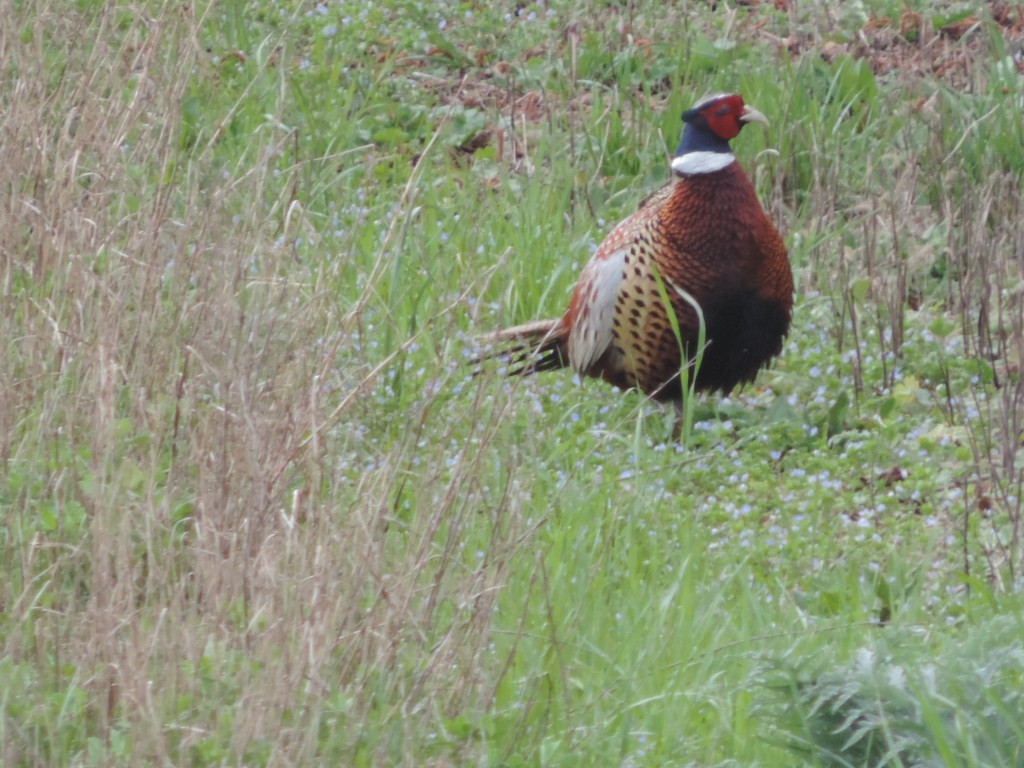
In my previous garden over the last seven years I saw the occasional infrequent visitor and this photo is one of them…a pheasant. Look at his colours! Isn’t he spectacular! Maybe pheasants aren’t that uncommon in the grand scheme of things but in all those years I saw one in my garden only once.
It feels like a double gift to get to see, close up, a rare bird visitor, when I’m already enjoying the ones who live here pretty much all the time.
What birds around you bring you the greatest joy? Which do you like to listen to, and which do you like to see? Are there any birds you’ve seen only once near where you live?
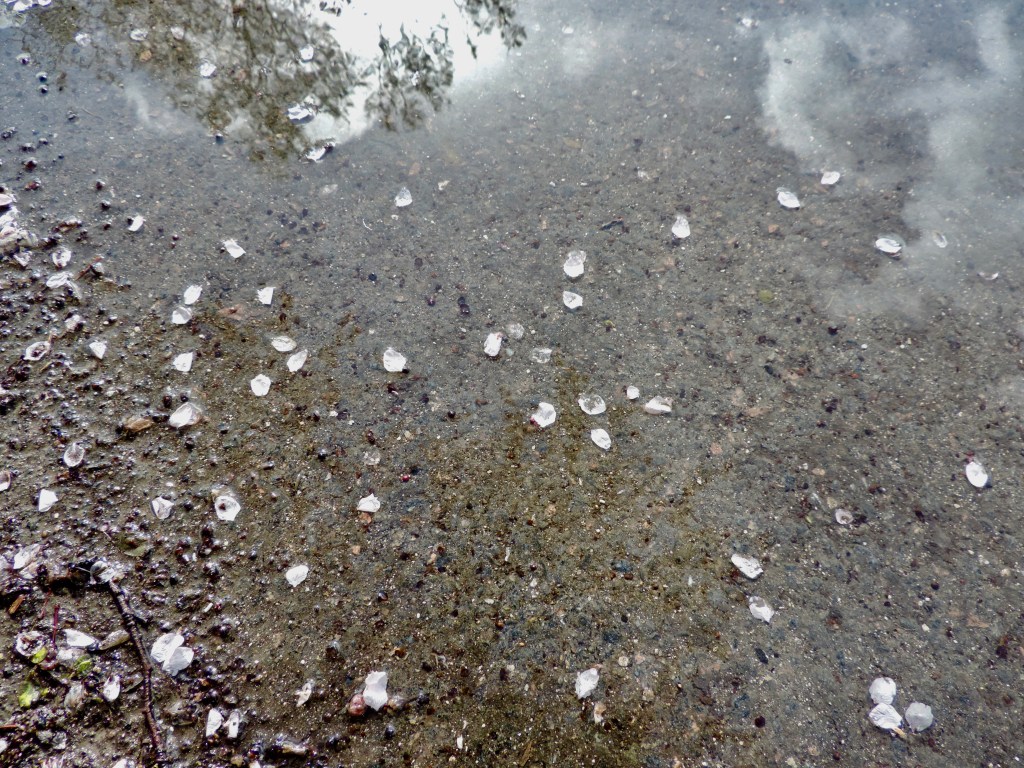
When I came across this puddle I was struck by the scatter of pretty petals floating on the surface of the water. But I also noticed the reflection of the sky, clouds and even some branches so I immediately looked up.
The puddle with its reflection and it’s floating petals is beautiful. I can stop and gaze at it and find it completely delightful. In fact, it’s like a work of art.
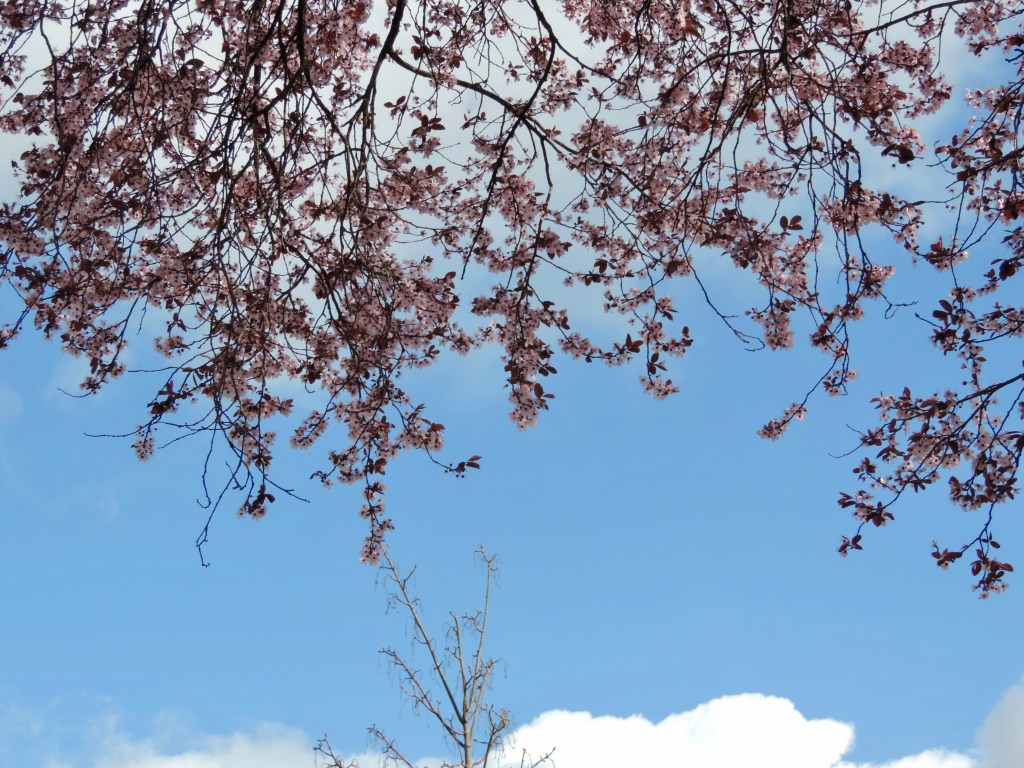
But reflections in particular draw our attention to the surroundings or the context of whatever we’re looking at. As I look up to see the source of the reflection I see a glorious display of blossom against the sky. My delight is doubled.
There’s great beauty to be discovered every day, and the experience of delight in whatever we encounter can be magnified when we take the time to look broader, wider, further and see the connections and contexts.
I never cease to be amazed by Nature. Look at this single flower? Isn’t it both glorious and extraordinary? The colours and the form both astonish me.
What impresses me first is the beauty of this plant. Beauty is an interesting phenomenon, isn’t it? What makes something beautiful? It’s not something that stands up to analysis or logic. You can’t draw up a list of criteria and then tick the requisite boxes.
You’ll be familiar with the phrase “beauty is in the eye of the beholder”. That implies that there’s an element of taste, and that’s true, isn’t it? What I find beautiful, you might not, and vice versa.
The most important point about beauty is that it’s an experience. It’s not something “out there”, just waiting to be discovered. But it’s such an important part of daily experience.
The more we encounter beauty, the more we experience delight, joy and wellbeing. I don’t think it’s stretching things too far to say beauty is good for your health.
I’m sure it’s a good idea to stay aware and to pause to enjoy whatever you find beautiful….a plant, an animal, a work of art….
But I don’t recommend enjoying beauty for some utilitarian reason….It’s sufficient unto itself.
We humans are incredibly creative creatures. Perhaps it’s that we are endowed with the faculty of imagination, but I think it’s more than that. We are great at problem solving, inventing new, previously unknown ways of doing things, of overcoming obstacles and of improving our daily lives. All that takes creativity.
But all that restricts creativity to a utilitarian purpose, and creativity is certainly a lot more than that.
Whether in the visual or plastic arts, in music, dance, poetry or storytelling, we seem to have a creative drive to express ourselves, to share our thoughts, ideas and feelings, and to try to find meaning and purpose in life.
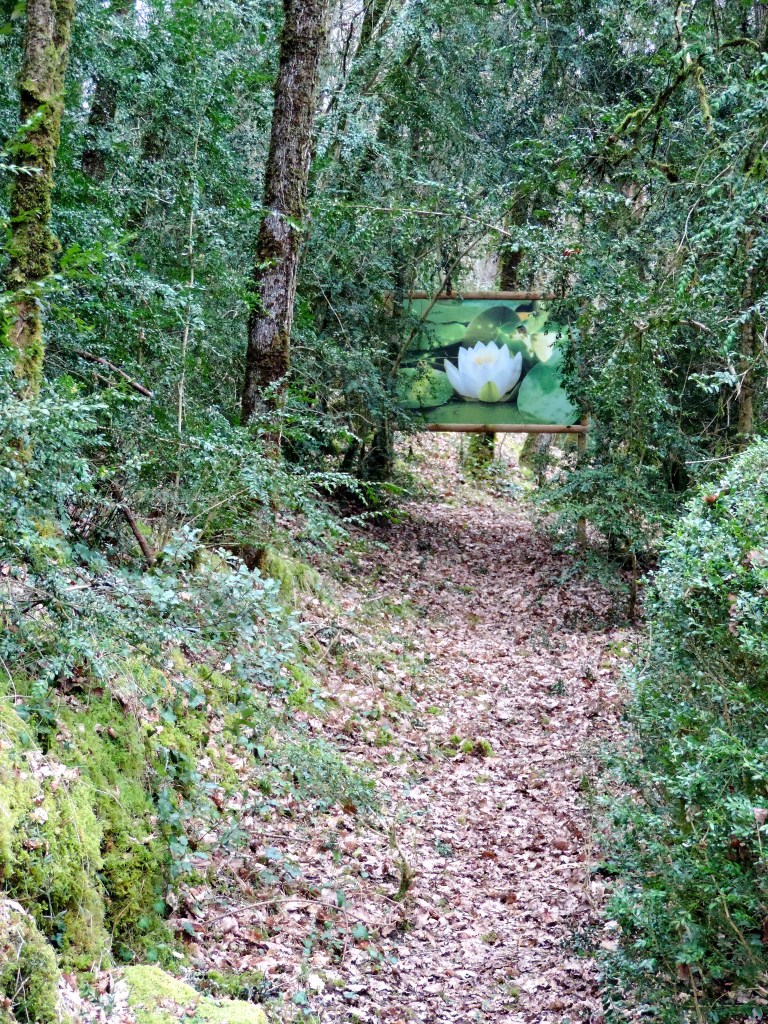
In this photo you can see one of the many creative photos exhibited in the forested part of Marqueyssac gardens in France. There were several like this – each one a woodland scene of fairies and elves. I loved it. The art added an extra layer of magic to the woodland walk.
Of course creativity isn’t exclusive to human beings. The universe is creative in an infinite number of ways. I love to see the new growth in the Spring, with new green shoots and glorious blossoms. It feels like being surrounded by creativity.
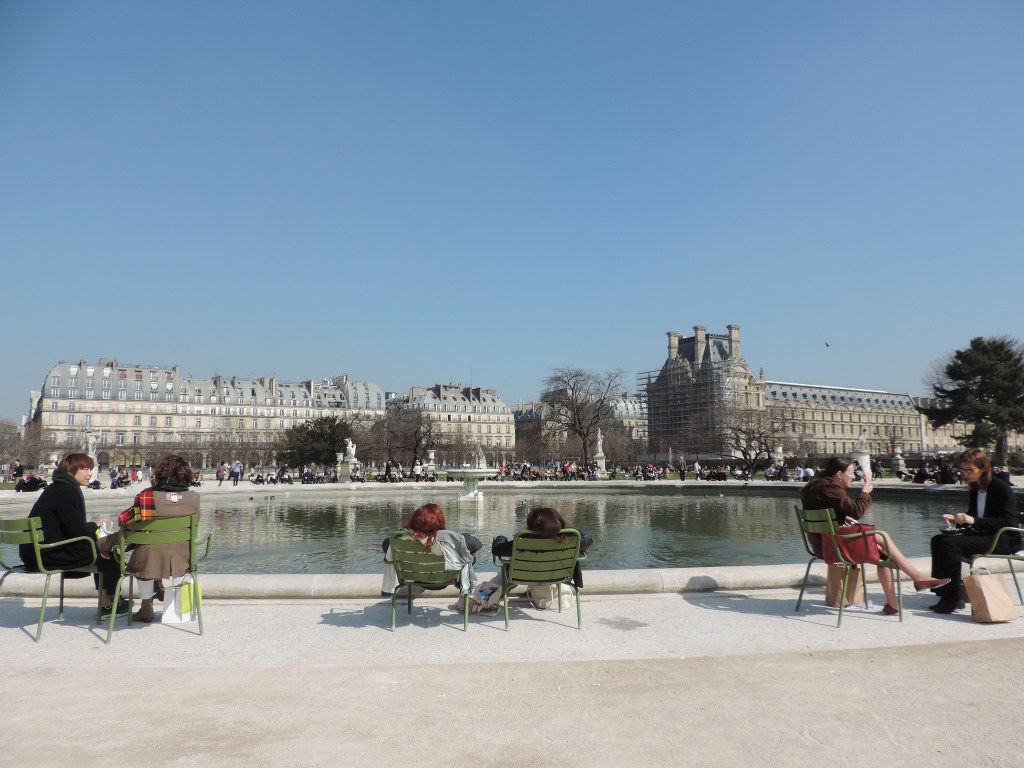
We humans have evolved with strong social abilities and needs. This photo which I took in Paris one sunny day shows people relaxing around one of the pools. There are many metal seats, of two different styles, scattered around the large pool and people find free ones and pull them together to sit and chat with their friends.
In this particular photo you can see three pairs of people talking to each other. On the far side of the pond you can see many, many more.
Of course some people go there alone and sit reading, listening to music on their earphones, or just relaxing, but the vast majority are there with others so you see most people sitting in pairs or in groups.
Communicating with others really is a core need and pretty much a daily activity for most of us.
We are social creatures.
That’s probably one of the reasons this pandemic has hit us so hard. Millions of people have spent weeks isolated from family and friends. When out and about we’ve been wearing masks and trying to keep a distance from others, both practices which disrupt our desire to connect. And now at this stage in the pandemic there’s lots of fear. Even as restrictions are eased many people now regard others as potential sources of infection, or, in other words, a threat.
So I suppose it’s no wonder that there seems to be so much social dysfunction now. There’s more anger and frustration and there’s often a new harshness in interactions between people. It’s not just online that people experience daily abuse. I’ve heard many stories of doctors, nurses, shop workers, teachers and others being sworn at and verbally abused at work.
It’s sad but maybe it’s an inevitable consequence of the social dimension of this pathology we’ve named “covid”.
It’s going to take time, patience and persistence to rebuild a healthier social environment, but I think that’s what we will do. Because, ultimately, we are these social creatures who survive and thrive on healthy relationships and interactions.
Ok, so this is a photo of some vegetation on a cliff. So far, not very interesting.
Then, suddenly, I see the cliff face! I mean THE FACE in the cliff!
Do you see it?
I can see one dark eye, a long face with a very straight nose and a thin, straight mouth.
Once you see it, you can’t un-see it.
There’s two things here which are highlighted by this. Our brains are particularly evolved to see faces – not just to recognise familiar faces (which is indeed one of our powers) but to spot a face even when it’s just a shape or pattern which has characteristics of a face. The second is our power of “re-cognition”. Once we register something, we are much quicker at being able to see it again. In fact that “re-cognition” is so “sticky” that it can be difficult to see past it.
We probably evolved these powers because they were beneficial to our survival. They enable us to spot another human very quickly and to be able to see a stranger quickly too. In both those cases, scientists would argue, that’s in case other humans are dangerous.
But that’s not our default is it? Well, sadly, for many people it’s becoming like that. And the stories we hear of violence, murder, and crime heighten our wariness.
Despite that, it’s still not my default. I engage with others from a more positive position. For example, I’ve recently moved house to a small hamlet in the French countryside and about a dozen strangers have stopped to speak to me since I moved here. Every one of them introduces themselves, tells me where they live around here and welcomes me. They are my new neighbours. Our connection is positive.
In my four decades of work as a doctor I saw I don’t know how many thousand patients. My repeated experience was that the more I got to know a person, the more I understood them and the more I cared about them.
So I think there’s another aspect to the evolutionary value of our ability to recognise faces. It enables us to make connections. We are social creatures through and through.
Babies learn to recognise their mother’s face astonishingly quickly and we soon develop the power to read emotions in peoples faces.
In other words we don’t just spot faces, we quickly learn to “read” faces too, and that, too, allows us to both make connections and to be wary when we recognise a threat.
Our contemporary cultures spread messages of threat and competition, but in every crisis, from the pandemic to this current war in Ukraine, I’m more struck by the countless acts of kindness carried out by ordinary people.
We are, in our core, social creatures. We want to connect, to help, to cooperate and share. But in places of power and wealth something else comes to the fore.
It’s as if we are suffering from a pandemic of narcissism. That’s not normal, and it’s not healthy. I hope we are on the cusp of change for the better. People are talking of a great awakening. I hope that’s true. Maybe one day we’ll change things. We will stop rewarding narcissists and reward kindness, love, caring and compassion instead.
How good would it be to recognise those values in the faces of those with power? To know that every day they spread love, kindness and compassion in the world.
Well we can start at home, start in our communities and localities, by being aware of those values in ourselves and others and just encouraging and growing that.
From there perhaps we can insist that people who assume responsibilities and powers act positively towards others too.
Let’s promote kindness, love, caring and compassion by demanding these values in all our organisations, businesses and politicians. We can reward those who manifest these values and withdraw our support from those who don’t.
Looking at this old photo today, taken in a Marqueyssac gardens in France, I’m struck by the difference between the planting on each side of this path.
On one side is a long, straight, trimmed hedge, whilst on the other a much “looser”, almost random distribution of bushes and trees.
Thomas Berry in “The Great Work” names the two fundamental forces of the universe as “wildness” and “discipline”. Too much wildness and you have unstructured chaos, too much discipline and you have a static order. For Life to emerge you need a perfect interplay of both.
Note that it’s an interplay, or what some would term “integration”, not the kind of balance where two opposites balance each other out.
David Wade, in The Crystal and the Dragon, describes the basic forces as the moving, flowing principle, and the ordering, or structuring principle.
Iain McGilchrist describes our two ways of engaging with reality. The left hemisphere allows us to focus, abstract and represent. It seeks to “grasp” whatever it sees and make use of it. The right hemisphere engages with reality as it is, seeking out the connections, relationships and seeing what exists within its contexts and environments.
We need both. And when they integrate well together we see the most amazing examples of creation.
This is a pretty common pattern in the sand created by the sea before the tide recedes from the beach. It looks like waves or ripples doesn’t it? When you look at this you know that it’s been created by the water.
There’s something about this kind of pattern which we recognise instantly as natural. I’m sure with skill, time and effort, an artist could create a similar pattern but there is something about an interplay of regularity and irregularity here.
Natural patterns usually share this quality. Not only are there “no straight lines in Nature”, a statement which isn’t 100% true but true enough to be a useful generalisation, but this interplay creates a kind of chaotic, or near chaotic, design.
This is where Nature exists. On the “far from equilibrium” zone, in the borderland between chaos and order. It’s unpredictable in detail, co-created with the local environment and it’s beautiful.
Here’s a different, equally natural, common pattern caused by water running over sand.
Beautiful, isn’t it?
Both of these patterns can be seen elsewhere, in rock, in trees, in a cloudy sky or on the landscape seen from high above.
When I come across patterns like these I feel I’m glimpsing the usually invisible creative power of the Universe.
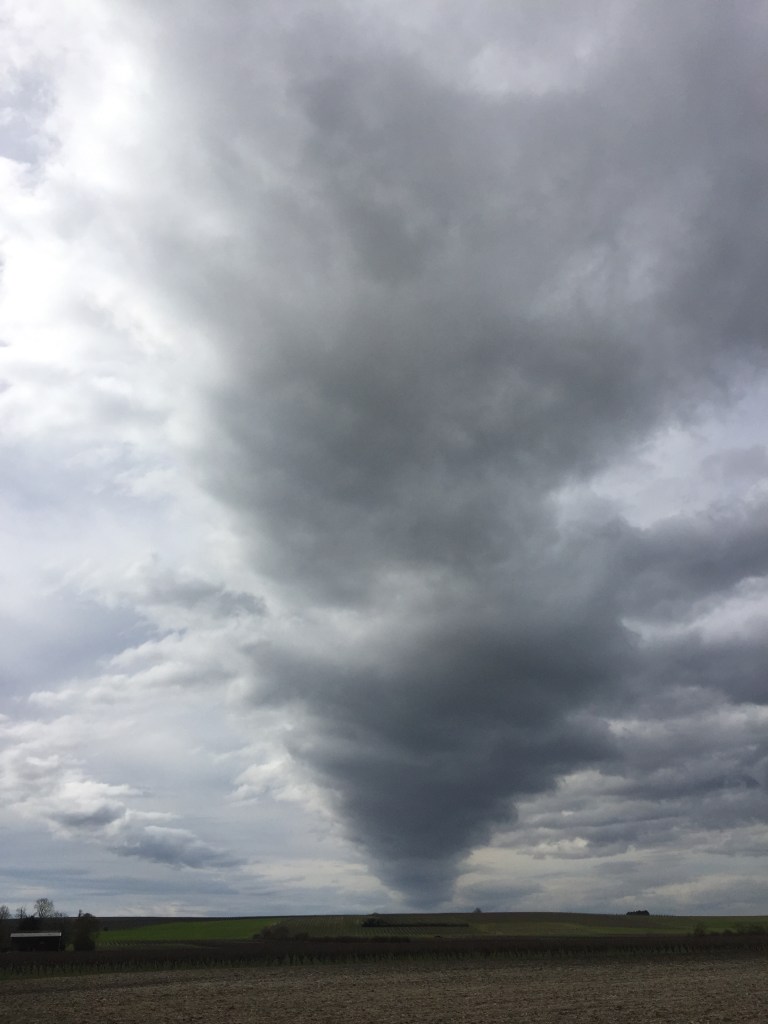
We humans see objects everywhere. I look at this sky and I don’t see simply an entirely grey sky, I see patterns. The sky is laden with water which, on a clear day, I can’t see, but on a day like this I see the water molecules collected together. We call these collectons clouds.
On this particular day I see a vast dark grey funnel of cloud stretching from above my head to as far as I can see. It looks like a vast highway or path in the sky. I see it as a distinct object…..a particular cloud, separate from the other clouds.
But where are it’s edges? Where does it begin and end? The closer I look, the harder it is to see an edge. “It”, this cloud, doesn’t seem so separate from the rest of the sky as it appears at first. It’s edges blur and fray and blend into the neighbouring clouds.
Yet it still seems an enormous heavy presence stirring a certain anxiety in me, carrying the threat of a storm, or at least, some heavy rain.
I don’t have to stand looking at it for long to see it change. Over the course of a few minutes it slides to the side, thinning and dissipating as it goes. Not much later, I can see no trace of it.
This is what we do. We abstract certain elements of reality, focusing on just a few of them, to the exclusion of others, and, so we see patterns which we’ve seen before, and we give them names. We turn them into objects.
Objects like clouds remind us that there are no fixed, separate objects at all. They show us that all so called objects are patterns within the Flow.
Clouds emerge in the sky, the way a wave appears on the surface of sea. They are perceptible for a short period of time, constantly changing, through every second of their existence, then they’re gone.
Some objects have much shorter lives than clouds, others much, much longer. It depends on the speed of the flow. Mountains take millions of years to form, and millions more to disappear.
I’m not saying objects are not real. I’m just saying they are never fixed, separate or permanent. They are a useful concept but it helps, I think, to try to see them as emerging patterns within the Flow, vastly interconnected within Indra’s Net of reality.
One March day a few years ago I noticed some ducks and some fish in a pond. Not very remarkable you might think, but what caught my eye was the pattern.
This particular duck is creating concentric rings of ripples on the surface of the water, probably through the paddling action of its webbed feet. It seemed like it was sitting quite still on that one point, even though it was obviously constantly moving to create the waves. That in itself is quite beautiful and mesmerising, but there’s more. Look where the fish are swimming. Some of them seem to be swimming along the ripples, making them appear to fit the overall pattern.
As a whole image the duck, the ripples and the fish, create an interlinked, beautiful pattern.
I return to this photo quite often. It reminds me how interconnected everything is. Nothing exists in isolation or in a vacuum. Just by being alive I change the world. My breathing, my eating and drinking, my actions, my words and even my thoughts create ripples of change.
Some ripples don’t go very far, but others are picked up and magnified by others and spread far through time and space.
This is how it is for all of us, and it’s long been this way.
So this reminds me to try to live consciously in awareness of the fact I’m embedded in one great web of becoming.
What energies are you sending out today? What ripples are you creating?
I welcome constructive criticism and suggestions. I will not, however, tolerate abuse, rudeness or negativity, whether it is directed at me or other people. It has no place here. ANYONE making nasty comments will be banned.