Some people say there is no such thing as a life force. Maybe there isn’t. Well, not an entity or a thing you could call a life force, not something you can grasp, directly observe or measure. But as a concept, as a phenomenon, it makes a lot of sense to me.
I always found it helpful to think of the life force as a blend of the body’s self healing capacity, the energy state of the whole system, and the quality of that vague phenomenon we call well being or vitality.
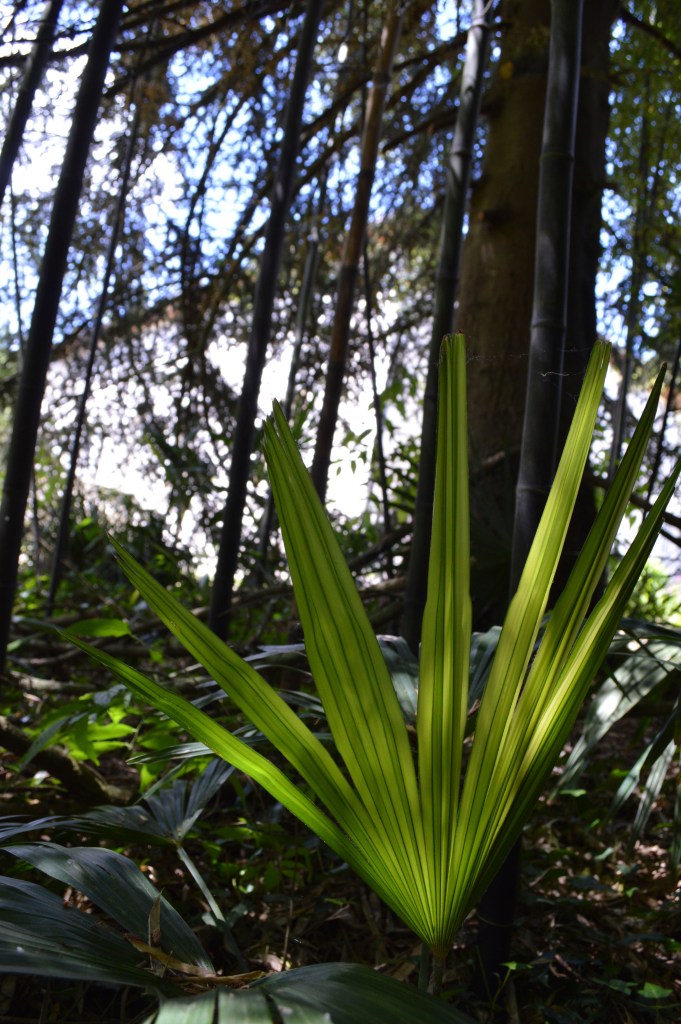
It’s something we all know. It’s subjective, not objective, yet we can all detect it. You can look at a plant and know instantly that it’s in good or bad health. You know yourself whether or not your strength and resilience is in good form.
When I was a junior doctor in Paediatrics my mentor said he wanted to teach me how to recognise quickly a sick child. Seemed an odd comment at the time but as the weeks passed I understood perfectly what he meant. Once I was a GP it was indispensable to me to be able to walk into someone’s house and know in an instant that a child needed emergency care. You knew before examining them, before making a diagnosis, that you had to act with urgency.
At the other end of life’s journey I often wondered just what it was that changed so clearly when someone died. In that moment, in that instant, it was as if a light went out. Yes, I know about organ failure, about cardiac and respiratory arrest, about brain death, but there’s something not so easy to define which seems to occur at the moment of death and I still think of it as the end of the life force.
The other way I find this concept useful is in relation to healing. It just seems to me that there is no true healing other than through the processes of self repair. That helped me remember to be humble. Whatever treatment I recommended or delivered I knew that what I was doing was supporting the self healing, self repairing, self balancing functions of the person.
How’s your life force today? Vibrant? Strong? Healthy? Or weak, dull and needing attention?
A walk in the forest never fails to throw up something startling, something curious or something amazing.
You know that favourite phrase of mine about discovering the wonder in the every day? I find that pretty much any day can feel a better day, can feel a good day, when I have a moment when something catches my attention and I am amazed.
I find this happens most in natural settings. Although I do believe you can find things to stir your curiosity and amazement in any environment, whether in a park, in the countryside or on a city street.
I particularly enjoy spending time around trees! It doesn’t have to be a large or dense forest but it’s good when a path is tree lined or there is an area of a park where several trees grow together. I like those “communities of trees”.
Search for “forest bathing” on this blog and you’ll find a few articles I’ve written about the health benefits which can arise from spending a bit of time amongst trees.
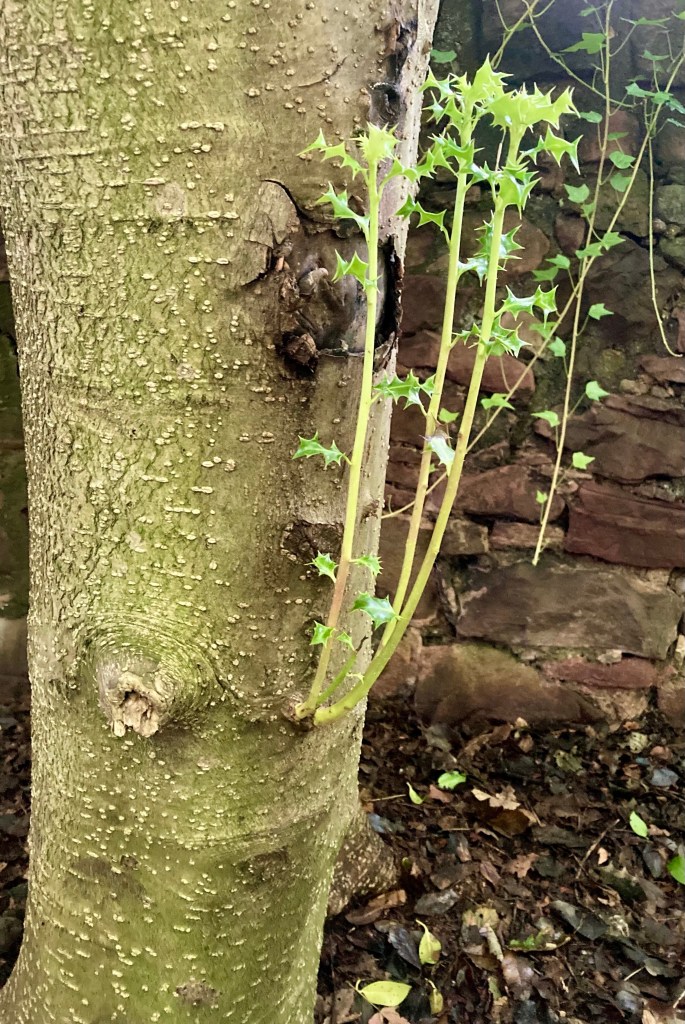
I took this photo earlier this week on a walk through a wooded area of one of Edinburgh’s many parks.
Isn’t it amazing? Look at this bright, vivid new growth emerging right out of the trunk of the tree and immediately stretching up towards the sunlight!
What a great image of LIFE – of creativity, of emergence, of the Life Force.
I love it. It resonates with me and delights me. I hope it does for you too.
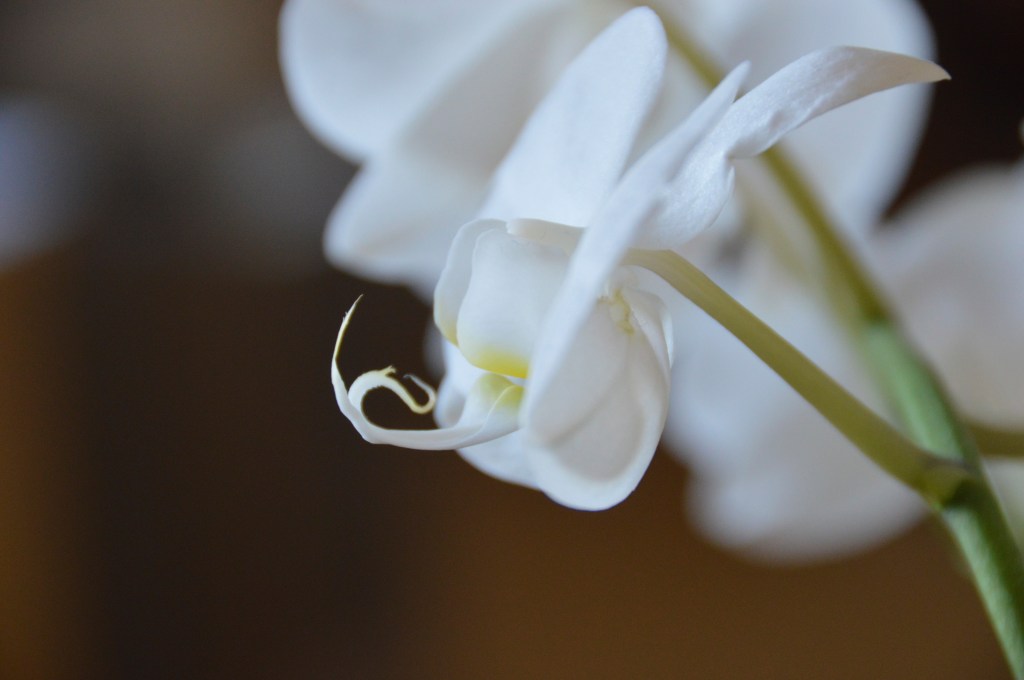
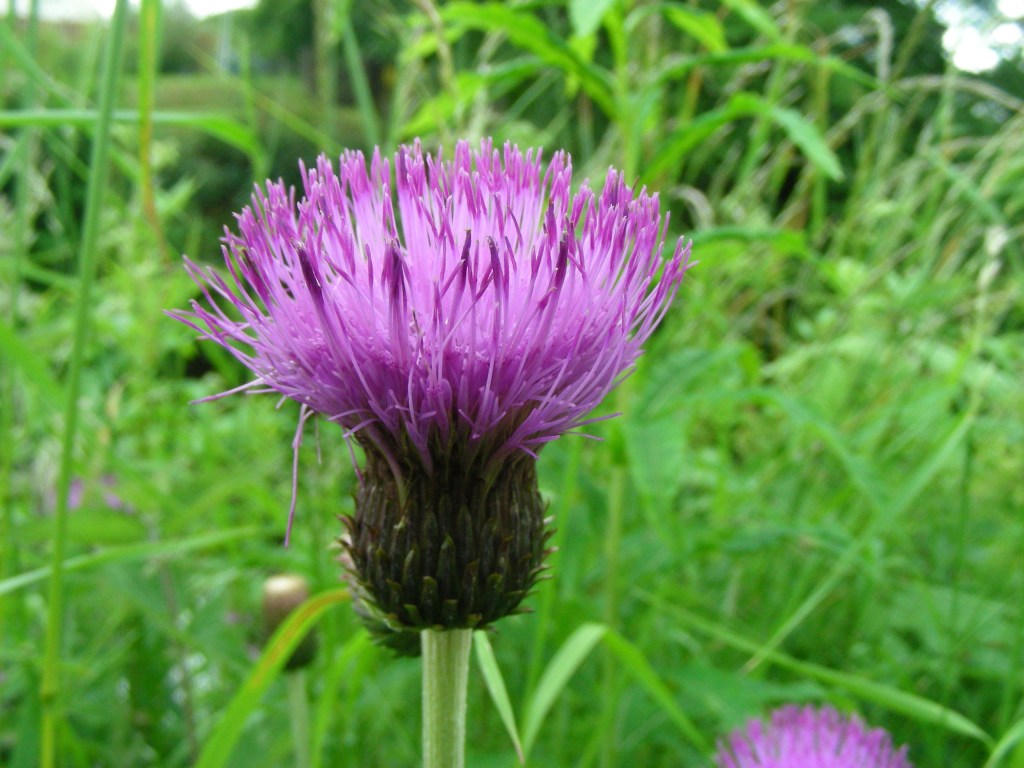
I can’t look at this photo without seeing what seems to be this flower gesturing “come hither”. It just looks to me like it has an outstretched hand with fingers curled and the index finger beckoning.
Well of course that’s really what flowers are about. The plants make themselves beautiful and attractive so that their preferred pollinators won’t be able to resist them.
A few years ago I discovered some of the philosophy and science of complexity and it hugely increased my understanding of the world. If you search my blog for “complexity” and/or “complex adaptive systems” you’ll find several articles about it. One of the features of complex systems is the presence of “attractors”.
Attractors are like organising nodes. They influence the flow of energy and information in the system and partly influence the physical forms and shapes which emerge.
These knots in a tree are the kind of pattern I visualise when I think of attractors.
There are three types of attractor – point attractors which organise around a single point (think of whirlpools or black holes), loop attractors which have two points which interact (creating alternating states, polarities and interlinked opposites), and chaos, or “strange” attractors, where a number of points are active together creating complex, and often perplexing patterns.
I think you can see the effects of attractors in natural physical forms but I think they also exist in our psyche. Certain events, experiences and habits develop the features of attractors, keeping us stuck in the same place, cycling around and around established loops, or pulling us into feelings of chaos and confusion.
Maybe you’ve come across the idea of describing stepping stones in your life or chapters in your personal story. We can also use this idea of attractors which are related to significant life events. That can help us make sense of things.
But more than this I think we can use attractors positively, through deliberate patterns of thought and behaviour. That’s how we create new habits, and break free of old ones.
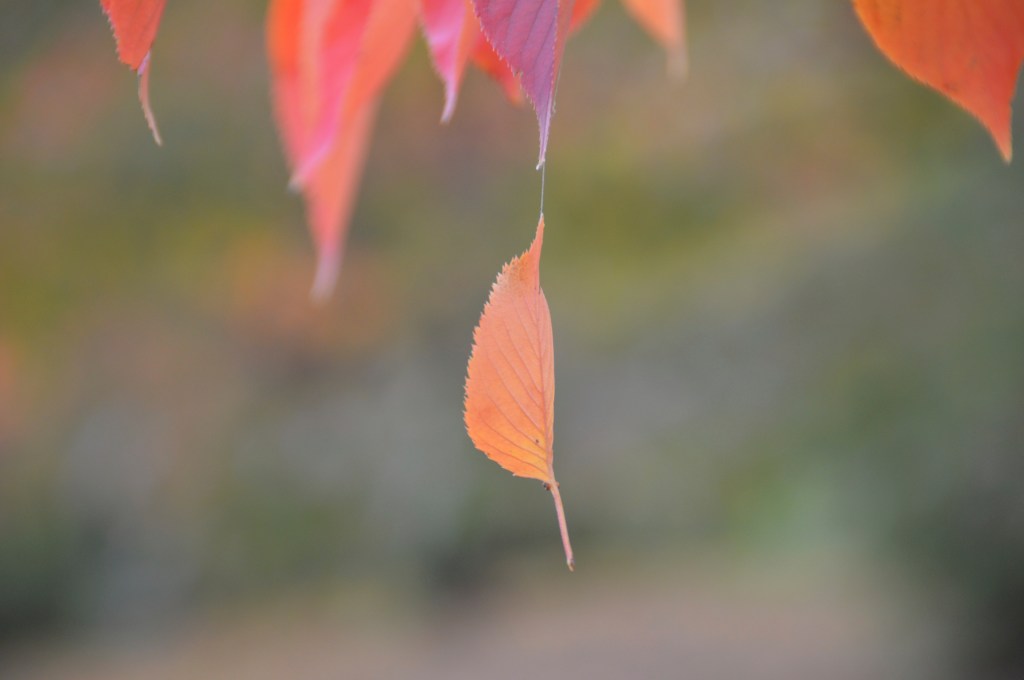
I saw this leaf spinning around in space and was astonished. How can a leaf hover like that? When I looked more closely I saw the missing piece….a fine, almost invisible thread connecting the leaf to another one which was still attached to the tree.
I suppose the closer inspection was a revelation. Suddenly I understood. But didn’t that revelation take the magic away? Because up to that point I was watching a leaf spinning on the spot in mid air. In fact it wasn’t magic. There was a thread.
But you know, discovering that didn’t take away the “magic” for me. Because isn’t this amazing and beautiful? A leaf spinning around attached by a single strand (probably from a spiderweb).
We humans love mysteries, but we love to solve them too.
I think that was a big part of my work as a doctor – the delight in unraveling mysteries, making sense of patients experiences. Time and time again making a diagnosis brought huge relief to people. A diagnosis, really, is an understanding, but it often seems to be a revelation.
Once we understand, once we see more clearly, mystery is transformed into discovery. And that’s pretty amazing.
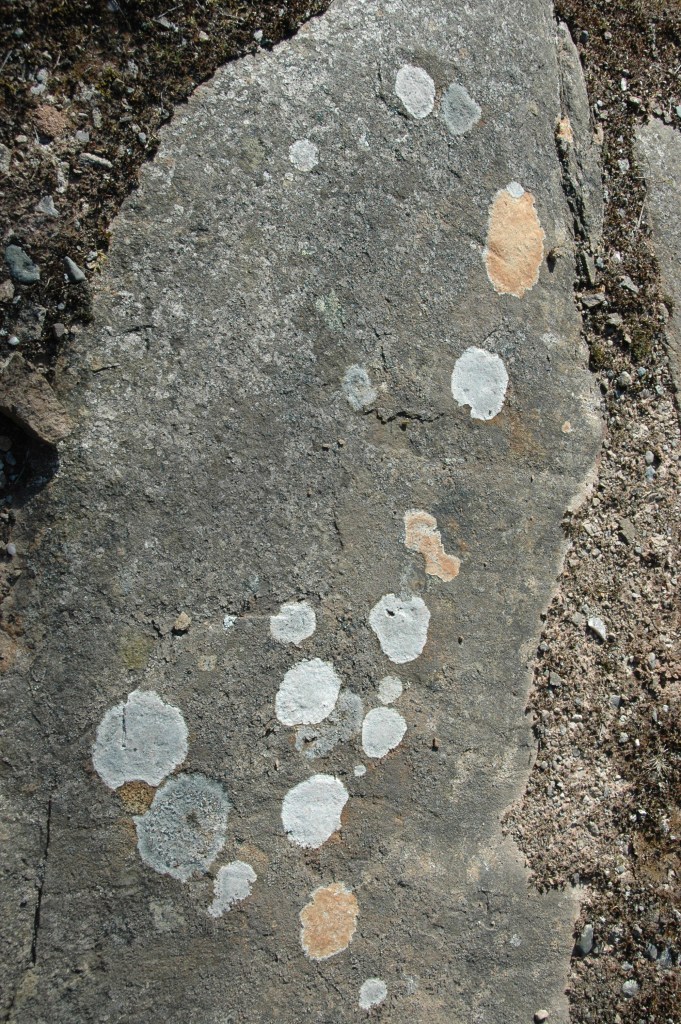
But there’s something both fascinating and playful about this image of lichen on a rock.
I know it’s natural but it seems like a work of art to me. I think that’s because of the combination of different colours, shapes patterns in each little lichen patch, but also because of their spread across the rock in a way which makes them resemble foot or paw prints.
I read that lichen grows mainly on north facing surfaces but I know for sure that’s not exclusive. I haven’t been able to know which way is north just by looking at lichen!
Thinking of that brings another idea to mind….constellations. It doesn’t take a huge amount of imagination to see this as a constellation rather than as a trail.
Either way, I can’t help thinking that we moderns have lost a lot of our ability to read the sky and the landscape. And it seems to me that’s a result of the extent to which we’ve separated and distanced ourselves from Nature.
Still I find it’s easy to reconnect. Just a short stroll in a forest, a park or a garden gives me an abundance of opportunities to notice, to be delighted, to wonder and to feel connected to the living world again.
I know there is lots of evidence supporting the claim that activities such as “forest bathing” or simply spending some time in green spaces is good for both health and well-being, but even without that I reckon we can all enjoy the benefits of being in a living, growing, diverse environment.
I recommend it.
Noticing, slowing down, wondering and savouring are all essential activities which enhance our quality of life.
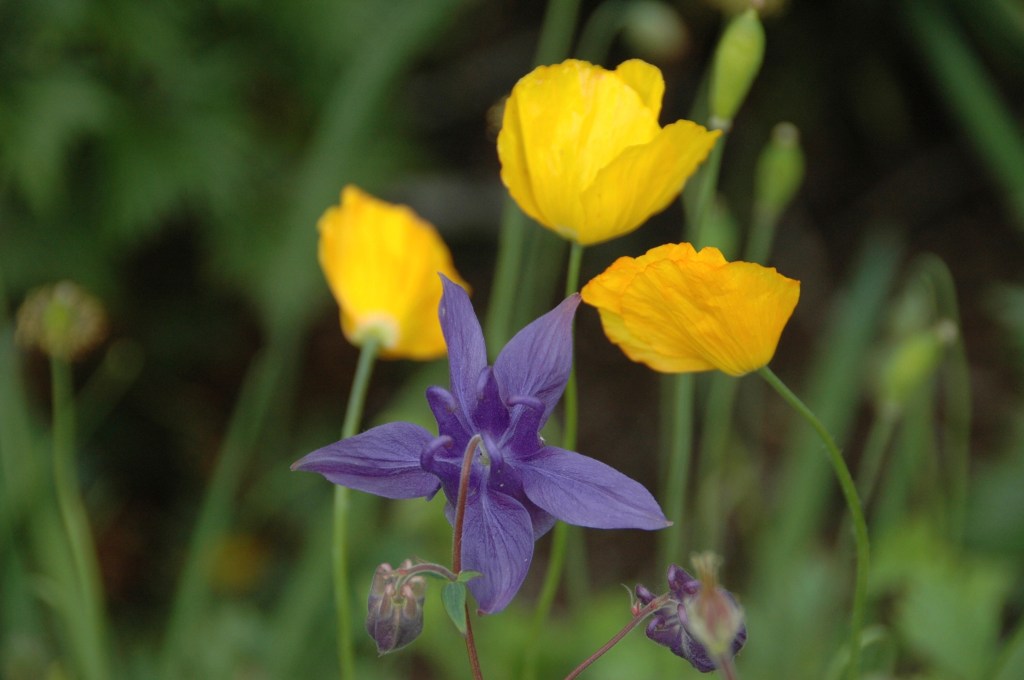
This is one of many photos I have where I get the impression that the contrasts and differences make everything in the image more beautiful. The purple against the yellow, the elaborate petal shapes against the simpler ones, both the flowers against the rich, green background. I love it.
You could focus in on any single element here and be amazed by it. You could explore any of the single flowers, perhaps try to draw one of them, and you would quickly find yourself relishing it’s uniqueness. But I think it’s the heightened presentation of their differences which makes the case that each is uniquely different.
This, is, absolutely, one of the foundations of my understanding of this world. I worked through four decades as a doctor. My “normal” working day was largely spent with patients one at a time. The entire essence of my work was the one to one relationship between doctor and patient built up over time. Continuity of care was the keynote of all the places where I worked. The expectation was to commit for the duration. Of course, that didn’t mean that each of us was the right person for every single patient. We weren’t. And as needed we would refer patients to colleagues, stand back, pass on the responsibility for a particular person’s care to another who had different skills, different knowledge, a different way of engaging, from our own.
I looked forward to Monday mornings because I knew I would meet a “new” patient, who would tell me a unique story, one I’d never heard before. My day unfurled, one patient at a time, and the full attention engagement with each, had clear starting points, and clear endings, set by them entering the consulting room, then leaving it. If I continued to allow my mind to be filled with the previous patient, I couldn’t be fully present for the one before me now. That rhythm and practice was, I now understand, a kind of meditation practice, moving through a cycle of full attention and fully letting go.
The sequence of patients was always an astonishment. Over the course of a single clinic, with a dozen or two patients, you couldn’t help but be amazed by how different each one was, how unique their story, how singular their experiences of both illnesses and treatments.
I’m sure that’s had an enormous influence on who I am, on how I make sense of this life, and on the creation of my values and beliefs.
I just don’t buy in to the industrialised model of standardisation and processes. There is no standard patient. There is no “mr or miss average”. There is no “ordinary” day. Every moment of every day is new, different and transient.
What struck me about this web was how big the spaces were. I think most of the spider webs which I’ve noticed, gazed at, photographed, have been constructed much more densely than this. You know what I mean? A web is just a threads knotted together to create a net…..in other words it’s a collection of holes. I remember hearing a story about an old fisherman being asked how he made his nets, and replying “I just tie together all these holes”, nodding in the direction of an empty bucket with the clear suggestion that the bucket was where he kept all the holes!
So when I stopped to look at this web it was the size of the holes which caught my attention. Why would the spider want such big holes? Wouldn’t that mean that most flies would pass straight through? If she’d made a net of smaller holes, wouldn’t she catch more flies?
Then my mind jumped from the size of holes in a web to the whole idea of sensitivity.
When we are very sensitive to something we pick it up in its smallest amounts. I have certain allergies and it takes only a tiny amount of invisible dust to set my eyes streaming and my nose running. It’s good to have body systems which will expel noxious substances but allergies are a problem…..they don’t protect us from what might harm us but upset us by over-reacting to tiny little things that don’t. The best way I know to deal with allergies, apart from trying to avoid what you are allergic to, is to somehow down-regulate that whole system…..to make it less sensitive. That’s kind of like using a net with bigger holes, isn’t it?
I don’t mean to write a post about allergies today, but as I’ve always sought out holistic solutions, I’ll just say that’s the approach I try to find. The system in the body which reacts to allergens is an integral part of the overall system of defence, repair and self-healing, so paying attention to wellbeing, health and resilience helps to down-regulate the allergic system.
Even if allergies are not an issue in your life, I bet there are many other over-sensitivities or hyper-sensitivities which do bother you. When we allow ourselves to get all het up over trivial little issues, not only do we experience a lot of discomfort but we impair our ability to resolve what needs to be resolved.
As I drove up from South West France to Central Scotland over the last couple of days I listened to an audio book…..John Le Carré reading one of his spy novels. Oh, he’s so good! One line which grabbed my attention was when one of his characters was talking about the art of diplomacy, and said something like, diplomacy is the art of treating all crises as normal and solvable.
Wow! What an interesting idea! How easy is it to turn a small difficulty into a crisis and then to become so overwhelmed by it that we become paralysed, unable to find the solution….worse, even failing to imagine that there is a solution!
A couple of minutes later I passed a van. I don’t remember the name of the company written on the side, but on the back door of the van were the words “Solutions not problems”.
Isn’t the universe an interesting and amazing place? How do these synchronicities happen? I’ve no idea.
But between the novel and the slogan I realised there really is an important message here – don’t set the net so densely that it picks up all the things you don’t want to pay attention to…….a net with bigger holes will only catch the more significant issues. Down regulate the sensitivity settings so that the alarm bells don’t keep going off when there is nothing important to attend to.
Our systems are all interconnected and the feedback loops mean that small things magnify and problems seem to escalate easily. Which is why, I think, it’s important to pause from time to time, to shift our focus, to move to higher ground to get an overview, and allow ourselves to respond to what’s important, finding the solutions to the problems which matter, instead of becoming entangled in the alarm bells of oversensitised defences.
It’s only when we down regulate these over reactive states that we find a sense of calm, of balance, and a flood of solutions which wash away many of the problems.
What do you think? How tight and dense is your net? What’s “setting you off”? Can you down regulate? Can you create a more useful net? Can you choose to respond to what’s important and let the trivia pass on by?
As I write this I’m remembering a book title – “Don’t sweat the small stuff”. I never read it, but maybe it’s about the same idea.
I’ve spent the best part of the last two days on the road.
This photo might give you a clue about where I am now….
Yes, I drove north to the Channel yesterday, crossed in the overnight ferry, then spent today driving up through England.
And, now, here I am, in Scotland!
Well, travel is sure different, isn’t it? I’ve had to show my certificates for my Covid vaccinations and my negative test and my passport and my residency card and my “travel locator form” showing where I’m going! All due to a combination of Brexit and the pandemic.
There’s no doubt all this bureaucracy is stressful but, hey, I think the only way to deal with it is first acceptance – no point fighting it if you want to travel – this is simply the reality to travel just now. Then take each step one at a time. That took a LOT of planning! Finally, organisation – we made up a folder each with paper copies of all the documents we needed.
But, hey, here we are now, about to see all our families for the first time in almost a year.
I know I often stress the importance of enjoying the journey but this time the best thing is the arriving!
You know the kind of fountain where the water collects into a pool, or basin, at the foot of the central spray? Well, spend a few moments looking at the surface of the water in there and you’ll see something pretty much like this……swirling patterns of flow around constantly appearing and disappearing bubbles.
It’s mesmerising.
I also think it’s a good metaphor for society. Each of us is like one of these bubbles….distinct, separate, yet connected. But we don’t live alone. The bigger bubbles are like groups of us. Several individuals living together sharing the same home, workplace, habits of living, beliefs or values.
How often do you hear the criticism of social media as a way of magnifying the effect of people living in bubbles? Only communicating with like minded others. Intensifying their exclusive world view, and so furthering divisions?
We do all live in our social bubbles, but if we remember this image we’ll remember that all the bubbles exist in the same pond. We are all connected. Our bubbles are transient and, actually, our sense of Self as separate, or our sense of group identity as separate, might be beautiful and attractive but, ultimately, it’s a limited way of understanding reality.
The reality is we all emerge from within the whole pond, the whole Earth, that we all live within the same environment, and that our separateness is a limited, transient, delusion.
As you probably know, still photography is my passion. Yet I am fascinated by change and movement. A bit of a paradox? Maybe, but here’s one particular photo which I return to again and again because when I look at it I see flow. I see movement. I see constant change. All in a still photo!
I love the shape of the water as it pours over the edge of the rock and I love the white foaming water too. Both seem to me to be full of energy.
Life, if I know anything, is a process of constant flow, a continuous exchange of atoms, molecules, energy and information.
Life is connection. Life is relationships. Life is unique experiences, every moment of every day.
Life is change, growth, development, and transformation.
I welcome constructive criticism and suggestions. I will not, however, tolerate abuse, rudeness or negativity, whether it is directed at me or other people. It has no place here. ANYONE making nasty comments will be banned.