I’m a big fan of diversity. It’s a fundamental characteristic of healthy Nature. In fact, as David Attenborough points out in his excellent « A Life on Our Planet » biodiversity loss is one of the greatest threats to the existence of our species.
Monocultures in agriculture are unsustainable, requiring ever increasing chemical inputs as the soil becomes exhausted.
Monopolies damage markets.
A team of people who all think exactly the same way loses the ability to adapt and innovate.
Healthy communities are diverse ones if integration is held as important (integration being the creation of mutually beneficial bonds between well differentiated parts). We thrive together as we bring to the table our different perspectives and ways of thinking, with a desire to produce the greatest wellbeing for everyone.
Democracy is a great idea if it allows diverse communities within a society to connect, to compromise and to collaborate. On the other hand, autocracies tend to impose one view, one set of values, and one way of thinking on all the others…..something which fosters conflict and, ultimately, leads to the whole system falling apart.
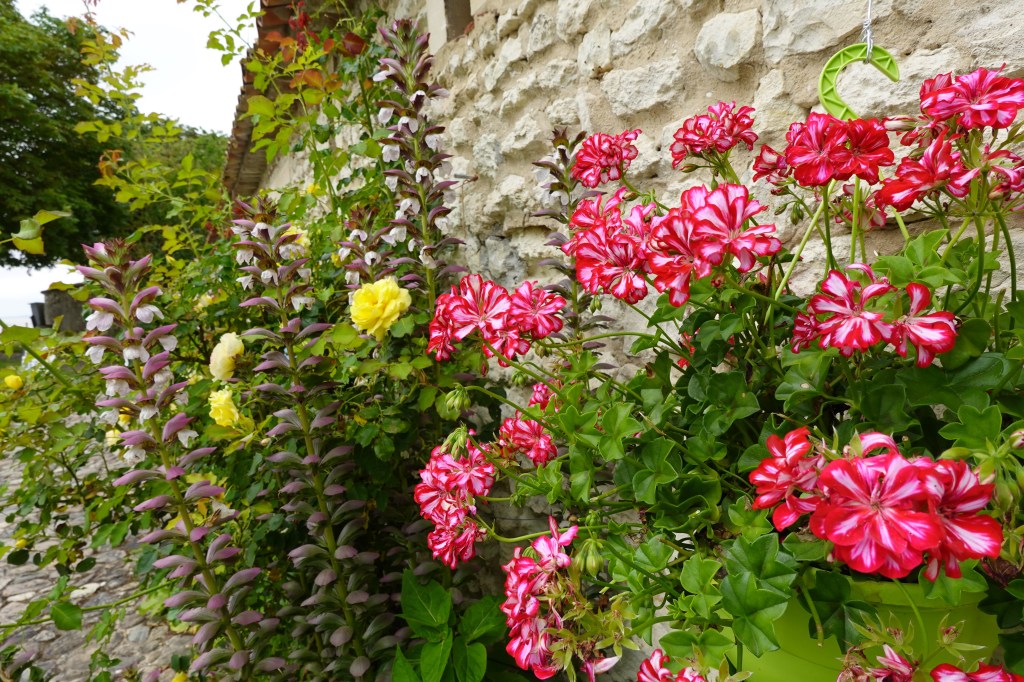
Diversity, as the photo above shows, is beautiful.
So, I don’t think of how to « tolerate » different views, opinions and ideas. I think how to integrate them. I don’t know how else to grow or flourish, let alone, survive.
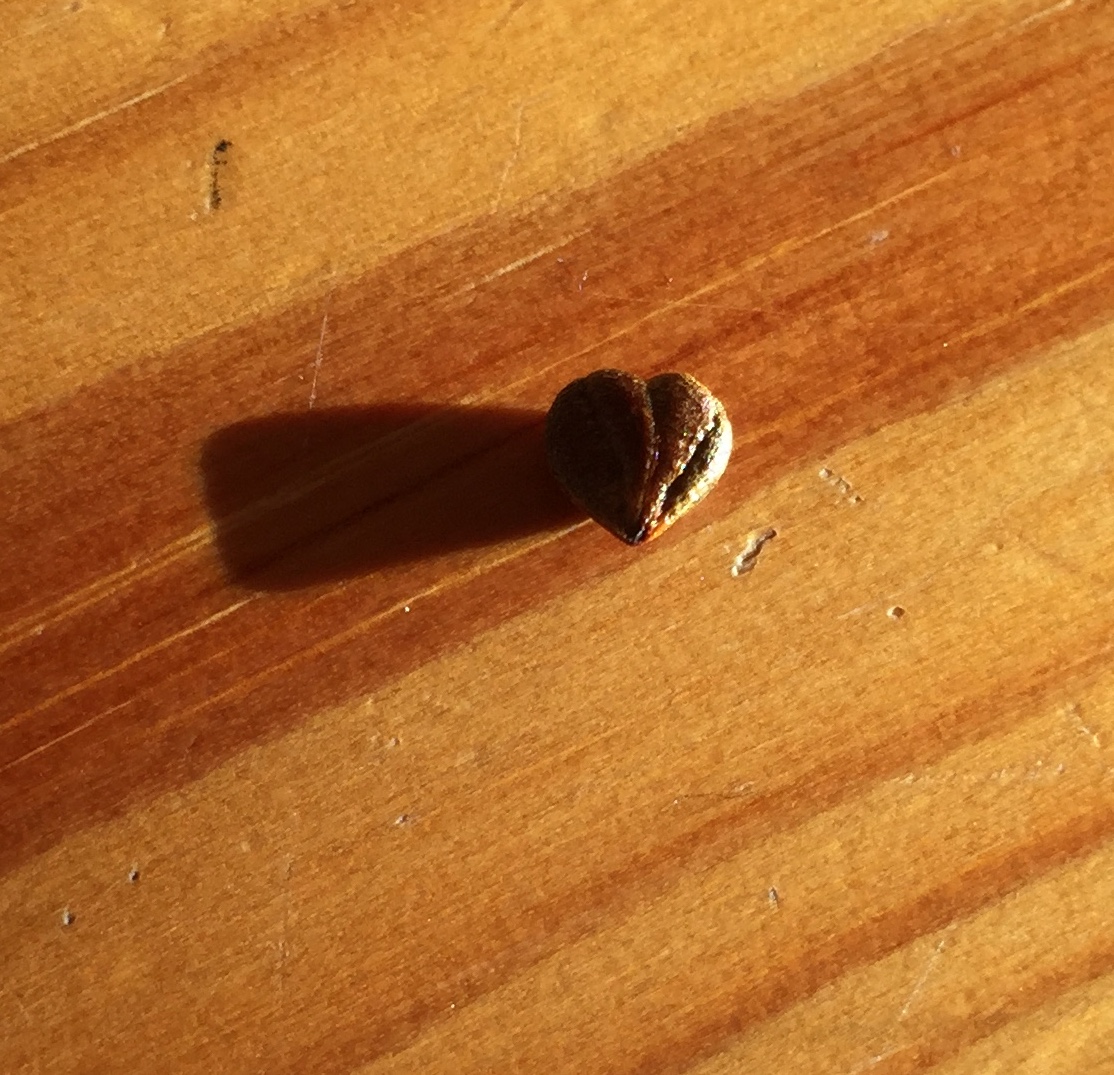
Look at this seed. I love how it’s heart shaped which immediately makes me think of my own beating heart.
It’s not a big leap from there to thinking about the whole phenomenon of Life. I mean, what exactly is it and how do we know when it’s there? Do those seem strange questions to you?
What is Life? I remember looking at the index in my main textbook of Medicine which I used during my university years. I was surprised there was no entry for “health”. Doesn’t that seem odd? You’d think if the goal was to train doctors how to help sick people become well, or how to heal the sick, then there might be a clear description at least, of health. After all how does a doctor know they are achieving their goal of health without a clear understanding of what health looks like?
That line of thought stayed with me throughout my working life, leading me to explore the philosophy of Medicine, philosophy of Science, the History of Medicine and Complexity Science.
It’s still not easy to say exactly what health is, but I’m sure it’s a phenomenon which is both objective and subjective.
However, that’s a digression, because what I encountered when exploring the absence of much consideration of health in Medicine, I came across a parallel issue in Biology. Try finding an entry for “life” in a biology textbook. Seriously – if you find one, let me know! Despite biology being pretty much a science of life, it seems science doesn’t find it that easy to say what life is. Or even when it’s there.
Which brings me back to this seed.
Is this seed alive?
Do you know that nobody can tell you the answer to that. There is no way to know by just looking at this seed – at any level – or by doing any measurements. The best science can do is to take a whole bunch of seeds and predict what percentage of them will turn into plants if nurtured. It can’t tell which particular seeds are “viable” or “alive” and which are as dead as a grain of sand.
There is only one way to find out – plant it, care for it, nurture it, and see if it grows.
Life, it turns out, reveals itself only in the experience of living.
I read a beautiful review by Robert Macfarlane yesterday. It was in the New York Review of Books and he was reviewing three books about navigation, wayfinding and landscape.
He gave several examples of astonishing navigational powers in several creatures, and of course, it’s hard to fail to be amazed by how a tiny migratory bird can travel thousands of miles and back between two particular places in the world. At least that’s my experience of the redstart who comes back to my garden every Spring, to give just one simple example.
Researchers have found magnetic particles in the beaks of migratory birds and similar structures which allow creatures to potentially detect the electromagnetic fields which encircle the planet, but they still haven’t figured out exactly how they use that ability.
It turns out there are highly specialised nerve cells in our brain which allow us to know both where we are in 3D space and to make maps of our surroundings so we can find our way easily from room to room and along familiar streets without having to stop to think about it.
But here’s the bit that really grabbed me.
Humans don’t possess inbuilt compasses, but we do have something arguably more powerful: storytelling. Our remarkable navigational ability as a species is closely connected to our ability to tell stories about ourselves that unfold both backward and forward in time.
Robert Macfarlane in NYRB reviewing Wayfinding by MR O’Connor
Isn’t that a great insight? Our navigational super power isn’t tiny magnetic sensitive particles in our brains. It’s our ability to tell stories.
Without this ability we’d never have been able to share with others what we’ve learned, what we can imagine and where we are.
I live in rural South West France, in a department called “Charente” which is the name of the slow moving, chilled out, river which runs through this land.
Perhaps the most characteristic feature of the landscape around here is vineyards. The rows and rows of vines are dedicated to the production of an alcohol called cognac, and the town of the same name is just a few kilometres from where I write this.
From the vineyards to the distilleries, the barrel makers, bottling plants and marketers, to the agricultural machinery and distillery equipment manufacturers and sellers, to the professional blenders, the groups of vineyard workers pruning, tying the vines along the wires, spraying the plants with herbicides and insecticides or tending to their fields with newly fashionable “bio” methods of viniculture, to the tasters and storytellers who turn these complex honey coloured liquids into magical hints of memories and desires, this is a whole complex web of human activity which forms a distinct culture.
I haven’t even begun to consider the non-human elements of this culture….the geography, geology, and ecology of this land.
Perhaps one of the most striking phenomena of this place is in the sky, however. I haven’t counted them but I’d be surprised if most years the majority of evenings in the year display pink, red or crimson skies at sunset.
You might think it’s so common that it becomes background, barely noticed, rarely acknowledged. But you’d be wrong. Night after night I notice the reddening of the sky, seeing the colour of the light change as it illuminates the pale stone walls, the dark leaves of the mulberry tree, or any clouds passing by.
I notice it, I get up, look out the window and, more often than not, go outside.
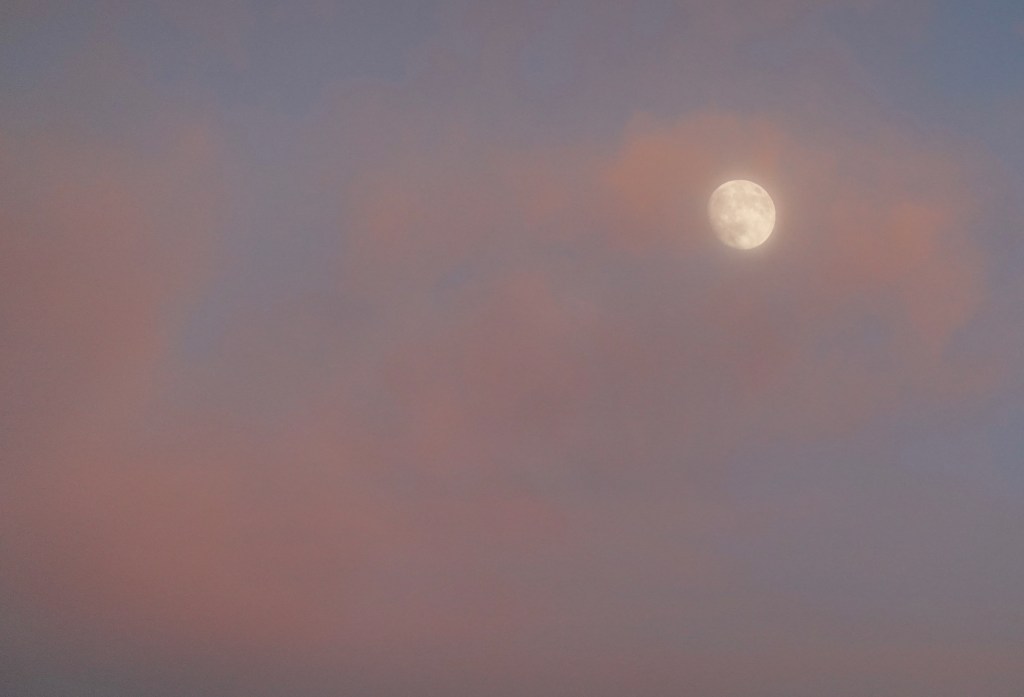
A couple of evenings ago the moon, waxing towards the full, appeared behind a thin pink cloud and I took this photo.
Well of all the hundreds of sunsets I’ve seen here over these last few years, this is the first time I’ve seen the Moon, veiled in pink.
It’s that sort of daily encounter with uniqueness and beauty which gets me wondering and delighting in just noticing what we call “this time and place”, or “this present moment”.
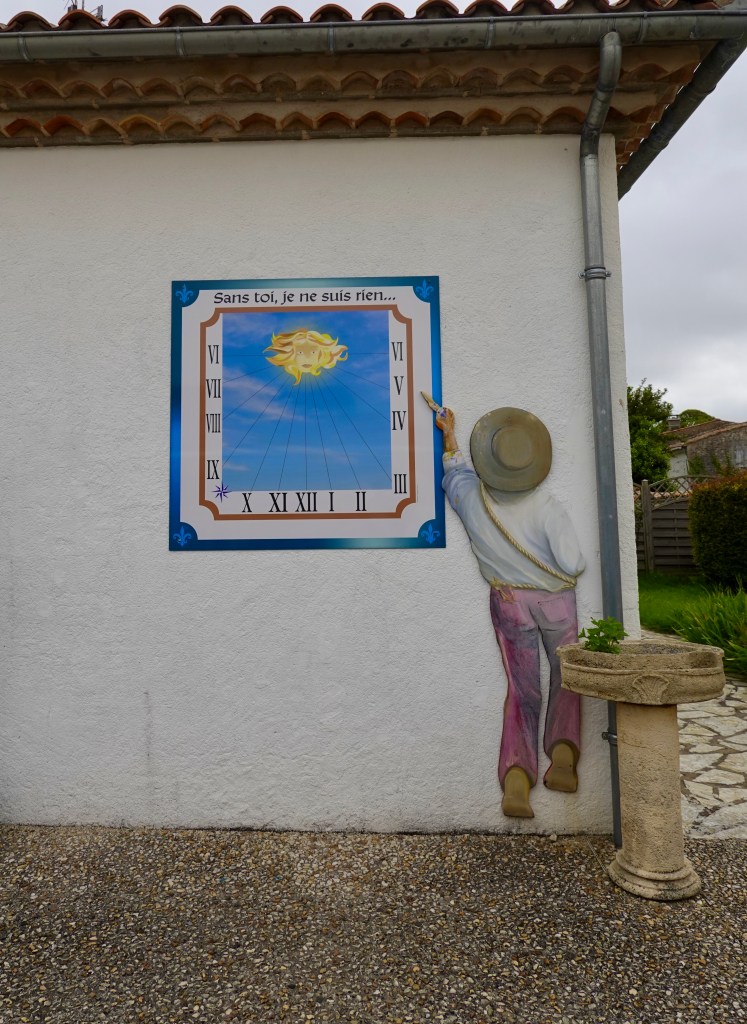
I saw this mural yesterday when I was visiting the little village of Talmont on the West coast of France. The wall belongs to a shop selling sundials, and the words along the top which translate as, « without you, I am nothing », are probably referring to the Sun.
However, surely it’s not so specific. After all, we wouldn’t just be nothing without the Sun, we wouldn’t even exist in the first place…..no Life on Earth would ever have been possible without the Sun.
So, I’m reading this phrase as something I’d think about in terms of other people. That reminds me of the African word, Ubuntu, which means, I think, « I am because you are ».
This French phrase comes at the same idea from a different perspective and it’s got a dash of romance added to it too, hasn’t it? Isn’t the kind of thing you might say to your lover.
You could argue that it’s an exaggeration. I wouldn’t be « nothing » without you, and you wouldn’t be « nothing » without me. But we would both be considerably diminished without each other.
I hope, dear reader, than your life is enhanced by your stopping by here, enjoying my photos and my words. Thank you for being here. I can tell you my life in enhanced by sharing this with you. And that’s why I’m doing this……
My life is more, because we share these few minutes with each other…..and your « likes » and lovely feedback ripple through my days.
So, maybe we wouldn’t be nothing without each other, but we would certainly be less.
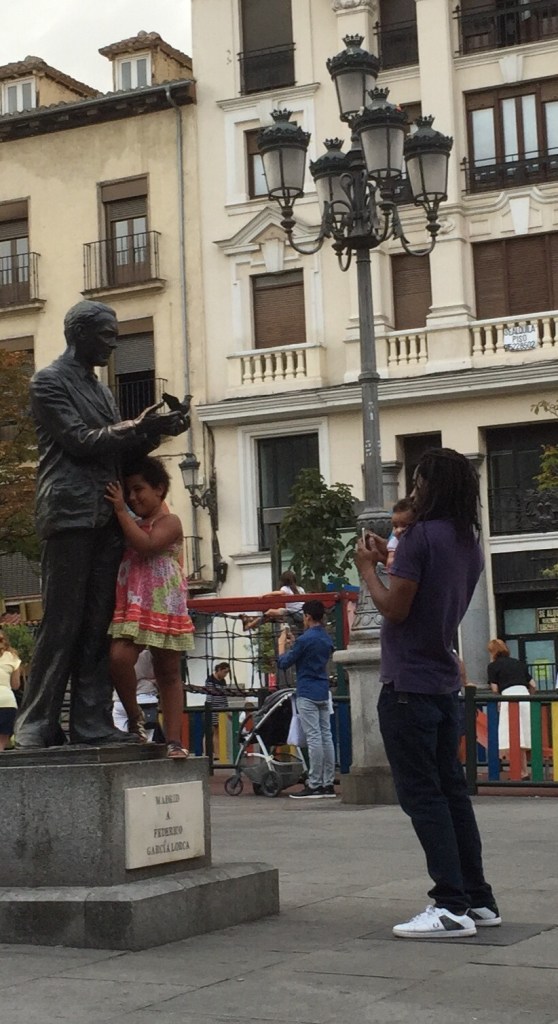
Five years ago I was in Madrid, sitting in one of the many plazas enjoying a glass of wine and I noticed a statue getting a lot of attention. It’s a statue of the poet, Lorca, where he is setting free a bird. You know how certain statues have highly polished parts because so many people have felt compelled to touch them over many years? There are just some statues which call out, silently, to be touched. The ones which touch the people who come near, I suspect. Like « Greyfriars Bobby » in Edinburgh. Well, Lorca’s statue seems to be one of those.
I was particularly struck by this little girl’s response to the statue. Look how she is cuddling Lorca? She’s the very picture of affection.
I’ve looked at this photo many times and every time it touches my heart. It puts me in touch with those flows of kindness, tenderness and affection which run through us all.
I know we are surrounded by stories of cruelty and violence. I know human beings can be capable of the most despicable acts. But there’s something else which runs through us all. You could call it love. You could call it socialisation. You could call it empathy. You could call it the desire to care and be cared for.
It’s present from the moment of birth. No baby would survive without it. No child would thrive without it.
We humans are no solitary creatures. We have achieved what we have achieved as a species. We learn from each other, teach other, support each other, work with and care for each other. If we didn’t, we’d all perish.
I don’t know, I just think it’s worth remembering that from time to time. After all maybe the future depends on our strengthening that connection with our « better angels »
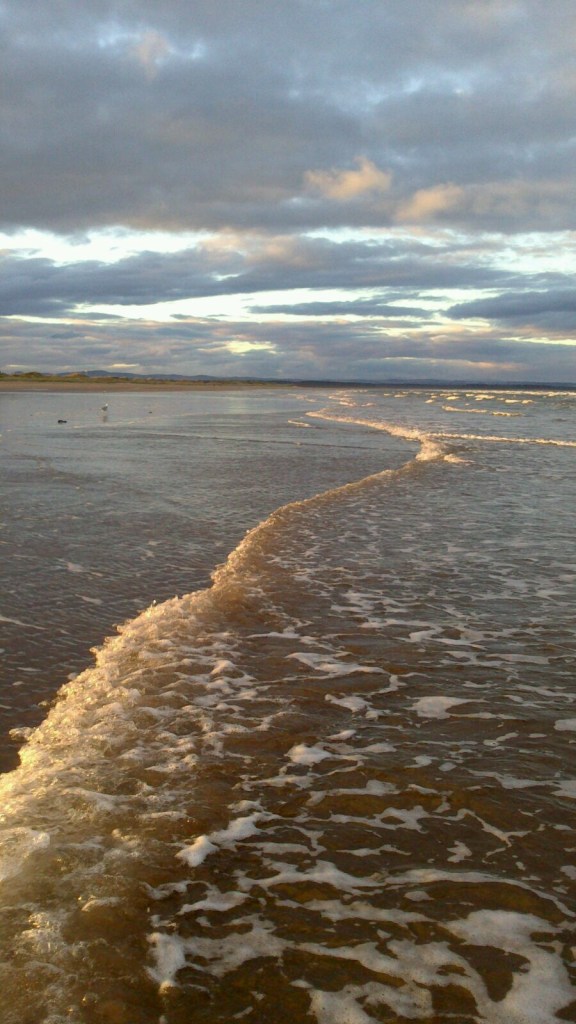
I love this photo. The way the sunlight catches the breaking edge of the waves turning the foam several shades of white, cream and gold delights me. It draws your eye right there – to the leading edge.
I don’t think of the world in terms of separate objects any more. Instead I see flows, intersections, meetings and connections. I see relationships and experiences. I see becoming, not being.
All that exists is impermanent. It’s not just that we humans are mortal, it’s that the whole of Nature is in a constant process of cycles of birth, growth, maturity and death. Transience makes every moment special.
Shifting my gaze from apparently separate objects to change and interaction enables me to see the contexts in which all exists. It focuses me on inter-dependence, on connections and collaborations.
I was thinking of this as I watched David Attenborough’s superb A Life on our Planet on Netflix. Have you seen it? I highly, highly recommend. One of the best things he’s ever done. I found it moving, thought provoking and optimistic. If you don’t have Netflix you can listen to the audiobook version on Audible, or, you can read the book.
Perhaps his key point is the importance of biodiversity which our current societies and economies are in the process of destroying. Because all of Nature is interconnected and interdependent we need biodiversity for the health of the entire planet. In fact we humans won’t survive without it.
It’s that combination of diversity and connections which is, I think, the key, and I reckon he is right when he tells us that the solutions are all there right in front of us. If we want to discover how to thrive, not just survive, then we should learn from Nature, and a great place to start on the path to sustainability is to support and develop both diversity and integration – by which I mean « the creation of mutually beneficial bonds »
When we do that we’ll be living on the golden edge.
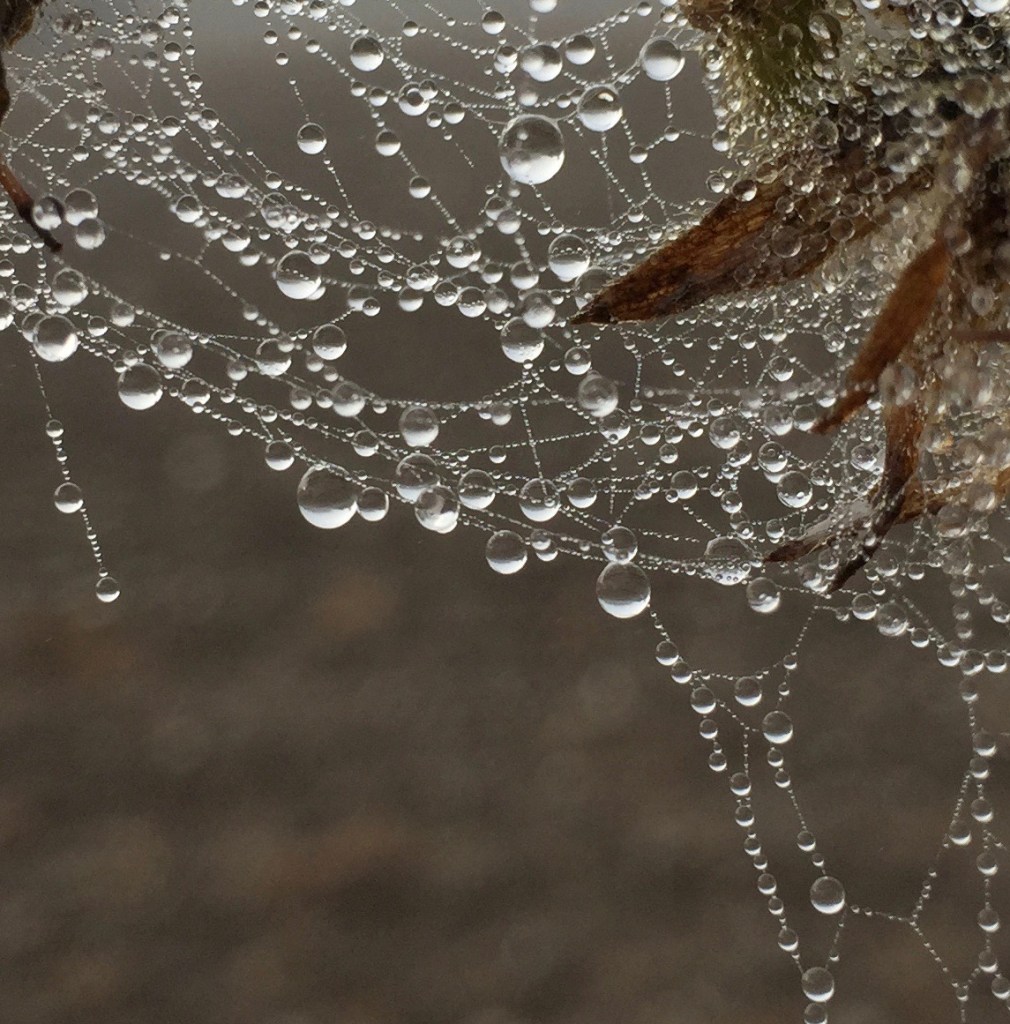
When I see a spider web heavily laden with dew in the morning, or after the rain, it’s the sparkling jewel like quality which catches my attention. But when I look more closely I’m transfixed by how every single water droplet acts as a tiny lens.
Whichever lens you look through you see pretty much the same scene. But if I was considering this more carefully I’d realise that each lens is in fact unique. There might only be tiny differences but they are measurable.
However the fact is that the differences are tiny. No matter which little lens you are looking through you are seeing pretty much the same scene.
So this reminds me about three important truths. First, we all perceive and experience the world from our own unique individual subjective perspective. Second, we are all sharing the same world. We don’t live in, or experience, totally separate ones. Third, we are all connected.
Ever since I read about Indra’s web I think of that when I see a be-jewelled web like this, so it’s easy to slip from the pure beauty of the particular web into a universal experience of dissolution into a sense of One-ness.
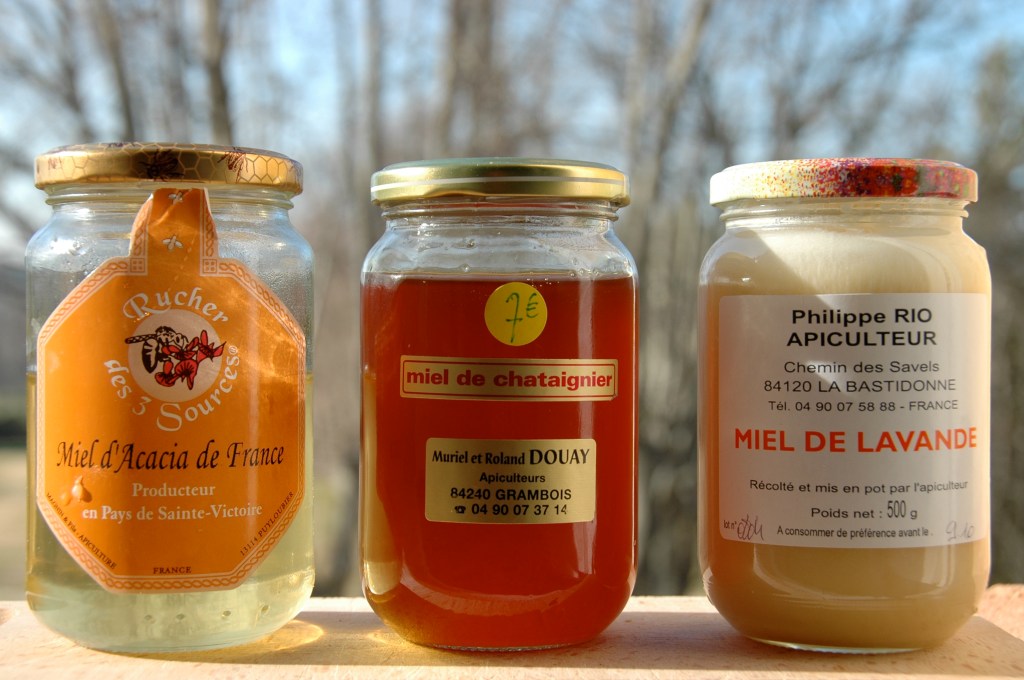
Here are three jars of honey that I bought at a market stall here in France.
From left to right they are acacia, chestnut and lavender.
What’s the first thing you notice?
They are SO different, huh? Just looking at these jars should make you pause and think about this issue which I reckon we encounter multiple times every day – how uniqueness is always present even when we obscure it by abstraction and categorisation.
What?
Well you see I understand why we call the contents of all three of these jars by the same name – honey – because it’s true. They are all honey. But I’ve heard some people say they love honey and others say they hate honey. And here’s where the problem starts. Believe me acacia, chestnut and lavender honey taste incredibly different. They don’t have the same consistency and they don’t even smell the same.
I adore the chestnut honey but I’m the only one in my house who does. Others can’t even stand the smell. I find the acacia kind of bland but it’s probably one of the most popular ones in the shop. And the lavender honey spreads utterly differently from the other two. You can pour the others, but you’ll wait a long time to see the lavender one pour!
I know this skill of analysis and categorisation which is carried out by the left hemisphere is a kind of super power that allows us to think quickly but abstracting just a small number of features or characteristics and classifying the entire “object” according to only those features distances us from reality.
Reality, it turns out is a vast interconnected web of uniqueness with every element, encounter and relationship constantly influencing and being influenced by the others.
Generalising, labelling, runs the risk of blinding us to uniqueness which doesn’t only mean we separate ourselves from reality but it threatens our humanity.
Just last year when visiting my mum in hospital I overheard one nurse say to another “Have you taken blood from bed 16 yet?”
Yeah, right, try getting blood out of a bed!
That’s a common way of thinking and speaking in Medicine. I can remember the excitement of our group in Medical School when we heard “there’s a really unusual heart murmur in ward 6”! Well, we were just learning how to use that iconic instrument, the stethoscope and there’s only one way to detect unusual sounds in someone’s heart – to listen to them and learn each distinct pattern.
Thing is it’s too easy for the actual people whose blood needs to be examined or whose heart is making an unusual sound to just disappear.
Are we going the right way with this issue?
I don’t think so.
By shifting our attention from stories to data we are de-humanising not just our health care but our societies.
Is it any wonder that public and political discourse has become so polarised? If we see someone as “one of them” and “not one of us” it’s going to be pretty difficult to build a mutually beneficial relationship with them.
How do we counter that? Well I guess it’s takes curiosity and a desire to discover what makes someone unique. Because here’s the interesting thing I’ve found in life – when you discover someone’s uniqueness you find what you share with them and at exactly the same time you find you appreciate them as whole people.
It turns out that what we all share is the fact that we are all different.
And seeing both differences and similarities in uniqueness enables us to humanise our daily encounters, to build bridges and to care for each other.
Turns out that makes for a tastier, richer, more delightful life.
This is one of the many stone circles I’ve visited in Scotland over my lifetime. This one is at Lundin, and it’s a pretty small one, but rather uniquely, has a tree growing in the middle of it. That’s pretty unusual. Mostly these circles have just grass or a covering of small stones in them.
I suppose you could look at this and say it’s just a few stones, placed on their ends in approximately the same part of a field. So what’s the big deal? But wouldn’t that be a terribly reductionist, thin, and poor way to encounter something like this.
The truth is I don’t think anyone seriously looks at this and thinks, so what, just some stones in a field!
There’s something about the arrangement of stones into rough circles which resonates deeply with us. They catch our attention, provoke our curiosity and stimulate our imagination. They may even invoke memories for some of us, remind us of stories, create a sense of deep time connection to ancestors.
There is something else they can do too – they can move us. I’m sure I’m not the only person to feel a thrill approaching a circle like this, to experience a quickening of my heart and my breathing. Not with all of them, but with many of them, I have a distinct feeling when I step inside the circle. I can’t quite pin it down. It’s partly a feeling of joy, partly a feeling of wonder, and partly a feeling of expectation. Of what? I don’t know. About the best I can say is that the feeling inside some of these circles is special. It’s unique.
Is this why they were built in the first place? We don’t know. Are they works of art, places of ritual, scenes of celebration or enquiry? We don’t know.
But here’s what I do know. They aren’t just a few stones in a field.
They are opportunities to be enchanted. To be re-enchanted. Because, hey, let’s face it, it’s pretty easy to feel dis-enchanted these days!
There are many kinds of special places for human beings of course. They aren’t limited to stone circles. I wonder which special places you’ve found in your own life?
These special places make us more aware that life can be deep, rich and meaningful if we look behind the superficially disconnected material view of reality.
I welcome constructive criticism and suggestions. I will not, however, tolerate abuse, rudeness or negativity, whether it is directed at me or other people. It has no place here. ANYONE making nasty comments will be banned.