If you’ve been following this blog for a while you’ll know that the “émerveillment du quotidien” is a key life principle for me.
That French phrase captures the sense of continuous open-ness to wonder. (It means the amazing everyday – more or less!)
But look what I managed to film today!
I’ve seen and heard this little creature buzzing around my garden recently and he never, ever stays still. Not for a second! I think it’s called a “hummingbird moth”.
His wings make a deep buzzing sound so its always obvious when he is around.
Look at the speed of his wings! Look at that long proboscis and how it can curl right up into a spiral! It’s astonishing!
I bet there’s a good chance you will look at this photo and it will touch your heart.
Looking after wee ones is SO important.
I wonder if we really honour and respect that enough?
Are our societies structured in the way which allows the wee ones to grow and thrive, to reach their full potential?
I think the solutions will lie in developing our heart intelligence, but we need our brain intelligence too.
For a data-driven, brain-focused approach, here’s a video of a presentation by Sir Harry Burns who was Scotland’s Chief Medical Officer until last year. It’s almost half an hour long, and some of it is pretty technical, but Harry Burns is expert at delivering the messages in clear, simple ways. I think the first twenty minutes or so of this presentation will startle you if you haven’t seen this kind of analysis before. The takeaway message is that the way we structure our society, in particular in the physical, emotional and social environments we create, powerfully influences the health and illness paths of individuals right from conception (or earlier?) and the first few months of life. (The last ten minutes or so of this particular presentation goes off into the “patient safety programme” – which is a different issue – in my opinion)
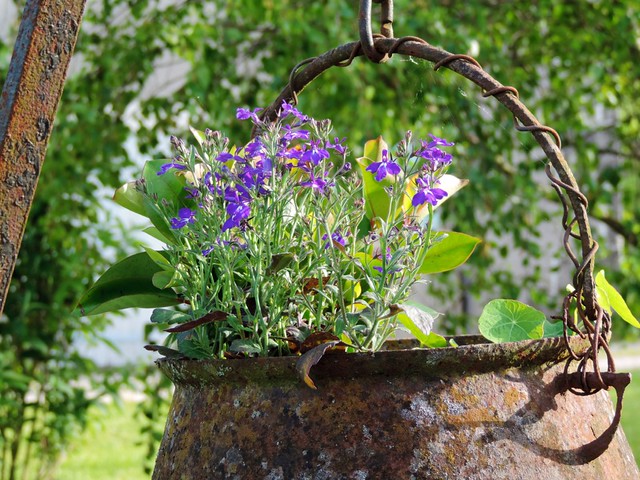
When you look at this photo you’ll see something living, the plants, and something “inanimate”, the cauldron. Some of you will also say you notice the sunlight and the shadows.
Every day these plants look different as they grow, flower, and, ultimately wither.
Every day the cauldron doesn’t look that different, but if we could see what it looked like on that first day when it was carried from the foundry to the shop, we’d see that it has changed a lot.
Everything changes. Just at different rates. Living organisms change rapidly, whilst inanimate objects change much more slowly, except for moments of catastrophic change where, for example, an object is broken.
We forget that, don’t we? That change isn’t optional, but the speed of change can be.
We are creators, we humans, and when we create we embrace change, we engage with it, we bring our imaginations to bear upon it, and so we make the world we live in.
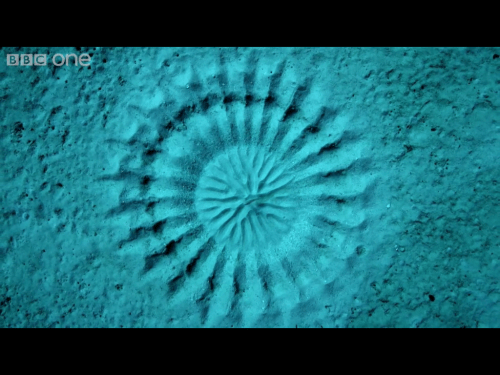
I saw it on a French Nature programme, but it’s originally from the BBC.
If you look carefully you’ll see the little puffer fish at the centre of his creation. Isn’t it totally amazing?
How can such a wee fish make such a perfectly accurate circular pattern like this? And isn’t it just beautiful?
Apparently this is what the male puffer fish creates to attract a female. If the female fish is satisfied with the creation she lays her eggs right in the middle of it, he fertilises them, then she lays more, which he fertilises. Then she swims off.
The way he makes the pattern, it creates a perfect consistency of sand in the middle for the protection of the eggs. In other words, from an engineering perspective, it’s brilliant.
But what amazed me most was how he makes it so beautiful, and how the beauty of the pattern attracts the female.
Are you aware of any other creatures, apart from human beings, which produce creative works of beauty? I know certain birds, and some other creatures, can create incredible nests, but ones which seem to be created to be beautiful? I didn’t know other creatures did that.
Oxfam recently reported that the 85 richest people in the world own as much wealth as the poorest HALF of the population of the world.
Oxfam said that this elite group had seen their wealth collectively increase by $668m (£414m) a day in the 12 months to March 2014. It found that it would take the world’s richest man – Mexico’s Carlos Slim – 220 years to spend his $80bn fortune at a rate of $1m a day
The rate of inequality is increasing rapidly. Thomas Picketty, the French economist whose book “Capital” has taken the world of economics by storm, has shown that this trend is set to continue because the returns on capital are so much greater than the rate of growth in the economy.
Is this accumulation of wealth into the hands of so few healthy? Is it just? Is it fair? Is it acceptable?
The extent to which inequality causes harm was laid out very clearly a few years back in “The Spirit Level” by Richard Wilkinson and Kate Pickett (no relation to Picketty!). Their work showed strong correlations between the degree of equality in a country and the extent of a wide range of social and health problems.
With an endorsement from Andy Haldane, chief economist at the Bank of England, the report said a 1.5% billionaire wealth tax would raise $74bn a year – enough to put every child in school and provide health care in the world’s poorest countries.
A billionaire tax? Is there the political will in the world to deliver that? What else does Oxfam suggest?
a clampdown on tax dodging; investment in universal, free health and education; a global deal to eradicate extreme poverty by 2030; shifting the tax burden from income and consumption to capital and wealth; ensuring adequate safety-nets for the poorest, including a minimum income guarantee; equal pay legislation and promote economic policies to give women a fair deal; and the introduction of minimum wages and moves towards a living wage for all workers.
Herman Daly, who worked for the World Bank from 1988 – 1994 suggests two very interesting measures to tackle this growing problem.
we need a serious monetary diet for the obese financial sector, specifically movement away from fractional reserve banking and towards a system of 100% reserve requirements. This would end the private banks’ alchemical privilege to create money out of nothing and lend it at interest. Every pound and dollar loaned would then be a pound or dollar that someone previously saved, restoring the classical balance between abstinence and investment.
Now, there’s a fascinating idea! That money should represent something REAL in the world! With all these elaborate “financial instruments” money and measures of economic “health” of countries is becoming increasingly detached from real activities, real use of resources and real people. Maybe such a proposal could begin to shift the balance back from capital to labour? He also suggests
a small tax on all financial trades would reduce speculative and computerised short term trading, as well as raising significant revenue
So, there’s an interesting selection of ideas – a billionaire tax, a move towards 100% reserve requirements and a financial transaction tax. Which political party is trumpeting these ideas? Which political party is prepared to put tackling inequality these ways at the heart of its manifesto for upcoming elections?
On youtube you can find a series of beautiful short videos in a series titled “Nature is speaking”. Each is narrated by a famous actor. Do go and check them out.
Here’s my favourite, with the truly magical voice of Kevin Spacey…….
I welcome constructive criticism and suggestions. I will not, however, tolerate abuse, rudeness or negativity, whether it is directed at me or other people. It has no place here. ANYONE making nasty comments will be banned.




 Heroes Not Zombies