Feeds:
Posts
Comments

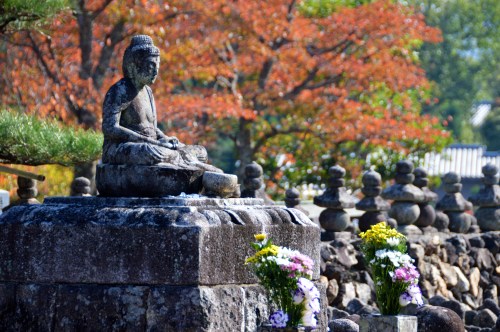
buddha kyoto

Mindfulness has become very popular, especially in America, where it has been pioneered by Jon Kabat-Zinn and others, but also in Europe. The French term for mindfulness is “en pleine conscience” – which more literally translates as “in full consciousness”.
I think it’s become so popular because it’s so helpful, particularly in the field of mental health where it has been developed through “Mindfulness Based Cognitive Therapy” (MBCT) to treat depression, and through “Mindfulness Based Stress Reduction” (MBSR), which does what it says on the tin.
But it’s more than a psychological tool for easing mental disturbances. It’s been found to influence the patterns of neurones and their connections (synapses) in the brain. Yes, it seems to actually have an influence on not just the function, but the shape, of the brain. This takes it into a realm beyond that of a therapy for diseases. As it develops the brain, so it can expand the mind. In other words it seems to have the potential to aid creativity, the growth of emotional intelligence and to increase resilience.

Freedom vs control
All through my working life as a doctor I was keen on therapies which did more than merely reduce suffering. A treatment which simply suppressed symptoms or kept a disease process under control, while potentially valuable (because who wants more symptoms and more disease?) was never that satisfying to me. I was always way more impressed with a therapy which enabled people to deepen their understanding of themselves and their lives, and free them up to grow and develop, to make life changing decisions, and, in so doing, to transform at least some of the underlying factors which caused their illnesses.
Mindfulness meditation is one such therapy. But then so are the exercises which enhance cardiac coherence, like “Heartmath”. And so are other meditation practices, whether they be “Vipassana meditation”, “transcendental meditation”, guided visualisation or “compassion meditation”.

Paying attention and non-judgement
As best I understand it, there are two fundamental tenets of mindfulness –

  • Paying attention
  • Non-judging

I would claim that these were the key tools of successful medical practice long before “mindfulness” became so popular in the West.
The absolute best I could ever do for any patient required that I paid attention to them, giving them my full focus, living together in the present time and place of the consultation. And that I listened with a determination to do two things – to understand them (through empathy), and to help them. I often thought that these were exactly the reasons why people came to consult me – to be understood, so that they could understand what was happening in their lives, and their bodies; and, to be helped, because they’d reached a place where they couldn’t solve their difficulties alone.
The non-judging part was equally crucial, because it’s one thing to pay attention, but if you judge what you hear it’s very hard to hear clearly. Judgement stops thought, as Hayakawa, the “general semanticist”, wrote in “Language in Thought and Action”

“A judgement is a conclusion……The premature judgement…often prevents us from seeing what is directly in front of us”

Diagnosis
Of course a diagnosis is a kind of judgement. It’s a summing up of the patient’s story, their symptoms and their signs. Diagnosis surely is the key to successful treatment. If you don’t know what you are treating, how can you offer the best treatment? So, I wasn’t against judgement as such, just “premature judgement”. In other words, trying to avoid reaching a diagnosis before I’ve paid sufficient attention.

Always more to discover
Ah, yes, I’m sure you’re thinking….so what is “premature” and what is “sufficient”?
And those are great questions. The answers to which are always “time will tell”. You can never be 100% in any particular moment that you’ve grasped the full story, that you’ve completely understood. In fact, it was quite common that patients would tell me towards the end of the consultation that they’d never told anyone the things they had just told me. But I’d respond to that by saying I don’t think anyone can be fully understood. In fact I think we each spend a lifetime trying to better understand ourselves and I’m not sure any of us reach a final, full point of understanding. There will always be more to discover.

“There will always be more to discover”

would be one of my mottos.

The ongoing relationship
Even when I’d made a diagnosis and initiated a treatment, it was important to follow through and follow up. To meet the patient again after an interval and to begin the loop of the spiral – to pay attention and to listen without judging. Failure to do that meant I’d potentially mis-judge how helpful the treatment was for this individual, and would deny me the opportunities to understand them even better.
It wasn’t unusual to hear a story from a patient which transformed my understanding of them, a story told by them several years into our therapeutic relationship. People who had told me several times things they said they’d never revealed to anyone else, could, after many, many consultations, tell me something of fundamental significance which they’d never even hinted at before. That kept me humble and reminded me of my motto “There’s always more to discover”.
I should just add here that my experience of sharing work with colleagues showed me time and time again that I could never say I was always the best person for the patient to work with. Other colleagues would discover things I’d never discovered, just as I’d discover things they’d never discovered. “There will always be more to discover” reminded me to be humble. I should never claim that I was “The One” who “knew best”.

Personalised Medicine
I think it’s those last two points which are forgotten about by some of the adherents of “Evidence Based Medicine”. The only way to know if a treatment is effective for this individual is to continue to pay attention, non-judgementally, to them. The Randomised Controlled Trials, and met-analyses, might help you to select a treatment but the proof is always in the experiencing, the personal experiencing. Only this patient can tell you whether or not their pain is improved, they are sleeping better, they feel less depressed, they can move more easily, or whatever. Only the changes in your measurements of this individual’s body can reveal the success or otherwise of this treatment. The truth is revealed in the follow up.

Personal benefits of medical practice
Finally, I think the work of a GP is a kind of mindfulness training in itself. When consulting at a rate of about ten or fifteen minute intervals you encounter a lot of different people in one day. For each and every one of them you have to be fully present and give them your complete attention. The moment they walk out of the door, and the next patient walks in, you have to stop thinking about them and switch your attention to the person right here, right now. It’s a continuous practice of attending, letting go, and attending again. It’s also a great non-judgement training. Again and again you seek to avoid rushing to conclusions, and again and again, you have to be prepared to drop your diagnosis because now you see there is a better one.
I felt blessed in many ways working as a doctor. Paying attention and listening without judging allowed me to reach levels of understanding with others which felt like a privilege. And, maybe it helped my brain while I was at it! I’d like to think so.

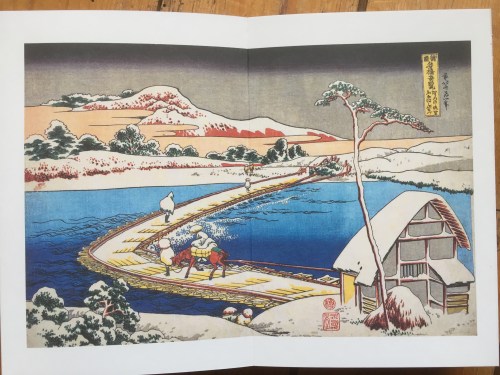
Floating bridge

floating bridge

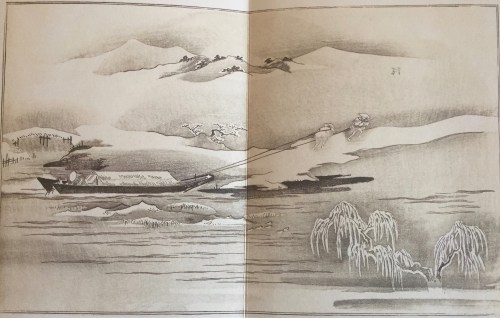
This is another of Hokusai’s prints, this time it’s a floating bridge.
When I looked at this first I thought why doesn’t the bridge go straight across the river? Why is it on a curve like that? Then I read that it is a floating bridge. Floating bridges are made from small boats or “pontoons” tied together. It moves with the flow of the water.
Have you ever seen such a bridge? Ever walked over such a bridge?
I haven’t.
I don’t know about you, but I don’t look at it and feel very confident. But this is a winter scene and it’s clear that the bridge, like everything else in the scene, is covered with snow. Well, snow and ice I suspect! With that realisation my already low confidence level plummets. Cripes! Really? Walk across a floating bridge that’s covered with ice and snow?
You’d have to be desperate, wouldn’t you?
Or maybe not. Maybe it’s a journey you’ve made many, many times, without any difficulties or disasters. So your confidence is actually high.
I often wonder about the phenomenon of confidence. How we get on a plane, or a train, or get into a bus or a car, and don’t really consider for a moment that we might not get to our destination, or even that we might not get there in one piece. But how many people are injured or killed traveling in cars, buses, trains or planes, or boats for that matter, every year? None of their journeys worked out for them.
But we can’t live like that, can we? We can’t live with the constant fear that the journeys we’ve made time and time again without any problems might turn out to be our last this time?
So we gain our confidence from our experience and we set off, probably not even giving it a second thought.
I suppose that’s the alternative to being paralyzed by fear – to cope with things as they happen – or, to put it another way, to cross the bridge when we come to it!

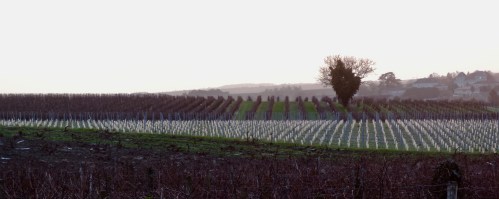
The house where I live is surrounded by vineyards. Not for wine making, but for the production of cognac. Each line of plants is known as a “wire” and each of the owners plant out, tend to, and harvest a certain number of wires.
There are no fences or hedges between each vineyard, but some of the wires run north to south, whilst others run east to west, or even on a diagonal. I don’t know how each person knows where their “patch” begins and ends but there are workers in the vineyards pretty much every day of the year, except Sundays.
Every single plant is tended individually, pruned back to two main branches, one running forward along the wire, and the other in the opposite direction.
I don’t know how many years of healthy productive life the plants have but there are three main phases of the vineyard, which you can see clearly, all at the same time in this photograph.
I just looked out of my window the other day towards sunset and spotted how I could capture all three phases in the one shot.
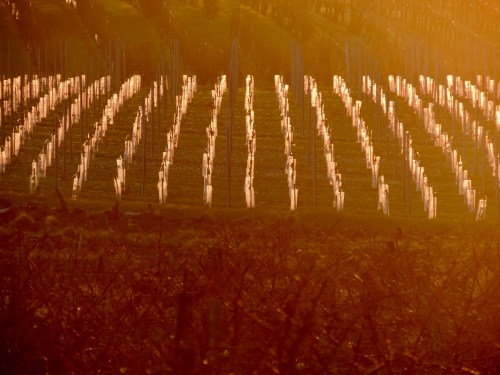
What you can see here are four distinct areas. The nearest and furthest away rare the currently active productive vines. These are the ones from which the grapes were harvested last year, and will be again, this coming year. In the middle there are two very different areas. The one nearer us shows an old, spent, field of vines in the process of being cut back and ripped up. Just beyond them in the grassy zone are rows and rows of new plants, each one protected by its own plastic tube.
It struck me, when I looked at this, that I could see the past and the future embedded in the present. I thought it was a vivid representation of the fact that time isn’t linear, it’s cyclical. There are cycles of seasons throughout a year, cycles of seeding, nurturing, growing, pruning, and removing the vines. And these cycles of the vines extend beyond single calendar years to encompass whole lifetimes of this remarkable plant.

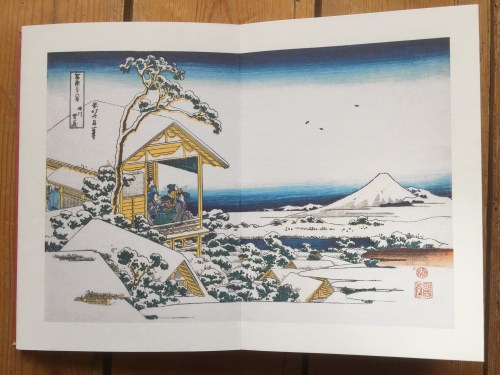
Look!

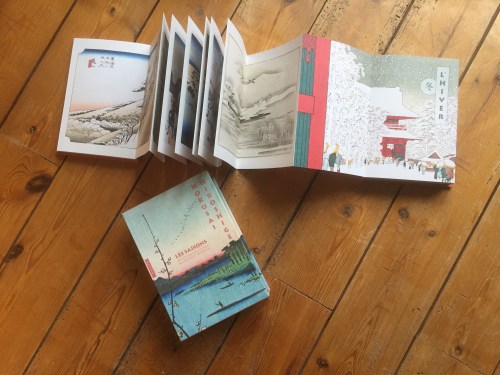
Today’s woodcut is by the famous Japanese artist, Hokusai (you know, the one who painted “The Wave”). It’s one of his “36 views of Mount Fuji”. The first thing which struck me when I looked at it was enhanced by the physical construction of this little accordion-print book that I have – each work of art is reproduced over a two page spread. In this case, the left page depicts what is in the foreground and the right, the distance. I find something immensely pleasing about that balance, or harmony. You can see the whole and the part all at once. You can see the “view from on high”, the overview, and the details of what is right in front of you, all at once.
That immediately provokes a train of thought in my mind about the two fundamental ways of engaging with the world which we humans have access to, thanks to our left and right cerebral hemispheres. The left, you might remember, favours a narrow focus of attention on parts, while the right gives us a broader focus on the whole. Beautiful.

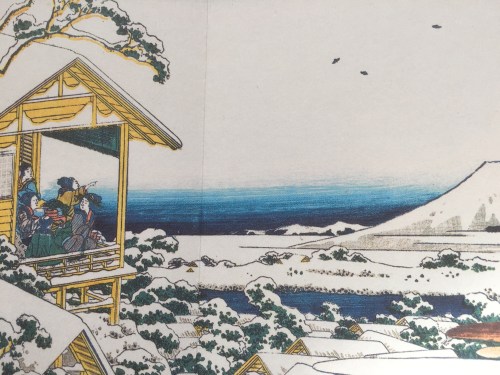
What I notice first is Mount Fuji, which, apparently was the artist’s inspiration for this series. Then I see the white snow covered landscape at its feet, and the endless blue beyond. I then turn to the left and see the little wooden pavilion with a group of women on the terrace. There are four of them. One is carrying a tray of food and drink, another turns to look her way. The third is pointing enthusiastically at something, and the fourth is turning to respond to her. Again, that’s a lovely balance…two people catching the attention of two other people. One to what’s right here in front of her, and the other to what lies in the distance.
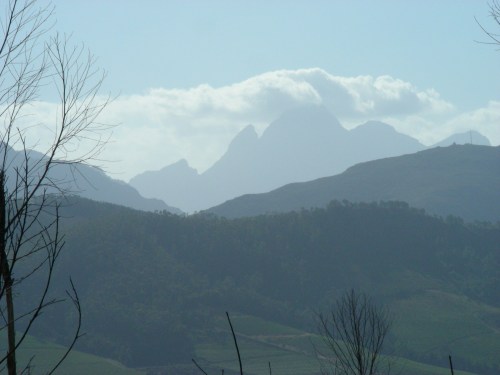
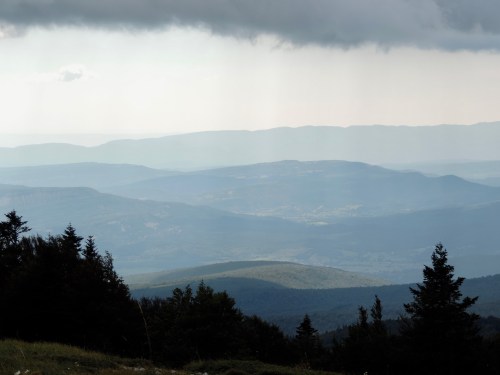
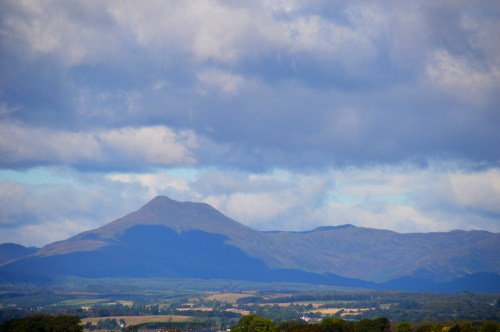
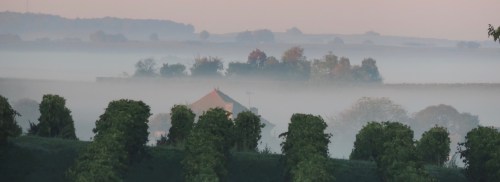
My booklet says that the scene shows a young woman enthusiastically pointing at the horizon. So, I return to the image and look to see if I can see what she is pointing at. It could be the horizon. By the way, do you notice how the further away part of the scene is the bluest part? That is a very, very common phenomenon. Here’s a couple of my own photos showing that –

It’s also something you can see reproduced time and again in paintings. The poet, Rebecca Solnit, writes the phenomenon of the blue distance beautifully in her essay collections, “A Field Guide to Getting Lost”.

The woman who is pointing, is she pointing at the horizon? Or at the mountain? Mountains are surely attention magnets. Growing up in Scotland I feel that mountains are in my blood. The shapes of specific mountains become very familiar to us, and Mount Fuji in Japan must be one of the most revered mountains on the planet. But maybe she’s pointing at the birds? Did you notice them? Birds always catch my attention. I love to sit in the garden in the summer and look up to see a few buzzards skimming the air currents gracefully, so high they aren’t much bigger than specks….a bit like these ones in this print.

You know, I think that’s one of the reasons why I write, take photos and share what I create. I’m the one enthusiastically pointing, saying “Oh wow! Look at that!!” I do that all the time. I do it when I’m by myself, when something catches my attention, moves me, or provokes a moment of wonder. I’ve written a number of times about the French phrase “L’Émerveillement du Quotidien” which captures this idea of being amazed by the so-called ordinary. In fact, the booklet which accompanies these woodblock prints says that it’s a “groupe de voyageurs s’émerveille devant le plus gros sommet du Japon” – a group of travellers amazing themselves in front of the highest summit in Japan – I like how French uses reflexive verbs – adding the “se” or “s’” in front of a verb – I can’t quite think of an English language equivalent.

Yep, that’s what it looks like to me – people amazing themselves! What a great thing to do! I love it when others do that too. It delights me when someone shares something they’ve noticed with me…..especially something which amazed them.

I hope this delights you too…..

Funny animals

I stumbled across something called the Comedy Wildlife Photography Awards today and several of them made me laugh.

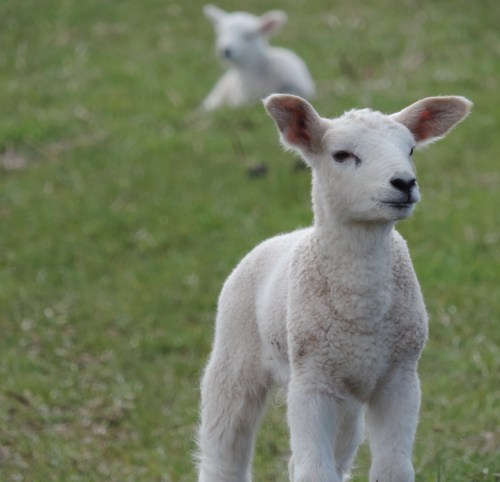
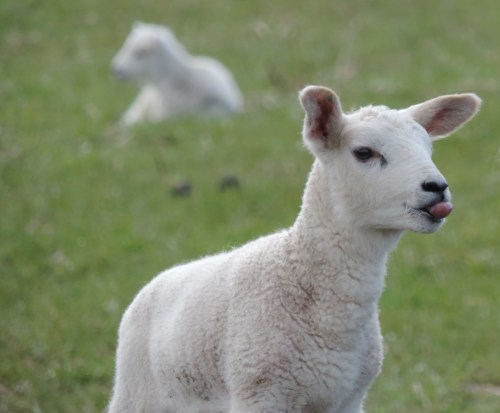
I also remembered a couple of photos I took while out on a walk a few years ago. It was lambing season and I thought I’d just take a photo of a cute lamb.

In fact, I took a couple of photos in quick succession, and it wasn’t until I got home and uploaded the photos to my computer that I discovered just what a cheeky lamb it was!

With hindsight I think you can see the same character in the first photo!

How do you begin your day?
Chances are the answer to that question has changed for you over your lifetime. For the couple of decades leading up to my 60th birthday I’d get up around 6am, shave, shower and dress, have a quick coffee, then set off for the railway station to begin my daily commute to the hospital in Glasgow. Once I’d retired and emigrated to France the pattern changed a lot. No commutes any more. And no routine requirement to be a particular place by a particular time. That was four years ago, and my patterns have changed a number of times over those four years. My most recent pattern is to get up when I wake up, usually between 7 and 8am, shave, shower, dress and then spend the next hour or so language learning. I’ve been learning French since I moved here and now I can read it pretty fluently, and can manage conversations with native speakers but I’m far from as fluent as I’d like to be, so I use apps, videos, or podcasts every day, and read articles which catch my attention in the newspaper, “Le Monde”. In addition to that I regularly buy French language magazines and books so always have more to read when I want but I don’t include that in my language learning time. Because I can set off after breakfast and be in Spain for lunch I’ve had a few trips to Spain. I’d never been to Spain until I moved here and I speak absolutely no Spanish, but I like the place so much I’ve decided to learn a bit of Spanish too. So each morning in my language learning session I’m working my way through the Duolingo Spanish course.
Before I settle down to learn though, I open the shutters. We live in a traditional old Charentaise house and all the windows have wooden shutters. The rhythm of closing them all at night, and opening them up every morning pleases me.
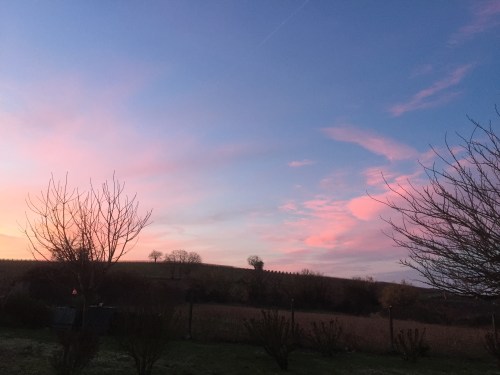
When I open the shutters it might still be dark outside but as we move away from the Winter Solstice it gets more and more likely that the first thing I see is the dawn.
Here’s what I saw this morning.

pink dawn1

Isn’t that beautiful?
It’s not like that every morning of course, but how it just captures my attention and entrances me when it does. It strikes me that it’s kind of life enhancing to witness, and pay attention to, the dawn.
So I was very taken with a quotation from Mary Oliver’s essay, “Wordsworth’s Mountain” which The Paris Review printed in an obituary article this week.

But dawn—dawn is a gift. Much is revealed about a person by his or her passion, or indifference, to this opening of the door of day. No one who loves dawn, and is abroad to see it, could be a stranger to me.

I like to think that although I only knew her through her writing, and how, of course, she had absolutely no idea I existed, that I wasn’t a stranger to her. What a lovely way to put it, don’t you think? Instead of just saying she could understand, or sympathise with, or share a point of view with, someone who loves the dawn, she said they couldn’t be a stranger to her.
That reminded me about the importance of the start of every day. Not just our first activities, or even our first thoughts or words, but how we begin the day. How we make that first connection.

What kind of connection do you make at dawn?

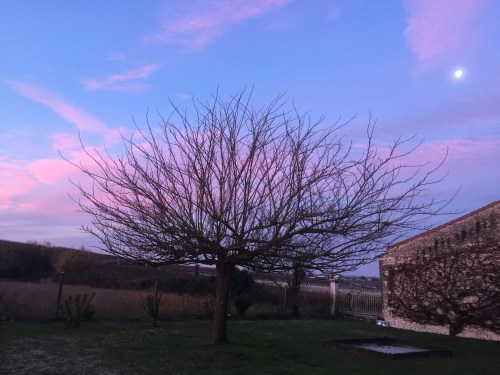
Here’s another photo I took this morning. The dawn sky behind the winter mulberry tree. (and, yes, that white spot in the top right corner is the moon! I know…but hey, it was just my iPhone!)

pinkdawn2

By the way, do you have a favourite Mary Oliver poem?
And if you’ve never heard it before, Krista Tippett’s 2015 interview with her remains one of my favourite Onbeing podcast episodes.

Treat yourself sometime.

Winter wonderings

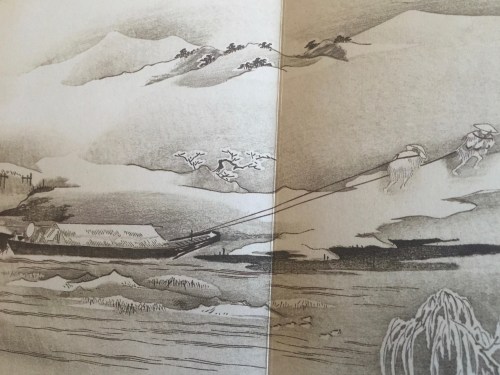
The Japanese woodcut I’m looking at today is from Kitagawa Utamaro in about 1790. He created five winter scenes to illustrate the 78 poems of Tsutaya Juzaburo’s collection, “Setsugekka”, (which means “Snow, moon and flowers”)

winter1

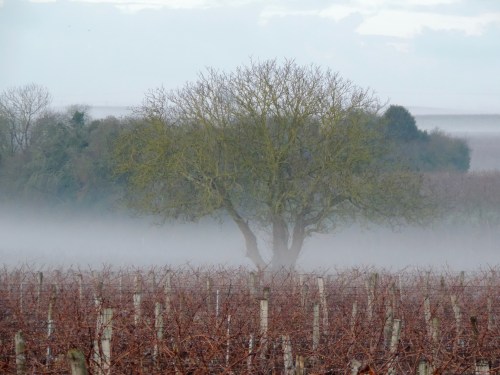
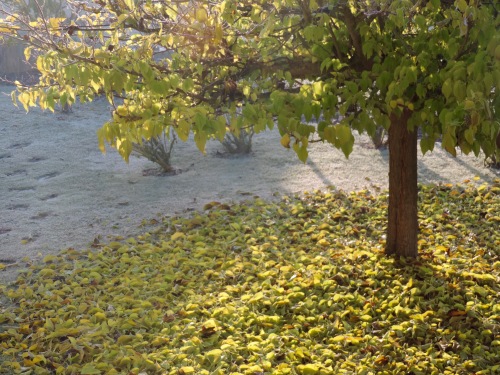
I’ve only seen a trace of snow a couple of times in my four years here in France, so snow doesn’t really feature in winter for me just now. However, there are certainly mists and frosts, both of which can be beautiful.

Version 2

tree in misty vines

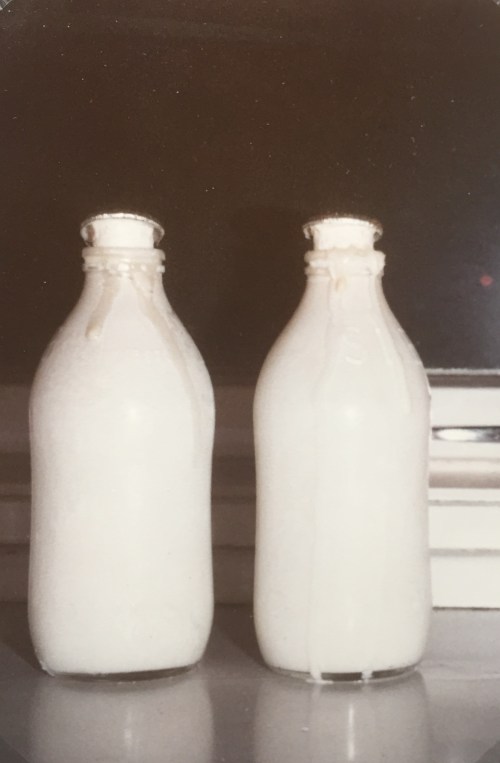
Of course, I’ve many, many memories of snow from all my years living in Scotland. I can remember one year, a year of my junior doctor training at Stirling Royal Infirmary when the snow fell and the temperatures dropped far into the minus range. The milk inside the milk bottles left on the doorstep (yes, that was a thing…..two bottles of milk delivered early each morning by the milkman) froze, expanding so much that the frozen milk pushed the silver caps up about an inch!

frozen milk
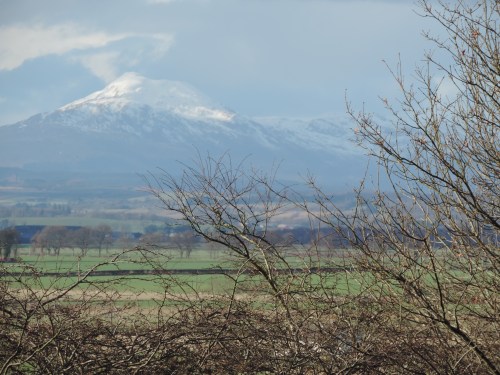
The last place I lived in Scotland before emigrating to France was the top floor of a renovated late nineteenth century textile mill. It had huge arched windows and from three of them I looked out across the Carse of Stirling to Ben Ledi…a shape that became as familiar to me as Mount Fuji is to Japanese people.

snow capped ben ledi

In the woodcut I can see three zones – in the distance, snow capped hills and mountains; in the foreground, a frozen weeping willow; and in the middle ground, two people struggling up a slope in the snow pulling a boat over the what seems to be a frozen river. The angles of their bodies and the lengths and taught-ness of their ropes suggests it’s really a huge effort. There’s a third person on the boat, but most of the boat is hidden by something like a tented canvas. It provokes my curiosity (as usual…..curiosity is probably my core characteristic!) and I wonder what lies under the canvas. Slightly further back is another frozen tree, perhaps a pine, and a snow-covered bridge.

winter1 people

It’s strangely still and frozen while conveying movement, effort and action at the same time. Do the people really have bare legs and feet? It looks like that! What an image of determination and co-operation there. No sense of ease, but of will and strength and progress in the face of adversity. But that adversity is also engagingly beautiful…..though I’m happier looking at it than imagining myself as one of the people in the scene!

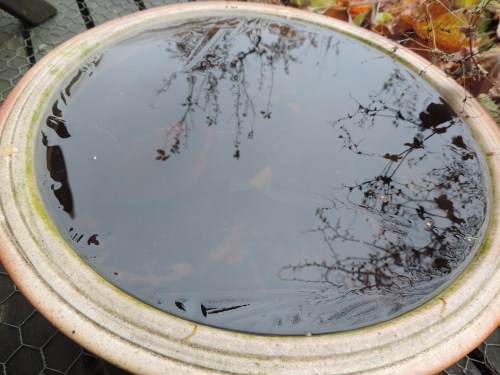
I also like the fact that the river seems frozen but not quite. I love that moment when you see water just beginning to freeze.

water starting to freeze

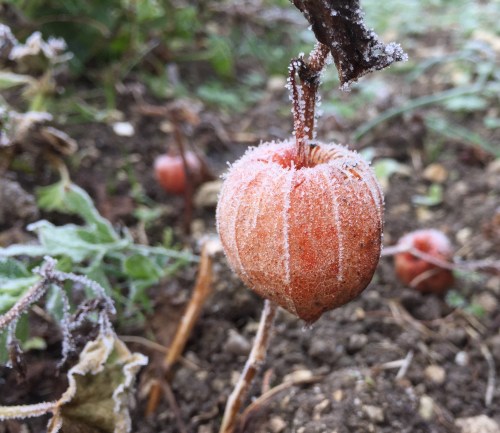
Isn’t water such a curious and amazing element? Combining those qualities of flow and stillness, moving from liquid to solid and expanding as it does so. And when it coats a plant, a flower, or a tree it somehow adds sparkle or even bling!

frosted japanese lantern

“En colère!”

I’d only been living in France for a few weeks when I realised that almost daily there was at least one report in the news of somebody being angry. In French, they say “En colère!” Some days it would be railway workers, the next air traffic control or Air France pilots. Mostly the people in the streets with “en colère” banners were workers who were “en grève” (on strike) and there were plenty of the red flags of the main trade unions. But it wasn’t always about workers on strike demanding better pay or conditions, or objecting to reforms of employment law. Sometimes it would be a group of parents protesting about the proposed closure of a small school, or workers and patients together protesting about a proposed closure of a local hospital. Other times it would be taxi drivers who felt threatened by the rise of Uber, or farmers struggling to survive in the face of cheap imports from other EU countries and the low prices for their produce forced upon them by the big supermarket chains.
What struck me was what they all had in common. They were all making it very clear that they were angry – en colère! I don’t know if they were also scared, anxious, sad or grieving, but they were certainly angry. It began to seem that anger was a characteristic of French culture.
When I thought back to living in Scotland, I couldn’t recall ever seeing protesters with banners saying they were angry. Sure, you’d see people protesting about proposed school or hospital closures but my memory is that they mainly had slogans like “Save our….[insert school or hospital here] or “Support our….[whatever]”. Pleas for help more than expressions of anger. Not to say people weren’t angry. I’m sure many of them were. It’s just they didn’t seem to express it as much as French people seem to do.
Then at the end of 2018 the anger in France boiled over. The “gilets jaunes” movement brought hundreds of thousands of people into the streets, occupying roundabouts and autoroutes, blocking the entrances to shopping centres, ports and even borders.
As I write this we’ve just had the tenth consecutive Saturday of protests and demonstrations in several of the larger French cities. The numbers demonstrating have gradually diminished since the initial high but there are still about 100,000 people taking part. The autoroutes, ports, borders and roundabouts have been cleared by the police but now every Saturday there are demonstrations in Paris, Bordeaux, Toulouse, and several other cities. Every Saturday the demonstrations start peacefully, then by the end of the afternoon there are confrontations with the police, clouds of tear gas fill the city centres and rubber bullets are fired at the protestors. Every Saturday museums, parks and public buildings are closed, trams and buses stop running, and shops and banks pull down metal shutters or nail large sheets of plywood over their windows. Every Saturday cars are burned, windows are smashed and running battles spill through the streets surrounding the main squares.
What unleashed all this anger? Why has it suddenly reached a new peak? It seems clear that the anger didn’t just spontaneously appear at the end of 2018 but this explosion of street demonstrations and blockages was apparently sparked by a proposed increase in taxes on petrol and diesel. The government caved in pretty quickly on that one, and also responded to some other demands about workers on minimum wage and so on. But the highly de-centralised protests continued, organised by diverse local groups collaborating by using social media and the demands spiralled to upwards of forty different, even conflicting ones.
The government has now launched “Le Grand Debat”, a national consultation exercise to run from the 15th January to the 15th March. It’ll give a lot of opportunities for anyone to express their grievances, but also to put forward their own ideas about the economy, taxation, public services, the environment, even the system of democracy in France. Every single Town Hall, or “Mairie” in France has made a “Cahier des Doléances” available – which is a notebook which anyone can write in to list their personal grievances. This is an ancient tradition in France. But still the “gilets jaunes” continue to express their anger.
It’s pervasive, this anger, and it’s laced with hatred….hatred for President Macron, hatred for all politicians, for the Police and for journalists.
In the beginning of the protests, we, like probably many people in France, stopped going out. When we had to go out on an errand, or whatever, we’d take meandering country lanes and back roads to avoid the roundabouts and motorways. I haven’t visited Bordeaux for many weeks now and I certainly wouldn’t consider going there for a weekend any more. During a few days in Paris before Christmas it felt as if the “City of Light” had turned into a city of obstacles and threats. On the Saturday we were there we had to make careful plans to pass our time in the parts of the city less likely to be invaded by protestors, parts close enough to our hotel to explore on foot because many of the metro stations were closed and buses cancelled.

Emotions

I’ve never liked anger.
I don’t think I handle it well. I’d say I see it as a destructive force which leads to hatred and violence. I do my best to avoid it.
So all this got me wondering……is anger negative? Or does it have a purpose, a positive value?
That wondering has led me into a wider study of emotions. What are emotions for? What are they exactly?
Pretty quickly I stumbled across this quotation from the psychologist, Donald Calne,

“The essential difference between emotion and reason is that emotion leads to action while reason leads to conclusions”

Aha! Now, that’s interesting! Emotions lead to actions. That makes sense.
wheel of emotions
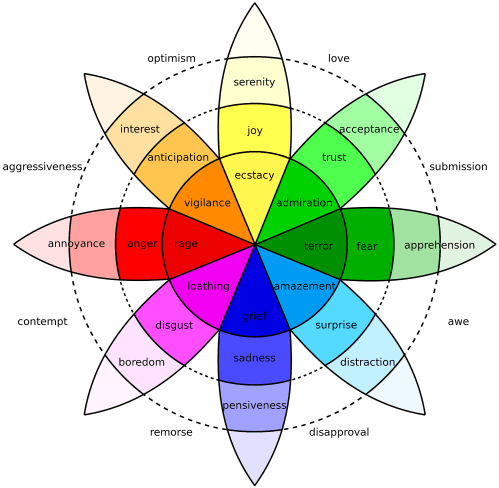
Next I came across Robert Plutchick’s “Wheel of Emotions”  which arranged eight emotions in a circle of four pairs. Eight?
Wait! I thought there were five basic emotions! Anger, Sadness, Disgust, Excitement and Joy. And I always thought that the first three of those were negative emotions, with the latter two being positive. Plutchick adds three more to these five, Fear, Surprise and Trust, and calls Excitement, Anticipation. He pairs them up as polar opposites like this – Anger and Fear; Sadness and Joy; Disgust and Trust; and Surprise and Anticipation.
I like that, but I had to take a pause. Before I looked at this any further, what were emotions anyway? Why do we experience them?
My understanding of the answers to those two questions comes from reading, over the years, some of the works of Antonio Damasio, and of Spinoza. I won’t go into any detail about their ideas here but suffice to say they’ve convinced me that emotions are whole organism adaptive strategies.
What?

“Emotions are whole organism adaptive strategies.”

Emotions aren’t just a class of thoughts sitting in our brains. They are patterns of change which involve every aspect of our being. That’s kind of intuitive, isn’t it? I mean, if you have a fright, or you are afraid, you feel your heart beating faster, your breathing quicken, your mouth dries up and your muscles tense. You know the emotion of fear doesn’t just live in your head. You might even know something about the changes in the nervous system, the endocrine system or the immune system which occur when we experience different emotions. I bet you’ve heard of the “fight or flight response” which activates the “autonomic nervous system”, a complex of nerves running between the brain, the heart and the rest of the body. You’ve probably even said from time to time that you have a “gut feeling” about something, or experienced some “heartache”.
The autonomic nervous system stimulates the adrenal glands which sit on top of your kidneys. These glands produce adrenaline. Other hormones provoke the release of sugar into the blood from stores in the body. The whole body is being geared up to deal with a perceived threat.
Or think of a time when you felt embarrassed. How your cheeks and neck turned bright red. Yes, I think we know that emotions are “whole organism” responses to something.
But what do we have them for? Why do we have them?
If Calne is right then they are there to make us act. Actually, and here’s a challenging thought, they are there to make us act in our own best interests. They are coping mechanisms. Or, better, “adaptive responses”.
Responses? Responses to what?
Ah, that’s where it gets even trickier. They are responses to stimuli – but we humans, with our complex brains and nervous systems, don’t just respond to stimuli in the external world. We create our own stimuli inside our heads, using our imaginations, our ideas, thoughts and memories. We have whole stories running in our brains, chains of memories, tied to certain feelings, images, thoughts. Stories which we’ve rehearsed and recalled probably hundreds of times. Small triggers, or stimuli, can set off whole cascades of linked reactions and changes based on one of these stories. So, sometimes, often I suspect, we experience a surge of emotion which no-one else can understand because there seems to be neither an external stimulus for it, or only a very feeble one. Panic attacks, temper tantrums, mood swings. All can be hard to fathom and rarely bear a simple one-to-one, linear relationship with a present circumstance or event.
Ok, so I can accept that these “whole organism changes”, these emotions, are “adaptive strategies” or responses, but then why are some negative and others are positive? What is the benefit, what is the usefulness, of the actions provoked by negative emotions?
Who wants to be disgusted, sad angry or taken unawares (surprised)?
Time to return to the Wheel.
I looked at the pairs again. Yep, I can see that sadness seems to be the opposite of joy, that trust is the opposite of disgust, and that surprise and anticipation also form a pair of opposites. But that leaves one more pair – Fear and Anger. So which is the positive one, and which is negative? It would seem that fear in negative, so that would make anger positive.
I never thought of it that way before. I didn’t see anger as a positive emotion.
When I go out in the car, I often play an audiobook while I drive. As it happens, I’m listening to Irvin Yalom’s “Becoming Myself” just now. He was describing his experience as a young doctor when he was humiliated but the surgeon who cruelly criticised his stitching skills at the end of an operation. Humiliation is still the mainstay of clinical education. All of we doctors have experienced it. In his reflections, Irvin wrote that he should have been angry and stood up for himself, but that he didn’t have “sufficient self-esteem”.
Now that’s interesting. Because I think anger often arises in situations of humiliation, or disrespect. In fact, the “gilets jaunes” movement cleverly used the device of the bright yellow, “hi vis” jacket (which every French motorist has a legal requirement to carry in their car) says “Look at me!” “Don’t ignore me!” “I’m here!” “I exist!” There’s a deep well of feelings of neglect, humiliation, powerlessness and injustice beneath this eruption of public anger.
Well, it doesn’t seem negative to say no to injustice. Or demand respect, or even attention. So maybe there is something move positive about anger than I’d thought.
But there’s still something nagging away at me here. Why have negative emotions at all?
Back to the Wheel again.
Here’s the next clever thing about the Wheel. He presents it as a colour wheel, with each of the eight main colours deepening in intensity as they move towards the centre, and fading as they move to the periphery. That gives us sixteen more emotions to consider. Eight from the intensification of the basic set, and eight from their dissipation. I like that. It makes the emotions more nuanced, more realistically dynamic. It immediately conveys a range of tones. Now the Wheel looks like a palette. A palette from which I can create a life of feelings, experiences, behaviours, thoughts and actions.

Engagement and Withdrawal vs Positive and Negative

But still it niggles at me. This idea of negative and positive emotions.
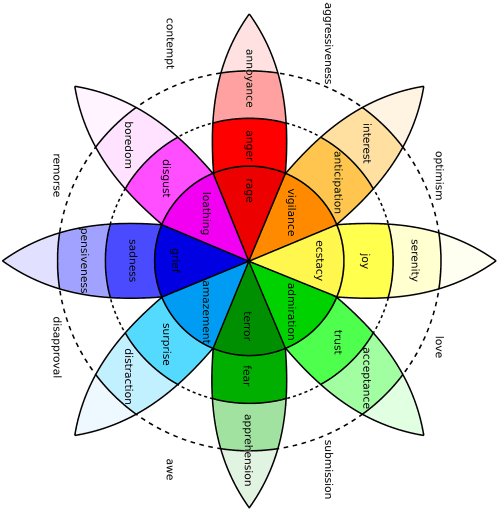
So, next, two things happen. I turn the Wheel round a bit, so that Anger is at the top, Anticipation, Joy and Trust are on the right. Disgust, Sadness and Surprise are on the left. This fits with another diagram I used to draw for patients when I was teaching the Heartmath method.
turned wheel

The first thing is I see the right half of the Wheel, more or less, representing engagement, and the left, withdrawal. I start on the horizontal axis in the middle and I see that joy is on the right, and its opposite, sadness, on the left. Joy engages me, it pulls me towards the object of my attention. It encourages me to be open and to make new connections, or to strengthen existing ones. Maybe even in the language of “The Little Prince”, it “tames” me. Or using the concepts of Dan Siegel’s “Mindsight”, it creates “mutually beneficial bonds” – the essence of integration.
On the other hand, sadness withdraws me. I retreat and want to be left alone. In the darkness of sadness, in the midst of the blues, it’s hard to connect, to be open, or to engage.
So, I carry this idea around the rest of the Wheel.
Disgust repels me – I spit it out, step backwards from, withdraw from whatever has disgusted me.
Surprise startles me. It makes me stop, withdraw and set myself up for a response.
Fear scares me. I remember a group of us as teenagers deciding to explore an abandoned mansion one night. It was pitch dark. Of course, we set ourselves up by sharing stories of ghosts and murderers. We completely spooked ourselves out. Then we tried to walk up through the dense. overgrown, rhododendrons, trees and bushes along a path we could hardly see an arms length in front of us, towards the abandoned building. I don’t know how it started but something triggered one of us and in an instant we were running for our lives, back down the path, away from the house. Not one of us could make it down that path. Fear makes us withdraw.
On the other hand, trust is the very essence of making a bond, of reaching out, connecting with another, and of establishing a sense of belonging.
Anticipation sets us into planning mode, as we prepare ourselves for whatever it is we think we are about to experience. We engage.
And so, here I am, back at anger. And what is anger other than another form of engagement? It drives us out of submission, out of passivity and reluctant acceptance to say “no”, “I don’t accept that” “I won’t be ignored” “I won’t be pushed around”.
As I consider the Wheel from this perspective I see there are no negatives or positives. There’s just engagement and withdrawal.
I’m not sure why, but at that point, the phenomenon of pain pops into my head. I mean, who wants pain? But pain is crucial in our lives. It’s an intense alarm signal which, at very least, says “Something is wrong!” and, usually, provokes us to take an action. Withdraw a hand from a hot plate. Make a different choice. Learn something from an experience, even.
So maybe withdrawal emotions are more like pain?
They work for us, in our best interests, to help us adapt.
I realise I’m thinking of all of this in the context of ordinary, daily, healthy life. The pathologies which arise from excesses of any of these emotions is another story. Something isn’t an adaptive response when it occurs in out of control or unbalanced ways. The inflammatory system of the body is a good example. We need it to defend ourselves against infections and to repair wounds but it becomes a destructive power when it overshoots or occurs without the presence of infection or injury. It’s therefore not a matter of saying that because emotions are “whole organism adaptive strategies” that they are a simple good. Nor are they sufficient in themselves to guide our behaviours. We gain a lot from our highly developed cerebral cortex, those two hemispheres with their large frontal lobes which give us the capacity for rational thought, will, and our ability to stand back and make active choices, amongst many other things.

An artisan of the emotions

So, there’s something to learn here. I mean for me, personally, in my own life. To learn to become aware of the emotions I’m experiencing, to learn where and when they arise, so that I can use them to my best advantage.
How do I interact with my emotional life to enhance my creativity? Can I learn to use the emotions to craft the life I want to live?
The term “artisan” is still used a lot in France. They use it for anyone who develops a particular skill, whether that be baking, wine making, or woodwork. It’s really a way of describing and respecting someone who has achieved an expertise. So, I’m wondering……how do I become an artisan of the emotions?
Dec17

One of the biggest differences for me since I retired and moved to the Charente in France is that I feel much more engaged with “the natural world”. I notice the sunrises and sunsets more. I notice the phases of the moon. I look forward to the constellation Orion appearing in the East and making his way across the night sky to the West every winter, and it amuses me somehow to see that he disappears for the summer, as if he migrates in the opposite direction from the birds. I’m much, much more aware of the birds here. I’ve encountered Hoopoes for the first time and they still astonish me. I recognise the call of the Redstart when he arrives from his winter holidays and his replacement with the Robin. I’m in that cycle of seasons which a garden demands, with its rhythm of tasks, from planting, to nurturing, to harvesting, and feeding the soil before it goes to sleep for the winter.
I’ve never spent such a large proportion of my life outside before.
So I’ve become every more interested in whatever it is that connects us to “nature”. I’ve been replacing the rhythms, schedules and timetables of Scotrail, the NHS, and the rest of a working life which includes a daily commute, with what feel like more natural rhythms. The cycles of the seasons, the celestial patterns of moon, sun and stars. The meals prepared from what’s available in the local market this week.

saisons

Hilary gave me a Christmas gift of an accordion-fold book by Amélie Balcou. It’s called “Les Saisons” (The Seasons) and is a collection of sixty Japanese woodblock prints. In the introduction she describes how the rhythms of nature are embedded in the Japanese calendar. Let me share her opening page with you. I’m not going to do a direct translation of her words into English, but to share the substance of what she describes.

The New Year commences with “hatsushinode” which is the practice of admiring the first sunrise of the year. As the first sun rises you make your wishes for the year ahead.
On the 3rd of February, “setsubun”, the arrival of Spring is celebrated. It’s seen as the turning point of the year and one traditional practice is to throw roasted soy beans out of the door to cleanse the home of last year’s evil spirits and drive away ones for the year to come. One variation of this practice is to eat one bean for each year of your life, plus one extra for the year to come.
March sees the arrival of the cherry blossom which begins in the south of the country then spreads north over the next few days with newspapers and TV showing maps, similar to weather maps, of its appearance. People take picnics in the parks under the cherry blossom trees and wander amongst them admiring them and photographing them. They are a strong reminder of the transitory nature of everything, something which enhances, rather than detracts from, their beauty.

“Hana Matsuri” on April 8th, is a Flower Festival connected to celebrating the birth of the Buddha.
The season of rains begins in May, the month when “Golden Week” is held. It’s called “Golden Week” because there are a number of holidays and festivals one after the other. On the 4th of May there is “Midori no Hi”. Midori translates as Green and this “Nature Day” or “Greenery Day”, when people try to spend the whole day outside in Nature, and might plant trees or clean up the local environment.

Summer begins in July with the Fire Festivals, celebrated with fireworks, “hanabi”, which means “fire flowers” (Isn’t that a lovely name for fireworks?). Also in July is “Tanabata”, the Star Festival. Tanabata translates as “The Evening of the Seventh” and was traditionally celebrated on the seventh day of the seventh month (of the Japanese lunisolar calendar). This is a time for people to write wishes, sometimes in poetic form, and hang them on bamboo. These are then burned or set afloat on the river at the close of the festival.
School holidays begin with “Umi no Hi”, “The day of the Sea”, which celebrates both the marine history of Japan and the gifts of the ocean. It’s a day to go to the seaside!
“Yama no Hi”, “Mountain Day”, was introduced as the first public holiday in August in 2016 because the government thought people were working too hard and would benefit from a day off in the mountains.

The autumn equinox is a glorious time for the celebration of the maple tree leaves which turn gorgeous shades of red. It’s also the time of “Tsukimi”, the moon viewing festival. Whilst viewing the full moon it is traditional to decorate the place with pampas grass decorations and to serve white rice balls, “Tsukimi dango”, flavoured with seasonal foods such as sweet potato and chestnuts.

I’m going to enjoy contemplating the images in this book over the course of this year, starting with some of the winter scenes, seeing as it’s winter time here in France as I write this. I’ll share them with you week by week.

But there’s something else I want to share with you now. It’s the story of a project designed to “prescribe nature” to patients which some GPs in Shetland are taking part in. I read about it in a recent issue of Resurgence magazine where they describe this collaboration between the RSPB (Royal Society for the Protection of Birds) and the NHS in Shetland.

They’ve picked up on the benefits of spending time in Nature – from lowering BP, to improving the immune system, to lifting depression and increasing well-being and they’ve created a leaflet called a “Nature Prescription calendar“. It has a photo for each month of the year with an associated check-list list of suggested activities to do that month so you can tick off whichever ones you’ve done that month. The genius of it is that the activities are 100% local – they refer to local pathways, beaches and so on, and use local words and sayings too. AND they are chosen to be relevant to that particular month so people begin to be in touch with the seasons and cycles of Nature again.
Honestly I think its fab and SUCH an inspiration. I really fancy trying to develop one for here.

How about you? How do you get yourself in tune with the planet?

Rainbows as bridges

may18

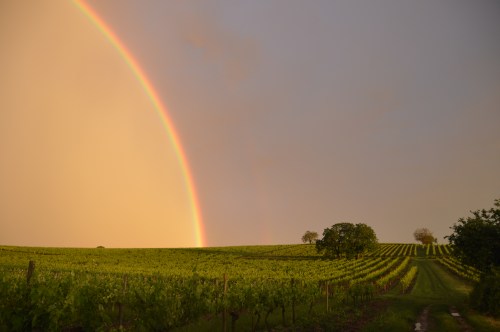
One day last year I walked outside and saw this rainbow at the top of the vineyards.

Yeah, sure, I’ve seen a ton of rainbows in my life but I’d never, ever, seen one like this.

I took several photographs but I’m not sure any really captured the view.

The rainbow lasted for about 30 minutes. Much, much longer than any other rainbow I’ve seen.

It’s brightness was incredible. If you look carefully you can see a second, parallel one just to the right of the main one. But the most astonishing thing was how different the world looked under the actual rainbow. You can see that quite clearly. The colour of the sky to the left of the rainbow ie under it, is completely different to the colour of the sky elsewhere. I’ve never seen that before.

You know the old story about finding gold at the end of the rainbow? Well, it seemed that this rainbow was arching over an entirely golden world.

There is another thought I had during that rainbow, and which come back to me now. That rainbows are a symbol of hope. Where does that come from? Is it the story of Noah and The Flood in the Old Testament? I suppose that’s where I get that memory. I was taught that the rainbow represented God’s promise not to flood the Earth again. It’s not entirely clear to me how that story of a promise morphed into a symbol of hope. So I went looking to see – are there other origins to this association of hope with rainbows? Actually, there seems to be a huge diversity amongst various cultures (why wouldn’t there be?) Here’s where I explored some of them.

One of the things which struck me, reading through that entry in wikipedia, was how often the rainbow was seen as a bridge.

Well that’s convenient! Because I wrote about how January is named after Janus, the god with two faces, one looking back and one forward. Look at this, from the wikipedia entry about Janus –

While the fundamental nature of Janus is debated, in most modern scholars’ view the god’s functions may be seen as being organized around a single principle: presiding over all beginnings and transitions, whether abstract or concrete, sacred or profane. Interpretations concerning the god’s fundamental nature either limit it to this general function or emphasize a concrete or particular aspect of it (identifying him with light, the sun, the moon, time, movement, the year, doorways, bridges etc.)

It feels like we are living in a time of transition (aren’t we always??) so maybe a beautiful rainbow is a good place to start the year – with hope, with a sense of new beginnings, and with the idea of a path, or a bridge, there, inviting us to follow it.

What about you? What do you associate with the appearance of a rainbow? Were you handed down any stories?

PS Didn’t I say yesterday I was starting a new blog over at bobleckridge.com/read ? Well, after yesterday’s post here, despite it being the first in a year, I was surprised and delighted by all the messages I received, and the new followers who signed up to heroesnotzombies. So, I’ve reminded myself of one of my favourite teachings – “AND not OR”. I’ll continue to post here, as well as creating new content for my new site. The new site will have a fresh photo of mine every week on the home page, an ever expanding gallery of my photos at bobleckridge.com/look and videos and the spoken word too, as well as articles and blog posts.