Feeds:
Posts
Comments

A red sky at night…..

from the moon

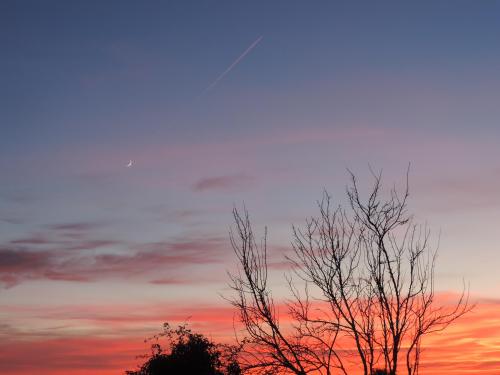
The sunset last night was glorious again, and the crescent moon hanging up there just added to my delight.

As I pointed my camera to capture moon above the setting sun I saw a jet stream glowing pink and giving the impression that the plane might have recently left the moon! (Ok, my imagination at work on that one!)

As I quickly tried out different compositional frames the silhouettes of the trees at the bottom of my garden seemed to provide a pleasing base and I clicked.

I love this image.

I love the glow of the sun, the sliver of moon, the pink trail from the plane, and I love the bare branches of the trees stretching upwards. That almost scraggy tree might not look like much but I can’t tell you just how much the birds around here like it. It is by far and away the most popular place to hang out for passing flocks of goldfinches, blue tits, blackcaps, thrushes, starling, sparrows….

Red sky at night, shepherds (or sailors) delight.

An image of hope in this weekend of sadness and distress…..

yellow drops drops

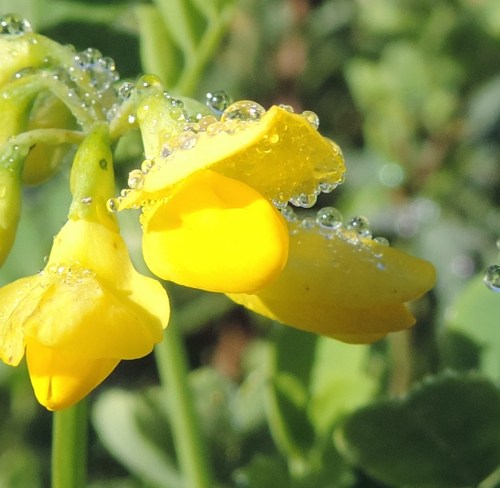
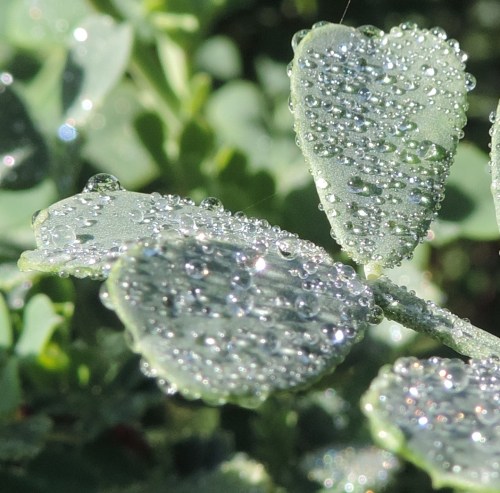
This bush in my garden looks pretty nondescript at this time of year, but look what happens early in the morning. Whether this is dew, or the traces of nocturnal rainfall, when the rays of the rising sun catch these drops, this bush is transformed.

What is it about water droplets that makes them so beautiful?

Do we have a gene which drives us towards what sparkles? (diamonds or eyes!)

Are we drawn to the light?

Tiny little jewels. Impossible not to notice. Impossible to ignore.

I’ll tell you what – beauty is important to us. It amplifies our lives. (to take a word from Big Magic).


Close to the edge

the edge

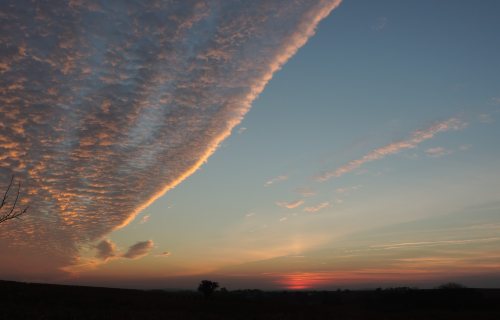
The most amazing weather system built up in the sky over the course of yesterday and as the sun set I saw this fabulous sight.

Transience and flow. These two phenomena are closely connected and lie at the heart of what I see everywhere in life. Life is a dynamic flow of energy, information and materials. In fact, not only “Life”, but Nature. All natural phenomena are dynamic, moving, changing, developing from one form into another.

I love this sense of flow. It invigorates me!

Transience is appreciated in the changing of the seasons. The most intense celebration of transience I’ve witnessed is in Japan when the cherry blossom appears. I remember seeing charts on the TV in Tokyo, like weather charts, but instead of showing the development of the rain or the sun over the country, they showed the spreading of the cherry blossom from the south to the north. I’ve seen cherry blossom photographs on the front pages of the national newspapers in Japan and I’ve milled around with crowds of picnickers, photographers and wanderers amongst groves of cherry blossoms. It’s a delight.

But there’s something else which comes with transience and flow and I think this weather system I saw yesterday really captures it. Dynamic change shows us how difficult it is to split our reality into pieces, pieces with clear boundaries or edges.

There are two edges which catch my eye in this photo. The edge of the cloud and the somewhat more metaphorical edge of the sunlight.

Clouds don’t have distinct edges of course, as you’ll have seen for yourself if you’ve ever looked out the window of a plane as it flies into, or out of, a cloud. The closer you look, the harder it is to see an edge. It’s that old “becoming not being” thing I have at the top of my blog. That constant becoming makes it pretty tricky to separate any one thing from another….from the cloud, and the “not-cloud”!

Have you ever just stood, or sat, and watched as the sunlight fades?

I don’t just mean watching the sun sink beneath the horizon (or, form another perspective, watching the Earth rise). I mean watching the light fade, the shades of colour change…..you can’t really separate it out into pieces can you? It’s a beautiful way to experience flow.

So we can get close to the edge can’t we? But the closer we get, the harder it is to pin it down!

I love that.

Habits and dents

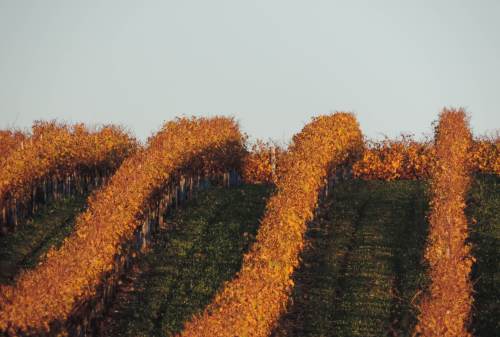
lines of vines

Habits.

We all have habits – LOTS of them! People often talk about habits as if they are bad things, and they can be, but we have them for a reason and don’t we all classify habits into two types anyway – “good” and “bad”?

Before I go any further let me just reiterate that I’m really not a fan of what is referred to as “two value thinking” – categorising whatever we are thinking about into boxes – “good” or “bad”, “black” or “white”, “right” or “wrong”. So often what we put into one category doesn’t look like it fits there very well after a while. However, for the purposes of this reflection let’s think about what’s “good” about habits and what’s “bad” about them.

Habits are good in at least a couple of ways I can think of – they bring us comfort, and so, ease, security and familiarity. We all want those feelings. And they allow us to turn our attention to other things. For example, if I have a routine way of making a cup of coffee, I don’t have to start from scratch every time and figure out how to make a cup of coffee. If I have a habitual path I take to get from home to work (whether walking, driving or taking public transport) I can just set off each day and not have to figure out how to get to my destination.

Why do we think of habits as bad then? Either because they are behaviours which we’d rather not have – for health reasons, or because they are particular patterns which always make us sad or fearful. Or because they restrict us. Because, let’s face it, habits can be very hard to break.

I think there are two ways to change habits –

First, become aware. If I become conscious of my habit then I can choose to repeat it. For example, if there is a particular route I like to take I can consciously choose to go that way, instead of just finding myself following it unthinkingly – that’s the heroes not zombies thing – it’s moving from autopilot to conscious living. Becoming aware and actively choosing doesn’t mean we have to do everything differently. Choosing changes how we experience a routine or a habit.

The second is to create new habits. When discussing how to get out of the same old ruts and loops, I used to talk to patients about “making better dents” – read about that here if you like. The idea though stems from the fact that it is much easier to create a new habit, which can then replace an old one, than it is to try to wrestle an existing one into submission! People talk about the 30 day rule for new habits – start doing something differently, and do it each day for 30 days – that seems to make it more likely to stick!

So instead of beating yourself about the head about bad habits, or struggling to “break” them, why not try first becoming aware of what they are, then either consciously choosing to continue them, to using your imagination to create a new, potential replacement?

vine leaf stalks

Wow! Look what the vine on my wall is doing now!

These strange stick-like stalks are what the vine produces to grow a leaf. The leaves grow on the ends of these foot long stalks and each one produces a single leaf. That means the vine has a real depth. It’s quite a way from the leaves to the wall! But not that autumn has come the stalks pop off the leaf at the end once it turns red and yellow, then some time after it pops off its attachment to the rest of the vine.

Isn’t that an amazing process?

Janine Benyus describes the fabulous harmony between form and function that we find everywhere in Nature. She’s a scientist who specialised in trees and forestry and began to wonder why we don’t look to Nature for our solutions. Her thought was that instead of thinking we can invent technologies which can “conquer” or “control” Nature maybe we can learn from some of the adaptive strategies of other species which have actually lived on this planet for a lot longer than we have.

She’s coined the term “biomimicry” to describe this concept.

I like this idea, and it seems consistent with my own experience of wonder, amazement and, frankly, humility, in my every day life.

The potential for sustainable solutions if we take this approach is exciting. I’ve just started reading her book. I suspect I’ll be posting a few thoughts which that stimulates but let me start today with a passage right from the start.

Nature has answers. Its strategies are wildly successful – collaborating, innovating, resilient, adapting to change and leveraging diversity.

Isn’t that a great list?

  • Collaborating
  • Innovating
  • Resilient
  • Adapting to change
  • Leveraging diversity

Think how applying those principles could improve the way we deliver health care, organise towns, influence a new approach to politics and economics even?


Apprentices to Nature

Good old “Cles” magazine! This magazine probably opens up more avenues for me to explore than any single other publication. There is currently a fifth anniversary special out with “5 reasons to be hopeful” forming a major section of the issue. The fourth reason is ecology taking root, and it’s here that I read about “biomimicry”.

It’s one of those concepts that when you read about it you think, why didn’t I know about this already?

From the home page at biomimicry.org here’s a short definition

Humans are clever, but without intending to, we have created massive sustainability problems for future generations. Fortunately, solutions to these global challenges are all around us.

Biomimicry is an approach to innovation that seeks sustainable solutions to human challenges by emulating nature’s time-tested patterns and strategies. The goal is to create products, processes, and policies—new ways of living—that are well-adapted to life on earth over the long haul.

The core idea is that nature has already solved many of the problems we are grappling with. Animals, plants, and microbes are the consummate engineers. After billions of years of research and development, failures are fossils, and what surrounds us is the secret to survival.

Here’s the founder, Janine Benyus, explaining it all eloquently and with fabulous imagery in a short (20 min) film.


I find this totally inspiring. What a fabulous way to look at life! To think that the solutions to all of our problems might just be there in the Natural world, just waiting for us to learn! What a different approach to technology – to develop technological solutions based on natural methods instead of much poorer, less efficient artificial ones. What a different approach to science – to apprentice ourselves to Nature in order to learn what has already been learned through adaptive processes over millions of years, instead of trying to find ways to control and battle against Nature.

And, potentially, what a fabulous research agenda, to learn how living organisms grow, defend and repair themselves – all without the use of any artificial or toxic “aids”. Now there’s the foundation of a new approach to health care.

Go on, take 20 minutes out of your busy day and watch that video. I hope you’ll be as inspired as I am!


Not dead

IMG_3724

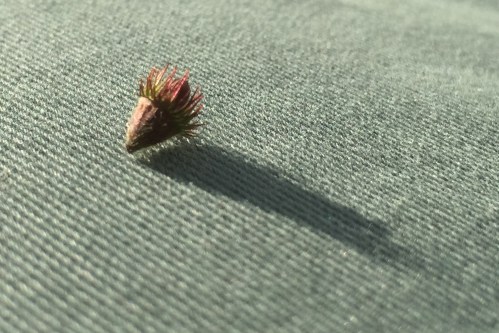
When we came back from a walk through the vineyards yesterday we found little seeds like this one sticking to our clothes.

Look how elaborate a structure it has – wonderfully designed for hitching a lift! Its tenacious little hooks beautifully created to spread the species.

I was just thinking about seeds the other day when I read about the massive explosion of flowers across the Atacama Desert. Did you read about that? Here’s some of the coverage. The Atacama Desert in Chile is one of the driest places on Earth but about every five to seven years the flowers flourish. This March there was the equivalent of fourteen years rainfall in a day and now there is the greatest flourishing of the flowers for decades.

Imagine. Those seeds all surviving in the desert heat without any significant water for years and years, then suddenly, with enough rain, they spring to life.

Remarkable as that thought is, here’s another one – how do we know if a seed is alive or dead? I mean if we collected some of the seeds from the soil during the dry years, could we tell which had the potential to spring to life and which were, well, dead?

I went on an internet hunt, and you know what? Nobody really knows. There’s a phenomenon in the lifecycle of seeds called “dormancy” where the seed seems inactive but its really just sort of sleeping. Funny thing is we have no way of telling whether a seed is dormant or dead. There are techniques, including a chemical staining technique, which cleverly detect some signs of respiration or metabolic activity, but interpreting the results isn’t easy and only allows a statistical probability of life to obtained for whole batches of seeds, not individual ones.

Can you imagine that? Not being able to tell if an organism is dead or alive? Is that true? Are there any botanists reading this who know differently? Can you tell if an individual, particular seed is dead or alive?


IMG_3721

I took a walk yesterday up to the viewpoint and used my iPhone to take this panorama shot.

The viewpoint is at the top of the hill just above the village where I’ve lived for exactly a year now.

In my monthly themes I think of November as being a month for reflection. And one of the ways I like to reflect is to take what’s referred to by French philosophers as the “view from on high” or “view from above“.

It’s a way of reflecting which involves pausing, standing back, and taking an overview. It’s not about analysing or considering the details.

So I took a little pause, standing there at the viewpoint, and gazed slowly in all directions, drinking in the fields of gold, and then I took a deep, slow breath or two and asked myself “how does this feel?”

It feels good.

What I feel is contentment.

I’ve been in touch with that pretty frequently recently, and when I first had that word, contentment, pop into my head I wanted to reject it. I mean it feels such a weak word, doesn’t it? A mediocre word. Couldn’t I come up with something a bit stronger than that?

So, I looked it up on my blog and found this from five years ago

Positive affect is defined as the experience of pleasurable emotions such as joy, happiness, excitement, enthusiasm and contentment. These feelings can be transient, but they are usually stable and trait-like, particularly in adulthood. Positive affect is largely independent of negative affect, so that someone who is generally a happy, contented person can also be occasionally anxious, angry or depressed.

Here’s what they found [I’m referring to a study here]

After taking account of age, sex, cardiovascular risk factors and negative emotions, the researchers found that, over the ten-year period, increased positive affect predicted less risk of heart disease by 22% per point on a five-point scale measuring levels of positive affect expression (ranging from “none” to “extreme”).

So, weak or strong, turns out contentment might well turn out to have a health benefit.

But there’s more – I’ve just finished reading Robert Brady’s “The Big Elsewhere”, which I highly recommend, and in there this week I found a passage he’d written “on contentment”. He refers to the Tao Te Ching where Lao Tzu says “There is no disaster greater than not being content” –

What does contentment have to do with disaster? Lao Tzu knew, and cryptically passes along the intimation, that contentment is the beginning of all that is worthy, that contentment is the seed and germ of every happiness, its absence accordingly the tiny breach that ruptures into every disaster, the pinhole in the dam, the lost horseshoe nail. Contentment is all the rest: pride in the way of one’s life and the fruit of it, whether one is a shepherd or chieftain, a fact that hasn’t changed since back in the tribal days when miracles were everywhere and museums were not yet needed to remind us of what is gone.

Contentment is the core of all that truly matters, it is the root of passion, the height of honesty, the beating heart of every joy, the embrace of a family; for there is no self in contentment; it is other-centred. The self-centred, in contrast, is perturbed, discordant, writhes with discontent and seeks release (insert the ‘seven cardinal sins’ here for starters).

What do you think? Is contentment something you recognise? Is it something you feel? Today?

It seems to me it’s not such a weak or mediocre feeling after all!
 

The changing present

I love the autumn. Not least because, like the Spring, it’s a season when change is most evident. Every morning when I open the shutters and step out into the garden the world around me is markedly different.

I was looking at the variety of shades and colours in the mulberry tree and the vine and I realised I quickly ran out of words. I don’t know if it is true that in some languages there are many different words for snow, but the range and number of colours and shades in one garden! Whew!

It’s astonishing.

I took a bunch of photos and turned them into a little slideshow. I hope you enjoy it. A couple of minutes of delight and “émerveillement du quotidien”.

Different

Ellen Langer says the way to live mindfully is to be on the lookout for novelty. See what’s new (new to you). Another way to think of this is to be aware of difference. Not just aware I suppose, but to seek and to delight in, difference.

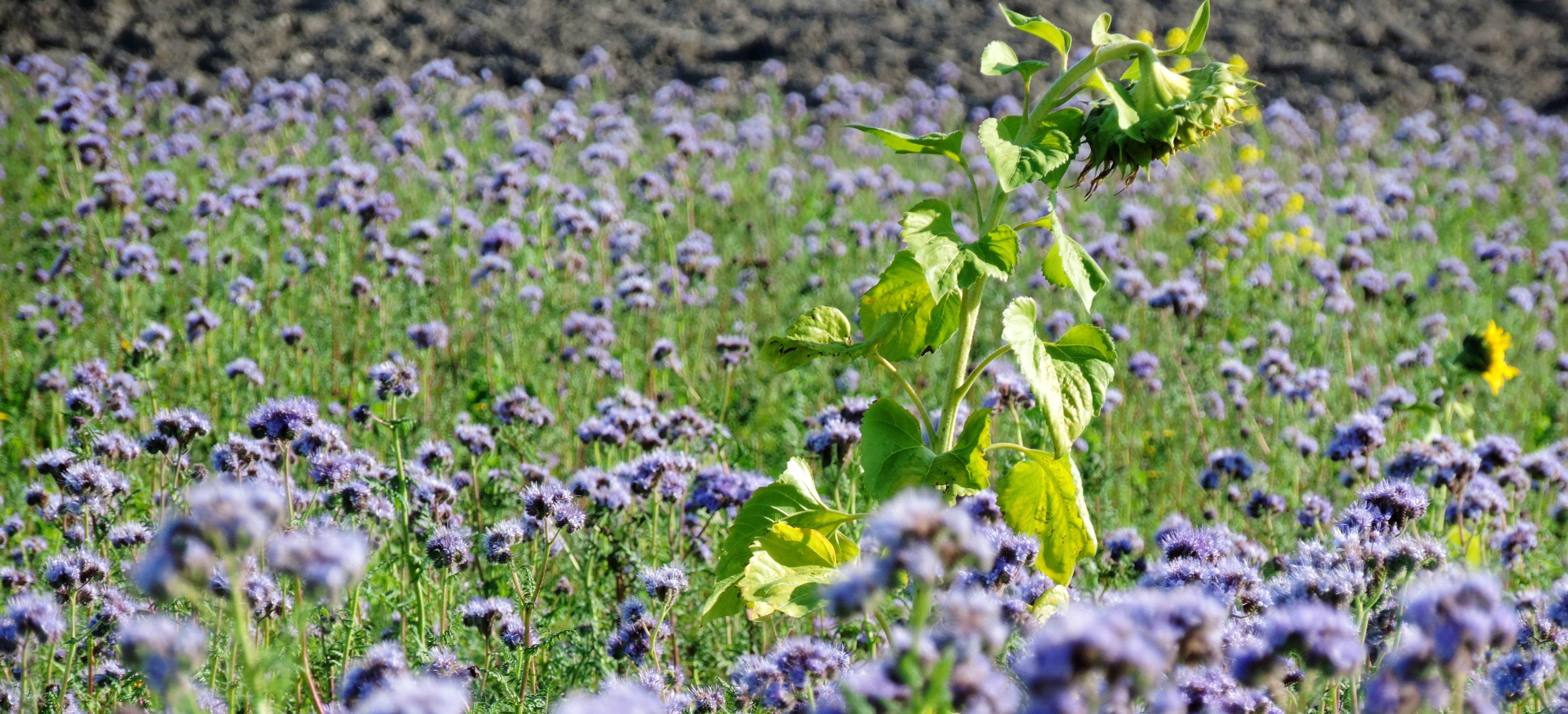
There is only one field of purple near me.

crop of purple

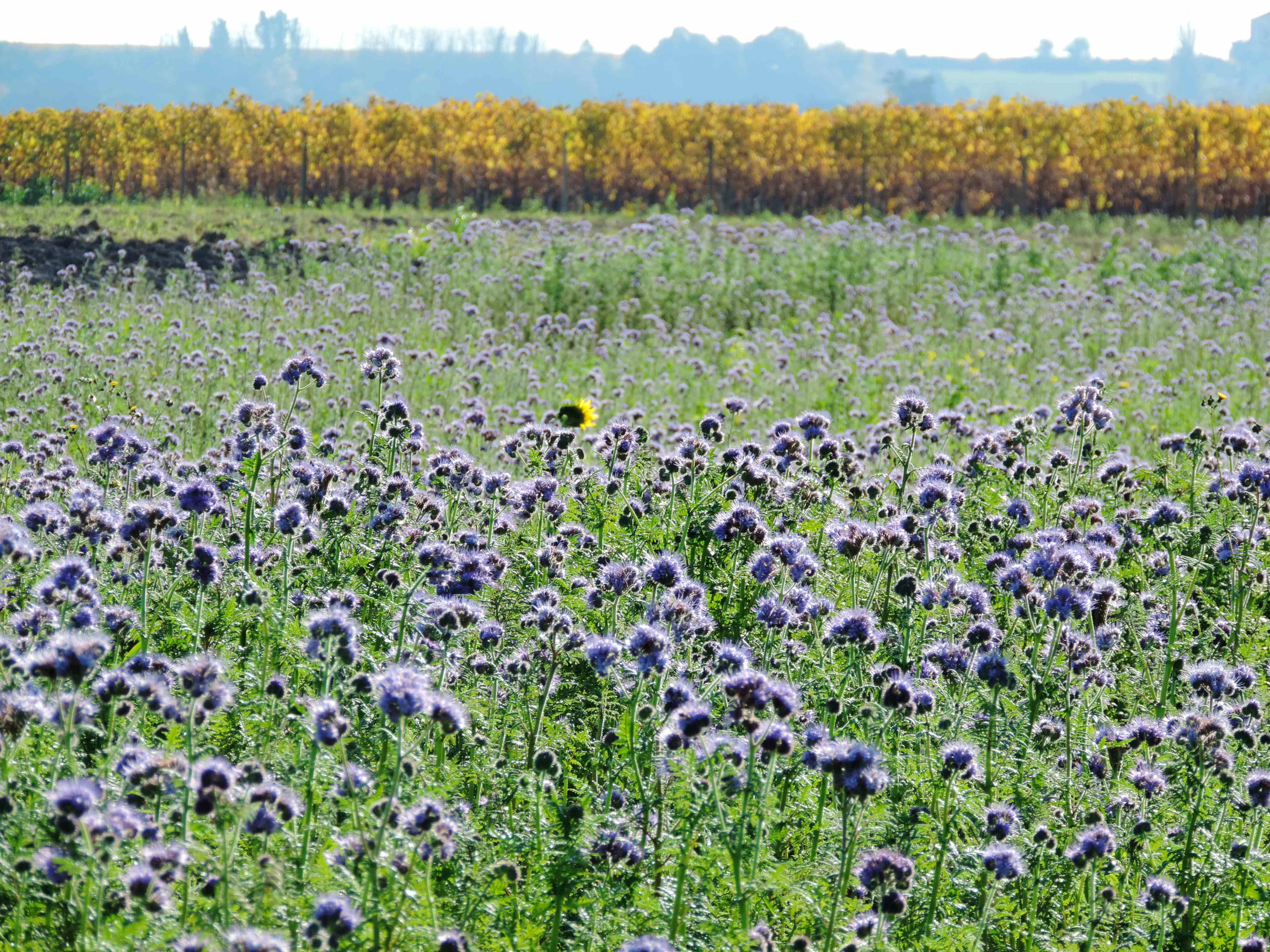
I don’t know what this purple flower is, but it was the field of colour bounded on one side by a vineyard,

purple and vine

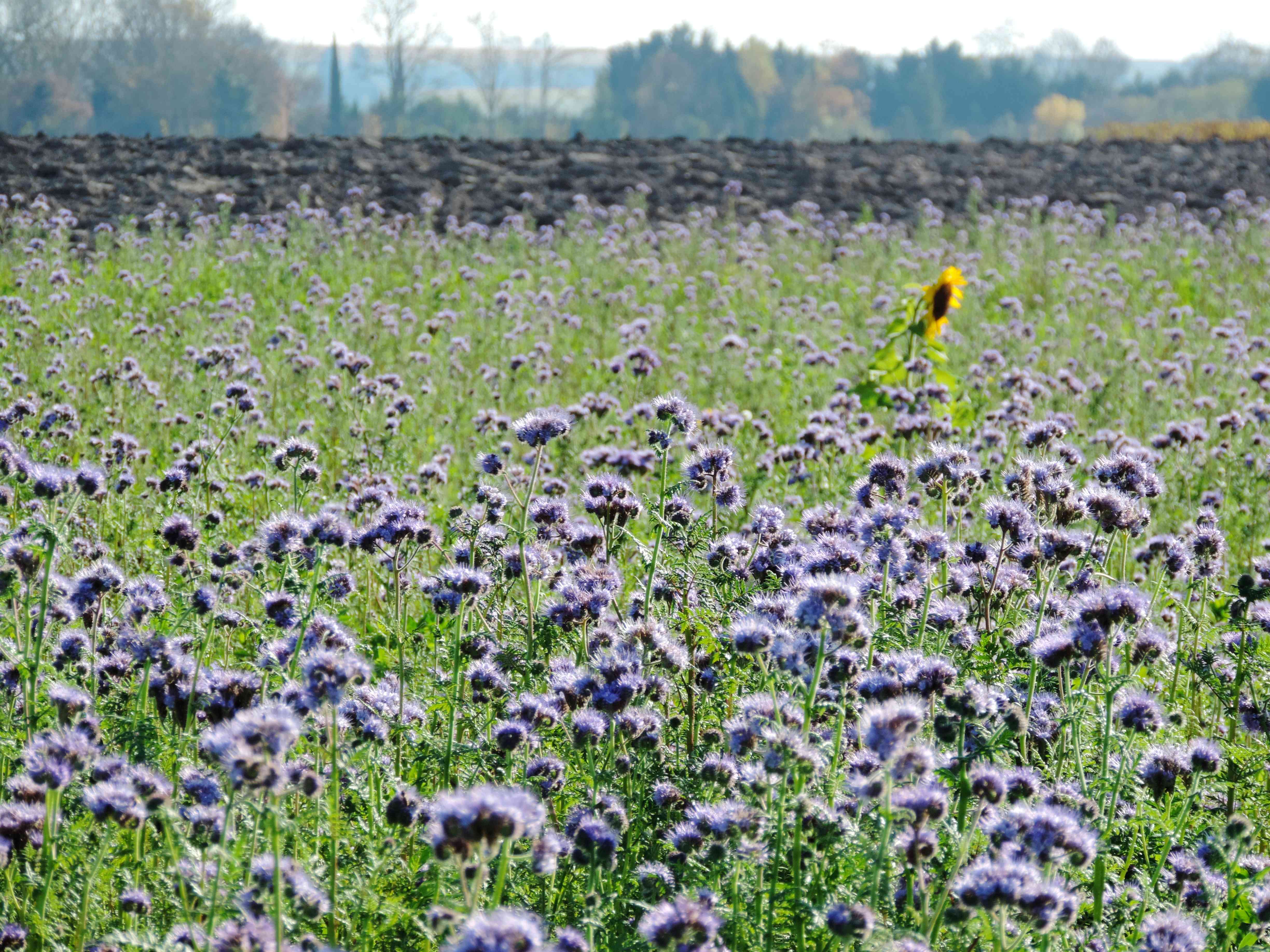
and on the other by a ploughed field,

ploughed

which caught my eye, and you’ll notice that there are half a dozen, or less, sunflowers, standing up boldly and proudly, head and shoulders above the crop – that kind of difference appeals to me too.

If you know what these purple flowers are please say in the comments section, but whatever they are called its their difference which literally stopped me in my tracks. It’s their difference which prompted me to pull the car over on the side of the road, clamber over a ditch and take these photographs.