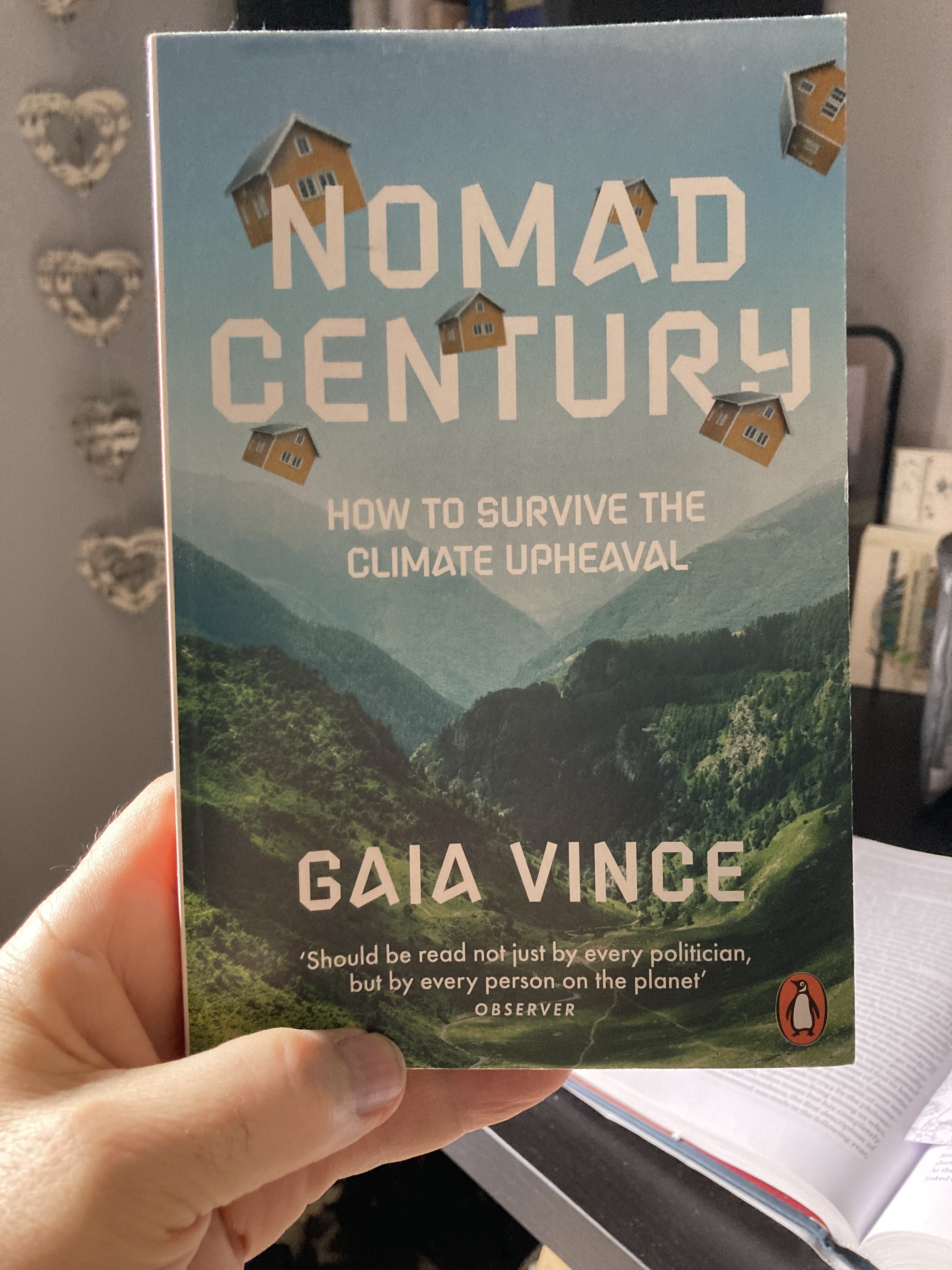
Here’s a book I’d recommend to anyone.
There are loads of books about climate change but science writer, Gaia Vince’s, book is probably the one I’ve enjoyed most. It is beautifully written, and easy read, and isn’t brimming over with despair about our changing climate. She doesn’t play down the significance, or magnitude, of the changes, but, in this book, she takes a focus on an aspect which I haven’t seen others do (or, at least, not so well) – migration.
“Migration is a survival strategy used widely in nature”
There’s a statement which resonates strongly with me. Whenever I try to explain reality, to demonstrate what “integration” actually means, and to highlight how important “cooperation” is, I focus on the human body. In the body are various organs…..heart, liver, kidneys, brain etc…..and in order for us to be healthy all of these organs have to relate to each other. They have to work with each other. They are not part of a competitive market fighting each other for nutrition and resources. Rather, they form “mutually beneficial bonds” – in other words, they create relationships which work both ways in the best interests of each part. This is integration – “the creation of mutually beneficial bonds between well differentiated parts”. Having explained that in relation to body organs, I go on to show how the same rule applies to all the cells and tissues of the human body, all of the billions and billions of cells which each of us has. And from there, it’s easy to see how the same principle applies throughout nature, across the globe, with complex webs of relationships forming between people, animals, plants, and the rest of the environment. Gaia Vance doesn’t use the word “integration” but what she focuses on is migration and cooperation.
For humans, migration is deeply interwoven with cooperation – it is only through our extensive collaboration that we are able to migrate, and it’s our migrations that forged today’s collaborative global society.
and
Studies across nature show that global dispersal is the most effective strategy for any species to prevent extinction.
and
…human brains are highly adaptive and we are hypersocial, able to cooperate with large numbers of unrelated people, supporting each other and sharing resources, ideas and knowledge
What she does so well in this book is to show just how natural it is to migrate. She describes the history of migration, in humans as well as in other species, and the history of borders and nation states (a surprisingly recent development in human civilisation). This reminds me of the writing of Rutger Bregman who challenges the whole issue of nation states and borders in his excellent “Utopia for Realists”.
This is a hopeful book which highlights how we need to think about migration differently – to move away from the toxic, xenophobic and racist narrative which seems to dominate in the world today.
We live in an inextricably interconnected interdependent world. None of us can live by ourselves. Our human super power is collaboration, and combing that with migration, learning how to plan for it, and manage it well, to ensure good integration, is our best hope in the face of a rapidly changing world.
Buy this book. Read it. Talk about it. Share it with your friends.

 Heroes Not Zombies