Feeds:
Posts
Comments

Posts Tagged ‘faith’

Rick Rubin refers to “the Source” when discussing the origin of ideas and inspirations. He writes that our creative ideas, the seeds of our acts of art, don’t come from inside us, which is what we unthinkingly believe, but, rather are “precious wisps [arising] from the unconscious like vapour, to condense and form a thought.”

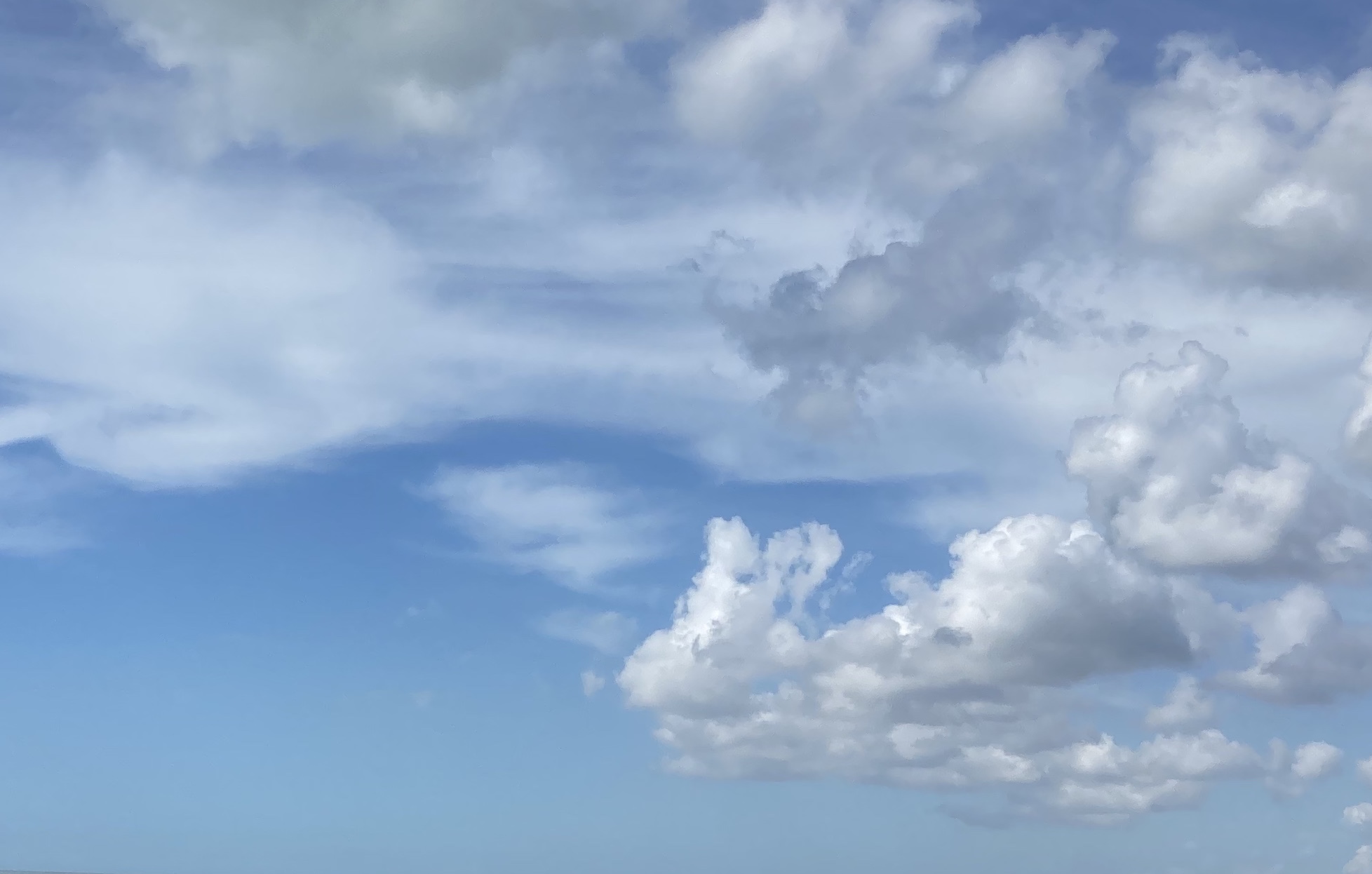
He uses the analogy of clouds.

“Clouds never truly disappear. They change form. They turn into rain and become part of the ocean, and then evaporate to return to being clouds. The same is true of art. Art is a circulation of energetic ideas. What makes them appear new is that they’re combining differently each time they come back. No two clouds are the same.

This whole concept has a foundation on the belief that the universe is benign, which reminds me of the much quoted idea about a friendly universe (attributed to Einstein)

If we decide that the Universe is an unfriendly place, then we will use our technology, our scientific discoveries and our natural resources to achieve safety and power by creating bigger walls to keep out the unfriendliness and bigger weapons to destroy all that is unfriendly and I believe that we are getting to a place where technology is powerful enough that we may either completely isolate or destroy ourselves as well in this process. If we decide that the Universe is neither friendly nor unfriendly and that God is essentially ‘playing dice with the universe’, then we are simply victims to the random toss of the dice and our lives have no real purpose or meaning.

“But if we decide that the Universe is a friendly place, then we will use our technology, our scientific discoveries and our natural resources to create tools and models for understanding the Universe. Because power and safety will come through understanding its workings and its motives.”

Using a slightly different form of language, Thomas Berry, in the final chapter of “The Great Work”, writes about “Moments of Grace” and tells the story of the evolution of the universe from this perspective, with each major “development” described as a “moment of grace” – the “Big Bang”, the formation of the fist stars, the creation of the planet Earth, the first forms of Life on the planet, the emergence of Human Beings, the first use of fire, the first gardens, the creation of writing and alphabets, and so on. Referring to each of these emergent steps in the history of we humans, situates us in a much “friendlier” universe.

Years and years ago I read a short article in Wired magazine which listed new words and their definitions. One of them was “pronoia” – defined as the delusion that others are conspiring behind our backs to help us out. That word popped up again recently when I was scrolling social media, defined now as a belief that the universe was “on our side”, helping us out.

The final writer who came to my mind as I read this idea of positive contributions from the universe, was Matthew Fox, who teaches “Creation Spirituality”. He claims the Catholic emphasis on “Original Sin” is all wrong, and makes a good case for replacing it with the idea of “Original Blessing”, pointing out that the creation story in Genesis is a very positive one, and that “original sin” isn’t described in the Bible at all (I don’t know if that’s true, my Bible knowledge isn’t that great, but he was a Catholic monk, so he should know!) I like his reframing though, and his “blessings” are very similar to Thomas Berry’s “moments of grace”.

It isn’t hard to find thinkers and authors who can help us to see the universe, not as meaningless, not as threatening and uncaring, but as vast phenomenon, which acts to support us in our survival and our creation.

Read Full Post »

The poet, Mary Oliver, wrote “Real attention needs empathy; attention without feeling is just a report.”

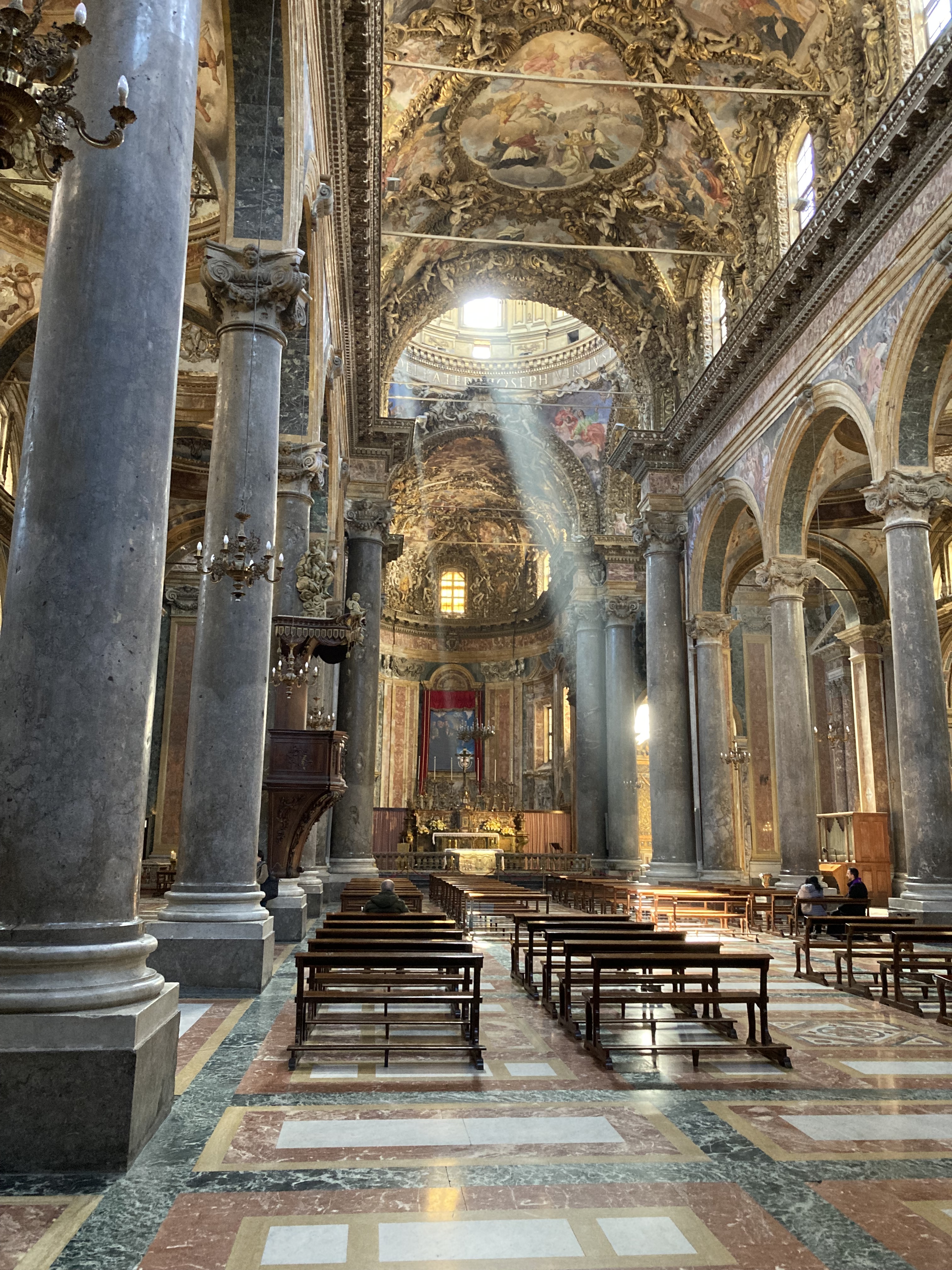
When I walked into this church in Palermo, I quickly experienced one of those moments of awe. Churches can leave me cold, and some, with their images of saints being tortured to death cruelly, I find quite off-putting. Maybe that’s just me, or maybe it’s because I brought up in the Church of Scotland, which stripped its churches pretty bare of most art.

However, the thing that really caught my attention in this particular church was that shaft of light, pouring down through the upper window, a bright sunbeam illuminating some of the space inside the church, before finally resting on some of the pews. Of course, my attention didn’t stay long on the pews, because the shaft of light pulled my gaze upwards towards the ceiling. What a ceiling, covered with art.

I was stirred by this sight, and moved, feeling a sense of being connected to something greater than me, but also feeling a sense of connection to the thousands of others who must have spent time in this church, gazing, praying, listening to sermons, singing hymns, deepening their sense of connection with each other, and with God.

So, for me, my attention, this time, was grabbed by the sunbeam, then, over the next few seconds, that light set fire to my sense of awe, and to deep feelings of empathy…..for fellow human beings, for the other creatures, as dependent as me for the sunlight in order to live, and for this entire, beautiful, astonishing little planet.

I pray we learn to treat her better, this Mother Earth. I pray we learn to treat our fellow, incredibly different species of Life, with whom we share this planet. I pray we learn to treat each other with more kindness, compassion and love.

Read Full Post »

I watched the prequel to “Yellowstone” recently, “1883”. There’s a character in it called “Shea Brennan”, who has a monologue about death of loved ones, how we deal with grief, and how that can inform our life choices.

“An Apache scout told me once, when you love somebody, you trade souls with ‘em. They get a piece of yours, and you get a piece of theirs. But when your love dies, a little piece of you dies with ‘em. That’s why you hurt so bad. But that little piece of him is still inside you, and he can use your eyes to see the world. So, I’m takin’ my wife to the ocean, and I’m gonna sit on the beach and let her see it. That was her dream.”

I thought it was a really moving, and rather beautiful, scene. Surprisingly, I haven’t heard that idea before, the idea that when you love someone you exchange a piece of your soul for theirs. In fact, I don’t think I’ve ever come across the idea that the soul can be broken up and a piece given away before. I’m more familiar with the idea that when you love someone your soul becomes entwined with theirs.

In fact, I prefer the image of the entwining, over the one of pieces being exchanged. The soul doesn’t feel a divisible concept to me, and, I’d say, my experience of life is that when you love someone you entwine your soul with theirs, and that your souls are entangled for ever after. Even if a relationship ends, through, drift, breakup, or death, the souls remain entangled.

However, let’s stay with the movie quote for now, because the other aspect of the belief he outlines, is that if your loved one has died, then they are able to experience the world through you in some way. That, too, strikes me as a beautiful thought, and, again, isn’t one I’ve really considered before. In the movie the character’s wife had a dream to see the ocean, so he decides to make his way to the coast so he can sit on the beach and she can see the ocean through him.

I think those with whom our souls are entangled, do continue to be affected by our experiences. Even as I write that, it strikes me as a radical, perhaps even crazy, idea, but there’s something there rings true. And it’s something I’ve encountered many times, in my dealings with patients and their relatives.

I follow the work of Christopher Ward on Instagram. He has something he calls “modelstrangers” where he stops people in the street and asks if he can make their portrait with his camera (he makes really wonderful portraits). As he takes photos he speaks to them, or actually, he does little interviews, and lets them do most of the talking. Recently, he encountered a young woman called “Amaal”, who said her brother, aged 20, had died last year, and she said “I have to live for both of us as he can’t enjoy it”, “so I want to enjoy everything” and she goes on to describe the beautiful, ordinary experiences of everyday life, which she nows pays close attention to, and which she enjoys. Really, it was a beautiful little interview. She’s obviously a very special person, but it’s the same sentiment…..that a loved one who is no longer with you can now only enjoy the delights of this world through you.

Whatever you believe about souls and about afterlife, I think this notion that we become entangled with others through love, and that we can consciously choose to share our daily experiences with them, wherever they are, for ever after, is a beautiful, life enhancing, deeply nourishing idea.

I’ve long believed that we should “relish the day”, that we should be “heroes not zombies”, becoming ever more aware of the beauty and mystery of this world, that we should stir our capacity to wonder as we go through an “ordinary” day, but, now I think I can take that a step further, and call to mind my loved ones, and share these daily delights with them, even if they aren’t here in my same time and place, to enjoy them for themselves. In fact, especially if they aren’t here in my same time and place, to enjoy them for themselves.

Here’s a link to the Instagram video (I don’t think you have to sign up for Instagram to watch it) – https://www.instagram.com/reel/DJraxjsoFw9/

Read Full Post »