Feeds:
Posts
Comments

Posts Tagged ‘politics’

Around the world we are seeing a rise in Right Wing politicians with a specific focus on the issue of immigration. Country after country is either reinforcing its borders, or planning to do so. The criteria for authorised immigration are getting tighter and more expensive and the rhetoric against those escaping war, torture, poverty or hunger is becoming more severe. Underpinning all this is a negative stance towards “foreigners” who are blamed for housing shortages, low wages, difficult access to health care, pressures on schools and crime. The answers to these supposed effects include closing borders to new migrants, rounding up unauthorised migrants and deporting them, and even “re-migration” (expelling those with a legitimate right to remain in the country). 

We could look at the facts and try to discover if any or all of these negative effects can indeed be laid at the doors of immigrants, but, frankly, many have already done so, and none of these claims stand up to scrutiny. 

But, let’s take another approach. Let’s think about where we place borders and how we control them. 

In the Middle Ages many cities in Europe built fortified walls around themselves. The gates into the cities were guarded by armed men and nobody could move freely into and out of the city. 

Then as nation states arose those walls came down, either literally, or functionally. The borders were re-drawn around the new nations. 

If you are at all interested in old maps, it’s easy to see that the current “national” borders, have, in many cases, been in existence for only a few decades, and that many have been drawn and re-drawn repeatedly.

But let’s do a thought exercise. What if we were to recreate, if not the actual walls, the borders around cities? What if, for example, we stopped people moving from one part of a country to another part? After all, the arguments against migration from one country to another are mainly down to strains placed on existing services, such as housing, health care and education, on the places to which the migrants move. So, if the problem is people moving into a particular city, or, even area of a city, and the answer is to stop them, why prevent only those coming from other countries? Why not stop those people coming from other cities in the same country? 

China does this. There was a recent report about taxi drivers in Shanghai, many of whom are “migrant workers” whose homes and families are hundreds of miles away (but still in China). These workers have a right to work in Shanghai, live in dormitories together, but have no right to bring their families with them, and no right to health care within Shanghai. 

How does that sound? 

Would you like your country to function like that, controlling the movement of people within the country to stop “locals” in one city from being “invaded” by “hordes” from other cities, or from the countryside? 

The rising tide of anti-foreigner speech, and actions, in populations and amongst politicians, is a return to the Middle Ages. Haven’t we developed since then? Haven’t we learned, since then, to identify with other humans who happen to live further away from us? 

Xenophobia is a political weapon. Migration is not a “legitimate concern”. The issue is how a country uses and directs its resources. If there is a deficit somewhere, then the answer is to address that deficit, not take away freedoms, or stoke fear and hatred of “the other”. 

It makes no more sense to try to control movement over national borders than it does to control movement within them. Setting one part of the population against another is a device to keep the privileged, privileged, to keep the elite, elite, to keep the wealthy, wealthy. 

We have greater wealth in our countries now than we ever have, but we’ve developed an economic/political system which funnels most of it into the hands of a tiny minority. It’s only the richest who are substantially increasing their wealth over the last fifty years. That’s untenable. But it’s not an issue caused by migration, or insufficient control of borders. 

And, for those who say that free movement over borders would be a nightmare, why isn’t it a nightmare to allow free movement within them?

Read Full Post »

We hear a lot about growth these days. The Labour government in the UK seems to think achieving economic growth is the answer to all our problems, and, frankly, every other capitalist country agrees. Perhaps that’s because capitalism as a system requires continuous growth to exist.

But the thing is, when I was a teenager I read the Club of Rome’s “Limits to Growth”. That scientific report caused quite a stir since it came out but then the usual suspects mounted their attacks and derided it, so, not much has happened since then. Well, I say not much, but we do have Kate Raworth’s Doughnut Economics, and also the de-growth movement. What I mean is the world has failed to respond remotely adequately to climate change, several governments are rowing back their “green” targets, and Trump and co are all in for “drill, baby, drill” and abandoning environmental protections. So, it doesn’t look good.

However, I come back to a point I’ve made elsewhere – growth of what, and for whom? Because the logic on which “Limits to Growth” was based is still sound. We live on a finite planet, so even if we use technologies to make “better” or “more efficient” use of physical “resources” (by which they mean the natural world), at some point, if every country “grows” every year ad infinitum, at some point, there is going to be nothing left to extract. We just can’t keep grabbing more and more and from the planet, creating more and more pollution, killing off species after species, and expect to have a planet our grandchildren’s grandchildren can thrive on. It just doesn’t make sense.

What is growing? Well, CO2 in the atmosphere. That’s growing. Microplastics in our brains. That’s growing. Insecticides, herbicides, fungicides, I-don’t-know-what-icides, in our water, our food, our bodies, even in our babies before they are born. And the wealth of the wealthiest people on the planet. That’s growing. Maybe we haven’t reached peak inequality yet, but we sure aren’t going to reach the point where really rich people think “OK, I’ve got enough. I don’t need any more than this”.

The planet, Nature, Gaia, grows. But she grows without creating waste or pollution. We see her growth in evolution, and in the history or evolution we see a growth in diversity of species. We see a growth in the interconnectedness of environments, biospheres and individual living creatures. Nature doesn’t grow exponentially in a straight line. It grows in a vast interconnected web of feedback systems, in competition and collaboration with all the other parts of that web. It grows in cycles. Cycles of seasons. Cycles of birth, development, reproduction, maturity and death.

What does healthy growth look like in a human being? Development, maturation, increased skills, abilities, knowledge and intelligence (not artificial intelligence, but the real intelligences of the mental, emotional and social kind). Are our societies doing well at fostering that in their populations? I mean, for ALL the people in their countries? Not so much, huh?

We’re going to have to take on board the basic insights of the “Limits to Growth” scientists, and to create a better system that makes better choices about what it wants to grow. Aren’t we?

Read Full Post »

I’m reading “A Sand County Almanac”, by Aldo Leopold, published back in 1949. It’s a delightful series of small essays on Nature, conservation and life on a farm in Wisconsin. It’s a breath of fresh air compared to the proclamations of today’s politicians, and a wholly different set of values, and seem to see the natural world as something to be plundered.

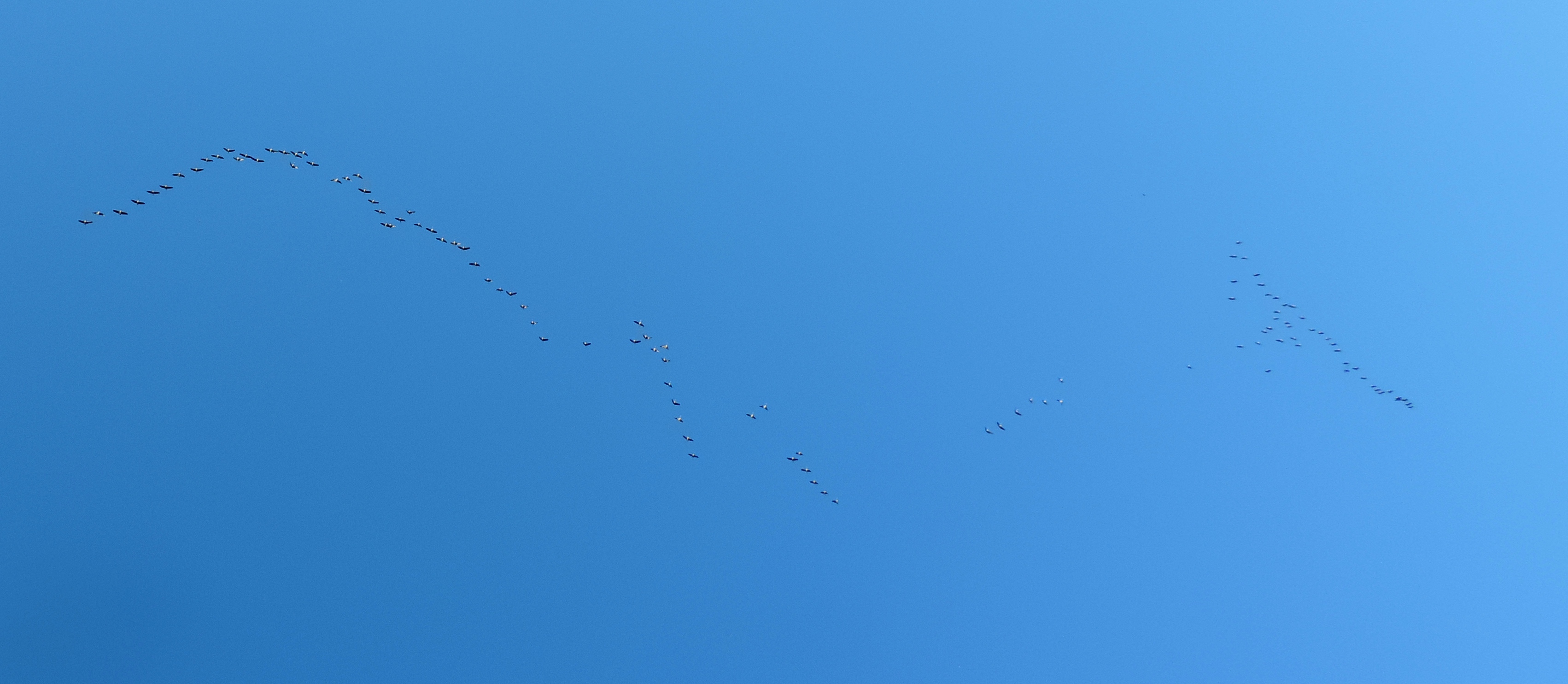
Early in the book, Leopold muses about the return of the geese from their winter migration. And he says this – “It is an irony of history that the great powers should have discovered the unity of nations at Cairo in 1943. The geese of the world have had that notion for a longer time, and each March they stake their lives on its essential truth”

Isn’t it amazing that the “essential truth” is we all share this one small planet, and that borders are totally artificial phenomena created by human beings to either try to grab a part of geography, or to exert power over others, creating a basic feeling of “us and them”. There are those who are included within a border, and there are those who are not – “aliens”, “foreigners”, “migrants” – any title other than fellow human beings.

Life moves around planet Earth.

We see it clearly in migrating creatures, not least the birds who spend part of the year in one hemisphere and part in another. But we only have to look back over a pretty short period of human history to see that we humans too, migrate. There have been great waves of migration in the past (not least to America from Europe in the 19th and early 20th centuries) and constant flows in between. Yet the powers that be seem to promote the us and them idea and think people should be judged and treated differently according to where they happened to have been born, or where their parents happened to have been born.

I think this is a kind of madness. It’s a delusion to think we can divide the human species up into all these separate, invented categories, and cruel to treat others according to where they, or their parents, happened to have been born. Who chooses where they want to be born?

I’ve long thought the problems of our modern societies are not caused by migration, but by greed, selfishness and inequality. Until we reverse the current trend of the rich getting richer while life becomes harder and less secure for the rest, politicians will seek “others” to blame – and, to often, those “others” are those who “were not born here”. Targeting those “aliens” or “foreigners” is a convenient way for keeping the Public attention away from those who are really causing the problems – the elites who grab and hoard more and more wealth, and are in the process of passing it on to their children through inheritance, enabling the next generations of the rich to become even richer, without having to do a single thing to do so.

This current system isn’t working. It’s not good for families. It’s not good for society. It’s not good for Nature. It’s not good for the planet. So who is it good for? Well, I think we know. But the trouble this, those profiting from it are a tiny minority of the human beings sharing this one little planet.

Read Full Post »

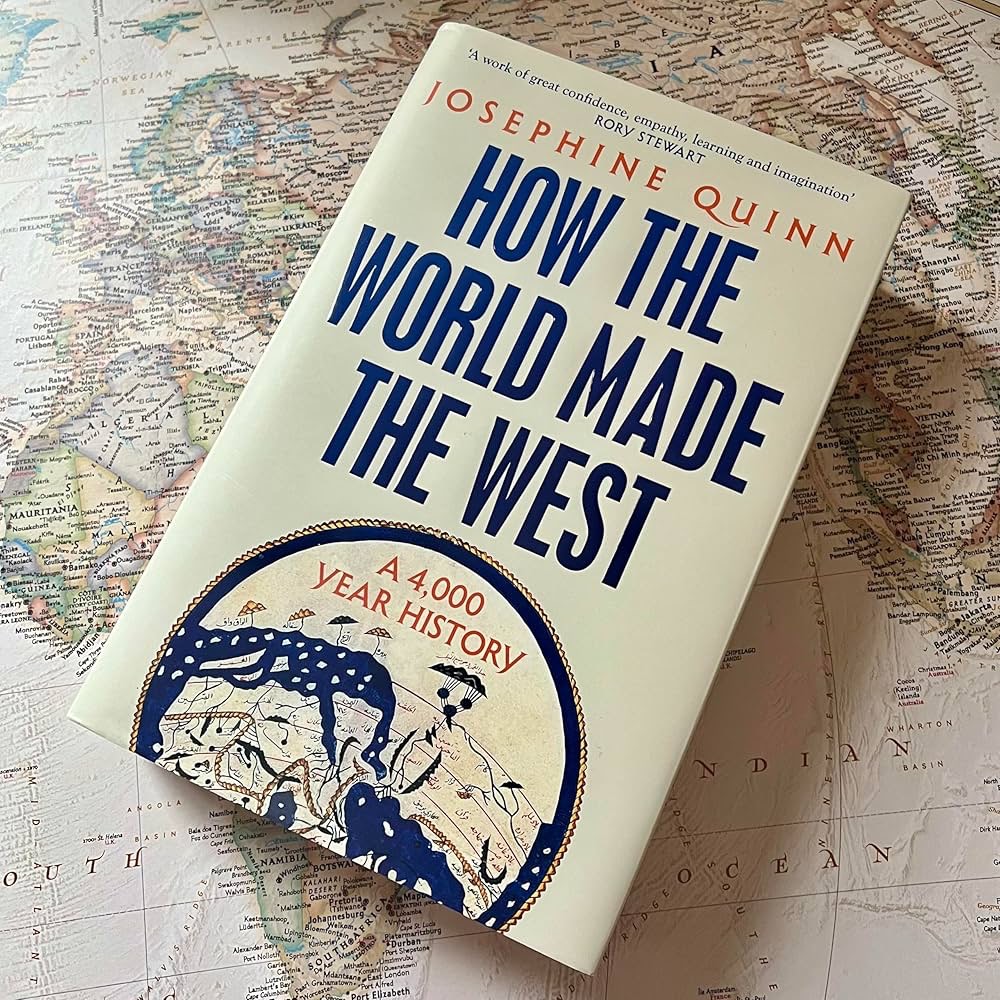
I”m currently reading this astonishing book by Josephine Quinn challenging the whole idea of “civilisational thinking”. She makes an extremely well researched and detailed case for how we got to where we are now, through hundreds of years of trade, travel, migration, and the rise and fall of power bases in cities and lands across Asia, Africa and what we now call Europe. It’s an astonishing read.

In her chapter about Athenian democracy, which is often held up as the standard “the West” claims to pay due to, she shows just how different democracy was there from the versions of it countries say they have now.

It feels as if our current versions of democracy are in crisis. They are distorted by populism, which seems to generate space for new waves of autocracy and fascism. And they are corrupted by money. It’s becoming clearer than ever that wealth buys the governments that the wealthy want. There is soaring inequality, and a decades long grinding down of working people and standards of living as neoliberalism shovels money up from the bottom to the top, privatises the Commons, and pushes “deregulation” to escape any chance of being held to account for the actions of corporations and billionaires. Meanwhile the Public looks at the system and can’t see a political party which will address the real problems we face.

In the Athenian version of democracy, Josephine Quinn highlights three features which protected it from both populism and corruption (accepting it didn’t do that 100%) –

1) Lawmakers were chosen by lot, not by anyone voting for them. What, no voting?! Yep, the method was probably pretty similar to the way a jury is chosen. Jurors are selected by lot. Nobody votes for them.

2) Secondly, those chosen were paid to do the job for a year, so it remained (technically) open to everyone, not just the rich.

3) And, thirdly, they had to step down after a year, and be subject to an open public audit, to look at how they had acted during their term of service. In other words, every one of them was held to account.

    These three basic features were designed to protect democracy from the rich and the corrupt, and to engage the greatest number possible of citizens in the law making of the land.

    Of course, Athens was a pretty small town by current standards, and present day countries couldn’t manage assemblies of the entire population to gather and make decisions (although with modern online technologies, perhaps the geographical limits have been lifted)

    This is an entirely different vision of democracy. If we chose our “representatives” the same we choose jurors, if we paid them for their work, limited them to a single term in office, and held them to open public audit when they stood down, it would make it harder for the wealthy to buy elections and for lobbyists to corrupt politicians (who couldn’t be career politicians any more) – Can you imagine it?

    There are lots of other good ideas around the world which might improve democracy, from citizens assemblies and referendums creating a more participative democracy, to trials of different kinds of proportional representation, but none of these ideas are as radical as those we saw in place back when democracy was born.

    I mean it’s pretty thought provoking, isn’t it?

    Read Full Post »

    I saw this post on Instagram recently, posted by a French philosophy site. I’ll translate it for you.

    “To be on the Left, is to, first of all, think about the world, then your country, then those close to you, and then yourself. To be on the Right, it’s the inverse”

    Deleuze is one of my favourite, and most fascinating French philosophers. He seemed to have the ability to get you to see something in a completely new light. This is one of his more political sayings, and, it strikes me, it’s as true today as it was when he said it. In fact, it’s even more true.

    Every populist Right wing autocrat we’ve witnessed in the world appears to put themselves first, then their close contacts, then their country, and, finally, if at all, the world. Whether we’re thinking of Trump, of Boris Johnston, of Orban, Putin, Farage, or Milei, it’s hard to avoid the conclusion that they speak and act in their own interests first, some of them to the point of pathological narcissism.

    And yet, everywhere, the Left seems to have lost its way. We’re going through a phase where “Left” has become a pejorative term (frequently paired with “hard” or “extreme”) and we see one Right wing populist group after another achieving power, with little effective opposition.

    Can we turn this around and embrace Deleuze’s priorities instead? Think first of the world, the planet we are desecrating, polluting and over-heating? Can we think of ourselves as a species, with ALL human beings our fellow citizens? Can we put that before thinking of countries, and seek to build, not destroy alliances and truly “integrative” , genuinely mutually beneficial relationships between countries? Can we then campaign for societies which serve the interests and needs of neighbours, our friends, colleagues and families, over the interests of billionaires and corporations? Can we then think how each of us can contribute to making this a better world for us all to live in?

    Does that sound radical to you?

    Read Full Post »

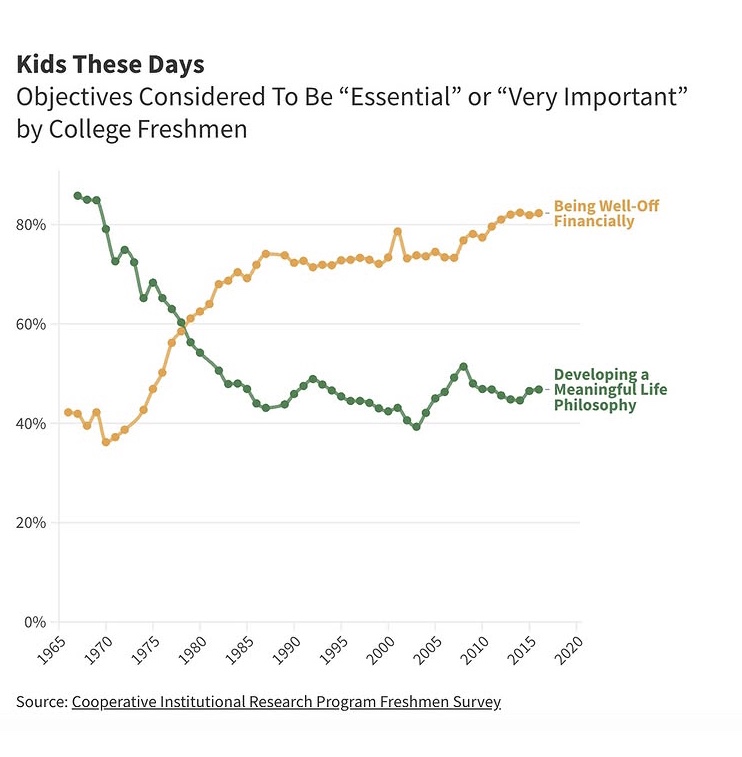
    I came across this chart the other day. Isn’t it fascinating? It charts the percentage of college “freshmen” saying that either “”Developing a meaningful life philosophy” or “Being well off Financially” was considered by them to be either an “essential” or “very important” objective.

    Basically it shows an almost complete reversal of positions of these two objectives between 1965 and 2020. Now, less than half give “developing a meaningful life philosophy” compared to over 80% of them saying “being well off financially” is essential or very important. Back in the 60s, these figures were almost exactly reversed and the crossover point in the chart seems to be in the latter half of the 70s.

    I’ve long held the belief that Thatcher and Reagan, as the main drivers of neoliberal economics, were at the turning point in our societies. I guess I’m part of what is called the “baby boomer” generation, and it seems to many of us that life has got harder and more precarious for most people in our communities over our lifetimes. It seems that Public Services have gone into steep decline, that wages have stagnated, house prices have soared, and jobs have become less secure.

    What went wrong?

    When we hear the present generation of politicians in the UK, and even more so in the USA, put forward policies which are every bit as neoliberal as Thatcher and Reagan, is it any surprise that this steep decline has been experienced everywhere. Inequality is higher now than it has been for decades. The whole economy has been “financialised” where we’ve been led to believe that the finance sector, and the rich, are the wealth creators, while, actually, their wealth is being created out of wealth, not out of productivity. The goods and services produced now seem cheaper and nastier than they were. The heroes of contemporary society are those who have grabbed the most for themselves over the shortest period of time and the huge numbers of billionaires and millionaires can’t find anything left to spend their money on except ridiculously expensive houses, yachts and private jets, so they’ve turned to buying political influence instead.

    When the goals of society are to promote the wealth of the wealthiest and to deny, as Thatcher did, that “society” even exists, has, surprise, surprise, led to exponentially increasing amounts of mental and chronic physical illness.

    Maybe Iain McGilchrist would point to likelihood that giving predominance to the left cerebral hemisphere over the right will have been, at least in part, at the root of this problem. But it’s a profound economic problem too. We are still trapped by the delusions of neoliberalism with its so called “free markets” which aren’t free at all, and “trickle down economics” which never trickle down.

    We need something better. We need to break free of the neoliberals and the populist far right.

    Read Full Post »

    Living on the edge

    I imagine that the first thing you notice when you look at this image is the sea. In fact, it was the sea which caught my attention, and triggered my camera release. But when I review it now, my eye is drawn from the water, to the rocks, and then to the houses perched on the top of the cliff. Strangely, I didn’t notice them when I was taking the photo.

    How would you like to live there? Right on the edge?

    You’d certainly have a fabulous view of the sea every day, for as long as you wanted to. As best I know house prices on the coast, with a sea view, are pretty much higher than house prices inland, so, perhaps most people are keen to live on the edge.

    Others find it a bit scary. They’re not so secure perched on the top of a cliff, and open to the winds and storms which sweep in from the sea from time to time.

    We’re all different.

    The philosopher, Gilles Deleuze, writes about the “far from equilibrium” zone. It’s where change occurs. It’s the closest area to chaos, to phase changes, to producing emergent phenomena which we couldn’t predict. He says that when we follow a “line of flight” towards the edge, things can become clearer. In the middle, in a balanced, and relatively static place, the mix of streams of information and energies can make it hard to distinguish characteristics and themes, but as you stretch out towards the edge, it’s a bit like unravelling a ball of threads, each colour becomes easier to see.

    But there’s something else about living on the edge which occurs to me. I’ve noticed the word “extreme” is used a lot these days, especially in politics, and always with an intention of shutting people down. Some views are described as “extreme right”, others “extreme left” (sometimes the word “extreme” is replaced with the word “hard”) but what does it tell us about the person to whom we are attaching this label? It’s a judgement, not an observation. The label is applied differently in different contexts of course. As I understand it, something like “universal health care” is described as an “extreme” view by some (much more so in the USA than in Europe). Here in France, that’s definitely not labelled “extreme”.

    I’m wary of labels at all times, but I’m especially wary of this “extreme” label. It doesn’t tell me anything. I want to hear what the person has to say. I want to understand their world view and their beliefs. I want to explore their values. Labelling them doesn’t let me do that.

    By the way, understanding a point a view, doesn’t mean you have to adopt it. It can, however, open up some points of common ground, and shift the discourse away from the harmful polarised quality which seems dominant at this time.

    Read Full Post »

    There are some words which are used a lot these days, which make me uncomfortable. Every time I hear them used I find my mind filling with questions and doubts.

    The first of these is “Growth”. The Labour government in the UK has come to power from a campaign fixed firmly on the concept of growth. It’s a word used by politicians and economists all the time. But growth of what? If I understand them, they are typically referring to something called “economic activity”, by which they mean the production of more goods, the delivery of more services, and the greater consumption of both by the populace. But is this not a bit lacking in nuance? Does a better, more sustainable future for us, for our children and their grandchildren, lie down the path of ever greater consumption? All this in a finite planet? I read the Club of Rome report, “Limits to Growth”, back when it came out, I think, in the 70s, and whilst much of the projected data in that report didn’t pan out, the underlying principle was that we can’t keep depleting limited natural resources, destroying ecosystems, and producing every more pollution. That seems right to me. There are natural limits to growth, just as there are natural limits to healing and to Life. But, more than that, just chasing growth without specifying growth of what, and for what purpose, lacks all value. Producing and consuming more highly processed food is causing an epidemic of obesity and chronic disease. Producing and consuming more oil and gas is heating up the planet, and polluting the oceans with plastics which will never disappear. If we want to pursue growth, shouldn’t we at least be clear about exactly what it is we want to grow, while remaining mindful of the damaging effects of too much production and consumption. There is also the issue of distribution of the fruits of any growth. The economies of the world have been growing – they’ve been shovelling more and more wealth into the hands of a tiny handful of people, whilst populations everywhere creak under the strain of a “cost of living crisis”. The pursuit of growth for growth’s sake, makes me uncomfortable.

    The second word which bothers me is “‘utility”. I read a great quote the other day – “those who believe in utility have to answer the question – utility for what? if the answer is just more utility you have a problem”. It’s the same issue as the growth question I suppose. When utility become the exclusive goal, again we lose all contact with quality and values. Something which is “utilitarian” just lacks something, doesn’t it? It’s limited, superficial, thin. It leads to the charge about “knowing the cost of everything and the value of nothing”. Yes, we want our goods and services to be useful, and in that respect, we have to pay attention to their utility, but we’ve got to ask – utility for what? Is it to further our pursuits of Beauty, Truth and Goodness? Is it to further our wellbeing? To increase justice and fairness? Is it to facilitate the flow of love and kindness? Or what?

    The third word which troubles me is “efficiency”. Especially, “cost efficiency”. The extreme pursuit of “the greatest bang for the buck”, of “paying attention to the bottom line” is replacing value in Life, with profit in corporate pockets. Our Public services, of health care, education, social care, and so on, are in crisis. We’ve closed hospital beds, failed to invest in training and employment of highly skilled professionals, and we find ourselves with increasing, unmet demand, and an annual cycle of “how are we going to cope” every single winter. Living organisms are complex adaptive systems and our services should be modelled on them, because they are there to improve the quality of Life, not to increase profits for a small group of “investors”. One of the characteristics of complex systems is “redundancy” – they have more adaptive strategies, systems and resources in place than they “need” at any particular moment, so that when a new, large challenge comes along, they can respond. They can deal with it. We’ve trimmed everything back to the bone. Didn’t the Covid pandemic show us that? Clear as day? Didn’t it expose our vulnerabilities, our inequalities, our impoverished resources? The efficiency of a machine, of the production of machines, is not the same as the efficiency of living, natural organisms. We are not machines. We are not machine like. And we need the services which are designed with Life in mind, with humans in mind, not those with the goals of profit making industrial production.

    What are your bug bear words? These are my top three. I don’t think I’ve articulated them here before, so I thought I’d take today to do so. I hope that next time you hear someone talk about growth, utility, or efficiency, you’ll stop to reflect and ask what they actually mean by those words, and whether or not you think they are contributing to a more healthy, more flourishing society.

    Read Full Post »

    The economist, Thomas Picketty, recently wrote this on his blog – “In France, the combined wealth of the 500 largest fortunes has grown by €1 trillion since 2010, rising from €200 billion to €1.2 trillion.”

    What he’s highlighted here is the massive increase in the wealth of the already wealthiest in the world over the last decade or so. There are lots and lots of other figures you can find if you go searching for them, but they are all examples of exactly this phenomenon – while there is great child poverty, millions of people suffering from a “cost of living crisis” and a decline in Public Services in European countries, some people……those who already hoard the most…..have been absolutely coining it in. This is despite such “crises” as the pandemic and the war between Russia and the Ukraine.

    At the same time, politician after politician complains about “the National Debt” and how “we can’t afford” to give people decent lives, decent houses and decent jobs.

    There have also been a number of articles in recent times about what has been coined the rise of the “inheritocracy” – increasingly, this large shift in wealth away from the general public into to hands of a tiny minority, is leading to more and more younger adults becoming wealthy because they happened to choose the right parents. This isn’t a meritocracy. And it isn’t about rewarding those who work the hardest and contribute the most. There’s a trend underway, and Picketty highlighted that trend in his best seller, “Capital” – that capital is growing faster than the economy, so inequality will continue to increase.

    It strikes me there’s something seriously wrong with this system. But let me just pull another issue into this, because these are the things rattling around my brain this morning – the other thing we hear politician after politician go on about is “growth”. “Growth” – the answer the Life, the Universe and Everything! In the UK Labour have built an entire set of policies on this premise – get “growth” and all the good things will follow – better family incomes, better Public Services, less hardship. But, don’t you ever stop to wonder – “growth of what?” I do. Not least because it’s clearer than it’s ever been that we live together on one, finite, massively interconnected planet. We cannot keep growing the global temperature. We cannot keep growing the oceans of plastic waste. We cannot keep consuming more (just consuming more, it apparently doesn’t matter what) every single year. At some point, we’re going to hit the buffers. Aren’t we?

    Look, I don’t have all the answers. It’s just that these are a couple of the issues which trouble me these days – both issues, which, along with Climate Change, pollution and species loss – lead me to conclude – there is something deeply wrong with this current world economic/political system.

    What do you think?

    Read Full Post »

    I find it pretty depressing how immigration is presented as a problem in so many countries. It seems every far right political group on the planet wants to build walls around their own country and keep any foreigners out. Why? Because people who aren’t born in the country where they now live are a problem to be solved?

    Personally, as an immigrant myself, I think everyone who live in the same street, the same village, town, or city, the same country even, should be treated equally. I’m not a problem because of my genealogy or my genes. We are all inhabitants, we who live together, sharing the same roads, the same shops, the same activities. I prefer the concept of “inhabitant” or “resident” over that of “citizen” if, by the latter term, we mean people who have passed whatever administrative and/or economic rules a country applies to people who weren’t born in that particular part of the world.

    In fact, more than anything geographical, I feel I am a member of the human race, and a unique expression of Life, just like all the other human beings who I share this planet with, just like all the other astonishing forms of life I share this planet with.

    I don’t think immigration is a problem to be solved. The problem to be solved is “integration”. Here’s the definition of integration I work with – “the creation of mutually beneficial bonds between diverse and well differentiated parts”. In other words, how do I live with my fellow “residents”, fellow “inhabitants”, fellow “citizens” in the part of the planet which I call home?

    When we don’t create healthy, positive, creative, and caring bonds between each other, we all suffer. We humans have always moved around the Earth, and we always will. Yet, most people who live in a particular part of the world would prefer to stay there – it’s war, violence, and utter poverty that drives out those who would rather stay.

    I think we should put our energies and our resources into living well together – that would include treating people in the same place equally no matter where they were born, actively helping immigrants to integrate by teaching them the language, customs and laws of the country, and encouraging their full participation in society. And we need to develop mutually beneficial, caring, creative relationships between countries, instead of hostility, hatred, fear, competition and violence.

    We humans are superbly adaptive creatures and we’ve evolved to be able to inhabit almost every corner of this little planet. But we’re going to have to adapt better if we all want to survive….or at least, if we want our grandchildren and their grandchildren to survive. We’ll do that through integration – by the creation of mutually beneficial bonds between ourselves and others.

    So, I reject the dominant narrative that immigration is a problem, and I say, loud and clear, that what we should address and “solve” rather, is integration – integration in our streets, our villages, our cities, our countries, and our planet.

    Read Full Post »

    Older Posts »