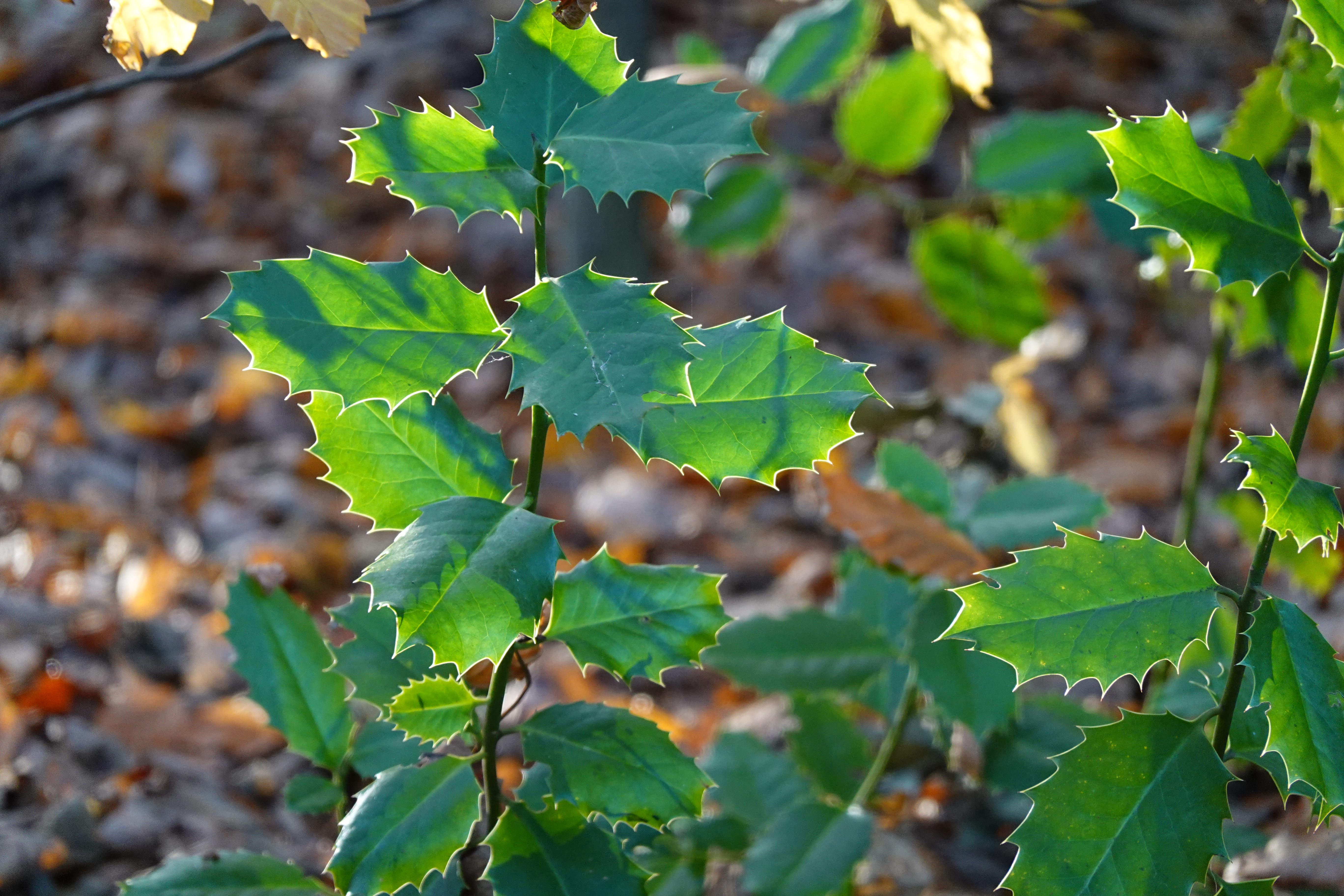
I’m not a botanist but I’m pretty sure that holly leaves have these jaggy edges for protection. I don’t think they are simply a decorative design feature. They are to dissuade animals from eating them. We living organisms have an incredible diversity of defence systems…..from spikes to poisons to….well, the list is huge. We humans also use a huge number of different defence strategies, both behaviourally and with our complex systems of immunity.
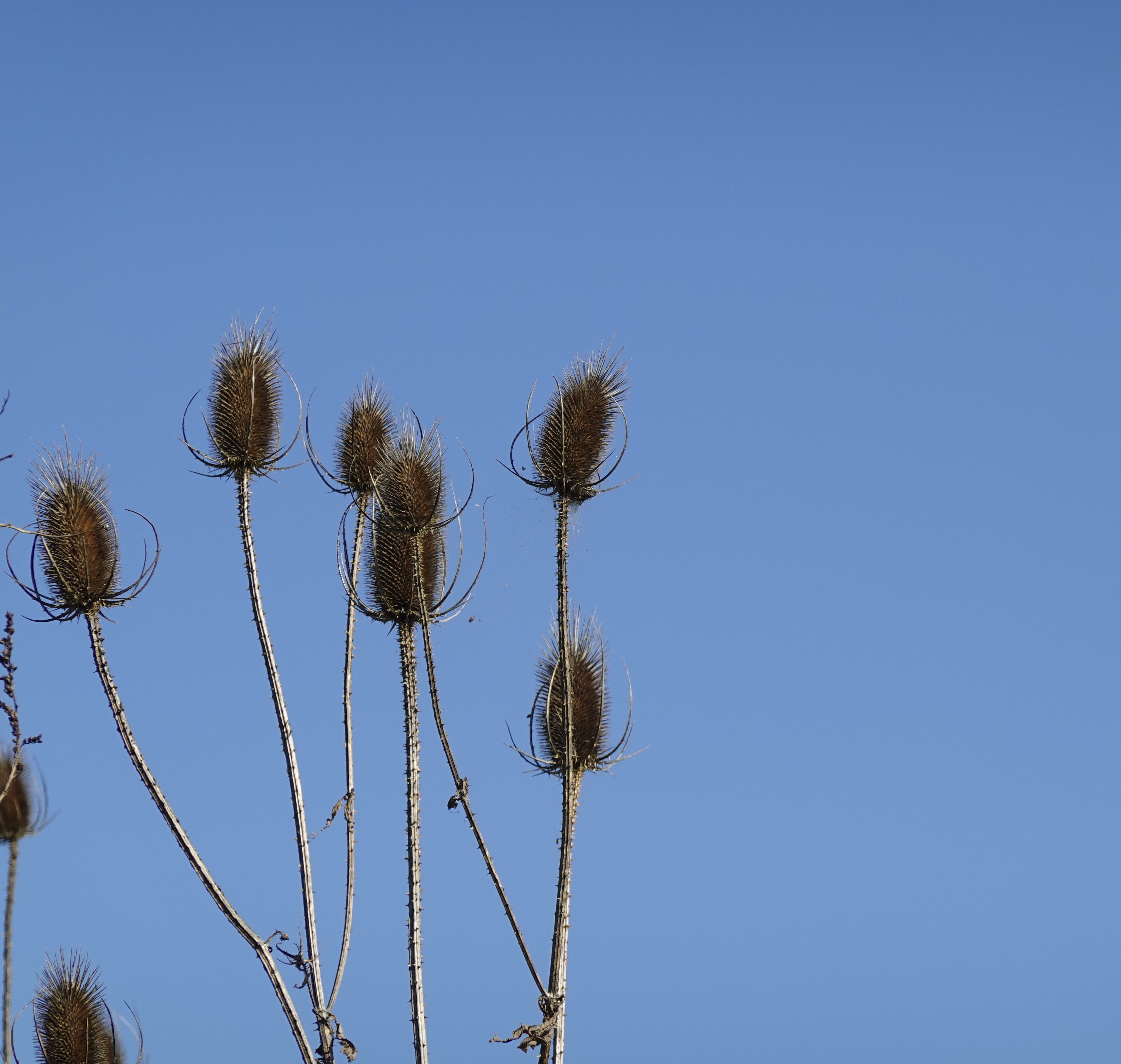
But not all spikes are for defence. Look at these seed heads with their elaborate spikes and hooks. These aren’t, as best I know, for defence, but to hook on to passing creatures, so that the seeds inside are carried by the others, allowing the plant to increase its chances of survival and propagation around the countryside. These systems of seed dispersal remind us that interactions between plants, animals and humans are normal. It’s not just we humans who need each other in order to thrive. All kinds of living creatures need others (sometimes other members of their own species, but often members of quite different ones) in order to survive and thrive.
Nature creates elaborate and complex webs and networks of relationships between living organisms. We call them ecosystems. The more diverse the ecosystem, the more it is resilient and able to adapt to changing conditions. Loss of species diversity is a huge risk to human beings. I’m not sure how aware we are of that fact.
We should be encouraging diversity, encouraging connections and relationships. We should be building physical, social and psychological ecosystems if we want to thrive.
Looking at these images today, on the last day of 2024, reminds me that for each of us to flourish in 2025, we need to pay attention to our relationships, and need to encourage difference between ourselves and others.
There are some words which are used a lot these days, which make me uncomfortable. Every time I hear them used I find my mind filling with questions and doubts.
The first of these is “Growth”. The Labour government in the UK has come to power from a campaign fixed firmly on the concept of growth. It’s a word used by politicians and economists all the time. But growth of what? If I understand them, they are typically referring to something called “economic activity”, by which they mean the production of more goods, the delivery of more services, and the greater consumption of both by the populace. But is this not a bit lacking in nuance? Does a better, more sustainable future for us, for our children and their grandchildren, lie down the path of ever greater consumption? All this in a finite planet? I read the Club of Rome report, “Limits to Growth”, back when it came out, I think, in the 70s, and whilst much of the projected data in that report didn’t pan out, the underlying principle was that we can’t keep depleting limited natural resources, destroying ecosystems, and producing every more pollution. That seems right to me. There are natural limits to growth, just as there are natural limits to healing and to Life. But, more than that, just chasing growth without specifying growth of what, and for what purpose, lacks all value. Producing and consuming more highly processed food is causing an epidemic of obesity and chronic disease. Producing and consuming more oil and gas is heating up the planet, and polluting the oceans with plastics which will never disappear. If we want to pursue growth, shouldn’t we at least be clear about exactly what it is we want to grow, while remaining mindful of the damaging effects of too much production and consumption. There is also the issue of distribution of the fruits of any growth. The economies of the world have been growing – they’ve been shovelling more and more wealth into the hands of a tiny handful of people, whilst populations everywhere creak under the strain of a “cost of living crisis”. The pursuit of growth for growth’s sake, makes me uncomfortable.
The second word which bothers me is “‘utility”. I read a great quote the other day – “those who believe in utility have to answer the question – utility for what? if the answer is just more utility you have a problem”. It’s the same issue as the growth question I suppose. When utility become the exclusive goal, again we lose all contact with quality and values. Something which is “utilitarian” just lacks something, doesn’t it? It’s limited, superficial, thin. It leads to the charge about “knowing the cost of everything and the value of nothing”. Yes, we want our goods and services to be useful, and in that respect, we have to pay attention to their utility, but we’ve got to ask – utility for what? Is it to further our pursuits of Beauty, Truth and Goodness? Is it to further our wellbeing? To increase justice and fairness? Is it to facilitate the flow of love and kindness? Or what?
The third word which troubles me is “efficiency”. Especially, “cost efficiency”. The extreme pursuit of “the greatest bang for the buck”, of “paying attention to the bottom line” is replacing value in Life, with profit in corporate pockets. Our Public services, of health care, education, social care, and so on, are in crisis. We’ve closed hospital beds, failed to invest in training and employment of highly skilled professionals, and we find ourselves with increasing, unmet demand, and an annual cycle of “how are we going to cope” every single winter. Living organisms are complex adaptive systems and our services should be modelled on them, because they are there to improve the quality of Life, not to increase profits for a small group of “investors”. One of the characteristics of complex systems is “redundancy” – they have more adaptive strategies, systems and resources in place than they “need” at any particular moment, so that when a new, large challenge comes along, they can respond. They can deal with it. We’ve trimmed everything back to the bone. Didn’t the Covid pandemic show us that? Clear as day? Didn’t it expose our vulnerabilities, our inequalities, our impoverished resources? The efficiency of a machine, of the production of machines, is not the same as the efficiency of living, natural organisms. We are not machines. We are not machine like. And we need the services which are designed with Life in mind, with humans in mind, not those with the goals of profit making industrial production.
What are your bug bear words? These are my top three. I don’t think I’ve articulated them here before, so I thought I’d take today to do so. I hope that next time you hear someone talk about growth, utility, or efficiency, you’ll stop to reflect and ask what they actually mean by those words, and whether or not you think they are contributing to a more healthy, more flourishing society.
The main news programme on the BBC tonight had the word RECESSION plastered behind the newsreaders for virtually the entire duration of the programme. Got me thinking about what on earth’s going on in our “global economy”. It seems the economic system we are all living with is designed around the concept of growth. Technically, a growth rate less than zero for two consecutive quarters is the official definition of a “recession”. Some of the items covered under this heading included fears of shop owners that people won’t buy so much this Christmas. But hold on a moment. Does this make sense? Can you really design a system that will work forever on the basis of consumption and production of more, more, more? We’ve already seen in recent weeks the consequences of a financial system geared around the mantra of making more and more money. In a finite world, does any of this make sense?
And what happens when human beings just keep consuming more and more? Oh sure, they grow all right – take a look at this map of the increasing levels of obesity in the USA – watch it spread across the whole continent like a contagion. This growth, this getting bigger, fatter, consuming more……this is health? This is a goal worth striving for? This is a system which will deliver good lives for the human race?
I don’t think so.
You see growth in a healthy way, growth in Nature isn’t about ever increasing consumption and accumulation. It’s about development. A healthy child grows into a healthy adult by maturing and developing. This involves learning, experience, acquiring skills, becoming resilient, adaptable and fit. That kind of growth is sustainable. That kind of growth is worth pursuing.
I don’t have the answers to this one, but it just strikes me that maybe we need an economic model which is based on a more natural and a more human concept of growth…….development, maturity and the fitness to be able to cope with what comes along. Not the current model based on greed, consumption and ever increasing production. The current model doesn’t work. It’s an illusion.
I welcome constructive criticism and suggestions. I will not, however, tolerate abuse, rudeness or negativity, whether it is directed at me or other people. It has no place here. ANYONE making nasty comments will be banned.


 Heroes Not Zombies