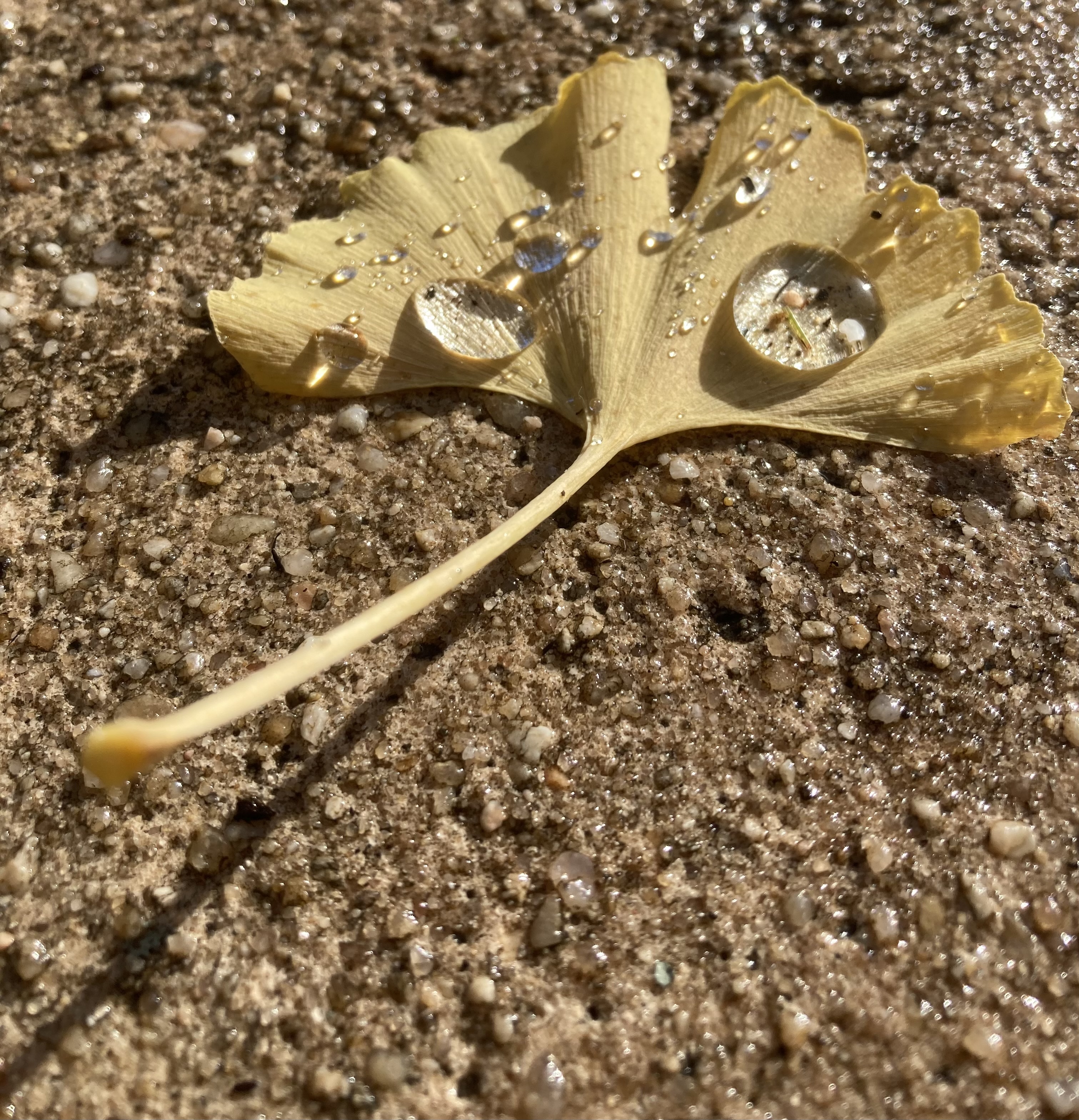
I find many trees beautiful. Some have especially lovely leaves which are so distinct in shape and colour that it’s easy to spot and recognise them. But what I find more powerful than just noticing and naming a tree, is to focus in on an individual leaf and take the time to really see it. There are no two leaves which are completely identical. Their uniqueness emerges as we consider their exact location at a particular time on a specific tree, or even, when we see a single leaf lying on the ground after a shower of rain.
The uniqueness of the leaf doesn’t lie in its “essence”, or even its particular shape, size and colour, but in its contexts and its relationships…….the tree on which it grew, the place where that tree grew, the season, the day and the time we noticed it, and took a moment to photograph it, the place the seed from which the tree grew came from, the person, or creature which carried the seed to this specific place, planted it, nurtured it, looked after it……and so on……
It’s the same for each of us. Every single one of us is unique. Over four decades of work as a doctor engaging with patient after patient individually, I never encountered two identical patients with two identical stories. Everyone had a special, un-repeatable, un-copiable (is that a real word??), presence. There was, and there remains, something incredibly special, even magical about uniqueness….perhaps not least because it can never be completely known.
There’s great beauty in uniqueness. There’s something “enchanting” about it. Not least because it’s the gateway through which we pass to encounter the “real”……all generalisations blind us to reality. They reduce complex individuality to features, characteristics or measurements. Labelling, judging and categorising extinguishes uniqueness and turns the beauty and wonder of diversity into something bland, soulless, and inhuman.
My life experience is that an awareness of uniqueness, and a desire to explore it and understand it, leads to a richer, deeper, more satisfying life.


 Heroes Not Zombies