Feeds:
Posts
Comments

Posts Tagged ‘water’

I like this kind of fountain where the water pools in a bowl, or on a table, and flows gently, but constantly over the edge. It’s common to see this type of structure in Japan, but I’ve seen them in many other countries too.

One of the things I like about this particular photo is how the water in the bowl is blue, green, purple and black, but as it flows over the edge it appears golden, silver and clear. I know that has a lot to do with the colour and structure of the container but that’s the thing with water….it adapts, morphs, according to where it finds itself.

Water is such a strong metaphor for change. It loves to flow. It hates to be stagnant. It loves to change from liquid to gas, sending up into the air both millions of invisible water molecules, and visible mists. It loves to firm up in the deep cold of winter, to become hard and to create spectacular structures from icicles, to snow crystals, to icebergs. Those hard, solid looking structures don’t appear to be flowing, but they don’t remain in any one particular form for long. They too give off molecules into the air, at the same time as they turn to liquid on their surfaces.

Without water there would be no life on Earth. We only have the one water cycle on this planet. We might artificially divide up areas of the world’s oceans and seas and give them names. We might try to claim ownership or rights over patches of water, or the seabed below them. But water knows no boundaries, and water continuously cycles into the air, onto the soil, and runs back down into the oceans again. You can’t keep any of the water separate from all the rest.

We try to keep the water out of our houses, but water goes where it wants to go, and no amount of concrete or sandbags can contain it for long. Are there more floods these last few years? It seems so. At least, here in France, it does. Do we understand that? Do we understand how the water cycle works and why rainfall is increasing? Do we understand how rivers are formed and how they flow? Because if we don’t understand these phenomena well enough, how are we going to live with them?

Coastlines don’t stay the same forever. River banks don’t stay the same for ever. We need to adapt to the changes. King Canute didn’t have the right idea.

Read Full Post »

There’s an ancient spring opposite my house. It was there in the times of the Celts and the Gauls, then the Romans came and built a small viaduct and channel to harness it. The pool at the spring’s origin flows over a small wall into a narrow channel, and out into a stream which runs for kilometres through the countryside. Several of the villages near me have the word “moulin” in their name. It means a “mill”. The water flowing along this stream powered the millstones which ground the wheat. There’s little left of actual mills, but there are some with remnants of great stone wheels in their gardens, or at the sides of a house. The road follows the route of the stream. It follows it so closely you’d think they had both been created at the same time, but I think the water probably found its own way, and the people followed.

From time to time, I’ll spend a while across at the spring, gazing at the water flowing past the ancient Roman walls, and listening to it gurgling its way to the stream. It’s such a delightful experience. A few moments under the trees, standing on the grassy slope, paying attention to the flowing water.

There are many aspects of Nature which enhance our lives. The Japanese practice “forest bathing”, benefiting from time spent amongst trees, an experience I highly recommend. Researchers have discovered benefits to hospital patients in terms of speed of healing and reduction in pain and complications if they have a view of nature through the window from their beds.

Experiences of flowing water, for me, is one of these many circumstances which enhance an ordinary day. Fountains can have a similar effect. We don’t have any near us, but many French towns have a number of fountains in their central squares, and they always draw me to them.

Do you have anywhere nearby where you can spend a few moments next to flowing water? A stream, a fountain, a waterfall? If so, all you need to do is to pay a little attention to it. Focusing on some flowing water for a few minutes often seems to make a day a better day.

Read Full Post »

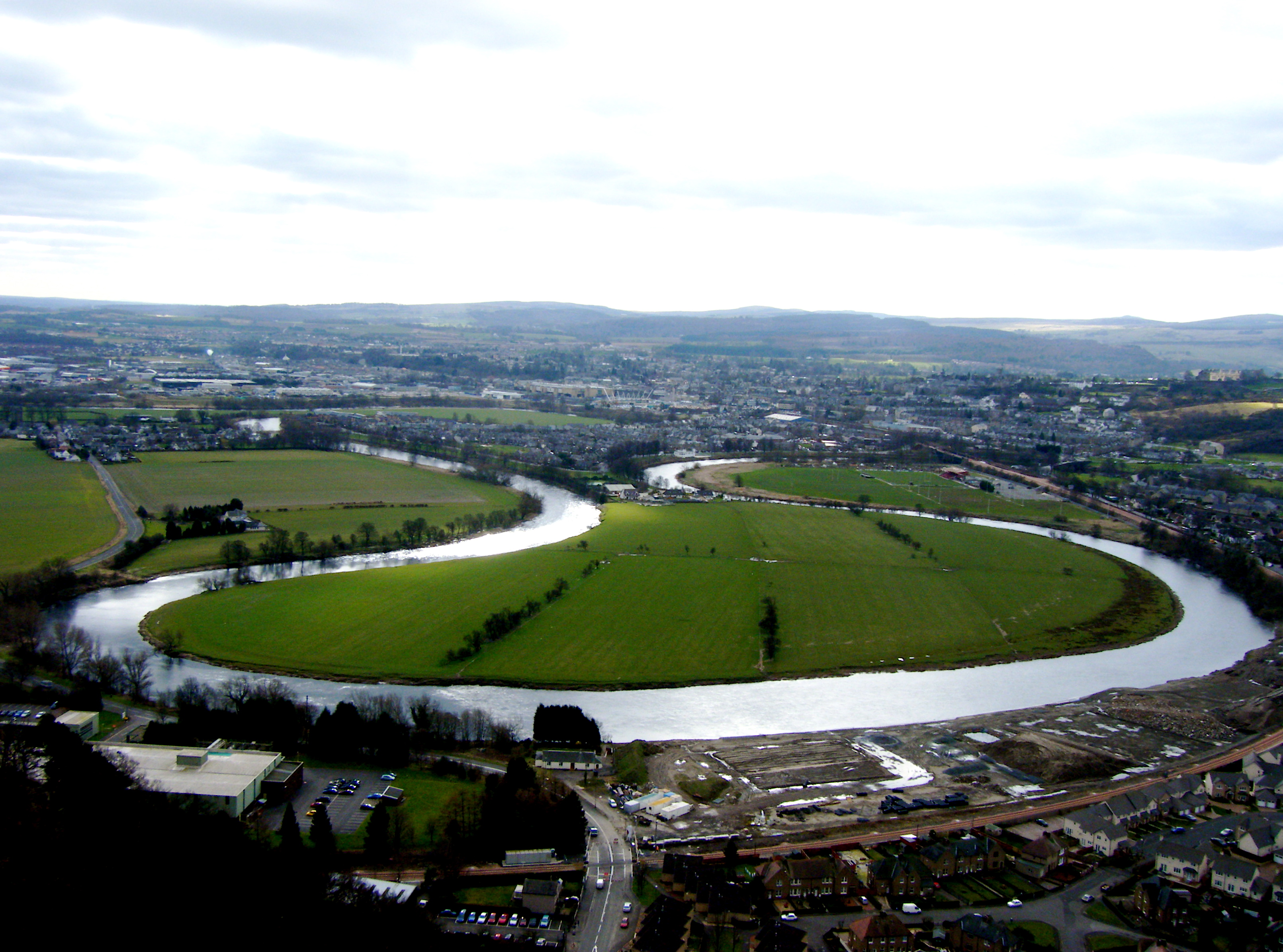
I was looking for exactly this photo the other day, and was delighted when I found it in my library – but I didn’t take it. My daughter, Amy, did. I’m pretty sure I’ve taken photos exactly like this in the past but it must be back to the days of 35mm film because I can’t find any in my digital library. This is a view of part of the River Forth, at Stirling, and it shows beautifully how the river twists, turns and curves around so much at this point in its journey.

I picked up a couple of little books by a French author, Olivier Clerc, when I was in Biarritz fairly recently. One is called “La Grenouille qui ne savait pas qu’elle etait cuite….” (which is about the frog who didn’t know she was being boiled) and the other is “Rien ne peut empecher la riviere de couler…..” (nothing can prevent the river from flowing. In both books, this Swiss author, writes about life lessons he’s learned by taking an analogical perspective on natural phenomena. He argues that as well as thinking analytically, which we are encouraged to do all the time, we should also develop the skills of thinking analogically. That in doing so we will find life itself becomes richer, deeper and more meaningful. I think he’s absolutely right.

The first essay in the second of those books is about how a river can be viewed two ways – first of all, you can see that it twists this way and that (just like the River Forth in this photo), and that if you trace the course of a river from where it starts in the mountains, you find that there seems no logic to its path – it heads west, perhaps, then south, then east perhaps and so on. It disappears at times, flowing into a lake, only to reappear out the opposite side, or into a marsh, or even below ground, before re-emerging perhaps many miles further on. And yet, we call the river by the same name along this twisting, turning, ever changing path. But there’s a second way to look at the river, and that’s to take a lateral slice through the landscape and see that, at every single point, the water is flowing downhill. At no point does it ever, ever turn around and start to flow uphill. It just doesn’t. It continues from Spring to Ocean, in a constantly downhill direction. He points out that these two views of the river show both continuity (as it flows through the landscape) and coherence, as it heads constantly downhill to achieve its goal of reaching the ocean).

He draws several lessons from this, not least being that behaviour is often hard to understand because we see it superficially, and that, we need to look beneath to see the underlying motivations, values and goals, in order to understand why someone is acting the way they do. He says this teaches us to be humble, to accept uncertainty, and to inspire us to look below the surface, to better understand others. What are the coherent threads that run through an individual story, be that of a person, a group within society, a culture, or even a nation? What lies beneath the apparent randomness, the veering this way and that, over years, and decades, that actually reveals the core beliefs, values and purposes?

I like anything which inspires me to pause and reflect. And I think learning to look at the natural world analogically can really deepen the joy of everyday life.

Oh, and just before I leave……I’m suddenly remembering a line from John O’Donohue –

“I would love to live like a river flows,
carried by the surprise of its own unfolding.”

Read Full Post »