There have been many epidemics in human history, and there will be many more. Some of those epidemics spread so much they become pandemics.
We discovered how to cope with these raging fires of infection many, many years ago…..
You have to isolate the infected from the rest of the population until they aren’t infectious any more. In the past that involved closing off whole walled towns, or sending the sick to isolated places.
That is still the basis of control – reduce the spread by reducing the opportunities for the virus to spread from one person to another.
In this current pandemic most countries have gone for “lockdowns” – which are more and more harmful the longer they go on. They are a desperate, short term measure. The other main policy has been to promote social distancing…..make people stay away from each other and touch each other less. This is also a pretty desperate, ultimately harmful, measure.
The most successful countries have gone for “Test, trace and isolate”.
No-one has been successful pursuing a “let it rip”, or “herd immunity” strategy. No wonder. It’s a bonkers, inhumane idea. Which infectious diseases have human beings ever successfully overcome by going to herd immunity? Not TB, not HIV, not malaria, not cholera, nope, not even smallpox, polio or measles (effective vaccines have played a significant role in these latter diseases)
This
Identify the infected and keep them at a distance from the non-infected is how to control an epidemic. It always has been, and it is now. The problem with Covid-19 is that over 80% of those infected, and able to spread it to others, are asymptomatic. That means the only way to identify those who are infected is by testing.
I know most western countries have really struggled to get their testing capacity up to speed quickly enough and some, like the UK, even abandoned testing for a while (apart from testing the sick in hospital). But that doesn’t mean it’s the wrong way to go. It’s intolerable to isolate whole populations and bring work and social life to a halt for long periods, or even repeatedly.
There’s only one way – “Test, trace and isolate” – do it intelligently, effectively and on a sufficient scale and fully support those who need to isolate for the period of their isolation.
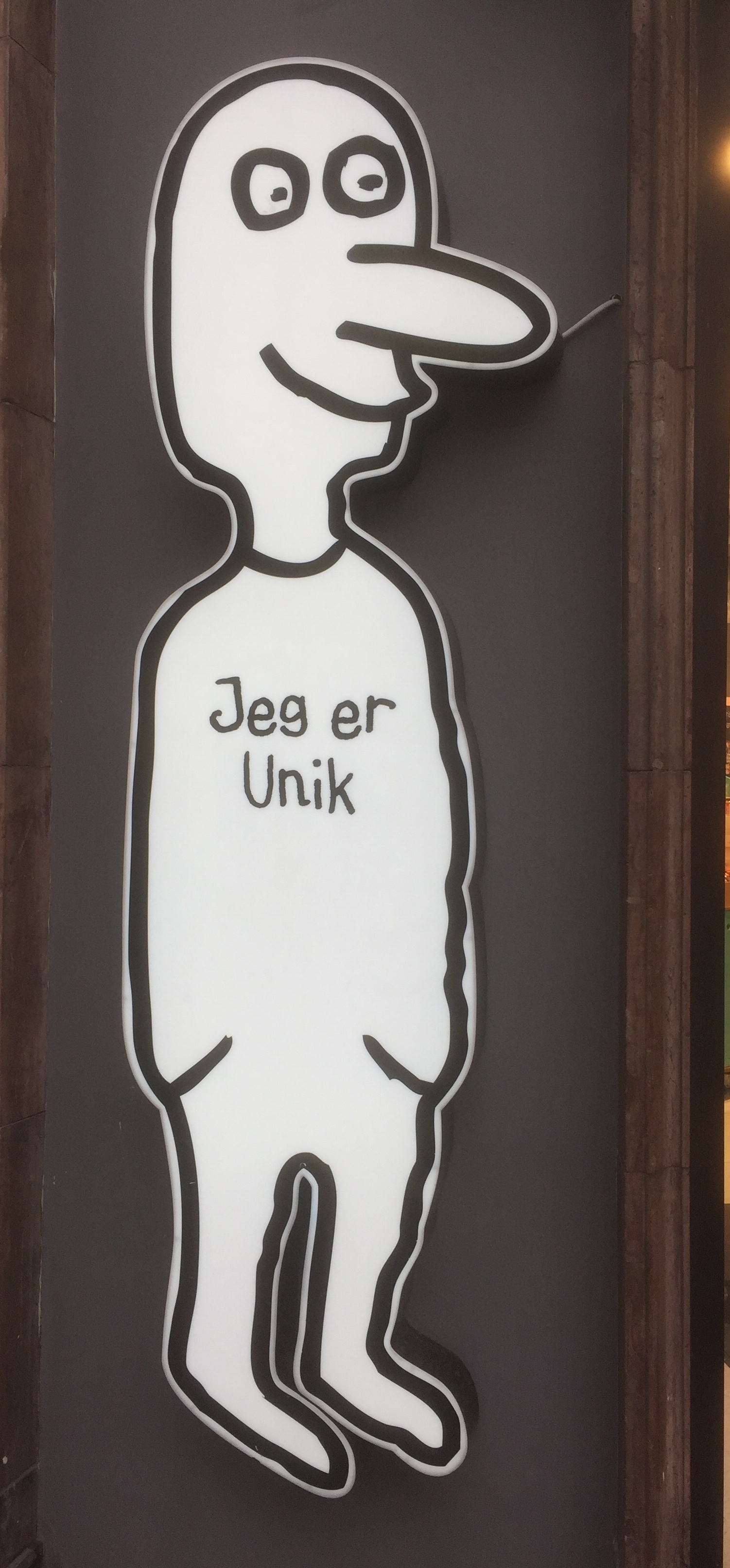
A couple of years ago I saw this image on the front of a shop in Copenhagen. Uniqueness is an important quality for me. Every single patient I ever treated was unique. Every single one had a unique story to tell me. I feel unique. I see you as unique.
So, what makes someone unique?
Is it your DNA? That’s part of it. There are no two human beings with identical genomes. Is it your face, your eyes, or your fingertips? That’s part of it too. There is scarily effective face recognition equipment already deployed everywhere from airports to security cameras. You can even get access to your phone by having it recognise your face. Iris recognition technologies have been around for some time allowing restricted access to closed spaces, and fingerprinting has a long history in detection work.
So, each of these characteristics can be said to be unique to you, but none of them captures your uniqueness, because YOU can’t be reduced to your fingertips, your eyes, your face, or your DNA. Maybe these features can help to name you….to tell others how to identify you from within a crowd, or a group.
But is this the same as “identity”?
I don’t think so. The reason why I don’t think so is that identification has spilled over from the capture of these physical features to encompass a whole person.
You are not reducible to any of these features, just as you are not reducible to any other “characteristics” such as country of birth, ethnicity, gender, religious belief, height and weight, or hair colour.
You are a person, and a person has a subjective reality, a life of memories, experiences, imaginings. A life of emotions, thoughts and beliefs. A unique, and singular story to tell, which is not, and never can be, the exact same as anyone else’s story, past, present or future.
Our uniqueness isn’t found in our characteristics or our features. It’s found in our connections….the connections which connect the past to the present, the present to future, our selves to other people, our unique set of experiences and life events, the contexts and environments of our existence. It’s found in the invisible nature of our subjective reality, with our own consciousness, our own unconscious being, and our ever changing, ever developing sense of self and person.
I abhor the reduction of a human being to a data set.
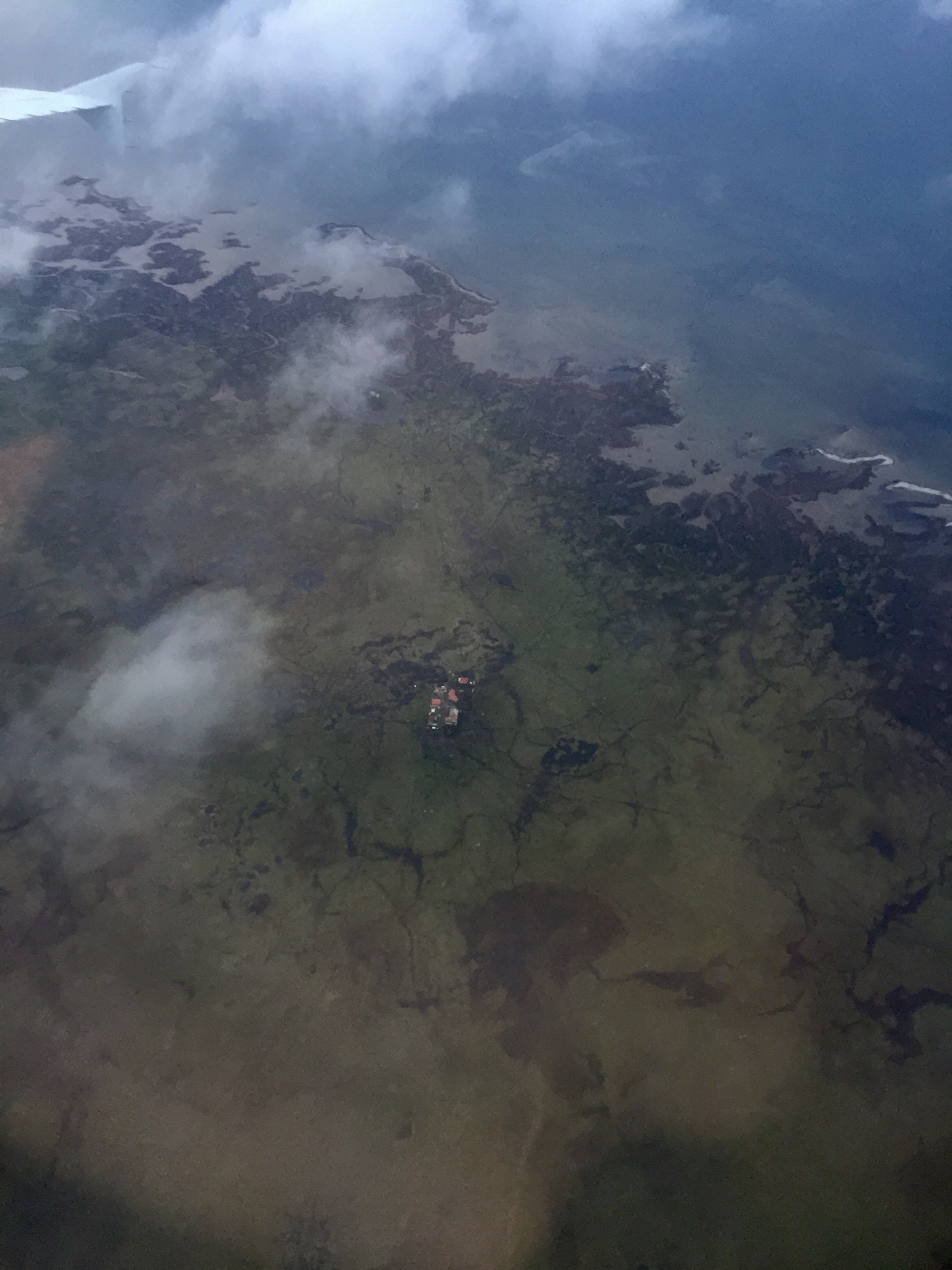
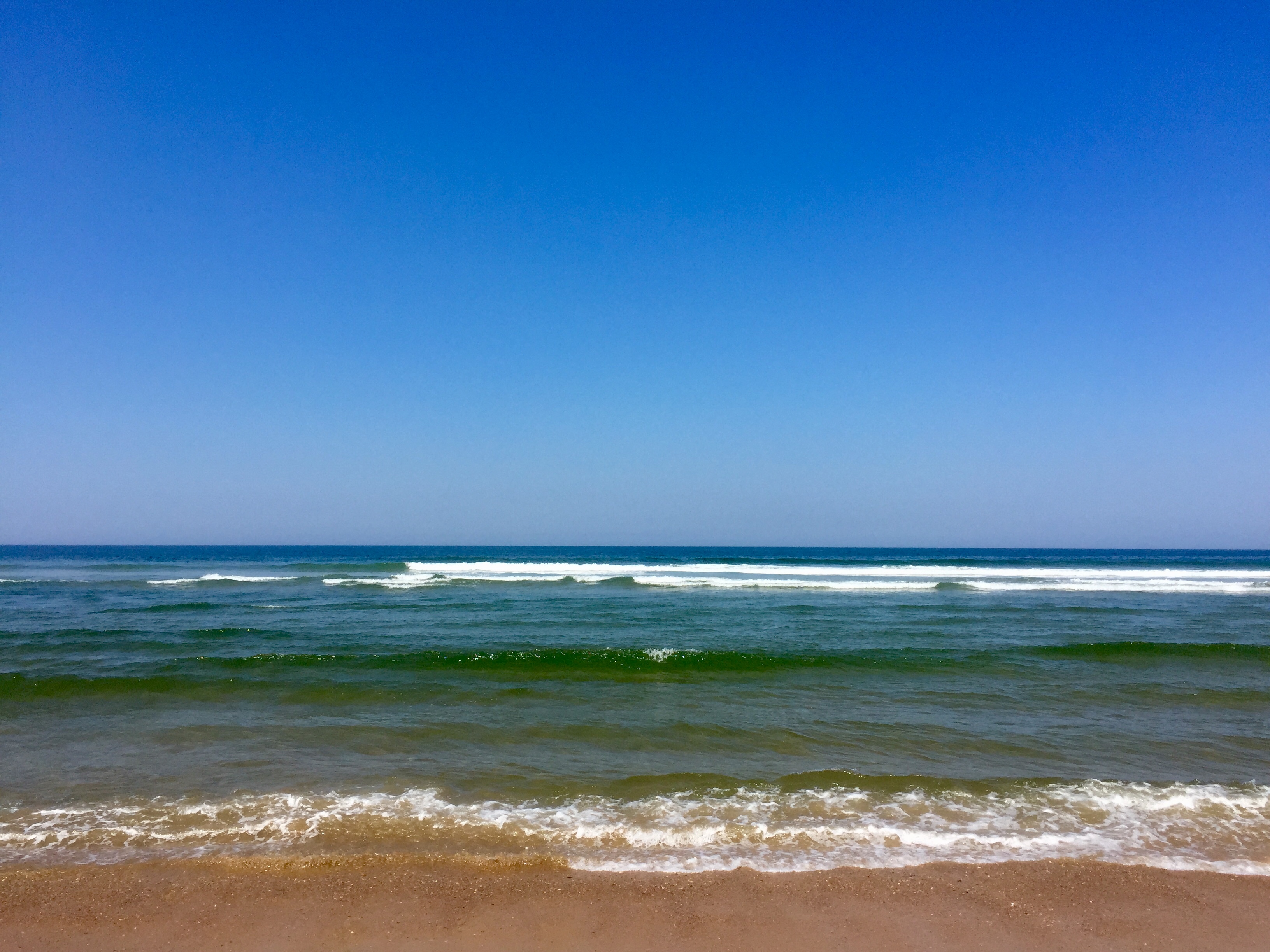
If I drive about an hour west from here I come to the edge of France. This particular stretch of coastline is called “La Cote Sauvage” (the wild coast) and it’s where you can stand and look out across the Atlantic Ocean. There’s something life expanding about gazing out over this immense expanse of water. It makes you take a deep, deep breath and fill your lungs, which is one way of making yourself a little bigger! The air is filled with that scent of saltwater, of clean air, and of distant, invisible places.
Many of us are drawn to the sea. We talk of “the pull of the sea” or the “call of the sea”. My ancestors, on one side of my family, came from the Orkney Isles, off the north coast of Scotland. I don’t know if that connects to a Viking thread or not, but I do know that the Vikings were great sea travellers. There are even some suggestions that they sailed as far as the continent we call North America. But, wherever they went, what induces a sense of awe and almost incredulity for me, was that they set out across expanses of sea like this one. They had no idea where they were going. There were no maps, and they didn’t even know if the ocean had an edge that you might fall off when you got there. They just set off.
What were they thinking, these ancient mariners? Did they just think, oh I can see the edge of the water over there in the distance, I think I’ll go and have a closer look? In much the same way that we drawn to go to the edge of a cliff, or a high building, so we can peer over and see what we can see. Did they think there might be new land there? New territories to conquer or treasures to grab?
I don’t know but I think the same questions can be applied to any of the sailors who set off across unknown seas like these. Given that I am a bit of a fan of the “and not or” idea I wouldn’t be surprised if it was a bit of both….with other motivations blended in as well.
It’s a bit of a metaphor for life, isn’t it? On any day we stand at the edge of an ocean, an expanse of possibilities stretching from here to eternity. What lies out there? The future. Is the future just waiting to be discovered? Probably not, is the answer. How many routes can we take to cross that sea? An infinite number, is the answer.
The bit that doesn’t work in this metaphor is in the answer to that first question….”what lies out there?” The future is not a distant place. It’s not just lying there, passively and patiently waiting to be discovered. Why not? Because the future is “emergent”…..that is, as in all complex systems, the future cannot be predicted from even a complete knowledge of the present, because complex systems come up towards “bifurcation points” where they might go one of two ways….towards greater complexity or towards collapse and chaos. When they pass through these points they show this quality of “emergence” which is defined as a state which could not have been predicted from the previous knowledge. When that emergence is of a certain degree of significance everything is different….the system has undergone a “phase change”.
So the future isn’t out there waiting because we are still busy making it. It will arrive when we get there. A sentiment we know well from the advice to “cross the bridge when you get there” (knowing that when you get there, there might not be any bridge, or even a gap to cross).
It’s our imagination and our curiosity which propel us onwards on this voyage of creation. Every day, every moment, even, co-creating with the rest of Existence, the next moments, the next days, the near and distant futures, which are still a gleam in their parents’ eyes.
There’s a way of looking at history where you can trace the development of a theme over decades, or even centuries. One of the themes I’m aware of is control.
Maybe the control issue has become particularly apparent because of this pandemic……in two ways.
Firstly, there’s our inability to control the spread of the coronavirus. Yes, I know, governments around the world and thousands of scientists are trying to exactly that – control the spread of the virus. But they can’t really. They can bring in measures which enforce changes in personal and collective behaviour to try to reduce the opportunities for the virus to jump from one person to another, and some countries are managing that better than others. But we can’t get rid of the pesky thing from the whole planet and as we live in a hyperconnected age reducing the incidence to zero in one country doesn’t guarantee it won’t make its way back.
Secondly, we are now subject to more controls, more restrictions than most of us have ever known. We are being monitored, surveilled, documented and followed to unprecedented degrees.
This second kind of control is not specific to infections of course. In many walks of life we are now subjected to increased levels of control. I retired from clinical practice as a doctor almost six years ago now, but in the last few years of work the level of monitoring and control of my daily “performance” increased many fold. A combination of “annual appraisal”, “revalidation” and “job plans” with an emphasis on what can be measured eg patient numbers and consultation length, diminished professional autonomy and steady forced everyone to somebody’s declared “norms”.
A lot of the desire for control is extremely well intended, but a lot of it isn’t. I’m not sure where the balance lies these days, but I suspect most money and resources go into enabling those with power and influence to keep and increase what they have through the control of the rest of us. A lack of transparency creates the suspicion that extra controls “in your interest” aren’t really in our interest!
But all this goes a long way back doesn’t it? And I’ve been thinking this morning how one of the origins is the idea that Man is separate from Nature and that we are either chosen to, or that we are choosing to, dominate and control Nature. Nature is seen as something separate from us, something to be exploited, a resource to be tapped, and potentially damaging phenomena are to be fought and controlled.
But that’s not right is it?
We are not separate from Nature. We emerge within all that is. We exist within the existence of the whole world. We are unfathomably hyperconnected with the whole of Planet Earth.
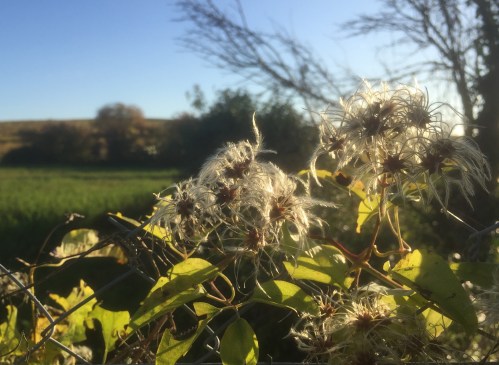
When you look around, you see that other forms of life thrive without having such an emphasis on control. Look at this photo I’ve shared today. It’s one plant which uses a particular form of seed dispersal – wind. It gambles the whole of the future existence of its species by letting go. It creates the forms and methods which give it the best chance of working well with the rest of the planet, from the wind, to the sun, to the soil, and holds its sons and daughters up to the heavens, then waits. Waits for the wind to blow, and to carry them to fertile lands.
OK, so we aren’t plants. And I’m not saying we can live the same way that they do, but there’s a lesson here, don’t you think? Something to reflect on. It’s in that action of “letting go”. Letting go in a way which maximises your ability to survive and to thrive.
How are we going to do that? How are we going to shift away from obsessive desires to control to learning to work with, to collaborate, to share, to learn with humility that we can’t control nearly as much as we’d like to?
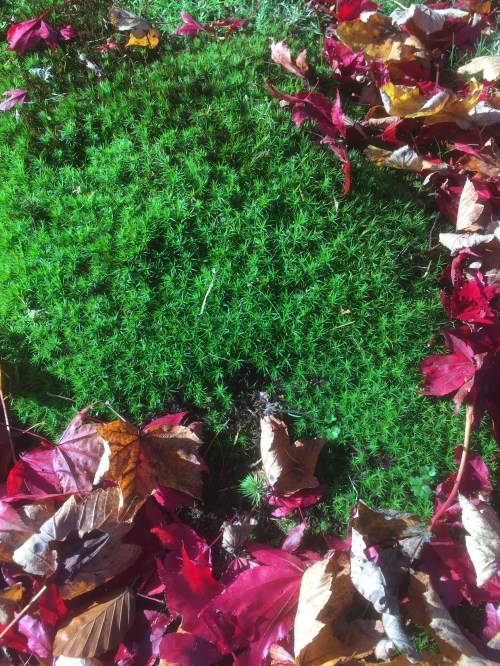
I took this photo in a Japanese Garden in Scotland in October two years ago. I’m steadily working my way through my digital photo library (from oldest to newest) and I’ve just reached October 2018…..which is pretty appropriate given its now October 2020.
This photo leapt out at me. I just LOVE it! Those gorgeous reds and greens together are quite stunning!
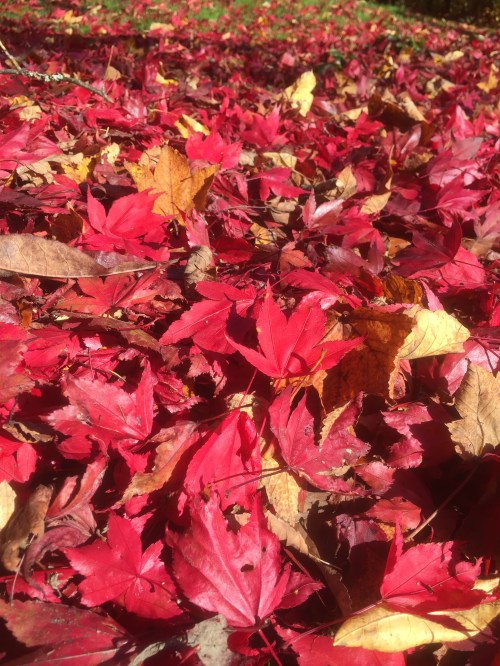
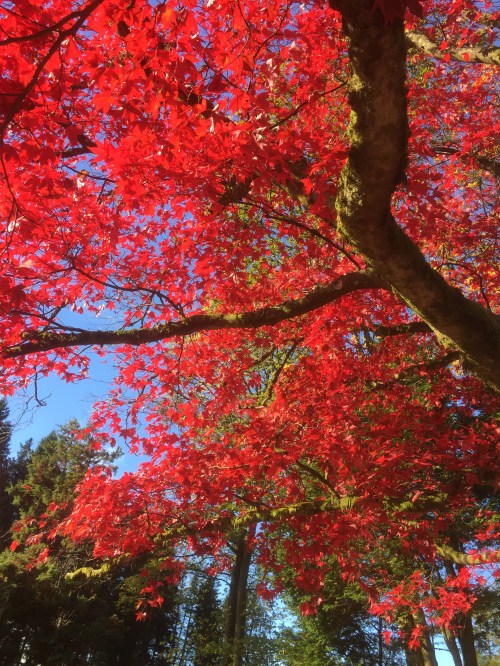
The next two photos also really transfixed me…..
I just think they are breathtakingly beautiful.
And, hey, isn’t a great idea to share some beauty today?
From the perspective of complexity science an “attractor” is an area of organisation within what otherwise appears as a chaotic system. Think of the phenomenon of a “Black Hole”. It’s like a sink hole where everything, even light, disappears into it. It’s like a point in the universe which pulls everything within its reach into its centre. A “Black Hole” is a sort of attractor.
An attractor appears around a focus, and once it is there it exerts this kind of “gravitational” or “magnetic” pull on anything which comes close to it. But the simplest way to think about it is the emergence of a consistent pattern in the midst of chaos. If there weren’t these points of organisational focus in the universe then space would be even, smooth and featureless. But space isn’t like that. It’s full of features, full of phenomena, of areas and points of organisation.
You can see something similar happen in the brain where distinct networks of neurones which “fire together”, “wire together”. There are examples of brain imaging which show the thickening of neural pathways when something is repeated…for example, when practising the piano (where you can see a thickening of the brain nerves used to control the fingers). It’s sort of a neural equivalent to what happens to muscles when someone practices body building.
The same thing happens with our habits of thought and emotion. The loops which start to fire in relation to particular thoughts or emotions have a pulling power. Many years ago I read a book by the psychologist Edward de Bono, “Water Logic”, where he described this tendency for thought patterns to become embedded in our brains by likening them to the way water makes its way down towards the sea from the heights of a mountain. The rain falls pretty evenly over the high lands, but starts to run together to form streams, rivulets, rivers and finally estuaries into the oceans. The next rain which falls tends to follow the paths already carved out by the previous rain.
I thought that was a pretty powerful image and I shared it with many patients over the years. It helped explain phenomena like flash-backs, compulsions and addictions to some extent. But I always thought it was only part of the story, and it wasn’t until I discovered “attractors” that I realised what the other part was.
So, it seems to me, that events which are accompanied by strong emotions can make new attractors in our minds. They can be traumatic events, accompanied by fear, anger, shame, or pain. Or they can be life-enhancing events like joy, wonder, tranquility, or a sense of one-ness with the world.
When we recall one of those events we are drawn back into the same original pathways and loops. Or when something new happens which is pretty similar to one of those attractors, then the whole thing kicks off quickly and powerfully once more.
Once I understood this I realised we can actively create our own new attractors, by having, and/or re-creating, the kinds of experience which we want….the ones of love, joy, belonging, tranquillity, awe or transcendence.
Attractors, it seems, are not fixed entities. They need to be fed to keep them growing, and neglect makes them likely to wither away. The more attention we give them, the more powerful they become.
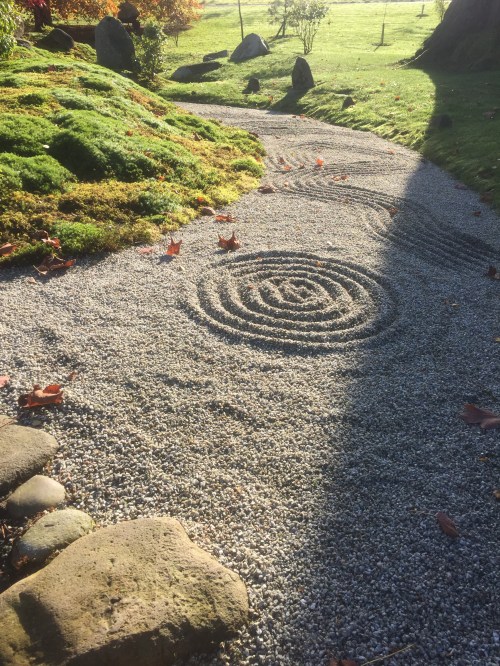
I was thinking about this today when I looked at this photo of mine, taken in a zen garden in Japan. What I like about this image is not just the spiral, which is indeed very attractive, but the wider scene – how there are different flows, paths, bends, loops and spirals across the whole expanse of the stones. Can’t we do this with our minds? Create our own unique inner landscapes of pattern by becoming aware of existing attractors, and actively creating new ones?
I’m pretty keen on biology….as you might imagine for a doctor! I’m interested in how the body works, the way the different cells, organs and tissues all function so beautifully together. I’m interested in discovering the connections within us with all the incredible feedback loops and cascades. I find it all fascinating.
But it was very clear to me from very early on in my work as a family doctor that human beings can’t be reduced to biology. There’s more to us than biology can explain. I often refer to the three flows which pulse through our very beings every moment of every day – the flows of materials, energy and information. Biology is pretty good at shining a light on the first two flows, but its the third one where things start to get so uniquely interesting when thinking about human beings.
One of the aspects of information flow is art. Now, I don’t mean to reduce art to information, or at least, not in the sense that information is “data”. I mean information as signals, not simply data. Information as meanings. So language, music and visual art all connect with us, and our whole being responds. You can blush because someone says something to you. Your heart can race because you hear a certain song. You can catch your breath, or feel a range of emotions, from disgust to delight, when you see a work of visual art.
Our lived environment is not just physical. We imbue it with meaning. We react to particular colours, designs, patterns, sounds, scents and physical touch. A particular taste can set off a cascade of memories….one of the most famous examples being Proust’s “madeleines”.
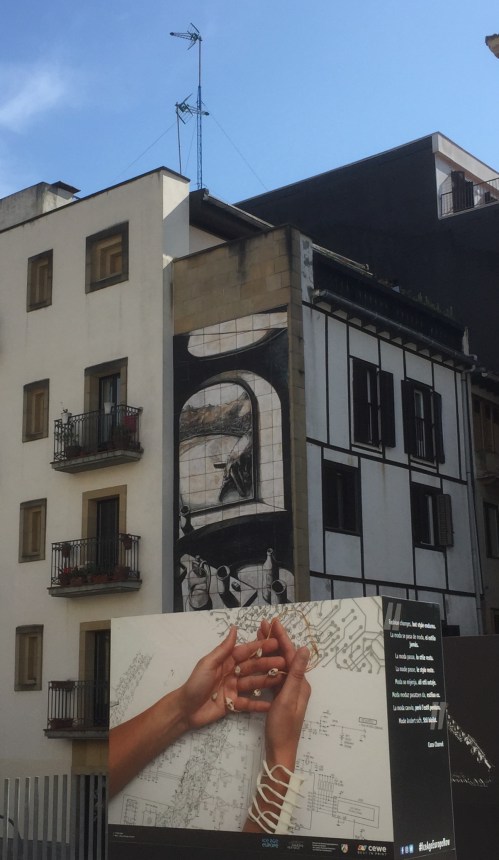
I think both street art, and advertising, affect us deeply. The images trigger certain responses within us…..maybe certain emotions, certain thoughts, or particular memories. But whatever they do, they change us. And because we are not compartmentalised, those changes ripple through our entire being. We don’t keep them in our heads.
I think we’re often quite unaware of the images and art around us. They often exert their influence in sub-conscious ways. But I like to be aware of them. I like to notice them, stop, and reflect.
In this photo I’ve captured both street art and advertising. What do you feel when you see them? What do you think when you see them? What effect do they have on you? (If any….because of course we are all affected differently by different images)
We co-create our lived reality, we humans. We do it collectively and we do it as individuals, creating and publishing, or “showing” our creations. We do that whether we are artists, or writers, or whether we simply talking to each other. We change the lived environment by constantly changing our behaviour, our language and by using our creative powers.
What kind of reality are you going to co-create today?
Maybe one the most important concepts at the base of all my understanding of people, of Life, and of the world, is that everything is connected. Nothing exists in isolation.
If I want to understand a patient, a friend, a relative, or myself, I have to follow as many of the threads which create the rich tapestries of Life as I can. I can never know them all. The daily judgement is deciding that I know enough to act, keep an open mind and awareness, and watch to see how things change after the act. I don’t really know any other way to live.
In scientific terms we humans are “open systems”. That means we don’t have impermeable walls or borders which separate us out from the rest of existence. It is just not possible to know an individual in total isolation. Our whole being is continuously immersed in flows of materials, energies and information which change us as we change them. We are influenced by, and impacted by, the environment in which we live, the food and drink we consume, the behaviours and emotions of other human beings, and the experiences of all non-human life every day. And vice versa……everything we do, what we consume, what we discard and excrete, how we act towards other humans and other forms of life changes the planet we share every day.
I loved hearing the stories patients had to tell me. Every single story was unique. Every story was a story of events, experiences, and change as a result of interactions between the person and their vast interconnected webs of environment and relationships.
I was taught that good medical practice is based on making a good diagnosis. A diagnosis is an understanding. It was my job to listen to the story, examine the patient, and, if necessary order some tests, to discern the patterns within their experience which I had been taught to recognise. In my early years as a doctor those patterns were almost exclusively pathologies, or diseases. Over time I came to understand that diagnosis, or “understanding”, needed to be both deeper and wider than that. It wasn’t enough to name the disease. A doctor had to learn to see and understand the person who was experiencing the disease. That shift from pathology to person involved teasing out the threads, exploring the influences, the impacts and the personal responses.
Each of us have distinct patterns which occur and re-occur throughout our lives. Patterns of thoughts, emotions, behaviours run through our stories. Patterns of memory, experience and fantasy cycle and spiral across whole lifetimes.
They are amazing. They are remarkable. They are astonishing. I can’t see a time will come when I’m done with this. It seems to me that every day there are new patterns to discern, threads to follow, new connections to find and to create.
What a life! What a remarkable, awe-inspiring, wonderful phenomenon is Life.
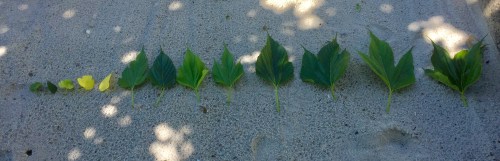
The leaves are starting to turn and to fall. There’s a large mulberry tree in my garden. I’ve never known a mulberry tree before but one of the things which astonishes me about it most is the diversity of its leaves.
Look at this photo. I gathered up a bunch of the leaves which had fallen and laid them out in size order. Isn’t that incredible?
Diversity is a key feature of Nature. Every single living creature is unique….not necessarily in its outward appearance, but in its existence.
The more complex, more evolved a creature is, leading up to the most complex of all creatures…..human beings, the more unique each one is. Why is that? It’s all down to connections.
If you only make measurements, and collect “data”, then you risk missing the uniqueness of whatever it is you are exploring. But if you take into consideration the environments, contexts and situations where your subject of study exists then you quickly realise that no two are the same. Yep, they can be the same weight, the same height, can be categorised and classified according to a limited set of “characteristics”, but their existence extends beyond their measurements.
Everything which exists is connected to, and constantly interacting with, the flows of materials, energy and information which course through the planet. I think this is the key to understanding uniqueness – it’s not in a data set, it’s in a complex network of connections.
To uncover uniqueness we need to explore individual existence, pulling together the past, the present and the possible futures, with a, frankly, inexhaustible web of relationships, bonds and connections.
The more we take a “holistic” approach, the more clearly we see the uniqueness of the person. The more we take a “reductionist”, or “abstract” approach, the more the person disappears into a collection of data.
Your uniqueness can’t be reduced to your gender, your race, your nationality, your size, the colour of your eyes or your hair. It lies in your singular existence, your blend of narrative, sensations, experiences, memories, hopes, thoughts and aspirations. It lies in your memories and your imaginings.
I find that the turning points of the year are a good time for some reflection. We’ve just passed through an equinox last week and, here in France, the summer heat has gone, and autumn has most definitely begun. Autumn is one of my favourite seasons (I have three other favourites! Ha! Ha!) and I’m looking forward to the leaves starting to turn golden, yellow, red and orange….gorgeous. But just as New Year is a like a gate to path through, watched over by Janus, the one with two faces, one looking forward and the other looking back, I think all these turning points are like gates.
Well, what a year 2020 has been so far! I know that Life is truly unpredictable but we sure didn’t see this coming, did we? For me, there are other factors in play which have turned 2020 into a bit of a waiting game. I find I’m constantly waiting for something….when is the virus going to go away? When are the restrictions going to be lifted? When can I travel again? Will there be a vaccine? Will there be new effective treatments for people who catch the virus? When are the Brexit trade negotiations going to be completed? How is that going to affect currency exchanges and therefore my income? When are the new regulations on residency coming in here in France, and when will my application for permanent status be approved? I could go on…….
You’ll have your own list, but do you notice something? Those are all about the future? They are all about what might happen, what is said to be going to happen but hasn’t happened yet…..and so on. So, let’s take a moment to turn the other way and look back. Let’s take a moment to reflect.
I think this pandemic is having impacts which are both personal and collective. It’s provoking many of us to think about how we live our lives. It’s making us think about what’s important. It’s a brake on that human tendency to take things for granted. I’ve read a couple of articles in the French Press recently taking another look at Sartre, and what he said about freedom during the time of the Nazi occupation. There’s something about living more consciously within limits and constraints which changes what we think about freedom, and which heightens the value of conscious presence. So, I’ve found that. That now, more than ever, I’m repeatedly drawn back to the here and now. I’m becoming more aware, making more conscious choices.
Let me give you an example or two. I’m more conscious now of what I eat, wanting to have a diet which encourages health and resilience. So, I’ve discovered new places to buy locally produced foods (which haven’t been shipped from half way across the planet) and I’m actually delighting in shopping trips for fresh fruit and veg, for locally sourced foods like honey, small farm meats and dairy and so on. I have also researched supplements and started boosting my levels of Vitamins C and D, and my levels of Zinc. The top three I identified as being important in immune health. I’m also more conscious, you might even say wary, about going anywhere. I don’t just pop out anywhere unthinkingly any more. I make a more conscious, deliberate choice.
Another positive change for me is a deepening of my connection with the natural world. I’m living in a house on the edge of a village in the heart of cognac-making vineyard country. The house has a garden with a fabulous mulberry tree right in the middle. The tree has grown enormously since we came to live here. I’m convinced we like each other! So, I spend as much time outside as I can. I’ve noticed that the days have been much quieter. Not all days, but there are certainly more days which sound like Sundays. And I’m hearing more bird calls and conversations than ever before. I’ve read about others having similar experiences…..as if humans stepping back a bit has allowed other creatures to step forward. I’m also convinced that spending time in the open air is good for, and time engaged with Nature is even better.
Collectively I think this virus has brought us an enormous opportunity to see things more clearly and to speak up for change. It’s clear that our health services have been inadequate and precarious. We shouldn’t have to be exhorted to “Protect the NHS” – the NHS is there to protect US! It’s clear that huge swathes of society are living precarious lives…..the poor, the long term sick, black and ethnic minorities, and so on. It’s clear that care of the elderly is inadequate and vulnerable. It’s clear that millions of people carry out vitally important jobs but they are undervalued and underpaid. It’s clear that globalisation in favour of capital has made whole countries less resilient, with elaborate distant supply chains breaking down. It’s clear that education is a mess and stuck in some very old ways of working. It’s clear that mass spectacles, mass tourism, mass anything really, just aren’t such a clever idea.
So what? you might ask?
Well, in my work as a doctor, I always thought that everything hinged on making a good diagnosis. If I didn’t see clearly what the patient was experiencing and couldn’t make sense of it, then treatment was going to be partial at best, and useless or harmful at worst. So I think we need to start by making some good diagnoses here….and diagnosis, for me, involves a kind of reflection.
Imagining, creating and spreading the possible solutions comes next. But we’d better start doing that soon!
How about you? What comes up for you as you reflect on your own life and our collective lives in the light of the 2020 pandemic so far?
I welcome constructive criticism and suggestions. I will not, however, tolerate abuse, rudeness or negativity, whether it is directed at me or other people. It has no place here. ANYONE making nasty comments will be banned.



 Heroes Not Zombies