Feeds:
Posts
Comments

Archive for November, 2022

Attention economy

We live in what has been termed “an attention economy”, which strikes me as in no small way paradoxical. I know what they mean. Sensationalism, shock, revulsion, fear and anger seem to be the most prominent tools used by all forms of mass and social media, and as so many business models are based on selling advertising space on the basis of “number of views” and “engagement”, I understand exactly what is meant by an “attention economy”.

Except, it seems to me, inattention is driven with even greater force than attention. It’s the short tweets, short videos, all competing with each other for a moment’s attention that pushes the viewer, the reader, the listener, ever quicker onwards to the next sound bite, the next breathtakingly brief “news” or “information”.

It all feels horribly shallow, frustrating, and, frankly, depressing!

What’s the answer to this? How do we move from bland to satisfying, from sensationalism to knowledge and understanding?

I use two habits. Slow down. And Wonder.

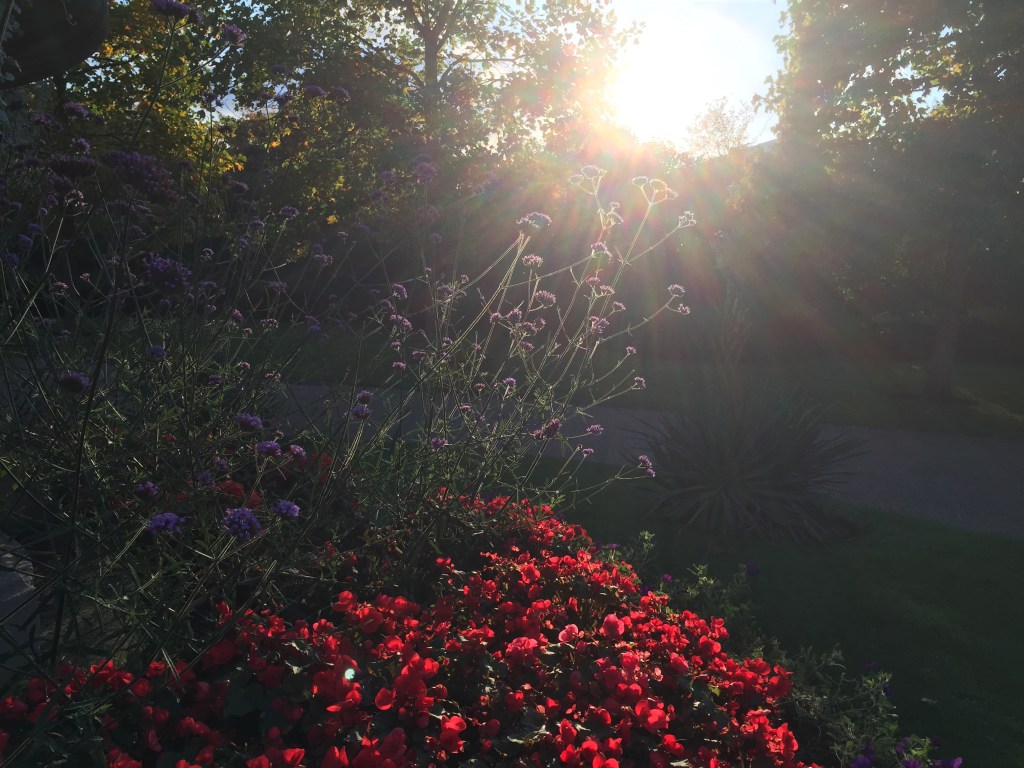
I can’t spend any time in my garden, at the Roman Spring across the road, or in a park or forest, without slowing right down. I’m stopped in my tracks every time. Yes, something “catches my attention”, but in these natural environments, it’s not something shocking or sensational, it’s beauty and fascination.

I see “an ordinary” flower, some berries, the shape of a tree, and I stop. More often than not, I take a photograph, or two or three. But I also take time to wonder….to be amazed, to be enthralled by, to contemplate and consider, the beauty, the intricacy of design, the delicacy, fragility, strength and power of what I see.

Here’s a passage from Wordsworth which resonates with my way of thinking.

Thanks to the human heart by which we live,
Thanks to its tenderness, its joys, and fears,
To me the meanest flower that blows can give
Thoughts that do often lie too deep for tears.

I find that those experiences build upon each other. They flex my muscles of attention differently. And I take these habits into the other areas of my life…..slowing down and wondering….habits which nurture a heart centred approach to this world and all the living beings I encounter.

And there’s another paradox of the attention economy – what strikes me as superficial and/or manipulative comes across as simply uninteresting. I’m not compelled to look below the headline, or to click the bait, because again and again, I find no satisfaction there.

Let me spend my attention on beauty and wonder instead, and I’ll live a more enchanted life.
Read Full Post »

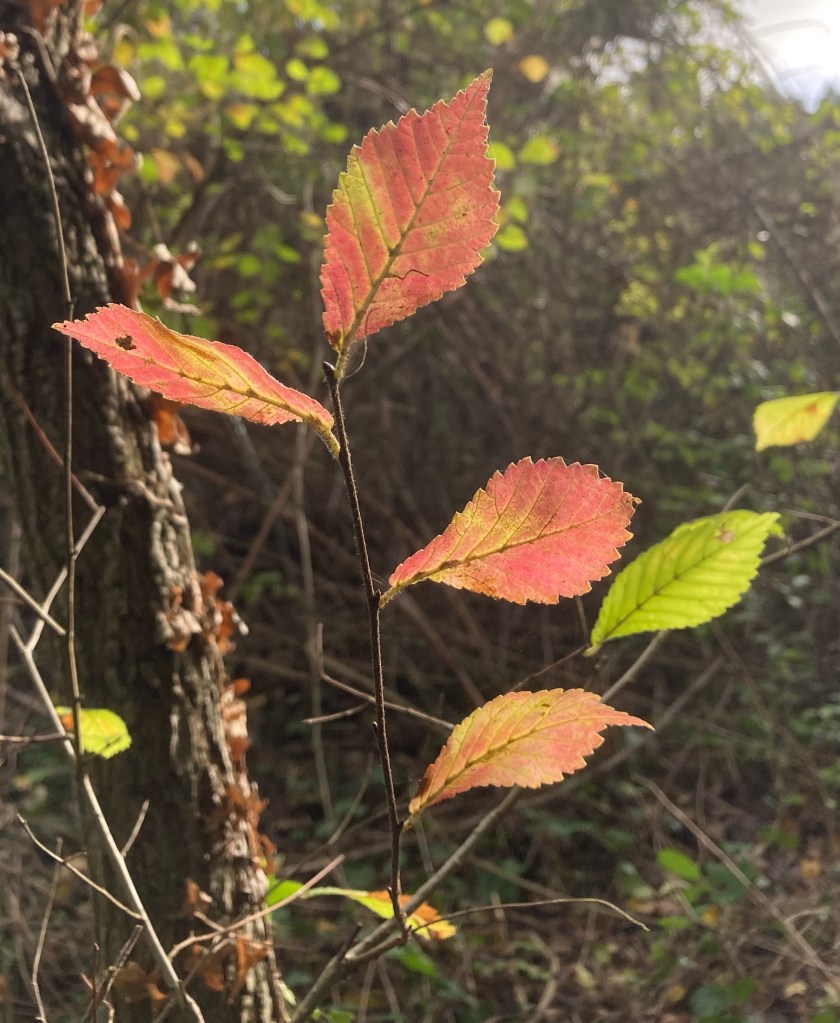
We do not “come into” this world; we come out of it, as leaves from a tree. As the ocean “waves,” the universe “peoples.” Every individual is an expression of the whole realm of nature, a unique action of the total universe.

Alan Watts

We come out of this world as leaves from a tree, or waves from the ocean.

What does the universe do? It “peoples”.

Perhaps you are familiar with “the new story of the universe”, which describes the appearance of the first elements and follows their progress through the creation of stars, galaxies, planets, and onwards to the emergence of Life on Earth.

What this story shows is that over billions of years the universe has become more complex, more diversified and more connected, producing, eventually human beings, the most complex phenomena known.

The universe does indeed “people”, the way a tree produces leaves and oceans wave.

Read Full Post »

Growth

I’m not an economist but I do think we can learn a lot from the natural world, and if economic theories and practices don’t fit with the natural world, they aren’t realistic. This is the one planet we all live on. This planet has one vastly interconnected ecosystem involving the gases in the atmosphere, the sunlight which bathes the world, the water cycle of oceans, rains, rivers and lakes, and the elements embedded in, and below the surface of the soil.

We are part of a living world, a biosphere, of bacteria, viruses, fungi, plants and animals, all processing elements of the Earth, changing the micro-biospheres in which they live, and in turn changing the entire planet.

This week, apparently, the human race grew past 8 billion people for the first time ever. The growth of the human species has been exponential, most obviously over the last one to two hundred years.

The thing about any exponential growth in the natural world is – it stops. It reaches a peak. Have we reached peak human yet? Who knows? But the reality is, one day, we will…..and the likelihood is that we’re entering peak zone right now.

So when we plan ahead to make a healthy vibrant world for our grandchildren and their grandchildren to live in, we should recognise we are in the peak zone, and the growth rate of the next hundred years isn’t going to be the same as the last hundred.

In our current economic system growth of a population is assumed to lead to growth of demand, and growth of demand will drive growth of supply. That’s what we hear all the time from our politicians – growth, growth, growth. Only a growing economy is a healthy one.

But the resources we consume to produce the goods and services to feed the growing demand and supply are limited. Nobody is making more Earth. Nobody is creating more inanimate matter – gold, silver, copper, lithium, cadmium, phosphorus….none of those things you find on a Periodic Table, or in and below the surface of the Earth. And when it comes to animate matter, we are destroying species, forests, marine communities, faster than at any time in history.

Resources, as we call the natural world, are limited, and consumption of them can’t keep on growing and growing. They too are entering, or have entered, the peak zone.

Nothing natural just keeps growing and growing forever. Nature behaves in cycles and seasons, developing through maturity, not simply getting bigger and bigger.

Don’t we need to create an economics which is more natural? One which recognises reality? One which addresses the longer timescales if we want our descendants to not just survive, but thrive?

Fortunately there are economists doing exactly this. If you’d like to explore this subject, I reckon a great place to start is Kate Raworth’s Doughnut Economics. Here’s a great introductory summary on Wikipedia

There’s a pretty large body of work exploring these issues. My first encounter with it would be Schumacher’s Small is Beautiful, and the Club of Rome’s Limits to Growth. Maybe you’ve come across some good authors or economists who are equally sceptical of the current economic model. If you have, please share them in the comments section.

Read Full Post »

We fill our lives with busyness….whether by living the work, eat, sleep, work cycle which has no room for anything else, or by filling our waking hours with tasks, “things to do”, “things that have to be done”.

“What have you been doing?”. “What have you done today?”. “What are you doing tomorrow?”

As Bart Simpson said “I’m a human being, not a human doing”. But we find it difficult just to “be”, don’t we? You’d think we keep busy to escape spending time with ourselves, facing ourselves.

There’s always lots to do, so it’s not hard to spend days so full of activity conducted on autopilot that we are hardly ever really aware of the here and now, hardly ever appreciating the greatest gift, the present.

Sometimes we just need to hit the pause button. Sometimes we need to “take a moment”, to breathe, to wake up, to see what’s around us, to hear the sounds of life, to savour the scents and aromas of the natural world, to feel a breeze, or the sun shining on our skin, or even the rain on our face.

Sometimes we need more than a couple of minutes of this. Sometimes we need a day where we don’t “have to” do anything, so we don’t. Apparently even God took the seventh day off, something which remains a lot easier to appreciate here in rural France than in the consumerist cities.

I often taught patients about the value of scheduling themselves an “artist’s date”, as proposed by Julia Cameron….a piece of time, whether an hour, half a day or a day, where only two rules applied – you have to spend it alone and you can only do whatever you enjoy doing, not something you “have to do”.

Those “bardos” can break up the torrent of business, giving us not only much needed rest, but the opportunity to “wake up and smell the coffee”, or “stop and smell the roses”.

I don’t speak Italian but I remember coming across a phrase – “dolce far niente” – which means “to do sweet nothing”.

Give yourself the gift of sweet nothing. You deserve it. You need it.

Read Full Post »

Surrounded by mystery

What we see of the world is only a sliver of what’s “out there”….Like our senses, every instrument has a range. Because much of Nature remains hidden from us, our view of the world is based only on the fraction of reality that we can measure and analyse. Science, as our narrative describing what we see and what we conjecture exists in the natural world, is thus necessarily limited, telling only part of the story….We strive toward knowledge, always more knowledge, but must understand that we are, and will remain, surrounded by mystery.

Marcelo Gleiser

I love that phrase, “surrounded by mystery”. Do you? Or do you find that frustrating, hoping for more certainty than ever seems achievable?

When there’s too much uncertainty around us, we start to feel lost and anxious, but people who are too certain, too convinced of the correctness and completeness of their own view are pretty scary too!

I’ve always had a preference for someone like Montaigne, who will throw in the occasional “que sais-je!” (What do I know?), and for those who clearly understand that no matter how sure they are about their knowledge and analysis, they remain ready to change and adapt at a moment’s notice, because there will always be more to know.

I always felt that although I could often reach a good understanding of what a patient was experiencing, make a good diagnosis, that there would always be more to hear, more to learn….that always, always, always, I was grasping “just a sliver”.

Politicians, economists, scientists, doctors, teachers….it’s always good to remain aware of the limitations of our knowledge and analyses. There’s nothing worse than those who don’t even know that they don’t know!

So what do I look for instead? Transparency, openness and accountability. That’s a start. Non judgemental listening and compassion are both good additions. All of those values trump the desire to be “right” and “certain”.

Beyond that I’m happy to know we will always be “surrounded by mystery”.

Read Full Post »

The uncountable counts

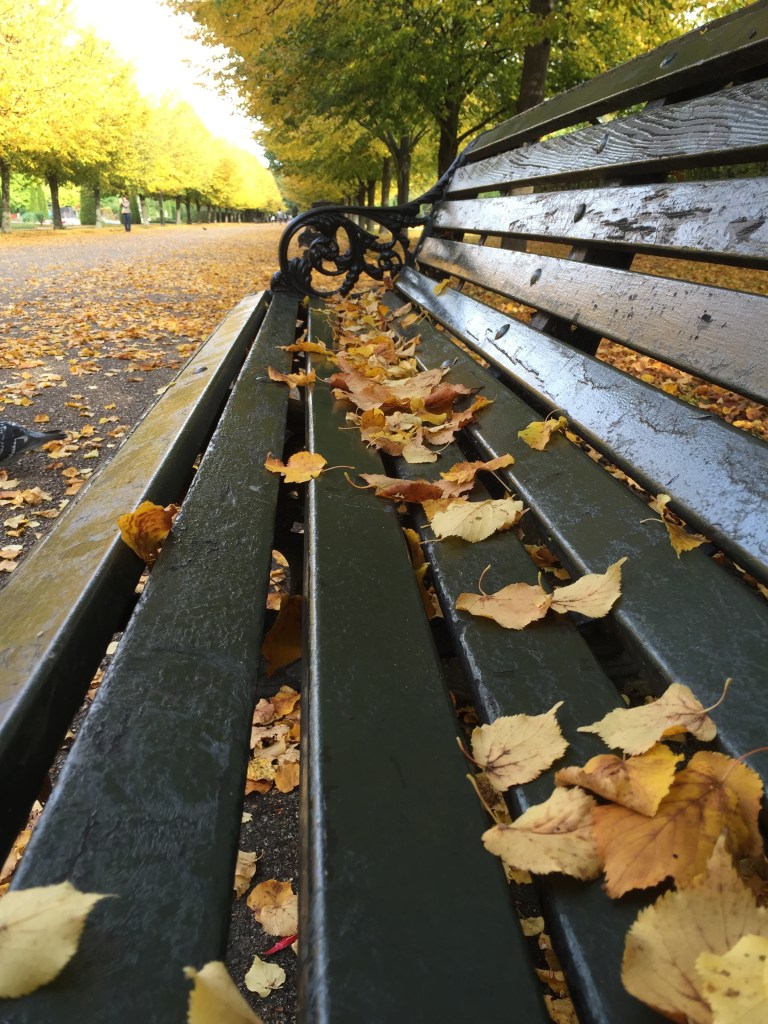
Have you noticed how we use the word “count” in two very different ways? We use it to describe numbers….we can count the number of leaves on a seat, the number of patients on a waiting list. We can count what can be measured. But we also use “count” to describe what matters, what we can rely on… “I can count on you”, or “That doesn’t count”.

These two uses slip into each other and give us the impression that only what can be measured, matters. Here’s Iain McGilchrist….

“Problems began only when science started to categorise whole swathes of experience as inadmissible evidence. What can be measured was alone henceforth real. This is obviously untrue: love, merely to take one example, is both real and immeasurable.”

It just won’t do to dismiss the entirety of individual narrative and subjective experience as “anecdote”, as if actual human life doesn’t matter.

This is a problem I came up against again and again at work. If we take a purely materialistic approach, we focus only on disease, on pathology….what can be measured. But time and again patients present with their highly individual experience of illness, with all kinds of invisible and unmeasurable symptoms, from pain, to fatigue, dizziness, nausea etc.

Iain McGilchrist is right to give the example of love which isn’t measurable, but surely should “count” when we try to understand what’s real.

When it comes to human beings I’m a lot more sceptical of numbers (measurements and statistics) than I am of what they tell me, of their personal descriptions of subjective experience, of their narratives.

Read Full Post »

Swimming together

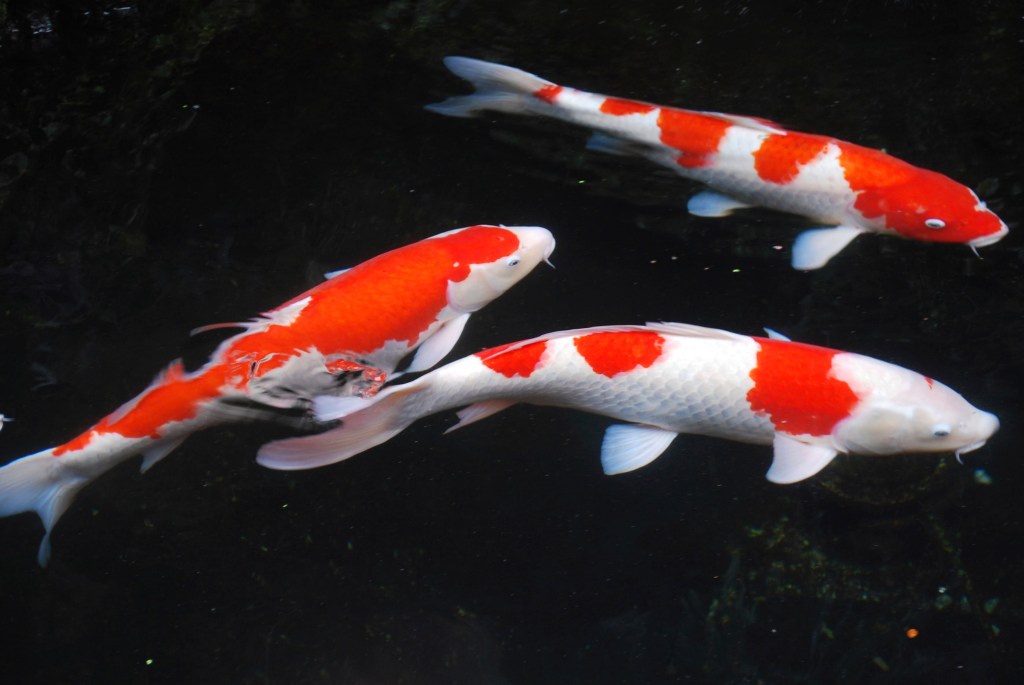
We can’t see it. Most of the time we are completely unaware of it. But just as these fish swim in the same water, we live in the same air. The same air, the same water, the same Earth.

Nation states can’t build borders for their citizens to live behind, separated from and unaffected by, the rest of the world. Borders have always been both invisible, temporary and impermeable.

Even within a single country, a single town or a single neighbourhood, we breathe the same air, drink the same water, eat food grown in the same soil. There is no separate air. There are no unconnected water cycles. There is just one Earth.

There are other, mostly invisible, environments which we share, which fashion our daily lives, and which work below our ordinary awareness – cultural, social, familial relationships which influence our moment to moment feelings, thoughts, choices and actions.

I think we often forget just how massively interconnected we are, just how much we affect, and are affected by, the lives of others.

Read Full Post »

Love

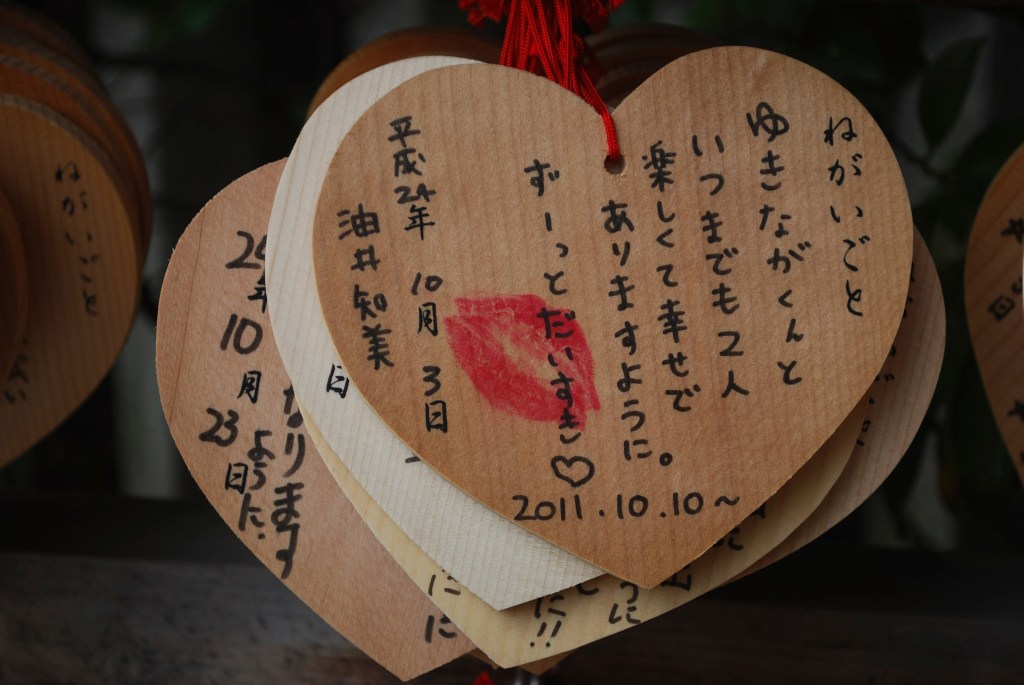
I don’t speak Japanese, and I can’t read it either, so I’m taking a bit of a gamble posting this photo which I took many years ago in the grounds of a temple in Japan.

There were dozens and dozens of these hearts hanging in this particular garden, each one with an inscription and many, like this, with a kiss. Maybe they are romantic messages from lovers, I don’t know, but clearly they are an outward expression of love.

We could do with more love in this world.

More kindness, more gentleness, more compassion and care. Loving relationships work well for everyone. They support and enhance us. They build – they create cooperation and collaboration. They make the world a better place.

We’ve tried a system built on hatred and fear. We’ve tried selfishness, greed and competition. We’ve tried inequality and injustice.

How’s all that going?

Let’s try something different. Love.

What would society look like then? What would health care look like then? Education? Work? Community? Families, neighbourhoods, friends and lovers? If we made the foundation, the touchstone and the core of all we do together, love.

Read Full Post »

Seeing and feeling

This little plant stopped me in my tracks. I’m sure it was the glistening of the sunlight on the millions of water droplets – my goodness, have you ever seen so many on a single leaf?

I think it’s particularly good at catching the water because its leaves feel like velvet…..at least when they are dry!

This is a plant I always want to touch. It’s soft and delightful. I wrote yesterday about gentleness and this is a plant which encourages you to be gentle, I find. It seems to want to be stroked, to have you lightly run your fingers over it.

As I thought about this I was struck by our two uses of the word feeling – one for the physical sensation of touch, and other for that subjective experience of emotional tone, which nobody can see but which creates the foundations for all of our daily experiences.

Funny we should use the same word, but then we do that a lot with language don’t we? For example, I use the word “touch” to describe the action of running my fingers over this leaf, but we also talk about “getting in touch”, or “keeping in touch”, when we mean communicating with each other, even when, or especially when, we are in very different, physical locations.

As Lakoff and Johnson describe in their “Metaphors we Live by”, almost all of our metaphors are embodied, and much of our language uses metaphors – after all it’s hard to speak of subjective experience objectively isn’t it?

Read Full Post »

Doucement….gently

Doucement in English translates to gently, and douce, means gentle. These are two of my favourite French words.

I integrated homeopathy into my medical practice throughout my entire career, first as a GP, then as a Specialist at Glasgow Homeopathic Hospital, which became the NHS Centre for Integrative Care. Homeopathy is often described as a form of “complementary medicine” in English, but in French the term for all such therapies (including acupuncture, herbalism, hypnotherapy etc) is “Medicine Douce” – or “gentle medicine”.

I’ve always liked the French term because somehow it conveys the important point that these techniques are intended to stimulate the body’s natural healing processes, not to attempt to control or exert power over the body.

There’s no doubt that our modern drugs and surgical techniques are incredibly powerful, at best life saving, but they also have the power to kill. But they aren’t so great in chronic illness, and they rarely produce actual cures. It turns out only the body can cure itself, only the complex adaptive processes of a living organism can enable someone to heal, in the broadest sense of the word. I’ve always thought we can benefit from both approaches working seamlessly together – that’s what “integrative medicine” is about.

But I’m not wanting to argue a case for a particular approach or method here. We are all different, and one of the clearest lessons I learned from my career is that one size does NOT fit all.

I’m inspired to write about gentleness here because I read the following lines in Wordsworth’s poem, ‘Nutting”,

Then, dearest maiden, move along these shades
in gentleness of heart, with gentle hand
touch
For there is a spirit in the woods.

Gentleness of heart – with a gentle approach comes kindness and care. With a gentle hand touch suggests a loving, care filled connection from one to another.

How different is this language from the war metaphors used so much in orthodox medicine where diseases are presented as invaders, as enemies to be defeated, as malevolent entities to be cast out?

Don’t we need more care, more understanding, more connection to walk with others, to hold a hand, to soothe a pain or fever with a gentle, loving touch?

It makes me think of indigenous peoples in North and South America, whose whole approach to life is respect, care and an attempt to live in harmony with Nature…..again a very different language from control, exploit, and conquer.

There are times we need a real toughness, need to draw on our power, but my sense is that we paid more attention to gentleness and kindness we might rediscover that “spirit in the woods”, the poet writes about.

Read Full Post »

« Newer Posts - Older Posts »