Feeds:
Posts
Comments

Archive for October, 2024

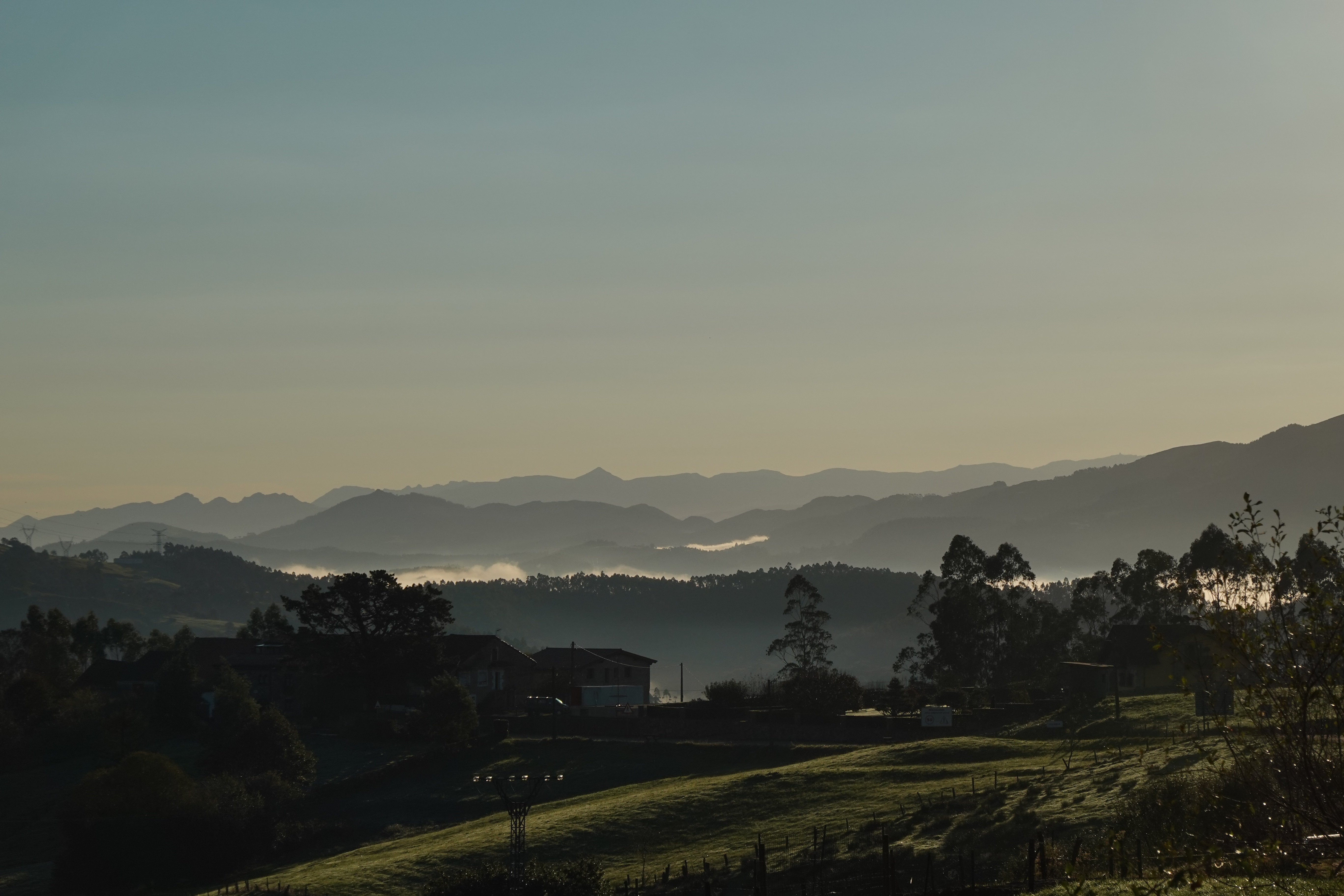
I was driving up the road from Comillas to the sequoia forest early in the morning and as I turned a corner the patches of mist lying in the valleys caught my eye, so I pulled in to a lay-by and took this photo. In fact, I took several photos, and also took a few moments to gaze from side to side and into the distance, just taking in the whole landscape stretching out before me.

As I look at this photo now I see even more than I saw when I stood at the side of the road. Yes, of course, I still see how several valleys are holding the morning mists, giving the impression of white river, and maybe a soft white lake. And as the range after range of mountains recedes into the background I notice, as I have done many times before, how the distance is, so often, a shade of blue….although at this moment, the early morning autumnal light brings a green tinge to it all.

But now I notice the electricity pylons, the ones in the foreground with their insulators catching the sunlight, and the more distant, much larger ones in the top left of the scene. I see a fence, where someone has claimed this little patch of planet Earth for themselves….something we humans have done for centuries, producing borders, privatising the commons, creating a distinct “mine” and “yours” (or, at least, “mine” and “not yours”!). I see a handful of houses, and a van. I see a road sign telling drivers to keep to less than 50 km per hour….a rule somebody has decided to impose, no doubt with the intention of keeping pedestrians safer. There’s a sign with the name “Valoria”, a tiny village of a handful of houses.

I love taking photographs, particularly of anything which catches my attention. I find that when I upload them to my computer and take my time with them, I invariably notice much more than I did when I was actually there. It’s not that the photographs are better than being there (in fact, if I hadn’t been there, I couldn’t have taken the photo anyway), but they enrich and enhance the experiences I had at the time.

I think it’s good to slow down. It’s good to take your time before you press the shutter and take a photo. And it’s good to return to the image you’ve created, time and again, to explore, to savour, to enrich.
Read Full Post »

One of the things which frustrates me most about Medicine is this question – “Is it physical?”, which may be asked in a slightly other form – “Is it organic?”, (or, the apparent opposite – “Is it functional?”), “Is it a problem of the body or the mind?”. This way of thinking which divides illnesses into two categories, separating out the mind from the body, is still way too common. It’s common in patients who refuse to accept their illness could have anything to do with their mind – “it’s a virus”, “it’s a hormone problem”, “it’s my genes” – usually because they have been led to believe that a problem involving the mind is a “mental problem”, which strangely continues to carry a stigma that an infection, or a broken leg don’t carry. Separating out the mind from the body is a common misunderstanding not least because it is promoted by doctors who should really know better by now.

The human being is a living, multicellular organism. Starting from a single, fertilised egg cell, the foetus doubles and doubles and doubles the number of cells, until the fully formed human being is born with trillions of cells on board. Trillions. It’s too big a number to visualise. In fact, the number of cells in a human body are estimated, not accurately counted, partly because cells die and are replaced constantly. None of these cells exist in isolation. They are all in constant communication with, and respond to, other cells within the organism, so that although we each have a heart, two lungs, a stomach, a liver, a brain etc, none of these organs exist by themselves. Every single one of them is “integrated” with all the others – that means each is in an active two-way relationship with other organs, tissues and cells. The cells of your body don’t compete with each other. They collaborate. They work together to make the whole organism healthy, so that it can adapt and to grow.

The mind, as best we understand it so far, is more than a function of the brain. It’s embodied. There are extensive neural and endocrine networks throughout the body which work together to produce what we call the mind. This understanding of mind is sometimes referred to as “embodied mind”. Search for that term online to learn more if you like. It’s a useful concept which allows us to see that the mind is not confined to the skull.

It turns out that terms like “heart felt”, and “gut feeling”, are not mere metaphors, but reflect biochemical activities and phenomena which involve, not only the heart and the digestive system, but the whole organism.

I used to say to patients and medical students, I only ever saw a body without a mind in the mortuary, and I never met a mind without a body.

It makes no sense to me to separate out the mind from the body, because when illness occurs, it might arise in a specific tissue, or organ (or it might not), but the response to the disorder is a whole being response – we use the powers of every system within the body, and our abilities to think and to feel (I mean emotional feeling), to defend and repair.

The big problem with separating off the mind from the body and looking for “physical” or “organic” problems is that if all the lab tests and imaging comes back within normal limits, an illness ends up being classed as “mental” – and treatments for mental disorders are then offered. Or worse, it is dismissed as “not real”.

But there is another way to look at all of this – a holistic way – where we don’t separate out the mind from the body and whatever the disease, we seek to address the person, not simply some of their cells or organs. Yes, maybe there are cellular pathologies which can be, and should be addressed, but healing and repair always involves a whole person.

Wouldn’t it be better if we never limited ourselves to addressing “pathologies” in cells and systems, but, rather, in addition (and not or, remember), we engaged with the whole person through their story, their actions, their thoughts and feelings? Shouldn’t we address the circumstances of their lives, because nobody lives in isolation from environmental influences?

It makes no sense to me to address only a pathology found in a particular tissue or organ. Medicine isn’t a kind of mechanics. It’s an art, and science, of understanding and relating.

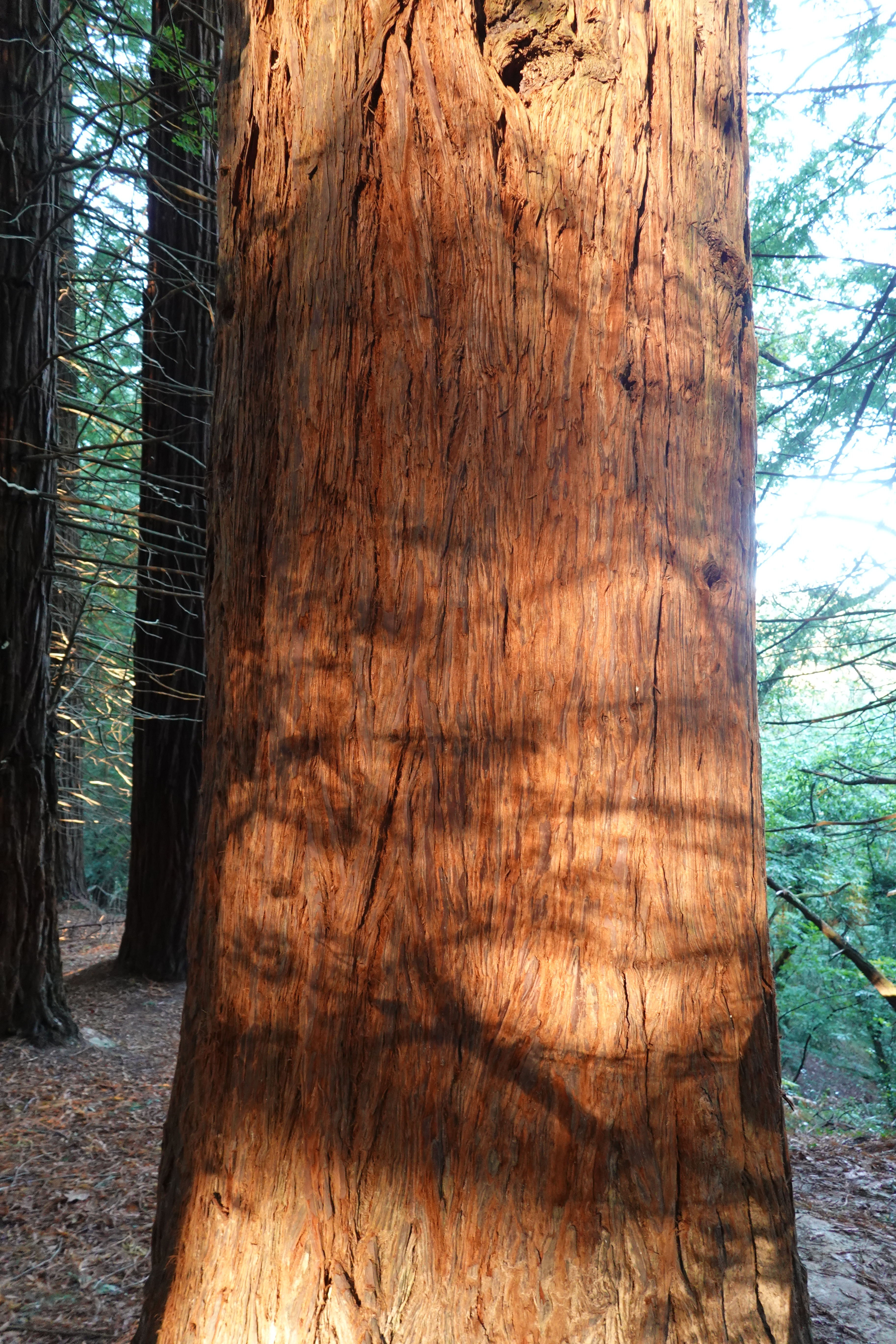
By the way, do you think you can see the suggestion of a heart on the bark of that sequoia in the photo I’ve posted above?

Read Full Post »

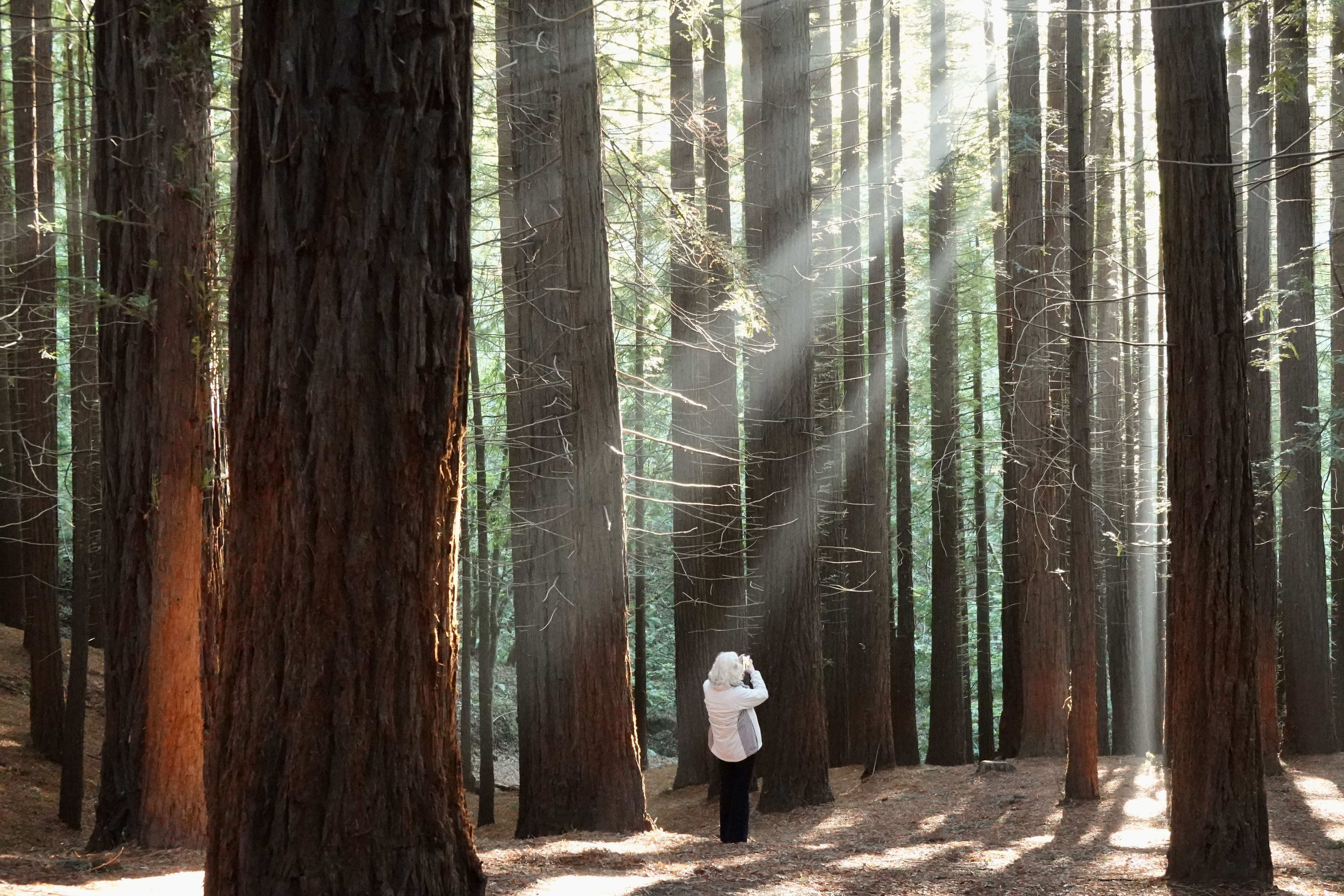
We made a visit to a sequoia forest in Catalonia recently and this is one of the many photographs I took. When I look at it now a passage from C S Lewis comes to mind. It’s many, many years since I read his little essay, “Meditation in a Toolshed”, but I’ve never forgotten it. It’s pretty easy to find online if you search for it. It starts like this –

I was standing today in the dark toolshed. The
sun was shining outside and through the crack at
the top of the door there came a sunbeam. From
where I stood that beam of light, with the specks
of dust floating in it, was the most striking thing in
the place. Everything else was almost pitch-black.
I was seeing the beam, not seeing things by it.
Then I moved, so that the beam fell on my
eyes. Instantly the whole previous picture
vanished. I saw no toolshed, and (above all) no
beam. Instead I saw, framed in the irregular cranny
at the top of the door, green leaves moving on the
branches of a tree outside and beyond that, 90 odd
million miles away, the sun. Looking along the
beam, and looking at the beam are very different
experiences.

He goes on to describe several examples of the difference between “looking at” and “looking along”, where he juxtaposes the “objective” vs the “subjective” (although he doesn’t use those terms), the “quantitative” vs the “qualitative”….and issue which has been at the heart of my career and my life. He summarises his idea with this –

We must, on pain of idiocy, deny from
the very outset the idea that looking at is, by its
own nature, intrinsically truer or better than
looking along. One must look both along and at
everything. In particular cases we shall find reason
for regarding the one or the other vision as inferior.

Most of the essay is about how we seem to have developed a habit of favouring the objective over the subjective to the point where the latter is dismissed as irrelevant, or even, unreal. I’ve heard a junior doctor say that his mentor told him “You can never believe patients. They lie all the time. You can only believe the results (the laboratory findings)”, and time and again, in neuroscience, our inner thoughts, sensations and feelings are reduced to biochemical reactions and neural pathways….as if the MRI scans and biochemistry reveals “the truth”, whereas the patient’s reported experience is dismissed as “anecdote”, or, worse, “illusion”.

As I look at this photo I see my wife, Hilary, standing in a sunbeam in the middle of the forest. I am “looking at” her in the forest. She is “looking along” the sunbeam and photographing the illuminated trees. And I know in that moment that these are two different representations of reality. Both are true. But there’s more – because as I am “looking at” this scene in the forest, I recall, and re-create, the experience I had of standing in the forest surrounded by the massive trees. I feel again the awe which I felt as the sunbeams shone through to the forest floor. I feel again the wonder I had standing amidst this community of trees (which, by the way, were planted only about seven years before I was born!)

We can understand a lot by measuring, by being objective. But we fail to grasp reality if we dismiss both the inner experience of others, and our own subjective one.

That means we need to value personal stories. We need to be curious about them, to respect them and to listen with non-judgemental empathy. Otherwise, we are only scratching a surface. Worse than that, we are in danger of replacing an understanding of what it is to be human, with a distorted and demeaned mechanistic one.

Read Full Post »

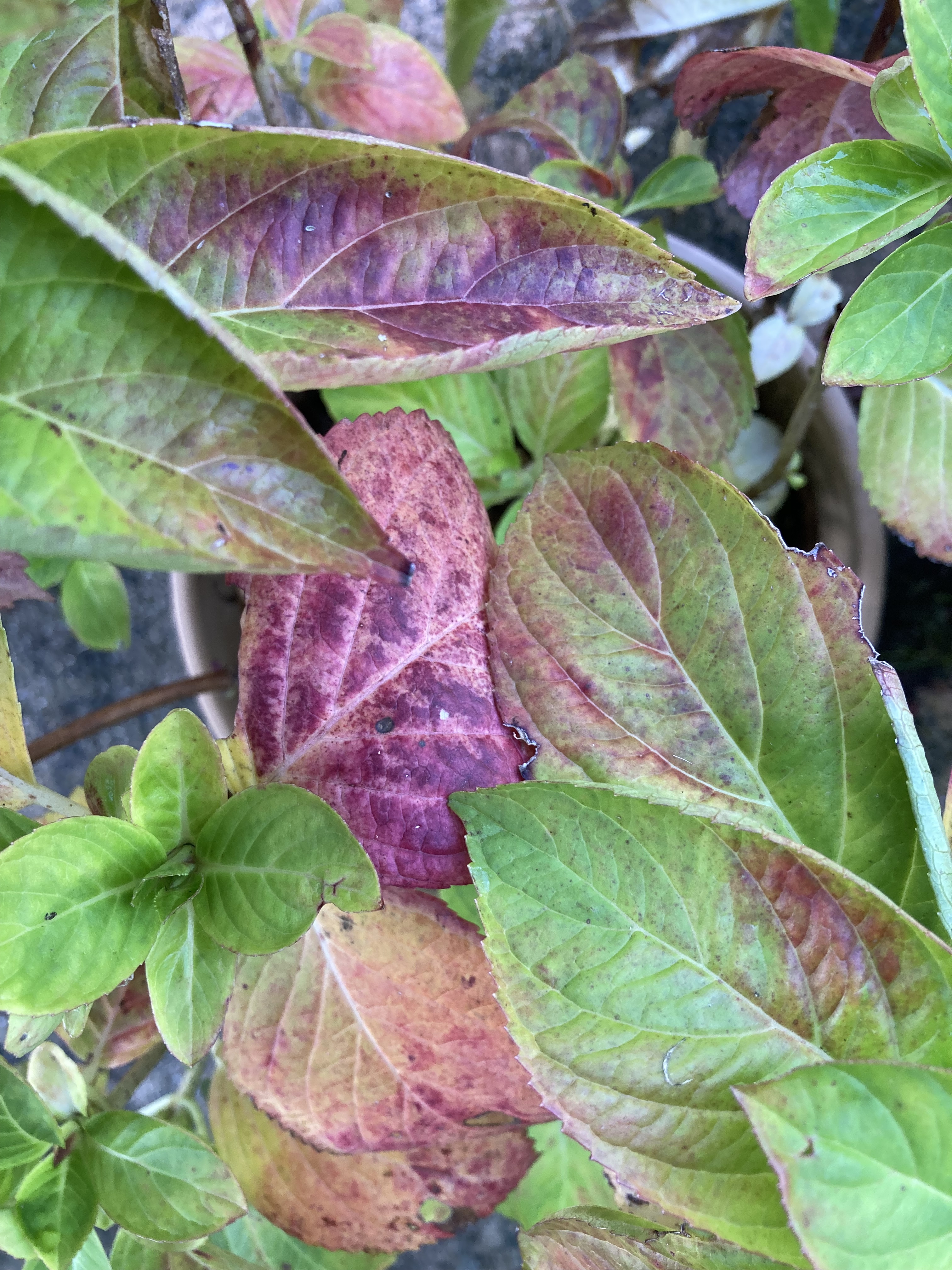
Spring and autumn are the two seasons where I notice change happening right before my eyes. Right now, in October, here in France, we are beginning to see leaves change colour. I love to gaze for a few moments at a plant like this, where some of the leaves are still bright green, some have patches of red or brown appearing, and some have gone fully deep red or even purple.

This reminds me of two things – the first is that change never stops. Everything in the world is constantly undergoing change. We are not the same today as we were a few weeks ago, and we are very different from what we were a few years ago (just browse through your photo albums to see how you’ve changed since you were a baby). The reality is that we change moment by moment. That’s why the advice to “be present”, or to “be here now”, is so relevant. Every single moment is unique, and if we breeze past it without noticing, it will be gone forever (except, of course, in the background of our subconscious the changes never cease to play their part).

The second is that change is so variable. It is heterogenous, not homogenous. You and I are unique. Our daily lives are unique. Our moment to moment experiences are unique and become even more unique over time, as nobody shares with us an exact personal history, an identical string of experiences. Just looking at this one plant and seeing the huge variation in colour as the leaves begin to change makes me even more aware of this uniqueness, of diversity.

So awareness of change slows me down, inspiring me to savour this moment, to live today as fully as I can. It inspires me to pay attention to the flow of Nature, to be aware of the fact that there are no fixed objects in this world, only different rates of change.

And awareness of change does something else for me – heightens my appreciation of uniqueness, of difference, and of diversity. Reducing life to abstractions, selecting single characteristics and bundling everyone who shares them into a single category is such a deluded way of living. We need to stop putting people into little boxes, labelling them and judging them, because when we do that, we just stop seeing them as they really are.

Read Full Post »