Here in Europe the school year is starting and for most children they haven’t been to school since about March or April because of this pandemic. Although we know now that children under the age of 14 seem to be almost unaffected by COVID-19 there is a lot of anxiety about children spreading the virus through the community, and, perhaps more specifically, to the adults who work in the schools. So each country has been making cautious preparations for the re-opening of its schools, looking at everything from cleaning regimes, the use of hand gels and masks, and the way children spend their time in the school buildings.
Out of all this, at least in the UK, has emerged a concept of “bubbles”. The idea is to have children spend most of their school day with a small group of other children and teachers…..often much smaller than a regular class size. The same concept of “bubbles” has also been used for the wider community in the UK, with lockdown rules easing gradually to allow slightly more people to interact on a daily basis – two households meeting up, then three perhaps; limitations to the number of people who can gather in any one place but allowing particular groups or families to meet up and spend regular time together.
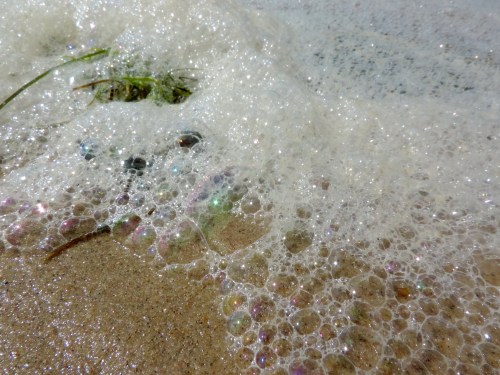
I think it’s an interesting idea. And, as this photo shows, a potentially beautiful one. This photo is of breaking waves on a beach in Western France where the land meets the Atlantic. The bubbles forming in the surf are just gorgeous, aren’t they?
It strikes me that this bubbles idea highlights a major issue for our societies and the way we organise our daily lives. It’s the issue of size. Mass gatherings, mass transport, mass tourism, have been shown to be amongst the most vulnerable points for us…..the circumstances which lead to most infections. The social distancing measures that each country has brought in have been based on the understanding that the more you keep people together in closed spaces the more the disease spreads.
So now we are seeing a huge increase in “home working”, and, it would seem, a large number of people find they actually prefer that to spending time every day packed onto buses or trains with hundreds of strangers, then working all day in the shared spaces of offices. People are learning to live locally, enjoying their local parks, shops, cafes etc now, instead of traveling long distances to share time with masses of strangers in huge workplaces, shopping centres and so on.
I’ve decided to re-read a book which made a huge impact on me when I young – “Small is Beautiful” by E F Schumacher. It’ll be interesting to revisit it in the light of what we’ve learned since it was written in 1974, and in the light of our experience of this pandemic. What I remember of the book is the key point that big is not best…..that we should try to create societies at human scales instead of around mass production and mass consumption.
Maybe the “new normal” will involve a lot less “mass” anything – maybe we will move towards a more human scale everywhere, overturning the industrialised principles of the last century to abandon so called “efficiencies of scale” (which have probably only ever been useful in the manufacture and delivery of products). Maybe we will start to create smaller schools, smaller classes, smaller hospitals, smaller communities. Maybe we will move towards more diversity and less uniformity.
We are more able to do that now. We now understand that complex systems are like vast interconnected networks of nodes and links. We know that the most robust and most resilient systems are diverse and adaptable. We know that distributed power and responsibility produces more sustainable systems and organisations than hierarchical, command and control, massively scaled ones.
Integration is the creation of mutually beneficial bonds between well differentiated parts. It’s how the body works. Not with a command centre, but with interconnected, responsive, open networks. It’s how Nature works, through inter-dependent, diverse elements within ecosystems.
Is this our model for a “new normal”?
Human scale. Small. Diverse, open and healthily inter-connected? Can we see a future way to live in this beautiful image of bubbles?
Yesterday I shared a post about two forms of growth….unfurling (unfolding, opening, flourishing or blossoming) and connecting (reaching out to make bonds, relationships and links).
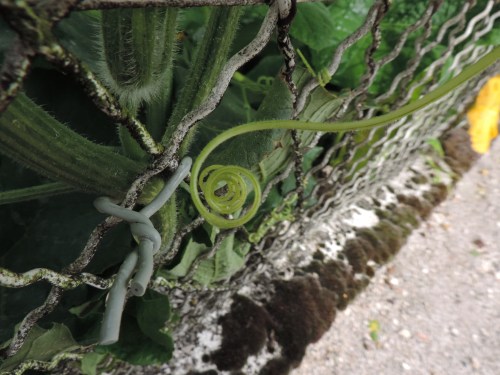
Today I came across a couple of photos from my garden which show both of these processes occurring at the same time. In this first photo you can see how the tendril or creeper which is reaching out is doing so in a kind of spiralling or un-spiralling way. It doesn’t consider that a straight line is the shortest distance between any two points! Perhaps there is something to learn from this – a sort of melange of meandering and spiralling around.
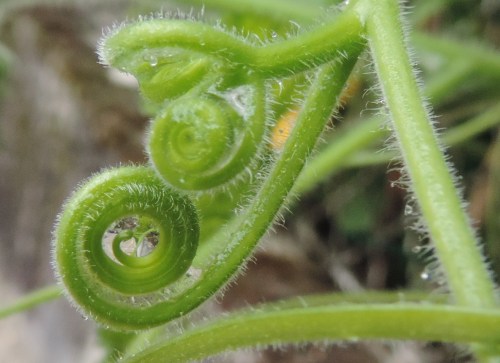
But what really struck me was this photo because I took a close up of these beautiful spirals and because I was focussing on the near distance the background has gone nicely blurred (something photographers call Bokeh I believe!) – but, wait! Look more closely! Look at the centre of the spiral which is in the bottom left corner of this image!
Through that spiral the distance suddenly becomes clear as crystal.
I don’t know what you think, but that reminded me of my favourite “And not or” theme – when you take BOTH of these processes of growth together suddenly you can see the world more clearly!
If you’re interested to read more about “And not or” check out my book.
Here’s where I’m for “efficiency” – in machines and in situations where you can accurately predict the outcomes.
Here’s where I’m against “efficiency” – in human situations. Human beings, all other living creatures, Nature and the environment are all complex, open systems. You cannot predict the outcomes with accuracy and certainty from any starting point. For three reasons – change is constant (nothing stays the same), everything is connected so subject to unpredicted influences, and the phenomenon of “emergence” where a complex system develops new characteristics and behaviours which couldn’t have been predicted from its prior state.
Everywhere you look in Nature you find something called “redundancy” – natural systems have more checks and balances, more options in play, than logic would lead you to believe was either necessary or “efficient”. This is the key to their robustness.
As Professor Margaret Heffernan, author of “Uncharted”, points out, aircraft are built with more control systems than they “need”. They have more engines than they “need”. It’s these backups, alternatives and “redundancies” which make a plane robust. She clarifies the difference between “resilience” which is the ability to recover, and “robustness” which is the ability to avoid failure in the first place.
Austerity economics plus managerial philosophies of “efficiency” plus neoliberal politics created the perfect conditions for the pandemic to be a disaster. In many, many countries the health care services had been cut to the bone. They weren’t robust. In many countries social care services had been cut to the bone. They weren’t robust either. In many countries industry, employment conditions, education…..you name it, had all been pared back, trimmed down, downsized, made “more efficient” by under-resourcing them, failing to replace staff who left, and, in fact, doing the exact opposite of developing and strengthening any of them.
How do we cope better with the next pandemic?
Well a good place to start would be to set our sights on “robustness” instead of “efficiency”. After all, in human beings and in all of Nature, the future cannot be predicted, the exact outcomes cannot be known. We are not machines.
Ok, you’re asking, what’s all that got to do with a table of pumpkins at a market? Well, that photo is from a fabulous Saturday morning farmers market in Capetown, and I love this display of diversity and abundance. I love how DIFFERENT they all are! No standardisation by size, shape of colour. Nature is like that. Diversity, abundance and redundancy are key features of healthy natural systems.
In several parts of France, usually along a river bank, you might find “bouquinistes”….second hand, and antiquarian booksellers, each with a wooden box, or a number of wooden boxes, which contain their books for sale. They close these up and lock them when they aren’t there, and open them up for browsing and sales while, usually, they sit nearby on a camp chair, or in small clusters with other bouquinistes, until somebody appears to want to buy something.
The most famous are in Paris, and the Seine has even been described as “the only river in the world which runs between two bookshelves”. The Parisian ones are the first ones I saw but these photos of mine are from another town, in the West of France. The term applies a lot more widely than just to the ones with the boxes along the river banks, however. You’ll often see a “bouquiniste” advertised and usually it’s a second hand, and/or antiquarian bookseller’s shop in a town centre.
I think their highly visible presence says something about French culture though. Books remain hugely popular in France. So are magazines and graphic novels. In fact, pretty much every town has a “Maison de la Presse” or something similar with a huge range of weekly and monthly magazines covering an incredible range of subjects, from hobbies, politics, design and art, to science, philosophy, history and geography. I just love those shops. There is something special for me about the way French magazines are produced. The graphic art, use of photography, diagrams and images are just superb. And there are plenty to choose from if you want to learn about something. I delight in the fact that so many aren’t “dumbed down” but assume readers with some intelligence and education.
I know there’s an ongoing debate about the subject of e-books. Some people love them, others hate them. I’m in neither camp but I certainly have my issues with e-books – number one being that they tend to be tied to specific “platforms” and you can neither give them away nor sell them second hand once you’ve read them. I don’t like that the only model for most e-books is rental, not ownership. However, I do read a fair number of non-fiction books as e-books. I love being able to highlight passages with my finger then use the references later when I am writing. In fact, that’s probably my favourite feature. I very rarely read fiction as an e-book, but I’m not really sure why!
Well, you know me, my favourite phrase is “and not or”. That’s exactly my position with books. I have LOADS of hardback and paperback books. I buy new, and I buy second hand. But I have also read a lot of “Kindle” books, and enjoy listening to audiobooks using “Audible” (especially when cutting the grass, or travelling in my car).
I retired from the NHS in Scotland where I’d lived and worked my whole life up until I was 60, then I sold up and emigrated to here, Nouvelle Aquitaine, in South West France. One of the many reasons I had for moving here was language and reading. I wanted to live part of my life in another language, and French was the one I was at least a bit familiar with. But I was also attracted to the French cultural tradition of books and learning. In fact, I often find I learn something in a French article which refers to a writer, thinker, scientist or whoever who is English speaking, Italian, Spanish, German or African (to name a few!). I then go exploring, perhaps reading further works by that author in their native English, or translated into English. However, I frequently seem to be able to find French translations of non-English speaking authors who have never been translated into English.
Books, magazines, and newspapers, in a second language have opened doors for me, widened and deepened my knowledge and understanding in ways I don’t think would have happened if I’d spent my whole life in a single-language culture.
How about you?
Do you read and/or speak more than one language? What’s been your experience of that? Have you found that it opens up whole vistas of knowledge and thought? Have you found that it’s brought you experiences you think would have been impossible if you’d remained with only your Mother Tongue?
At the beginning of the year I received an invite to speak at a conference in Canada. The invitation was to talk about my experience of four decades of work as a doctor who used homeopathy. I was surprised, but it was a very kind invitation and I accepted.
The way I prepare for talks is to let some ideas and questions rattle around my brain for a bit, then start making notes. The kinds of notes I make are sort of mind maps. They aren’t as formal as those you’d find in books about the mind mapping. I just put down key words and phrases on a page, then draw circles, squares or diamond shapes around them and link them up. I’ll do a few versions of that, then I open up “Keynote” and I make a slide for each element in the mind map, pull in images from my photo library, write a few words (not many) on some of the slides, then arrange them to create a sequence which enables me to tell the story I want to tell. Well, I ended up with a set of three presentations, each of which would take about an hour to tell. I’d been told I’d be allocated two 90 minute slots in the schedule.
Then before the time arrived for the conference, along came COVID-19 and the event was cancelled. Maybe it will happen some other time, but maybe not. I’d enjoyed putting the presentations together so that gave me an idea. Why not write a book covering the same ground? I’d had an idea for a long time that I should tell my own story. I didn’t want to write a textbook, or a polemic, an argument for a way to live, a way to practice Medicine, or even make the case for the use of Homeopathy. I just wanted to make a record of my own life, my own experience.
I’m sure if any of us sat down to write our own story we’d immediately come up against the question, “But which story?”, because there are many stories of our lives. I didn’t want to write an autobiography which told the story of my family, my relationships, and my personal development. I wanted to tell the story of why I became a doctor, what kind of doctor I became, and how that came about. Not least because I thought it would help me to understand my own life better. I suppose it’s my “professional story”, but really, it’s the story of my “calling”.
I wanted to publish the book too, because I wanted others to be able to read it. Not to earn money from sales, nor to try to convince anyone of anything, but more to add to my over all project of sharing my personal experience of curiosity, wonder and joy – that’s what this blog is all about – and that’s what I committed to do daily from the day of lockdown. I’ve been writing a post based on one of my photos every day since the middle of March and I don’t feel like stopping any time soon. I already know, from feedback from some of you, how much you appreciate these posts and that completely delights me. Writing them adds to my life, so I’m very, very happy if reading them adds to yours!
Now, more than ever, I want to set off some positive, loving, inspiring waves. I’ve no idea where they will go, or what effect they will have, but it feels like a way to make a positive contribution to our times.
With lockdown, with the presentations already mapping out a story, and with the daily practice of writing for the blog, it all came together and I wrote this book – “And not or” – “A calling and a listening”.
This is how I did it, the tools I used, and what I had to learn.
I wrote the text using an A4 sized notebook and a pen. I wrote and wrote and wrote, till I thought I’d written all I wanted to write. Then I used that handwritten text to write the digital version using a program called “Ulysses“. Listen, before I go any further, I’m just laying out what I did, not saying you should do exactly what I did if you want to write your own book! But, on the other hand, I’ve always found it helpful to read what other writers have done. So, you could use any software you want. I started with Ulysses. I use this program on my desktop Mac, as well as on my iPad (for which I have a proper Bluetooth connected keyboard).
When I wrote the first digital version, I didn’t just copy out all the words I’d written in my notebook. Instead, I’d read a section, then start to transcribe the words into the wordprocessor, but I found I often decided to write it differently, to leave out whole sentences or passages, and to write brand new ones instead. By the time I’d done that I had what I called “draft 2” (the written text constituting “draft 1”). The way Ulysses works is that you write “sheets” – for me, each “sheet” was a chapter. I like the simple markdown language you can use with Ulysses. If you put a # sign at the start of a line it turns that line into a heading. If you put two ## signs it turns that line into a secondary heading. I only used those two levels of headings. The first level heading were the chapter titles, the second level to navigate sections within a chapter. The other main markdown tools I used were for inserting images (hey, you know how much I love my photos!), for marking a paragraph as a quotation, and for creating lists. That’s pretty much it. Ulysses presents you with a left hand column of your sheets, each one showing just the first line or two. I used that to get an overview of the whole book. That let me see what I thought was repetitive, and what I thought was missing.
Next step was “draft 3” – read through the whole digital text, correcting and editing as I went. Once I got to the end of that, I felt, well….dissatisfied! Something wasn’t right, and I couldn’t see what it was. So I put the whole project away for a week. Then when I came back to it I saw there were half a dozen chapters which seemed problematic. They were in two groups of three, and each group had overlap and repetition in it. I still couldn’t see the way ahead though. So, here’s the next neat thing about Ulysses, you can select whichever sheets you want to review and print them off. I printed off the six in question. Then I read through the printouts with pencil in hand, scoring out, adding in, and linking up different paragraphs. Once I’d done that I went back into the program and changed the text according to that latest “edit”. I also chopped out three other chapters that just didn’t seem to fit well at all. What do they call that? “killing your darlings” – dropping some of the sentences you love the most – because they just don’t fit. I guess I now I had gone through “draft 4”, to “draft 5”.
Time for another complete read through, correcting and editing as I went – “draft 6”. OK, this felt good now. Time to try and turn it into a published book. I decided I wanted a physical, paper version, and a digital version (and not or….get it?).
For the paper version I decided to use Blurb. This is a company I’ve used about once a year to make a photo album of my best, or most memorable photos of that year. I love their quality of print. And I’d already taught myself the basics of their software – “Bookwright“. Now, I’m sure with all the software I use that I’m no expert and there are probably easier ways to do things, but, hey, I only know what I know, so I don’t know any easy way to import all the text into “Bookwright”. Instead I created the pages, inserted either text or photo “layout boxes” onto each page, copied and pasted the text, chapter by chapter into Bookwright, imported all the photos I’d used, and dropped them into the right places, then ran the “preview” option, and the error checking, both of which identified things that needed fixed. Then I uploaded it to the Blurb site and ordered up my proof copy.
Meantime I had to think how to produce a digital version. Apple have something called “iBooks Author” which I’d used before, (I’ve since learned Apple are about to discontinue that software) and there were ebook creation tools I knew existed to produce “Kindle” or “ePub” versions.
Whoa! Too much to think about it! I then discovered that Amazon had produced new software called “Kindle Create“. I downloaded it, discovered you could import a “Word” file into it, make a cover, preview it, then upload it to Amazon. Ulysses makes it easy to export your sheets as a single “.docx” file so I did that, opened it up in “Pages”, then exported the document from there as a “Word” doc into Kindle Create. It was easy, and straightforward, just took time and care.
Now, I’m sure if you use Windows your workflow and the tools you can use will be different, and maybe some of you know a lot more about these programs and methods than I do – and if that’s true, please go ahead and share what you know in the comments here, or share links to your own articles if you’ve written them.
and a Kindle version – https://amzn.to/2UozjIw – if you are in the UK. If you are not in the UK, go to your local Amazon site and search for “Leckridge” – you’ll find it quickly that way (let me know if you don’t!)
Here’s my summary of the book –
Why become a doctor? This is one doctor’s response to that question. It begins with a calling, then continues through listening. Patient after patient, over four decades of Practice, tells their own unique story. Each one is an attempt to find healing. To find healing, the doctor and the patient embark on a relationship which allows them to uncover Nature’s pathways to health. Each pathway is a life of adaptive strategies revealed through the body, the emotions, and in patterns of behaviour, language and thought. Two small words open different doors of understanding. “Or” divides, separates and focuses attention on single parts. “And” connects, integrates and focuses attention on the whole. We need both approaches but if we are to heal, individually, together, and at the level of the planet, we need to shift the balance away from “or” to “and”. Through an exploration of narrative, psychoneuroimmunology, neuroscience, complexity and complementary medicine, this is one doctor’s experience of shifting the balance from “or” to “and”.
If you fancy reading it, go ahead, and if you’d like to give me feedback you can find me most places by searching for “bobleckridge” – I’m here on WordPress, but I’m also easily found on Facebook, Twitter, Flickr, and I use gmail.com (just put “bobleckridge” before the @ sign)
I have a shelf in my bookcase where I collect some of the books which have made the biggest impact on my thinking and understanding. On that shelf sits a first edition of Iain McGilchrist’s “The Master and His Emissary”. If you’ve been reading these posts for a while you’re bound to have come across my references to his description of how our two cerebral hemispheres engage with the world in different ways.
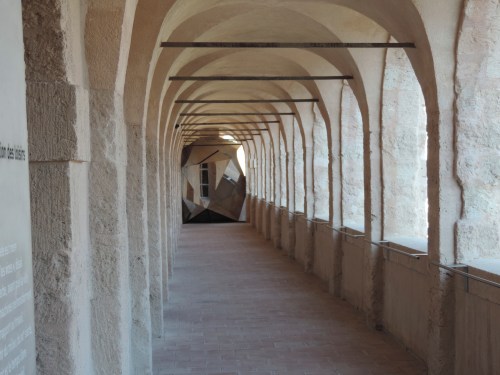
When I came across this old photo from Marseilles the other day I immediately thought of the “left brain” view of the world. The left cerebral hemisphere is utterly brilliant at focusing in on whatever we are considering. It helps us to see the trees in the wood. It picks out elements, features, characteristics or parts. Then it helps us to analyse, label and categorise whatever it is that can be recognised.
It needs to have a narrow focus to be able to do that. It zooms in. It hones our attention. It separates and abstracts by blanking out the connections, the contexts and the environment.
This long corridor of arches looks very much like that kind of focused attention to me.
But there’s more. At the end of this passageway what do we see? It’s kind of hard to make out, isn’t it? What you are looking at here is an installation of irregular, angled mirrors. So you aren’t seeing a complete picture. Rather you are seeing a number of disconnected views or parts.
Our left brain is pretty good at doing that too. Its preference is for the parts, not their connections.
How the brain is supposed to work is that the after the left side does this focusing, separating, labelling and categorising, it’s supposed to pass this information back to the right side to have it contextualised. In other words, after seeing and recognising the pieces, the left passes over to the right to recreate the whole picture, to help us to understand whatever it is we’ve “grasped” by seeing how it connects to everything else.
Iain McGilchrist’s thesis is that this natural flow has become rather disrupted. The left brain has a tendency to hang on to what it grasps, and to convince us that whatever it has analysed is “correct”. Over the centuries we’ve evolved a complex society and civilisation which has encouraged us to prioritise the left brain over the right.
That’s a big mistake. That’s only using half a brain. To rectify this we have to learn how to use the whole brain again, and to practice doing that as often as we can. That’s going to involve deliberately returning again and again to the right brain functions – seeing the connections, discovering the particular, appreciating the whole, and weaving together the multiple threads to enjoy the entire tapestry of the world.
I don’t know about you, but that excites me!
I love that this idea is not about abandoning our left brain functions but re-integrating them into the right brain ones. How satisfying!
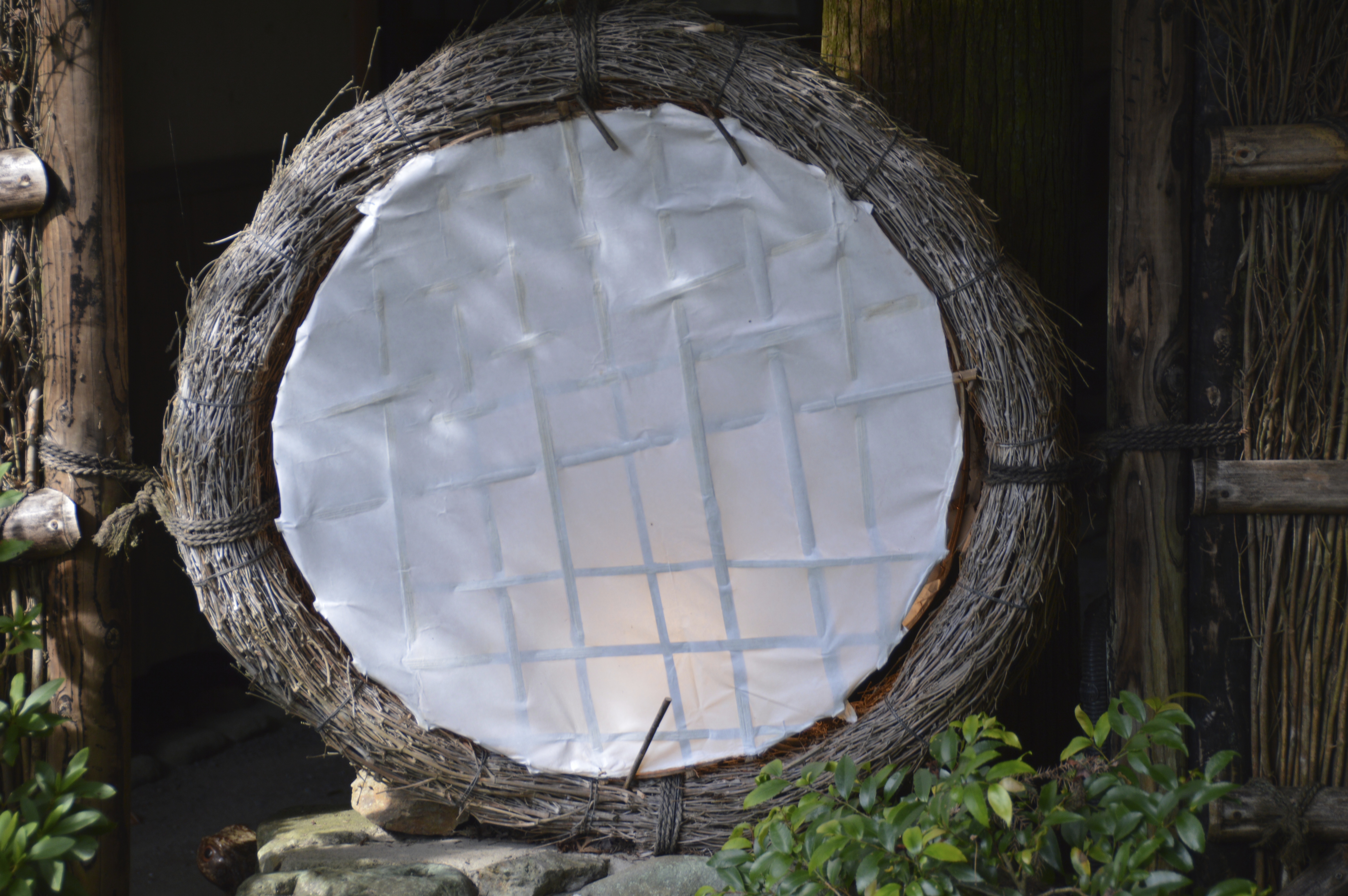
The light filtered through the paper caught my eye.
It’s soft and pleasing. It drew me to it. Then when I looked more carefully I saw the matrix of stalks criss-crossing behind the paper, and that changed my perception of it again. Then I noticed the woven circular frame. From first glance, to detailed inspection, I find this utterly beautiful.
I was thinking about it today as I contemplated it again and I remembered a book I read decades ago – The Lens of Perception, by Hal Bennett. I must say I don’t remember the details of the book all these years on, but the central metaphor did stick with me. The author proposed that we don’t see the world directly. We see it through a series of lenses, or filters, each of which is coloured by certain values and beliefs. It was quite an imaginative way of exploring how culture and social conditioning profoundly influences our perception and experience of the world.
Using a different metaphor, in these days of social media we read about “echo chambers” where we only read the messages and information put out by people who closely share our pre-existing beliefs and our prejudices. As the world divides into separate echo chambers people lose the ability to communicate with each other. Differing views are described as, at best, dissent, and, at worst, as betrayal. This is a powerful way of enforcing conformity. Divide and rule. Hardly a new idea is it?
However, it isn’t easy to see what filters or lenses we are using. Well, it seems easier to see which ones other people are using than our own ones anyway. (And what was that old Bible teaching about taking the plank out of your own eye before trying to remove the splinter from someone else’s?)
It’s not impossible though, and I suspect there are at least two very different ways to do it. One is to take the time to reflect on our pre-occupations. Have you ever done the “Morning pages” exercise promoted by Julia Cameron? Quite simply it is writing continuously without stopping until you’ve filled three A4 pages. It’s a stream of consciousness form of writing. You do it every morning for thirty days. Whenever I have done it I don’t read what I’ve written until the end of the thirty days. Each time it’s been a revelation. I find themes, phrases, and issues recurring over and over again. I find preoccupations I either didn’t know I had, or which I, at very least, didn’t know I held so strongly.
There are other ways to explore your values and beliefs but they all involve a conscious effort to describe them.
The other major way is to “phone a friend” as they say in the famous game show.
Robert Burns, my national poet, said –
“O, wad some Power the giftie gie us
To see oursels as others see us!
It wad frae monie a blunder free us,
An’ foolish notion.”
A wish to be able to see ourselves as others see us.
Well, there’s only one way to do that – other people.
This is where it gets tricky. Because to do this you need a friend or colleague who you trust. You need someone who won’t judge you. There’s no point jumping into somebody else’s echo chamber and challenging everyone there to find out what they think about your views! I suspect you know the answer to that before you even begin.
No, I think you have to start by sharing at a very personal level. But the trouble with that is, those others who you trust are likely to be seeing the world through the same filters and lenses as you do in the first place. I know they say “opposites attract” but I’ve always found that applies more to magnets than it does to people. However, there is no substitute for dialogue when it comes to clarifying what beliefs, values and world views you hold most dear.
Can we promote dialogue? Surely we can.
How do we escape the echo chambers, but criticise and challenge our views safely? I don’t know any way to do that which doesn’t involve non-judgemental engagement. It’s the key that opens the door.
Is there a non-judgement lens or filter?
What would the world look like when viewed it through that one?
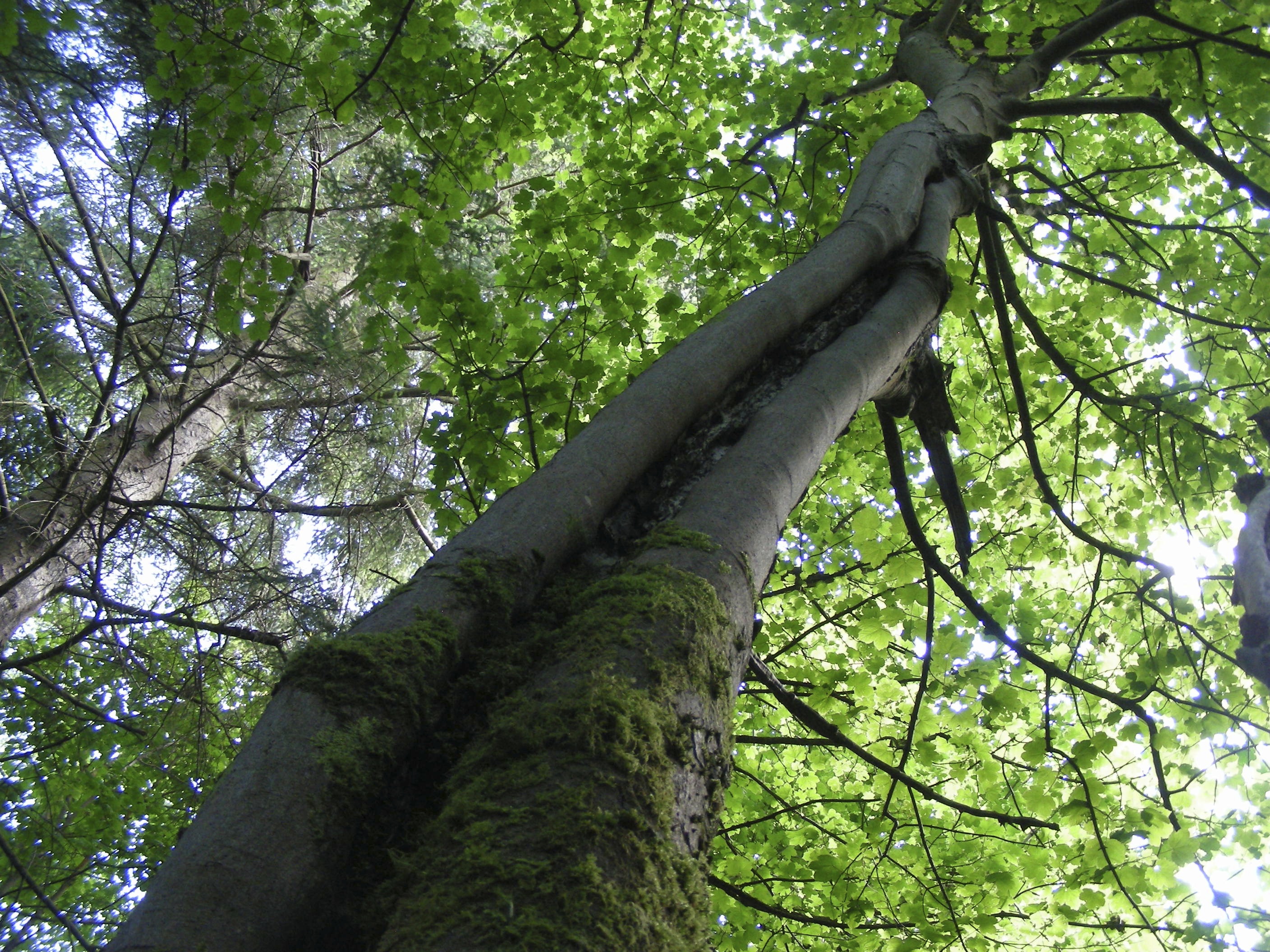
When I noticed this tree in the forest I thought it had a long deep groove running the whole length of its trunk. It was as if it folded in on itself. But then I looked more closely and I saw that a better explanation was that there were two trees growing together. You could trace two distinct trunks all the way up, each spreading its own branches high above the forest floor.
I was even more taken with this when I saw it as two entwined, two organisms, two life forms, living, surviving and growing together. It reminded me of the myths of the soul….that each of us is in search of the other half….each of us longing for our soul mate.
But maybe I’m wrong. Maybe this is one tree which has partially divided itself…..partially, but not completely, so that now it appears as almost two trees instead of one. But does it really matter? Do I care whether these are two trees living intimately together, or one tree manifesting two clearly visible aspects of itself?
The first idea stimulates my thoughts about how important relationships are. It makes me think about how I can’t fully understand anyone, or any thing, in exclusion from its relationships. We are all embedded in vast networks of other people, other creatures, plants, micro-organisms, elements and molecules. We all come into being through a process of emergence within those networks. We all survive and thrive only because of those relationships and networks.
The second idea stimulate my thoughts about our multiple selves. I’ve never been able to understand anyone, including myself, by reducing them to a single, solitary self. Miller Mair’s “Community of Self” really impressed me. It struck me as true. I know a distinct self as a doctor, which is quite different from, yet completely connected to, my self as a parent for example.
A homeopathic doctor in Paris once told me he saw every patient as like a diamond, with different facets glinting in the sunlight. Each facet represented an aspect of that person. That impressed me too.
Then, much later, I read the works of the French philosopher, Gilles Deleuze, and his focus on “a multiplicity of singularities” seemed to me to be saying the same thing, just in a different language.
We are all multiple.
We are all a complex of multiple, distinct, unique “singularities” – both within ourselves, and within our world.
Last Night As I Was Sleeping, is a poem by Antonio Machado (this translation from the original Spanish is by the poet, Robert Bly). I’ve decided to return to an exploration of poetry during this strange time in our world, and have started by reading “Ten poems to change your life”, by Roger Housden. The first poem in the book is The Journey, by Mary Oliver, and the second one is this one by Antonio Machado.
Roger Housden, who says, of Antonio Machado, “He lived a plain and simple existence, much of it as a country schoolteacher. What mattered to him was the deep current that joins the human soul to the world. What mattered above all to him was to be awake to that deeper life.”
I love the images in this poem, starting with the spring of fresh water breaking out in the heart. “The origin of the spring is not in your own heart; its waters are carried there by some secret aqueduct from a source beyond all your knowing”.
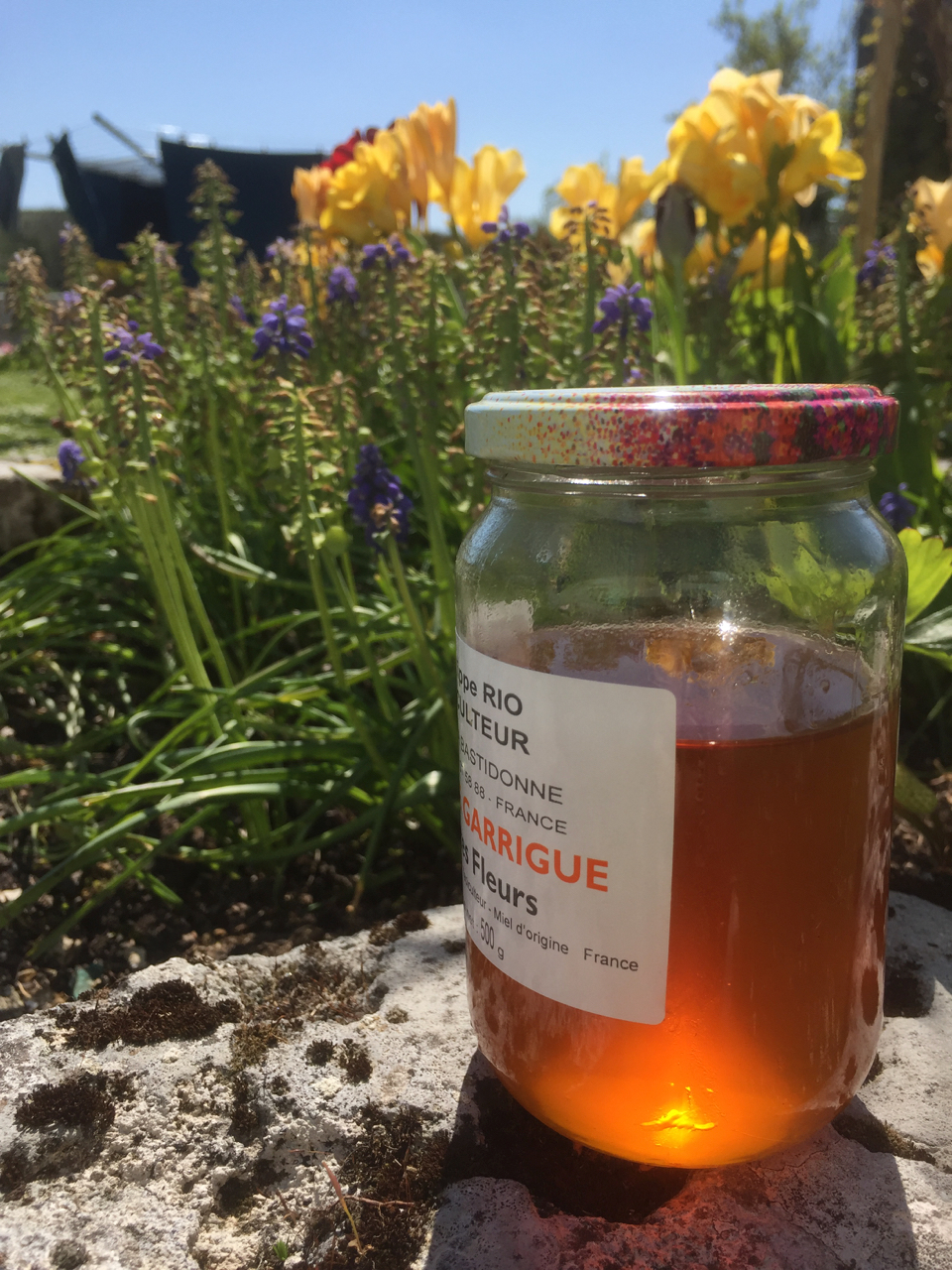
Then in the next verse he talks of making sweet honey from our old failures. What a nice variation on the “when life gives you lemons make lemonade”!
The next image is of the sun shining in his heart. Roger Housden says “Machado becomes the source of his own warmth and light”.
In the final stanza where Machado dreams of God in his heart, Housden says “He dares to leap over metaphor altogether and say directly what he has been inferring all along: you are own source, drink from your own well, live by your own undying light……..the light of the world that streams through your life….”
I found that as I read it various of my own photos came to my mind so I thought I’d collect them together here with the poem. What I really love about this poem is that idea of the flow of Life pouring through the depths of our being and found by looking at what we have in our heart.
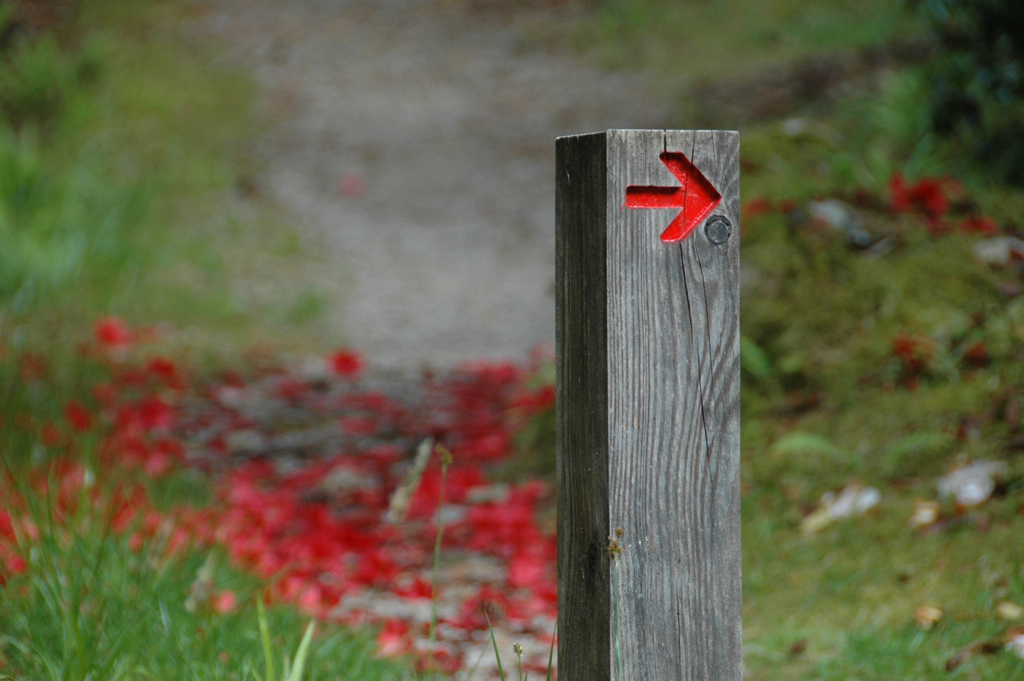
One day I was walking in a forest and I came across this signpost. Clearly, this was the way to go….
I followed the path strewn with blood red petals, but I didn’t know where it would take me.
Mary Oliver, in The Journey, the beginning of which I quoted above, continued her journey…
It was already late
enough, and a wild night,
and the road full of fallen
branches and stones.
I turned a corner, and there before me I saw…..
…red petals cascading down a slope, and rising high up into the canopy of the trees. Maybe this is what I came to see? But I carried on….
as you strode deeper and deeper
into the world,
determined to do
the only thing you could do –
determined to save
the only life that you could save.
Eventually, I found this….
…the heart of the wood.
So, this is how it is, isn’t it?
We don’t need a “goal”, or an “outcome”. We don’t need to “get” or “consume” anything in particular.
What we need to do, is find our heart.
This is as good a time as any to listen, and find out if you can hear what your heart is telling you.
We have access to more than one kind of intelligence. Not just the rational intelligence of the analytic left cerebral hemisphere in the brain, but the emotional intelligence of the heart.
You think that’s fanciful? Or just a nice metaphor?
I don’t think so.
It turns out we have a network of neurones, yes, neurones, the specialist kind of cell you find in a human brain, around the heart. There is a neural network around the heart. Apparently, the nerve connections between the brain and the heart are not just about the brain regulating the heart, they are two way. Our heart informs our brain.
And emotions? Those deep, intense embodied rivers of information and activity which course through the depths of our very being…..are they something supplementary? Are they something inferior in some way to our thoughts?
I don’t think so.
Our emotions are the organising, adaptive strategies which have evolved to enable us to survive and to thrive.
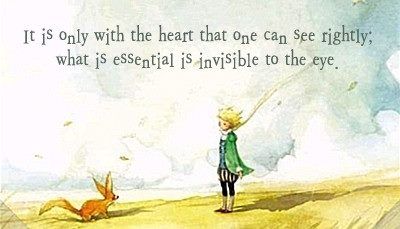
As the fox said to the Little Prince – “what is essential is invisible to the eye”.
I welcome constructive criticism and suggestions. I will not, however, tolerate abuse, rudeness or negativity, whether it is directed at me or other people. It has no place here. ANYONE making nasty comments will be banned.








 Heroes Not Zombies