Feeds:
Posts
Comments

Archive for the ‘creativity’ Category

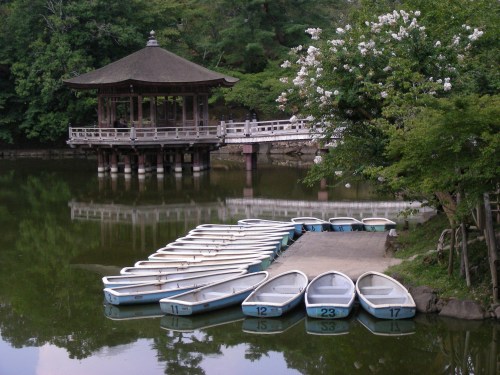
It strikes me that this is a pretty good image for this present moment.

All our boats are tied up at the dock. Empty. Nobody there.

Actually, when you look really carefully there is somebody in the pagoda. It’s hard to see them. I have the impression they might be a ghost!

Moored is the word we would use to describe the situation these boats find themselves in. They’ve been carefully set aside, brought home, tied up to the dock to keep them safe. I guess we’re all a bit moored just now, aren’t we? Although, frankly, an increasing number of people are feeling quite the opposite – un-moored!

But let’s stick with this image for a wee bit longer.

I see nineteen boats arranged around this platform, and, yes, it bugs me that they aren’t aligned by number – what does that say about me? – but, worse than that, one of them is number 23 – and I can only count 19 of them! Are there are at least four missing? Where are they? Are they OK? So, already, what at first glance looks like a completely peaceful scene, with the reflections of trees, clouds and blue sky on the surface of the still, still water, starts to become a little…..unmoored?

Then I see the blossom of the tree above the boats, and instantly, I’m back to enjoying the beauty of the scene. My gaze follows the hidden path to bridge, and across to that gorgeous pagoda, itself perfectly reflected in the calm lake. Then I notice that indistinct person, that ghostly presence, and I start to unravel again.

Now, here’s the thing, until today, every time I’ve looked at this image I’ve seen and experienced nothing but calm, and I’ve delighted in its beauty. This “un-mooring” is new. It doesn’t come from the photo itself. It comes from where I am, here and now.

Well, this is a great truth…..whatever we perceive, whatever we see, notice, appreciate and experience, is always, but always, an interaction between our “self” and what is around us. This is the way I understand the teaching that there is no real world “out there”. This is how I understand relativity. It’s not that there is nothing objective, or that nothing exists unless I see it, hear it, or otherwise sense it. It’s that my lived experience of reality always, but always involves my memories and my imagination.

We co-create our world.

Read Full Post »

Several years ago I visited the town of Nara, in Japan, and as I wandered through this park I came across all these people sitting drawing and painting. As I look at this again today I’m struck by how it would meet the requirements of social distancing that we are all being urged to follow (except, here in France, as in some other countries, parks and forests are currently out of bounds to everyone!).

But what really strikes me about this image is how it captures a fundamental human characteristic – creativity.

We are creative creatures.

We invent. We solve problems. We compose and perform music. We draw. We paint. We carve. We write and we share stories, poems, ideas and observations. We are brilliant at creating and manipulating symbols and signs. We make maps and plans. We build. We weave, sew, and knit. We create pots, cups and mugs from clay. We create jewellery from precious metals and stones. We make gardens, parks and forests, sewing seeds, nurturing seedlings, fashioning the landscape to our pleasing. We transform nutrient laden plants into nutritious food. We heal and develop new ways to heal.

I could go on……[add some of more of you own liking].

Yes, I know, some of you will be thinking, human beings are pretty damn destructive too. Aren’t we spoiling, ravaging and polluting too?

Yes, we are. And if we are to survive as individuals and as a species, we are going to have to tackle that. But what will we tackle it with? Creativity.

Has there every been a better time to foster, practice and share our creativity?

I don’t think so.

In this time of pause, when everyday life has been put on hold, we are going to need all our creativity to get out of this situation and wouldn’t it be wonderful if we used our creative powers to make a better world “after-the-pandemic”, to resist those who will want a return to the old ways which got us into this situation?

How might you change the way you live #after-the-pandemic?

What new habits are you going to create?

What new behaviours are you going to develop?

How do you think you can maximise your creativity today, and in the days and years to come?

What are you going to write, or draw, or paint, or build, or weave or……….?

Are you going to start today?

Read Full Post »

I took a lot of photos from my windows when I lived on the edge of the village of Cambusbarron. Most of them looked out directly towards Ben Ledi. I never, ever ceased to be entranced by that view. It changed every day.

Of course, you’d tell me a mountain doesn’t change. At least, not visibly on a daily basis. But, look, this is typical of my idea of “Ben Ledi”. I never saw Ben Ledi, the mountain without any sky around it. I never saw it without the light illuminating it in different colours. I never saw it without the clouds casting shadows on it. Well, maybe there was the odd day when there were no clouds at all, but only rarely, and, even then, the light and colours changed constantly.

So, for me, whatever I look at, I see it in its contexts, its environment. I see its situation. I see the interplay of all the elements in the frame of my gaze. And then…..

….then I “see” it with my heart. I feel the emotions arise within me, shaded by memories and imaginings, coloured by symbols and significance.

When I look at this particular photo, I am in awe very quickly. I see the black hole darkness of the clouds which loom over the top third of the picture. I see how that darkness frames the sunlit mountain with the dark earth below. It’s almost like looking through a letter box. Looking through a letter box to see what the universe is delivering today.

I see the familiar shape of Ben Ledi, like a sleeping giant, an ancient ancestor of the elephants, perhaps.

I see the intensity of the sun peeking out along the edge of the cloud base, and how it lights from behind the low cloud or mist which sits at the foot of the mountain. Lights that low cloud so that it glows, not with a silver lining, but a golden one.

I see some of that low cloud rise up in the shape of dragon, looking towards the mountain….flying home, perhaps?

I see Ben Ledi, that great mountain, cradled in soft clouds, gently glowing with the sun’s golden light. Wrapping it in ephemeral, constantly shape-shifting cloth.

I see the life bringing energy of the Sun illuminating the Earth.

I see the life giving water of the sky kissing and caressing the Earth.

I feel calm.

I feel comforted.

I feel delighted.

I feel the stirring of my Soul.

Read Full Post »

One day you finally knew

what you had to do, and began


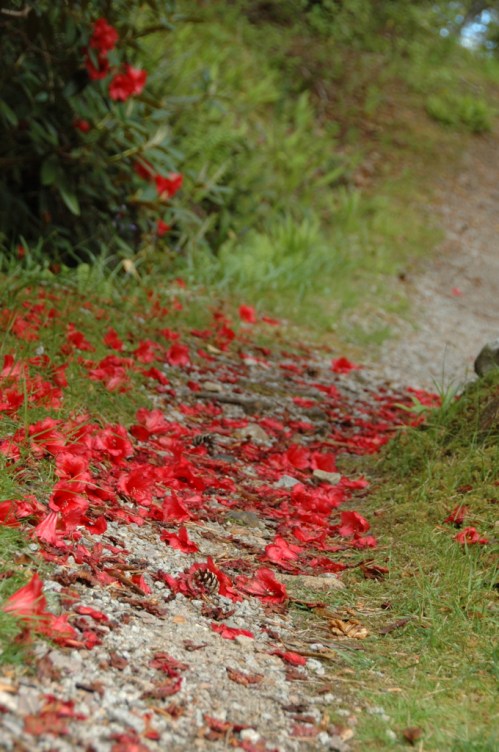
One day I was walking in a forest and I came across this signpost. Clearly, this was the way to go….

I followed the path strewn with blood red petals, but I didn’t know where it would take me.

Mary Oliver, in The Journey, the beginning of which I quoted above, continued her journey…

It was already late

enough, and a wild night,

and the road full of fallen

branches and stones.

I turned a corner, and there before me I saw…..

…red petals cascading down a slope, and rising high up into the canopy of the trees. Maybe this is what I came to see? But I carried on….

as you strode deeper and deeper

into the world,

determined to do

the only thing you could do –

determined to save

the only life that you could save.


Eventually, I found this….

…the heart of the wood.

So, this is how it is, isn’t it?

We don’t need a “goal”, or an “outcome”. We don’t need to “get” or “consume” anything in particular.

What we need to do, is find our heart.

This is as good a time as any to listen, and find out if you can hear what your heart is telling you.

We have access to more than one kind of intelligence. Not just the rational intelligence of the analytic left cerebral hemisphere in the brain, but the emotional intelligence of the heart.

You think that’s fanciful? Or just a nice metaphor?

I don’t think so.

It turns out we have a network of neurones, yes, neurones, the specialist kind of cell you find in a human brain, around the heart. There is a neural network around the heart. Apparently, the nerve connections between the brain and the heart are not just about the brain regulating the heart, they are two way. Our heart informs our brain.

And emotions? Those deep, intense embodied rivers of information and activity which course through the depths of our very being…..are they something supplementary? Are they something inferior in some way to our thoughts?

I don’t think so.

Our emotions are the organising, adaptive strategies which have evolved to enable us to survive and to thrive.

As the fox said to the Little Prince – “what is essential is invisible to the eye”.

Here’s Mary Oliver’s poem, The Journey, in full –

One day you finally knew
what you had to do, and began,
though the voices around you
kept shouting
their bad advice–
though the whole house
began to tremble
and you felt the old tug
at your ankles.
“Mend my life!”
each voice cried.
But you didn’t stop.
You knew what you had to do,
though the wind pried
with its stiff fingers
at the very foundations,
though their melancholy
was terrible.
It was already late
enough, and a wild night,
and the road full of fallen
branches and stones.
But little by little,
as you left their voices behind,
the stars began to burn
through the sheets of clouds,
and there was a new voice
which you slowly
recognized as your own,
that kept you company
as you strode deeper and deeper
into the world,
determined to do
the only thing you could do–
determined to save
the only life you could save.

Read Full Post »

One of the strongest characteristics which human beings have is our ability to make links.

We connect what we see to what we have already seen and to what we imagine we might be able to see.

There’s a lot in that sentence, but I’m not going to unpick it right now….suffice to say we blend the perceptions of the present with memory and imagination.

That is an incredible power.

It helps us to discern patterns which we use to recognise what we are perceiving and to be able to make reasonable assumptions about the future.

For example, as a doctor I learned how to diagnose. Diagnosing involves listening to a person’s description of their experience and to their telling of their story, examining them physically if needed, then conducting certain tests if still not in a position to make a good diagnosis. A diagnosis enabled me to do two things – firstly, to recognise both the likely disease or pathology underlying the patient’s experience, and secondly, to gain an understanding what that meant in this person’s life. Yep, diagnosis is more than naming a disease. It’s about arriving at a level of understanding – an understanding of this illness in this person’s life.

Once I had a diagnosis I could then decide how to act. I could decide what to do and how quickly I had to do it. At that moment I’d be imagining certain futures. If I do this, then what might happen, and if I do that instead, what might happen? How quickly might those possible futures become real? To answer those questions I needed a knowledge of the patterns of disease – how is this disease likely to develop based on what we have all seen so far?


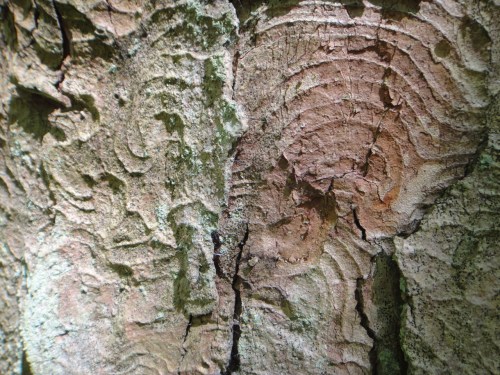
I picked this image today to reflect on our ability to recognise patterns around us, AND to apply those patterns widely. When we look at something, we don’t just “see it as it is”, because everything we see, hear, smell, taste, touch, sets off chains of memory and imagination.

So when I look at this particular tree I see these three enormous swirls. They look like whirlpools and water eddying around hidden rocks. A while ago I learned about complexity science and it really opened up my understanding of the world.

There are certain characteristic features of complex systems and one of them is the existence of “attractors”. “Attractors” are kind of organising points. They are part of what creates the differences within any given system or object. I’ve seen some scientists describe reality as “lumpy” rather than “smooth” and although I don’t really like that language I understand what they mean.

The universe is not uniform.

The phenomena of the universe are not distributed uniformly.

There are three common kinds of attractor –

Point attractors – these organise the surrounds around a single point. These three knots in this wood look a bit like three point attractors.

Loop attractors – this is where there are two centres of attraction acting together as one. They produce what looks like an infinity loop, or a figure or 8. They are a way of seeing polar opposites as part of the same system.

Strange attractors – also called complex attractors. This is where there are a number of centres of attraction all interacting within the same system. It can be hard to see any patterns here but we can recognise them when we seem the whole system. In other words, if we zoom in too close and focus only on certain parts we can’t see the way this system as a whole behaves. But when we stand back, zoom out, climb the hill, “take the view from on high”, or however else you want to describe it, we see that all the apparently separate parts are actually interconnected and working together.

I think as you encounter the world, you’ll see examples of these three kinds of attractor everywhere. See how many you can spot this week.

Ok, so, let me be clear. This is MY interpretation of these things. I’m not a complexity scientist. I just wanted to share how I make sense of my life and the world I live in.

I hope that there might be something here which sheds a light on things for you too.

Read Full Post »

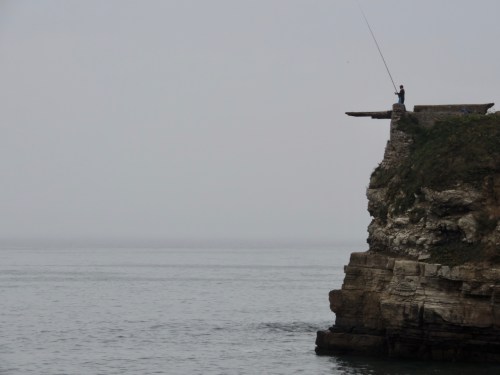
I took this photo in Gijon, Spain a while back. I’ve returned to look at it many, many times.

There’s something hear which captures my attention and provokes my thoughts.

I’ve always been struck by two things in this image. The first is the solitary nature of the fisherman. It reminds me how we humans are constantly addressing two apparent opposites. We are highly social creatures. We need relationships. We need to connect. We want to share. On the other hand, every one of us is unique. Every one of us experiences this universe from the position of the subjective self. There’s no alternative to that. We need to know that we exist, that we are seen and heard, that we can exert our will and make a difference in the world. We all need some time alone. Alone with our thoughts, our memories, our sensations and experiences. And, yes, it’s also great to share.

The other thing is the distance between this fisherman and the water (and therefore the fish!). It looks a LONG way down. I can’t see his fishing line but I can see that the rod he is using seems huge. There does seem to be a man-made ledge at the top of this cliff so I’m guessing it’s a good place to fish. And as I’ve never fished in my life, I know nothing about fishing, but I’m going to guess that a good place to fish is where you catch fish. There would be little point in standing there dangling a line into the sea far below if you never caught a fish, would there? (Or maybe there would. Sometimes I wonder if the main pleasure from fishing comes from the solitude, not from catching anything. But maybe some of you do go fishing and you can tell me)

As I look at this image again today, well into our third week of lockdown in the midst of this pandemic, I see a third thing – hope.

Hope?

Yep, hope.

Here is a man, a solitary man, standing far above the source of what he hopes for (fish?), but with sufficient hope to actually stand there.

I think that’s one of the things we need at this point – hope.

I hope for an end to this pandemic and its deaths and confinements.

I hope for a re-evaluation of the world we live in.

I hope we carry forward our new-found admiration and respect for all the people in under-valued jobs who keep our societies going – the health workers, the carers, the cleaners, the food producers, the transporters, the cashiers, the shelf-stackers, the teachers, the people who keep the water flowing, the lights on, the heating working, the researchers and innovators……has this list got an end? I’m sure you are already thinking of other workers whose importance to us all is suddenly coming to the fore.

I hope we shift our focus and our energy away from competition and control towards co-operation and helping.

I hope we learn from this experience.

I hope that what we learn leads us to make different choices.

I hope we take forward this valuing of human beings and relationships and build it into our new societies.

What do you hope for?

Let’s begin to imagine what kind of world we want to build together in the light of what we know now.

(My list of hopes is by no means complete. I only hope I can inspire you to start to make your own list)

Read Full Post »

Markings.

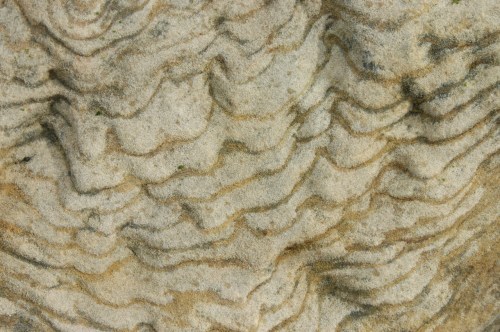
I find patterns utterly fascinating….wherever they are. Look at this blend of textures and colours on the surface of a tree. Isn’t it beautiful? It’s as if some artist has been doodling or a sculptor has been running his or her fingers through wet clay.

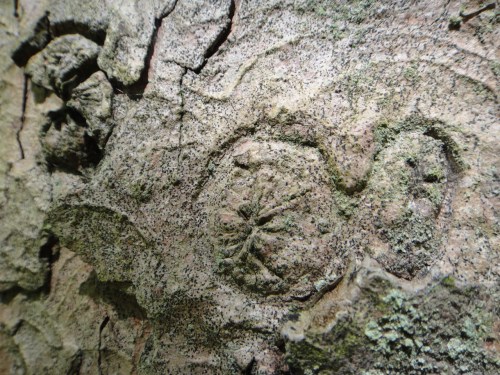
Here’s another one.

This one looks like an infinity loop to me.

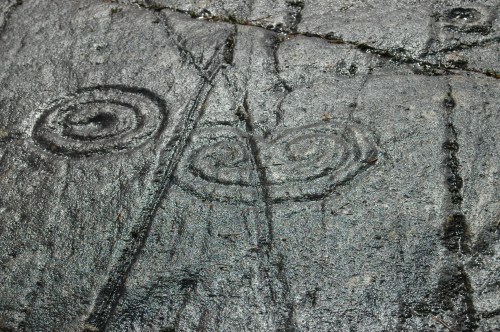
It reminds me of some of the cup and ring markings on the rocks in the Kilmartin Valley in Scotland. Here’s a photo I took of one of them.

The cup and ring markings in Kilmartin are really impressive and challenging. As best I know absolutely no-one has managed to explain them. Are they maps? Are the signatures? Are they messages from one person or tribe to another? Are they symbols, and if so, of what? Or are they doodles?

We humans have a particular kind of creativity. We imagine, we play and we make marks. I love all of that. But then I look around me and I see that making marks is embedded in all kinds of natural phenomena. It’s as if the whole Universe just loves to make marks.

We live an a creative universe.

Creativity runs through us the way our blood runs through us, the way our breath runs through us, the way we are infused by the streams of materials, energies and information which run through us, the way our spirit runs through us.

We react and we act. We engage and we respond. Catabolism and anabolism (biological terms related to our metabolism….how we break down materials which we consume and fashion them into the things we need to live) are at the core of our being.

Just by living, we create, but isn’t it such a thrill when we create consciously?

Isn’t it such a delight when we stumble across the works of creation?


Read Full Post »

When I took this photo I was attracted to the white flowers, but when I looked at it on my computer it seemed to me that the white flower in the middle of the shot had turned into a butterfly.

When I looked closer, it hadn’t.

But like some of those optical illusions, once you’ve seen it, you can’t unsee it! So, now whenever I look at this image the first thing I see is a white butterfly, which transforms itself before my eyes into a flower. Given that perhaps one of the key characteristics of butterflies is transformation, that seems strangely appropriate.

OK, I know butterflies don’t transform into flowers, or vice versa. Well, not directly anyway. (You could argue that everything which exists on Earth is made from the same atoms which have made everything else) However, just seeing that has taken this image to a new level for me.

In a few short moments I can let my mind follow the path of a butterfly, its eggs, its caterpillar stage, its chrysalis, and on to a new butterfly. And I can let my mind follow the path of the flower, the insects which come seeking sweetness, the pollen spreading, the new seeds forming and scattering, a green plant shooting up through the dark earth, and a new flower stretching out its petals under the warmth and light of the Sun.

And it all seems WHOLE. I see an intertwining of Nature’s cycles and rhythms unfolding before my mind’s eye.

I hope you can too.

Read Full Post »

I took this photo recently when visiting the Caumont gallery in Aix en Provence (before France closed down!).

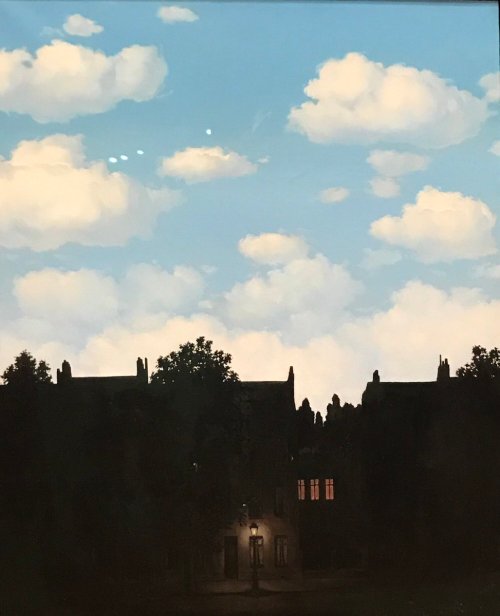
I was attracted to the light shapes on the wall of the building opposite. The one on the right looks like a cocktail glass, but the other two are vaguely like kanji – which, given that the gallery had a special show of Japanese prints, is highly likely!

When I look at the photo now I’m reminded of two things – a famous painting by Magritte

And, a photo I took in the New Carlsberg Museum in Copenhagen of ancient biblical scripts written in Aramaic and found in Palmyra.

The room with the scripts showed the letters projected across the images on the walls as a soundtrack played of someone speaking words in Aramaic from the book of Genesis. That was one of those moments where the hairs on my arms stood up on end and my eyes got watery.

I have long since had a love of words. I have hundreds of books. I read all the time, often several books at once. I love stories and I am insatiably curious. When I qualified as a doctor I bought a complete set of Encyclopaedia Britannica with my first month’s salary. I know wikipedia might have surpassed that now but I can still get the thrill of serendipity by leafing through its pages and falling down a knowledge rabbit hole. At work I looked forward to every Monday morning because I knew it was the start of a week where patients would come and tell me their stories. Every single one of them unique.

I taught in Japan at one point and tried to learn a little Japanese. I didn’t get very far but I am still enthralled by their three alphabets – yes THREE! I chose to emigrate from Scotland to France when I retired to have the experience of living in another language and I’ve got a little collection of favourite French words for which I can’t find any direct English translations, or where the English translation feel somewhat inadequate. I love that. (Emerveillement would be my first example!) I’ve also been trying to teach myself Spanish over this last year, just because I’ve discovered Spain since moving to South West France, and have had a number of fabulous road trips there (I’m using the Duolingo app).

Words, and stories.

I’m also quite an avid reader of poetry, and I recently heard a fantastic interview with the American poet laureate, Tracy K Smith, on Ezra Klein’s podcast. Highly recommended!

With more and more of us having to put our normal lives on hold and stay at home I think this is a great opportunity to explore more books, more poems, more stories, words and art. Are you finding that too?

Read Full Post »

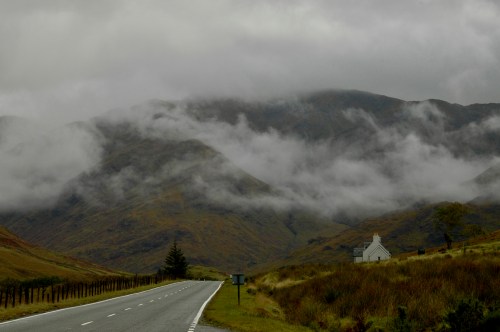
I can’t remember if I took this photo as I was on my way towards the mountains, or I was leaving them behind me. So, I thought I’d imagine it both ways.

I remember leaving home for the first time when I was 18. Leaving to catch the train to Edinburgh where I was about to start six years at university learning Medicine. As I walked down the empty road I had the sensation of suddenly leaving my body, soaring high up into the sky, and looking back down at what seemed a tiny figure walking along the road. In that instant I felt very small and very alone. I turned and looked back. Even my house seemed small now. As I look at this photo I’m reminded of that day, even though this is not a photo of my house, nor of the road I walked down. It’s just that as my eye is drawn back down that deserted road past a tiny white house, that I see the centuries old mountains standing there, as still and as familiar as ever, but obscured today by insubstantial, wispy clouds of water, thoughts and memories.

The past fades behind us as the clouds of time veil the once clear outlines of our memories. But the past is still there. Still exerting its gravitational pull. Still anchoring us, reminding us of roots, and ancestors and belonging.

I sit here today looking forward. Sometimes I see the future looming large ahead and I strain my eyes to make it out, but it hides, or is hidden, behind my anxious thoughts of what if, and what if not, and who knows? These ever changing thoughts and concerns floating in front of my destination. Or my destiny? Walking along a clear, straight road without knowing where it will lead, when it will turn, or dip, or rise.

Maybe the years and experiences which have shaped me give me a new confidence now. An acceptance of not knowing. A humility from not being able to predict. An excitement about the mysteries and wonders which, undoubtedly, lie ahead.

I find myself looking forward to these moments when I’m able to look back. And I love how I my attention can float, like those wispy clouds in front of the immense unknowns of the mountains, allowing me to appreciate the past, the future, and this flitting, yet eternally present moment.

Read Full Post »

« Newer Posts - Older Posts »