Feeds:
Posts
Comments

Archive for the ‘from the consulting room’ Category

rrr.jpg

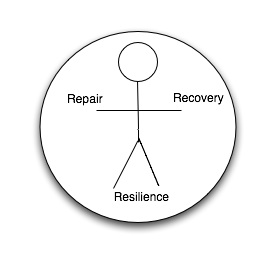
Here’s a diagram I drew last night.

This works for me as a symbol of what health care should do.

In the middle we see the symbolic representation of a person. All health care should be focussed on the individual. It’s this person with me today who needs my attention. It’s this person in their uniqueness who needs to be understood and cared for. It’s the whole of this person who is with me today (not just the bit of them that’s not working!)

There are three Rs –

  1. Repair
  2. Recovery
  3. Resilience

Most treatments are directed at repair. Dilating constricted airways, reversing spasm of arteries, killing infecting organisms etc. But we only become well again by recovering from an illness. If we have an infection then an appropriate antibiotic might kill the bacteriae but it’s our body’s processes of healing and recovering which restore our tissues and our whole beings to health. The processes of recovery are not so well understood and very few medical interventions claim to stimulate or enhance recovery, but we see reports like this which show that the patients’ emotional state influences recovery for example and some research has shown that the physical environment in which a patient is nursed influences recovery. In other words, recovery is not about just dealing with the disease, recovery is about addressing the whole person in the context of their environments.

Finally, after recovery, can we do anything to reduce the chances of this person falling ill this way again? Can we increase their resilience? So much of preventitive health these days is a technical fix – drugs – drugs to lower blood pressure and cholesterol for example – but the best way to be healthy and to stay healthy is to be more resilient – and that involves not just the physical body but the whole person in the context of their life. Not so much is understood about resilience and very, very little exists in health care to specifically address and enhance an individual’s resilience.

Wasn’t it Benjamin Franklin who said

God heals and the doctor takes the fees

Well, that’s not good enough any more. We need more research to understand the processes of recovery and resilience and we need to ask the question of health care – how does this intervention address the patient’s needs for Repair, Recovery AND Resilience? And if the intervention ONLY addresses repair, then what else are we going to do to address both Recovery and Resilience? Because without addressing these needs we are fighting a continually losing battle of repeated repairs.

When the NHS was created in the UK, the Labour government genuinely believed that providing health care for all would so improve the health of the nation that the costs of the service would fall year by year. It never happened. Quite the reverse. Why? Because they created a National Repair Service, not a National Health Service. (well, that’s part of the reason, another part is that health is a much more complex phenomenon than can be addressed by a health care service – poverty, housing, sanitation, education and work and so on are HUGE influences on health experience too)

There’s one final element to this little drawing. The circle around the person. This represents understanding that we need to address a whole individual within the context of their life, and also represents that a person needs cared for by a circle of carers. Health including recovery and resilience is influenced by that complex network of individuals – professionals, friends and relatives who surround the person.

Fundamentally, though, the circle represents CARE – nobody really gets better unless someone cares for them. All health care should be delivered by people who CARE.

Read Full Post »

I’ve just started reading Sebastian Faulks’ Human Traces. On page 21 this sentence struck me

Do we already possess all we need to stop feeling the world as the sound of footsteps and the ache of our backs and to look up – to the woods and the hills and the oceans that stretch out in their immensity, just waiting to be seen?

I’m in the habit of drawing simple little diagrams to explain things to patients. I draw one which is just a circle. I say “This circle represents your life”. Then I draw a much, much smaller circle inside the first one and I say “When we have chronic pain, or sadness, or breathlessness, or stiffness, or whatever, our life becomes much smaller. Maybe we can’t go out so much. Maybe we can’t face other people. Maybe everything loses its joy. It’s necessary to do this to survive sometimes. We all need to feel safe before we can grow. If the treatment I’m going to give you works it’ll reduce your symptoms and stimlate your body’s natural healing processes and so let you begin to look up and start to see that you can move outside of this constricted, safe zone, and as you do, your world will start to get bigger and more enjoyable again. Then we’ll know you are getting well.”

We don’t grow with our heads down. We grow when we look “to the woods and the hills and the oceans that stretch out in their immensity”

These are the hills I see from my bedroom window

Read Full Post »

Orthopaedic surgeons at St Louis University School of Medicine were a bit puzzled when their clinical tests on patients post hip surgery indicated they were recovering well but the patients own reports didn’t confirm that. What they did was ran a parallel questionnaire which amongst other things asked about emotional well-being. The two sets of results didn’t correlate

“What we found was surprising – the clinical test found good-to-excellent results, while the self-test taken by the same patients showed significantly worse recovery.”

Now, to you and me that might not be a surprise but, strangely, to these surgeons it was a shock. You know why? The surgeons see themselves as technical fixers. In this case they were fixing hips and they were assessing how well the new hips worked. But they are being confronted with the fact that the hips in question are inside people and people are a lot more complex than just the bits of their bodies.

You can’t but applaud this conclusion from Berton Moed MD

“The number one issue is recognition – we need to acknowledge that there’s more going on with patients than what current clinical tests tell us,” he says.

But wait, his suggestions for what do about this problem is worryingly medicalised –

“Do we need to look at other interventions besides fixing their hip? I think we might have to,” he says. “That could include bringing in social workers and psychologists to work with the patients in the areas that surgeons, who often are super subspecialists, may not be able to deal with.”

OK, I’ll let the “super” and “sub” bit connected to the “specialists” go for the moment but do we really need social workers and psychologists to help patients recover? Because surgeons don’t know how to address a patient’s issues and feelings?

Please, let’s recognise that people are always more than the sum of their parts and that every health care intervention should take into consideration the whole person, not just the wonky bit! Recovery, true recovery, from an operation is a complex phenomenon. If we don’t recognise this we are in danger of wasting a lot of time and good effort only doing half a job. Every surgeon and every nurse on a surgical ward should be able to address and care for the human needs of the patients in their care.

By the way, just what is a “super subspecialist”? Someone who only has the skills to deal with bits of people?

Read Full Post »

Morag Wilson, a 32 year Dietetics Manager in the NHS committed suicide by stabbing herself with a kitchen knife then throwing herself from a bridge 100 feet above the Manchester ship canal. The coroner said she was driven to this sad end by the pressures of her job. Specifically, Agenda for Change had produced very disparate outcomes for dieticians in her region and resulted in widespread resentment amongst staff. The coroner said this

“I find it extremely sad that a young woman with such a lot going for her, very dedicated to her work, has been reduced to despair by the pressure upon her at work,” he said. “When people introduce these rules and systems perhaps a bit more thought as to what effect they will have on people would be helpful.”

The NHS should be a people focussed organisation – focussed on the patients and those who deliver the health care. Targets, budgets, managerial processes, should all be measured against the impacts they will have on people. Please, can we have a health service that cares, that really cares about people?

Read Full Post »

BBC news reports today that Loyd Grossman has attacked government for failing to take patients’ nutrition seriously. In response, the Department of Health “spokesperson” (why are these people always anonymous?) says

A Department of Health spokesperson said: “Hospital food has improved greatly over the past few years.

Wow! It has??!! Well I work in an NHS hospital and I can’t say I’ve seen any improvement in hospital food, so that got me wondering…….improved how? What has improved? The food has improved? I popped across to the Audit Scotland site and found a report on catering in NHS hospitals in Scotland dated last November.

They found that NHS spending on food and beverages (that’s not the catering costs including staff pay and so on, it’s just the cost of the food and beverages) rose from £2.23 per person per day in 2001/2002 to £2.34 in 2005/2006 (and they point out that’s less than the rate of inflation over that period) But that’s an average! The hospital where I work actually spends less than two pounds per patient per day on food and beverages. (about £1.60 actually)

OK, so it’s not rocket science, but what do you reckon? You think the DOH spokesperson is right? The food has improved “greatly” in recent years but they’re actually spending less on it?

How can we expect sick people to get better if we don’t feed them well? Surely a sick person needs even better nutrition than a healthy person does? Here’s my question to anyone in the DOH “What’s your daily spend on food and beverages for your family?” Then compare that to what a hospital patient is given and ask yourself if there’s a problem here.

Read Full Post »

present.jpg, originally uploaded by bobsee.

Here’s a slide I made for one of the talks I give to medical students and doctors. I use this diagram during consultations with patients sometimes too.
Imagine that from the left to right here is your life line – the day you’re born on the far left and the day you’re going to die on the far right. We all know our left hand dates but none of us know our right hand ones! Let’s assume we are currently about half way along (I know, I know, but “middle age” seems to stretch for longer periods the older you get!)
Everything from the day you were born until now is in the past. It exists in our memories. Everything from now until you are going to die is the future. It exists in our imaginations.
If you spend most of your time thinking about and talking about the past, or most of the time worrying about what might happen in the future, the one place where you are not spending your time is – THE PRESENT.
So, if the past or the future is troubling you and consuming your thoughts and your energy, then draw your attention into the present from time to time. The more you do so, the less you’ll be spending time, attention and effort in your memories or in your imagination. You’ll be living NOW, experiencing life as it is actually happening.

Read Full Post »

Learning the materia medica of homeopathic remedies teaches us about the kinds of ways different people experience the world and cope with life’s challenges. There are amazing parallels and resonances between these patterns and significant characteristics of the starting materials of the remedies.

Let’s take a look at Lycopodium. This is club moss. A delicate looking type of fern moss which creeps along the forest floor looking pretty insignificant. However, back in the Carboniferous Period this plant was one of the greatest trees in the forest. Imagine what it might be like to have a knowledge of your greatness, your superiority over others trapped inside body and personality which is small, weak and insignificant. This gives you a sense of the essence of the materia medica of Lycopodium.

People who respond well to this remedy are often quite haughty, even contemptuous of those who they consider to be their inferiors. But in the presence of authority they become quite obsequious.

There are some great characters from literature like this. Think of Dickens’ Uriah Heep, or Peake’s Steerpike. Or think of Grima Wormtongue. Here he is ……..

That video clip is wonderful. I’ve always liked that song and the way Anyathe has put together the clips from Lord of the Rings to this soundtrack is just superb. It gives us a more sympathetic understanding of this rather distasteful character.

The person who needs Lycopodium after all is just struggling to survive and get on in life as we all are. There’s a duality at the core of their being. Two understandings of the self, each of which expresses itself in different contexts. The child who needs Lycopodium is often as good as gold at school and a very disturbed, difficult child at home, or vice versa, depending on which authorities they respect. The adult who needs it usually reveals their dual nature when they are in the middle of a hierarchy. They are good employees but bullying bosses.

Read Full Post »

….that might seem like a strange and obvious statement, but the reality is that health is experienced by individuals which is why we need a health service which is patient centred, taking a holistic focus to understand the differences between people as well as their similarities (what diseases they have). However, the other side of the partnership in healing is the health care professional – doctors, nurses and other professionals. There’s a strange distortion of “Evidence Based Medicine” which seeks to reduce the whole of health care to numbers, as if people don’t matter. We see this in the way that randomised controlled trials are conducted using methods which explicitly seek to exclude the individual people effects – you never see any mention in a research paper of who the individual health care professionals were who actually interacted with the nameless and faceless patients in the trial. It’s as if we can only rely on studies which exclude the effects and contexts of human beings. This has always struck me as strange.

In any GP partnership, patients quickly suss out which doctor is good for which approach. Those who want to be given time to talk about their problems seek out the doctor who listens. Those who want antibiotics seek out the one who is best known for prescribing them without lectures…….and so on.

Doctors are not clones. They are individuals too. In good health care each of us needs to find a doctor we can connect with, one who is on our wavelength. Yes, we want a surgeon, a physician, a GP who has good up to date technical knowledge and skill. That’s a given. But we need more than that. We need a good human relationship with him or her.

So, I wholeheartedly endorse Dr Everington of the BMA today who says

Doctors feel under attack, the government wants to turn everything into something that has just a monetary value. Vocation, dedication and lifetime commitment to patients and the NHS has little value in this new world – we are just financial commodities.

There’s a process going on in the NHS known as “Agenda for Change“. It’s central tenet seems to be that every job in the NHS can be described according to the knowledge and skills required to do that job, every person can have their knowledge and skill level assessed, then anyone with the requisite level for a particular job can do that job. The actual human beings become dispensible and interchangeable. The whole process is demoralising for thousands of NHS staff. People matter. Personal, individual qualities and characteristics matter. Two different people doing the same job will interact with people differently. In health care this matters. In a factory making widgets it maybe doesn’t. But GP surgeries and hospitals are not factories and people are not widgets.

Read Full Post »

A study published in The Archives of Internal Medicine looked at how doctors greet their patients. In particular they studied how often doctors used the patient’s name and how often they greeted the patient with a handshake. They claimed to show that most patients wanted to be greeted by name and with a handshake and that many times doctors failed to use the patient’s name. However, the statistics on the handshaking are fascinating –

Seventy-eight percent of patients surveyed wanted a doctor to shake their hands, while 18 percent did not. In the taped sessions, doctors and patients shook hands 83 percent of the time.

Read that carefully. 78% of patients said they wanted the doctor to shake their hands. 83% of time the doctor shook the patients hand. What does this mean? That doctors are shaking patients’ hands too readily? That more patients get their hands shaken than wish to do so? Funnily enough, there’s no comment about this strange anomaly.

Read Full Post »

Janssen LP have created goggles and a headset that give the wearer the experience of having hallucinations. There are two scenarios to choose from – riding on a bus where people appear and disappear randomly and birds of prey claw at the windows, and going to pharmacy where the pharmacist gives you poison instead of pills and other customers stare at you in disgust.

They’ve used these goggles to train social workers, policemen and others who might have to deal with mentally ill people and have apparently shown that after the training the workers understand mental illness better – learning through virtual empathy!

Read Full Post »

« Newer Posts - Older Posts »