Feeds:
Posts
Comments

Archive for the ‘from the dark room’ Category

IMG_3278

In her book, “Big Magic”, Elizabeth Gilbert tells the story of a botanist friend who teaches environmental biology in New York. She begins by asking her students two questions – “Do you love Nature?” (every hand in the class goes up) and “Do you believe that Nature loves you in return?” (every hand goes down).

Sad, that, isn’t it?

The myth of the heartless, uncaring universe has dominated our cultures. Even worse, the myth that “wild nature” actively works against us so needs to be “tamed” and “controlled” feeds the climate of fear which is used to control us.

What choices might we make if we took a different view?

What might our societies become if we both loved Nature and believed that Nature loved us in return? (Of course, I take it for granted that you accept Nature isn’t something separate from us. We are inextricably a part of Nature)

Two recent photos came to mind as I thought about this. The one above, which is lunch one day in my home. Look at the yellow tomatoes, the cheese, the butter, the bread, the salt and pepper and the water. Look at the delicious bowl of “potiron” soup.

Then, how about this photo I took in Regents Park in London last weekend?

IMG_3409

Taken facing the sun (as the photography books tell you not to!) and revealing both the glow of red flowers in the life-giving sunlight and the longing of the purple ones as they reach for the sun.

What do you think?

Do we live in an essentially hostile or uncaring universe? Or are we part of a loving, nurturing and caring one?

Read Full Post »

IMG_3419

Elizabeth Gilbert’s book, “Big Magic”, is about “creative living”. What is that?

…when I refer to “creative living”….I’m talking about a life that is driven more strongly by curiosity than by fear.

Well, I think that really is a key – we are so driven by fear, and fear is used as such a tool to control whole populations these days. To be driven by curiosity rather than fear strikes me as likely to completely alter our view of the world.

Take health care for example. So much health care is generated by fear – fear of dying, fear of getting cancer, fear of getting this disease, or that disease. It creates a whole ethos and it’s sure not a positive one. What if we underpinned our healthcare with curiosity instead? What if we consciously sought out experiences which were nourishing, nurturing, stimulating, life enhancing? Would that lead to healthier lives instead of lives of avoidance?

I do believe a creative life is a richer life. Here’s what Elizabeth Gilbert says –

A creative life is an amplified life. It’s a bigger life, a happier life, an expanded life, and a hell of a lot more interesting life.

That reminded me of a book I read a long time ago – Robert Solomon’s “Joy of Philosophy” – where he juxtaposes a “thin” life with a “passionate” one. His use of the metaphors of thin vs thick throughout that book struck me as original and clear. Who wants a “thin life”?

Elizabeth goes on to explain in a little more depth what she means by “creative living” –

The universe buries strange jewels deep within us all, and then stands back to see if we can find them. The hunt to uncover those jewels – that’s creative living.

Ooh, I love that. What a lovely metaphor! We really do all have unique and wonderful treasures buried within us. In fact, I don’t think it is possible to fully mine the depths of any individual human being, but what jewels lie there waiting to be discovered when we take the time to explore!

The courage to go on that hunt in the first place – that’s what separates a mundane existence from a more enchanted one.

Yep, it might take courage, but what else are you going to do with all that fear that is thrown at you in this world?

And who wants a “mundane existence”?

Read Full Post »

DSCN4494

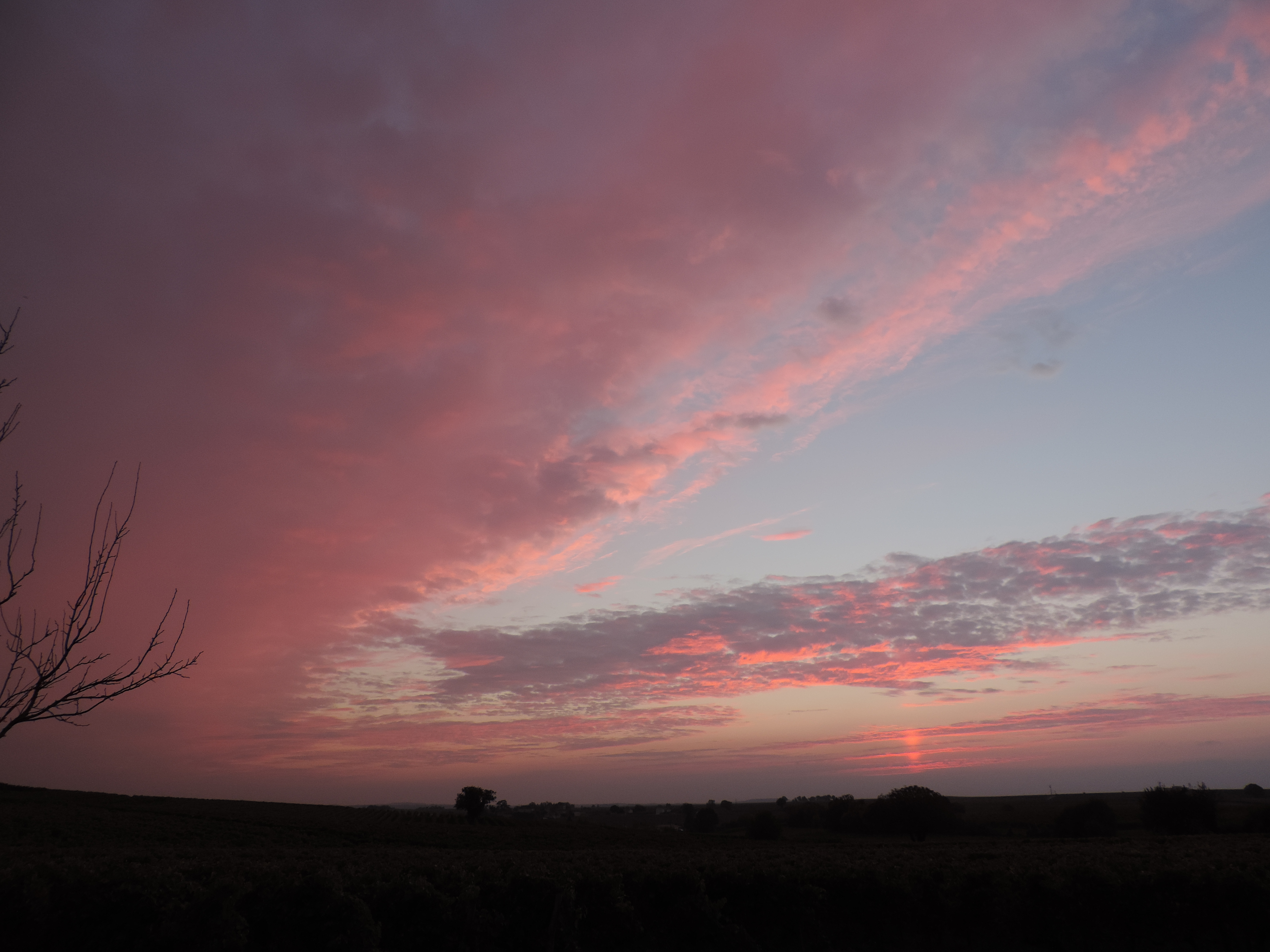
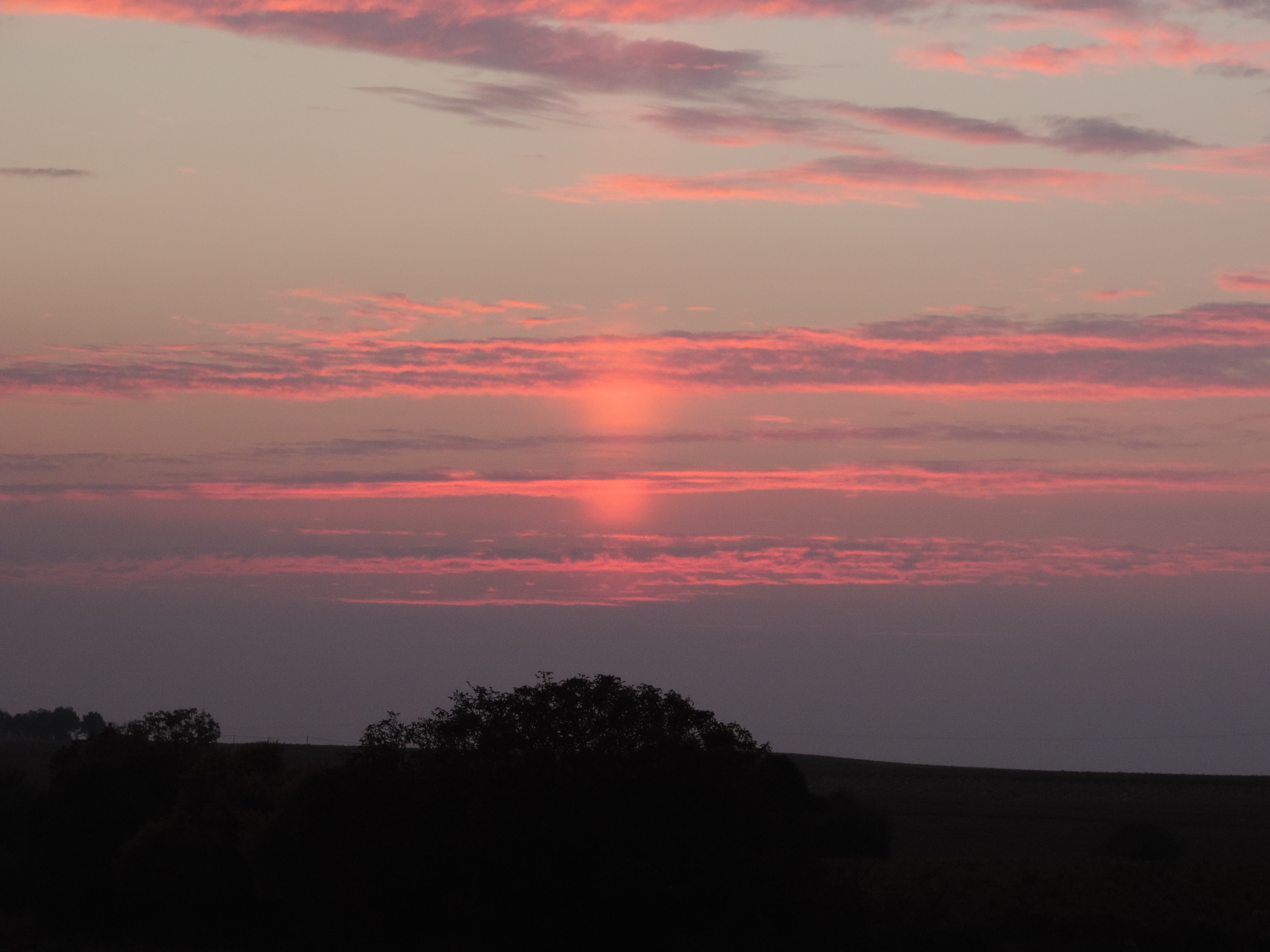
I’m pretty keen on sunsets, and I’ve stood and watched a LOT of them, but the other night, as the sun set, I found myself saying “never seen that before” – again!

Look at this phenomenon! It’s like there is a small chain of suns setting!

DSCN4491

Or two of them, at least!

Well, as Ellen Langer says, the way to lead a mindful life is to look out for novelty.

Or, as I learned from homeopathic practice – allow yourself to be struck by what’s “strange, rare and peculiar”. The thing is, there’s something “strange, rare and peculiar” every single day, because the nature of the universe is constant change and creativity. There’ll always be something today which is different from yesterday….

Do you think you could ever be done with looking at sunsets? Is there a time when you stop noticing them?

Read Full Post »

IMG_3417

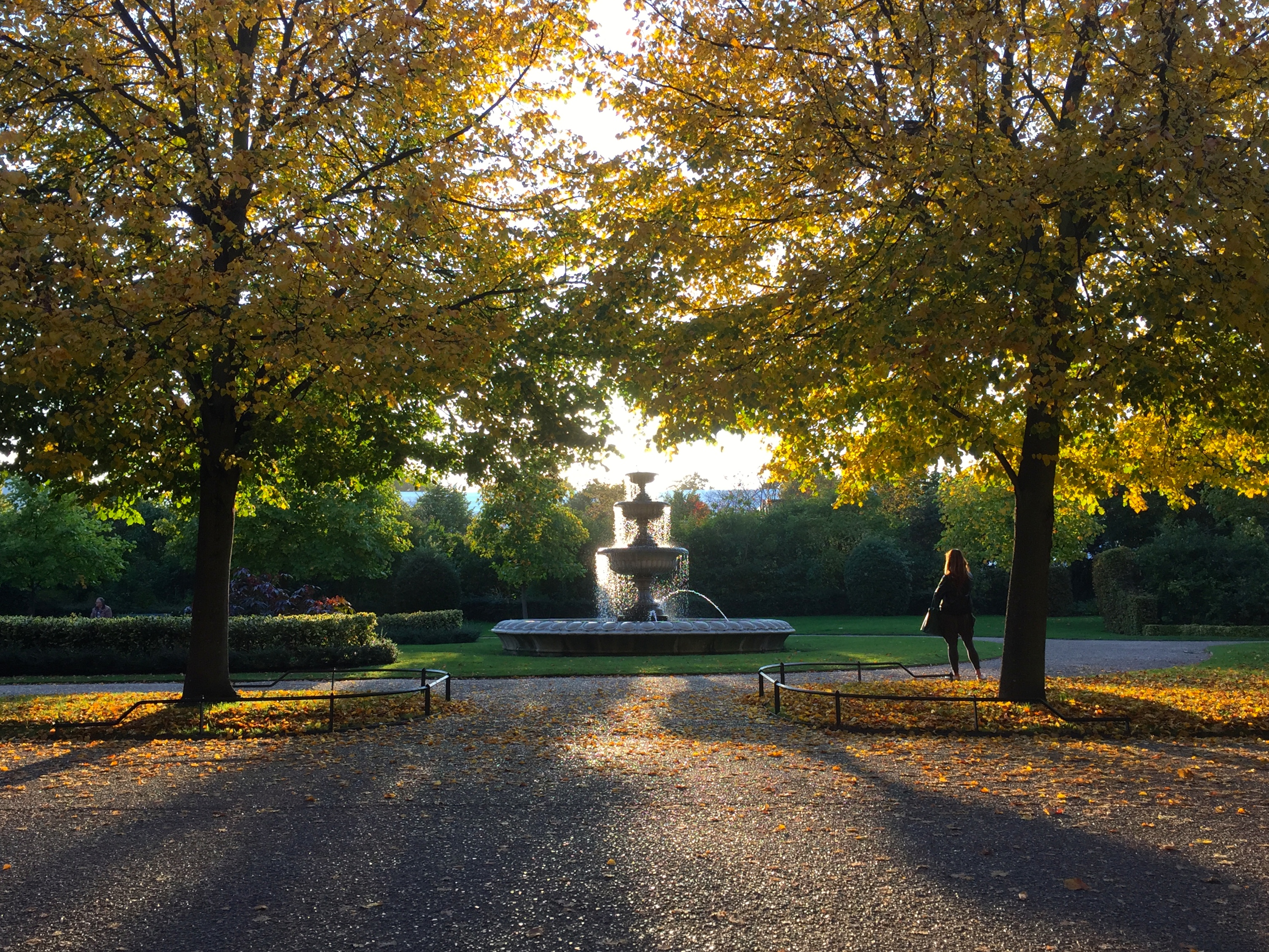
As I walked through Regent’s Park in London the other day, I noticed the power of the beauty of Nature.

Even joggers were stopping in their tracks to look at, or photograph some of the beautiful autumn leaves.

As I sat on a park bench to read a little of a novel, I noticed this woman standing very still, apparently transfixed by the fountain, the sunlight and the leaves. Or maybe she was just lost in her own thoughts? After I’d read a chapter of my book I looked up and she was still there, standing in exactly the same position.

The power of the beauty of Nature to enchant and en-trance…..

Read Full Post »

One of the new experiences I’ve had this summer (my first summer living in the Charente region of France) is with barn owls.

Not long after I moved here, a barn owl flew out from a neighbour’s barn and up onto a light on my house, then quickly flew back home again. I saw the owl a few times, mostly as a blur of white as it flew from somewhere above my front door at night. One time as I was chatting to a friend of mine, the owl came out, flew three times around the mulberry tree, keeping its eyes on us, then flew back to the barn.

Do you know about the noise the barn owls make at night – its a hissing noise, not a hoot. Barn owls don’t hoot. Well for a couple of months in the summer I heard a lot of hissing from the dovecots in our house.
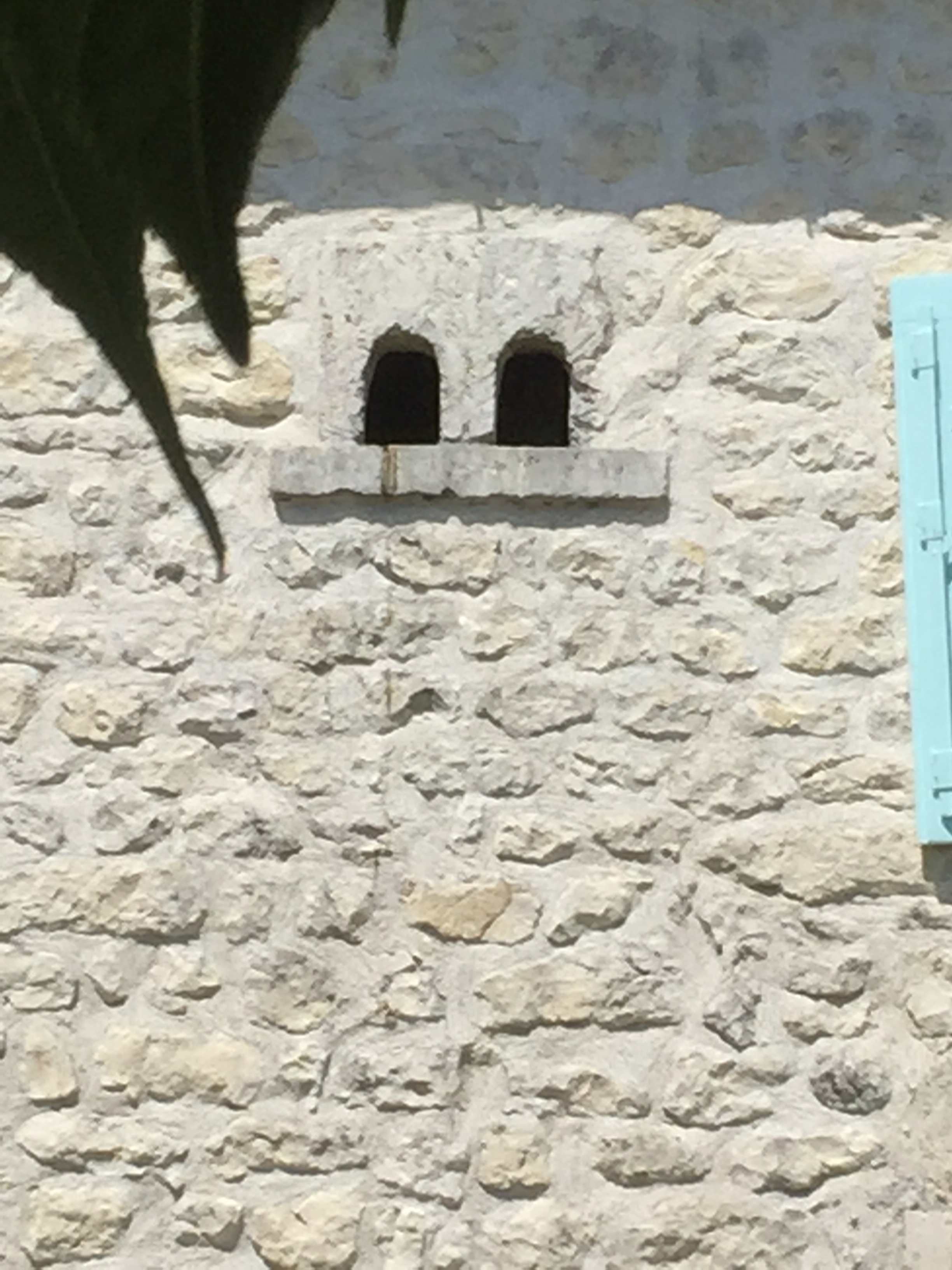
Can you see those two little holes in the wall next to the third from the left upstairs window?
front of house
You can see them better close up
dovecots in wall
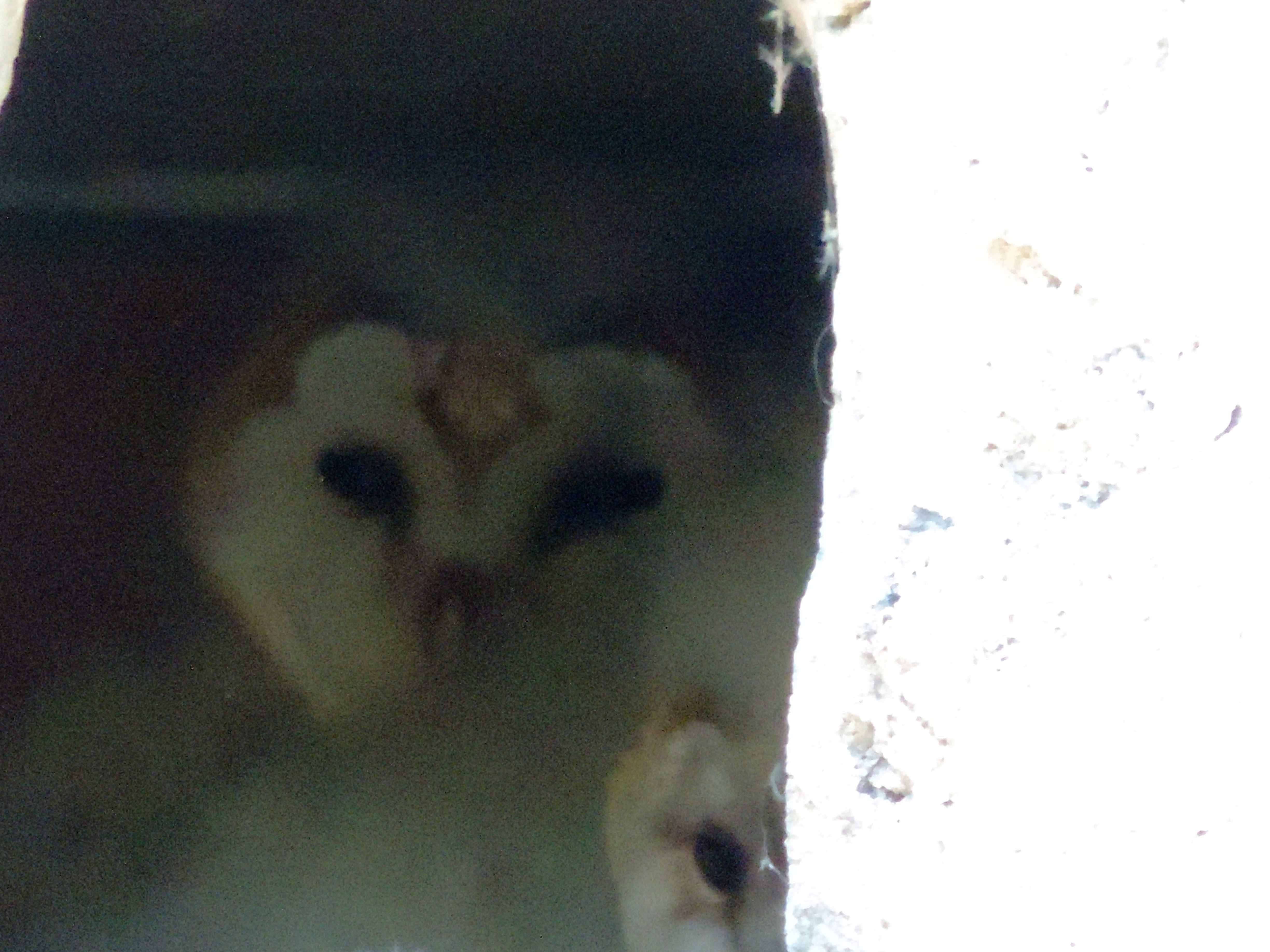
Well that’s where the noise was coming from and that’s where the barn owls have a nest.
I haven’t managed to see any owls actually fly into or out of the holes but after a few days I stood back in the garden and when I looked really carefully I could see owls. I used my little camera with the zoom lens, set the zoom to max, ratcheted up the ISO setting to the darkest conditions and stood very very patiently for ages until I got some pics of the owlets in the nest –
two owlets in nest
Well that was all very exciting and I sent an email to Marie-Pierre, Hilary’s friend who knows a lot about birds and she said they were definitely barn owls and we should watch out for one getting thrown out because that happened a lot and when it did you should put it back in the nest or up in a tree so it doesn’t get caught by cats or foxes.
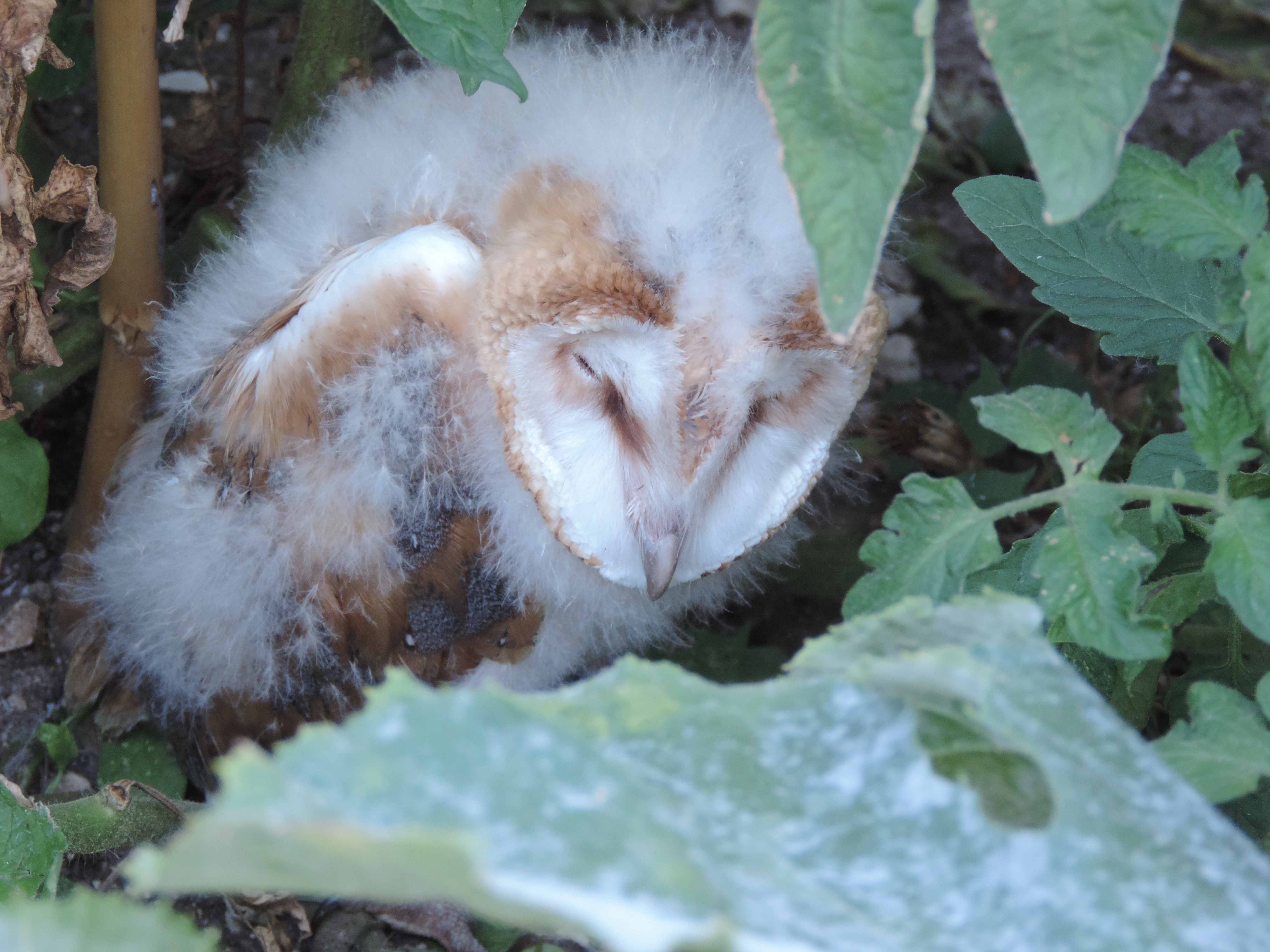
A couple of days later we found an owlet hiding under the tomato plants in the veggie plot –
owlet in veggies
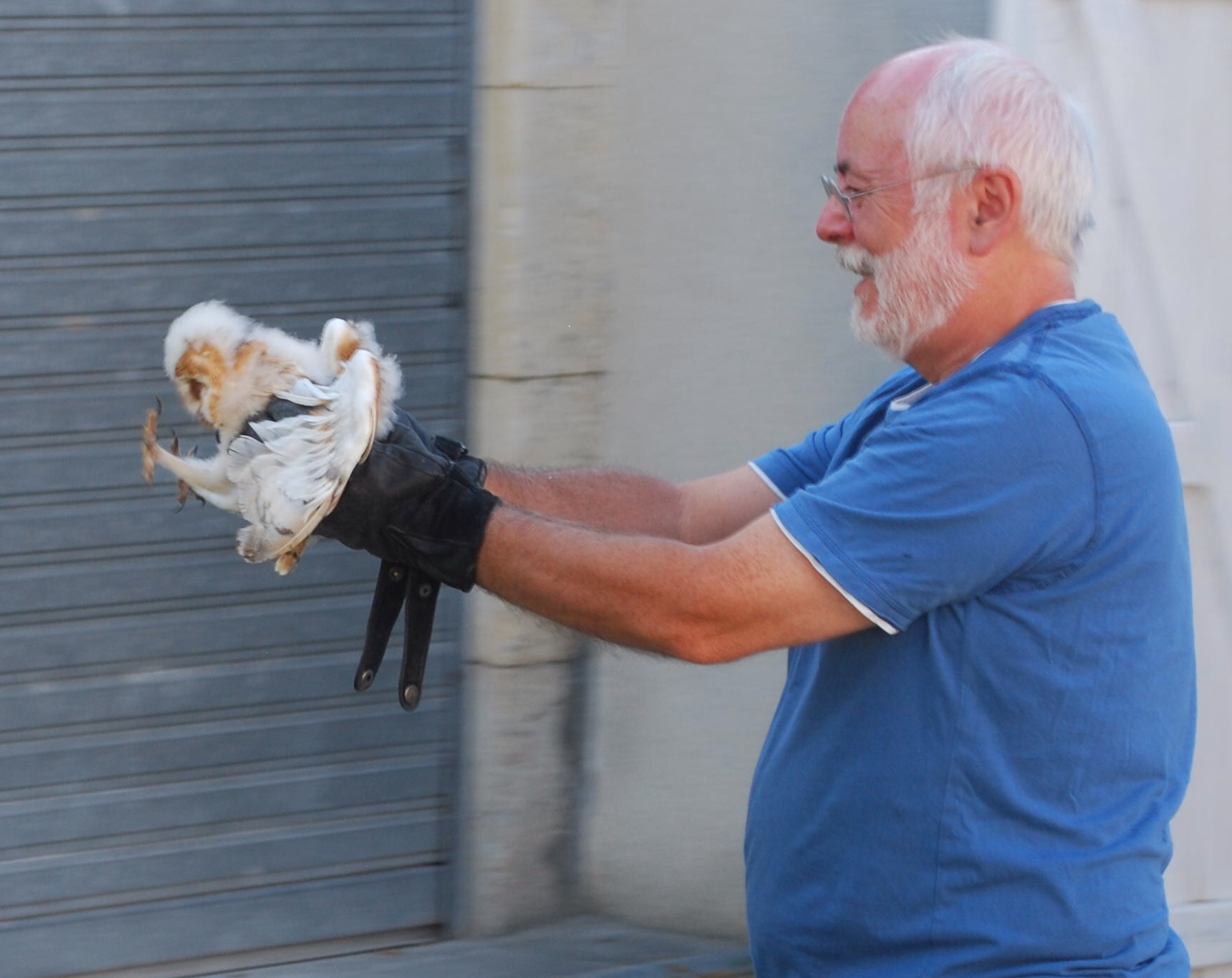
Well the nest is too high for me and I didn’t think I could reach it with a step ladder so I put it in the mulberry tree – there’s a photo of me carrying it!
me carrying owlet
Next day it was gone and no sign of feathers or anything so we reckoned it had either been carried back to the nest or it had flown.
However the following day we found it hiding between a stone trough and the wall of the house – and it didn’t look great. I put it back in the tree and went off to the supermarket to get it some chicken pieces but by the time I came back it was back behind the trough again.
A wee while later (it was pouring rain all that day) it staggered out onto the path and fell over so I picked it up and put it in a shoe box and put that in the shed – it didn’t look like it had long to go and a couple of hours later it was still and had passed away.
I found that very upsetting. Really sad and tearful. But then that’s Nature I guess and I read about barn owls and the young don’t have a lot of luck! Often one gets thrown out the nest then the parents don’t feed it any more and once they learn to fly they are chased off to find their own territory but most don’t make it dying from starvation cos they don’t hunt well enough, or killed by cats, foxes or cars!
Yikes!
The next day, I couldn’t believe it – another baby owl behind the trough! Oh no! So this time I put the step ladders on a plank and took the owlet up the steps with me and pushed him over the ledge into the dovecot.
He, or she, didn’t fall out again!
It’s been a bit of an emotional roller coaster and a big learning for me. I handled the second owl much more easily than the first and looks like I might have made a better decision with it. However, why do they get thrown out in the first place? Is it because they aren’t right somehow and the mother is protecting the others with limited food supplies?
Who knows!?
Well the hissing continued for a few weeks, then at around the time I expected the little ones to fly off, the family decanted across to my neighbour’s barn, but they came back to the garden every night to hunt, play and hiss.
I went to Scotland for a week, and when I came back the garden was silent again at night. I guess the young ones have “dispersed” – off to find their own territories and take their chances in life.
I felt a bit sad that they’d gone, but it’s good that they have. It’s the natural flow of Life.
I wonder if the adults will come and nest here again next year. Well, if they do, then I’m a bit more experienced, and I’ve bought a taller ladder, so I’m ready for any wee ones which tumble out into the garden.

Read Full Post »

DSCN4463

What if we built a health care system starting by ensuring that every patient gets enough time with the doctor, nurse or therapist for them to be seen, heard and treated as an individual?

Jacques Lacan said that the greatest gift we can give someone is to listen fully without judgement or interpretation.

What if we gave that gift to every patient, every time?

Also, so that every time a patient met a doctor, nurse or therapist, they didn’t have to start to tell their story all over again, but rather, the story could be deepened and extended enabling understanding to increase and a relationship to be built, what if we also built a health care system based around continuity of care?

If we started from there, what might that lead to…..?

Individualised care, enough time with every patient, continuity of care…..what would you add next?

Read Full Post »

IMG_3283

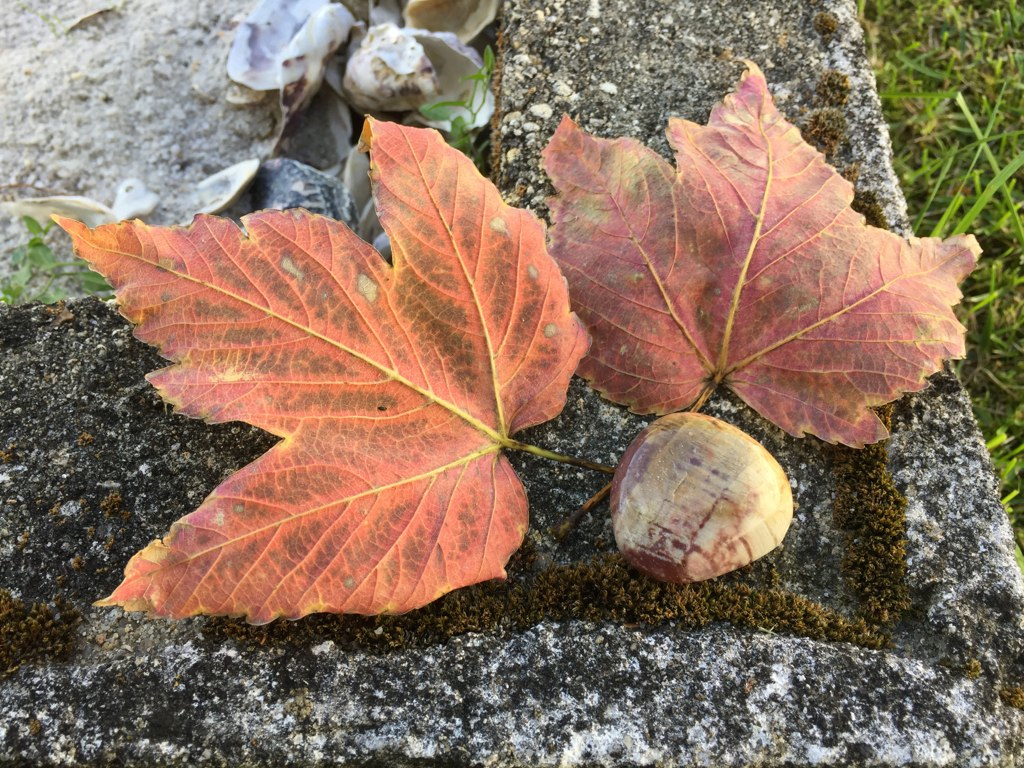
As I walk around I like to notice things – you’ve probably realised that! And when I notice them, I often take a photo. I’ve written before about the benefits of keeping a camera in your hand, but nowadays with smartphones many more of us have cameras in our hands!

I found a leaf which caught my eye. Then I found another. I picked them up, took them home then laid them in the garden, on the corner of the sandpit where my grand-daughter, Ava, had left a stone she liked.

I took the photo.

Pleasing, don’t you think? And now I can look at this scene again as much as I like.

I recommend it – everyday, simple creativity.

Read Full Post »

DSCN4475


DSCN4476

Have you ever come across a little book entitled “Li: Dynamic Form in Nature” by David Wade?

It’s tiny, but it’s a total treat.

He takes and old Chinese philosophical concept “li” and translates it in a particular way which throws an amazing light on what we see around us.

Simply put, he describes li as the invisible forces, or energies which produce the different shapes and forms of the natural world – you know the kind of things – the branching forms of a tree or root system, the wave forms in water and sand, the feathery patterns of clouds and, ah, well, feathers!

I love encountering these kinds of echoes and symmetries, especially when we can see a similar form in two or more completely different contexts – like the sky I look up at, then the feather I find on the grass at my feet.


Read Full Post »

DSCN4485

One of my favourite podcasts is “onbeing with Krista Tippett”. Recently she interviewed Ellen Langer on the Science of Mindfulness.

Ellen Langer has carried out some really interest research, some of which she mentions in the interview, but I first encountered her work when studying Dan Seigel’s Interpersonal Neurobiology course. Her take on mindfulness is different from that of the more dominant meditation based one.

She says that meditation can be a good form or mindfulness practice but, it’s not necessary.

She says we can go through life either mindfully, or mindlessly.

Doesn’t that seem crystal clear?

I like it, because, for me, it maps directly onto my heroes not zombies. I do think we tend to slip into autopilot, or “zombie mode”. But if we wake up and become aware we can become the conscious authors of our own stories (the ones where we are the main protagonist, the hero)

How do we do that?

How do we wake ourselves up? Jolt ourselves out of autopilot/zombie/mindless mode?

She says – search for the new.

It’s novelty and the search for novelty which creates the mindful state.

And I think she’s right, because to search for the new involves intention and attention. We wake ourselves up first of all by deciding to do so. We live consciously by choosing to live consciously. Then when we are looking and listening out for what is new, different, or changed, then we not only paying attention, but we are paying attention to reality. (Instead of painting over reality with habit)

Try it for yourself.

She says see if you kind find out something new about the next person you speak to.

But what about right now?

Right now, wherever you are. Once you stop reading this, look around you and see if anything is new, if anything has changed since yesterday. Look for what’s new, different or changed.


Read Full Post »

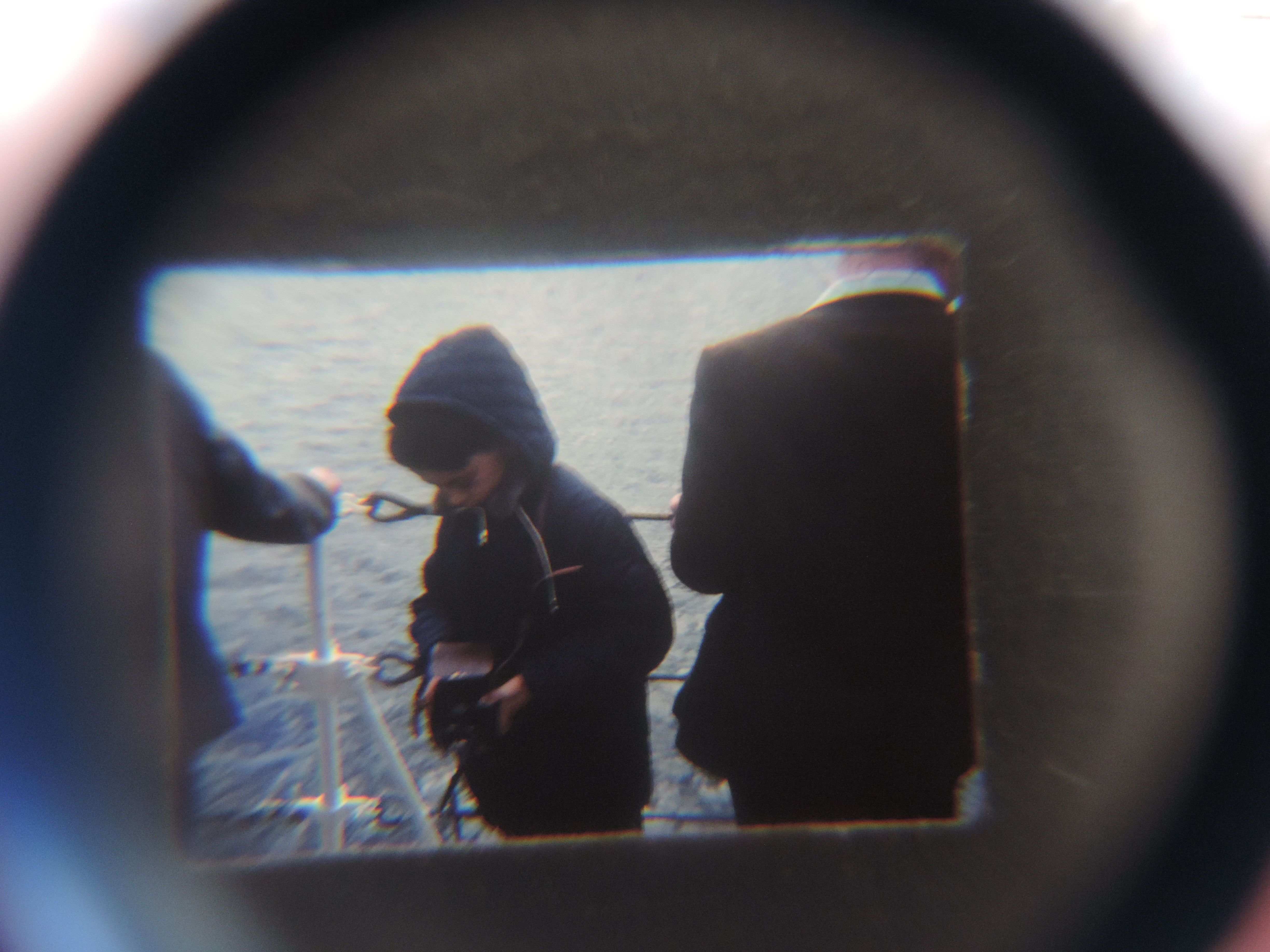
IMG_3200

(me, aged 8, on a boat to Orkney, taking photos with my box camera)

If in every field the triumph of life is creation, must we not suppose that human life has its goal in a creation which, unlike that of the artist and philosopher, may be pursued always by all – the creation of self by self, the developing of the personality by an effort which draws much from little, something from nothing, and adds unceasingly to whatever wealth the world contains? (L’Énergie spirituelle. Henri Bergson. 1919)

I talk a lot about creativity. I think it is one of the defining characteristics of human beings. We constantly make and re-make our world.

It’s quite common for people to think that creativity is what artists have and if you aren’t an artist you aren’t creative. I think that’s a way too limited understanding of what creativity is.

We are creative when solve daily problems. We are creative when we make food. We are creative when we tell stories (which do all the time). We are creative when make plans. We are creative when we sing, play an instrument, make something, express ourselves.

We are creative all the time as we make our selves – we are constantly engaged with the process of self-making, and we never stop developing, evolving and growing – all of which are creative acts.

Own your creativity.

I think it’s one of the three basic characteristics of human life.

Read Full Post »

« Newer Posts - Older Posts »