Feeds:
Posts
Comments

Archive for the ‘from the living room’ Category

When you listen to a favourite piece of music, do you have the same experience every time you listen? Have you ever had a wonderful meal in a restaurant, returned at a later date and had, maybe another wonderful meal……but were the two meals the same? Was the experience the same? If you look at a great painting, do you see exactly the same painting every time? I don’t mean is it the same object. I mean do you have the same perceptive, affective experience…….do you actually notice, regard, attend to the painting in an identical way, and does that produce an identical pattern of thoughts and feelings in you?

William James considers it this way in his Stream of Consciousness essay…

…and yet a close attention to the matter shows that there is no proof that an incoming current ever gives us just the same bodily sensation twice. What is got twice is the same OBJECT. We feel things differently accordingly as we are sleepy or awake, hungry or full, fresh or tired; differently at night and in the morning, differently in summer and winter; and above all, differently in childhood, manhood, and old age. For an identical sensation to recur it would have to occur the second time in an unmodified brain. But as this, strictly speaking, is a physiological impossibility, so is an unmodified feeling an impossibility….

The reality is, we never have the exact same experience twice. So maybe you should slow down a little, become more aware, more mindful of this present moment. You’ll never have another chance to have this particular experience again.
Read Full Post »

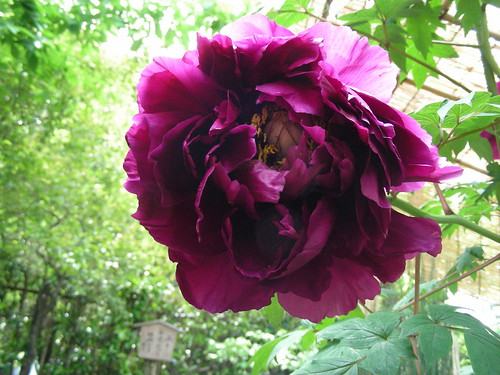
I went to see the paeonies in Ueno Park in Tokyo yesterday. I’ve been before but I was as delighted this time as I was last time.

paeony garden Ueno

(by the way, look how the light just seems to shine out of this flower – like a halo or something)

I recently read these words I noted down from Iain McGilchrist’s superb “The Master and His Emissary

Smiling, laughter and dance are – gloriously – useless; how many of us really beleive that when we dance, laugh or smile we do so ultimately because of some dreary utility to the group to which we belong?

Perhaps, indeed the fact that so many of our distinguishing features are so ‘useless’ might make one think. Instead of looking, according to the manner of the left hemisphere, for utility, we should consider, according to the manner of the right hemisphere that finally, through intersubjective imitation and experience, humankind has escaped from something worse even than Kant’s “cheerless gloom of chance”: the cheerless gloom of necessity.

I smile a lot – I think I’m known for it. I kinda hope that if there’s ever a little statue left in my name it’ll be smiling…..a bit like this little bohdisattva I saw in Otagi Nenbustu-ji.

bodhisattvas

And then, this morning I stumbled across this quote from Poincare, the mathematician –

The scientist doesn’t study Nature because it is useful; he studies it because he delights in it and he delights in it because it is beautiful

We live in such a utilitarian society these days. I don’t like it. I like to live for the fun of it, for the curiosity, the passion, the love and the sheer pleasure.

Read Full Post »

seedling

new growth

In my “months with meaning“, May, is the month of new beginnings (think of the Darling Buds of May). It’s a time for new growth, of the unfurling and unleashing of potential.

So, what are you going to begin NOW?

How would you like to grow, NOW?

Read Full Post »

Welcoming strangers

This morning, close to Kyoto station, an elderly Japanese man approached us, held out his hand to shake mine, and said “Thank you for coming to Japan”.

He asked us where we came from and when we said “Scotland” told us about the times he’d had in Edinburgh, Glasgow, Aberdeen and Inverness. He then asked if we’d mind helping him with his English a little and produced a crumpled set of notes with Japanese and English sentences written in his own handwriting (at least I think it was his own). He wanted to check his translations and understand the nuances of meaning. One of the phrases which provoked a fair exchange was “I was born in the year of the tiger”. Would an English speaking person say that, he wanted to know. We explained that in the UK at least there was no general tradition of allocating an animal to a year in the way it is done in other countries.

Ah, he said, you don’t have the same twelve animals? Which animals do you have?

We pointed out we didn’t have any. He thought that was very strange, how we would just say we were born in the year “xxxx” and quote a four figure number. Suddenly, I felt we’d missed out on something!

We discussed maybe half a dozen other phrases with him, and then he thanked us profusely and zipped away. Goodness, he could move fast!

This isn’t the first time something like this has happened to me in Japan. It’s never happened in any other country, and, sadly, in many countries, when someone approaches in such a fashion, you can’t help but be suspicious, and suspect they’re going to get round to asking for money. That’s never, ever happened to me in Japan.

On the train from Kyoto to Tokyo I reflected on the exchange and thought lots of things. How do we treat visitors to Scotland? Are we as welcoming? How wonderful that elderly people continue to have such enthusiasm to learn. How awful that my meagre attempts to learn Japanese have stalled so badly! Time to get that learn Japanese book out again! And how wonderful when learning a language, to have the courage to approach strangers and politely request conversation to improve your understanding and your skills.

This little exchange made me feel it’s a privilege and an honour to be visiting this country.

Read Full Post »

On the day a third of the world watched a single wedding (you know who I mean!), I spotted this couple walking in the grounds of a temple in Kyoto.

young Japanese couple

Here’s my theme for today – LOVE – let’s spread more of it…..

Read Full Post »

As I wandered today I wondered……don’t we all perceive the world differently? If our stories, our personal stories, shape our selves, which is how it seems to me, then our experiences will frame our present reality. We experience today in the light of our past experiences and our imagined futures. Stories all have this movement….from the past, to the present, to the future – a beginning, a middle and an end I suppose.
So one of the most powerful ways in which memories and dreams can create our present is how they frame our perception and our interpretation of today’s experiences.

through the round window

What frames are you aware of? Which memories, which dreams or fears, create the frames of your present?

The other thing I wondered about today was about the uniqueness of our individual perspectives. We can only experience the world as a subject, as this subject, living this life. So, how does the world look from your unique, subjective perspective?

room with a view

(this is a view from the tatami mats, across the strips of carpet, towards the Japanese garden – this is a view from where I was kneeling)

Finally, how can we share these ways of seeing? How can we develop our inter-subjective experience? One way, for me, is through the sharing of our stories. You can share your experience by telling me it. I can share mine, by telling you…..or by showing you what I caught with my camera…..(I’m sure you can think of other ways too)

Read Full Post »

leaves on leaves

What on earth is this? Look carefully….leaves and sky reflected in leaves on stone in the rain.

trees on marble

leaves on marble

Strikingly beautiful. Leaves and trees engraved onto marble glistening in the rain.

This next one makes it look like I’ve just teleported from Scotland to Tokyo. (I didn’t teleport, by the way, just the regular AirFrance flight)

reflected me

This was a striking experience……the combination of multiply different environments, natural, artistic, built and cultural…..suddenly, here I am, in a different, floating world.

Read Full Post »

Ken Wilber proposes in his Integral Theory, that there is a over-arching map which you can see in various theories of psychological development. Essentially, he proposes four levels of development – egocentric, where the child’s issues are all about their own needs, to ethnocentric, where there is an awareness of the family, tribe, or community of others like us. At this level, accepted norms of morality are adopted. These levels are sometimes termed “preconventional”, then “conventional”. The next, “postconventional” level, Wilber identifies as worldcentric, where we become aware of being part of all peoples, or all Nature. He goes beyond that level to propose a fourth, “integral” one.

One of the authors he cites as an example of this framework, is Carol Gillegan, whose “In a Different Voice”, describes a theory of gender difference along this developmental path. Here’s a wee summary (I think this is an interesting take on development)

All children start out with this selfish stage, but as females progress into the next one, they are taught to care, and as they learn to care for others, they develop feelings that to care for yourself is selfish and wrong. At the next level of development they learn that to fail to care for yourself is as wrong as failure to care for others. They learn this because of their focus on relationships – relationships involve two parties and if one party fails to look after herself, the relationship will be damaged.

Gilligan’s theory about males, takes a focus on justice or rights. The little selfish boy develops through learning that all people have rights to life and self-fulfillment which are protected through non-interference. In other words, rights set limits. As they mature they learn that they have to take increasingly more responsibility for care.

I’m not a great fan of such tightly gendered understandings, but there’s certainly food for thought in this theory. Maybe these two approaches are better thought of as right or left brain approaches as McGilchrist describes them…..with a right brain approach suiting a focus on relationships and the left on logic and the individual. We all need both halves of our brain after all, so maybe these “male” and “female” paths are better thought of as “intelligences” (as in multiple intelligences theory) , or “lines” (in the Wilber model).

There’s certainly food for thought in why we have feelings of guilt or selfishness when we take some time to care for our selves. And how we balance that with feelings of guilt or selfishness from too great a level of “non-interference”. We need to be both self-caring and compassionately engaged.

Read Full Post »

Spring

When I was developing my monthly themes, this month struck me as the time of the cherry blossom. In Japan the brief weeks of the cherry blossom are greatly celebrated. There’s a connection between this natural phenomenon and the reality of transience. It’s the brevity of duration of the blossom which is celebrated.
There’s something about this idea which makes the present even more special. And so we can think about life. The few years we spend here are all the more special for their brevity.
This year, after the earthquake, tsunami, and still unfolding nuclear chaos, transience assumes an even greater poignancy in Japan, and, so, for me, too.
Yet whilst there is undoubted sadness in loss, this transience is something that deepens my gratitude for Life, and for the present.

Read Full Post »

Female/Male, yin/yang, moon/sun, there are these two aspects, types or tendencies described in many cultures throughout history. It’s too simplistic to say men are one way and women are the other. However, it’s also too simplistic to say men and women are the same. This way of thinking can be helpful if we consider male or female qualities are tendencies, rather than fixed types, if we see their interaction as being present and dynamic in all human beings, and if we aspire to an integrated, mature state, where each of us access both ways of being.

One helpful discussion about this is in Carol Gilligan’s “Different Voices”, where she highlights masculine and feminine ways or types of being in terms of “voices”.

A man’s voice tends to be focused on autonomy, justice and rights, whereas a woman’s voice tends to be focused on relationships, care and responsibility. In other words, men tend towards agency, and women towards communion (see the qualities of holons).
Men follow rules, women follow connections. Men look, women touch. Men tend towards individualism, women to relationships.

Neither of these are better than the other. For example, if the masculine way goes too far, or goes wrong, we see

not just autonomy, but alienation, not just strength but domination, not just independence, but fear of commitment. And if the feminine way goes too far, instead of being in relationship, she becomes lost in relationship, instead of healthy communion, she becomes dominated by others, and instead of flow, panic, or meltdown.

Read Full Post »

« Newer Posts - Older Posts »