Feeds:
Posts
Comments

Archive for the ‘from the reading room’ Category

Last weekend’s Sunday Herald carried an article about Edwyn Collins. The headline spread over two pages was “I’m happy basically….but before my stroke, I wasn’t really”. Well, as you might imagine, that caught my attention.

Edwyn Collins is a singer. You maybe remember his 1994 hit “A girl like you”

Just over couple of years ago, aged 44, he suffered a stroke. A serious stroke, paralysing his right side and taking away his speech. But here’s a man who doesn’t give up. Through determined rehab with incredible loving support from his wife he’s not only singing again but is about to release a new album. Although right handed he’s also taught himself how to draw again using his left hand! It’s an amazing interview.

I have a stroke to deal with. But I’m feeling positive. And feeling relaxed, and generally focussed on things. I’m relaxed and dreaming all the time. So my life is happy at the moment. I feel connected. I feel alive again.

His wife adds

I think you’re a better tempered person. You cope. And you have patience. And you’re not self-pitying at all. You’re not even depressed………We’ve got so much to feel…….

and Edwyn finishes her sentence

…..to feel grateful for.

Well, what do you think? Health and the absence of disease are not the same. It’s wrong of us to write people off who have a chronic illness or disability. You can experience “health” in both the absence and the presence of disease.

This is a story of someone who believes their life got better through the experience of recovery from illness (same kind of story Lance Armstrong tells in his autobiography, It’s Not About the Bike). Notice the elements of Edwyn’s story. All of these were involved, sorry, are involved in his recovery –

  • hope
  • loving relationships
  • determination
  • patience
  • an absence of self-pity
  • a capacity to cope
  • creativity
  • music
  • drawing
  • slowing down
  • reflection
  • dreaming
  • gratitude

Worth thinking about?

Finally, when I searched for him on youtube I first found A Girl Like You but then I found this – I’m sorry I can’t show that video clip here, the person who posted it to youtube has disabled embedding but please follow that link and listen to the lyrics. “Make Me Feel Again” was recorded in 1993. Don’t you think that’s amazing?
Read Full Post »

I have a habit of buying the Guardian on a Thursday. It’s the Technology section that attracts me but I usually enjoy the whole paper. Do you ever read obituaries? I don’t often but I really should make a point of doing so more often. Reading an obituary of Hans Georg Gadamer in the Japan Times a few years ago completely changed my understanding of health and opened the doors for me to a mysterious and previously unexplored (by me) section of the bookstores – philosophy.

Today I read the obituary of Norman Cohn. No, I’d never heard of him either. He died aged 92 and this phrase was the first one in the obituary to catch my eye –

as a lecturer in French at Glasgow University (1946-51), he embarked on the studies that would make his reputation, despite having no formal training as an historian. Indeed, his very unorthodoxy may account for the originality of his insights.

Isn’t that such a great insight? How often does “formal training” and orthodoxy crush innovation and originality? The subject of his studies and publications was the recurrent myths which continue to underpin the demonisation and destruction of whole groups of people.

As Cohn himself pointed out, all his work was fundamentally concerned with the study of the same phenomenon: “the urge to purify the world through the annihilation of some category of human beings imagined as agents of corruption and incarnations of evil”.

This statement by writer, Richard Webster, really grabbed my attention –

The key to his extraordinary achievement perhaps lay in the fact that in his own life the personal and political were never severed, and matters of the heart were as important to him as matters of the head

Here was a man who obviously lived in a holistic passionate and highly individualistic way. His first wife, Vera, who he married in 1941, was

daughter of Menshevik revolutionaries, who had previously lived in a ménage à trois with Raoul Hausmann, one of the founders of Dada.

She died aged 96 and he subsequently married for a second time. Richard Webster, writes –

When I last met him in December 2004, he was genial, hospitable, radiant with his recent marriage to her and looking forward to a late honeymoon in Provence during which he would celebrate his 90th birthday.

And concludes

His greatness will always reside in the manner he combined deep scholarship with a passionate zest for life.

Wow! Is this an inspirational life, or what?

Read Full Post »

I was inspired recently reading about Benjamin Franklin’s virtues tool for personal growth. Apparently he wanted to continuously improve his character so he read a lot about virtues to see what people said about the qualities and characteristics a person might hope to develop. He summarised the various authors by collecting together the 13 virtues which he thought most authors agreed.

He then made himself a chart with the 13 virtues down the first column and the seven days of the week making up the other columns. Every day he reflected on his behaviour and put a black mark in any box where he felt he had acted in a way which failed a particular virtue. He did this throughout his adult life, focussing on one particular virtue each week to improve himself.

He showed himself his improvement through the decline in the numbers and spread of black marks.

Now I have issues with that particular method but I’ll return to that in another post.

The 13 particular virtues are interesting and although written in what now seems old fashioned language, the principles he elaborates in relation to each virtue show he had a thoughtful, tolerant and balanced approach to virtues.

Have a look at them. What do you think? Would you sign up to all of these? If not, which would you remove from your list? And would you add any he hasn’t included?

If you want to follow in his footsteps you can download of pdf of his chart here and use it either as a standalone or as an integral part of the marvelous HipsterPDA project!

Here they are –

  • Temperance – eat not to dullness; drink not to elevation
  • Silence – speak not but what may benefit others or yourself;
    avoiding trifling conversations
  • Order – let all your things have their places; let each part of
    your business have its time
  • Resolution – resolve to perform what you ought;
    perform without fail what you resolve
  • Frugality – make no expense but to do good to others
    or yourself; that is, waste nothing
  • Industry – lose not time; be always employed in
    something useful; cut off unnecessary actions
  • Sincerity – use no hurtful deceit; think innocently and justly;
    speak accordingly
  • Justice – wrong none by doing injuries or omitting
    the benefits that are your duty
  • Moderation – avoid extremes; forbear resenting injuries
    so much as you think you deserve
  • Cleanliness – tolerate no uncleanliness in body,
    clothes or habitation
  • Tranquillity – be not disturbed at trifles or accidents
    common or avoidable
  • Chastity – rarely use venery but for health or offspring;
    never to dullness, weakness, or the injury of our own
    or another’s peace or reputation
  • Humilty – imitate Jesus and Socrates

Read Full Post »

The Happiness Hypothesis by Jonathon Haidt. ISBN 978-0-099-47889-8.

This book is by a Professor of Social Psychology at the University of Virginia. The book’s subtitle is “Putting Ancient Wisdom and Philosophy to the Test of Modern Science”. I read it because it was one of three books about happiness discussed by Jean Kazez here. I really enjoyed it. His writing style is easy and at times humorous. He discusses the understanding of happiness from the perspective of ancient Buddhist and Greek thinkers and in the light of findings from cognitive science and the more recent positive psychology.

He makes a good case for the idea that happiness in the result of several factors – some genetic (the given of the physical functioning of an individual brain), some situational (the conditions of life) and some behavioural (the choices we make, the actions we take). I’ve not really considered the first of those before. I guess I’ve thought that things like happiness, depression, optimism and pessimism are all learned phenomena that emerge from the experience of the events which happen in an individual’s life and the sense that individual makes of those experiences, the stories they tell themselves and others about their life. Recently though, both with certain patients in my practice and with what I’ve been reading in that crossover area between neuroscience, psychology and philosophy, I’ve been coming to understand the more complex and intimate links between the body and the mind and between the physical and the subjective. So it makes sense to me that as we don’t all have either a body or a mind which functions exactly the same way as anybody else’s that experiences of positive and negative emotions will be present to different degrees in different people. What he refers to as a person’s “affective style” emerges from the interplay of approach and avoidance behaviours which is influenced both from their genetic make-up and their early life experiences. I find that a helpful concept.

He shed a light on quite a few other issues for me. I like this phrase –

…those who think money can’t buy happiness just don’t know where to shop

He then goes on to explain the different effects of spending money on objects as opposed to spending it on quality time and activities with loved ones.

He distinguishes pleasures from gratifications – a pleasure is a sensory and/or emotional delight. It’s transient and if repeated too often the brain adapts to the stimulus and the amount of pleasure drops (you might like ice cream but eat too much of it at a sitting and the pleasure payback fades). A gratification is an activity which fully engages you, draws on your strengths and allows you to lose your self-consciousness. Gratifications improve your mood for longer and you don’t tire of them in the way you tire of pleasures.

He comes down in favour of positive psychology and its emphasis on understanding your strengths and playing to them, linking this to the older idea of acquisition and development of virtues. What goes along with this is his emphasis on taking actions rather than passively sitting waiting for happiness to just float past.

It is vain to say that human beings ought to be satisfied with tranquility; they must have action; and they will make it if they cannot find it. (Charlotte Bronte)

I liked what he had to say about goals. I often find that talk of goal-setting lacks something but I found it quite hard to put my finger on why. Here’s the explanation. First from Shakespeare –

Things won are done; joy’s soul lies in the doing.

And from the scientific perspective he describes “effectance motive” – we are all driven to make things happen. We get more pleasure from striving towards our goals than we do in achieving them.

His conclusion is this –

Happiness is not something that you can find, acquire, or achieve directly. You have to get the conditions right and then wait.

And he recalls Tolstoy to point to the areas where we need to get the conditions right –

One can live magnificently in this world if one knows how to work and how to love…..

Through love and through work (in the broadest sense, not work just as employment) we can be engaged with others and with the world and we can experience the joy of making things happen, drawing on our strengths, building our characters, and experiencing meaningful lives.

Read Full Post »

Happiness

I read a really fabulous article by Jean Kazez on Philosophy Now. It’s a review of three books about Happiness. I was SO impressed with her discussion that I popped over to Amazon and bought all three (while I was there I put her own book into the basket too). I’m almost finished the first one now “The Happiness Hypothesis” by Jonathan Haidt and I am thoroughly enjoying it. I’ll post more about later but for now let me say he writes very well, and with a nice sense of humour. He considers what Buddhist and Greek thinkers have said about happiness and sets them against modern, scientific insights from neurology, evolutionary biology and psychology. He’s keen on positive psychology and that’s another point of agreement for me. I can’t remember right now how I stumbled upon positive psychology but when I was teaching in Japan a few years back one of the doctors there asked me if I’d heard of “Solution Focussed Approach”. I hadn’t, but when I read the textbooks they immediately made sense. See, one of my bugbears about health care is that it isn’t focussed on health at all – it’s focussed on disease, so to read about a therapeutic approach which explicitly focussed on how an individual might become well again was very appealing. It wasn’t long after that when I came across the writings of Martin Seligman. I was VERY impressed. So, reading Jonathon Haidt’s summary of Martin Seligman’s “Happiness Formula”, and his linking of the old idea of virtues to the new ideas of positive psychology sent me off again to the Authentic Happiness site where there are loads of interesting questionnaires which will help you understand what your own greatest strengths are. Go check it out if you haven’t done so already. I really recommend it!

Read Full Post »

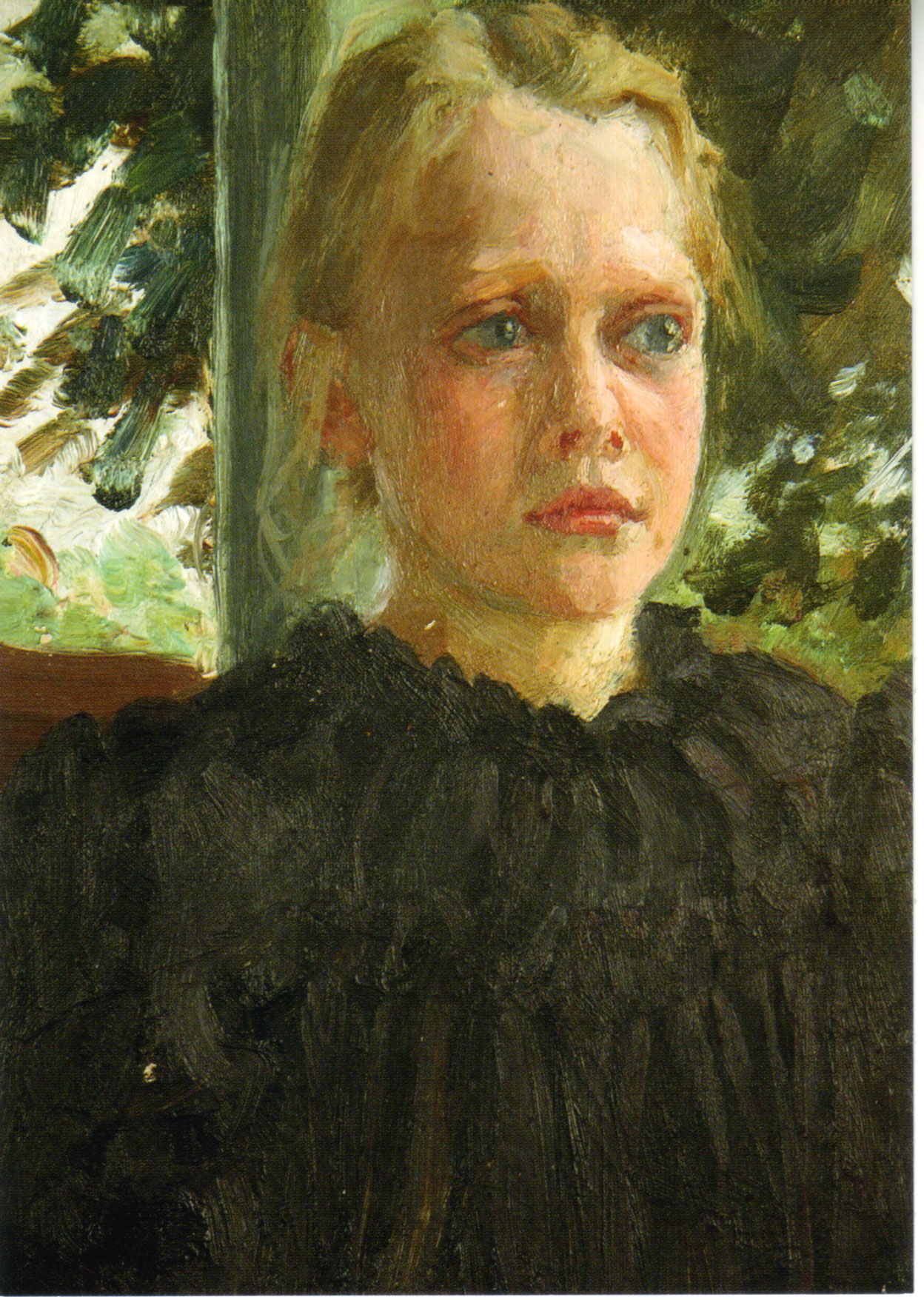
Julia Hasselberg

I found myself captivated by this portrait of Julia Hasselberg painted by Eva Bonnier. Eva Bonnier was a Swedish artist and this painting is of her lover’s illegitimate daughter who Eva adopted after Julia’s father’s death.

This girl has a look which is very familiar to me. It’s a combination of pain and resilience. There’s reserve, distance, independence and spirit here. The kind of spirit that emerges from suffering to strengthen and protect. I find it both moving and powerful.

You can find this portrait and others by Eva Bonnier along with a really interesting short biography of her on the Giornale Nuovo blog. Thank you for posting this Mr h.

All Eva Bonnier’s portraits which you’ll see in that post share these characteristics for me. These are powerful people, fiercely independent, with that special kind of strength which emerges from suffering. One thing that fascinates me is this description of Eva Bonnier

She is reputed to have been an intelligent, strong-willed and sharp-tongued woman who ‘could neither in private nor as an artist charm or flatter her contemporaries.’

How much does the character of the artist influence their portraits of others? How much do they see a bit of themselves in their subjects and, unconsciously, highlight those qualities in them? What do you think Ester?

Read Full Post »

It is that loving you as much as I have been able to manage has defined the person that I am. That is who I have become.

Sebastian Faulks. Human Traces.

How do we gain a sense of self? How do we answer the question “Who am I?” It seems to me that we gain a sense of self through the stories we tell ourselves and others. It’s a narrative process and it’s an always unfinished, creative process. We are all unique. Every time I conduct a clinic I meet new patients. Never once have I heard a patient tell me the exact story I’ve heard before. Everyone has a new, unique narrative. But this implies that the creation of a sense of self is all internal. It isn’t. We create a sense of self through our boundaries, our connections, our interfaces and interactions. We create a sense of self through our experience of love – its presence, its absence, its possibility, its loss.

Loving you, I become me.

Read Full Post »

Evolution is a passage from the most automatic to the most voluntary.

Sebastian Faulks. Human Traces.

The zombie life is the automatic life. Becoming the hero of your own personal story involves developing awareness and making more and more conscious choices.

Read Full Post »

ripples in the sand, originally uploaded by bobsee.

Then the long trail of her footprints, stretching back towards the sea, became slowly indistinct as each one filled with water and edged in upon itself; and in a matter of minutes, as darkness began to fall, the shape of the foot was lost at every place until the last vestiges of her presence were washed away, the earth closing over as though no one had passed by.

Sebastian Faulks. Human Traces

Read Full Post »

Human Traces by Sebastian Faulks (ISBN 978-0-099-45826-5) is a novel of ideas. Set in the late 19th, early 20th century it tells the story of two young men who become idealistic doctors, determined to work together to understand mental illnesses so that they can cure them. In addition, they hope that in understanding the interface between the body and the mind they will understand what it is to be human.

I found it really absorbing. Much of the discussion was around subjects which are very familiar to me – consciousness, the relationship between the body and the mind, the debate about whether mental illnesses have neurological bases or not, and the still young area of evolutionary biology. However, as a doctor, the book has additional relevance. After all, my experience is also one of idealism and hope; the belief that doctoring will be about curing, and the gradual erosion of that to aim at managing diseases instead of curing them (that last is a painful loss – for sure, doctors have cures for many acute diseases now, but the burden of illness is chronic disease and, sadly, we seem a long way off from finding genuine cures for those)

Sebastian Faulks floats an incredibly interesting hypothesis about the hearing of voices, having one of the characters, Thomas, propose that this was a facility that all human beings possessed but which has since been lost by most of us. He cites the literary evidence of Man’s relationship to God/gods where the earlier stories show people hearing voices which they obeyed – they experienced the daily reality of their gods; and later stories showing that people no longer reliably heard those voices and had to throw lots, examine entrails, find unusual characters (prophets) who could still hear the voices, in order to know what the gods wanted. He links this idea to the emerging concept of evolution and natural selection by proposing that the hearing of voices was linked to the development of consciousness and the loss of the voices was related to the development of self-awareness through the acquistion of language. If you are not familiar with any of these ideas this novel is a great place to introduce yourself to this area of thought.

However, this 609 page novel did not engage me emotionally……..until page 595. From page 595 to the very last word of the novel, it hit me like a sledgehammer. I didn’t just cry. I sobbed. I was totally unprepared for it. This is quite honestly one of the most powerful pieces of writing I’ve read. Maybe it hit me so hard because it touched so many issues which lie in the core of my being – what is it to be a doctor? what use am I to others? how do we get a sense of self and how does it feel to lose that to an illness like dementia? what does it mean to become invisible? and, ultimately, what trace do I leave on this Earth?

There are a number of phrases and passages which have stimulated a whole lot of things for me, and I’ll return to post about some of them separately.

Thought provoking, educational, well-written, and, ultimately, powerfully emotional.

Highly recommended.

Read Full Post »

« Newer Posts - Older Posts »