Feeds:
Posts
Comments

Archive for the ‘health’ Category

Right through to the vieux port

Herman Daly, senior economist at the World Bank, 1988 – 1994, who is a Professor at the School of Public Policy, University of Maryland, writes in the current issue of “Resurgence” magazine, about the need for a steady-state economy. He argues that the current pursuit of growth is neither sustainable, nor sensible, pointing out that there has been no growth in the quantity of the physical material of the Earth since it was formed, but that it continues to grow, evolve and develop despite that. This is an interesting perspective. It shifts the agenda towards evolution and development rather than acquisition and consumption and challenges us to think about qualities not just quantities. I was particularly struck by his closing sentences though –

So, in closing, I will only mention what seems to me to be the deeper issue. Is Creation the purposeless, random consequence of multiplying infinitesimal probabilities by an infinite number of trials, as taught by the reigning paradigm of scientific materialism? I say Creation with a capital C advisedly, and certainly not in denial of the well established scientific facts of evolution. Rather it is in protest to the metaphysics of Naturalism that everything, including evolution (by random genetic mutations selected by a randomly changing environment), is ultimately happenstance. It is hard to imagine within such a worldview from where one would get the inspiration to care for Creation, which of course Naturalists would have to call by a different name – say, “Randomdom”. Imagine urging our fellow citizens to work hard and sacrifice to save “Randomdom”! Intellectual confusion is real, but the moral nihilism logically entailed by deterministic materialism (Naturalism), uncritically accepted by so many, is probably the bigger cause of environmental destruction.

It’s one of those strange synchronicities of life that the new issue of Resurgence came through my letter box two days after writing a post about connections which provoked a discussion about randomness in the universe.

And, just to complete the synchronicity experience, I was discussing medical practice with a friend and colleague this week, where we agreed that “co-creation” was the way to go. There is a shift in the way doctors and patients relate to each other, and maybe one of the best ways to understand that, and develop it, is to consider one of the characteristics of all living organisms (as seen through the lens of complex adaptive systems) – that is the characteristic of “co-evolution”.

Co-evolution is a term used to describe how every organism inextricably exists within a context or environment, and as it is an open, dynamic system, there is constant exchange of energy and information which produces complex patterns of linked changes. Think how a group of human beings settling to live in a particular part of the world begin to change the physical environment by living in it, and how the physical environment in which live influences the way they live.

Co-evolution is a creative process, and isn’t this the characteristic which runs right through the entire story of the universe? Isn’t it the story of Creation? Aren’t we the co-creators?

Read Full Post »

As I was walking in a forest the other day I came across this –


new growth in the forest

I often feel a kind of thrill seeing new growth like this. It’s the emergence of Life on Earth. This little seedling might well grow up to be one of the great trees of this forest. How does it do that? How does this one little seed begin to sprout, begin to reach upwards through the decaying leaves on the forest floor, and seek out the sun, the air, and the rain?

And then a little further on, I find this tree….


tree

Don’t adjust your screen – it’s the right way up!

Look at these twists and curves and corners, as the tree reaches first this way, then another. Who could predict which way any of these branches would grow? Who could predict what this tree would look like today if they were seeing it back when it was one of those little seedlings pushing its way towards the light?

I see this everywhere.

I saw it every day with every patient I ever met. Who could have predicted how this person would be today, what life they would be living, and how they would be experiencing it?

Nobody.

That’s what gets me about the irrational arrogance of those who claim to know. Those who claim certainty. I am never convinced by those who claim they know what the results will be of a particular treatment for a particular individual. They can throw the term “evidence based” about as much as they like, but if they think that label gives them some magical ability to predict the future for individual human beings, then they are quite likely to be mistaken.

I don’t like the irrational arrogance of certainty in any area. I don’t like it in politics, matters of belief, wordview (religious, atheistic or scientistic), in economics, or any other human domain. Life is not predictable. Living organisms cannot be properly understood if represented as mere objects. All living forms are dynamic, open, complex systems. All are unique and together they are diverse. Commonalities matter, but so do differences.

If there is one thing I always doubt, it’s certainty.

But then, like Montaigne, I’m fond of saying “mais, que sais-je?” (“but what do I know?”)

Read Full Post »

Dandelion

I am currently reading a fascinating book entitled “The Secret Life of Pronouns” written by James Pennebaker, a psychologist who has studied the way we speak and write and how that relates to our personalities, to our illnesses and to our ability to heal wounds.

I was really struck by the section where he is discussing traumas and how people deal with them. He made the point that despite the fact that everyone experiences different traumas in their lives, most people neither become ill as a result, nor need specialist help.

That was one of those moments for me which is, on the one hand, and “aha!” moment, and on the other a moment of recognition/reaffirmation.

I think this observation applies to the whole of life and is fundamental when we think about health and health care but we’ve forgotten it.

Working as a doctor it’s easy to get the perspective that everyone gets ill and needs medical interventions, but that’s such a distortion of the reality of life. In fact, I’m reminded of what the Professor of Obstetrics said to my wife at her first antenatal visit. He said, “I see your husband is a medical student. Tell him that pregnancy and childbirth are normal experiences. As a medical student he will only see the situations where something goes wrong but for the great majority of women, things don’t go wrong.”

I was very grateful for that advice and it came back to me from time to time throughout my career. For most of us, for most of our lives, we are not thinking about our health, and we don’t need to seek specialist health advice. Of course I’m not denying the reality of morbidity and mortality. It’s also true that we will all experience illnesses and we will all, finally, die. It’s just that we have amazing adaptive abilities.

Take something like a flu epidemic. Only a minority of the people who are exposed to the virus will actually contract influenza. Only a minority for those who contract influenza will need specialist medical help. All of those who recover from influenza will do so because their body’s natural healing functions do what they are designed to do.

We do really forget that. There is no healing, other than that brought about by the body’s natural, adaptive, healing capacity. Yes, medical treatments can make the difference between life and death at times, it’s not that they are in any way irrelevant. But too often we think that healing is about medical treatment alone. It never is.

We humans have astonishing, natural, default abilities to deal with what comes along in life – whether that be mental traumas, physical traumas, infections etc. And when we do become sick, in every single instance we need our body’s self-organising, autopoietic abilities to do what they are designed to do.

Yes, if you are ill, you may well need specialist help, and please do seek it when you think you should. But don’t ever forget have the natural human ability to recover, to heal, and to be healthy.

Health is normal. Healing is normal. We should never forget that in all circumstances we should support and encourage those natural mechanisms.

Read Full Post »

Rose hips

Last few grapes

Human beings are very adept making medicines from plants.

Have you come across the Sacred Science project? (They have made a thought provoking documentary about plants used in healing in the Amazon – you can find it on vimeo, but google sacred science to learn more).

Many, many years ago in the Botanic Gardens in Edinburgh I saw an exhibition of the uses of plants by desert peoples. I’ve never forgotten it. I was so impressed with the market stalls they set up, with one displaying plants used to die clothes beautiful colours, and another one showing plants used to treat a variety of diseases. I remember thinking how on earth did they figure that this particular plant was great for dyeing your clothes purple, but this other is a great cure for diarrhoea?! It was that exhibition which introduced me to the whole field of ethnobotany……the study of Man’s relationship to plants.

A few years later I read that Samuel Hahnemann, the founder of homeopathy, first experimented with Peruvian tree bark (Cinchona). When I read about that medicine, which had been used to treat “swamp fever”, a disease we now know as “malaria”, I remember thinking how did the indigenous peoples of Peru know that this particular plant would treat this particular disease – a truth we confirmed many, many years later when we isolated the chemical, quinine, from this same tree, and found it was a good treatment for malaria.

I don’t know the answers to those old questions, but I am still fascinated by potential benefits we humans can receive from plants.

As I write this I’m watching the last few days of the grape harvest in Charente. Those grapes will be used to make cognac, using processes not that dissimilar to the ones we use in Scotland to make whisky from grain. I’m just learning that the various areas within the cognac-producing region of France produce extremely different flavours – just like the different regions of Scotland produce distinctly different whiskies. In both cases, the specific interactions between people and plants in these countries produce distinct and unique results.

What’s your favourite human-plant interaction?

Read Full Post »

In the A to Z of Becoming, second part, N stands for NEST.

photo

photo

photo


Although we normally associate nesting with birds, like this little one building his unusual upside down nest with its entrance from below, we also use the concept of nesting in our own lives.

In one way, our nest is our home. We all need a sense of home, and each of us will personalise our living space to create our own familiar nest. Have you thought about your home that way? What’s your nest like? How’s it doing? Have you made it the kind of nest you want to live in? Is there anything you’d like to change or modify to make it a more comfortable nest, make it more YOUR nest?

It’s interesting to look at the three photos above. They remind us that it takes time to build a nest. We don’t often walk straight in to a house and it’s instantly our home. It takes time, effort and choices to make it home. They also remind us that all nests are unique. There’s no single “right way” to build a nest. What’s important, is not only that it does the job of providing us with shelter, but that it feels like our home.

We use the concept of nesting in another way too, I think. Nesting involves some snuggling down, or, in old Scots’, to “coorie doon”. I’ve a friend who talks about the need for the occasional “Club Duvet Day”…..you get the idea. Sometimes we need to create a pause which involves making a small, comfortable space and settling into it for a bit.

So, what do you think?

Is there anything you could be doing to make your nest more the way you’d like it to be?

Or do you have the need this week to “coorie doon” for a wee while, to create a wee nest and settle into it – for rest, for restoration, for recovery?

Read Full Post »

I’m always interested in research which demonstrates ways in which we can support natural healing – after all, there isn’t any other kind of healing, is there?

Here’s an interesting study using writing practice

49 healthy adults aged 64 to 97 years wrote about either upsetting events or daily activities for 20 minutes, three days in a row. After a time lag of two weeks, to make sure any initial negative feelings stirred up by recalling upsetting events had passed, all the subjects had a biopsy on the arm, and photographs over the next 21 days tracked its healing. On the 11th day, 76 percent of the group that did expressive writing had fully healed as compared with 42 percent of the control group.

This particular exercise – writing about an important or upsetting event for 20 minutes each day for three days in a row – has been around for quite some time. James Pennebaker pioneered it, and has studied the effects of writing on health extensively. He says

People who are able to construct a story, to build some kind of narrative over the course of their writing seem to benefit more than those who don’t,” Pennebaker says. “In other words, if on the first day of writing, people’s stories are not very structured or coherent, but over the three or four days they are able to come up with a more structured story, they seem to benefit the most

What’s particularly interesting here is how the creation of story goes along with changing perspectives and understanding better what’s been happening.

Pennebaker’s research developed a computer-based, text analysis program to analyze word counts in different categories, such as emotion words (e.g. happy, sad, angry, joyful), cognitive words (e.g. realize, understand, think), self-reference words (e.g. I, we) and an additional 70 categories. Much to the surprise of the researchers, the change in emotion words didn’t correspond to improved health. The more powerful predictor of improved health was the use of cognitive words–that is, individuals who showed an overall increase in the use of causal words (e.g. because, reason) and insight words (e.g. realize, know, understand) showed improved health.

So it’s not just about telling a story, changing perspective or increasing understanding, it’s about improving immune function and both physical and mental health.

Read Full Post »

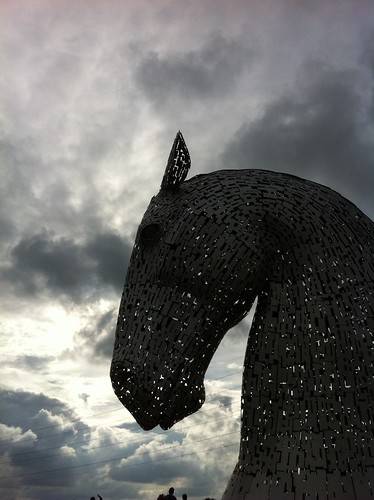
One kelpie

The kelpies

A fairly recent development just off the Stirling/Edinburgh motorway is the installation of these “kelpies”. I visited them at the weekend for the first time. They’ve been installed in a newly created park area which has lots of common space for roller-blading, cycling, walking, feeding ducks at the duck pond, a children’s adventure playground and so on, but everyone comes to walk around, and be amazed by, the kelpies themselves. I visited on a Sunday which is probably a more busy day but there were hundreds and hundreds of people there.

Kelpies are part of the myths of Scotland – I suspect most people aren’t that particularly familiar with them, but I wonder how many go home and read a bit about them. Wikipedia is a good starting point (but it does strangely include paintings which depict kelpies as naked females, when, in folklore in Scotland, the kelpie was invariably male)

I loved that so many people were walking, sharing time with family or friends, and gaining such sheer pleasure from this open air art. What a fabulous combination of art, community and healthy activity. Made me wonder if we don’t pay enough attention to the way art in particular can be a central focus of influence on our quality of life.


Read Full Post »

In the second series of verbs in the A to Z of Becoming, L stands for Laugh.

I think it’s been well established that “laughter is the best medicine” – and, the best way to test that is to try it yourself.

Humour, however, is very personal, so I don’t know if the things which make me laugh, also make you laugh.

Here are a couple of short videos which have made me laugh again and again over the years…..


What I suggest this week, is that you find what makes you laugh, and treat yourself……have a good laugh, you’ll feel the better for it!

Read Full Post »

image

That’s the statement I came across in an interview with a “new realist” philosopher the other day. I’m not going to get into what on earth is “new realist” here just now but when he was asked if science (or more precisely Physics) had proven that the universe had no purpose, that it made no sense?

Well that’s a claim we often hear from people who claim the only reality is physical, the universe is random, and evolution isn’t “going anywhere”. This isn’t a world view I’m attracted to.

My understanding is that human beings exist, and that we all have consciousness and subjective experience. Values are important to us. For example, you can look at that photo above and describe it according to its botanical classification. I look at it and see a beautiful image. It’s the beauty of the image which strikes me.

This philosopher said that science is the study of objects, whereas for human beings it was often something not at all like an object which brought meaning to life. The example he gave was democracy. He said what colour was democracy? What were its dimensions? Science has no answer to these questions. Because democracy is not an object, it’s something which gives lives meaning.

I don’t know about you but that certainly gets me thinking. What about the “sciences” which don’t deal with objects? Like economics, or psychology, or “social sciences”?

Then I got to thinking about health and how, as a doctor, I needed to understand the body in a scientific way. I needed to know what to measure when, and what to do with the results. But I also needed to understand the lived experience of a person. When they talked to me about pain, about an itch, about nausea or dizziness, they were not talking about objects which could be measured. And what about the narrative…..how a person experienced and made sense of their illness?

So, there is something helpful in this idea of science being the study of objects. It helps us see the relevance of science and the absurdity of scientism (which claims ultimate and absolute authority for the “truth” as revealed by science.

Objects are an important part of reality, but they sure aren’t everything that exists!


Read Full Post »

Healing first

tree repair

If you cut yourself, fall over and scrape your skin, or if you break a bone, your body’s healing response kicks in and makes a quick repair, then over a few days or weeks completely repairs the injury. Sometimes medical treatment is needed to support this process (cleaning the wound, applying a dressing, holding the broken bone in place with plaster, bandages, or even screws and plates), but the only way the damaged tissue recovers is through the body’s own healing system.

If you are infected with a virus or a bacteria, again your body’s healing response kicks in, attacking the offending organism, and repairing any tissues damaged by the infection. Antibiotics can kill some bacteria, and some viruses can be killed with drugs too, but we have no medication which heals the tissues or organs damaged by the infection.

There’s a third kind of disease/illness which isn’t caused by either trauma or organisms, and that’s the kind which is rising relentlessly, it seems, throughout the World. Everything from many cancers, to “inflammatory diseases” like asthma, “autoimmune diseases” like rheumatoid arthritis, chronic diseases like diabetes, multiple sclerosis, dementia and Parkinson’s disease, to genetic disorders, are understood best by us as pathologies, and whilst the body’s healing system constantly struggles with these disorders it never quite manages to throw them off. However, the healing response does try to limit damage, to repair what can be repaired, and to increase the over all resilience (defence and recovery) of the individual.

We seem to understand pathology better than we do healing. Maybe we need to invest more time, people and resources into changing that. 

And although people will always get sick or injured, and we will always need to find the ways to assist people with these illnesses, shouldn’t we also integrate actions and support which stimulate and enhance the healing response, not just in every therapeutic plan, but first of all, before we do anything else? (Well, of course, that depends on the urgency of the situation), but is there ever a case for ignoring the healing response?

Real healing is natural. But that doesn’t mean we can take it for granted.


Read Full Post »

« Newer Posts - Older Posts »