Feeds:
Posts
Comments

Archive for the ‘health’ Category

The biomedical approach to health and illness, not only puts lesions, or pathological changes in the body’s tissues or symptoms, at the heart of diagnosis and treatment. The idea is that disease is a physical phenomenon, with changes which can observed and/or measured. However, what drives patients to consult doctors is frequently not the sudden appearance of a lesion which can be seen. Rather, it’s often the experience of a symptom. Some of the commonest symptoms include pain, weakness and dizziness.

Researchers who have studied patients with common symptoms have found that in a large proportion of cases, there are no objective findings which might explain the presence of the symptoms. This may be dismissed as “in yer heid”, or “nothing wrong” but both of these judgements are unfair and inaccurate. The occurrence of symptoms in the absence of detectable tissue changes has been labelled “Medically Unexplained Symptoms” (MUS) This is a very, very common situation. Different studies have shown that a lack of a medical explanation may occur in 30% of all consultations at a Primary Care level, and in up to 85% of those with particular, common symptoms.

This is really a big problem.

  1. Firstly, all treatments, surgical or pharmacological, are directed against lesions – measurable, pathological changes in tissues or systems. So, in the absence of such pathology, modern medicine’s tools are hopelessly inadequate.
  2. Secondly, non-surgical and non-pharmacological treatments are not well developed, tested or proven, so patients in this situation often end up with operations or drugs because no other solutions are known, and these interventions all carry risks of harm, so patients find that not only are they not helped, but they end up worse off because of side-effects and other iatrogenic harms.
  3. Thirdly, patients in such a predicament often find their suffering dismissed as either psychological and sent for psychiatric treatment, or, worse, find that they nobody actually believes that they are experiencing the suffering they are complaining of.
  4. Fourthly, (and this one is hardly ever mentioned), the existence of “MUS” suggests that symptoms are not the reliable indicators of disease which doctors assume them to be. This leads to the problem of patients whose symptoms are ascribed wrongly to the discovery of pathology. Just because some inflammation is found, or a growth is found, it does not mean that this pathology is the whole cause of the symptoms which the patient is experiencing. In fact, it does not even mean that the pathology is the partial cause of the symptoms. This can lead to the prescription of drugs or the carrying out of surgical procedures which make absolutely no impact on the patient’s suffering.

The concept of “Complex Adaptive Systems” gives us another whole way of understanding such diverse and difficult symptoms – the problem need not lie in a body tissue or in the mind – the problem can lie in maladaptation or malfunctioning of the system as a whole. Such a concept leads to a demand for holistic interventions, because no simple, single-explanation, solutions can work.
Read Full Post »

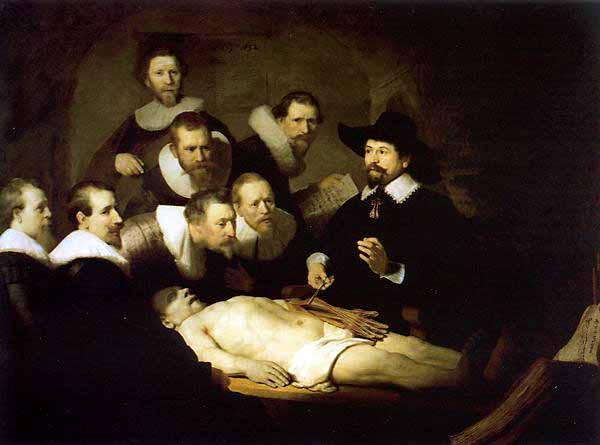
The rationale for what is known as “orthodox”, “Western”, or, more accurately, “biomedical” medicine, is very materialistic. It’s focussed on the physical, and has been since the morbid anatomists of the 15th and 17th century Parisian hospitals began conducting post-mortem dissections and claimed that disease was what you could see, touch, and measure. This reduction of human suffering to physical components was a new phenomenon which was dramatically captured by Rembrandt in The Anatomy Lesson of Dr Tulp.

This combined with Bichat‘s concept of “the lesion” focussed the attention of doctors and scientists on smaller and smaller parts of the human body. The development of the microscope knocked the morbid anatomists off their dominant chairs by showing that disease was not just what you could see and measure with your own eyes, but was actually a disturbance of, and within, cells. Further technological developments allowed smaller and smaller components of human beings to be studied and measured, and this has continued up to the present day, to the extent that “diagnosis” has become the art of interpreting machine-generated measurements of body components and even an examination of DNA.

But human beings are complex adaptive systems, and the more complex a system, the less you can understand it by only examining its parts. Pain cannot be understood by a simple consideration of neural pathways, cell receptors and short chain proteins. Depression cannot be understood by a simple measurement of serotonin levels. And health cannot be understood by adding up a whole list of biological metrics.

As Mary Midgely said,

One cannot claim to know somebody merely because one has collected a pile of printed information about them.

However, most of our interventions are devised within this materialistic and reductionist framework.
Most surgical interventions are intended to remove diseased, or “abnormal” tissue. Most non-surgical interventions involve the use of drugs – manufactured molecules intended to interact with molecules within the human body.

In many cases, this approach pays off. In managing acute, life-threatening disease it is very effective. You are less likely to die in the middle of heart attack, an asthmatic attack or an epileptic fit now than you would have been fifty years ago. The problem lies with chronic illness, where this approach is not nearly so effective. The chances of having heart disease, asthma or epilepsy is greater now than it was fifty years ago, and there are still no cures. There are no known treatments which will cure these chronic problems.

Maybe this is partly because the more chronic the problem, the more unique, the more personal, the experience and its manifestation. Maybe we need a different approach because whole people cannot be understood as mere sums of their parts.

We need to put molecules and materialism into their most useful contexts and not assume that they present the only truth.

We need to design health care around whole people, not bits of them. Let’s have Person Sized Medicine.

Read Full Post »

We all love simple solutions. Human beings have such strong urges to understand. We are driven to try and make sense of our experiences and our lives. It could be argued that this drive is a significant factor in human survival and development. It’s a good thing to try to understand. What’s not appreciated so much is the value of doubt. Whilst it’s good to understand, it’s the belief that we never completely understand anything that drives our continual growth. Without doubt, thought stops, reflection ceases and learning hits the buffers.

I’m not arguing for obfuscation. I do like clarity. But the reality is that we are complex creatures living complex lives. Health and illness cannot be reduced to simple formulae or single causal factors. It’s for these reasons that I find myself so impressed with the recent work from the Glasgow Centre for Population Health which has just published an interesting piece of research.

They have studied 20 European regions to make comparisons with the experience of the West of Scotland. The regions they studied were similar to the West of Scotland in terms of de-industrialisation, deprivation and poverty. What’s happened over the course of the second half of the twentieth century is that the West of Scotland has fallen behind all the other regions. Life expectancy figures and a whole bank of illness and health measures have shown all the other regions are improving faster than the West of Scotland.

There’s a common and fairly simplistic view that deprivation is the main cause of ill health, but deprivation cannot explain the differences between the West of Scotland and other similar regions. That’s the somewhat startling conclusion of this study. If deprivation cannot explain it, then what is the explanation? I’m impressed that the Centre for Population Studies has explored a number of possible explanations but hasn’t found any of them to be satisfactory. However, complex causes such as income inequality (it’s been repeatedly shown that the greater the income inequality within a community, the poorer the health experience at any discrete level of wealth), migration and the speed of change (de-industrialisation), are probably all significant, whilst, simple explanations such as absolute deprivation scores, cigarette and alcohol consumption, and so on, cannot explain the differences.

Health is a complex phenomenon and this kind of adult, intelligent research is just what we need.

Read Full Post »

A rather disturbing report from the Healthcare Commission in England has found that less than half the staff in the NHS believe that patient care is top priority for the Trusts which provide NHS services.

That’s pretty shocking. Shouldn’t it be clear to everyone who works in health care that THE top priority should ALWAYS be patient care? There’s something going badly wrong if patient care is NOT the top priority. Health care is about people, and there are two groups of people who are very important in delivering health care – the patients and the carers (staff). This latter group, as far as the NHS is concerned, are not a happy group. The same report states that only one in four staff members feel valued by their bosses.

There’s been something going on in the NHS in recent years……a form of managerialism which has introduced management methods from industry and commerce which are not appropriate in health care. “Agenda for Change” has broken NHS staff morale, and is probably one of the key factors causing staff feelings of being undervalued. And targets based on throughput and so-called outcomes is producing a health service which has lost sight of its main purpose.

Health care should be about caring – caring for the people who use the service and those who provide it.

Read Full Post »

One of my patients today told me a terrible story of her experience undergoing surgery. I’m not going to recount any of that here of course, but she made such a good point to me I thought I’d share it with you. Maybe you agree?

She said, whenever a drug is prescribed, even if the doctor doesn’t go into a lot of detail about the possible benefits and potential harms, when you pick up the medicine from the pharmacy, the packaging contains a pretty comprehensive description of the product, including a list of the known, potential harms. This, she said, allows a person to make a fairly informed choice about whether or not to take the drug. However, there don’t seem to be any such leaflets available about surgical procedures.

Why not? she asked. There are “generic” potential harms – anaesthetic risks, infection risks and so on – which could easily be desribed, and then, surely there are known “specific” risks related to the intended procedure. Couldn’t the Royal College of Surgeons organise its members to develop comprehensive written information to be given to any patient before an intended procedure? Wouldn’t that allow a more properly informed consent?

I think this is SUCH a good idea. I’m not aware that such a thing exists at the moment. If it does, could you point me to it?

Thank you

Read Full Post »

coffee
I recently posted about the claimed health benefits of tomatoes, and continuing in that vein………something else I really enjoy is my daily coffee.

Apart from enjoying it, can I add a little health-benefit smugness to my mug? Turns out I can! Recent research has shown that caffeine protects the “blood brain barrier” from the damaging effects of cholesterol. One of the many ill-effects of cholesterol is damage to the tissues which protect the brain from toxic substances circulating in the blood. The researchers believe this may explain the potential for a coffee a day to reduce the chances of getting Alzheimer’s Disease.

Like with the tomatoes, I don’t really need other reasons to enjoy coffee, but it’s good to know I can consider it part of my healthy lifestyle!

Read Full Post »

Mmmm….delicious, originally uploaded by bobsee.

Who would have thought that tomatoes could be controversial?

Well, if you agree with this person – you’ll think they are fabulously health-giving (offering all kinds of protection against cancers)

But, if you agree with this person – you’ll think they are some kind of abomination  (because they are from the nightshade family)

Me? I think they look and taste delicious! Insalata Caprese is my favourite. I first tasted this on the Island of Capri and it was very simple there – tomatoes, mozarella and basil drizzled with olive oil. Mmmmmmm (psst – heard about mozarella?) Ho, hum…..is nothing safe any more?


Read Full Post »

We do live in a “pill for every ill” society. Arthur Frank, in his “Wounded Storyteller” describes the commonest type of story told by patients in contemporary society as being the “Restitution Story”. By this he means “I’m broke, Doc, please fix me”. He says it’s the fast food approach to health, the quick oil change while-you-wait approach. It’s technological and it’s based on a conception of illness as being about a bit of the body that’s not working and on a conception of Medicine as being about applying the right technology for the quick fix.

Whilst this approach has delivered dramatic results in acute situations, it’s done really nothing in the long term for chronic ones. Even in societies where the burden of death and disability from infectious disease has been reduced we are seeing steadily growing rates of chronic illness. The quick fix approach doesn’t deliver long term health and it doesn’t deliver a very effective fix!

Here’s a paper from the “Harvard Health Letter“, headed “Managing Seven Common Conditions without Medication”.

In summary, they say Arthritis – lose weight, gain mobility and less pain; Cholesterol – drop your LDLs (bad blood fats) 5% by keeping saturated fats off your diet; Cognitive decline – brain exercise and physical exercise slows this up; Depression – regular physical activity lifts mood; Diabetes – regular physical activity drops sugar levels; High Blood Pressure – lose weight, regular exercise; reduce salt and drop your BP; Osteoporosis – lose weight and eat more vit D and calcium for stronger bones.

OK, so not exactly rocket science – basically lose weight and exercise more – but at least it’s a start. It’s the mentality behind this report that appeals to me though. When our first concern with an illness is what drug to take or operation to have, we’ve missed the boat. Our first concern should be “what do I need to do differently?” because if you keep doing the same you’ll just get more of the same! But I think we need to push this agenda a lot further and into areas so far pretty unexplored. Sure, things like smoking, alcohol, drugs, diet and exercise are all modifiable factors in our lives which can influence which diseases we get and how those diseases progress, but we need to think of whole people, and not solely in this kind of mechanical or reductionist way. Mental states are significant factors in maintaining health and in determining recovery – positive attitudes, empowerment, hope, loving and being loved aren’t talked about so much by doctors or health care providers but they should be. In fact, if we treat people as only physical bodies we don’t treat them as human beings at all. We are much more than our physical selves.

So let’s all agree that diet, exercise and drugs are important considerations in health and illness, but what other factors would YOU consider? What about writing for example? Or music?

What factors are important in YOUR life to keep you healthy, or that you’ve found were important parts of your recovery from illnesses?

Read Full Post »

The other night there I had a strange dream. I was trying to diagnose what was wrong with a patient but his symptoms kept changing. They didn’t change one by one, but in whole sets. It was like he was flipping from one disease to another over a matter of minutes, making it impossible to pin down what was actually wrong with him. I was thinking (in my dream) that I’ve often seen rapidly changing and vague collections of symptoms but this was different. Then I realised there was something additionally strange about this man. At one moment he seemed to be distant, aloof, faraway, as if not in this world at all, then the next he would be fully present, talking and answering questions. It was as if in addition to his rapidly changing sets of symptoms there was a flipping in and out of the world. At that point in my dream I heard a voice inside my head (you know the way we do sometimes in dreams – a clear voice but without an obvious source, a voice from within your own head but somehow everywhere around you at the same time). The voice said “He’s got dimensional slippage”. Pardon? “He’s got dimensional slippage. I think this may be the first recorded case” Well, then that other thing happened that only seems to happen in dreams – I knew exactly what the voice was talking about (suddenly I had knowledge I hadn’t had before). I knew in that instant that the problem this man had was that versions of himself from parallel universes were seeping into each other; that “normally” parallel universes are inaccessible from within each other and not only did this man have something wrong which had undermined those normal boundaries of existence but that his very illness was a proof of the existence of a multidimensional multiverse. (Bear with me here. If these terms are unfamiliar to you, believe me, they were unfamiliar to me too – well, not totally of course, but at that moment I couldn’t have explained to you, had you asked me, what it meant to have more than 4 dimensions in the universe, what a parallel universe actually was, or what the term “multiverse” really meant!). That’s the point where I woke up. Now, normally I probably dream every night but only have that knowledge of dreaming that we often wake with, a knowledge that is totally absent of detail. But every now and again I have a vivid dream, and every now and again (much less often) that dream comes with a feeling of significance. I wake thinking “that was an important dream”. But, of course, I’ve no idea why! That’s the feeling that dream gave me. I feel it was important but I didn’t understand it and I don’t know why it’s important.

So, what did I do?

Well, I started to try and find out what more than 4 dimensions would look like, because I really wasn’t sure I’d grasped that idea very well at all. And I did a bit of reading to see if I could understand the concept of multiple parallel universes – “multiverses”.

First I found this short video –

then, this fascinating interview with Lisa Randall –

So now it became clear to me that when mathematicians and physicists talk about dimensions, they are referring to dimensions in space. And as Lisa Randall points out, there’s really no way for us to picture more than the three dimensions of space (up/down, right/left and back/forward) along with the fourth dimension of time.

But somewhere in my musings about the dream I got to thinking “what is a dimension anyway?” Isn’t a dimension something we represent with an axis on a chart? Every axis represents a spectrum, doesn’t it? Thinking that way, consciousness is a kind of dimension. Every day we move up and down the axis of consciousness from sound asleep to awake and aware. When I thought of my dream patient becoming more or less present, I thought of a dimension of presence. People are like that, aren’t they? They move back and forward between being fully present and having drifted off, as if to some other planet. What if each of us moves back and forth along an axis of presence? And what if, just like visible light is only a small part of the electromagnetic spectrum, the visible body is only a small part of the axis of presence? Then maybe we fade away, as old people often seem to, and, maybe ghosts (if they exist!) are people beyond the visible part of the presence spectrum? Hmm….

There are many dimensions we can imagine this way. I know, of course, this is not what physicists mean by dimensions, but if co-ordinates along a number of axes situate an object or a person, then maybe imagining where we are beyond the spatial and temporal dimensions, gives a different way of considering our lives here and now.

I thought of the dimensions of consciousness, of presence, of emotions like happiness/sadness, and of a 3 dimensional group  (like space is 3D) of body/mind/spirit.

Which dimensions would you consider important in your life, and where are you along each of them now?

Maybe my dream was just a way of getting me to think about the multiple aspects of a human life, and to consider that we are all in a constant state of flux and change, moving back and forth, up and down and along multiple axes or dimensions. And maybe the diagnosis I was looking for wasn’t “dimensional slippage” but the dis-integration of the whole self. After all, that’s probably the closest I get to understanding what illness actually is…..a dis-integration of the whole self.

Read Full Post »

Every time I see a patient for a first consultation I draw the following diagrams to explain what I’m trying to do and how it might fit with whatever other treatments they are receiving.

First I draw two simple shapes –

becoming unwell

I say, “The circle on the left represents health and the disordered looking circle on the right represents ‘not health’. In acute diseases, it’s usually pretty easy to understand what’s caused the problem (represented by the red arrow). For example, along comes the flu virus and gives you flu, or along comes the number 6 bus and knocks you down and breaks your leg”. “The whole purpose of undergraduate training in medicine is to teach doctors how to recognise the disordered circles. It’s called ‘making a diagnosis’. This training focuses on the disease or the lesion. The doctor says ‘I know what this is. It’s the flu.’ or ‘You’ve got a broken leg’ or whatever. Whatever the problem, the body sets about its normal activity of trying to repair damage and restore health. This process is represented by the sweeping purple arrow –

well/unwell

“Interestingly, because doctors are trained to diagnose the problem in terms of the disease, all the treatments you are offered are intended to fight, suppress, or remove the disease. What the treatments are not designed to do is enhance the process represented by the purple arrow. Benjamin Frankin understood this. He said ‘God heals and the doctor takes the fee’. It seems strange to me that at medical school we only learn about pathology, about diseases and how to fight them, when, in reality, nobody, but nobody, gets better from any illness without the healing process working. It’s the body’s own capacity to self-repair, self-heal and self-restore which returns, or attempts to return you to health. Treatments directed against diseases might give the body a better chance to do that. In fact, with many diseases, the problem may be too serious for the body to manage to self-heal without the support of fighting the disease. Fighting the disease isn’t a bad thing. It’s just not enough. We need to see what we can do to support and promote your self-healing.”

I then add the following elements to the diagram –

chronic illness

What this shows is the addition of arrows, representing treatments, on the top right directed against the disease. The horizontal lines represent the kind of wall these treatments attempt to put between the disease and the outside world. Many, many treatments are called “anti-something” – anti-biotics, anti-inflammatories, anti-depressants, anti-hypertensives – that’s because most treatment is intended to act against the disease. I point out that, that may be important to do, but that what is missing are the treatments represented by the arrows added on top of the big purple arrow. These represent any treatments intended to support and stimulate the processes of self-repair and self-recovery. (I might then have a discussion with the patient about what factors influence these processes). The final element of this little diagram is the addition of the arrows around and within the circle which represents health.  What I say about them is “In acute disease, as we already discussed, the cause is often obvious and single. In chronic diseases, however, the factors which have produced the problem are typically multiple. The aetiology, or origin, of chronic disease in a person is multifactorial. Some of these factors may be internal – genetic factors, hormonal and nutritional factors for example. Some of them will be external – impacts from the environment, viruses, bacteriae, physical trauma, emotional and psychological traumas and so on. Really anything which impacts on you as a person can impact on your health, and may be a factor involved in causing the illness.’

I find this introduction opens up a holistic, mind-body approach to any illness, empowers the patient, allows for their to be hope, and takes away any “either/or” thinking about dealing with illness from a biomedical perspective of fighting the disease or a biopsychosocial perspective of helping a person with an illness to recover better health.

What do you think? Tell me if this is clear and whether or not you think it is helpful. It’s easy for me to adjust the conversation with the patient at the time, but in a little post like this it might not be so clear?

Read Full Post »

« Newer Posts - Older Posts »