Feeds:
Posts
Comments

Archive for the ‘health’ Category

In How Doctors Think, Jerome Groopman, argues against the modern tendency to reduce human beings to averages and medicine to a slavish adherence to algorithms.

Clinical algorithms can be useful for run-of-the-mill diagnosis and treatment….But they quickly fall apart when a doctor needs to think outside their boxes, when symptoms are vague, or multiple and confusing, or when test results are inexact.

There are some people who think “science” (which has been defined as the study of what can be measured – not a definition I would accept!) is about “facts”. By this they tend to mean phenomena which can be isolated and observed objectively. But human life is more complex than the sum of the bits that such scientists study. This is especially obvious to anyone who has worked in a Primary Care setting where patients typically tell stories of “vague, or multiple and confusing” symptoms and where the test results are frequently ambivalent. You can’t understand a person by focusing simply on the measurable bits.

Today’s rigid reliance on evidence-based medicine risks having the doctor choose care passively, solely by the numbers.

You know, it’s almost considered heresy in some places to raise any kind of question mark over the hegemony of EBM, but if we want to be rational human beings who think for ourselves and don’t just do what others tell us, we should question those practices. Those who would try to divide all therapeutic interventions into “proven” and “unproven” and devise “guidelines” which  only allow for the availability of the “proven” treatments are going to stop progress in its tracks. There are not two fixed boxes in medical practice with one containing “proven” treatments about which all that needs to be known is known, and one containing “unproven” treatments about which we needn’t bother finding out any more.

Statistics cannot substitute for the human being before you; statistics embody averages not individuals.

When I read that statement I thought about a talk given by a statistician which pointed out that the average number of legs which each person in the UK has is less than two – yes, think about it for a moment – because thousands of people have lost a limb the total number of legs is less than 2 x the population of the UK, therefore the average number of legs a UK resident has is 1 point something! I know, it’s silly, but it does make a valid point – you can’t treat individuals as averages – frequently, there is no Mr or Mrs Average!

What is Dr Groopman’s recommendation in the face of this? Well, he quotes one of the doctors whose conversations make up the text of this book –

Falchuk paused “And once you remove yourself from the patient’s story, you no longer are truly a doctor”

Patients’ stories are frequently dismissed by scientists as anecdotes (and they say that contemptuously) but in clinical practice they are really the key.

Here’s to the patients! You are the heroes of your stories.

Read Full Post »

“How Doctors Think” by Jerome Groopman (ISBN 978-0-618-61003-7) should be on the recommended reading list of every medical student and doctor. Dr Groopman is a physician who specialises in Haematology. This book is the best presentation on the cognitive processes involved in medical decision making I’ve ever read. Actually it’s main focus is on how doctors make a diagnosis and on their cognitive errors which result in them missing or mistaking the correct diagnosis. It’s clear and it’s comprehensive. It’s the kind of book that stimulates me to think about a number of aspects of medical practice and I’ll probably do individual posts about a number of them.

My summary understanding of this book would be that doctors make diagnoses by recognising patterns – that certainly seems consistent with what I think about my own practice. The key to this is the doctor-patient relationship. It’s the patient’s narrative that holds the key and the effect the patient has on the doctor colours how he or she hears that narrative.

My one criticism of this book would be that the whole focus is on the discovery of the “lesion” which is the source of the symptoms. Trouble is, as Kroenke and others have shown us, the vast majority of symptoms presented to doctors don’t come from “lesions”. I’d have liked to read Dr Groopman’s take on that huge issue.

Read Full Post »

Iona Heath wrote an open letter to Gordon Brown in the BMJ this week. She quotes his recent statement on preventitive services in the NHS –

…..an NHS which:”Identifies your clinical needs earlier than before, is targeted to keeping you healthy and fit, and puts you far more in control of your own health and your own life. And in the long run a preventive service personal to your needs is beneficial not just to individuals but to all of us as we reduce the cost of disease.”

She reminds us that Beveridge said at the time of the setting up of the NHS that he –

envisaged “a health service which will diminish disease by prevention and cure.” He foresaw “development of the service and as a consequence of this development a reduction in the number of cases requiring it.”

It was nonsense then and it’s also nonsense now. Neither the disease-focussed treatments of the NHS, nor the screening and early intervention strategies proposed will lead to a healthier nation. Iona Heath writes –

Medical science does not save lives, it defers death. No one lives for ever and, on average, a quarter of a lifetime’s costs of health care are incurred in the last year of life, whenever death occurs. Preventive health care, when it lengthens lives, exposes people to other health risks and cannot reduce costs. You imply that preventive health screening is an entirely benign endeavour and you make absolutely no mention of the well recognised harms of screening. When those who consider themselves healthy submit themselves to screening, they confront the possibility of serious disease and inevitably this can cause a burden of anxiety that varies from the trivial to a severity amounting to disease in itself. Every screening test gives both false positives and false negatives: the one dangerously reassuring, the other leading inevitably to further investigations that become increasingly invasive and risky.

and

Your problem as the financial custodian of the health service is that much of the burgeoning pharmaceutical treatment of risk factors is futile. Once a risk has been identified and treatment initiated, there is no way of knowing whether the treatment is effective but, none the less, it must be continued. The outcomes are negative, can only be measured at the population level, and cannot be assessed in relation to the individual taking the medication. A health service based on need and the relief of suffering is affordable by a tax paying population; one based on treating every identifiable risk factor is not.

These excellent points are not heard often enough. Too often the drug treatment of a risk factor is promoted as being life saving. Even if it did what it claimed to do it would not save lives……it would change the cause of death and in doing so alter the life experience. This is not the way to help more people experience better health for more of their lives.

Dealing with poverty, the enormous and increase disparity in incomes, improving housing, education and the experience of work, have all been shown to be factors which help to improve the health of populations. These interventions don’t try to pick off risk factors one at a time, they improve quality of life and resilience overall.

Isn’t it time we started to take on board that health is not the mere absence of disease, and therefore to understand and promote what is genuinely healthy instead of focusing on disease avoidance?

Read Full Post »

Jason Robert, of Arizona State University, made a presentation on Feb. 16 at the American Association for the Advancement of Science annual meeting. The focus is on mental health, but I think if you take a whole person understanding of health and illness you’ll agree that his points apply to all of health care.

“My claim is that gene maps and brain scans will likely not be able to offer universal, culture-free representations of the essence of mental illness. That is, mental illness is subject to biological and socio-cultural factors, such that isolating any of these as core elements will almost always miss the mark at the expense of patient care,”

He talks about how “personalised medicine” is being presented as a focus on DNA, with promises of new understandings of disease and new treatments which emerge from this genome-focus.

“None of these predictions have borne out, in part because they fail to grapple with the complexity of human beings — as brains, bodies, and, embedded in culture, steeped in history, and dynamically creating their own words,”

How well said! The attempts to reduce human beings to their elements, isolate those elements and treat them as if they were not a part of a whole, are doomed to failure because that’s just not how human beings function. It’s not real. What’s real is that the mind and the body are not two separate entities but are both manifestations of the one organism and that organism is embedded in physical, social and cultural environments – embedded – cannot exist in any kind of environment-free setting (if you could even imagine such a possibility!). And, his final, crucial point in that quote above – “dynamically creating their own words” – more than that, we can see that we actually create an entire sense of self from our own words….from our personal narratives.

He says

“We feel this newest generation of physicians have to be deeply well-trained in genetics and neuroscience, but not at the expense of a deep and meaningful training in interpersonal communication, interaction with actual people who really at the end of the day are your patients and your first priority,”

We really are in danger of losing this. The current trend is towards an increased dominance of statistics, management methods and pharmaceuticals. At the end of the day we are going to have to reclaim the central priority of the individual patients doctors see every day. I’ve just finished reading Jerome Groopman’s excellent “How Doctors Think” (which I will write a few posts about in the coming days) and he makes it so clear that without conscious engagement of the doctor with the individual patient, really nothing can go as well as it should. I’ve been teaching Fourth and Fifth Year Medical students this week and I was pretty shocked to hear from them that when they are being trained to “take a full history” ie to meet a patient for the first time and hear their story, they are only allocated 20 to 30 minutes to do so. When I was at Medical School, as beginners we were given an hour to that job. Once you moved from being a student to being a doctor the time pressures ratched up enormously and you had to hone your case taking skills down to just a few minutes in acute situations. However, at least you had a thorough grounding in a more comprehensive, patient-centred history recording. (Groopman says every generation of doctors thinks they were better trained than the current one. In terms of making a diagnosis from the history alone I’m afraid I am guilty of sharing that belief – is it true?)

In arguing the case for not oversimplifying our cultural understandings of people, he says

“We shouldn’t pretend that culture is any easier to understand than a person is; to understand that you can’t have caricature of culture in mind. What’s really critically important is understanding cultures dynamically, as complex, historic, social and political structures that dramatically influence people’s lives.”

I like that because I think there is a real tendency in all of us to stereotype people on a cultural basis without really understanding the culture at all. I also like how he points out that culture is a dynamic phenomenon, not a fixed one.

The conclusion of the piece is absolutely spot on –

While Robert acknowledges that it’s certainly the case that DNA and brain scans are going to be important, “if you ignore everything else, you might never have the capacity to actually influence the well-being of the patient.”

Well said!

Read Full Post »

I feel most uncomfortable about the direction of health care delivery in England just now. It’s not just the supermarket type of ethos of purchasers and providers which I dislike, but it’s the compartmentalisation of human experience into boxes labelled “disease” or “risk factor”. This reduction of a human life to “manageable” units each of which can then be dealt with by any faceless and nameless practitioner is deeply disturbing.

Surely health and illness are human experiences? Neither can be properly understood from averages and statistics. Neither can be understood or engaged with meaningfully without consideration of both the personal, subjective experiences which the patient relates through their unique narrative, nor without consideration of the contexts of an individual’s life. But more than that – isn’t health care a human activity which cannot be understood outwith the human relationships of those involved?  Doesn’t it matter exactly who the doctor is?

Lord Darzi is promoting the development of polyclinics (also rather offensively I feel, referred to as “one stop shops”) where many, many doctors work in the same building. He says the days of personal relationships with individual doctors are behind us as most single handed practitioners now practice in at least groups of 4 – 6, so what’s the difference if they practice in groups of dozens? Aren’t they all interchangeable?

I really disagree. Who says that an individual practitioner is a bad idea? Take a look at Tom Bibey’s blog for a most excellent example of what a single handed doctor can do. Clinical practice is about people, not populations. A trusting relationship built up between a patient and an individual doctor is worth its weight in gold. We only see this being devalued when we move from a concept of health care which reduces human beings to diagnostic categories.

I would suggest that what health care needs to do is to enable the creation of better, personal, holistic services and that will only be achieved by putting “whole” people, and human relationships, at the heart of the plans.

Health and illness are about people. It’s personal medicine we need, not processing plants.

Read Full Post »

Prescribing statins (lipid lowering drugs) prophylactically to try to reduce heart attacks has become big, big business. Just one drug, Lipitor, made by Pfizer, made $12.7 BILLION of sales last year alone. Health Insurance companies in the US, and the national GP contract in the UK reward doctors for putting patients with “high” cholesterol onto statins to produce lower blood levels in those patients. But does this do any good?

Many studies have shown that if you prescribe statins to people who have had a heart attack, then you are likely to reduce the rate of death from strokes and further heart attacks. For every 28 patients over 65 with heart disease who take statins, one life will be saved. The population based West of Scotland study showed you needed to treat 715 men to save one life.

However, studies of those without heart disease, and those aged over 70, have failed to show any significant lowering of mortality from the consumption of statins.

There are two other problems with statins – firstly, if they do what they say they do, they will reduce deaths from heart disease. What they don’t do is improve the quality of life of those who take them. Secondly, many experts believe the incidence and severity of side-effects from taking statins for many years is unknown, and probably underestimated.

We are right to be sceptical of drug company sponsored “evidence” when considering mass treatment of healthy individuals whose cholesterol level happens to fall outside the promoted “norms”. This is a problem which is widespread in medicine. A finding from one group of patients is turned into “evidence” and is then applied widely to groups of the population who are significantly different from the experimental group.

Read Full Post »

Michael Pollan has written a Change This Manifesto about his new book “In Defence of Food”. I love the opening line –

Eat food. Not too much. Mostly plants. That, more or less, is the short answer to the supposedly incredibly complicated and confusing question of what we humans should eat in order to be maximally healthy.

In a three part book, he attacks the dominance of “experts” who promote a reductionist idea of nutrition based on components which are not foods; the Western diet with its imbalances and overload of processed foods; and sums up with 12 commandments to escape from the effects of the Western diet.

Essentially, he is arguing for us to eat whole foods, not industriously produced so-called foods which are manufactured from components; to enjoy our eating as a social experience; and for us to eat more fruit and veg, and less meat. The conclusions then are not ground-breaking but I like the simplicity of the message and the call to treat food as food, not as some utility, and to enjoy the sharing of meals.

Read Full Post »

There has been an accepted wisdom in the management of diabetes. Diabetes, as you probably know is a disease which presents with abnormally high levels of sugar in the blood. It’s actually a complex disease and involves much more than sugar levels but doctors, dietiticians and other experts have always worked on the premise that if you can “normalise” the patient’s blood sugar level, then you’ll reduce the risks they have of the serious harms that come with this disease. One of the most serious potential harms is death from heart disease. Now a study which has run for four years has come up with a totally surprising result.

Researchers took people who have “Type 2” diabetes (by far the commonest form of diabetes, and not the kind that usually required insulin treatment – that’s the kind that affects younger people mainly) and they randomly assigned them to different groups. The study is looking at management of sugar, cholesterol and blood pressure. The groups studied for sugar control were divided into an “intensive” control group and a “less intense” control group. The former group has had diet and drugs to try to maintain a blood sugar level the same as that found in people who don’t have diabetes. Everyone expected that the less well controlled group would suffer more heart disease but the study has just been stopped because so many more people in the “intensive” control group have died from heart disease than in the less well controlled group. This is totally contrary to expectations, and, so far, nobody has come up with an explanation.

The researchers are at pains to say that diabetics shouldn’t give up their drugs because we don’t yet understand what’s going on here and there is still clear evidence that blood sugar levels which go sky high pose a serious immediate risk to health.

Here’s the statement which really struck me though –

Clearly, people without diabetes are different from people who have diabetes and get their blood sugar low.

I suspect the answer to this puzzle will be found when that conclusion is taken on board. Human beings are just not like machines, and the idea that health can be achieved by managing to control the level of a single particular component of the body within an artificially set of “norms” is misguided. You don’t cure diabetes by assuming the only difference between a diabetic and a person without diabetes is the level of the blood sugar.

This is an excellent example of why we need to understand health and disease from a complexity perspective rather than a simplistic, reductionist one.

Read Full Post »

Healing trees – the Kaki tree

I lived in Edinburgh both as a medical student and as a general practitioner for a couple of decades. One of my most favourite places in the world is in Edinburgh – The Royal Botanic Gardens. The gardens are pretty extensive and you can see something different every single time you go. I used to go several times a week when I lived close by. Click here and you’ll see a satellite photo of the gardens to give you an idea of their scale. Whenever I had visitors come to stay for a few days, I’d take them to “the Botanics”.

So one day I took two Dutch doctor friends of mine for a visit to the gardens. Like me, they specialise in homeopathic medicine and as we walked around the gardens they were telling me about a homeopathic medicine prepared from the Diospyros kaki tree which survived the nuclear blast in Nagasaki. They’d had some experience using it in helping patients to recover from severe shocks – specifically patients with either Post Traumatic Stress Disorder, or with cancer.

[NB – this is NOT a cure for cancer! Note my colleagues were saying it was of use in helping a patient to recover particularly from a psychological trauma. Homeopathic treatment is not aimed at pathology, the intention is to stimulate the normal repair and recovery processes of a human being, whatever the actual diagnosis. It can be a useful adjunct to treatments designed to deal with any pathologies, but if there is an improvement in the disease, then that improvement is due to the stimulation of self-healing]

Back to my story……….well, I had never heard before that any tree had withstood the blast in Nagasaki but apparently one did. It was a Japanese Persimmon tree (Diospyros kaki), one of the Ebony family of trees. The particular Nagasaki specimen has had cuttings taken and sent all around the world to be planted and nurtured as a “peace tree”. We chatted as we walked over the bridge and into a copse of trees.

botanics bridge

What does this Diospyros kaki tree look like I asked my friend. Well, she said, it looks quite like that tree over there and pointed to the nearest tree to where we were standing.

dios kaki

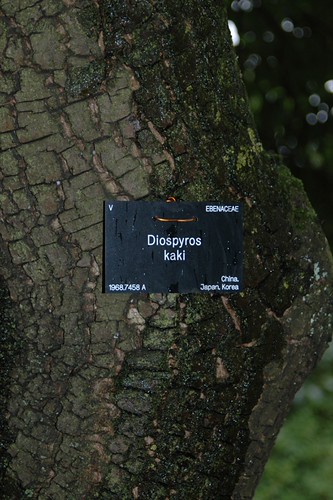
Let’s go and take a closer look I suggested and used my usual technique for identifying trees in the Botanics – I looked at the label!

kaki label

Well! We were stunned! Of all the trees in the Botanics what on earth were the chances that we’d be standing next to the one example in the gardens of the particular tree we were discussing?!
My Dutch friend said, “I don’t know what you believe about how the world works, Bob, but I’m going to send you a sample of the remedy prepared from the kaki tree.

Before I tell you the next part of the story, have a look at the bark of this tree.

kaki bark

You begin to have an idea why this particular species managed to withstand the nuclear blast. Still, for any tree to withstand it was quite amazing. Diospyros kaki means fruit of the gods and this tree is recognised as highly significant in Japan, the kaki fruits being placed in Shinto shrines. Here’s the fruit at an early stage of development –

kaki fruit

My colleague was as good as her word and the following week two vials of the homeopathic remedy arrived for me at the dispensary in Glasgow Homeopathic Hospital.

The following day I had a new patient, a young woman whose recurrent breast cancer disease had recently been described by the oncologists as terminal and who had been told she had very few weeks left to live. She was suffering from nightmares and sleeplessness which none of the sedatives she’d been prescribed had helped and she wanted to try a homeopathic medicine. I’m not going to give any more detail than that here but suffice it to say, I gave her the Diospyros kaki remedy and her sleep immediately returned to normal. In fact, more startling than that, she went on to experience an improvement in her energy and well-being and she went on to live for another couple of years. In those two years she stopped her career, trained in another area altogether, and worked successfully in her new field for a few months before the cancer overwhelmed her and she died.

I’ve used this remedy a few times since in similar circumstances. It’s one of the remedies which really makes me think about our basic concepts of health and healing. It does not cure cancers, but in the right circumstances, in my very small experience with this, it can help a patient cope, and, more than that, even to grow in the presence of severe disease.

[Let me just finish this with a short paragraph about the homeopathic method, because this, I think, is an amazing story. However, I want to make very clear that not only is this not a cure for cancer, but it’s not the relevant medicine for just anyone who has cancer. Every homeopathic prescription is individualised on the basis of the patient’s unique personal story, taking into consideration the disease, the person who has the disease, and the contexts of their life. The patients for whom I’ve prescribed this kaki remedy, and who report that they benefited from it, have all been strikingly remarkable people – pragmatically positive, creative and caring individuals – who share a number of characteristic features]

Read Full Post »

Maybe, like me, you have a collection of “significant” books. By that, I mean books which had a big impact on the way you think, or the way you understand life. I’ve written about some of those books here already, but here’s another one which I read a few years ago. Hans-Georg Gadamer‘s “The Enigma of Health: The Art of Healing in a Scientific Age” is a collection of essays by this professor of hermeneutics (I know, I had to look it up in a dictionary too, but, trust me, this man had a brilliant mind!)

Gadamer died in 2002, and while I was visiting Tokyo, a copy of the Japan Times slid under my hotel room door early one morning, included an obituary about him. I’d never heard of him, but it’s amazing what you’ll read in the wee small hours in a foreign country when your body and your head are still half a day away in your home town! I was completely fascinated with what I read and his thinking about health really captured my imagination so I went online and ordered up “The Enigma of Health” from Amazon. By the time I got back home it was waiting for me. Let me share a few quotes with you. I wrote them down in my Moleskine (as I do!)

Although health is naturally the goal of the doctor’s activity, it is not actually ‘made’ by the doctor.

I make this point with every new patient I see. It’s the big unspoken truth about medical practice. Doctors’ treatments might reduce or remove a pathology, might even redress an inner imbalance, but they don’t cure – only the body does that. He says more about here –

Yet the goal of the art of medicine is to heal the patient and it is clear that healing does not lie within the jurisdiction of the doctor but rather of nature. Doctors know that they are only in a position to provide ancillary help to nature.

Franklin put it another way when he said “God heals and the doctor takes the fees”

I often ask medical students to tell me the answer to this – if a patient with a urinary tract infection gives a urine sample which grows bacteria which the lab shows are sensitive to a particular antibiotic and the patient is prescribed that antibiotic, what will the antibiotic do? The ones who don’t think carefully say the antibiotic will cure the infection. It won’t. It’ll kill the bugs. That’s it. The inflamed bladder wall, which might even be bleeding from the effects of the infection will be restored completely by the body’s repair processes. The healing is natural. The antibiotic only removes the offending bug to let the healing system do its job. This might seem like nit-picking, but it isn’t. It involves a profound change in thinking. Doctors aren’t gods. At best they assist healing and all healing is a natural process.

…the doctor’s power of persuasion as well as the trust and the co-operation of the patient constitute essential therapeutic factors which belong to a wholly different dimension than that of the physico-chemical influences of medications upon the organism or of ‘medical intervention’.

There are some who think that health and illness can be understood in purely physical terms and that treatments can be understood to work, or not work, on the basis of their physico-chemical effects. That’s a limited way of thinking. Healing involves more than that, and may not even involve any physico-chemical intervention at all. Those who think medicine can be reduced to a science (as opposed to a science and an art) rely on measurements of phenomena. Gadamer is brilliant about this –

….modern science has come to regard the results of such measuring procedures as the real facts which it must seek to order and collect. But the data provided in this way only reflect conventionally established criteria brought to the phenomena from without. They are always our own criteria which we impose on the thing we wish to measure.

I believe it was Max Planck who said “facts are what can be measured”. Well, reality cannot be reduced to facts. The tendency to reduce understanding to physical measurements is accompanied by a concept of health as some kind of product – an end point or state which can be known and measured. Gadamer argues instead –

…physicians do not simply create a product when they succeed in healing someone. Rather, health depends on many different factors and the final goal is not so much regaining health itself as enabling patients once again to enjoy the role they had previously fulfilled in their everyday lives.

This clear statement suggests to us that health is an experience and it’s an experience which in its detail will be different for every person depending on the characteristics and environments of their lives. Later in his essays Gadamer considers how far from being a measurable product, health is really what is experienced when illness is not present or goes away. This is the “enigma” of health – that we only know it by its absence. Consider the fingers of your right hand. Right now you’re not really aware of them. Trap them in a car door and then you instantly become aware of them. You get the idea?

This post could go on forever! I’ll stop, but suffice it to say this is a deeply thoughtful consideration of our concepts of health, illness and healing.

Read Full Post »

« Newer Posts - Older Posts »