Feeds:
Posts
Comments

Archive for the ‘life’ Category

IMG_1550

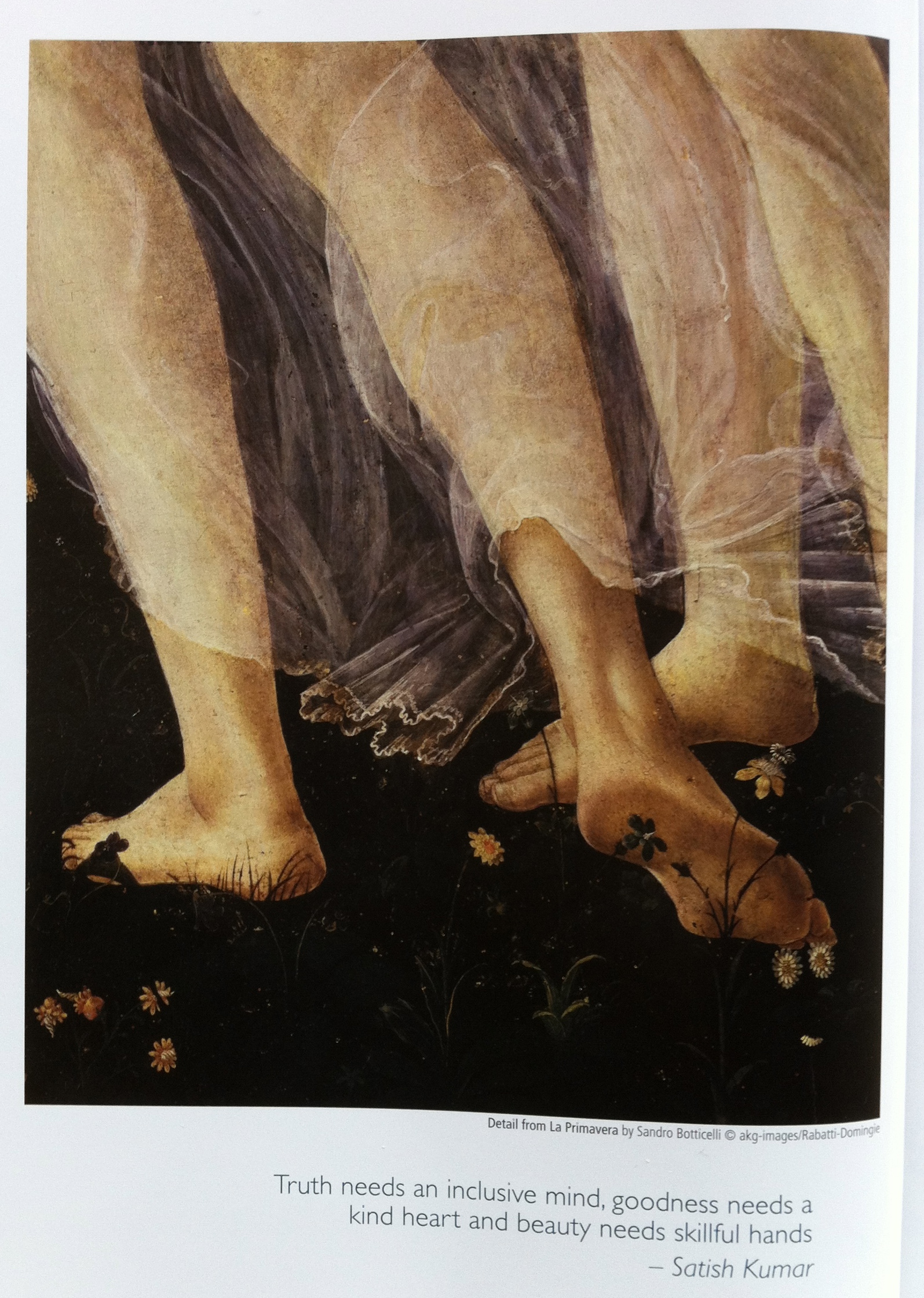
I’ve been a subscriber to Resurgence magazine for more years than I can remember. The latest issue has an editorial by Satish Kumar which eloquently talks about the interconnections between Truth, Goodness and Beauty – which he refers to as TGB.

What I particularly like the way he embodies truth, goodness and beauty…..

There is a corresponding trinity: head, heart and hands. With our head, with our thinking and intellect, we comprehend truth; with our heart we experience goodness and with our hands we create beauty

I think it’s interesting how he highlights the issue of this consumerist society promoting physical goods and shopping so highly, with a constant drive to make these physical goods as cheaply as possible. It’s not that we hold our physical objects, or those who make them, in the highest esteem

According to the prevailing ethos of our society manual work must be done by machines as far as is possible, or by cheap labour, either at home, or by immigrant workers from poorer countries. Most ‘manually manufactured’ goods are expected to be made in countries like Bangladesh by poorly paid artisan craftsmen and women; the economy of a country like England aspires to be transformed into a ‘knowledge economy’. This is a very unbalanced state of affairs.

He concludes with a classically INTEGRAL vision

Our society needs a bigger picture – a holistic vision. The hallmark of a balanced society is to honour and respect mental work and manual work equally. We need both. Only then we can develop our head, heart and hands in total harmony; science, spirituality and the arts need to be in complete coherence leading to the trinity of TGB – truth, goodness and beauty – as an integrated whole.
 

Read Full Post »

DSCN1247

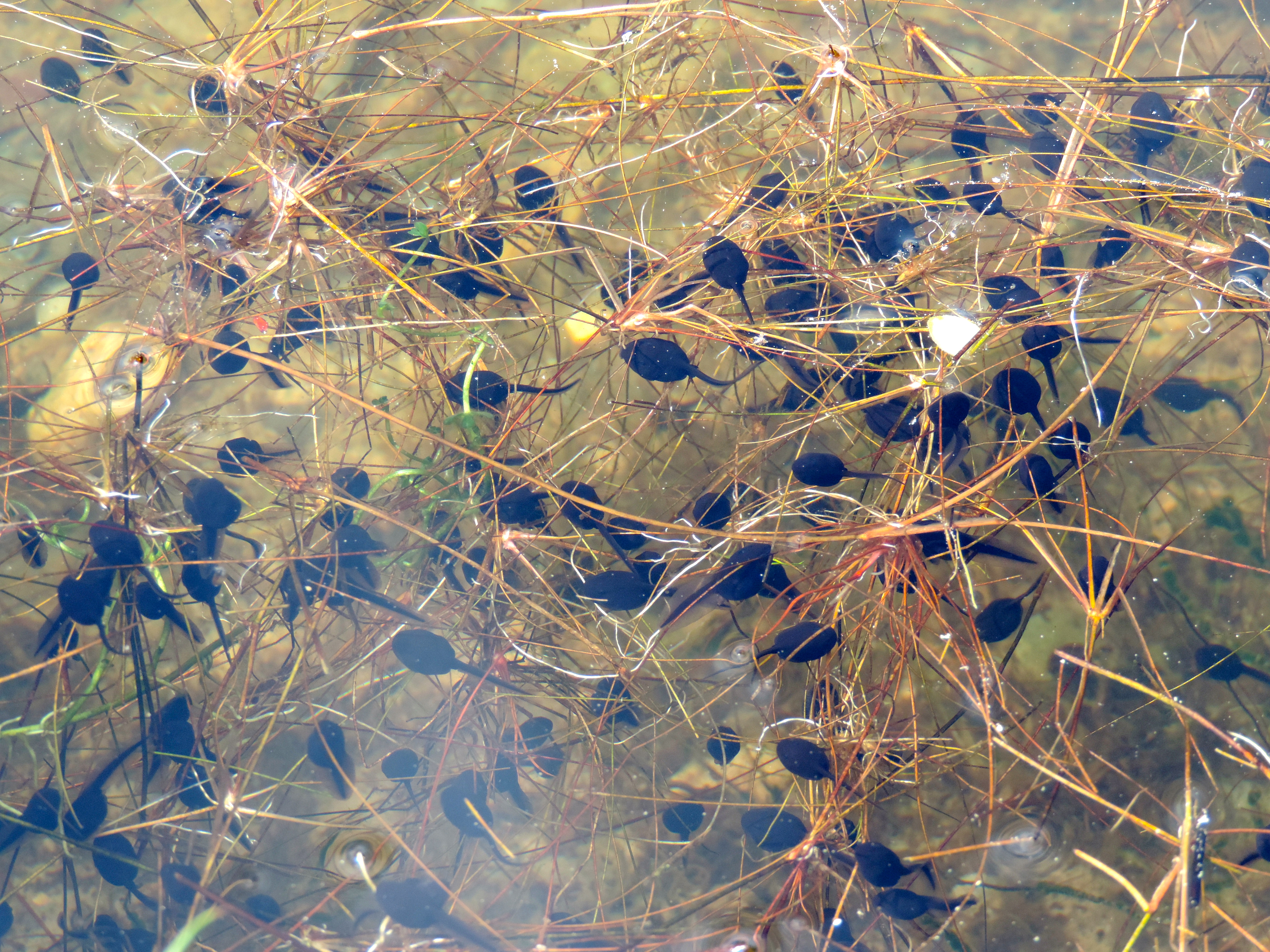
Spotted these tadpoles in a pond up near Aberfeldy yesterday. This shot of them captured only a small portion of the hundreds swimming around the edge of the pond.

What do you think about when you think of tadpoles?

I bet you don’t think what I do.

Here’s what happens when I see tadpoles. I hear a song in my head. “Share it” by Hatfield and the North.

Do you know that song? Do you know why I hear it when I see tadpoles? Well, when I was a teenager, my friends and I were great fans of bands like Soft Machine, Caravan, Camel, and Hatfield and the North. So when Hatfield and the North played the Student Union at Edinburgh University we went along. My friend Ian seemed to know all the words of their songs and sang along. At the end of the concert, Ian made for the front and asked Richard Sinclair, the singer a question. The question?

“I can make out all the words of ‘Share it’ apart from the first one. It’s “something is screaming in my ear” but what’s the something? Richard Sinclair leaned down from the stage and whispered one word into Ian’s ear. What was the word?

Tadpoles.

If you don’t know the song, here it is


Listen carefully to the very first word. You’ll see he wasn’t kidding! 

But do you know what amazes me most about tadpoles? Metamorphosis.

During metamorphosis, a tadpole loses it tail, grow legs, loses its gills and grows lungs, rewiring it’s nervous system and on and on…..the number of changes are astonishing. How does it do that? We know a little bit about some of what’s involved (hormonal changes and different responses in different tissues to the same hormones) but we absolutely don’t know how these these massive changes are co-ordinated. 

Amazing. Completely amazing

Read Full Post »

Sleep.

Is that a problem for you?

I’m afraid if it is, you’re not going to like this next sentence…….Sleep is my core skill. I seem to have some kind of spirit level in my brain, so that whenever I lie flat, the sleeping potion floods my brain and, instantly, I mean instantly, I’m asleep. I move between the two states of sleeping and waking the same way. It’s like some kind of switch. Click. I’m asleep. Click. I’m awake. Now you know what really puzzles me about this? I have absolutely no voluntary control over this switch. I can’t just “decide” to move between the two states. Mind you, if I need to be up at a certain time, then I tell myself that before lying down, and usually, (I’m not confident enough to not use an alarm), I wake up about 2 minutes before the set time (and switch the alarm off before it goes off by itself!) How does the brain do that? How can it do it so accurately?

There are many, many mysteries about sleep and I know lots of people really struggle with sleep, whether it’s trouble getting off to sleep, or waking repeatedly or just too damn early. In my role as a doctor I suggest a number of things….I don’t have a one size fits all approach to anything, but try Heartmath for starters. Lots of people find that helps. I don’t just mean try it before sleeping time, I mean integrate it into your day. I believe various different meditation practices can help, as can the usual areas of exercise, diet, and “sleep hygiene” (which involves establishing pre-sleep habits).

People sleep differently in different cultures too. Tokyo must the be city with the greatest number of day time sleepers. You see people asleep in cafes, on the metro, everywhere really. It’s quite surprising for a visitor. The countries on the Med have a habit of the siesta, which might have more to do with sunshine than anything else (“Mad dogs and Englishmen…..?”)

So, have a think about sleep this week. What patterns and rhythms work best for you? What induces a “good” sleep for you?

And here’s a couple of photos of sleepers I took earlier (first one in Tokyo, second one in the afternoon in Provence)


sleeping in tokyo

barrow

And here’s what we all hope for (this taken again in Tokyo, on the hoarding around a building site)

Sleeping baby on hoarding

Read Full Post »

Diving for silver?


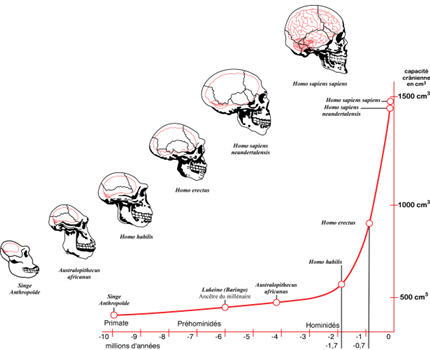
It seems we didn’t evolve into human beings in a smooth, seamless way, but more with a pattern of great leaps and long, slow changes.

One of these great leaps was in the growth of the size of the brain. One of our pre-human ancestors, Homo erectus,  had much smaller brains than we do, but over the course of 200,000 generations (2 million years), their brain size roughly doubled in size, taking them up to about the same size as brain as we humans have (since about 500,000 years ago).

As Stephen Oppenheimer states, rapidly increasing brain size was a key feature that set humans apart from the walking apes that lived before 2.5 million years ago. Since then our brains have trebled in volume. This increase was not gradual and steady: most of it came as a doubling of volume in Homo erectus 2 million years ago. The greatest acceleration in relative brain size occurred before 1.5 million years ago – early in our genus. Modern humans – and Neandrathals – living before the last ice age 20,000 to 30,000 years ago had bigger brains than do people living today. (from)

Interestingly, brain size in humans hasn’t increased over the last half million years (indeed it’s shrunk a bit!), but what has happened is rapidly increasing asymmetries in the brain. It’s not just that our massive cerebral cortexes are asymmetrical, but within each area of the brain there are highly specialised areas. In other words, its a story not just of an increase in size, of adding more and more neurones, but of complexity.

Here’s one of the puzzles about evolution though – how on Earth did brains evolve so quickly? You might say 2 million years doesn’t seem that quick but look at the speed of change.

cerveau_evolution


This is why some people refer to the growth of the human brain as the second “Big Bang”…….although I do like the idea of a “Great Leap”!

Read Full Post »

light tree

kaleidoscope

the moon

Don’t you love a good mystery?

For me, I love mystery not only in fiction, or in movies, but in life.

I am regularly amazed by the every day, and I know now that the future emerges from the present in ways which are always surprising, always mysterious.

So, I was delighted to find these lines in a Mary Oliver poem, “Mysteries, yes

Let me keep my distance, always, from those
who think they have the answer.

Let me keep company always with those who say
“Look!” and laugh in astonishment,
and bow their heads.


Read Full Post »

poppy field

The local robin

a wish

daisy
I came across this phrase of Emerson’s the other day

Tis curious that we only believe as deep as we live.

And the first thing I thought was “Tis curious that we only live as deep as we believe”! But then I decided to track it down and see it in its context. It comes from his “The Conduct of Life” in the section where he writes about beauty. There are some real gems in that piece of writing.

Our books approach very slowly the things we most wish to know. What a parade we make of our science, and how far off, and at arm’s length, it is from its objects! Our botany is all names, not powers: poets and romancers talk of herbs of grace and healing; but what does the botanist know of the virtues of his weeds?

Can we really know about plants only by treating them as objects to measured, weighed and classified? And what happens when we apply that approach to human beings too?

We should go to the ornithologist with a new feeling, if he could teach us what the social birds say, when they sit in the autumn council, talking together in the trees. The want of sympathy makes his record a dull dictionary. His result is a dead bird. The bird is not in its ounces and inches, but in its relations to Nature; and the skin or skeleton you show me, is no more a heron, than a heap of ashes or a bottle of gases into which his body has been reduced, is Dante or Washington.

The bird is not in its ounces and inches, but in its relations to Nature”. Wow! How true is that? And isn’t that exactly where our present approach often falls down? We fail to see what we are studying in its “relations”. 

The motive of science was the extension of man, on all sides, into Nature, till his hands should touch the stars, his eyes see through the earth, his ears understand the language of beast and bird, and the sense of the wind; and, through his sympathy, heaven and earth should talk with him. But that is not our science. These geologies, chemistries, astronomies, seem to make wise, but they leave us where they found us.

and

Science in England, in America, is jealous of theory, hates the name of love and moral purpose. There’s a revenge for this inhumanity. What manner of man does science make?

These last two passages raise a subject we don’t hear much about, but I think we are beginning to hear more now, and will hear even more in the years ahead. It relates to Einstein’s famous question about the Universe….

Is the Universe friendly?

And it also relates to Iain McGilchrist’s point about the two different approaches to the world from our two different cerebral hemispheres. If it’s true, which I think it is, that we create the world we live in through what we pay attention to, what our values and beliefs are, then what kind of world do we create from this detached, materialistic scientism?

What is life like for someone who sees things that way? And what’s life like for someone who sees things the way Emerson is suggesting? Do you think the Universe is a hostile place, that everything happens by chance, and nothing has any meaning?

What I share here in this blog is just my experience, just snippets from the life of me, how I experience life, what stimulates my thinking, my passions, my imagination. But it’s the way I approach the world which creates this particular world I’m living in and sharing with you.


Read Full Post »

Swan cruising


Mary Oliver’s poem, “Swans” (which you can read in full here) ends……

What we love, shapely and pure,
is not to be held,
but to be believed in.

Does that resonate with you? “Not to be held, but to be believed in”? That has echoes for me of the “witnessing not measuring” I woke with the other day. It speaks to the subjective world of values over the objective world of things which can be possessed.

Read Full Post »

I’ve been familiar with Maslow’s hierarchy of needs for some time, but I’ve recently discovered I was only aware of part of his schema.

His idea was that we have many needs which motivate us to act and to choose how to act, and those needs are, to some degree, prioritised with the more basic needs demanding attention before “higher” needs emerge.

His most basic needs are those related to physical security – the needs for food, drink and shelter. Without food, without drink and without shelter we are unlikely to survive.

All human beings need love. We need relationships. If you think that’s not true, pause for a moment and ask yourself why solitary confinement is used as a punishment in prisons, or why “sending to Coventry” ie enforcing social exclusion has historically existed as a community punishment. These love and relationship needs are about emotional security. In Maslow’s hierarchy, first you need to attend to your physical security, then your emotional security.

However, he isn’t finished there. Next up is self-esteem, without which we don’t feel we matter. This is closely bound up in our sense of identity, our “worth”.

So far, so good, and this is where my familiarity ended. But in fact there is a whole other level above these needs in Maslow’s description.

All of these needs so far can be thought of as “deficiency needs”. They are based on “lack” and meeting them is useful to us, so they can be thought of as “utilitarian”, or as about “getting” things.

Above this, Maslow describes “being needs”, which are ends in themselves. They are about “giving”, and are more creative than utilitarian. Being needs are those related to purpose, value and meaning. These needs, he says, “express an overflow of our own being”.

It is these “being needs” which make us “fully human”.

When we recognise that animals occupy only the lower rungs of Maslow’s ladder of needs – those for sustenance, shelter, and some form of social life (but of course not all animals belong to groups) – we can see what this means. We are only fully human when we pass beyond these, as the being or meta-needs that lie ahead can be pursued only by us, or by beings like us ……. As far as we know, no animal wonders why it exists. Or, to put it another way, we are the only animals that do, and that wonder is precisely the threshold between our being only animals and being fully human. (Gary Lachman)

Read Full Post »

sunset over ben ledi


I look out at this mountain every day (It’s called Ben Ledi), but how different the world might look to me if I actually climbed to the top of it (I haven’t done that….yet!)

Climbing a mountain for aesthetic reasons was, apparently, a defining moment in the development of human consciousness. The famous climb was that of the Italian poet, Francesco Petrarca (Petrarch) in the fourteenth century. He was the first to record climbing a mountain to see the view.

We can say that the origins of our modern appreciation of nature go back to 26 April 1336, when the Italian poet Francesco Petrarca (1304–1374), better known as Petrarch, made his famous ascent of Mount Ventoux in France. This event has gone down in history as the first time someone climbed a mountain solely to see the view. Clearly people had scaled heights before, but Petrarch claimed he was the first to do so solely out of curiosity, for what we might call aesthetic reasons. He recounted his excursion in one of the letters making up his Epistolae familiares (1350)

That’s a quote from Gary Lachman‘s “Caretakers of the Cosmos”. He points out that several thinkers and writers reflected on this famous ascent.

Ernst Cassirer saw in Petrarch’s ascent of Mount Ventoux ‘testimony to [the] decisive change in the concept of nature that began in the thirteen century’ and which led to nature becoming a ‘a new means of expression’ for human consciousness, as well as to a ‘desire to immediately contemplate nature’.

Cassirer wrote brilliantly about how human beings create a world of symbols. Unlike other creatures which live on their instincts and sensory organs, we humans use symbolism to create a richer world and to live in it quite differently from other forms of life.

what began with Petrarch’s ascent, for Gebser, was the age of what he called ‘perspectival consciousness’, the perception and representation of the world from a unique human vantage point.

Jean Gebser’s “Ever-Present Origin” describes an evolution of consciousness from the archaic, to magical, to mythical and mental, and up to the present evolution of  an “integral” form.

I’m sure you can discover many other references to Petrarch’s ascent, but as I look out again at Ben Ledi, I’m able to imagine being at the top and to see Scotland from there. That profoundly influences my sense of who I am and my place in the world. I wonder what it’s like to live in a country without mountains?

Read Full Post »

Untitled

Mirror, mirror


In the A to Z of Becoming, R is for reflect.

What does it mean to reflect? I think reflecting has a number of elements. There’s a pace to it. When we reflect, we slow down. Instead of reacting, or “pressing on” with busy-ness, we temporarily stop, pause, take a breath. So taking a moment to reflect acts a natural break, creates that “necessary distance” the neuropsychologists talk about.

There’s an element of checking yourself out too isn’t there? The way we do when we look in a mirror. We see how we seem. We look at how others might see us. Or even without mirrors, but in conversation, or with the help of a journal, we can consider how we are living, what choices we are making, what habits we have acquired. We can think about our direction, our goals, hopes and fears. We can take a moment to reflect on how decisions we’ve taken are working out.

I think reflecting is something I do every day as a doctor too. In psychotherapy and counselling students are taught to reflect someone’s words back to them. This might even be called “mirroring” and when it’s done mechanically, or clumsily, it can feel a bit annoying (“What I hear you say is……..[insert clients own words here]”) but when it becomes a natural conversation, it lets the person reflect on the words they are using, the phrases they are repeating, and the beliefs which are underpinning their current state of mind or body.

When you can spend some time with someone who cares about you and will listen to you without judging you, you can gain some very fruitful insights as you reflect together.

So, here’s your verb for this week – reflect. Try it out and see what happens…….

Read Full Post »

« Newer Posts - Older Posts »