Feeds:
Posts
Comments

Archive for the ‘life’ Category

Last year I learned how to teach the Heartmath technique – find out more about Heartmath here.

Here’s a simple guide to the theory and the practice.

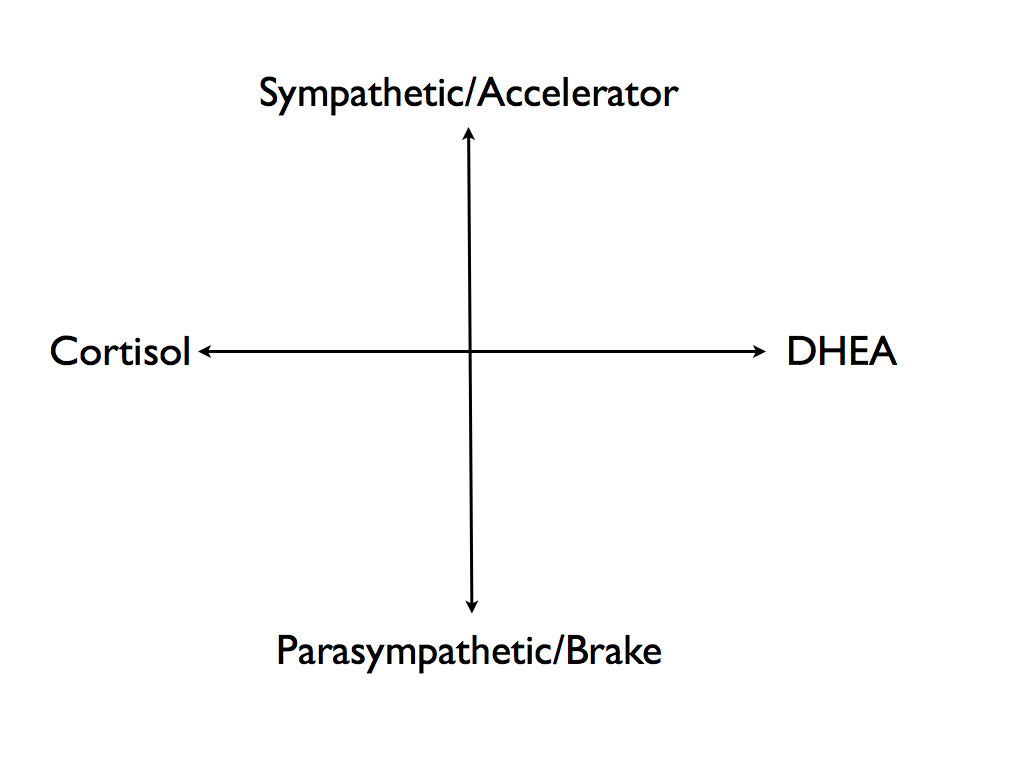
Here is a map called “the emotions map”

It has two axes – the vertical one shows the “autonomic nervous system” – this is the part of the nervous system which is responsible for the survival responses of “Fight of Flight OR Freeze” reactions. The autonomic nervous system is divided into two pathways – sympathetic and parasympathetic. Think of the sympathetic as being like the accelerator – when it is active there is a lot of adrenaline released into your system, your heart beats faster, your breathing is faster, and your body mobilises oxygen and energy to all your muscles ready to help you “fight or flee”.

The other path is the parasympathetic and can be thought of as a brake – through activation of the “vagus nerve” it slows down the heart, quietens and closes down your systems – the “freeze” reaction. We frequently oscillate wildly between these two extremes, flying from panic to collapse and back again!

The second axis, the horizontal one has one of the body’s main defence hormones at the left – cortisol. This is necessary for normal defence, but in excess cortisol can do a lot of harm. It’s sometimes called the “Stress hormone”. The right hand edge of this axis is “DHEA”, sometimes known as the “vitality hormone” – when there is a lot of this in the body, all the cells age more slowly and growth is stimulated.

What we want to achieve is a harmony of these systems – when we are in the top left quadrant our heart rhythm is chaotic. The heart rate varies all the time in a normal heart, but when the “heart rate variability” is chaotic, we’re not in a good place! Interestingly, when we are in the zone on the right of this chart, our heart slips into “coherence” – a kind of overlaid smooth, harmonious rhythm of the heart rate variability. In coherence we have harmony, we reduce the stress hormones and the excess autonomic activity, and we redress the balance between cortisol and DHEA.

Now here comes the fascinating bit – each of these zones or quadrants is associated with particular emotional states, with particular feelings.

The Heartmath technique consists of re-experiencing one of the “positive” emotions on the right of this chart by recalling and reliving an episode or even where we felt such a feeling.

There are three steps to achieve “Quick Coherence” – a basic Heartmath technique.

Step 1. Heart focus. Bring your attention or your focus to the heart area of your body.

Step 2. Heart breathing. Take three, slow, deep, even breaths, filling the heart area of your body with oxygen, then emptying your lungs of all the carbon dioxide. Slowly in, slowly out, for three breaths.

Step 3. Heart feeling. Now recall an event where you experienced one of the positive, heart felt emotions. Here’s a couple of ones I use to give you an idea of the kind of event I mean. One is one of my grandchildren running up to me, shouting “grandpa!” and jumping up into my arms. That’s a great one! Another is looking out over Ben Ledi from my living room window when we have one of those gorgeous deep red sunsets – just amazing! Pick one of your own, and recollect it. Stay with that memory until you become aware that you are feeling that feeling again. This is about recreating a feeling. Once you have it, that’s it. You’re there.

Congratulations, you just managed “Quick coherence”.

Do check out the Heartmath Institute website – lots of great resources there to explore this technique in more detail!

Read Full Post »

sunset

In Ian McCallum’s “Ecological Intelligence” he mentions how Copernicus brought about one of the great revolutions in human thought by convincing us that the Earth moved around the Sun, not the other way around. However, centuries later, we haven’t really managed to take this radical shift on board. We still tend to think of ourselves as being the centre of everything. We betray our perspective through the language we use.

We talk about sunset and sunrise. But the sun doesn’t set, it stays where it is. And the sun doesn’t rise, it’s the Earth which turns.

He postulates shouldn’t we be thinking instead of talking about the Earth rising into the night, and dipping into the day?

Stop and think about it for a moment. What does it feel like to think of the Earth rising into the night instead of the Sun setting?

Read Full Post »

Is Nature “out there”?
Are we, as human beings, separate from Nature? Is Nature there for us to exploit? To have dominion over? To control? To dominate?
Much human activity seems based on this set of beliefs, but it is a delusion.
There is no separate “Nature” from “us”. Every creature, every life form, every natural force, energy and phenomenon is interconnected.
This idea that we are separate from Nature is deeply to connected to a way of thinking which separates the “subjective” from the “objective”.
The idea of “objective” contains a tendency to turn experiences, phenomena, even other people into “things”.
It’s a stance which dehumanises, and denatures.

Look at this fence –

the living fence

I love how this fence instantly challenges the view that it is a “thing” – you can see it’s a living organism.

Whilst on holiday recently, I stumbled across a book by a South African author, Ian McCallum. Ecological Intelligence. [978-1555916879]

He argues that we need to reconnect to other animals and to Nature, and interestingly writes a lot about the concept of the “field”.
I find that concept so useful.
In my Be The Flow, I muse about the relationship between a wave and the sea. In this analogy, the sea is the “field” and the wave is a person. We emerge out of the field assuming distinct, identifiable, unique form. But we don’t leave the field. The wave is at no point separate from the sea. The wave constantly changes throughout its life. It is transient, dynamic, and, soon, its gone. Where does it go? It returns to the sea which in fact, it never left. It “disappears” into the field.

Read Full Post »

It’s been a very full and frequently challenging 2011. So I’m taking a break…..sometimes it’s good just to sit for a bit.

just sitting

That’s not me in the photo by the way, but I am in the same place as this guy – Capetown

Read Full Post »

sea path

There’s change underway. Don’t you feel it? The old certainties are crumbling. The global systems are stumbling from crisis to crisis. From “Arab Spring” to “Occupy” there’s spreading unrest. From country to country austerity measures are being imposed by governments without popular democratic support.

Underlying these economic and political stories there are bigger changes flowing. Ian McGilchrist’s excellent “The Master and His Emissary” describes a struggle between two world views – one emerging from a left brain approach to the world, and one from the right. He makes the case that the left brain approach has dominated for the last four hundred years or so creating our industrialised, command and control based societies.

Seth Godin’s superb “We are all Weird” shows how mass consumption, mass production and mass control, the dominant ways of 20th century world, are being replaced by an emphasis on difference, diversity and uniqueness.

Next year is 2012. There are many predictions that this will be a crucial year for humanity.

Let’s embrace it. Let’s embrace change by shifting our focus and our energy on bringing about the changes we want.

Let’s embrace the following “C change” –

  • Consumption to Creativity
  • Credit to Cash
  • Control to Coherence
  • Competition to Co-operation
  • Coldness to Compassion

Consumption to Creativity
When politicians and economists talk about growth, which they claim is an essential characteristic of a healthy society, they mean consumption (or production of goods and services to be consumed). Their emphasis is on figures like GDP, or Gross Domestic Product, the turnover and profit of large companies, which is how much they’ve sold, and how much money they’ve had to spend to produce those sales. But is this growth? Production for consumption? What’s the point of that? Ever greater consumption, at best, is not a sustainable path. At worst, a tipping point will be reached (has been reached?) where the pursuit of greater consumption becomes harmful, divisive and destructive. So, consumption is not a a good target, nor is it an adequate surrogate for growth.
In human beings, greater consumption tends to produce bigger, fatter people. There’s a limit to the amount a person can consume. As the limits are reached waste (and waist size) increases.
Consuming for the sake of consuming doesn’t happen in Nature. Animals consume what they need to be fit and healthy. In the wild, they never become obese. Plants consume in order to grow and develop. Here’s the lesson to be learned from Nature.
If growth is about healthy development, then greater growth should constitute a genuine improvement in life. If it is just about consumption, it becomes a source of degeneration and decline.
So what if we could learn the lessons of the plant world, for example? What if we rated development more highly than consumption? Development, in human terms, is about improving physical fitness, mental resilience, wellbeing, skills, talents and capacities.
There is a common theme underlying these qualities, and that theme is creativity. Creativity produces growth and development. It expands both our abilities and our expressivity – our talents and our self-expression.
What if we prioritised development, improvements in skills, knowledge, performance, as well as expressivity?

This would require a shift away from consumption to creativity.

Credit to Cash.
This current crisis of the global economy, is a crisis of a system based on ever increasing consumption and credit. Once lending slows up, the financial system grinds to a halt. What was the key characteristic of the 2008 crisis? The drying up of credit, or lending, as trust and security fell amongst the banks and financial institutions. Yet, increasingly, finance is based on illusion. Banknotes bear words promising to pay the bearer were originally backed up by gold reserves. If you wanted you could turn these pieces of paper into real gold. But now with derivatives, and computerised, digitised money, the amounts of “money” in the world are no longer related to reality. Country after country is reported as being in debt. Debt they can’t pay off if asked to do so. Who is everyone in debt to? Who is asking to be paid off? And with what? Imaginary money is used to buy ever greater amounts of imaginary money, spiralling up into ever more unstable, unsustainable levels of debt and credit. The total amount of national and personal debt in the world is higher now than ever before in history.
One way to gain greater financial health at a personal or family level, is to move away from imaginary money to real money. In other words, to reduce the amount of credit needed in daily life by moving towards a cash, or bartered economy.
If I do this for you, then you’ll do that for me. Real goods, real materials, real cash. If countries did that too, then the need for credit would diminish.
The less the need for credit the less power and privilege will be held by those who gain from imaginary financial instruments. Those who hold power over whole countries through lending would be disempowered.
What if all the countries which have debt, agreed one day to declare they had no debt? What if they set the counter back to zero? Recalibration Day. Where power shifted back to people and away from the rich minority who hold all the “credit”.

Control to coherence

Industrialisation comes with an emphasis on control. The scientific method of the industrial age has become a way of predicting future states and developing technologies to achieve those states. The wave of industrial development known as Fordism, has produced a whole management ethic around command and control structures. The development of mass production, mass marketing and mass consumption, reduces individuals to units to be controlled and life to outcomes determined and managed by those who hold the power.
Yet, the universe is a vast, complex, unpredictable and uncontrollable place. An individual life is unpredictable and uncontrollable. The crises in the global financial systems, the revolutions and power struggles of the political systems and the ecological stresses manifested in both climate change and the constant appearance of apparently random catastrophic events, from tsunamis to earthquakes, to hurricanes and volcanic eruptions, surely make it crystal clear to us that control is, ultimately, impossible.
What to do? Nobody feels comfortable out of control. Nobody feels safe and secure in rapidly changing, completely unpredictable situations.
We can’t achieve control. But we can achieve coherence. We can actively seek to be more in harmony….with each other, and with the Earth. The greater our actions produce coherence in our interconnected domains of Life, the more we will experience a sustainable, nourishing way of living.

Competition to Co-operation
One aspect of Darwin’s work has been picked up and overblown to an enormous degree – competition. It’s highlighted as the key characteristic for success and survival. Nature is presented as “red in tooth and claw”, one endless struggle pitching every individual organism not only against other species but against all the other members of the same species. Only the best, the fastest, the “fittest” survive.
Of course, there’s something in that view, but that is not all Darwin said, and it’s certainly not all there is to evolution. The other important characteristic is in fact co-operation. It can be argued that it is actually the ability of human beings to interact socially which gives them their dominant place in the evolution of Life on planet Earth. Our social skills include our development of language, and our faculty of imagination which underpins empathy and compassion. It may be that these are the most important human features.
All creatures engage in competition and co-operation but human beings really excel at forming bonds, creating networks, sharing information and resources.
The creation of a economic and financial system based on competition has led us down the path to war and totalitarianism throughout history. Maybe it’s time to up the emphasis on our co-operative powers instead and see what systems we could create from that perspective.
Some may argue that there’s a link between male dominance/competition and female nurturing/co-operation. Could it be that a healthier future lies in shifting the centuries old gender bias of cultures, religions and economic-political systems? Increase the influence of women in all aspects of society.

Coldness to Compassion
One of the greatest problems with reductionism is that if you reduce a human, you no longer have a human. The reduction of human beings to units within a mass dehumanises.
In health care it should be impossible to discover stories of neglect or cruelty. Sadly, that’s far from the case. How can a patient be left unattended, treated as a “case of…..”, uncared for within a health service? Why is poverty tolerated? Why is there famine, rape, torture, human trafficking, terrorism?
A lack of compassion.
With sufficient compassion none of these horrors would be possible.
So there’s my final “C” change – from Coldness to Compassion. A shift of emphasis towards the heart.

Read Full Post »
One of my most favourite magazines in the world is a French language one entitled “Cles“. In the current issue they have a theme about optimism.

I love their exploration of the different ways of understanding the thinking patterns of optimists and pessimists. They quote Winston Churchill, who famously said

“The optimist sees the opportunity in every difficulty. The pessimist sees the difficulty in every opportunity.”

The introductory article says

L’optimiste relativise ses echecs (je ferais mieux la prochaine fois) et generalise ses succes (j’ai vraiment de la chance), alors que le pessimiste generalise ses echecs (je suis decidement un nul) et relativise ses succes (c’etait juste un coup de bol)

Here’s my translation (I’m not an expert!) – The optimist puts his failures/setbacks into perspective – “I will do better next time” and generalises his successes – “I’m really lucky”, whereas the pessimist generalises his failures/setbacks – “I’m really an idiot” and relativises his successes – “It was just a stroke of luck”.

I think one of the interesting things about thought frameworks is how they tend to create the outcomes expected, so we really do find that some people are generally luckier than others. Can you just decide to become more optimistic? I don’t want to over-simplify this, but, yes, I think you can (but then I would, wouldn’t I? I’m an optimist!!).

The issue of “Cles”, explores the “science of optimism” – now there’s a scientific discipline I’d be keen to know more about…..

They suggest the “golden rules” revealed by the science of optimism include the importance of “vigilance” – attentiveness; curiosity; the “capacite a rebondir” – the capacity to bounce back, or to be resilient; and, altruism.

What do you think? What qualities facilitate the tendency to optimism?

Read Full Post »

running time

BE THE FLOW

Take a pencil and draw a straight line. The beginning of the line represents the day you were born. You know that date. The end of the line represents the day you will die. Nobody knows that date. Now put a cross somewhere along the line representing today.

Everything between the day you were born and today is past. It doesn’t exist any more. You can only access it by using your memory (or the memories of others). Everything between today and the day you’ll die is the future. That doesn’t exist yet. You can only access it by using imagination. Some people focus a lot of their attention and energy on the past, maybe going over and over some painful event, some loss or hurt. Although they are alive now, they’re living in the past. Others focus most of their attention and energy on the future, wondering and worrying about all that might be, but which isn’t yet. They are living in some multi-layered world of what ifs.

The present is hard to grasp. The moment you become aware of it, it flies into the past. If you try to prepare yourself for what’s to come, for what lies in the immediate future, then that can rush into the present with such speed that it obliterates it.

There is only really one time you can be fully alive and that’s the present time. Using our memories we pull the past into the present, and using our imaginations we pull the future into the present too. The present is formed from past realities which create the framework of possible futures in the here and now.

The flow of time is like a great river which you can stand in the middle of. Or you can wade upstream into the past and see where the present is coming from. Or you can dive in downstream and imagine what the river may become.

The flow of time is not uniform and consistent however. Can you think of a time when time seemed to drag? Can you think of a different time where, conversely, it flew past? What do you think influenced those different speeds? Are there any particular activities or circumstances for you where time tends to drag, or to fly? What influences the speed of time? What slows it up? And what speeds it up? Is it down to you? Can you influence the speed of time, and if you can, how can you do that?

We us a lot of metaphors of time in our language. Let’s consider some of them to see what effect they have on the flow of time.


Passing the time. Do we mean passing in the same way a car overtakes another? Or do we mean transferring it, somehow?

Taking my time. Where are you going to take it? And how are you going to take it? Take my time declares a very personal time. It implies that I am in control of time.

Wasting time. How can time be wasted? We tend to say time has been wasted when we mean that we wish we hadn’t chosen to do exactly what we did choose.

Enough time, or, time enough. These are statements of contentment about time. Either we are able to complete something, or there is a satisfactory amount of time to do what we want to do.

The right time.The wrong time. This implies correct or incorrect actions. For example, it might be a good idea to sit down, but in certain circumstances, sitting down now will cause some problem or some offence. This judgement about right and wrong, like most such judgements, is usually after the event. We judge the present as right or wrong depending on the outcome of the future.

Time stands still. Can you actually experience time standing still? Can you achieve a moment of quiet and stillness through meditation, for example, where the flow of time seems stopped.

Making time. It’s not possible to manufacture time. Time flows by without us having any ability whatsover to see or otherwise  know where it comes from or where it’s going to end up. Yet, intuitively, we have a sense that we can make time stand still, or that someone else can make it stand for us.

Sharing the time. Sharing time is like sharing candle flames. If you and I share some time together, then neither of us has any less time. In fact, when we share time with someone, we can experience a heightened quality of time.


As you consider these, and other, metaphors of time, what do you learn about the flow of time?

That it is continuous but that it changes speed.

That you can move around in the flow of time, using memory, attention and imagination, each to varying degrees.


BE THE FLOW

Read Full Post »

waterfall

BE THE FLOW

Measure your personal energy. Let’s begin by devising a method for measuring your personal energy. This is any energy which only you can detect. Only you can say what your physical energy is like, whether or not you are feeling vigorous and vibrant, or washed out and exhausted. Only you can say what any of your personal energies are like. There are no machines which will measure these energies for you and there are no experts who can measure them for you either.

The simplest way to measure your personal energy is to use a “visual analogue scale”. It’s a kind of thermometer of personal energy. One such scale is the 0 – 100 scale. 0 represents the lowest amount of energy you can imagine, and 100 represents the greatest amount of energy you can imagine having. You can draw this scale on a vertical, or horizontal, or curved line, with 0 at one end of the line, and 100 at the other.

Most commonly the line is drawn as a vertical line with energy rising the way temperature rises in a thermometer. A pleasing alternative is more like a barometer or a speedometer where the needle moves from the low point of 0 at the far left to the high of 100 far right.

Draw your own line the way you want it to be.

Now think about your physical energy level. Right now. This very moment. Place an X on the line to represent what your physical energy level is now. Don’t take time to think about it. Just do it. You can’t get this wrong. You’re the only one who knows the correct answer.

Now you’ve got that number recorded, how about thinking about your mental energy? Do the same exercise. 0 represents the lowest mental energy you can imagine, and 100 the greatest. Where will you place your X right now?

Thirdly, let’s try spiritual energy. This isn’t so easy for some people and if it’s not for you, why not try, instead, to measure your emotional energy?

Go ahead.

You now have three points on your line (or 4 if you decided to spiritual AND emotional!). Are all the points at exactly the same position?

Commonly, they aren’t. We seem to have the ability to holistically, intuitively, and instantly assess these personal energies and to be able to discriminate between them.

In order to understand how energy flows within you, you can create an energy chart. You can measure whichever of the energies you’d like to understand – either a global, overall energy, or a specific, such as any of the four energies we considered above. In fact, you may choose to follow a number of these energies.

A simple two axis graph will enable you to create a useful chart. Make the vertical axis the energy one, with 0 at the bottom, and 100 at the top, and make the horizontal axis time. The duration of time covered by the horizontal axis should be that of the time period over which you want to assess your energy. Do you want to chart its ups and downs over a day? A week? A month?

Of course, as always, why opt for “or” when you can opt for “and”? Why not keep separate charts for each of these time periods and see what rhythms or cycles appear?

Most of us have some point in a day when our energy is at its best and also a time when it’s at its lowest. Are you a morning person, an afternoon person, or an evening person for example? Women especially might find a monthly rhythm connected to their menstrual cycle. Men and women might find that one particular day of the week is typically their peak energy day (or their trough energy day!)

It’s worth while making notes alongside the readings too. For example, when you record the measurement, what had you just been doing before you measured? Eating? If so, what? Conversing? With whom? The more notes you make alongside the readings, the more you are likely to be able to answer the questions – What increases your energy? and, What decreases your energy?

It can also be useful to note what you do in response to certain energy levels. For example, when your physical energy is high, what does that lead to? When your mental energy is high, what do you do at that time? And, conversely, what about when your energy feels low, what do you tend to do then?

Your answers to these questions will begin to reveal your default coping and response strategies to different energy levels.

Finally, consider the effect of sleep. What energy levels do you record before and after sleeping and are they different depending on whether you assess the effects of night time sleep or day time sleep? Is there a difference related to the number of hours of night time sleep? For many people, there’s an optimum range of night time sleep. Too little is insufficient, and too much, is just as bad. The same can be said for day time naps. What exactly is a “power nap”? Is there any such thing for you? Can you get a significant energy boost from just a few minutes napping?

Charting your personal energies – global, physical, mental, emotional and spiritual – in this way will teach you a lot about who you are and how you function. You can’t learn this about yourself in any other way.

As you become practiced at doing this, you’ll also find your ongoing level of energy awareness is heightened. You’ll be more able to experience the flow of energy within and around you.

BE THE FLOW

Read Full Post »

BE THE FLOW

autumn falls

THREE RIVERS OF FLOW

What flows like a river?

Which flows make us who we are?

Which rivers flow together to create the river of Life?

Let’s consider the following three.

Energy; Time; and Consciousness

Energy

All substance is energy. All solid objects, whether animate, or inanimate, appear very different from the forms of energy with which we are familiar….heat, light, electricity etc. But in fact, all substances consist of molecules, molecules are built from atoms, and the deeper and deeper we peer into atoms, the more we see simply energy. As electrons whizz perpetually around in the nuclei of the atoms, and as physicists smash atoms to pieces only to discover more and more particles of energy, we discover that all substance is energy, that all energy is part of a great continuum, and that apparent solidity is only that – apparent. There is no different material of the universe called solid. It’s all energy.

Some energy can be experienced directly with our own senses. Light, sound and heat, for example. Some energy can be measured with machinery we manufacture. In fact, we are able to measure the energy our sensory organs can detect, and we can also measure energy for which we have no natural detection equipment – electricity and calories for example.

Other energies cannot be measured with machinery, cannot be detected with our sensory organs, but can be experienced as direct realities – the personal energies – mental energy, physical energy, spiritual energy.

Time

We measure the flow of time with our chronometers, our clocks, watches and timers. These measurements are completely artificial. They were invented by humans and developed as mechanical devices calibrated against the turn of the Earth, and the cycles of the sun and the moon.

But our experience of the flow of time is neither so linear, nor so constant. We experience time as passing slowly, or quickly. We experience time standing still, or time flying. We are also able to consider different durations of time, and in so doing, to change our perspectives.

Consciousness

Consciousness refers to your individual awareness of your unique thoughts, memories, feelings, sensations and environment. Your conscious experiences are constantly shifting and changing.

What is consciousness? It is the awareness of existence. It’s the experience of “I AM”.

But consciousness is not limited to our personal experience of living inside our bodies. As every person matures and develops we can see a natural progression of the expansion of consciousness from egocentric (the awareness of “me”), to ethnocentric (the awareness of “those who are like me”), to world-centric (the awareness of all Nature), and, ultimately, to universe-centric (the awareness of all that is). Each of these “levels” of development of consciousness contains the previous levels within it, so as consciousness expands to include all those who are like me, it continues to include the consciousness which is aware of “me”.

As we consider these expanding horizons, we increase the spread and depth of our connections, ultimately experiencing the universal consciousness from which all personal consciousness emerges.

BE THE FLOW

Read Full Post »

waterfall

I first came across the use of the word “flow” in relation to well-being when I read the book of that name by the psychologist, Czikszentmihalyi. Since then, I’ve found it a useful concept, not only in relation to happiness, mood and thinking, but also in relation to the entire good functioning of the human being.

When all your billions of cells work in harmony (another good word when thinking about health) then there is an integrated, coherent flow of energy and co-ordinated activity throughout your entire being.

In my BE THE FLOW, I explore this concept with words and images. Here’s the section on flow itself….

FLOW

What do you think of when you think of “flow”?

Flow involves constant movement and change.

We say we are in the flow, when what we are doing goes well, feels effortless and even exciting. When a sportsperson is in the flow, they are performing at their best, running fastest, scoring goals, hitting balls far and accurately. When a musician is in the flow, they are making beautiful, or stimulating, or moving, music. When a dancer is in the flow, his or her movements are elegant, beautiful and awe inspiring.

We all have days when Life flows well. Those days, we feel good, we achieve what set out to achieve, we get what we wish for.

It takes effort, practice and skill to make performances seem easy, to make them flow.

Flow might be effortless but it is full of energy.

A fast flowing river is vigorous, energetic, powerful.

You can hear the sound of the water flowing over a waterfall echoing through the forest long before you catch sight of the falls themselves.

When we see clouds racing across the sky, blown by the high winds, we don’t say they are flowing, but we could. They are water, and they are moving, fast and far, apparently effortlessly. The clouds flow over the sky from one horizon to the other.

The low clouds flow down over the tops of the mountains, like liquid nitrogen spilling out of its container. They flow down the side of the mountain, enveloping it, swathing it, wrapping it up in soft, wet, white cloud.

Healthy living organisms exhibit the characteristics of flow. They have vitality and vigour. All their parts are working well together, communicating well with each other, working in harmony, or showing what is termed “coherence”. Everything is flowing in the same direction, without turbulence, and without stasis. The coherence of flow creates a distinguishable being. We can see and know its existence. We can distinguish it from its surroundings, just as we can name a river.

Flow also suggests direction. Usually something which is flowing is flowing somewhere…..towards some point. Flow pushes towards what is called the “far from equilibrium point”. It pushes at the boundaries, at the limits. And, in so doing, new phenomena appear. This novelty, this appearance of new behaviours or patterns is known as emergence. Flow is, therefore, the driving force behind creativity.

BE THE FLOW

Read Full Post »

« Newer Posts - Older Posts »