Feeds:
Posts
Comments

Archive for the ‘life’ Category

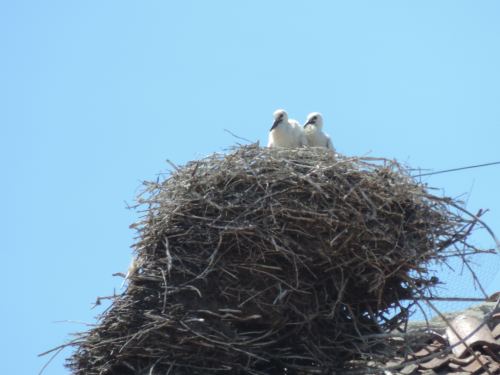
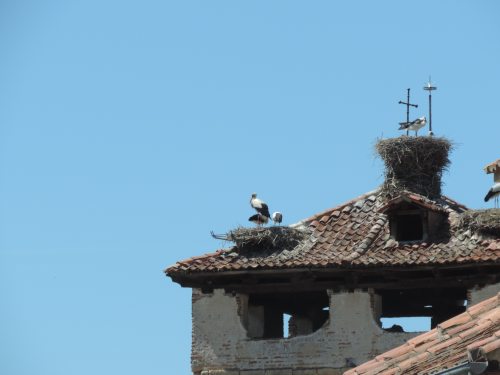
I was in Segovia last week and I noticed quite a few towers had stork nests on them, and the nests had adult storks as well as chicks

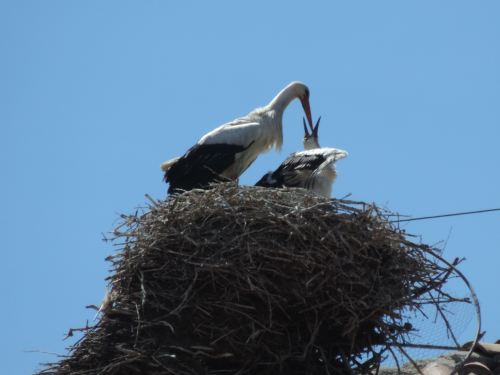
Then as I looked one of the adults (the mother?) brought home some food

Wow! Amazing, huh?

There’s been something rattling around in my head for a while. It’s related to the ideas of the left and right hemisphere ways of engaging with the world, as described by Iain McGilchrist, but also to the ancient traditions of yin and yang, of the divine masculine and the divine feminine, of the Emperor and the Empress in the Tarot Majors, of alchemical and spiritual practices of bringing together two halves to make a whole…..and to my thoughts about two fundamental forces of the universe.

Here’s what’s been cropping up – (NB this is thinking about the psyche not about gender…..whilst our societies might ascribe clearly different tasks and roles to men and women I believe for each of us to be whole we need to integrate the male and female within us all – the anima and animus if you wish (I know that’s not quite the same) )

There are two pairs of behaviours, functions, activities which we ALL need to access….not just farm out one pair to someone of the opposite sex while keeping the first pair for ourselves!

The two pairs are –

Provide and Protect

and

Nourish and Nurture

I think we all need all of these behaviours in the adults around us or we won’t grow into healthy adults ourselves. And when I look at these storks in Segovia I see the incredible, huge structures of the nests, built to provide a home and shelter, built up high to protect from predators. And I see this adult feeding the chick directly – providing nourishment and nurture both at the same time (food and loving attention)

Maybe each of us specialise in, or concentrate on, one of these pairs – we are the providers and protectors OR we are the nourishers and nurturers – but I feel it’s becoming clearer to me that all of us need to develop both of these pairs….that with only one, we are not whole.

Read Full Post »

I was in Saint Jean de Luz last week and the colours of the lichens and mosses on this old bridge caught my eye. Then I noticed the ruler and I wondered if the river had ever reached the “59”, or even higher? And if it had, that would have been written down somewhere and compared to the water levels in previous months and years. Maybe “59” was a record. Maybe it’s only ever reached “49” or even less. Whatever the numbers, people would have their stories to tell. There would be stories of “the great flood”, of rooms, shops, maybe even whole houses submerged under the water. Stories of desperation, of fear, of rescue, of heroism and of hope. Then the waters would have receded again, down to a lower number, and once cleaned up and dried out, the townspeople would “return to normal”. (Whatever a phrase like that can ever mean!)

For me, the beauty in this image lies in the stones, the green and orange life growing on the surface, in the shape of the arch (with most of it left implied), and the dark river running beneath. But it’s the ruler that I return to and I wonder how we choose what to measure and what those measurements mean to us.

In health care we carry out lots of measurements. There is even a movement of people dedicated to recording figures for many of their daily bodily functions. “The Quantified Life”. Does that appeal to you? Can we adequately capture the experience of being healthy with a data set?

All these measurements, these figures, that data…..it gives us the sense of “having a handle on” something….even “having the measure of something”. And we use the numbers to rank experiences and events. The warmest day, the highest river level, the least rainfall. Is that how we remember our past? Is that how we tell our individual stories to others? Recounting the records, telling the numbers, reading out the data? Or by sharing the stories of our experiences?

Thing is, for me, there’s so much more in a life of qualities, than quantities. So much more to tell of beauty, of love, of wonder and amazement. So much to make sense of, to try to understand the meaning of, the purpose of. So much to experience, moment by moment, without a ruler in sight.

But you know, when I return to this image I see again that I have both. The qualities and the means to record the quantities. And isn’t that how to live a full life? To use both halves of the brain? The side which measures, and the side which experiences? The side which concentrates on the parts, and the side which pays attention to the “between-ness”, the connections, the whole?

Read Full Post »

There’s a climbing plant making its way along the fence and when I stopped to look more closely I was amazed to see the structures it creates to get a grip of the ironwork. There are many tight, strong, spring-like spirals of bright green like this. Mostly the cross a space diagonally, not straight up, or straight down. That surprised me. I was taught that a straight line was the shortest distance between two points. It seems that plants aren’t that interested in shortest distances, and don’t do straight lines.

I read somewhere, long, long ago, that there are no straight lines in Nature. If you see straight lines, you can be pretty sure that humans have had a hand in their creation.

Life doesn’t go in straight lines either does it? I sets off along unpredictable paths, spiralling as it goes……

Despite our constant seeking out the so-called simple insights of “this causes that”, when it comes to living organisms, it’s always a bit more complex, a bit more nuanced, a lot more unpredictable than that.

And here’s something else – isn’t the shape of this just stunningly beautiful?

I mean, its enough you’d think, to be in awe of just how a plant actually creates a structure like this (from sunlight, air and water) and uses what it creates to anchor itself, to get a hold on its environment. I mean, how on earth does it do that? But, that aside, just look at it! Isn’t it gorgeous?

Read Full Post »

When I saw this fountain inside a stone arch in the Place Colbert in Rochefort I liked it immediately.

I’m often drawn towards something, feeling almost compelled to photograph it. If I pass up on such a feeling I instantly regret it. Sometimes I have to stop, go back, and just take the photograph because it’s bothering me that I didn’t. I had that experience here. First time I saw it I paused, gazed for a few moments, then moved on. But I stopped, turned around and went back, taking my time to get exactly the shot I wanted to get. I knew I wanted to capture the fountain but I didn’t want the fountain without the stone arch which surrounded it. I was also very conscious of what I could see “through” the frame of the arch. The Mairie at the back is an impressive building. In fact, even in the smallest towns in France, the Mairie is often the most impressive building. I’ve never seen one that looks neglected. The French flags flying help you to know what country you are in, and the blue sky is what I’ve become used to living here. I like the reflection of the building in the pond of water on the far side of the fountain, and the pigeon sitting waiting to take a drink. I like the tree in the right hand corner of the square and how someone has parked their car right underneath it. That’s so common here. I’ve learned that one already. When parking your car, try to find the space under one of the trees. It’ll stop the sun turning your car into an oven! I love the shape and sparkle of the fountain itself, and the choppy surface of the foreground water contrasting with the still, reflective surface behind. I like the colour of the stone, the worn edges and weathered surface.

I can only describe these things now as I look at the photograph. At the time, the scene just “caught my eye” and I framed the image and captured it without being aware of any analytical thought.

When I look at it again now, it seems to me that this work of art, this fountain inside an arch, is symbolic of the two most fundamental forces in the universe – structure and flow.

What forms would exist without the integrated play of these two forces? The structuring force which builds through repetitions, creating crystals, stones and bones. And the flowing force which surges through all that is, constantly changing, never still, producing life itself.

These two forces lie in the heart of all the diversity, the uniqueness and the beauty of all that exists.

That delights me.

Read Full Post »

I come across something new every day.

You do too.

Some of those new things are so startling they make us stop and look more carefully.

Often when I stop and look more carefully I’m filled with wonder, awe and amazement……and loads of questions!

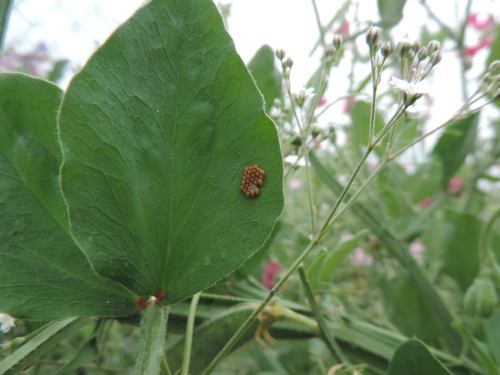
I mean, look at this photo here! What, oh, what, is that??!!

It’s a small collection of eggs on a leaf. But look at the arrangement. Have you ever seen anything like this before? What kind of creature laid its eggs in this tightly fitting symmetrical pattern? A geometry bug? An insect with OCD?

And look again, a little more closely time, because on of the eggs is out of place. It’s either failed, or it’s hatched already leaving just the casing to become a bit unstuck. So the pattern doesn’t look as “perfect” as we might like. There are quite different cultural responses to something like that. Some people find complete symmetry the most pleasing. Others would look at something like this and see the one egg which has “broken” the pattern and see that as “natural”, as “alive”, even as a symbol of transience, of change, and of “becoming not being”. And it will look all the more beautiful for that.

How do you feel when you look at this?

What thoughts, memories, emotions or imaginings does it spark?

Read Full Post »

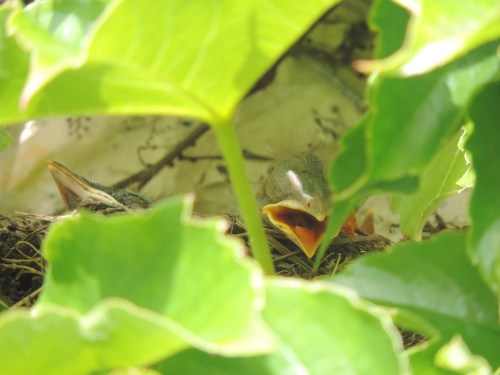
I’ve been watching a pair of blackbirds dash in and out of the ivy for some time now and this morning I thought I heard that tiny squeak of new life so had a peek (from a distance). There they are! Two little blackbird chicks!

This wasn’t an easy photo to take. I used full zoom so I could remain as far away from them as possible and the bright sun behind my back was making the LCD viewfinder pretty hard to see. Also, have you ever tried finding something using the zoom function on a camera? You’d be surprised how hard it can be to train the lens exactly on what you can see with your naked eye. Once I uploaded the images to my Mac I saw this. Wow!

Look at the one on the right, eyes closed, mouth wide open, tuft of little white feathers on its head. And how green this little BLACKbird is!

How do you feel when you look at this image?

There’s something here delights us, thrills us, makes us feel good, isn’t there?

Can we carry that feeling forward as a core value?

To delight in, and to welcome, LIFE, here on this little planet Earth.

Read Full Post »

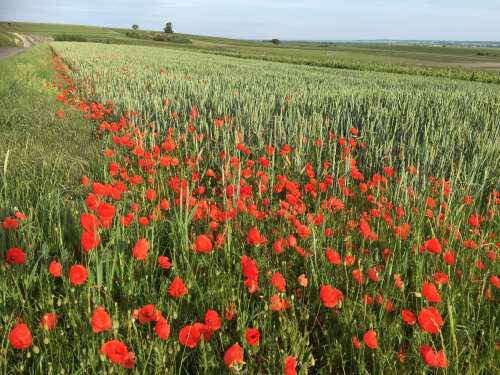
I drove out of the village, as I have done countless times, and I noticed a bloom of poppies in a field of wheat.

I’ve noticed these poppies each day for several days, and I remember noticing them at this time last year too.

But this time, I pulled over onto the grassy verge and stepped out to have a better look. I looked at one or two of them up close. I crouched down and looked at them against the wheat, then against the sky. I stood up and gazed over the whole extended scene. Then I took some photos.

When we travel along familiar roads and paths, both physical paths from one place to another, and mental paths, or habits of thought, we slip easily into automatic mode. Automatic mode makes it easy to get from one place to another, or to complete a task with a minimum of effort, but it by-passes reality.

When we stop, hit the pause button, take a moment to turn our attention to what’s here and what’s now, then we immerse ourselves in reality.

That attentive focus slows the heart, calms the body and stills the mind as we allow the five senses to present us with the world around us. For a little moment the flood of memories and imaginings, the stuck loops of thought, the anxious repetitions of what-ifs, ebb away, to be replaced with colour, light, sound, and sensations of smell, touch or taste.

I find that when I do this, the world becomes a more and more wonderful place, filled to overflowing with beauty, novelty and presence.

I recommend it.

Read Full Post »

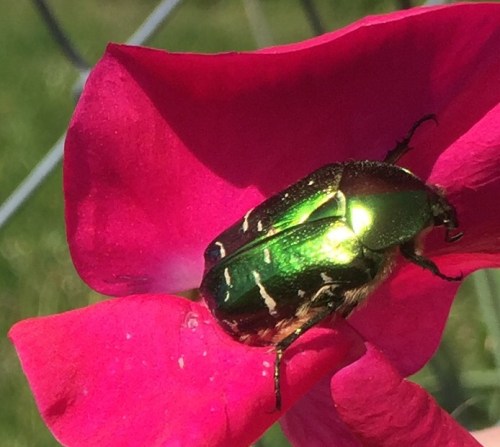
Spotting this little creature on the petals of this flower hooked me. I stopped, looked closely, drawn by the beauty of the sunlit metallic green colour, particularly against the red petals.

I was more than drawn to it. I was engrossed by it. It caught my attention and for a few moments I revelled in it.

I savoured the moments.

Then, of course, because this is what I do, I took a photograph.

This is one kind of attention.

It’s the kind of attention of the senses. It might be visual, as it was in this case. It might be a sound, like a bird song, or the chirping of a cricket. It might be a scent, like the honeysuckle bush I passed on my walk, or might be the taste of the fresh, juicy gariguette strawberries in the market, or the feeling of the cool morning grass on the soles of my bare feet.

There’s something that happens to the heart with this kind of attention….it slows down. And as it slows down, the “parasympathetic nervous system” becomes active (actually it’s not as linear as that. The world isn’t as cause and effect as we think), and the whole body relaxes, the pupils in the eyes dilate and softly focus. There’s a feeling of peace, joy, delight, ease.

It’s wonderful.

There’s another kind of attention which is the type associated with mental effort. The kind we need when we work with mathematics and logic. In that second kind of attention quite the opposite occurs in the body. The heart speeds up, adrenaline quickens the body, sharpens the mind, produces a very narrow, focused concentration.

We need both these kinds of attention, but sometimes, I think, we rely too much on the mental effort type, and not enough on the kind that melts us into the rest of the universe.

Read Full Post »

Many years ago I discovered the writings of a French philosopher called Gilles Deleuze. I found some of his writing really hard to understand but several of his basic ideas and concepts completely changed the way I saw the world. That “becoming not being” phrase at the head of my blog is one of them. That shift from seeing the world as a collection of separate objects to seeing that everything is connected and always changing was a radical shift for me.

One of the other concepts was exploring the difference between trees and grass….what he termed “arboreal” vs “rhizomal” thinking.

You know the basic shape of the tree….a single stem or trunk which bifurcates again and again producing more and more branches and twigs as it grows upwards, and more and more roots and rootlets (is there such a word?) as it grows down into the soil, the one a kind of mirror image of the other.

This tree like form is everywhere. It’s the shape of our circulatory system as arteries branch out into smaller arteries which branch out into capillaries. It’s the shape of our lungs as the trachea bifurcates into bronchi which bifurcate into smaller bronchi, bronchioles (there is such a word!) and ultimately into alveoli.

We use it as a way of ordering and organising what we see in the world. It’s the most fundamental way of categorising and classifying the world. Everything is ultimately connected back to the single trunk or stem….the same original root, but everything exists in a separate category way out along the furthest branches, each ultimately distinct from, and separate from, everything else.

Grass is a rhizome. It doesn’t grow in this branching way from a single root. You can’t find the original stem or root of the grass. It’s like it has multiple points of origin, and each blade is connected to roots which then connect to other roots in a vast web or network. This rhizome structure is everywhere too. Because there is nothing which isn’t connected. The connections are multiple, diverse and ever increasing.

Two things became clear to me when I compared these two phenomena.

One was that the tree like view was produced by a sequence of “or” choices – at each division we say this is either this or that. The rhizome view is produced from a sequence of “and” choices. We don’t say “I’ll use either Facebook or Twitter”, we’ll use them both and connect them to each other. That’s what I do when I started to blog. I created my blog on WordPress but automatically connected every post to a tweet and a Facebook post. That way I could write once and share on several different platforms, for different audiences.

The other thing, which came after I read “The Master and His Emissary” was discovering how well adapted our left hemisphere is to the “arboreal” view of the world, and our right is adapted to the “rhizomal” one. We use the left to discriminate, categorise and classify. We use the right to see the whole by focusing on the relationships and connections.

How amazing that we have evolved this incredible brain with its ability to engage with the world in both tree-like, and grass-like, ways simultaneously.

Read Full Post »

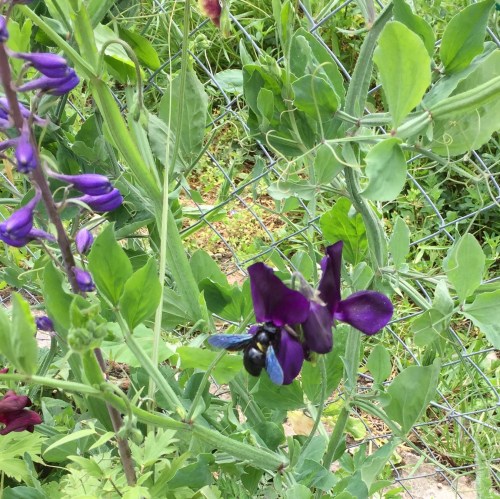
Look at this! I mean, just look at this! I know, it’s not one of my best, my sharpest photographs, but I was in the garden the other day and I heard this deep low buzzing sound. It wasn’t as deep as the humming-bird moths which will arrive when the buddleia bushes bloom later in the year, but it was a lot deeper than the various species of bees and wasps I usually hear in the garden. Luckily, when I turned to the sound I saw the source. This inch long jet black bee with iridescent blue wings. I quickly got my iPhone out of my pocket and did my best to snap a shot before the bee flew away. I have never seen anything quite like this. There were two or three of them buzzing around the flowers but they just never settled long enough to be able to focus a camera and take a nice close up (not yet anyway – I haven’t given up!).

I looked it up online and it seems this is a “violet carpenter bee”. Never heard of such a creature. What a thrill! What a delight! Made my day!

There’s an important lesson to learn here. I’m sure you’ll have come across “mindfulness”. It’s quite the thing these days. Mostly the term is used in relation to certain meditation practices and they are good ones. It seems that mindfulness meditation can have a lot of benefits, from easing depression and anxiety, to stimulating “neuroplasticity” (that’s the phenomenon of how the brain changes and develops itself). But even before the meditation practices were popularised Ellen Langer researched mindfulness in everyday life. She claims we can either go through life mindfully or mindlessly. Seems a clear choice, huh? How do we lead a more mindful life? Search for the new.

By new, she means what’s new to you. The trick, you see, is that every day is new. You have never lived this day before. Nobody has ever had, or ever will have, the same experience as you are going to have today. Once you are aware of that you can set out to be aware of what’s new.

Iain McGilchrist points out in “The Master and His Emissary” that our left cerebral hemisphere has a preference for what is familiar, whilst the right hemisphere thrives on curiosity – it leads us to seek out what’s new. His larger thesis is that we have become very left brain dominant in our present society and that some deliberate change of focus to the right brain might bring about a much more healthy, more integrated level of brain function.

I recently read a book by French author, Belinda Cannone, “S’émervieller”, which explores many of the ways we can bring a heightened sense of wonder and awe into our everyday lives. Bottom line is the same as Langer and McGilchrist say – seek out what’s new. And that’s exactly the experience I had the other day when this violet carpenter bee turned up amongst the garden flowers. Cannone gives various different examples of the places, times and activities which seem most likely to stimulate “l’émerveillement” (“amazement”) and the strongest one is “Nature”.

The thing is the natural world, especially the world of living forms, is constantly changing. Pretty much any time we spend in natural environments will be likely to gift us the delights of something new.

Let me just clarify what I mean by “new” in this piece. I mean it’s anything you haven’t seen before, heard before, smelled before, touched or tasted before. It’s also the newness of the present moment. You have never ever lived this present moment before, so what do you notice? Right here, right now. It’s also the encounter with anything you don’t know or don’t understand. These are the experiences which stimulate our curiosity and our drive to learn. They are the every day experiences of adventure and discovery.

From the Japanese art of forest bathing, to Richard Louv’s claim that we are suffering from “Nature-deficit disorder” which can be treated with a good dose of “Vitamin N” (Nature), to l’émerveillement, to mindfulness and neuroscience, it’s clear that one of the best ways to develop a healthier brain is to spend some time in Nature – whether that’s a forest, a beach, a park, or a garden. I recommend it.

You’ll be amazed.

Read Full Post »
« Newer Posts - Older Posts »