Feeds:
Posts
Comments

Archive for the ‘life’ Category

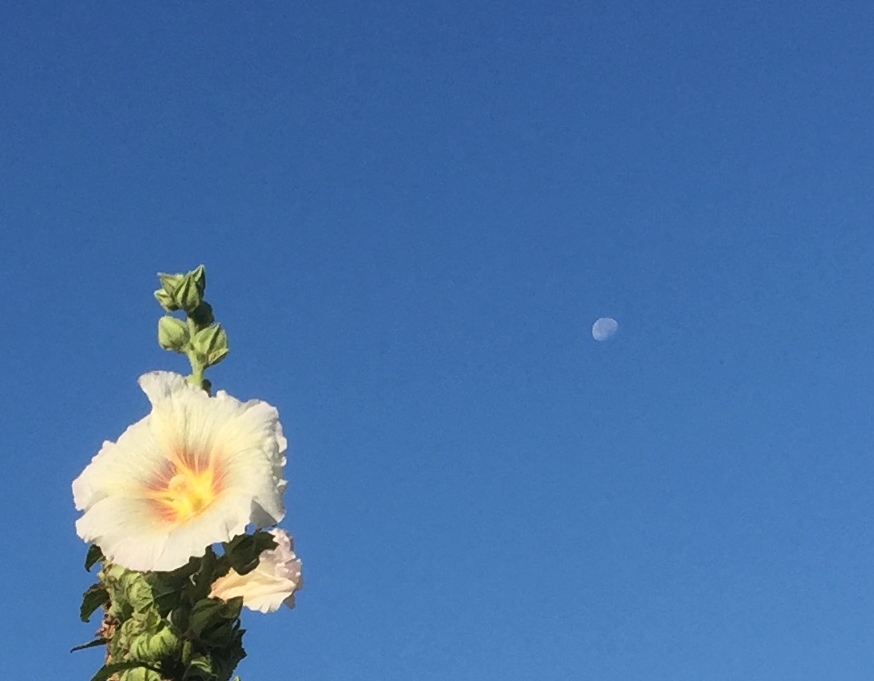
IMG_3131

I only recently stumbled across the work of Michel Conche, the French philosopher.

He says this about Nature – that Nature is like an artist. Nature is a poet, continuously improvising and creating.

I like that.

In one of his works where he writes about the Tao Te Ching, he says

The Tao Te Ching allows the artist and the philosopher to live according to Nature, to place their confidence in the flow of things, to be led by inspiration, unlike the man of action who attempts to master Nature and the course of things through calculation.

The reference to “the flow of things” particularly resonates with me. As does living a life “led by inspiration”. But the phrase “unlike the man of action who attempts to master Nature and the course of things through calculation” really struck me. It immediately made me think of the definition of the scientific method which I saw a student on the train learning years ago – “Observation, Description, Explanation, Prediction, Control”. And it reminded me of the left hemisphere approach to the world which is described so clearly in Iain McGilchrist’s “The Emperor and His Emissary” – how we use that half of our cerebral cortex to analyse, measure, categorise and “grasp” things.

Conche uses this language of the “man of action” vs the “artist”, not to suggest that artists don’t “do” anything, but reflecting the thinking of the Tao Te Ching and concepts such as “wu wei

Because he is about to create, he finds himself on the margins of society and fixed forms. If he consents to a paid profession, it is only to earn what is necessary for life and work. Literally, the artist “works without acting” (wei wu wei: Chinese for “non-action”), because, contrary to the entrepreneur who sets an objective for himself and then uses means to obtain it, the artist cannot know in advance what the work will be. He advances step by step, innovating where necessary, incapable of rationalizing his steps.

We’ve lost touch with so much of that “artistic” way, haven’t we? With our emphasis on outcomes, goals and targets.

The man of action is the opposite of the artist, because he wants to know in advance all things concerning his actions, in order to move forward in complete safety. He wants, as much as possible, to avoid risk, which is precisely what the artist cannot avoid. To master Nature and the course of things by calculation is the dream of the man of action; nothing pleases him more than the progress of science and technology. The artist places his confidence in the flow of things, allowing himself to be led by inspiration.

Ha! There’s that thing about fear again! As Elizabeth Gilbert said in her “Big Magic” –

…when I refer to “creative living”….I’m talking about a life that is driven more strongly by curiosity than by fear.

So if we understand Nature as an artist, “led by inspiration”, “driven more strongly by curiosity than by fear”, “continuously improvising”, placing “confidence in the flow of things” – how does that feel?

Doesn’t it feel very different from the view of Nature as a mechanism, measurable, and controllable?

I like this idea of Nature as an artist – becoming not being!
Read Full Post »

IMG_3411

It’s almost the 100th anniversary of the birth of Roland Barthes and I’m seeing more and more articles about him here in France. Here’s one quote which struck me the other day –

Vitality in old age does not lie in proving that one can continue to carry on doing what one has always done but precisely in making a break – a rupture, a commencement, a vita nova.

More and more of us are living longer and longer. So how are you going to spend your extra years if you get them? Working at the same job for longer? For many that might be a necessity. For a few years anyway, but for another twenty or more?

It’s almost a year since I stopped clinical practice, sold my house and moved to France.

I was born and raised in Scotland and worked there as a doctor for just under forty years. There’s no doubt I feel deeply connected to all of that past. But I’d had a long term plan to live part of my life differently.

So here I am learning a second language and living in a different culture. That’s what I planned and I do think that broadens and deepens my experience of life. I also wanted to live in a different climate but I hadn’t foreseen just how much I’d enjoy being barefoot in a garden every day for weeks on end. Nor how great a pleasure it is to be able to eat most of your meals outside.

The house where I’m living is south facing and surrounded by vineyards as far as I can see. I think it’s that seamless connection between the garden and the open countryside which makes me feel closer to Nature than ever before. I used to look out from my flat in Scotland to the mountains in the distance. It was a beautiful view. But in hindsight it seems that Nature was at a distance there, and now I’m actually living in it.

Picking vegetables which grow in the garden, preparing and eating them is an unexpected delight. There’s a daily covered market nearby too selling local, fresh and seasonal produce. I’d forgotten the pleasure of eating according to the season, but there is something wonderful about eating the first strawberries and figs, then waiting till they come around again next year.

I’m reading more than I’ve ever done. I’ve got more time to think and reflect, and I’ve several writing projects on the go. I’m taking lots of photographs and I’ve begun to reconnect with my piano and my guitar. This feels like a creative time of life.

Who knows what this next year will bring? All I can say is I’m glad I took Roland Barthes’ advice – even though I didn’t know I was doing that at the time!

Read Full Post »

I came across a very short video the other day which both delighted and moved me. It is truly magical. There are no words in it but a little story is told. I think it’s the gestures of the station mistress which make this so incredibly powerful. We have no idea what she is saying to the train driver but her hands and movements are so expressive you can’t help but be entranced by her. Then when the train pulls away, what she does is just…..well, look for yourself……

It was posted onto Facebook by Kyoto Journal (which I like a lot!) Here’s what the film-maker, Erez Sitzer, says about it –

i was searching for a train station. the kind you rarely see. small. countryside. we found it. and by happenchance, found something else. someone else. miyako. the station master. i watched her smile at each exiting passenger. then, noticed her wave at the departing one-car train. then, surprisingly, she continued waving. she waved until there was no trace left of the distant train. no one witnessed her, except, well, me. in that short span, my love and wonder of life was renewed. when i spoke to her later, she said at first she felt so shy. and hardly waved at all. slowly, over time, she began doing something she neither needed to do, nor imagined she ever would. so, this is miyako, master of a tiny station in the middle of nowhere japan who attends to every train and passenger that passes by


Read Full Post »

DSCN4431

You’ll maybe have noticed the by-line at the top of my blog – “becoming not being”. That was a phrase I encountered when reading the works of the French philosopher, Giles Deleuze. I suppose I’m still surprised how little that understanding informs our lives.

From the version of the “scientific method” which dominates our thinking, to the increasingly control driven methods of politics, the economy and society, we seem to privilege a view of the world which is based on what is fixed and “measurable” – data, categories, statistics and metrics.

Yet, that view gives us such a poor representation of reality as we find it in Nature.

Heraclitus, about 2500 years ago, wrote about change. He pointed out that we “cannot step in the same river twice”.

Philo, in the first century BC, said

“In a procession the first ranks get out of sight as they move further. In a torrent the waves stream faster than our capacity to perceive them. Similarly in life, things pass by, move away and although they seem firm, not one of them remains fixed for a single moment. All flee continuously.”

The twentieth century saw the splitting of the atom, and with that, the confirmation that there are no solid, fixed irreducible entities at the base of reality.

Yet it’s only now, in the last years of the twentieth century and the first years of the twenty-first that we are seriously grasping what all of those insights mean.

The controlling ethos of measurements and norms might be everywhere still, but the seeds of change are sprouting.

For me, understanding that we can’t fix, box, contain and pin down reality is liberating.

The constancy of change, of becoming, seems to offer a different way of living – more free, more diverse, more creative.

We really are the co-creators of our universe and our daily lives. I wonder what kind of world we’ll co-create in the years ahead? And although that’s a question no-one can answer, the thrill, for me, is in knowing that I can, and will, contribute to the change.

And so will you.


Read Full Post »

berries

“L’émerveillement du quotidien” is one of my favourite French phrases. It captures an attitude of mind and an approach to life which I think both opens me up to new experiences and enriches my every day.

There’s a sense of wonder in that phrase – of amazement, of delight and of awe. A “wow”!

I’m very taken with the philosophers who emphasise difference – because looking for difference not only helps me to be aware of novelty and transience. All of which together contributes to valuing uniqueness, diversity and dynamic change.

But there is also curiosity here. Elizabeth Gilbert, in her “Big Magic”, emphasises curiosity –

I believe that curiosity is the secret. Curiosity is the truth and the way of creative living……In fact, curiosity only ever asks one simple question: “Is there anything you’re interested in?” Anything? Even a tiny bit? No matter how mundane or small?…..Following that scavenger hunt of curiosity can lead you to amazing, unexpected places….Or it may lead you nowhere. You might spend your whole life following your curiosity and have absolutely nothing to show for it at the end – except one thing. You will have the satisfaction of knowing that you passed your entire existence in devotion to the noble human virtue of inquisitiveness.

And that should be more than enough for anyone to say they that lived a rich and splendid life.

There you have it – it’s not about ends, it’s about means. It’s not about goals, targets or ticking things off the to do list. It’s about following your inquisitiveness.

Because we’ll just never be done with discovering and learning!


Read Full Post »

IMG_3278

In her book, “Big Magic”, Elizabeth Gilbert tells the story of a botanist friend who teaches environmental biology in New York. She begins by asking her students two questions – “Do you love Nature?” (every hand in the class goes up) and “Do you believe that Nature loves you in return?” (every hand goes down).

Sad, that, isn’t it?

The myth of the heartless, uncaring universe has dominated our cultures. Even worse, the myth that “wild nature” actively works against us so needs to be “tamed” and “controlled” feeds the climate of fear which is used to control us.

What choices might we make if we took a different view?

What might our societies become if we both loved Nature and believed that Nature loved us in return? (Of course, I take it for granted that you accept Nature isn’t something separate from us. We are inextricably a part of Nature)

Two recent photos came to mind as I thought about this. The one above, which is lunch one day in my home. Look at the yellow tomatoes, the cheese, the butter, the bread, the salt and pepper and the water. Look at the delicious bowl of “potiron” soup.

Then, how about this photo I took in Regents Park in London last weekend?

IMG_3409

Taken facing the sun (as the photography books tell you not to!) and revealing both the glow of red flowers in the life-giving sunlight and the longing of the purple ones as they reach for the sun.

What do you think?

Do we live in an essentially hostile or uncaring universe? Or are we part of a loving, nurturing and caring one?

Read Full Post »

IMG_3419

Elizabeth Gilbert’s book, “Big Magic”, is about “creative living”. What is that?

…when I refer to “creative living”….I’m talking about a life that is driven more strongly by curiosity than by fear.

Well, I think that really is a key – we are so driven by fear, and fear is used as such a tool to control whole populations these days. To be driven by curiosity rather than fear strikes me as likely to completely alter our view of the world.

Take health care for example. So much health care is generated by fear – fear of dying, fear of getting cancer, fear of getting this disease, or that disease. It creates a whole ethos and it’s sure not a positive one. What if we underpinned our healthcare with curiosity instead? What if we consciously sought out experiences which were nourishing, nurturing, stimulating, life enhancing? Would that lead to healthier lives instead of lives of avoidance?

I do believe a creative life is a richer life. Here’s what Elizabeth Gilbert says –

A creative life is an amplified life. It’s a bigger life, a happier life, an expanded life, and a hell of a lot more interesting life.

That reminded me of a book I read a long time ago – Robert Solomon’s “Joy of Philosophy” – where he juxtaposes a “thin” life with a “passionate” one. His use of the metaphors of thin vs thick throughout that book struck me as original and clear. Who wants a “thin life”?

Elizabeth goes on to explain in a little more depth what she means by “creative living” –

The universe buries strange jewels deep within us all, and then stands back to see if we can find them. The hunt to uncover those jewels – that’s creative living.

Ooh, I love that. What a lovely metaphor! We really do all have unique and wonderful treasures buried within us. In fact, I don’t think it is possible to fully mine the depths of any individual human being, but what jewels lie there waiting to be discovered when we take the time to explore!

The courage to go on that hunt in the first place – that’s what separates a mundane existence from a more enchanted one.

Yep, it might take courage, but what else are you going to do with all that fear that is thrown at you in this world?

And who wants a “mundane existence”?

Read Full Post »

DSCN4494

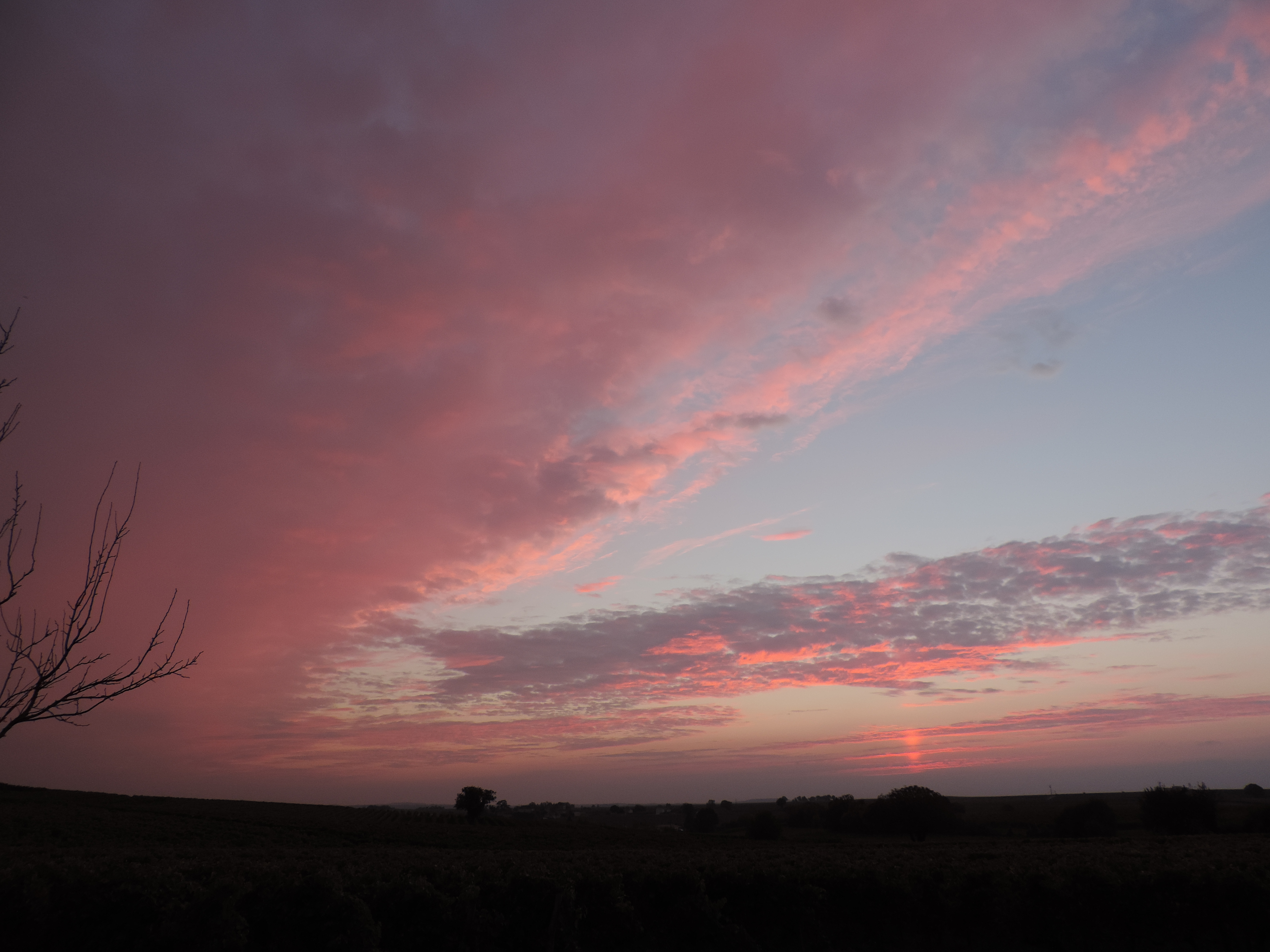
I’m pretty keen on sunsets, and I’ve stood and watched a LOT of them, but the other night, as the sun set, I found myself saying “never seen that before” – again!

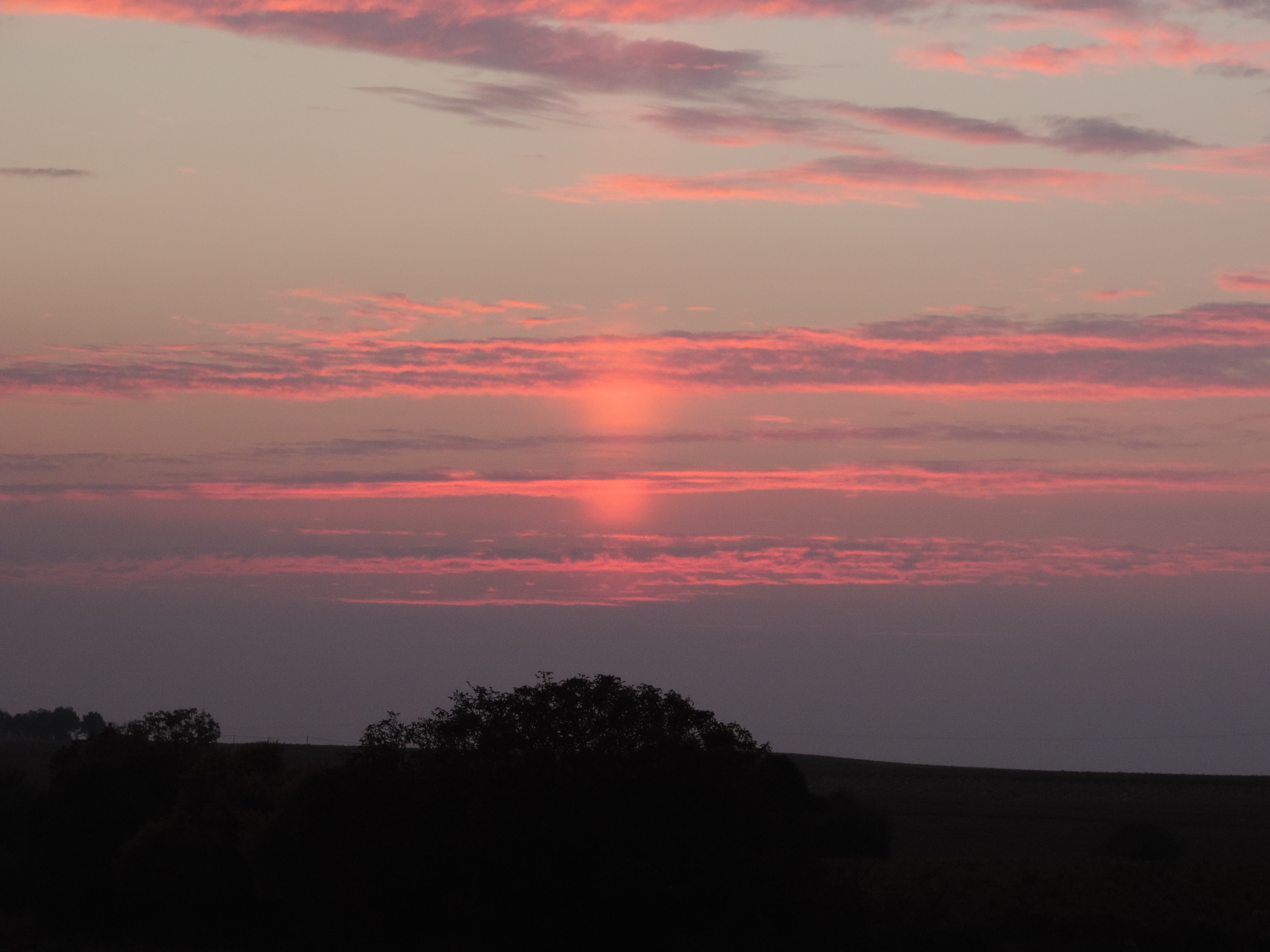
Look at this phenomenon! It’s like there is a small chain of suns setting!

DSCN4491

Or two of them, at least!

Well, as Ellen Langer says, the way to lead a mindful life is to look out for novelty.

Or, as I learned from homeopathic practice – allow yourself to be struck by what’s “strange, rare and peculiar”. The thing is, there’s something “strange, rare and peculiar” every single day, because the nature of the universe is constant change and creativity. There’ll always be something today which is different from yesterday….

Do you think you could ever be done with looking at sunsets? Is there a time when you stop noticing them?

Read Full Post »

IMG_3417

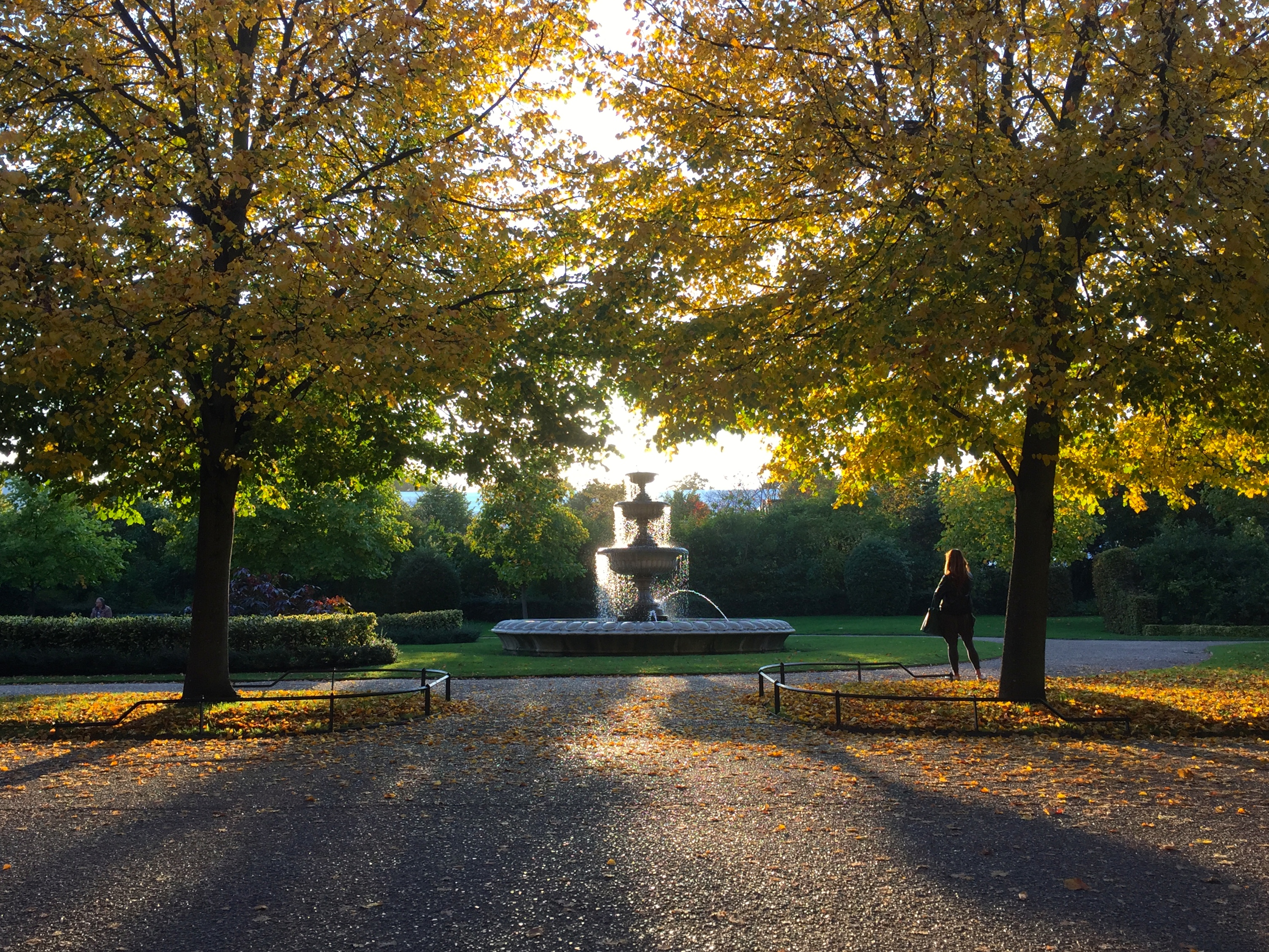
As I walked through Regent’s Park in London the other day, I noticed the power of the beauty of Nature.

Even joggers were stopping in their tracks to look at, or photograph some of the beautiful autumn leaves.

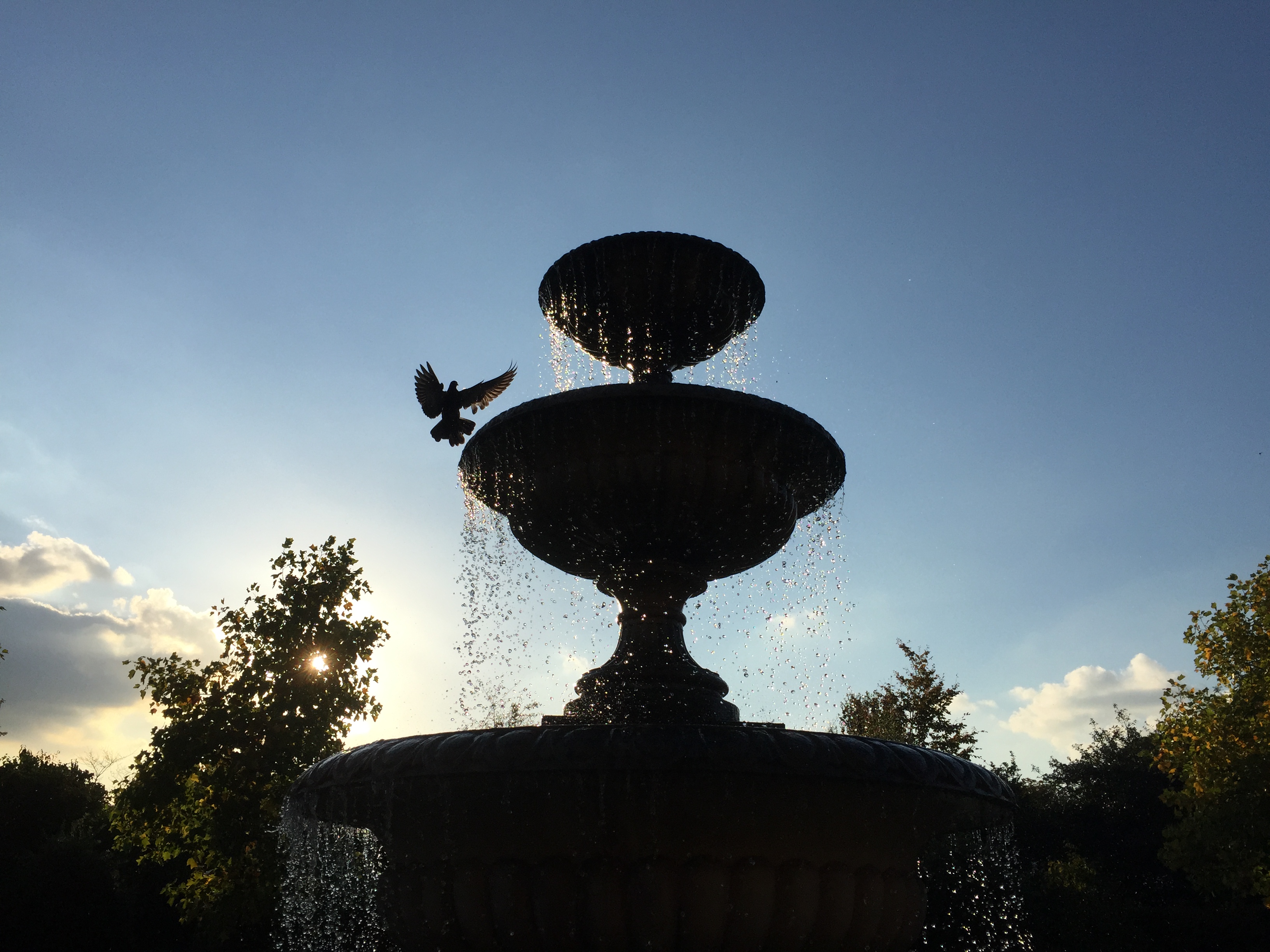
As I sat on a park bench to read a little of a novel, I noticed this woman standing very still, apparently transfixed by the fountain, the sunlight and the leaves. Or maybe she was just lost in her own thoughts? After I’d read a chapter of my book I looked up and she was still there, standing in exactly the same position.

The power of the beauty of Nature to enchant and en-trance…..

Read Full Post »

One of the new experiences I’ve had this summer (my first summer living in the Charente region of France) is with barn owls.

Not long after I moved here, a barn owl flew out from a neighbour’s barn and up onto a light on my house, then quickly flew back home again. I saw the owl a few times, mostly as a blur of white as it flew from somewhere above my front door at night. One time as I was chatting to a friend of mine, the owl came out, flew three times around the mulberry tree, keeping its eyes on us, then flew back to the barn.

Do you know about the noise the barn owls make at night – its a hissing noise, not a hoot. Barn owls don’t hoot. Well for a couple of months in the summer I heard a lot of hissing from the dovecots in our house.
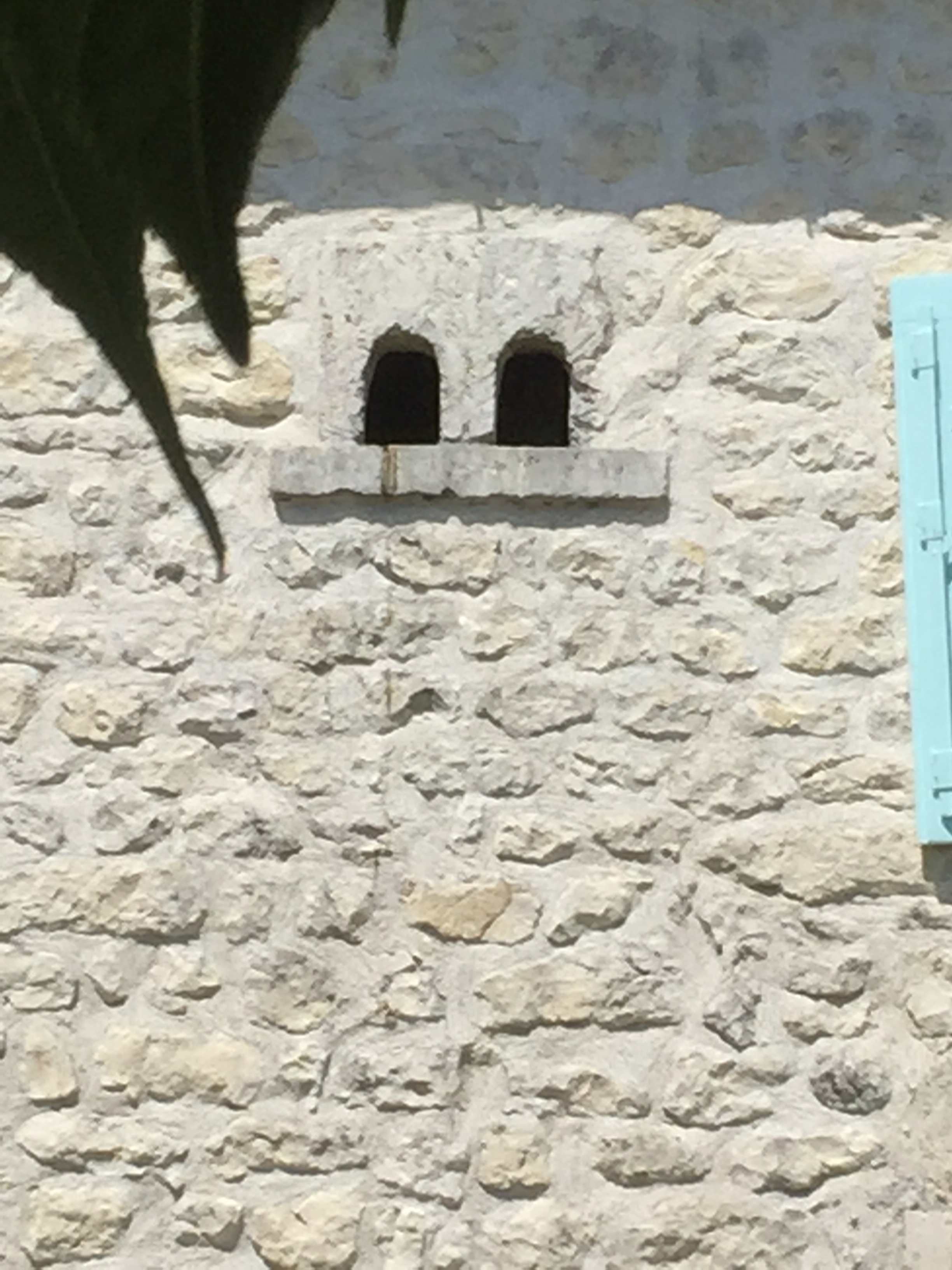
Can you see those two little holes in the wall next to the third from the left upstairs window?
front of house
You can see them better close up
dovecots in wall
Well that’s where the noise was coming from and that’s where the barn owls have a nest.
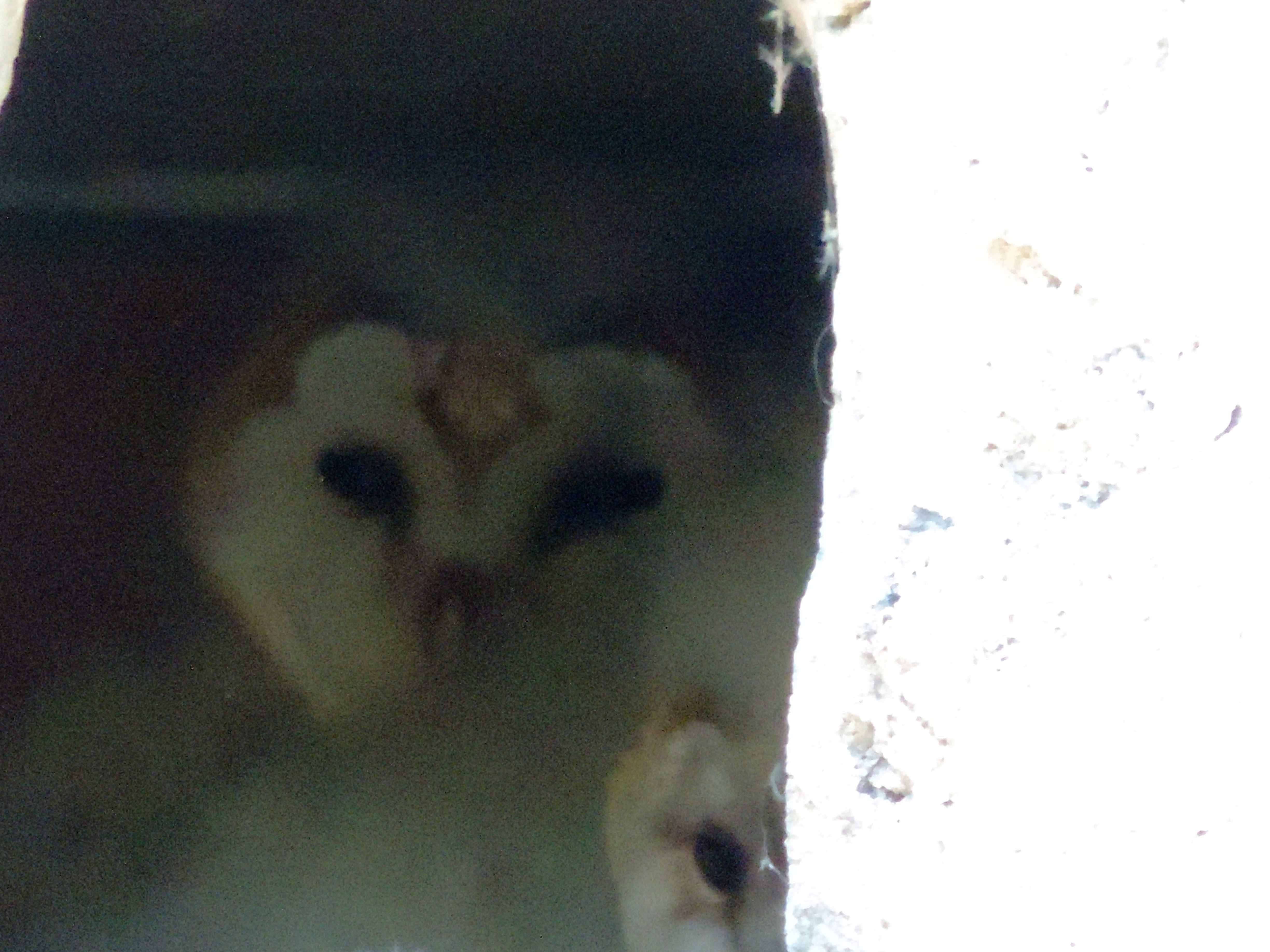
I haven’t managed to see any owls actually fly into or out of the holes but after a few days I stood back in the garden and when I looked really carefully I could see owls. I used my little camera with the zoom lens, set the zoom to max, ratcheted up the ISO setting to the darkest conditions and stood very very patiently for ages until I got some pics of the owlets in the nest –
two owlets in nest
Well that was all very exciting and I sent an email to Marie-Pierre, Hilary’s friend who knows a lot about birds and she said they were definitely barn owls and we should watch out for one getting thrown out because that happened a lot and when it did you should put it back in the nest or up in a tree so it doesn’t get caught by cats or foxes.
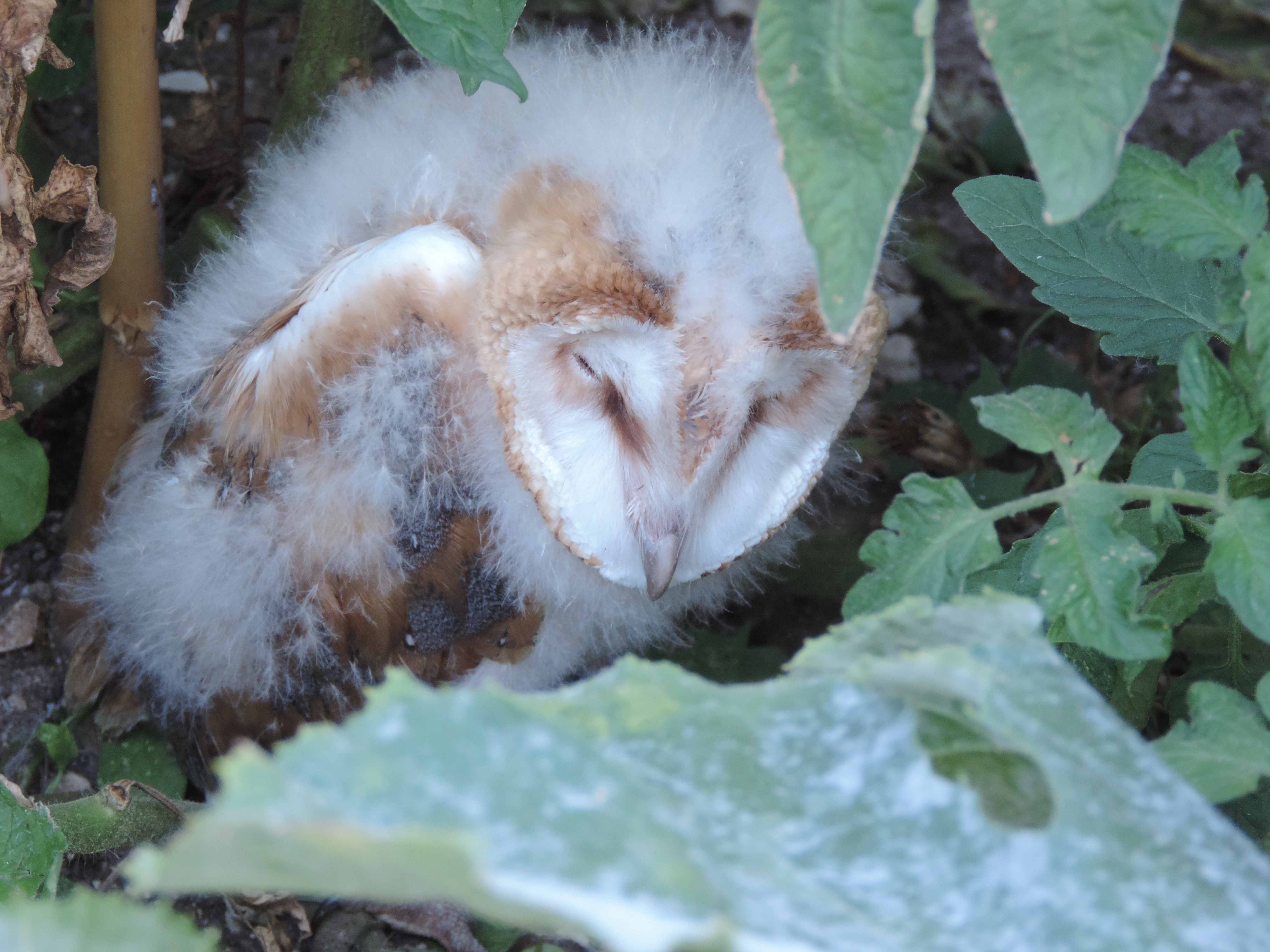
A couple of days later we found an owlet hiding under the tomato plants in the veggie plot –
owlet in veggies
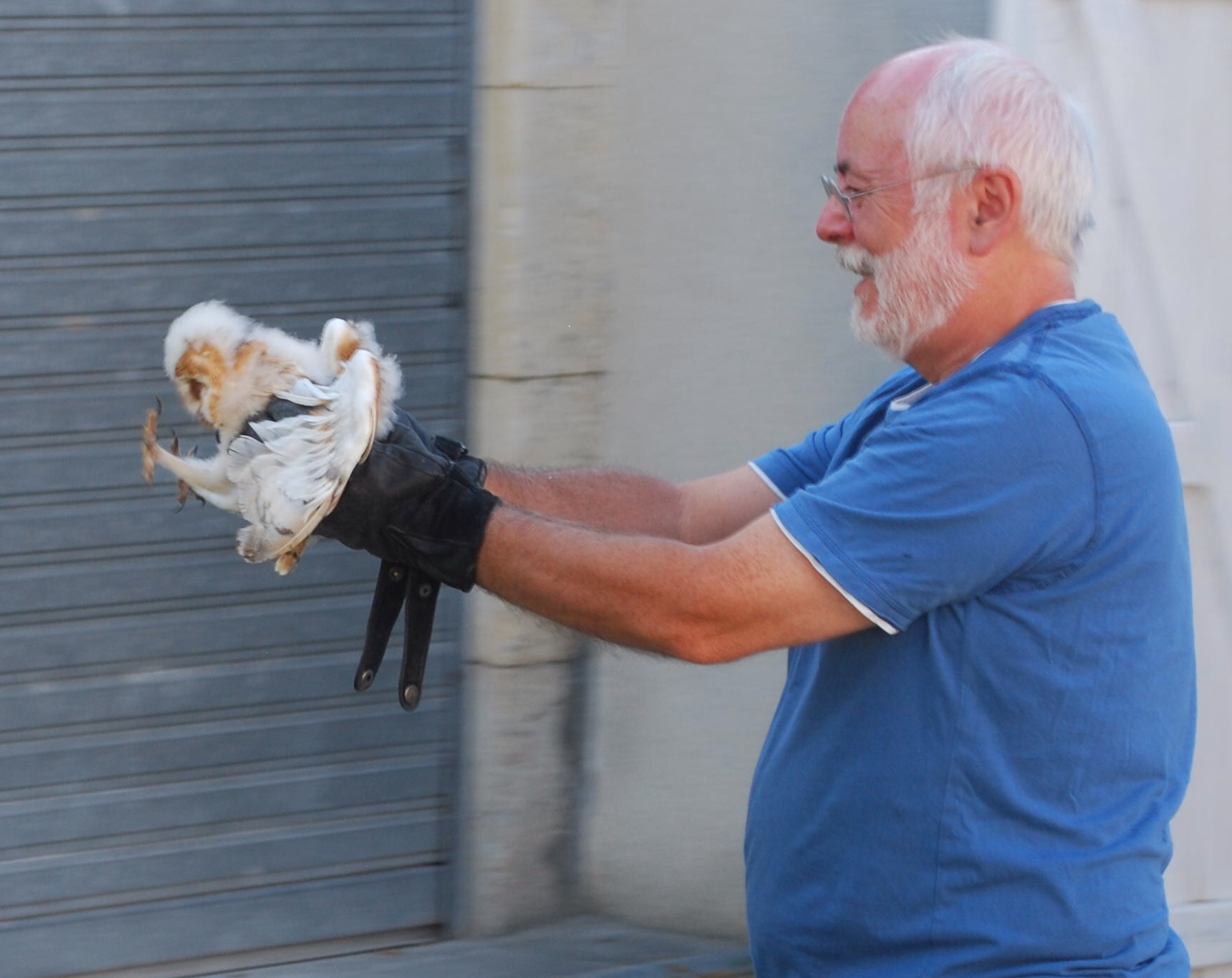
Well the nest is too high for me and I didn’t think I could reach it with a step ladder so I put it in the mulberry tree – there’s a photo of me carrying it!
me carrying owlet
Next day it was gone and no sign of feathers or anything so we reckoned it had either been carried back to the nest or it had flown.
However the following day we found it hiding between a stone trough and the wall of the house – and it didn’t look great. I put it back in the tree and went off to the supermarket to get it some chicken pieces but by the time I came back it was back behind the trough again.
A wee while later (it was pouring rain all that day) it staggered out onto the path and fell over so I picked it up and put it in a shoe box and put that in the shed – it didn’t look like it had long to go and a couple of hours later it was still and had passed away.
I found that very upsetting. Really sad and tearful. But then that’s Nature I guess and I read about barn owls and the young don’t have a lot of luck! Often one gets thrown out the nest then the parents don’t feed it any more and once they learn to fly they are chased off to find their own territory but most don’t make it dying from starvation cos they don’t hunt well enough, or killed by cats, foxes or cars!
Yikes!
The next day, I couldn’t believe it – another baby owl behind the trough! Oh no! So this time I put the step ladders on a plank and took the owlet up the steps with me and pushed him over the ledge into the dovecot.
He, or she, didn’t fall out again!
It’s been a bit of an emotional roller coaster and a big learning for me. I handled the second owl much more easily than the first and looks like I might have made a better decision with it. However, why do they get thrown out in the first place? Is it because they aren’t right somehow and the mother is protecting the others with limited food supplies?
Who knows!?
Well the hissing continued for a few weeks, then at around the time I expected the little ones to fly off, the family decanted across to my neighbour’s barn, but they came back to the garden every night to hunt, play and hiss.
I went to Scotland for a week, and when I came back the garden was silent again at night. I guess the young ones have “dispersed” – off to find their own territories and take their chances in life.
I felt a bit sad that they’d gone, but it’s good that they have. It’s the natural flow of Life.
I wonder if the adults will come and nest here again next year. Well, if they do, then I’m a bit more experienced, and I’ve bought a taller ladder, so I’m ready for any wee ones which tumble out into the garden.

Read Full Post »

« Newer Posts - Older Posts »